Integrated landscape approaches
cifor.org/colands
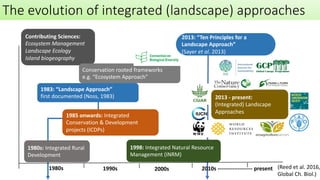
1980s 1990s 2000s 2010s ------------------- present
1980s: Integrated Rural
Development
1998: Integrated Natural Resource
Management (INRM)
1985 onwards: Integrated
Conservation & Development
projects (ICDPs)
Contributing Sciences:
Ecosystem Management
Landscape Ecology
Island biogeography
Conservation rooted frameworks
e.g. “Ecosystem Approach”
1983: “Landscape Approach”
first documented (Noss, 1983) 2013 - present:
(Integrated) Landscape
Approaches
2013: “Ten Principles for a
Landscape Approach”
(Sayer et al. 2013)
The evolution of integrated (landscape) approaches
(Reed et al. 2016,
Global Ch. Biol.)
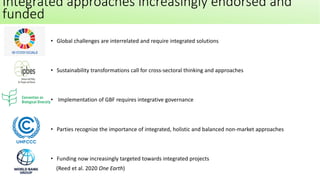
• Global challenges are interrelated and require integrated solutions
• Sustainability transformations call for cross-sectoral thinking and approaches
• Implementation of GBF requires integrative governance
• Parties recognize the importance of integrated, holistic and balanced non-market approaches
• Funding now increasingly targeted towards integrated projects
(Reed et al. 2020 One Earth)
Integrated approaches increasingly endorsed and
funded
Integrated
landscape
approaches
might aim to
Inspire transformational
change
Enhance resilience
Improve governance
Conserve biodiversity
Restore ecosystems
Mitigate climate change
Alleviate poverty
Why so popular?
• conceptual ambiguity leaves the approach open to
interpretation and in the realm of subjectivity and uncertainty
• greatly enhances the potential for the concept to be abused,
mis-assimilated, or co-opted
• implies a lack of basic norms and rules to follow with potential
for conceptually weak and poorly designed implementation
efforts
Despite enthusiasm, ILA definition or conceptual
framework is lacking
Latin America &
Caribbean (n 38)
Southern Africa (n 13)
South Asia (n 16)
East Asia & Pacific (n 33)
West Africa (n 16)
East Africa (n 41)
Multi-region (n 9)
Evidence of implementation
Reed et al. 2017 Land Use Policy
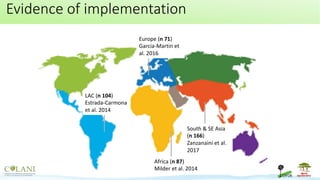
Africa (n 87)
Milder et al. 2014
South & SE Asia
(n 166)
Zanzanaini et al.
2017
LAC (n 104)
Estrada-Carmona
et al. 2014
Europe (n 71)
Garcia-Martin et
al. 2016
Evidence of implementation
Evidence of effectiveness?
“We show that despite considerable enthusiasm for
landscape approaches, the evidence base within the
scientific literature remains poorly developed”.
Peer
reviewed
articles
Grey
literature
(web
screening)
Grey
literature
(document
screening)
Totals
Case studies 24 97 53 174
Countries 16 52 42 61
Success 13 46 20 79
Reliable data 6 8 1 15
But integration does underscore performance
(Carmenta et al. 2020)
(Carmenta et al. 2022)
And application of ILA principles can lead to
transformational change
“Effective implementation using the landscape
approach could lead to a forest transition….
improving farmers’ livelihoods”
(Acheampong et al. 2020)
“……. application of the landscape approach principles
…… increased resident capacity, conflict resolution,
definition and clarity on mandates, roles and
responsibilities, higher landscape connectivity and
opportunities for policy influence”
(Omoding et al. 2020)
What hinders implementation?
Interaction problems
• Lack of communication, collaboration,
coordination
• Lack of agreement due to differing
visions
• Power relations
Participation problems
• Absence of stakeholder groups
• Varying levels of engagement
• Lack of capacity, skills
Resource problems
• Limited financial resources
• Lack of/inaccessible data
Institutional problems
• Incompatible national
policies
• Misaligned institutional
structures
Vermunt et al. 2020 Current Landscape
Ecology Reports
Barriers to implementation
• an incomplete characterisation of integrated landscape
approaches
• poor incorporation of gender-related dimensions
• an uncritical acceptance of the potential and value of integrative
approaches
• a lack of attention to deeply embedded socio-political issues
and historical legacies
• a poor understanding of cross-scale dynamics,
interdependencies among levels of governance, and inherent
power structures
What hinders implementation (and effectiveness)?
Thank you
This project is working with CIFOR, the Global Landscapes Forum (GLF) and other partners to
conduct innovative research related to landscapes, including forestry and other productive
processes; as well as the essential work of engaging multiple stakeholders
cifor.org/colands

Integrated landscape approaches

  • 1.
  • 2.
    1980s 1990s 2000s2010s ------------------- present 1980s: Integrated Rural Development 1998: Integrated Natural Resource Management (INRM) 1985 onwards: Integrated Conservation & Development projects (ICDPs) Contributing Sciences: Ecosystem Management Landscape Ecology Island biogeography Conservation rooted frameworks e.g. “Ecosystem Approach” 1983: “Landscape Approach” first documented (Noss, 1983) 2013 - present: (Integrated) Landscape Approaches 2013: “Ten Principles for a Landscape Approach” (Sayer et al. 2013) The evolution of integrated (landscape) approaches (Reed et al. 2016, Global Ch. Biol.)
  • 3.
    • Global challengesare interrelated and require integrated solutions • Sustainability transformations call for cross-sectoral thinking and approaches • Implementation of GBF requires integrative governance • Parties recognize the importance of integrated, holistic and balanced non-market approaches • Funding now increasingly targeted towards integrated projects (Reed et al. 2020 One Earth) Integrated approaches increasingly endorsed and funded
  • 4.
    Integrated landscape approaches might aim to Inspiretransformational change Enhance resilience Improve governance Conserve biodiversity Restore ecosystems Mitigate climate change Alleviate poverty Why so popular?
  • 5.
    • conceptual ambiguityleaves the approach open to interpretation and in the realm of subjectivity and uncertainty • greatly enhances the potential for the concept to be abused, mis-assimilated, or co-opted • implies a lack of basic norms and rules to follow with potential for conceptually weak and poorly designed implementation efforts Despite enthusiasm, ILA definition or conceptual framework is lacking
  • 6.
    Latin America & Caribbean(n 38) Southern Africa (n 13) South Asia (n 16) East Asia & Pacific (n 33) West Africa (n 16) East Africa (n 41) Multi-region (n 9) Evidence of implementation Reed et al. 2017 Land Use Policy
  • 7.
    Africa (n 87) Milderet al. 2014 South & SE Asia (n 166) Zanzanaini et al. 2017 LAC (n 104) Estrada-Carmona et al. 2014 Europe (n 71) Garcia-Martin et al. 2016 Evidence of implementation
  • 8.
    Evidence of effectiveness? “Weshow that despite considerable enthusiasm for landscape approaches, the evidence base within the scientific literature remains poorly developed”. Peer reviewed articles Grey literature (web screening) Grey literature (document screening) Totals Case studies 24 97 53 174 Countries 16 52 42 61 Success 13 46 20 79 Reliable data 6 8 1 15
  • 9.
    But integration doesunderscore performance (Carmenta et al. 2020) (Carmenta et al. 2022)
  • 10.
    And application ofILA principles can lead to transformational change “Effective implementation using the landscape approach could lead to a forest transition…. improving farmers’ livelihoods” (Acheampong et al. 2020) “……. application of the landscape approach principles …… increased resident capacity, conflict resolution, definition and clarity on mandates, roles and responsibilities, higher landscape connectivity and opportunities for policy influence” (Omoding et al. 2020)
  • 11.
    What hinders implementation? Interactionproblems • Lack of communication, collaboration, coordination • Lack of agreement due to differing visions • Power relations Participation problems • Absence of stakeholder groups • Varying levels of engagement • Lack of capacity, skills Resource problems • Limited financial resources • Lack of/inaccessible data Institutional problems • Incompatible national policies • Misaligned institutional structures Vermunt et al. 2020 Current Landscape Ecology Reports Barriers to implementation
  • 12.
    • an incompletecharacterisation of integrated landscape approaches • poor incorporation of gender-related dimensions • an uncritical acceptance of the potential and value of integrative approaches • a lack of attention to deeply embedded socio-political issues and historical legacies • a poor understanding of cross-scale dynamics, interdependencies among levels of governance, and inherent power structures What hinders implementation (and effectiveness)?
  • 13.
    Thank you This projectis working with CIFOR, the Global Landscapes Forum (GLF) and other partners to conduct innovative research related to landscapes, including forestry and other productive processes; as well as the essential work of engaging multiple stakeholders cifor.org/colands