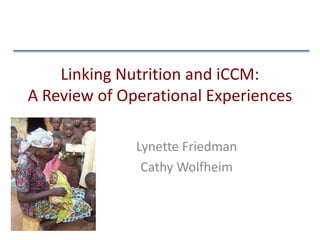
Linking Nutrition and iCCM:
A Review of Operational Experiences
Lynette Friedman
Cathy Wolfheim
Objective of the review
Map out and describe
operational experiences and
supporting evidence in
linking nutrition and iCCM
to
--Identify emerging lessons
--Identify questions needing
investigation
Methodology
• Desk review (120 + documents)
• Key informant interviews (22)
• In-depth analysis of selected country experiences:
– South Bangladesh
– Ethiopia
– Niger
– South Sudan
Focused on: Context, interventions implemented,
costs, and evidence of coverage and performance
Experiences grouped into four
typologies
• Non-mutually exclusive
• Useful to examine experiences; the way
forward may be through a combination of
typologies or the addition of new approaches
Experiences grouped into four
typologies
• # 1: Advising on “feeding the sick child”
within existing iCCM services
• # 2: Linkages with Social and Behavior
Change activities on child nutrition
• # 3: Linkages between iCCM activities and
acute malnutrition treatment through
assessment and referral
• # 4: Treatment at community level of
uncomplicated severe acute malnutrition
# 1: Advising on “feeding the sick
child” within existing iCCM services
For ALL children
treated at home,
advise on home care
--Advise caregiver to give more fluids and continue
feeding
--Advise on when to return. Go to nearest health
facility immediately, or if not possible, return to
CHW if child
Cannot drink or feed
Becomes sicker
Has blood in the stool
--Advise caregiver on sleeping under a bed net (ITN)
--Follow up child in 3 days
Supporting evidence identified
• Feeding and fluids advice for sick child included in
most iCCM materials reviewed
• Caregiver and health worker support of nutrition
during and after illness is frequently suboptimal
• In many contexts, recommended feeding practices
are poor, with responsive and active feeding not
being practiced
• Sources:
– 10 country review of national iCCM training materials
– Malawi quality of care study
– South Bangladesh counselling data
Implications of Typology 1
• Simplest of the four models to implement
• Minimal cost
• Coverage only for the sick child visit
• Little data on quality or quantity of feeding-
related counseling
• No data on effect of the advice on health
status of the child
#2: Linkages with Social and Behavior
Change (SBC) activities on child nutrition
Sub categories:
1. iCCM CHW is part of larger
team; different cadre of
volunteers provides health
education
2. Same programme has iCCM
and SBC interventions
3. Health education messages
included in iCCM CHWs
responsibilities
Supporting evidence identified
• Nutrition Weeks in Rwanda were found to be
effective in promoting behavior change for
better children’s diet: Ex. Minimum
Acceptable Diet 55% higher in intervention
area
• Process evaluation in Bangladesh and Viet
Nam found sizable improvements in feeding
practices in Alive & Thrive programme areas
between 2010 and 2013
Implications of Typology 2
• Potential reach/coverage is vast
• Evidence exists for potential effect and impact
• SBC efforts can be resource intensive and
require good formative research and design
• Which cadres carry out SBC and how close does
the link need to be with iCCM?
# 3: Assessment and referral
• Gold standard iCCM: Red
MUAC and bilateral pitting
oedema are danger signs for
immediate referral
• Typology 3 may also include
active screening or active
case detection through
home visits or GMP
activities
Typology 3 Examples
• South Sudan, Malaria Consortium: CDDs trained
to assess and refer
• Rwanda, Concern Worldwide, IRC and World
Relief: Active and passive case finding for MAM
and SAM using MUAC and WFH; referral
• Niger Red Cross: monthly weighing sessions and
active screening with MUAC
• Pakistan LHWs screen during house-to-house
visits and other opportunities
• Global iCCM policy is to screen all sick children
using MUAC and bilateral oedema
Supporting evidence identified
• Potential issues related to correct use of MUAC
• Little hard evidence on:
– How well CHWs provide assessment and referral
– Whether referral advice is followed
– Whether children are admitted and receive adequate
treatment
• Some indication that active case finding increases
coverage of treatment for childhood illness; no
data showing whether the same is true for acute
malnutrition
• Variable policies for yellow MUAC reading
Implications of Typology 3
• Requires a strong programme in place at
health facilities to treat acute malnutrition
• Requires a functioning referral and counter-
referral system
• No data to indicate whether coverage is
increased
# 4: Treatment at community level of
uncomplicated SAM
• Two principal types of implementation
– added onto existing responsibilities of the
iCCM worker (South Bangladesh, Ethiopia
HEW)
– iCCM worker linked to or connected with a
second community-based cadre (Malaria
Consortium S. Sudan)
Supporting evidence identified (1)
• Numbers of children
treated for SAM increased
(South Bangladesh, Niger)
• Quality of SAM treatment
and iCCM remained high (S
Bangladesh, Ethiopia, S
Sudan)
• High cure rate (S
Bangladesh)
Supporting evidence identified (2)
• Workload increased significantly (South
Bangladesh)
• Difficulty classifying SAM (Ethiopia)
• Costs of community treatment of SAM are on
same level as other interventions (South
Bangladesh)
Implications of Typology 4
• Training time: likely to exceed one
week
• Training complexity: requires
judgment
• Quality of care: some indication that
this is not problematic
• Supervision: increasingly complex
Implications of Typology 4
• Policy: Permission for CHWs to use and
dispense additional medications
• Supply: Potentially difficult logistics,
RUTF bulky
• Costs: RUTF most significant line item
• Protocol adaptations: appetite test, RUTF
dosages, admission and discharge criteria
Conclusions (1)
• The profile of the CHW is decisive
• The organization of work and current
responsibilities help determine the best approach
• iCCM is only one delivery platform
• The political context is also decisive
• There is a palpable tension between the
“nutrition” and “health” sectors
• Other sectors and concerns must be taken into
consideration
Conclusions (2)
Context,
Context,
Context.

Integrated Community Case Management_Friedman

  • 1.
    Linking Nutrition andiCCM: A Review of Operational Experiences Lynette Friedman Cathy Wolfheim
  • 2.
    Objective of thereview Map out and describe operational experiences and supporting evidence in linking nutrition and iCCM to --Identify emerging lessons --Identify questions needing investigation
  • 3.
    Methodology • Desk review(120 + documents) • Key informant interviews (22) • In-depth analysis of selected country experiences: – South Bangladesh – Ethiopia – Niger – South Sudan Focused on: Context, interventions implemented, costs, and evidence of coverage and performance
  • 4.
    Experiences grouped intofour typologies • Non-mutually exclusive • Useful to examine experiences; the way forward may be through a combination of typologies or the addition of new approaches
  • 5.
    Experiences grouped intofour typologies • # 1: Advising on “feeding the sick child” within existing iCCM services • # 2: Linkages with Social and Behavior Change activities on child nutrition • # 3: Linkages between iCCM activities and acute malnutrition treatment through assessment and referral • # 4: Treatment at community level of uncomplicated severe acute malnutrition
  • 6.
    # 1: Advisingon “feeding the sick child” within existing iCCM services For ALL children treated at home, advise on home care --Advise caregiver to give more fluids and continue feeding --Advise on when to return. Go to nearest health facility immediately, or if not possible, return to CHW if child Cannot drink or feed Becomes sicker Has blood in the stool --Advise caregiver on sleeping under a bed net (ITN) --Follow up child in 3 days
  • 7.
    Supporting evidence identified •Feeding and fluids advice for sick child included in most iCCM materials reviewed • Caregiver and health worker support of nutrition during and after illness is frequently suboptimal • In many contexts, recommended feeding practices are poor, with responsive and active feeding not being practiced • Sources: – 10 country review of national iCCM training materials – Malawi quality of care study – South Bangladesh counselling data
  • 8.
    Implications of Typology1 • Simplest of the four models to implement • Minimal cost • Coverage only for the sick child visit • Little data on quality or quantity of feeding- related counseling • No data on effect of the advice on health status of the child
  • 9.
    #2: Linkages withSocial and Behavior Change (SBC) activities on child nutrition Sub categories: 1. iCCM CHW is part of larger team; different cadre of volunteers provides health education 2. Same programme has iCCM and SBC interventions 3. Health education messages included in iCCM CHWs responsibilities
  • 10.
    Supporting evidence identified •Nutrition Weeks in Rwanda were found to be effective in promoting behavior change for better children’s diet: Ex. Minimum Acceptable Diet 55% higher in intervention area • Process evaluation in Bangladesh and Viet Nam found sizable improvements in feeding practices in Alive & Thrive programme areas between 2010 and 2013
  • 11.
    Implications of Typology2 • Potential reach/coverage is vast • Evidence exists for potential effect and impact • SBC efforts can be resource intensive and require good formative research and design • Which cadres carry out SBC and how close does the link need to be with iCCM?
  • 12.
    # 3: Assessmentand referral • Gold standard iCCM: Red MUAC and bilateral pitting oedema are danger signs for immediate referral • Typology 3 may also include active screening or active case detection through home visits or GMP activities
  • 13.
    Typology 3 Examples •South Sudan, Malaria Consortium: CDDs trained to assess and refer • Rwanda, Concern Worldwide, IRC and World Relief: Active and passive case finding for MAM and SAM using MUAC and WFH; referral • Niger Red Cross: monthly weighing sessions and active screening with MUAC • Pakistan LHWs screen during house-to-house visits and other opportunities • Global iCCM policy is to screen all sick children using MUAC and bilateral oedema
  • 14.
    Supporting evidence identified •Potential issues related to correct use of MUAC • Little hard evidence on: – How well CHWs provide assessment and referral – Whether referral advice is followed – Whether children are admitted and receive adequate treatment • Some indication that active case finding increases coverage of treatment for childhood illness; no data showing whether the same is true for acute malnutrition • Variable policies for yellow MUAC reading
  • 15.
    Implications of Typology3 • Requires a strong programme in place at health facilities to treat acute malnutrition • Requires a functioning referral and counter- referral system • No data to indicate whether coverage is increased
  • 16.
    # 4: Treatmentat community level of uncomplicated SAM • Two principal types of implementation – added onto existing responsibilities of the iCCM worker (South Bangladesh, Ethiopia HEW) – iCCM worker linked to or connected with a second community-based cadre (Malaria Consortium S. Sudan)
  • 17.
    Supporting evidence identified(1) • Numbers of children treated for SAM increased (South Bangladesh, Niger) • Quality of SAM treatment and iCCM remained high (S Bangladesh, Ethiopia, S Sudan) • High cure rate (S Bangladesh)
  • 18.
    Supporting evidence identified(2) • Workload increased significantly (South Bangladesh) • Difficulty classifying SAM (Ethiopia) • Costs of community treatment of SAM are on same level as other interventions (South Bangladesh)
  • 19.
    Implications of Typology4 • Training time: likely to exceed one week • Training complexity: requires judgment • Quality of care: some indication that this is not problematic • Supervision: increasingly complex
  • 20.
    Implications of Typology4 • Policy: Permission for CHWs to use and dispense additional medications • Supply: Potentially difficult logistics, RUTF bulky • Costs: RUTF most significant line item • Protocol adaptations: appetite test, RUTF dosages, admission and discharge criteria
  • 21.
    Conclusions (1) • Theprofile of the CHW is decisive • The organization of work and current responsibilities help determine the best approach • iCCM is only one delivery platform • The political context is also decisive • There is a palpable tension between the “nutrition” and “health” sectors • Other sectors and concerns must be taken into consideration
  • 22.