Section 6.3: Inverse Substitutions
Section 6.5: Improper Integrals
1
Week 5 Learning Objectives
— Evaluate integrals involving square roots of quadratic
expressions using:
— Appropriate trigonometric substitutions
— Completion of the square
— Decide if a given definite integral is improper.
— Evaluating improper integrals by finding the suitable
limit(s).
— Use p-test to decide whether an improper integral is
convergent or divergent
— Use the comparison test to decide whether an improper
integral is convergent or divergent.
2
Example: Evaluate
ò -
2
/
1
3
/
1
2
2
1
1
dx
x
x
Can’t be solved using
the techniques seen earlier
Goal: Get rid of the radical
3
Recall: 1 − sin& ' = cos& '
Example Continued
4
Trick:
Let ! = sin &, for −
,
-
≤ & ≤
,
-
Thus:
This is called the inverse
substitution which can be
made provided &ℎ0& sin & is
a one-to-one function.
Therefore, we have to restrict t
to the interval −
,
-
,
,
-
t
t
t
t
x cos
cos
cos
sin
1
1 2
2
2
=
=
=
-
=
-
Since cos & is positive
on −
,
-
,
,
-
Example Continued
— Thus the integral reduces to
!
"
#
"
$
1
&$ 1 − &$
(& =
Since & = sin - ,
(& = cos - (-
= !
123456
"
#
7
8
csc$ & (& = 9
− cot &
123456
"
#
7
8
= − cot
;
6
+ cot(arcsin 1/3)
5
When & = 1/3, then 1/3 = sin -,
That is for what angle t, sine is 1/3?
Take arcsine of both sides to get:
arcsin 1/3 = arcsin(sin -) which yields:
When & =
"
$
then
7
8
= sin -,
arcsin 1/2 = arcsin(sin -) which
yields:
!
123456
"
#
7
8
1
sin$ - cos -
cos - (-
6
Example
7
Example
Example: Evaluate
Trick: Let ! = 2tan ', )*+ − /2 < ' < p/2.
Thus:
dx
x
ò + 2
4
1
4 + !2 = 4 + 4 tan2 ' = 2| sec '| = 2 sec '
8
1 + tan2 8 = sec2 8
The reference Triangle
This substitution can be realized as follows:
tan $ =
&
2
And
sec $ =
4 + &-
2
So, ∫
/
0123
4& = ∫
- 5673 8
- 567 8
4$ = ln | sec $ + tan $| + ;
Since x = 2 tan $
4& = 2 sec- $4$
Note: The reference triangle becomes very useful in back-substituting
Back-substituting: ∫
/
0123
4& = ln
0123
-
+
2
-
+ ;.
9
10
Examples
11
Example: Evaluate
Trick: Let 2" = sec ', )*+ 0 < ' < p/2.
Thus:
ò -
2
1
2
1
4
1
dx
x
t
t
t
t
x tan
tan
tan
1
sec
1
4 2
2
2
=
=
=
-
=
-
12
sec/ ' − 1 = tan/ '
Example Continued
When % = 1, then 2 1 = sec -, so - =
/
3
When % = 2, then 2 2 = sec -, so - = arcsec 4 13
-
2x
1
4%4 − 1
6
7
4
1
4%4 − 1
8% =
1
2
6
9
:
;<=>?= @
1
tan -
sec - tan - 8-
= A
1
2
ln | sec - + tan - |
9
:
;<=>?= @
=
1
2
ln 4 + 15 − ln 2 + 3
Summary of Trig Substitutions:
14
Your Turn: Evaluate
Trick: First complete the square, and use x - 2 = tan t.
ò +
-
3
1
2
5
4
1
dx
x
x
1
)
2
(
1
4
4
5
4 2
2
2
+
-
=
+
+
-
=
+
- x
x
x
x
x
15
Solution:
!
"
#
1
%& − 4% + 5
+% = ln 2 + 1 − ln 2 − 1
16
Example
17
Improper Integrals
Example 1:
Is the area bounded above by the curve: 2
1
x
y =
below by the x-axis, and to the left by ! = 1, finite?
Let A(t) denote the area of the region bounded
by % = 1/!' below the x-axis and between x =1 and x=t
Then, ( ) =
∫
+
, +
-. /! = 0
−
+
- +
,
= 1 −
+
,
18
dx
x
dx
x
b
b ò
ò ¥
®
¥
=
1
2
1
2
1
lim
1
If we consider different values of t, we observe that as t gets larger
larger, the area gets closer and closer to 1.
Therefore, the area of the shaded region as t tends to
infinity is given by
19
Type I Improper Integral
20
Example 2:
21
!
"
#
1
%
&% = lim
+→#
!
"
+
1
%
&% = lim
+→#
-
ln %
"
+
= lim
+→#
(ln 0 − ln 1) = ∞
Determine whether following improper integral
is divergent or convergent:
Therefore, The improper integral
is divergent.
Example 3:
Evaluate:
dx
x
ò
¥
¥
-
+1
1
2
What does this integral represent?
22
The area of the infinite region
under the curve of
y=
"
#$%"
and above the / − 1/23.
23
How to compute this area?
∫
"#
# $
%&'$
() = ∫
"#
* $
%&'$
() + ∫
*
# $
%&'$
()
∫
"#
* $
%&'$
= lim
0→"#
∫
0
* $
%&'$
()
lim
0→"#
2
arctan )
0
*
=
lim
0→"#
(arctan 0 − arctan ;) =
=
>
.
lim
0→#
@
*
0
1
)> + 1
()
= lim
0→#
2
arctan )
*
0
= lim
0→#
(arctan ; − BCD;BE0) =
F
2
Therefore, ∫
"#
# $
%&'$
() =
=
>
+
=
>
= F
24
Your Turn!
— Determine whether following improper integral is divergent or
convergent:
!
"#
$
%&'(%
25
Hint: use integration by parts to evaluate the integral
Solution: ∫
"#
$
%&'(% = −1. The improper integral is convergent.
!
"#
$
%&'(% = lim
>→"#
!
>
$
%&' (%
@ = % (A = &'(%
(@ = (%. A = &'
! %&'(% = %&' − ∫ &'(%
= lim
>→"#
B
(%&' − &')
>
$
= lim
>→"#
(−1 − E&> + &>) Note: lim
>→"#
E&> = lim
>→"#
E/&">= lim
>→"#
1/e"H=0
Example 4
— For what values of p is the the integral ∫
"
# "
$% &'
convergent?
26
We have seen already for the case where p=1, the improper integral is divergent.
So, let us assume that ( ≠ 1. Then,
,
"
#
1
'- &' = lim
2→#
,
"
2
'4-&' = lim
2→#
5
'4-6"
−( + 1
"
2
= lim
2→#
1
1 − (
1
9-4" − 1
Power Rule
for integration By the FTC (II)
— If ! > #, then $ − 1 > 0, so as ( → ∞, (+,-
→ ∞ and
-
./01 → 0. Therefore,
3
-
4
1
5+
65 = lim
.→4
1
1 − $
1
(+,-
− 1 =
1
1 − $
−1 =
1
$ − 1
.
So the improper integral is convergent for ! > #.
— If ! < #, then $ − 1 < 0, so as ( → ∞,
-
./01 = (-,+
→ ∞,
so the the improper integral is divergent.
27
To Summarize
— The improper integral p-test:
For ! > 0,
28
∫
%
& '
() *+ is convergent if , > 1 and divergent if , ≤ 1.
Note: You can use the p-test for integrals of the above form.
However, you must specify the value of p.
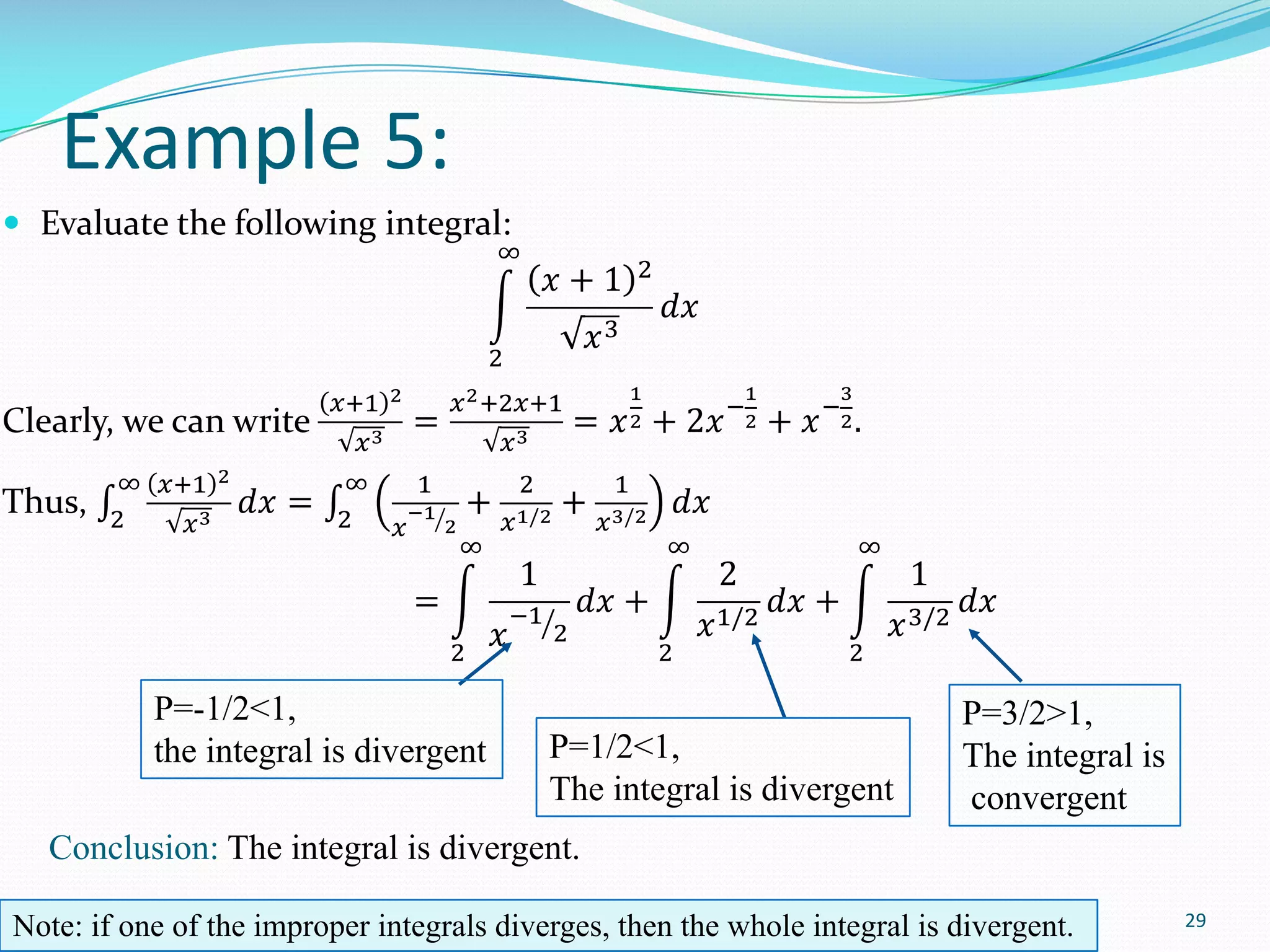
Example 5:
— Evaluate the following integral:
!
"
#
$ + 1 "
$'
($
Clearly, we can write
)*+ ,
)-
=
),*")*+
)-
= $
/
, + 2$1
/
, + $1
-
,.
Thus, ∫
"
# )*+ ,
)-
($ = ∫
"
# +
) 4
5/
,
+
"
)//, +
+
)-/, ($
= !
"
#
1
$ 4
1+
"
($ + !
"
#
2
$+/"
($ + !
"
#
1
$'/"
($
29
P=-1/2<1,
the integral is divergent P=1/2<1,
The integral is divergent
P=3/2>1,
The integral is
convergent
Conclusion: The integral is divergent.
Note: if one of the improper integrals diverges, then the whole integral is divergent.
Example 6:
— Find the area in the 4th quadrant bounded between
the x-axis, the y-axis, and the curve y = ln x.
That is, we need to evaluate the following integral:
!
"
#
| ln '| ('
PROBLEM! At ' = 0, , = ln ' has a vertical asymptote!
This takes us to Type II Improper integrals.
30
Type II Improper Integrals
31
Back to Example 5:
32
!
"
#
|ln '| (' = lim
,→".
− !
,
#
ln ' ('
Integrating by parts, we let
0 = ln ' (1 = ('
(0 =
#
2
(' 1 = '
Thus,
lim
,→".
− ∫
,
#
ln ' (' = lim
,→".
|
−['56 ' ,
# − ∫
,
#
'
#
2
(']
lim
,→".
∫
,
#
ln ' (' = lim
,→".
|
−['56 ' − '] ,
#
= lim
,→".
−(1 ln 1 − 1 − : ln : + :) = lim
,→".
− (: − : ln : − 1)
Recall: lim
,→".
: ln : = “0 ? ∞” (An indeterminate form). To evaluate this limit, rewrite
lim
,→".
: ln : = lim
,→".
BC ,
#/,
= lim
,→".
#/,
E#/,F = lim
,→".
−: = 0.
H
Since ln ' < 0 on the interval (0,1]
— Thus,
!
"
#
− ln ' (' = lim
,→".
−(0 − 0 ln 0 − 1) = 0 − 0 − 1 = 1.
Therefore, the area in the 4th quadrant bounded between
the x-axis, the y-axis, and the curve y = ln x is 1.
33
Note: We can also say that the improper integral ∫
"
#
| ln '| (' is convergent.
Example 6
— Determine whether ∫
"
#
$ sec ( )( converges or diverges.
— We know that sec x is improper at x =
*
+
, thus,
,
"
*
+
sec ( )( = lim
1→
*
+
3 ,
"
1
sec ( )(
= lim
1→
#
$
3 ln 5
sec ( + tan ( "
9
= lim
1→
#
$
3 ln sec t + tan t − ln sec 0 + tan 0 = ∞
34
Recall: lim
1→
#
$
3 sec = = ∞
and
lim
1→
*
+
3tan t = ∞
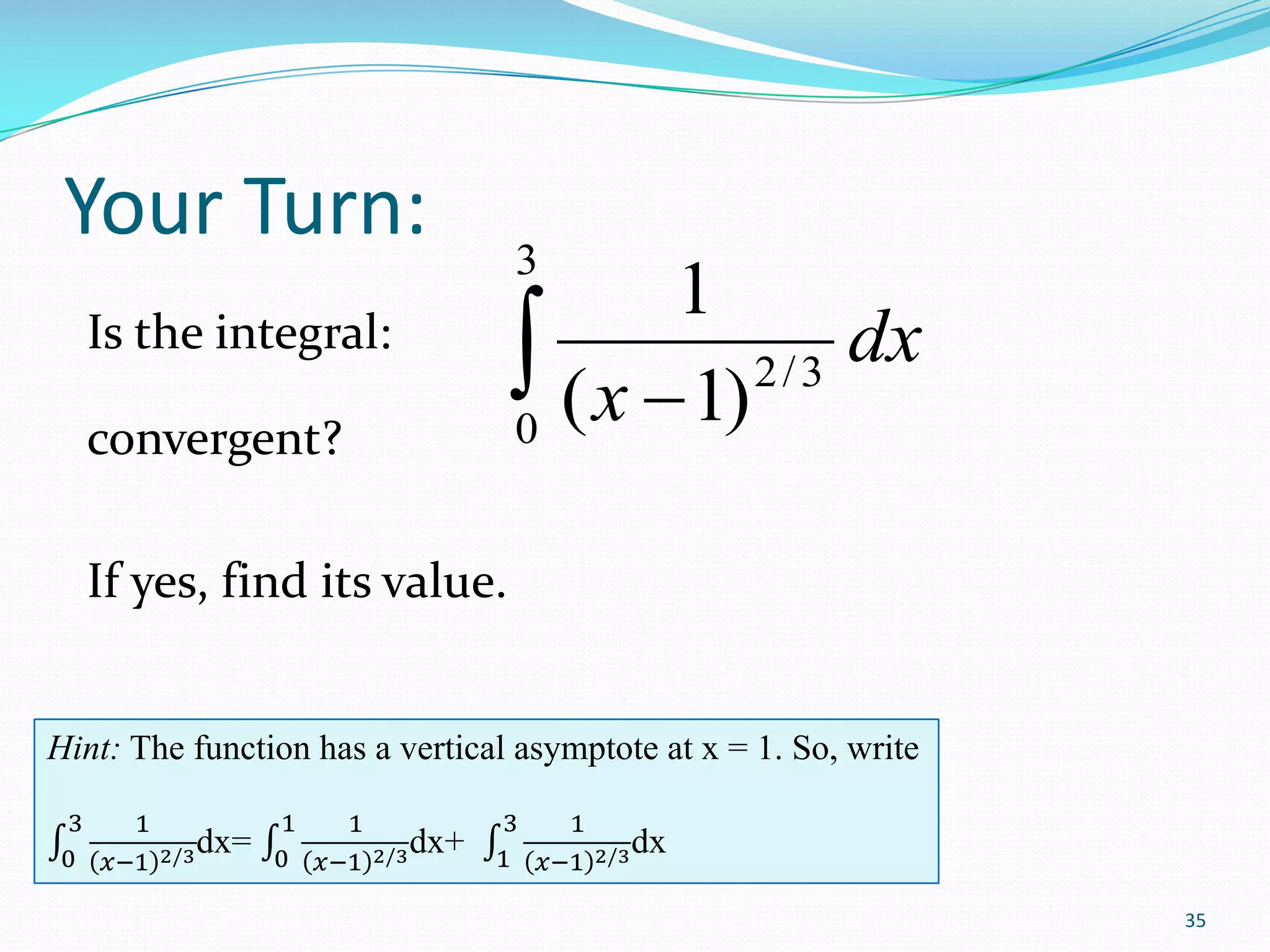
Is the integral: dx
x
ò -
3
0
3
/
2
)
1
(
1
convergent?
If yes, find its value.
Your Turn:
Hint: The function has a vertical asymptote at x = 1. So, write
∫
"
# $
%&$ '/)dx= ∫
"
$ $
%&$ '/)dx+ ∫
$
# $
%&$ '/)dx
35
Partial Solution:
36
A Comparison Test for Improper
Integral
— When we are presented with an improper integral, one of
the main questions we need to answer is whether the
integral is convergent or divergent. Consequently, we have a
test to determine the convergence or divergence of an
improper integral.
37
Note: The comparison test is very useful when the improper integral is
impossible to evaluate.
A similar theorem applies for
Type II improper integrals. (See example 9)
Example 7
— Show that ∫
"
#
$%&'
() is convergent.
— Clearly, we cannot evaluate this integral directly.
Therefore, trying to compare it to an integral that is
easily evaluated is the best approach to answering this
question.
— ∫
"
#
$%&'
()= ∫
"
*
$%&'
()+ ∫
*
#
$%&'
()
— ∫
"
*
$%&'
() = Number (it is a definite integral)
— To evaluate ∫
*
#
$%&'
(), we observe that )2
≥ ) for all
) ≥ 1. Therefore, −)2 ≤ ) and thus $%&'
≤ $%&.
38
Example Continued
— The integral of !"#
is easy to evaluate:
— ∫
%
&
!"#
'( = lim
-→&
∫
%
-
!"#
'( = lim
-→&
|
−!"#
%
-
— = lim
-→&
|
−!"#
%
-
= lim
-→&
−!"-
+ !"%
= !"%
.
— Since !"#3
≤ !"#
then ∫
%
&
!"#3
'( is convergent, thus
— ∫
5
&
!"#3
'( is also convergent by the comparison test.
39
Convergent
Example 8
— Determine whether the following integral is divergent or
convergent:
!
"
#
1 + &'(
)
*)
— We observe that 1 + &'(
> 1, that is
",-./
(
>
"
(
when ) ≥ 1.
— In addition, we know that ∫
"
# "
(
*) is divergent by the p-test,
as 7 = 1.
— Thus, by the comparison test ∫
"
# ",-./
(
*) is divergent.
40
Example 9
— Determine whether ∫
"
# $
%&%'
() is convergent or
divergent.
— Notice that this is an improper integral of type I
(upper limit is infinity) and type II (
$
%&%'
has a
vertical asymptote at ) = 0).
— Thus, we need to split up the integral:
∫
"
$ $
%&%'
() + ∫
$
# $
%&%'
() = -$ + -.
— Since ) + )/
> ), on 0,1 , then ) + )/ > ), thus,
1
) + )/
<
1
) 41
— Therefore, !" < ∫
%
" "
&
'( = 2
— On 1, ∞ , we observe that ( + (9 > (9, so
( + (9 > (9, that is
1
( + (9
<
1
(9
— Therefore, !< < ∫
"
= "
&
>
?
'(
— Since !" and !< both converge,
Then, ∫
%
= "
>
'( is convergent. 42
Since
"
&@&>
< 1/ (, then by the
Comparison Test, !" is convergent
as ∫
%
"
1/ ( '( is convergent.
Since
"
&@&>
< 1/ (9, then by the
Comparison Test, !< is convergent
as ∫
"
= "
&>/? '( is convergent, F =
9
<
> 1.

Lecture 6 Inverse Substitutions - MAT 1052.pdf

  • 1.
    Section 6.3: InverseSubstitutions Section 6.5: Improper Integrals 1
  • 2.
    Week 5 LearningObjectives — Evaluate integrals involving square roots of quadratic expressions using: — Appropriate trigonometric substitutions — Completion of the square — Decide if a given definite integral is improper. — Evaluating improper integrals by finding the suitable limit(s). — Use p-test to decide whether an improper integral is convergent or divergent — Use the comparison test to decide whether an improper integral is convergent or divergent. 2
  • 3.
    Example: Evaluate ò - 2 / 1 3 / 1 2 2 1 1 dx x x Can’tbe solved using the techniques seen earlier Goal: Get rid of the radical 3 Recall: 1 − sin& ' = cos& '
  • 4.
    Example Continued 4 Trick: Let != sin &, for − , - ≤ & ≤ , - Thus: This is called the inverse substitution which can be made provided &ℎ0& sin & is a one-to-one function. Therefore, we have to restrict t to the interval − , - , , - t t t t x cos cos cos sin 1 1 2 2 2 = = = - = - Since cos & is positive on − , - , , -
  • 5.
    Example Continued — Thusthe integral reduces to ! " # " $ 1 &$ 1 − &$ (& = Since & = sin - , (& = cos - (- = ! 123456 " # 7 8 csc$ & (& = 9 − cot & 123456 " # 7 8 = − cot ; 6 + cot(arcsin 1/3) 5 When & = 1/3, then 1/3 = sin -, That is for what angle t, sine is 1/3? Take arcsine of both sides to get: arcsin 1/3 = arcsin(sin -) which yields: When & = " $ then 7 8 = sin -, arcsin 1/2 = arcsin(sin -) which yields: ! 123456 " # 7 8 1 sin$ - cos - cos - (-
  • 6.
  • 7.
  • 8.
    Example: Evaluate Trick: Let! = 2tan ', )*+ − /2 < ' < p/2. Thus: dx x ò + 2 4 1 4 + !2 = 4 + 4 tan2 ' = 2| sec '| = 2 sec ' 8 1 + tan2 8 = sec2 8
  • 9.
    The reference Triangle Thissubstitution can be realized as follows: tan $ = & 2 And sec $ = 4 + &- 2 So, ∫ / 0123 4& = ∫ - 5673 8 - 567 8 4$ = ln | sec $ + tan $| + ; Since x = 2 tan $ 4& = 2 sec- $4$ Note: The reference triangle becomes very useful in back-substituting Back-substituting: ∫ / 0123 4& = ln 0123 - + 2 - + ;. 9
  • 10.
  • 11.
  • 12.
    Example: Evaluate Trick: Let2" = sec ', )*+ 0 < ' < p/2. Thus: ò - 2 1 2 1 4 1 dx x t t t t x tan tan tan 1 sec 1 4 2 2 2 = = = - = - 12 sec/ ' − 1 = tan/ '
  • 13.
    Example Continued When %= 1, then 2 1 = sec -, so - = / 3 When % = 2, then 2 2 = sec -, so - = arcsec 4 13 - 2x 1 4%4 − 1 6 7 4 1 4%4 − 1 8% = 1 2 6 9 : ;<=>?= @ 1 tan - sec - tan - 8- = A 1 2 ln | sec - + tan - | 9 : ;<=>?= @ = 1 2 ln 4 + 15 − ln 2 + 3
  • 14.
    Summary of TrigSubstitutions: 14
  • 15.
    Your Turn: Evaluate Trick:First complete the square, and use x - 2 = tan t. ò + - 3 1 2 5 4 1 dx x x 1 ) 2 ( 1 4 4 5 4 2 2 2 + - = + + - = + - x x x x x 15 Solution: ! " # 1 %& − 4% + 5 +% = ln 2 + 1 − ln 2 − 1
  • 16.
  • 17.
  • 18.
    Improper Integrals Example 1: Isthe area bounded above by the curve: 2 1 x y = below by the x-axis, and to the left by ! = 1, finite? Let A(t) denote the area of the region bounded by % = 1/!' below the x-axis and between x =1 and x=t Then, ( ) = ∫ + , + -. /! = 0 − + - + , = 1 − + , 18
  • 19.
    dx x dx x b b ò ò ¥ ® ¥ = 1 2 1 2 1 lim 1 Ifwe consider different values of t, we observe that as t gets larger larger, the area gets closer and closer to 1. Therefore, the area of the shaded region as t tends to infinity is given by 19
  • 20.
    Type I ImproperIntegral 20
  • 21.
    Example 2: 21 ! " # 1 % &% =lim +→# ! " + 1 % &% = lim +→# - ln % " + = lim +→# (ln 0 − ln 1) = ∞ Determine whether following improper integral is divergent or convergent: Therefore, The improper integral is divergent.
  • 22.
  • 23.
    The area ofthe infinite region under the curve of y= " #$%" and above the / − 1/23. 23
  • 24.
    How to computethis area? ∫ "# # $ %&'$ () = ∫ "# * $ %&'$ () + ∫ * # $ %&'$ () ∫ "# * $ %&'$ = lim 0→"# ∫ 0 * $ %&'$ () lim 0→"# 2 arctan ) 0 * = lim 0→"# (arctan 0 − arctan ;) = = > . lim 0→# @ * 0 1 )> + 1 () = lim 0→# 2 arctan ) * 0 = lim 0→# (arctan ; − BCD;BE0) = F 2 Therefore, ∫ "# # $ %&'$ () = = > + = > = F 24
  • 25.
    Your Turn! — Determinewhether following improper integral is divergent or convergent: ! "# $ %&'(% 25 Hint: use integration by parts to evaluate the integral Solution: ∫ "# $ %&'(% = −1. The improper integral is convergent. ! "# $ %&'(% = lim >→"# ! > $ %&' (% @ = % (A = &'(% (@ = (%. A = &' ! %&'(% = %&' − ∫ &'(% = lim >→"# B (%&' − &') > $ = lim >→"# (−1 − E&> + &>) Note: lim >→"# E&> = lim >→"# E/&">= lim >→"# 1/e"H=0
  • 26.
    Example 4 — Forwhat values of p is the the integral ∫ " # " $% &' convergent? 26 We have seen already for the case where p=1, the improper integral is divergent. So, let us assume that ( ≠ 1. Then, , " # 1 '- &' = lim 2→# , " 2 '4-&' = lim 2→# 5 '4-6" −( + 1 " 2 = lim 2→# 1 1 − ( 1 9-4" − 1 Power Rule for integration By the FTC (II)
  • 27.
    — If !> #, then $ − 1 > 0, so as ( → ∞, (+,- → ∞ and - ./01 → 0. Therefore, 3 - 4 1 5+ 65 = lim .→4 1 1 − $ 1 (+,- − 1 = 1 1 − $ −1 = 1 $ − 1 . So the improper integral is convergent for ! > #. — If ! < #, then $ − 1 < 0, so as ( → ∞, - ./01 = (-,+ → ∞, so the the improper integral is divergent. 27
  • 28.
    To Summarize — Theimproper integral p-test: For ! > 0, 28 ∫ % & ' () *+ is convergent if , > 1 and divergent if , ≤ 1. Note: You can use the p-test for integrals of the above form. However, you must specify the value of p.
  • 29.
    Example 5: — Evaluatethe following integral: ! " # $ + 1 " $' ($ Clearly, we can write )*+ , )- = ),*")*+ )- = $ / , + 2$1 / , + $1 - ,. Thus, ∫ " # )*+ , )- ($ = ∫ " # + ) 4 5/ , + " )//, + + )-/, ($ = ! " # 1 $ 4 1+ " ($ + ! " # 2 $+/" ($ + ! " # 1 $'/" ($ 29 P=-1/2<1, the integral is divergent P=1/2<1, The integral is divergent P=3/2>1, The integral is convergent Conclusion: The integral is divergent. Note: if one of the improper integrals diverges, then the whole integral is divergent.
  • 30.
    Example 6: — Findthe area in the 4th quadrant bounded between the x-axis, the y-axis, and the curve y = ln x. That is, we need to evaluate the following integral: ! " # | ln '| (' PROBLEM! At ' = 0, , = ln ' has a vertical asymptote! This takes us to Type II Improper integrals. 30
  • 31.
    Type II ImproperIntegrals 31
  • 32.
    Back to Example5: 32 ! " # |ln '| (' = lim ,→". − ! , # ln ' (' Integrating by parts, we let 0 = ln ' (1 = (' (0 = # 2 (' 1 = ' Thus, lim ,→". − ∫ , # ln ' (' = lim ,→". | −['56 ' , # − ∫ , # ' # 2 ('] lim ,→". ∫ , # ln ' (' = lim ,→". | −['56 ' − '] , # = lim ,→". −(1 ln 1 − 1 − : ln : + :) = lim ,→". − (: − : ln : − 1) Recall: lim ,→". : ln : = “0 ? ∞” (An indeterminate form). To evaluate this limit, rewrite lim ,→". : ln : = lim ,→". BC , #/, = lim ,→". #/, E#/,F = lim ,→". −: = 0. H Since ln ' < 0 on the interval (0,1]
  • 33.
    — Thus, ! " # − ln' (' = lim ,→". −(0 − 0 ln 0 − 1) = 0 − 0 − 1 = 1. Therefore, the area in the 4th quadrant bounded between the x-axis, the y-axis, and the curve y = ln x is 1. 33 Note: We can also say that the improper integral ∫ " # | ln '| (' is convergent.
  • 34.
    Example 6 — Determinewhether ∫ " # $ sec ( )( converges or diverges. — We know that sec x is improper at x = * + , thus, , " * + sec ( )( = lim 1→ * + 3 , " 1 sec ( )( = lim 1→ # $ 3 ln 5 sec ( + tan ( " 9 = lim 1→ # $ 3 ln sec t + tan t − ln sec 0 + tan 0 = ∞ 34 Recall: lim 1→ # $ 3 sec = = ∞ and lim 1→ * + 3tan t = ∞
  • 35.
    Is the integral:dx x ò - 3 0 3 / 2 ) 1 ( 1 convergent? If yes, find its value. Your Turn: Hint: The function has a vertical asymptote at x = 1. So, write ∫ " # $ %&$ '/)dx= ∫ " $ $ %&$ '/)dx+ ∫ $ # $ %&$ '/)dx 35
  • 36.
  • 37.
    A Comparison Testfor Improper Integral — When we are presented with an improper integral, one of the main questions we need to answer is whether the integral is convergent or divergent. Consequently, we have a test to determine the convergence or divergence of an improper integral. 37 Note: The comparison test is very useful when the improper integral is impossible to evaluate. A similar theorem applies for Type II improper integrals. (See example 9)
  • 38.
    Example 7 — Showthat ∫ " # $%&' () is convergent. — Clearly, we cannot evaluate this integral directly. Therefore, trying to compare it to an integral that is easily evaluated is the best approach to answering this question. — ∫ " # $%&' ()= ∫ " * $%&' ()+ ∫ * # $%&' () — ∫ " * $%&' () = Number (it is a definite integral) — To evaluate ∫ * # $%&' (), we observe that )2 ≥ ) for all ) ≥ 1. Therefore, −)2 ≤ ) and thus $%&' ≤ $%&. 38
  • 39.
    Example Continued — Theintegral of !"# is easy to evaluate: — ∫ % & !"# '( = lim -→& ∫ % - !"# '( = lim -→& | −!"# % - — = lim -→& | −!"# % - = lim -→& −!"- + !"% = !"% . — Since !"#3 ≤ !"# then ∫ % & !"#3 '( is convergent, thus — ∫ 5 & !"#3 '( is also convergent by the comparison test. 39 Convergent
  • 40.
    Example 8 — Determinewhether the following integral is divergent or convergent: ! " # 1 + &'( ) *) — We observe that 1 + &'( > 1, that is ",-./ ( > " ( when ) ≥ 1. — In addition, we know that ∫ " # " ( *) is divergent by the p-test, as 7 = 1. — Thus, by the comparison test ∫ " # ",-./ ( *) is divergent. 40
  • 41.
    Example 9 — Determinewhether ∫ " # $ %&%' () is convergent or divergent. — Notice that this is an improper integral of type I (upper limit is infinity) and type II ( $ %&%' has a vertical asymptote at ) = 0). — Thus, we need to split up the integral: ∫ " $ $ %&%' () + ∫ $ # $ %&%' () = -$ + -. — Since ) + )/ > ), on 0,1 , then ) + )/ > ), thus, 1 ) + )/ < 1 ) 41
  • 42.
    — Therefore, !"< ∫ % " " & '( = 2 — On 1, ∞ , we observe that ( + (9 > (9, so ( + (9 > (9, that is 1 ( + (9 < 1 (9 — Therefore, !< < ∫ " = " & > ? '( — Since !" and !< both converge, Then, ∫ % = " > '( is convergent. 42 Since " &@&> < 1/ (, then by the Comparison Test, !" is convergent as ∫ % " 1/ ( '( is convergent. Since " &@&> < 1/ (9, then by the Comparison Test, !< is convergent as ∫ " = " &>/? '( is convergent, F = 9 < > 1.