‫بسم ا الرحمن‬
                  ‫الرحيم‬

‫ل‬
‫ول ت سبن لذ ن قتل ف سب ل ّ‬
‫َ َ َحْ َ َ ّ اّ ِي َ ُ ِ ُوا ِي َ ِي ِ ا ِ‬
   ‫َمْ َاًا َلْ َحْ َا ٌ ِنْ َ َّ ِمْ ُرْ َ ُو َ *‬
     ‫أ و ت ب أ ي ء ع د ربه ي زق ن‬
‫صدق ا العظيم‬
Best of IDF


               Insulin Resistance
                From Theory to Therapy


     Presented by: Dr. Emad Hamed
      Practicing Physician, Naga- Hammady
Why Insulin Resistance ?

 Although it is a well known and documented condition for
  years; I think it is still a vague issue in the minds of many
  Practicing Physicians.
 We want to point out the role of IR in T1DM, hypertension,
  PCOS and other conditions.
 It is important to clarify that IR is a measurable parameter and
  it's measurement is easy, practical and very useful in
  understanding the underlying pathogenesis of different
  conditions and consequently their management.
Presentation Topics
 Background

 Assessment of Insulin Resistance

 Epidemiology

 Type 1 Diabetes

 Insulin Resistance & Metabolic Syndrome

 Metabolic Syndrome (MS)

 MS in Persons with IFG & IGT
Presentation Topics
 IR & the Liver
 OBESITY
 IR & Hypertension
 IR & Vit. D
 IR & PCOS
 IR & Other Issues ( Spleen – Psoriasis )
 Management of IR
 Prevention of Diabetes
Background

 The syndromes of insulin resistance actually make up a
  broad clinical spectrum, which includes obesity, glucose
  intolerance, diabetes, and the metabolic syndrome, as
  well as an extreme insulin-resistant state.
 Many of these disorders are associated with various
  endocrine, metabolic, and genetic conditions.
Assessment of Insulin
             Resistance
In theory, insulin sensitivity can be assessed through the
following methods:
Fasting insulin level Measurement of response to direct
intravenous infusion of insulin.
Euglycemic insulin clamp technique.

“These 2 tests are accurate, but they are research tools
and are not routinely used in clinical practice”.
Assessment of Insulin
               Resistance
 Homeostatic model assessment for insulin resistance
  (HOMA-IR)
 • = fasting glucose (mg/dL) X fasting insulin (uU/mL) / 405
 • = fasting glucose (mmol/L) X fasting insulin (uU/L) / 22.5.
 •   A value greater than 2 indicates insulin resistance.

 Quantitative Insulin Sensitivity Check Index (QUICKI).
They both correlate reasonably well with the euglycemic
  clamp technique.
Epidemiology

 The mean HOMA-IR score of the subjects from urban
  community were statistically greater than that of the
  subjects from rural community.

 The prevalence of insulin resistance in urban community
  and rural community were 64% and 2% respectively.

                    ( P-1393, Nigeria )
Epidemiology

 A study was done to examine Insulin Resistance among
  5-15 years old children from an urban area of Sri Lanka.

 Although many children were able to control glucose
  within normal limits, they had very high levels of insulin
  secretion denoting that insulin resistance is developing
  form a very young age. Those who were of low birth
  weight but obese as children had the highest risk of
  developing insulin resistance.

                    ( O-0434, Sri-Lanka )
Epidemiology

 A study was done to assess IR in diabetic people as well in
  healthy controls and to find out it's association with the
  components of MS in Nepal.
 C-peptide levels and insulin resistance are closely associated
  with the components of MS in healthy individuals as well as in
  diabetic people.
                       ( P-1392, Nepal )
Type 1 DM
 MS is a frequent finding in Type1 DM and it's presence
  is associated with poor metabolic control and more
  micro and macro vascular complications.
 MS was associated with increased IR estimated by
  eGDR.
                   ( D-1108, Spain)

 Obese Type1 patients may as well show insulin
  resistance. The amount of insulin can be significantly
  reduced through additional treatment with Metformin
  and DPP4 inhibitors.
                  ( P- 1402, Germany )
IR & Metabolic Syndrome
Insulin resistance plays a major pathogenic role in the
development of the metabolic syndrome, which may include any
or all of the following:
Hyperinsulinemia
Type 2 diabetes or glucose intolerance
Central obesity
Hypertension
Dyslipidemia that includes high triglyceride levels
Low HDL-C level and small, dense low-density lipoprotein
(LDL) particles
Hypercoagulability characterized by an increased plasminogen
activator inhibitor–1 (PAI-1) level.
Metabolic Syndrome

 Metabolic syndrome (MS) is defined by cluster of
  cardiovascular risk factors which to a greater extent is
  influenced by ethnicity. Many definitions have been
  suggested since the inception of this syndrome which has
  created uncertainty among physicians.
 To determine the frequency of metabolic syndrome in type
  2 D.M according to three commonly used operational
  definitions (WHO, NCEP ATP III and IDF) and to evaluate
  the agreement between these classifications in Pakistani
  cohort.
Metabolic Syndrome
 A study was done to examine the relationship between
  reduction in insulin resistance and various metabolic
  parameters in patients with metabolic syndrome.
 Data obtained show that insulin sensitizing therapy
  significantly changes SUA levels and other metabolic
  parameters; all this strongly depends on the degree of
  the reduction in insulin resistance.

                    ( P-1408, Georgia )
Metabolic Syndrome
 This study results suggest that NCEP (ATPIII) and IDF are
  the most reliable criteria for diagnosing metabolic
  syndrome in type 2 diabetic patients, with NECP capturing
  more patients in comparison to IDF definition.
 The alarmingly high frequency of metabolic syndrome in
  type 2 diabetes found in this study suggests that primary
  prevention strategies should be initiated early in this ethnic
  group and our health care system should be geared up to
  cope with this deadly condition.
                      ( P-1400, Pakistan )
Metabolic Syndrome
 A study was done to examine the difference in prevalence
  of Metabolic Syndrome in populations of Albania in
  confront of the Italians and Peruvians.
 They conclude that in all three population the prevalence
  of metabolic syndrome among young healthy people is
  important and the risk factors are almost the same with a
  difference for low HDL level that is found very often
  amongst Albanian.
                   ( P-1412, Albania )
Metabolic Syndrome

 Metabolic Syndrome in obese women was frequent
  especially after menopause, thus multiple cardiovascular
  risk factors are added so a particular attention is needed to
  avoid serious complications.

                     ( P-1404, Tunisia )
Metabolic Syndrome

 The aim of this paper was to examine the relationship
  between time spent in sedentary behavior and metabolic
  syndrome using meta-analysis.
 Current results, emphasize the importance of reducing
  sedentary behaviors, such as TV viewing and time on the
  computer, for the prevention of metabolic syndrome.

                     ( D-0817, UK )
Metabolic Syndrome
 Waist circumference (WC) is a convenient measure of
  abdominal adipose tissue and it is a risk factor for
  cardiovascular diseases (CVD) and diabetes.
 The cutoff points for WC are higher in women than the
  currently recommended 80cm for Sub-Saharan
  populations, whilst in men it is lower. Of importance is
  that the cutoff points are reversed in this population for
  the genders.
 These results emphasize the importance of establishing
  ethnic based values to correctly identify subjects with the
  metabolic syndrome.
                 ( D-1110, South Africa )
MS in Persons with IFG & IGT

 The prevalence of MS in persons with either IFG or IGT
  was twofold that encountered in the general population,
  while in individuals with both IFG and IGT it is similar
  to that found in patients with type 2 diabetes mellitus.
 Therefore IFG and IGT should not be approached as
  isolated conditions because often are associated with
  other features of the MS that, individually and
  interdependently, are responsible for a substantial
  increase in cardiovascular morbidity and mortality.
                  ( P-1399, Romania )
IR & the Liver

 The liver has a central role in the regulation of
  circulating glucose concentrations. During fasting,
  glucose is produced mainly by the liver as a result of
  increased glycogenolysis and gluconeogenesis (GNG).
 During postprandial state the impaired suppression of
  hepatic glucose production (HGP), due to the presence
  of hepatic insulin resistance, determines high glucose
  concentrations.
IR & the Liver
 Insulin acts at the level of the liver through a direct and/
  or indirect effect (i.e. on glucose transport and/or
  intracellular enzymes). Insulin resistant (IR) subjects
  have increased fasting GNG, but fasting glucose
  concentration remains within normal ranges, as well as
  HGP,     because    of   a   compensatory     decrease   in
  glycogenolysis.
IR & the Liver

 When T2DM develops, the hepatic autoregulation is
  lost, increased GNG and glycogenolysis determine the
  increase in HGP that explains fasting hyperglycemia.
 In conclusion, the liver plays a determinant role in the
  pathogenesis of T2DM.

                     ( S-103, Italy )
IR & the Liver

 Ectopic fat deposition in the liver is associated with
  metabolic abnormalities, including insulin resistance,
  dyslipidemia and diabetes.
 Non-alcoholic fatty liver disease (NAFLD) is defined as
  increased liver fat in individuals who do not drink
  excessive alcohol and who do not have other causes for
  liver disease.
IR & the Liver

 A subset of patients with NAFLD have non-alcoholic
  steatohepatitis     (NASH)   characterized   by   lobular
  inflammation and evidence of cellular damage with or
  without fibrosis.
 While simple steatosis is considered relatively benign,
  NASH can progress over time to cirrhosis.
                       ( S-114, USA )
IR & the Liver
 A study was done to assess the effect of Orlistat
  (Gastrointestinal lipase inhibitors) + Metformin vs Metformin
  alone in Nondiabetic Patients with Insulin Resistance and
  Nonalcoholic Steatohepatitis (NASH)
 Orlistat (Gastrointestinal lipase inhibitors) therapy and dietary
  counseling were associated with significant decreases in
  NASH.
                     ( O-0439, Venezuela )
IR & the Liver

 Nonalcoholic fatty liver disease (NAFLD) does not seem
  to be associated with MS in Bangladeshi population as
  defined through the 3 major criteria provided by IDF,
  ATP III and WHO.
 Various components of MS are associated with NAFLD
  among which central obesity, dysglycemia and
  dyslipidemia are the most significant ones. However,
  they do not seem to cluster in the manner as predicted by
  IDF, ATP III and WHO
                 ( P-1384, Bangladesh )
IR & the Liver

 Several prospective studies have shown that fat
  accumulation in the liver due to non-alcoholic causes
  (NAFLD) precedes and predicts type 2 diabetes,
  cardiovascular disease and NASH independent of obesity
  and fat distribution.
 The study suggested that avoidance of excess simple
  sugar intake may be an important factor in the prevention
  of progressive deterioration in glycemic control in type 2
  diabetes due to worsening hepatic insulin resistance and
  of NASH.
                    ( M 108, Finland)
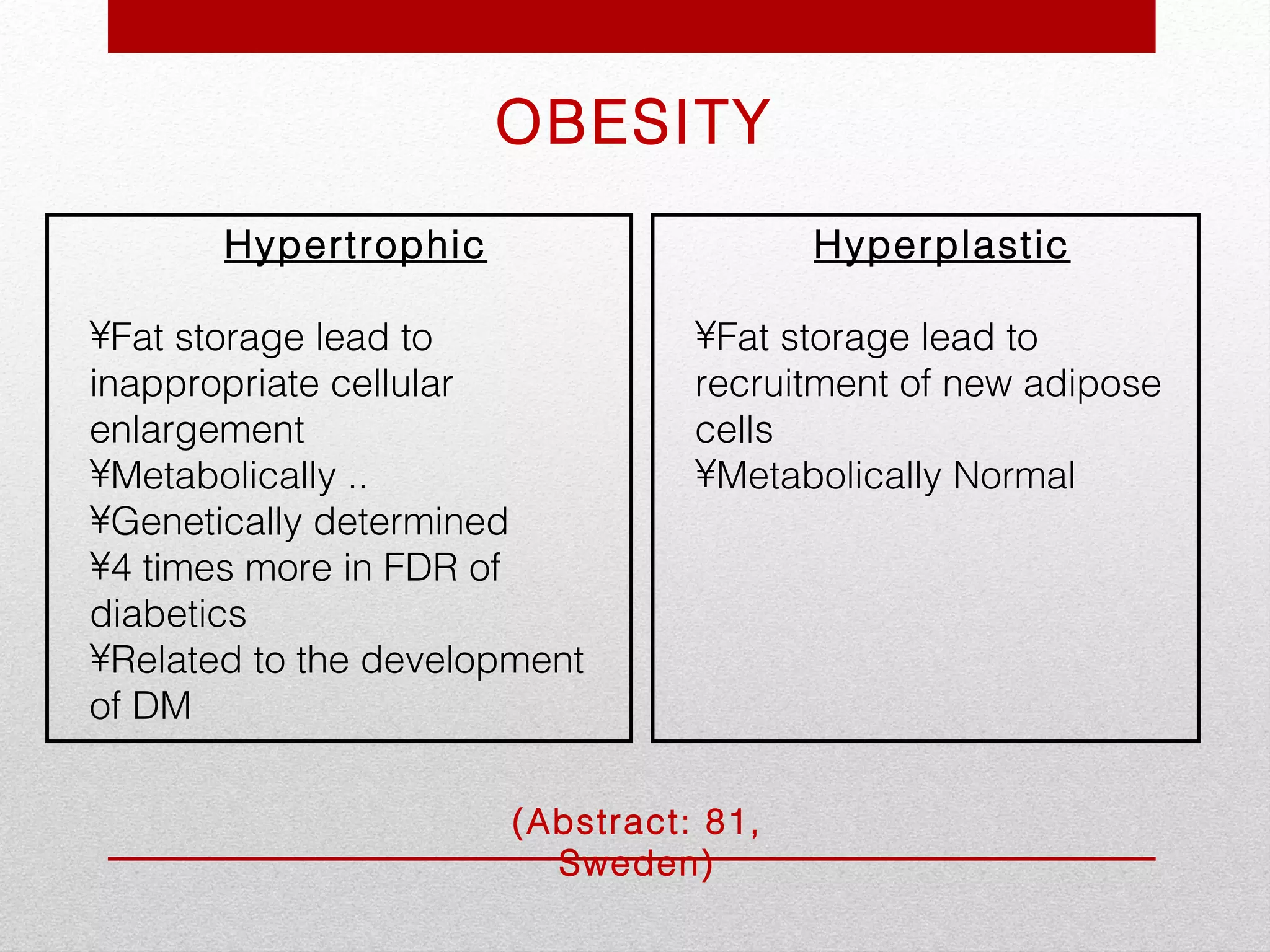
OBESITY
       Hypertrophic                     Hyperplastic

•Fat storage lead to             •Fat storage lead to
inappropriate cellular           recruitment of new adipose
enlargement                      cells
•Metabolically ..                •Metabolically Normal
•Genetically determined
•4 times more in FDR of
diabetics
•Related to the development
of DM

                       (Abstract: 81,
                         Sweden)
OBESITY

 Visceral fat-derived protein " Visfatin" plasma levels
  correlates strongly with the amount of visceral adipose
  tissue in humans.
 It has high significant correlation with HOMA IR and
  other parameters linking Visceral fat to IR, DM and
  obesity.
                 ( D- 1112, Egypt )
IR & Hypertension

 Hypertensive diabetics have significant insulin
  resistance and higher fasting insulin levels when
  compared to normotensive counterparts.
 Though complications were higher in the same group
  they were not statistically significant.
 Diabetic patients with hypertension should be treated
  more aggressively and evaluated for complications.
                   ( D-1111, India )
IR & Hypertension

 Elevated values of heart rate and insulin resistance reflect
  enhanced sympathetic nervous system activity and may
  be connected with development of coronary artery
  disease and diabetes.
 24-h double product calculated as systolic blood pressure
  and heart rate and body mass index may be
  complementary parameters in prediction of insulin
  resistance in hypertensive nondiabetics with coronary
  artery disease.
                     ( P-1386, Poland )
Insulin Resistance &
             Hypertension

 Nigerian hypertensives have greater HOMA-estimated
  insulin resistance than their normotensive counterparts.
 This finding implies that hypertensive patients should
  have regular screening for diabetes mellitus and other
  categories of glucose intolerance as the increased insulin
  resistance seen in them will increase their risk of
  developing type 2 diabetes mellitus.
                    ( P-1387, Nigeria )
IR & Vit. D

 Vitamin D supplementation improved insulin resistance
  after a single large dose of Vitamin D in South Asians.
 Vitamin D deficiency may explain the higher prevalence
  of diabetes and metabolic syndrome in South Asian
  population.
                        ( D-0820, UK )
 Circulating osteocalcin level is associated with improved
  glucose tolerance, insulin secretion and sensitivity
  independent of the plasma adiponectin level in human.
                    ( D-1109, Korea )
IR & PCOS
 Routine measurement of WC in patients with PCOS and normal body
  mass can be a marker of IR, type 2 diabetes mellitus, arterial
  hypertension and cardiovascular diseases.
                         (P-1397, Uzbekistan)
 Recent studies indicate the possible role of vitamin D in the
  pathogenesis of IR and glucose metabolism.
 Women with PCOS have mostly insufficient 25-OH-D levels, and
  25-OH-D replacement therapy may have a beneficial effect on IR in
  obese women with PCOS.
                            (P-1383, India)
 Hyperandrogenemia and insulin resistance in PCOS may have an
  inherited basis and these are likely to be associated with the disorder
  as independent traits.
                         (P-1410, Bangladesh)
IR & Other Conditions

 A study was done to examine the spleen as a major
  source of inflammation-induced insulin resistance in
  obesity.
 Spleen has a potential role on metabolism, as its surgical
  removal causes protection against obesity-induced
  inflammation and insulin resistance, enhanced by
  reduction on macrophage migration to metabolic tissues.
                     (D-0819, Brazil)
IR & Other Conditions
 Psoriasis (Ps) is a chronic autoimmune disease which affects
  the skin and joints. Adipocytokines may play an important
  role in the physiopathology of psoriasis lesions and
  pathogenesis of impaired fasting glucose (IFG)
 The secretory dysfunction of proinflammatory and anti-
  inflammatory adipocytokines represent the main link
  between IFG and Ps.
 Weight loss and exercise have been reported to significantly
  increase adiponectin and decrease leptin levels.
 Body weight loss and exercise could potentially become part
  of the general management of Ps in patients with IFG.
                     (P-1395, Romania)
Management of IR
Metformin in T2D & Prediabetes
 Metformin is a biguanide; it reduces hepatic glucose
  output and increases the uptake in the peripheral tissues
  (muscle and adipocytes).
 Metformin is a major drug in the treatment of patients
  who are obese and have type 2 diabetes. The drug
  enhances weight reduction and improves lipid profile
  and vascular integrity.
Management of IR
Metformin in T2D & Prediabetes

 Metformin in patients with T2D and prediabetes reduces
  insulin resistance, especially at patients with IFG and
  IGT, improves glycemic and lipid control, decreases
  cytokines connected with insulin sensitivity.

                    (D-0821, Russia)
Management of IR
          Exenatide & metformin
 A study to evaluate the effect of exenatide and metformin
  on the insulin resistance variation after 3 months of
  treatment in type 2 diabetes patients receiving insulin.
 This study confirm that association of exenatide + insulin
  treatment at obese T2DM patients seems to decrease the
  total insulin daily dose, but the insulin resistance compared
  for the group treated with metformin and the group treated
  with exenatide seems to be not statistically different.
                     (P-1380, Romania)
Management of IR
       Dietary omega-3 (PUFAs)

 Omega-3 PUFAs administered exert a number of
  beneficial effects on diabetes associated metabolic
  disorders (glycemic control, FFA, antioxidative defense),
  attenuate IR parameters,
 increase plasma adiponectin and decrease osteoprotegerin
  levels thus lowering cardiovascular risk of T2Ds
            (P-1403, Ukraine & Netherlands)
Management of IR
       Exenatide & glimepiride

 A multicenter, randomised, single-blind study on the
  effects of exenatide or glimepiride on insulin resistance
  in patient intolerant to metformin at maximum dose.
 Exenatide and glimepiridel improved diabetes control
  when added to metformin, but only Ex improved insulin
  resistance related-parameters.
                     (D-0815, Italy)
Management of IR correction with
   fetal stem cells in metabolic
             syndrome
Results:-
IR Reduction, insulin-sensitivity restoration in all groups.
Reduction of basal and stimulated hyperinsulinemia in
IGT-group
Reduction of serum C-peptide
Other effects: reduced glycemia, lipid count, weight loss,
blood pressure decrease.
Conclusions:-
In MS, TFSC ( Transplantation of Fetal Stem Cell )
results in reliable subsidence of IR symptoms.
                      (P-1391, Ukraine)
Prevention of Diabetes
           Alfa Glucosidase
 The STOP-NIDDM trial demonstrated The STOP-
  NIDDM trial demonstrated that the alpha-glucosidase
  inhibitor acarbose reduced the risk of diabetes by 25% in
  subjects with
 It is suggested that the effect of acarbose on the
  prevention of diabetes in subjects with IGT was in part
  mediated by an effect on the disposition index, thus an
  improvement in insulin secretion adjusted for insulin
  resistance.
                    (O-0440, Canada)
Prevention of Diabetes

 Pharmacologic intervention with medications that reverse
  known pathophysiologic abnormalities - beta cell dysfunction
  and insulin resistance - uniformly prevent IGT progression
  toT2DM. (DREAM, DPP, TRIPOD, PIPOD, ACT NOW)
 Metformin in the US DPP and Indian DPP reduced the
  development of T2DM by ~30% and has been recommended
  by the ADA.
 Metformin consistently reduces the rate of conversion of IGT
  to T2DM.
                     (Abstract: 49, USA)
Prevention of Diabetes


 A recent analysis of the 10 year follow up of the DPP
  demonstrated that metformin treatment was highly cost
  effective in diabetes prevention.
 Pharmacologic intervention with a variety of agents
  (thiazolidinediones, metformin, acarbose, GLP-1
  analogues) consistently reduces the rate of conversion of
  IGT to T2DM.
                   ( Abstract: 49, USA)

Insulin resistance idf

  • 1.
    ‫بسم ا الرحمن‬ ‫الرحيم‬ ‫ل‬ ‫ول ت سبن لذ ن قتل ف سب ل ّ‬ ‫َ َ َحْ َ َ ّ اّ ِي َ ُ ِ ُوا ِي َ ِي ِ ا ِ‬ ‫َمْ َاًا َلْ َحْ َا ٌ ِنْ َ َّ ِمْ ُرْ َ ُو َ *‬ ‫أ و ت ب أ ي ء ع د ربه ي زق ن‬ ‫صدق ا العظيم‬
  • 2.
    Best of IDF Insulin Resistance From Theory to Therapy Presented by: Dr. Emad Hamed Practicing Physician, Naga- Hammady
  • 3.
    Why Insulin Resistance?  Although it is a well known and documented condition for years; I think it is still a vague issue in the minds of many Practicing Physicians.  We want to point out the role of IR in T1DM, hypertension, PCOS and other conditions.  It is important to clarify that IR is a measurable parameter and it's measurement is easy, practical and very useful in understanding the underlying pathogenesis of different conditions and consequently their management.
  • 4.
    Presentation Topics  Background Assessment of Insulin Resistance  Epidemiology  Type 1 Diabetes  Insulin Resistance & Metabolic Syndrome  Metabolic Syndrome (MS)  MS in Persons with IFG & IGT
  • 5.
    Presentation Topics  IR& the Liver  OBESITY  IR & Hypertension  IR & Vit. D  IR & PCOS  IR & Other Issues ( Spleen – Psoriasis )  Management of IR  Prevention of Diabetes
  • 6.
    Background  The syndromesof insulin resistance actually make up a broad clinical spectrum, which includes obesity, glucose intolerance, diabetes, and the metabolic syndrome, as well as an extreme insulin-resistant state.  Many of these disorders are associated with various endocrine, metabolic, and genetic conditions.
  • 7.
    Assessment of Insulin Resistance In theory, insulin sensitivity can be assessed through the following methods: Fasting insulin level Measurement of response to direct intravenous infusion of insulin. Euglycemic insulin clamp technique. “These 2 tests are accurate, but they are research tools and are not routinely used in clinical practice”.
  • 8.
    Assessment of Insulin Resistance  Homeostatic model assessment for insulin resistance (HOMA-IR) • = fasting glucose (mg/dL) X fasting insulin (uU/mL) / 405 • = fasting glucose (mmol/L) X fasting insulin (uU/L) / 22.5. • A value greater than 2 indicates insulin resistance.  Quantitative Insulin Sensitivity Check Index (QUICKI). They both correlate reasonably well with the euglycemic clamp technique.
  • 9.
    Epidemiology  The meanHOMA-IR score of the subjects from urban community were statistically greater than that of the subjects from rural community.  The prevalence of insulin resistance in urban community and rural community were 64% and 2% respectively. ( P-1393, Nigeria )
  • 10.
    Epidemiology  A studywas done to examine Insulin Resistance among 5-15 years old children from an urban area of Sri Lanka.  Although many children were able to control glucose within normal limits, they had very high levels of insulin secretion denoting that insulin resistance is developing form a very young age. Those who were of low birth weight but obese as children had the highest risk of developing insulin resistance. ( O-0434, Sri-Lanka )
  • 11.
    Epidemiology  A studywas done to assess IR in diabetic people as well in healthy controls and to find out it's association with the components of MS in Nepal.  C-peptide levels and insulin resistance are closely associated with the components of MS in healthy individuals as well as in diabetic people. ( P-1392, Nepal )
  • 12.
    Type 1 DM MS is a frequent finding in Type1 DM and it's presence is associated with poor metabolic control and more micro and macro vascular complications.  MS was associated with increased IR estimated by eGDR. ( D-1108, Spain)  Obese Type1 patients may as well show insulin resistance. The amount of insulin can be significantly reduced through additional treatment with Metformin and DPP4 inhibitors. ( P- 1402, Germany )
  • 13.
    IR & MetabolicSyndrome Insulin resistance plays a major pathogenic role in the development of the metabolic syndrome, which may include any or all of the following: Hyperinsulinemia Type 2 diabetes or glucose intolerance Central obesity Hypertension Dyslipidemia that includes high triglyceride levels Low HDL-C level and small, dense low-density lipoprotein (LDL) particles Hypercoagulability characterized by an increased plasminogen activator inhibitor–1 (PAI-1) level.
  • 14.
    Metabolic Syndrome  Metabolicsyndrome (MS) is defined by cluster of cardiovascular risk factors which to a greater extent is influenced by ethnicity. Many definitions have been suggested since the inception of this syndrome which has created uncertainty among physicians.  To determine the frequency of metabolic syndrome in type 2 D.M according to three commonly used operational definitions (WHO, NCEP ATP III and IDF) and to evaluate the agreement between these classifications in Pakistani cohort.
  • 15.
    Metabolic Syndrome  Astudy was done to examine the relationship between reduction in insulin resistance and various metabolic parameters in patients with metabolic syndrome.  Data obtained show that insulin sensitizing therapy significantly changes SUA levels and other metabolic parameters; all this strongly depends on the degree of the reduction in insulin resistance. ( P-1408, Georgia )
  • 16.
    Metabolic Syndrome  Thisstudy results suggest that NCEP (ATPIII) and IDF are the most reliable criteria for diagnosing metabolic syndrome in type 2 diabetic patients, with NECP capturing more patients in comparison to IDF definition.  The alarmingly high frequency of metabolic syndrome in type 2 diabetes found in this study suggests that primary prevention strategies should be initiated early in this ethnic group and our health care system should be geared up to cope with this deadly condition. ( P-1400, Pakistan )
  • 17.
    Metabolic Syndrome  Astudy was done to examine the difference in prevalence of Metabolic Syndrome in populations of Albania in confront of the Italians and Peruvians.  They conclude that in all three population the prevalence of metabolic syndrome among young healthy people is important and the risk factors are almost the same with a difference for low HDL level that is found very often amongst Albanian. ( P-1412, Albania )
  • 18.
    Metabolic Syndrome  MetabolicSyndrome in obese women was frequent especially after menopause, thus multiple cardiovascular risk factors are added so a particular attention is needed to avoid serious complications. ( P-1404, Tunisia )
  • 19.
    Metabolic Syndrome  Theaim of this paper was to examine the relationship between time spent in sedentary behavior and metabolic syndrome using meta-analysis.  Current results, emphasize the importance of reducing sedentary behaviors, such as TV viewing and time on the computer, for the prevention of metabolic syndrome. ( D-0817, UK )
  • 20.
    Metabolic Syndrome  Waistcircumference (WC) is a convenient measure of abdominal adipose tissue and it is a risk factor for cardiovascular diseases (CVD) and diabetes.  The cutoff points for WC are higher in women than the currently recommended 80cm for Sub-Saharan populations, whilst in men it is lower. Of importance is that the cutoff points are reversed in this population for the genders.  These results emphasize the importance of establishing ethnic based values to correctly identify subjects with the metabolic syndrome. ( D-1110, South Africa )
  • 21.
    MS in Personswith IFG & IGT  The prevalence of MS in persons with either IFG or IGT was twofold that encountered in the general population, while in individuals with both IFG and IGT it is similar to that found in patients with type 2 diabetes mellitus.  Therefore IFG and IGT should not be approached as isolated conditions because often are associated with other features of the MS that, individually and interdependently, are responsible for a substantial increase in cardiovascular morbidity and mortality. ( P-1399, Romania )
  • 22.
    IR & theLiver  The liver has a central role in the regulation of circulating glucose concentrations. During fasting, glucose is produced mainly by the liver as a result of increased glycogenolysis and gluconeogenesis (GNG).  During postprandial state the impaired suppression of hepatic glucose production (HGP), due to the presence of hepatic insulin resistance, determines high glucose concentrations.
  • 23.
    IR & theLiver  Insulin acts at the level of the liver through a direct and/ or indirect effect (i.e. on glucose transport and/or intracellular enzymes). Insulin resistant (IR) subjects have increased fasting GNG, but fasting glucose concentration remains within normal ranges, as well as HGP, because of a compensatory decrease in glycogenolysis.
  • 24.
    IR & theLiver  When T2DM develops, the hepatic autoregulation is lost, increased GNG and glycogenolysis determine the increase in HGP that explains fasting hyperglycemia.  In conclusion, the liver plays a determinant role in the pathogenesis of T2DM. ( S-103, Italy )
  • 25.
    IR & theLiver  Ectopic fat deposition in the liver is associated with metabolic abnormalities, including insulin resistance, dyslipidemia and diabetes.  Non-alcoholic fatty liver disease (NAFLD) is defined as increased liver fat in individuals who do not drink excessive alcohol and who do not have other causes for liver disease.
  • 26.
    IR & theLiver  A subset of patients with NAFLD have non-alcoholic steatohepatitis (NASH) characterized by lobular inflammation and evidence of cellular damage with or without fibrosis.  While simple steatosis is considered relatively benign, NASH can progress over time to cirrhosis. ( S-114, USA )
  • 27.
    IR & theLiver  A study was done to assess the effect of Orlistat (Gastrointestinal lipase inhibitors) + Metformin vs Metformin alone in Nondiabetic Patients with Insulin Resistance and Nonalcoholic Steatohepatitis (NASH)  Orlistat (Gastrointestinal lipase inhibitors) therapy and dietary counseling were associated with significant decreases in NASH. ( O-0439, Venezuela )
  • 28.
    IR & theLiver  Nonalcoholic fatty liver disease (NAFLD) does not seem to be associated with MS in Bangladeshi population as defined through the 3 major criteria provided by IDF, ATP III and WHO.  Various components of MS are associated with NAFLD among which central obesity, dysglycemia and dyslipidemia are the most significant ones. However, they do not seem to cluster in the manner as predicted by IDF, ATP III and WHO ( P-1384, Bangladesh )
  • 29.
    IR & theLiver  Several prospective studies have shown that fat accumulation in the liver due to non-alcoholic causes (NAFLD) precedes and predicts type 2 diabetes, cardiovascular disease and NASH independent of obesity and fat distribution.  The study suggested that avoidance of excess simple sugar intake may be an important factor in the prevention of progressive deterioration in glycemic control in type 2 diabetes due to worsening hepatic insulin resistance and of NASH. ( M 108, Finland)
  • 30.
    OBESITY Hypertrophic Hyperplastic •Fat storage lead to •Fat storage lead to inappropriate cellular recruitment of new adipose enlargement cells •Metabolically .. •Metabolically Normal •Genetically determined •4 times more in FDR of diabetics •Related to the development of DM (Abstract: 81, Sweden)
  • 31.
    OBESITY  Visceral fat-derivedprotein " Visfatin" plasma levels correlates strongly with the amount of visceral adipose tissue in humans.  It has high significant correlation with HOMA IR and other parameters linking Visceral fat to IR, DM and obesity. ( D- 1112, Egypt )
  • 32.
    IR & Hypertension Hypertensive diabetics have significant insulin resistance and higher fasting insulin levels when compared to normotensive counterparts.  Though complications were higher in the same group they were not statistically significant.  Diabetic patients with hypertension should be treated more aggressively and evaluated for complications. ( D-1111, India )
  • 33.
    IR & Hypertension Elevated values of heart rate and insulin resistance reflect enhanced sympathetic nervous system activity and may be connected with development of coronary artery disease and diabetes.  24-h double product calculated as systolic blood pressure and heart rate and body mass index may be complementary parameters in prediction of insulin resistance in hypertensive nondiabetics with coronary artery disease. ( P-1386, Poland )
  • 34.
    Insulin Resistance & Hypertension  Nigerian hypertensives have greater HOMA-estimated insulin resistance than their normotensive counterparts.  This finding implies that hypertensive patients should have regular screening for diabetes mellitus and other categories of glucose intolerance as the increased insulin resistance seen in them will increase their risk of developing type 2 diabetes mellitus. ( P-1387, Nigeria )
  • 35.
    IR & Vit.D  Vitamin D supplementation improved insulin resistance after a single large dose of Vitamin D in South Asians.  Vitamin D deficiency may explain the higher prevalence of diabetes and metabolic syndrome in South Asian population. ( D-0820, UK )  Circulating osteocalcin level is associated with improved glucose tolerance, insulin secretion and sensitivity independent of the plasma adiponectin level in human. ( D-1109, Korea )
  • 36.
    IR & PCOS Routine measurement of WC in patients with PCOS and normal body mass can be a marker of IR, type 2 diabetes mellitus, arterial hypertension and cardiovascular diseases. (P-1397, Uzbekistan)  Recent studies indicate the possible role of vitamin D in the pathogenesis of IR and glucose metabolism.  Women with PCOS have mostly insufficient 25-OH-D levels, and 25-OH-D replacement therapy may have a beneficial effect on IR in obese women with PCOS. (P-1383, India)  Hyperandrogenemia and insulin resistance in PCOS may have an inherited basis and these are likely to be associated with the disorder as independent traits. (P-1410, Bangladesh)
  • 37.
    IR & OtherConditions  A study was done to examine the spleen as a major source of inflammation-induced insulin resistance in obesity.  Spleen has a potential role on metabolism, as its surgical removal causes protection against obesity-induced inflammation and insulin resistance, enhanced by reduction on macrophage migration to metabolic tissues. (D-0819, Brazil)
  • 38.
    IR & OtherConditions  Psoriasis (Ps) is a chronic autoimmune disease which affects the skin and joints. Adipocytokines may play an important role in the physiopathology of psoriasis lesions and pathogenesis of impaired fasting glucose (IFG)  The secretory dysfunction of proinflammatory and anti- inflammatory adipocytokines represent the main link between IFG and Ps.  Weight loss and exercise have been reported to significantly increase adiponectin and decrease leptin levels.  Body weight loss and exercise could potentially become part of the general management of Ps in patients with IFG. (P-1395, Romania)
  • 39.
    Management of IR Metforminin T2D & Prediabetes  Metformin is a biguanide; it reduces hepatic glucose output and increases the uptake in the peripheral tissues (muscle and adipocytes).  Metformin is a major drug in the treatment of patients who are obese and have type 2 diabetes. The drug enhances weight reduction and improves lipid profile and vascular integrity.
  • 40.
    Management of IR Metforminin T2D & Prediabetes  Metformin in patients with T2D and prediabetes reduces insulin resistance, especially at patients with IFG and IGT, improves glycemic and lipid control, decreases cytokines connected with insulin sensitivity. (D-0821, Russia)
  • 41.
    Management of IR Exenatide & metformin  A study to evaluate the effect of exenatide and metformin on the insulin resistance variation after 3 months of treatment in type 2 diabetes patients receiving insulin.  This study confirm that association of exenatide + insulin treatment at obese T2DM patients seems to decrease the total insulin daily dose, but the insulin resistance compared for the group treated with metformin and the group treated with exenatide seems to be not statistically different. (P-1380, Romania)
  • 42.
    Management of IR Dietary omega-3 (PUFAs)  Omega-3 PUFAs administered exert a number of beneficial effects on diabetes associated metabolic disorders (glycemic control, FFA, antioxidative defense), attenuate IR parameters,  increase plasma adiponectin and decrease osteoprotegerin levels thus lowering cardiovascular risk of T2Ds (P-1403, Ukraine & Netherlands)
  • 43.
    Management of IR Exenatide & glimepiride  A multicenter, randomised, single-blind study on the effects of exenatide or glimepiride on insulin resistance in patient intolerant to metformin at maximum dose.  Exenatide and glimepiridel improved diabetes control when added to metformin, but only Ex improved insulin resistance related-parameters. (D-0815, Italy)
  • 44.
    Management of IRcorrection with fetal stem cells in metabolic syndrome Results:- IR Reduction, insulin-sensitivity restoration in all groups. Reduction of basal and stimulated hyperinsulinemia in IGT-group Reduction of serum C-peptide Other effects: reduced glycemia, lipid count, weight loss, blood pressure decrease. Conclusions:- In MS, TFSC ( Transplantation of Fetal Stem Cell ) results in reliable subsidence of IR symptoms. (P-1391, Ukraine)
  • 45.
    Prevention of Diabetes Alfa Glucosidase  The STOP-NIDDM trial demonstrated The STOP- NIDDM trial demonstrated that the alpha-glucosidase inhibitor acarbose reduced the risk of diabetes by 25% in subjects with  It is suggested that the effect of acarbose on the prevention of diabetes in subjects with IGT was in part mediated by an effect on the disposition index, thus an improvement in insulin secretion adjusted for insulin resistance. (O-0440, Canada)
  • 46.
    Prevention of Diabetes Pharmacologic intervention with medications that reverse known pathophysiologic abnormalities - beta cell dysfunction and insulin resistance - uniformly prevent IGT progression toT2DM. (DREAM, DPP, TRIPOD, PIPOD, ACT NOW)  Metformin in the US DPP and Indian DPP reduced the development of T2DM by ~30% and has been recommended by the ADA.  Metformin consistently reduces the rate of conversion of IGT to T2DM. (Abstract: 49, USA)
  • 47.
    Prevention of Diabetes A recent analysis of the 10 year follow up of the DPP demonstrated that metformin treatment was highly cost effective in diabetes prevention.  Pharmacologic intervention with a variety of agents (thiazolidinediones, metformin, acarbose, GLP-1 analogues) consistently reduces the rate of conversion of IGT to T2DM. ( Abstract: 49, USA)