Instruments
Part A
Instruments Used For Preparing the Surgical
Patient and Incision Making
Content
 Cheatle’s Forceps
 Rampley’s Sponge Holding Forceps
 Mayo’s Towel Clip
 Bard Parker Knife Handle
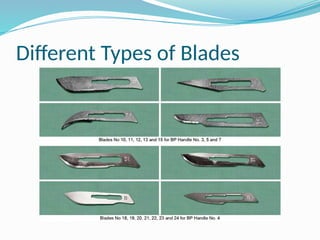
 Different Types of Blades
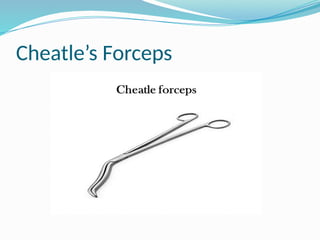
Cheatle’s Forceps
Cheatle’s Forceps
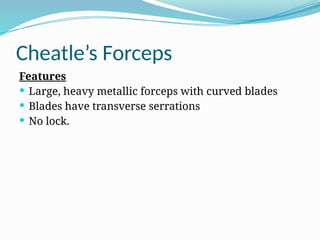
Features
 Large, heavy metallic forceps with curved blades
 Blades have transverse serrations
 No lock.
Cheatle’s Forceps
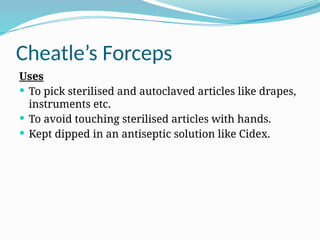
Uses
 To pick sterilised and autoclaved articles like drapes,
instruments etc.
 To avoid touching sterilised articles with hands.
 Kept dipped in an antiseptic solution like Cidex.
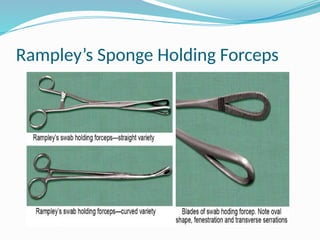
Rampley’s Sponge Holding Forceps
Features
 Long Instrument 9 ½” with thin shaft.
 It has a catch lock which helps in holding the sponge
while cleaning.
 Blades are fenestrated near its distal end.
 Inner aspect of blades is serrated.
Rampley’s Sponge Holding Forceps
Uses
 Used for cleansing the skin.
 Used to clean the blood during dissection of Calot's
triangle during cholecystectomy.
 Used to hold the fundus and Hartmann's pouch of the
gall bladder during cholecystectomy.
 Used for removing the laminated membrane and the
daughter cysts during operation of hydatid cyst.
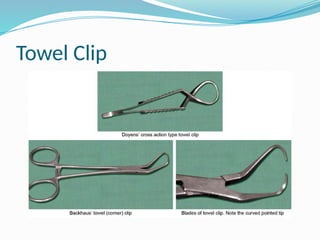
Towel Clip
Towel Clip
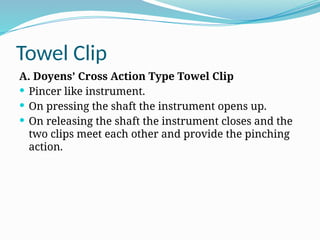
A. Doyens’ Cross Action Type Towel Clip
 Pincer like instrument.
 On pressing the shaft the instrument opens up.
 On releasing the shaft the instrument closes and the
two clips meet each other and provide the pinching
action.
Towel Clip
B. Backhaus’ Towel (Corner) Clip
 Provided with finger bows, a rachet, a pair of shaft
and two sharp hooks.
 On closing the rachet the two clips are apposed and
on releasing the rachet the clips open up.
Towel Clip
Uses
 Used for fixing the draping sheets.
„
 Used for fixing the diathermy cables, suction tubes,
„
laparoscopic camera cables and fiberoptic light
cables to the draping sheets.
 May be used as a tongue holding forceps.
„
 May be used as cord holding forceps.
„
 May be used for holding the ribs while elevating a
„
flail segment of chest.
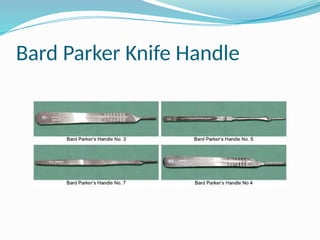
Bard Parker Knife Handle
 Flat stainless steel instrument with one end
narrower with a slot on either side for attaching the
scalpel blade.
 A number is written on the handle.
 The numbers maybe 3, 5, 7 and 4.
 In scalpel handle no. 4 the site for attachment of the
blade is little wider than the handle number 3, 5 and
7 where it is little narrower.
Different Types of Blades
Scalpel uses
 Used to make skin incisions for any operation.
 The blade numbers 20, 21, 22, 23 and 24 used for
larger incisions and dissections.
 The blade number 15 used for smaller incisions,
„
while excising a sebaceous cyst or during
venesection.
 The blade number 11, stab knife is used to incise the
„
skin for drainage of an abscess.
 It is used to incise the skin for inserting drains.
„
Scalpel uses
 To raise skin flaps during mastectomy, incisional
hernia repair, during thyroidectomy and radical neck
dissection.
 To divide the cystic duct and artery during
cholecystectomy after these are ligated.
 The renal and splenic pedicle may also be divided by
„
a scalpel after ligature during nephrectomy and
splenectomy.
Instruments
Part B
Instruments Used for Hemostasis and
Needle Holders
Content
 Artery Forceps
 Mosquito Artery Forceps
 Kocher’s Hemostatic Forceps
 Mayo’s Kidney Pedicle Clamp
 Needle Holder
 Difference Between Artery Forceps and Needle
Holder
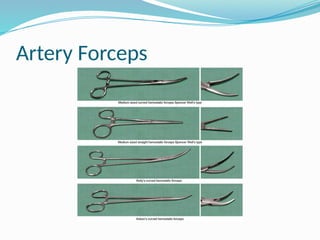
Artery Forceps
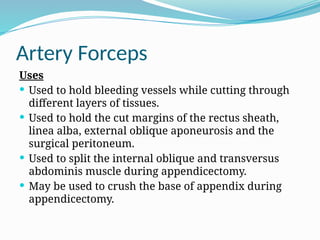
Artery Forceps
 Types
 Small or Mosquito
 Medium
 Large or Pedicular
 Can be curved or Straight.
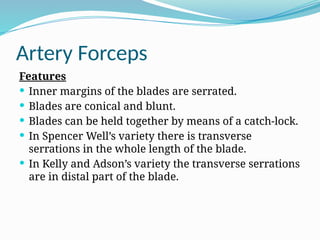
Artery Forceps
Features
 Inner margins of the blades are serrated.
 Blades are conical and blunt.
 Blades can be held together by means of a catch-lock.
 In Spencer Well’s variety there is transverse
serrations in the whole length of the blade.
 In Kelly and Adson’s variety the transverse serrations
are in distal part of the blade.
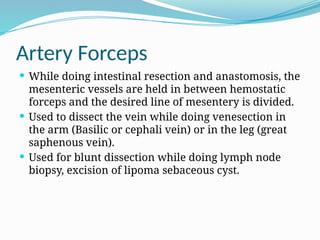
Artery Forceps
Uses
 Used to hold bleeding vessels while cutting through
different layers of tissues.
 Used to hold the cut margins of the rectus sheath,
linea alba, external oblique aponeurosis and the
surgical peritoneum.
 Used to split the internal oblique and transversus
abdominis muscle during appendicectomy.
 May be used to crush the base of appendix during
appendicectomy.
Artery Forceps
 While doing intestinal resection and anastomosis, the
mesenteric vessels are held in between hemostatic
forceps and the desired line of mesentery is divided.
 Used to dissect the vein while doing venesection in
the arm (Basilic or cephali vein) or in the leg (great
saphenous vein).
 Used for blunt dissection while doing lymph node
biopsy, excision of lipoma sebaceous cyst.
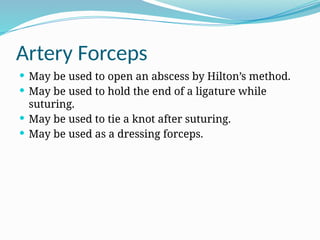
Artery Forceps
 May be used to open an abscess by Hilton’s method.
 May be used to hold the end of a ligature while
suturing.
 May be used to tie a knot after suturing.
 May be used as a dressing forceps.
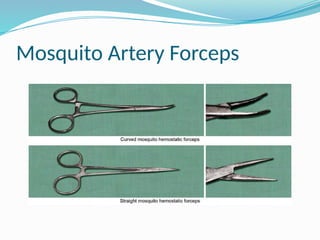
Mosquito Artery Forceps
 Features
 Light, small and delicate instrument
 The blades are smaller and there are fine transverse
serrations in the blades.
 The tip of the blades are conical and are non-toothed.
Mosquito Artery Forceps
 Uses
 Used to hold fine bleeding vessels.
 Used as hemostatic forceps for operations in infants
and children where the vessels are delicate.
 Used during circumcision.
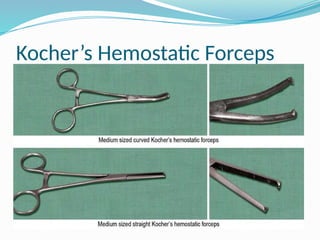
Kocher’s Hemostatic Forceps
 Features
 The blades are slightly longer than in a Spencer
Well's type of hemostatic forceps.
 At the tip of the blades there is a tooth in one blade
„
and a groove in the other blade where the tooth fits.
 Suitable for holding vessels in tough structures like
palm, soles and the scalp where the vessels tend to
retract in the deep fascia.
Kocher’s Hemostatic Forceps
 Uses
 Used to hold perforating vessels during mastectomy.
 Used around the margin of thyroid gland lobe before
excision of the enlarged thyroid lobe.
 Used for holding vessels in the scalp while raising a
skin flap for craniotomy.
 Used to hold bleeding vessels while operating on
palm and sole.
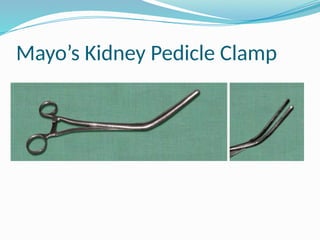
Mayo’s Kidney Pedicle Clamp
 Features
 This is a stout and large forceps.
 The blades are long and angled to provide a good
view at a depth.
 There are vertical serrations in the blades.
Mayo’s Kidney Pedicle Clamp
 Uses
 Used during nephrectomy to hold the renal pedicles
before division
 May be used during splenectomy to hold the splenic
pedicle.
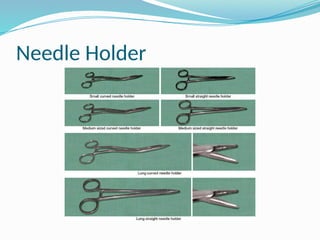
Needle Holder
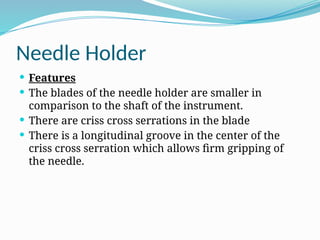
Needle Holder
 Features
 The blades of the needle holder are smaller in
comparison to the shaft of the instrument.
 There are criss cross serrations in the blade
 There is a longitudinal groove in the center of the
criss cross serration which allows firm gripping of
the needle.
Needle Holder
 Uses
 The needle holders with fine blades are used to hold
finer needles (2/0, 3/0, 4/0 atraumatic catgut, vicryl,
mersilk).
 The small sized needle holders are used for suturing
on the surface.
 The long needle holders are used for suturing at the
depth inside the abdomen, pelvis or chest.
 The curved needle holders are used for suturing in a
cavity or at a depth for better visualization.
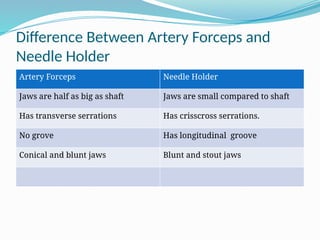
Difference Between Artery Forceps and
Needle Holder
Artery Forceps Needle Holder
Jaws are half as big as shaft Jaws are small compared to shaft
Has transverse serrations Has crisscross serrations.
No grove Has longitudinal groove
Conical and blunt jaws Blunt and stout jaws
Instruments
Part C
Dissecting Forceps And Tissue Holding Forceps
Content
 Plain Dissecting Forceps
 Toothed Dissecting Forceps
 Allis’ Tissue Forceps
 Lane’s Tissue Forceps
 Babcock’s Tissue Forceps
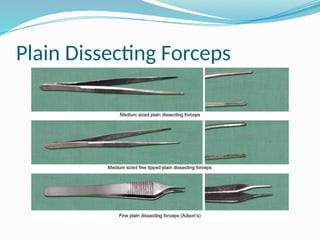
Plain Dissecting Forceps
 Features
 There are grooves on the shaft of the instrument
which allows easy gripping.
 There are transverse serrations at the tip of the
blades which helps in lifting the tissues and the
needle during suturing.
 There are no tooth at the tip.
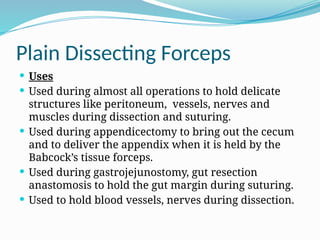
Plain Dissecting Forceps
 Uses
 Used during almost all operations to hold delicate
structures like peritoneum, vessels, nerves and
muscles during dissection and suturing.
 Used during appendicectomy to bring out the cecum
and to deliver the appendix when it is held by the
Babcock’s tissue forceps.
 Used during gastrojejunostomy, gut resection
anastomosis to hold the gut margin during suturing.
 Used to hold blood vessels, nerves during dissection.
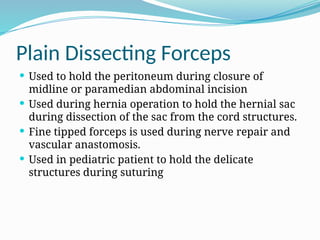
Plain Dissecting Forceps
 Used to hold the peritoneum during closure of
midline or paramedian abdominal incision
 Used during hernia operation to hold the hernial sac
during dissection of the sac from the cord structures.
 Fine tipped forceps is used during nerve repair and
vascular anastomosis.
 Used in pediatric patient to hold the delicate
structures during suturing
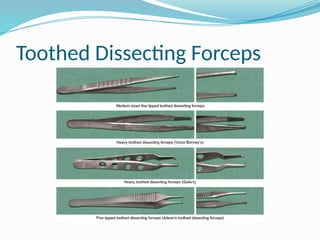
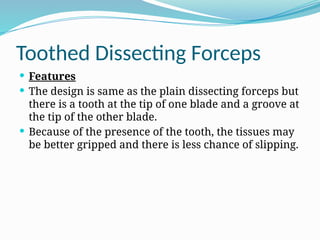
Toothed Dissecting Forceps
 Features
 The design is same as the plain dissecting forceps but
there is a tooth at the tip of one blade and a groove at
the tip of the other blade.
 Because of the presence of the tooth, the tissues may
be better gripped and there is less chance of slipping.
Toothed Dissecting Forceps
 Uses
 Used during almost all operations to hold tough
structures like skin, fascia and aponeurosis.
 Used to hold the cut skin margins during suturing.
 Used to hold the linea alba or the rectus sheath
during closure of abdominal incision.
 Used to hold the scalp during closure of scalp
incision.
 Used to hold the cut margins of the prepuce for
suturing during circumcision.
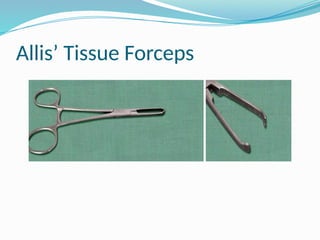
Allis’ Tissue Forceps
 Features
 This is a light instrument.
 The blades are longer and there is a gap between the
blades which can accommodate some amount of
tissue.
 The tip of the blades are provided with sharp teeth
with grooves in between.
 When the ratchet is closed the teeth of the one blade
fits in the groove of the other blade and vice versa
Allis’ Tissue Forceps
 Uses
 During laparotomy through midline incision, skin
margins may be retracted by applying Allis tissue
forceps to the skin margin while linea alba is incised.
 While closing the midline incision the linea alba may
be held up by Allis tissue forceps during suturing.
 Used to hold the skin margins during incisional
hernia operations to raise the skin flaps.
 Used during thyroid operations, neck dissection to
hold the margins of the skin while raising skin flaps.
Allis’ Tissue Forceps
 Used to hold the cut margins of the bladder
during transvesical prostatectomy or suprapubic
cystolithotomy.
 Used to hold the neck of the bladder during
bladder neck resection.
 Used to hold the galea aponeurotica while raising
a skin flap during craniotomy.
 Used to hold the skin flaps while excising a
lipoma, sebaceous cyst or lymph node.
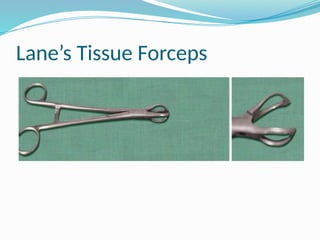
Lane’s Tissue Forceps
 Features
 This is a thick and heavy instrument.
 The terminal part of the blades are curved and
fenestrated.
 At the tip there is a heavy tooth in one blade with
groove in the other blade.
 Because of stout teeth at the tip this holds tissues
firmly but it is traumatizing.
Lane’s Tissue Forceps
 Uses
 During mastectomy it may be used to hold the breast
„
while dissecting it off from the pectoral fascia.
 Used during submandibular or parotid gland
excision to hold the gland during dissection from the
adjacent structures.
 May be used to fix the draping sheets and also to fix
„
the suction tube and the diathermy cable to the
draping sheets as an alternative to towel clip.
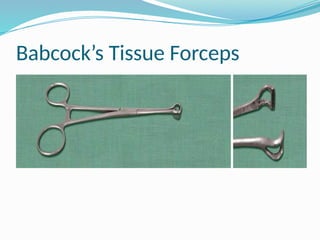
Babcock’s Tissue Forceps
 Features
 This is a light instrument.
 The terminal part of the blades are curved and
fenestrated.
 The tip is provided with a ridge in one blade and
groove in the other.
 As there are no teeth this is a non-traumatic forceps.
 The fenestration in the blade allows some soft tissue
to be accommodated in the hollow while holding it.
Babcock’s Tissue Forceps
 Uses
 Used during appendicectomy. One holds the
appendix near its tip, one holds the body of the
appendix and the third holds the base of the
appendix.
 Used during gastrectomy, gastrojejunostomy to hold
the margins of the stomach while applying an
occlusion clamp.
 Used during small and large intestine resection
anastomosis to hold the margins of the gut before
applying an intestinal occlusion clamp.
Babcock’s Tissue Forceps
 Used during gastrostomy or jejunostomy to hold the
gut while applying purse string suture.
 Used to hold the cut margins of the bladder during
transvesical prostatec tomy or suprapubic
cystolithotomy.
Instruments
Part D
Scissors and Retractors
Content
 Scissors
 Mayo’s Scissors
 McIndoe Scissors
 Metzenbaum scissors
 Cat’s Paw Retractor
 Langenbeck’s Retractor
 Czerny’s Retractor
 Morris Retractor
 Deaver’s Retractor
Mayo’s Scissors
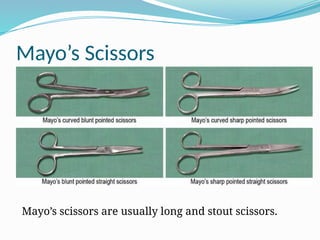
Mayo’s scissors are usually long and stout scissors.
Mayo’s Scissors
 Uses
 Used for cutting sutures.
„
 Used during appendicectomy to split the internal
„
oblique and transversus abdominis muscle.
 Used to cut tough structures like linea alba, external
oblique aponeurosis, anterior and posterior rectus
sheath during entry into the abdomen by a midline,
paramedian or subcostal incision.
 May be used to cut dressings.
 May be used to cut a corrugated rubber sheet drain.
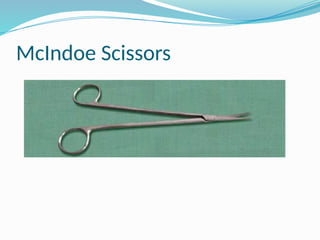
McIndoe Scissors
McIndoe Scissors
 Features
• These are fine scissors.
• The blades are delicate and smaller than in
Mayo’s scissors.
McIndoe Scissors
 Uses
 Used during appendicectomy to cut the external
oblique aponeurosis and peritoneum. The
mesoappendix is cut after being ligated.
 Used during herniorrhaphy:
 To cut the external oblique aponeurosis to expose the
inguinal canal.
 To dissect the hernial sac from the cord structures and
to open the fundus of the hernial sac.
 „Used during mastectomy and incisional hernia
operation to raise the skin flap by sharp dissection.
„
McIndoe Scissors
 Used during thyroidectomy and radical neck
dissection to raise skin flaps by sharp dissection.
 Used during splenectomy, nephrectomy to cut the
„
pedicles after ligature.
 Used during cholecystectomy to cut the cystic duct
and the artery after they are ligated.
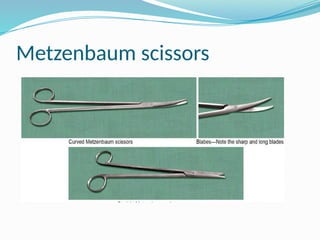
Metzenbaum scissors
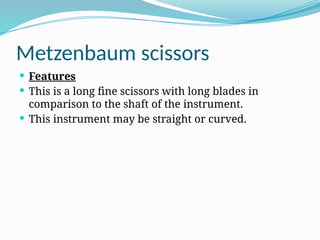
Metzenbaum scissors
 Features
 This is a long fine scissors with long blades in
comparison to the shaft of the instrument.
 This instrument may be straight or curved.
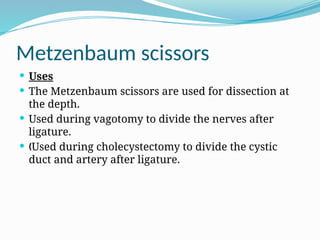
Metzenbaum scissors
 Uses
 The Metzenbaum scissors are used for dissection at
the depth.
 Used during vagotomy to divide the nerves after
ligature.
 Used during cholecystectomy to divide the cystic
„
duct and artery after ligature.
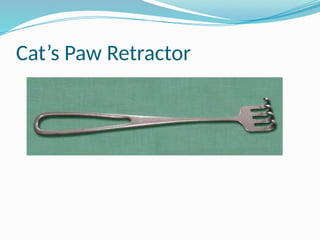
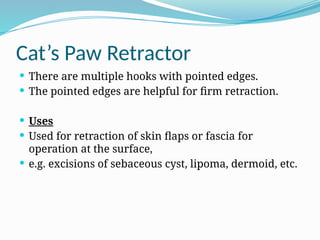
Cat’s Paw Retractor
Cat’s Paw Retractor
 There are multiple hooks with pointed edges.
 The pointed edges are helpful for firm retraction.
 Uses
 Used for retraction of skin flaps or fascia for
operation at the surface,
 e.g. excisions of sebaceous cyst, lipoma, dermoid, etc.
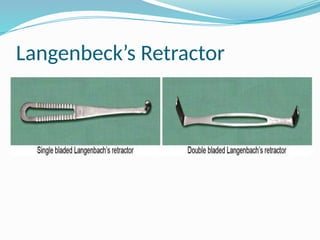
Langenbeck’s Retractor
 Features
 The single bladed Langenbach’s retractor has a
handle, a long shaft and a flat solid blade.
 The blade is curved at right angle to the shaft.
 The tip of the blade is curved at right angle for better
retraction of the tissues.
 In double bladed retractor there is another flat solid
blade at the other end of the shaft.
Langenbeck’s Retractor
 Uses
 Retractors placed suitably help in better visualization
of the operative field.
 The tissue handling may also be minimized.
 Bleeding may be better seen and controlled with
placement of retractors.
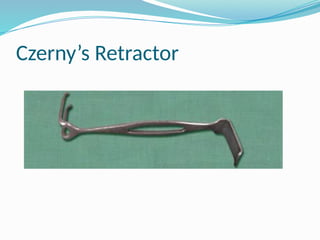
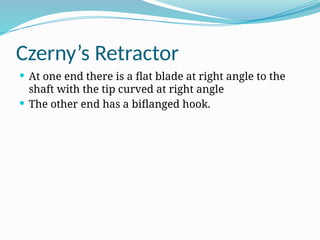
Czerny’s Retractor
Czerny’s Retractor
 At one end there is a flat blade at right angle to the
shaft with the tip curved at right angle
 The other end has a biflanged hook.
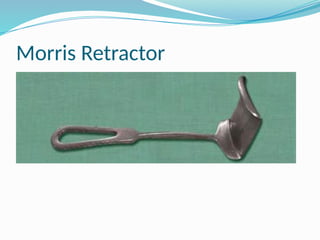
Morris Retractor
• Features
• The design is like L.
• The handle is wider and the blade is also wider.
• The lower end of the blade is curved inward at right
angle.
Morris Retractor
 Uses
 These retractors are used for tissue retraction during
different operations.
 Used during appendicectomy to retract the layers of
„
the abdominal wall while making the incision. „
 Used while making and closing different abdominal
incisions for ease of working in deeper layers of the
abdominal wall.
 Used during thyroidectomy to retract the strap
„
muscles and the sternomastoid for dissection and
ligation of the thyroid vessels.
Morris Retractor
 Used during modified radical mastectomy for
retraction of pectoralis major muscle for better
visualization during axillary dissection.
 Used during inguinal hernia operation for retraction
of different layers for proper visualization during
repair of the posterior wall of the inguinal canal.
 Used during radical neck dissection for retraction of
skin flaps, sternocleidomastoid muscle for better
visualization at depth.
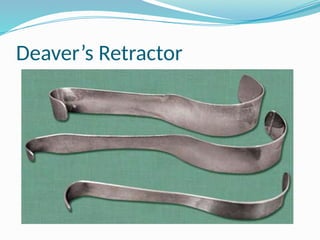
Deaver’s Retractor
Deaver’s Retractor
 A large curved retractor which is shaped like “S”.
 Uses
 Used during cholecystectomy for retraction of right
lobe of liver.
 Used during truncal vagotomy for retraction of left
lobe of liver.
 Used during gastrectomy for retraction of liver.
„
 Used during pancreaticojejunostomy for retraction
„
of stomach.
Deaver’s Retractor
 Used during right or left hemicolectomy to retract the
abdominal wall while mobilizing the colon from the
paracolic gutter.
 Used during kidney operation to retract the
abdominal wall.
 Used during anterior resection of rectum or
„
abdominoperineal resection to retract the urinary
bladder in male or uterus in female during dissection
in the pelvis.
Instruments
Part E
Instruments Used for GI Surgery and
Biliary Tract Surgery
Contents
 Gastric Clamps
 Intestinal Clamps
 Cholecystectomy Forceps
 Right angled forceps (Lahey’s forceps).
 Desjardin’s Choledocholithotomy Forceps
Gastric Occlusion Clamps
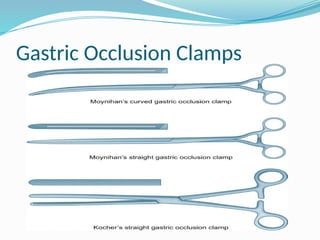
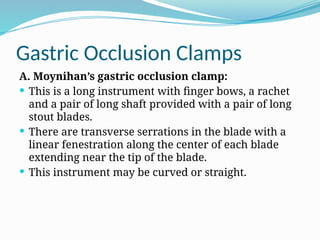
A. Moynihan’s gastric occlusion clamp:
 This is a long instrument with finger bows, a rachet
and a pair of long shaft provided with a pair of long
stout blades.
 There are transverse serrations in the blade with a
linear fenestration along the center of each blade
extending near the tip of the blade.
 This instrument may be curved or straight.
Gastric Occlusion Clamps
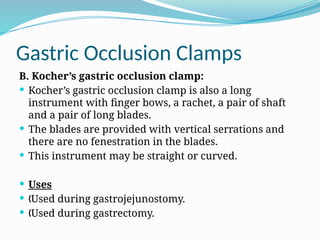
B. Kocher’s gastric occlusion clamp:
 Kocher’s gastric occlusion clamp is also a long
instrument with finger bows, a rachet, a pair of shaft
and a pair of long blades.
 The blades are provided with vertical serrations and
there are no fenestration in the blades.
 This instrument may be straight or curved.
 Uses
 Used during gastrojejunostomy.
„
 Used during gastrectomy.
„
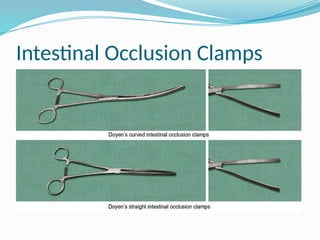
Intestinal Occlusion Clamps
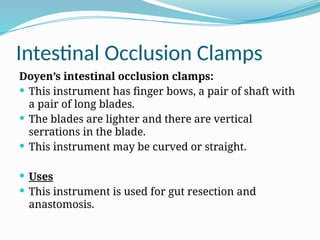
Doyen’s intestinal occlusion clamps:
 This instrument has finger bows, a pair of shaft with
a pair of long blades.
 The blades are lighter and there are vertical
serrations in the blade.
 This instrument may be curved or straight.
 Uses
 This instrument is used for gut resection and
anastomosis.
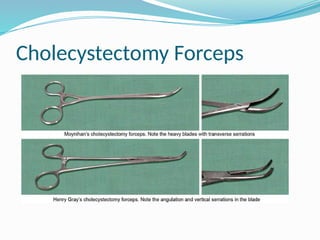
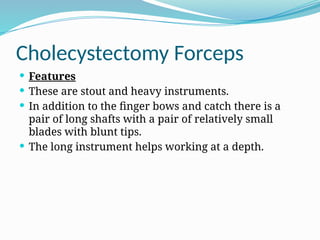
Cholecystectomy Forceps
 Features
 These are stout and heavy instruments.
 In addition to the finger bows and catch there is a
pair of long shafts with a pair of relatively small
blades with blunt tips.
 The long instrument helps working at a depth.
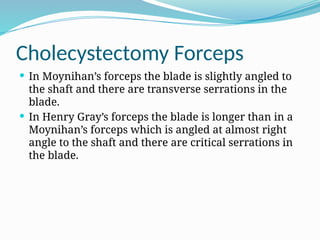
Cholecystectomy Forceps
 In Moynihan’s forceps the blade is slightly angled to
the shaft and there are transverse serrations in the
blade.
 In Henry Gray’s forceps the blade is longer than in a
Moynihan’s forceps which is angled at almost right
angle to the shaft and there are critical serrations in
the blade.
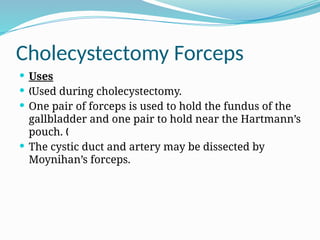
Cholecystectomy Forceps
 Uses
 Used during cholecystectomy.
„
 One pair of forceps is used to hold the fundus of the
gallbladder and one pair to hold near the Hartmann’s
pouch. „
 The cystic duct and artery may be dissected by
Moynihan’s forceps.
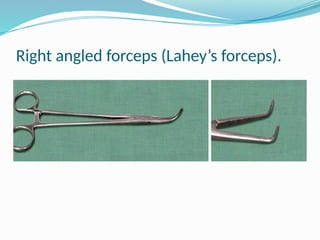
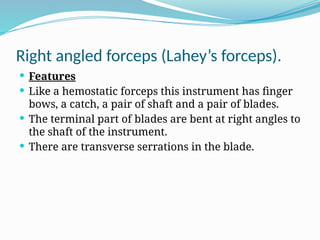
Right angled forceps (Lahey’s forceps).
 Features
 Like a hemostatic forceps this instrument has finger
bows, a catch, a pair of shaft and a pair of blades.
 The terminal part of blades are bent at right angles to
the shaft of the instrument.
 There are transverse serrations in the blade.
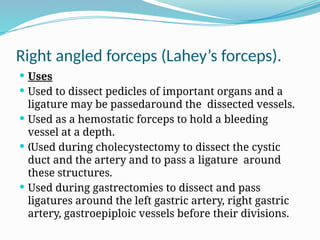
Right angled forceps (Lahey’s forceps).
 Uses
 Used to dissect pedicles of important organs and a
ligature may be passedaround the dissected vessels.
 Used as a hemostatic forceps to hold a bleeding
vessel at a depth.
 Used during cholecystectomy to dissect the cystic
„
duct and the artery and to pass a ligature around
these structures.
 Used during gastrectomies to dissect and pass
ligatures around the left gastric artery, right gastric
artery, gastroepiploic vessels before their divisions.
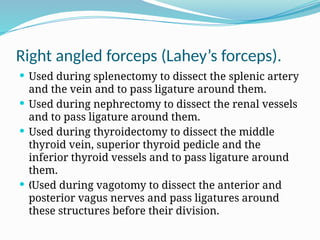
Right angled forceps (Lahey’s forceps).
 Used during splenectomy to dissect the splenic artery
and the vein and to pass ligature around them.
 Used during nephrectomy to dissect the renal vessels
and to pass ligature around them.
 Used during thyroidectomy to dissect the middle
thyroid vein, superior thyroid pedicle and the
inferior thyroid vessels and to pass ligature around
them.
 Used during vagotomy to dissect the anterior and
„
posterior vagus nerves and pass ligatures around
these structures before their division.
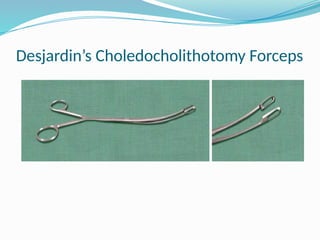
Desjardin’s Choledocholithotomy Forceps
 Features
 This is a long and slender instrument.
 There are finger bows but no catch.
 The shafts are curved, in some it is a gentle curve
and in other varieties there are different degrees of
curvature.
 The blades are small and fenestrated centrally.
 There are no serrations in the blade.
Desjardin’s Choledocholithotomy Forceps
 Uses
 This is used during choledocholithotomy.
 This is used during laparoscopic cholecystectomy.
While extracting the gallbladder through the
epigastric or umbilical port, the gallbladder is
partially delivered through the wound.The
gallbladder is opened and the stone removed from
the gallbladder by the Desjardin’s
choledocholithotomy forceps.
 It may also be used during removal of kidney,
ureteric or bladder stone.
Instruments
Part F
Instruments used in Urology and Ano-rectal
Surgery
Content
 Urethral Dilator/ Metallic bougie
 Pyelolithotomy Forceps
 Cystolithotomy Forceps
 Brodie’s Fistula Director
 Kelly’s Rectal Speculum (Proctoscope)
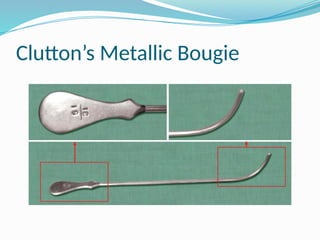
Clutton’s Metallic Bougie
 Features
 This is a solid, cylindrical metallic instrument.
 The handle is violin shaped with a long shaft and the
terminal end has a smooth curve with a blunt tip.
 The number written on the handle has a difference of
4.
 The denominator number denotes the circumference
in mm at the base and the numerator denotes the
circumference in mm at the tip.
 This is available in a set of 12 and the different
numbers are 6/10, 8/12, 10/14, 12/16 ........... 28/32.
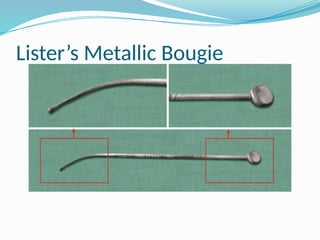
Lister’s Metallic Bougie
 Features
 This is identical to a Clutton’s metallic bougie.
 The differences are:
 The handle is rounded and the tip is olive pointed.
 The number written has a difference of 3 and has
same implication as in Clutton’s metallic bougie.
 This is also available in a set of 12.
Metallic Bougie
 Uses of Metallic Bougie
 Used for dilatation of urethra in urethral stricture
 Used for dilatation of urethra prior to introduction of
cystoscope
 Used during repair of rupture urethra by rail road
technique.
 Used during choledocholithotomy as a sound to
ascertain presence of bile duct stones.
 May be passed through the ampulla of vater to
ascertain the patency of ampulla.
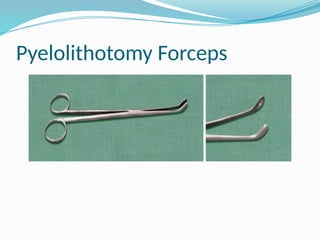
Pyelolithotomy Forceps
 This is a long instrument, consists of finger bows, a
pair of shaft and a pair of blades.
 The blades are small and oval with transverse
serration on the inner side of the blades with a
central groove.
 There is no rachet in the shaft.
 Uses
 This instrument is used to hold the stone during
nephrolithotomy, pyelolithotomy or ureterolithotomy.
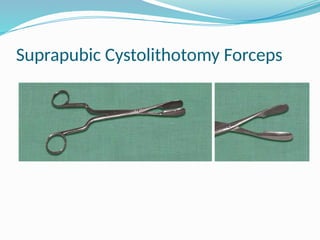
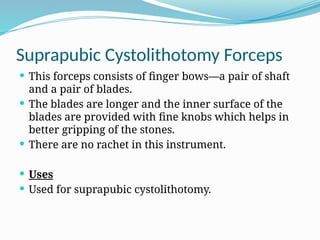
Suprapubic Cystolithotomy Forceps
 This forceps consists of finger bows—a pair of shaft
and a pair of blades.
 The blades are longer and the inner surface of the
blades are provided with fine knobs which helps in
better gripping of the stones.
 There are no rachet in this instrument.
 Uses
 Used for suprapubic cystolithotomy.
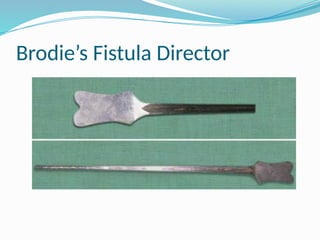
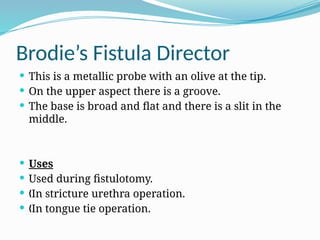
Brodie’s Fistula Director
 This is a metallic probe with an olive at the tip.
 On the upper aspect there is a groove.
 The base is broad and flat and there is a slit in the
middle.
 Uses
 Used during fistulotomy.
 In stricture urethra operation.
„
 In tongue tie operation.
„
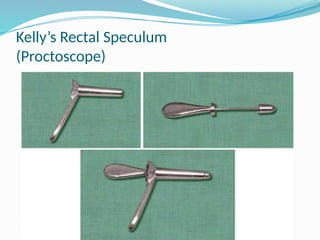
Kelly’s Rectal Speculum
(Proctoscope)
Kelly’s Rectal Speculum
(Proctoscope)
 Features
 The instrument is about 3 inches long.
 There is a hollow outer sheath where a handle is
attached.
 The terminal end of the sheath is either round or
obliquely cut.
 The inner rod is called the obturator and its terminal
part is smooth and rounded and fits well with the
outer sheath.
 In some instrument, there is arrangement for
attachment of a light.
Kelly’s Rectal Speculum
(Proctoscope)
 Uses
 The proctoscope may be used for diagnostic or
therapeutic purposes.
 Diagnostic use:
 Diagnosis of piles
 An anal or a rectal polyp
 Carcinoma of anal canal or rectum
 Diagnosis of ulcerative colitis
 Internal opening of a perianal fistula
 Apex of an intussusception
Kelly’s Rectal Speculum
(Proctoscope)
 Therapeutic uses:
 Used during injection sclerotherapy of piles.
 Used during polypectomy
 Used while taking a biopsy from a rectal or an anal
growth.
Thank You

All and Surgery Surgery Instruments (1).pptx

  • 1.
    Instruments Part A Instruments UsedFor Preparing the Surgical Patient and Incision Making
  • 2.
    Content  Cheatle’s Forceps Rampley’s Sponge Holding Forceps  Mayo’s Towel Clip  Bard Parker Knife Handle  Different Types of Blades
  • 3.
  • 4.
    Cheatle’s Forceps Features  Large,heavy metallic forceps with curved blades  Blades have transverse serrations  No lock.
  • 5.
    Cheatle’s Forceps Uses  Topick sterilised and autoclaved articles like drapes, instruments etc.  To avoid touching sterilised articles with hands.  Kept dipped in an antiseptic solution like Cidex.
  • 6.
  • 7.
    Rampley’s Sponge HoldingForceps Features  Long Instrument 9 ½” with thin shaft.  It has a catch lock which helps in holding the sponge while cleaning.  Blades are fenestrated near its distal end.  Inner aspect of blades is serrated.
  • 8.
    Rampley’s Sponge HoldingForceps Uses  Used for cleansing the skin.  Used to clean the blood during dissection of Calot's triangle during cholecystectomy.  Used to hold the fundus and Hartmann's pouch of the gall bladder during cholecystectomy.  Used for removing the laminated membrane and the daughter cysts during operation of hydatid cyst.
  • 9.
  • 10.
    Towel Clip A. Doyens’Cross Action Type Towel Clip  Pincer like instrument.  On pressing the shaft the instrument opens up.  On releasing the shaft the instrument closes and the two clips meet each other and provide the pinching action.
  • 11.
    Towel Clip B. Backhaus’Towel (Corner) Clip  Provided with finger bows, a rachet, a pair of shaft and two sharp hooks.  On closing the rachet the two clips are apposed and on releasing the rachet the clips open up.
  • 12.
    Towel Clip Uses  Usedfor fixing the draping sheets. „  Used for fixing the diathermy cables, suction tubes, „ laparoscopic camera cables and fiberoptic light cables to the draping sheets.  May be used as a tongue holding forceps. „  May be used as cord holding forceps. „  May be used for holding the ribs while elevating a „ flail segment of chest.
  • 13.
  • 14.
    Bard Parker KnifeHandle  Flat stainless steel instrument with one end narrower with a slot on either side for attaching the scalpel blade.  A number is written on the handle.  The numbers maybe 3, 5, 7 and 4.  In scalpel handle no. 4 the site for attachment of the blade is little wider than the handle number 3, 5 and 7 where it is little narrower.
  • 15.
  • 16.
    Scalpel uses  Usedto make skin incisions for any operation.  The blade numbers 20, 21, 22, 23 and 24 used for larger incisions and dissections.  The blade number 15 used for smaller incisions, „ while excising a sebaceous cyst or during venesection.  The blade number 11, stab knife is used to incise the „ skin for drainage of an abscess.  It is used to incise the skin for inserting drains. „
  • 17.
    Scalpel uses  Toraise skin flaps during mastectomy, incisional hernia repair, during thyroidectomy and radical neck dissection.  To divide the cystic duct and artery during cholecystectomy after these are ligated.  The renal and splenic pedicle may also be divided by „ a scalpel after ligature during nephrectomy and splenectomy.
  • 18.
    Instruments Part B Instruments Usedfor Hemostasis and Needle Holders
  • 19.
    Content  Artery Forceps Mosquito Artery Forceps  Kocher’s Hemostatic Forceps  Mayo’s Kidney Pedicle Clamp  Needle Holder  Difference Between Artery Forceps and Needle Holder
  • 20.
  • 21.
    Artery Forceps  Types Small or Mosquito  Medium  Large or Pedicular  Can be curved or Straight.
  • 22.
    Artery Forceps Features  Innermargins of the blades are serrated.  Blades are conical and blunt.  Blades can be held together by means of a catch-lock.  In Spencer Well’s variety there is transverse serrations in the whole length of the blade.  In Kelly and Adson’s variety the transverse serrations are in distal part of the blade.
  • 23.
    Artery Forceps Uses  Usedto hold bleeding vessels while cutting through different layers of tissues.  Used to hold the cut margins of the rectus sheath, linea alba, external oblique aponeurosis and the surgical peritoneum.  Used to split the internal oblique and transversus abdominis muscle during appendicectomy.  May be used to crush the base of appendix during appendicectomy.
  • 24.
    Artery Forceps  Whiledoing intestinal resection and anastomosis, the mesenteric vessels are held in between hemostatic forceps and the desired line of mesentery is divided.  Used to dissect the vein while doing venesection in the arm (Basilic or cephali vein) or in the leg (great saphenous vein).  Used for blunt dissection while doing lymph node biopsy, excision of lipoma sebaceous cyst.
  • 25.
    Artery Forceps  Maybe used to open an abscess by Hilton’s method.  May be used to hold the end of a ligature while suturing.  May be used to tie a knot after suturing.  May be used as a dressing forceps.
  • 26.
  • 27.
    Mosquito Artery Forceps Features  Light, small and delicate instrument  The blades are smaller and there are fine transverse serrations in the blades.  The tip of the blades are conical and are non-toothed.
  • 28.
    Mosquito Artery Forceps Uses  Used to hold fine bleeding vessels.  Used as hemostatic forceps for operations in infants and children where the vessels are delicate.  Used during circumcision.
  • 29.
  • 30.
    Kocher’s Hemostatic Forceps Features  The blades are slightly longer than in a Spencer Well's type of hemostatic forceps.  At the tip of the blades there is a tooth in one blade „ and a groove in the other blade where the tooth fits.  Suitable for holding vessels in tough structures like palm, soles and the scalp where the vessels tend to retract in the deep fascia.
  • 31.
    Kocher’s Hemostatic Forceps Uses  Used to hold perforating vessels during mastectomy.  Used around the margin of thyroid gland lobe before excision of the enlarged thyroid lobe.  Used for holding vessels in the scalp while raising a skin flap for craniotomy.  Used to hold bleeding vessels while operating on palm and sole.
  • 32.
  • 33.
    Mayo’s Kidney PedicleClamp  Features  This is a stout and large forceps.  The blades are long and angled to provide a good view at a depth.  There are vertical serrations in the blades.
  • 34.
    Mayo’s Kidney PedicleClamp  Uses  Used during nephrectomy to hold the renal pedicles before division  May be used during splenectomy to hold the splenic pedicle.
  • 35.
  • 36.
    Needle Holder  Features The blades of the needle holder are smaller in comparison to the shaft of the instrument.  There are criss cross serrations in the blade  There is a longitudinal groove in the center of the criss cross serration which allows firm gripping of the needle.
  • 37.
    Needle Holder  Uses The needle holders with fine blades are used to hold finer needles (2/0, 3/0, 4/0 atraumatic catgut, vicryl, mersilk).  The small sized needle holders are used for suturing on the surface.  The long needle holders are used for suturing at the depth inside the abdomen, pelvis or chest.  The curved needle holders are used for suturing in a cavity or at a depth for better visualization.
  • 38.
    Difference Between ArteryForceps and Needle Holder Artery Forceps Needle Holder Jaws are half as big as shaft Jaws are small compared to shaft Has transverse serrations Has crisscross serrations. No grove Has longitudinal groove Conical and blunt jaws Blunt and stout jaws
  • 39.
    Instruments Part C Dissecting ForcepsAnd Tissue Holding Forceps
  • 40.
    Content  Plain DissectingForceps  Toothed Dissecting Forceps  Allis’ Tissue Forceps  Lane’s Tissue Forceps  Babcock’s Tissue Forceps
  • 41.
  • 42.
    Plain Dissecting Forceps Features  There are grooves on the shaft of the instrument which allows easy gripping.  There are transverse serrations at the tip of the blades which helps in lifting the tissues and the needle during suturing.  There are no tooth at the tip.
  • 43.
    Plain Dissecting Forceps Uses  Used during almost all operations to hold delicate structures like peritoneum, vessels, nerves and muscles during dissection and suturing.  Used during appendicectomy to bring out the cecum and to deliver the appendix when it is held by the Babcock’s tissue forceps.  Used during gastrojejunostomy, gut resection anastomosis to hold the gut margin during suturing.  Used to hold blood vessels, nerves during dissection.
  • 44.
    Plain Dissecting Forceps Used to hold the peritoneum during closure of midline or paramedian abdominal incision  Used during hernia operation to hold the hernial sac during dissection of the sac from the cord structures.  Fine tipped forceps is used during nerve repair and vascular anastomosis.  Used in pediatric patient to hold the delicate structures during suturing
  • 45.
  • 46.
    Toothed Dissecting Forceps Features  The design is same as the plain dissecting forceps but there is a tooth at the tip of one blade and a groove at the tip of the other blade.  Because of the presence of the tooth, the tissues may be better gripped and there is less chance of slipping.
  • 47.
    Toothed Dissecting Forceps Uses  Used during almost all operations to hold tough structures like skin, fascia and aponeurosis.  Used to hold the cut skin margins during suturing.  Used to hold the linea alba or the rectus sheath during closure of abdominal incision.  Used to hold the scalp during closure of scalp incision.  Used to hold the cut margins of the prepuce for suturing during circumcision.
  • 48.
  • 49.
    Allis’ Tissue Forceps Features  This is a light instrument.  The blades are longer and there is a gap between the blades which can accommodate some amount of tissue.  The tip of the blades are provided with sharp teeth with grooves in between.  When the ratchet is closed the teeth of the one blade fits in the groove of the other blade and vice versa
  • 50.
    Allis’ Tissue Forceps Uses  During laparotomy through midline incision, skin margins may be retracted by applying Allis tissue forceps to the skin margin while linea alba is incised.  While closing the midline incision the linea alba may be held up by Allis tissue forceps during suturing.  Used to hold the skin margins during incisional hernia operations to raise the skin flaps.  Used during thyroid operations, neck dissection to hold the margins of the skin while raising skin flaps.
  • 51.
    Allis’ Tissue Forceps Used to hold the cut margins of the bladder during transvesical prostatectomy or suprapubic cystolithotomy.  Used to hold the neck of the bladder during bladder neck resection.  Used to hold the galea aponeurotica while raising a skin flap during craniotomy.  Used to hold the skin flaps while excising a lipoma, sebaceous cyst or lymph node.
  • 52.
  • 53.
    Lane’s Tissue Forceps Features  This is a thick and heavy instrument.  The terminal part of the blades are curved and fenestrated.  At the tip there is a heavy tooth in one blade with groove in the other blade.  Because of stout teeth at the tip this holds tissues firmly but it is traumatizing.
  • 54.
    Lane’s Tissue Forceps Uses  During mastectomy it may be used to hold the breast „ while dissecting it off from the pectoral fascia.  Used during submandibular or parotid gland excision to hold the gland during dissection from the adjacent structures.  May be used to fix the draping sheets and also to fix „ the suction tube and the diathermy cable to the draping sheets as an alternative to towel clip.
  • 55.
  • 56.
    Babcock’s Tissue Forceps Features  This is a light instrument.  The terminal part of the blades are curved and fenestrated.  The tip is provided with a ridge in one blade and groove in the other.  As there are no teeth this is a non-traumatic forceps.  The fenestration in the blade allows some soft tissue to be accommodated in the hollow while holding it.
  • 57.
    Babcock’s Tissue Forceps Uses  Used during appendicectomy. One holds the appendix near its tip, one holds the body of the appendix and the third holds the base of the appendix.  Used during gastrectomy, gastrojejunostomy to hold the margins of the stomach while applying an occlusion clamp.  Used during small and large intestine resection anastomosis to hold the margins of the gut before applying an intestinal occlusion clamp.
  • 58.
    Babcock’s Tissue Forceps Used during gastrostomy or jejunostomy to hold the gut while applying purse string suture.  Used to hold the cut margins of the bladder during transvesical prostatec tomy or suprapubic cystolithotomy.
  • 59.
  • 60.
    Content  Scissors  Mayo’sScissors  McIndoe Scissors  Metzenbaum scissors  Cat’s Paw Retractor  Langenbeck’s Retractor  Czerny’s Retractor  Morris Retractor  Deaver’s Retractor
  • 61.
    Mayo’s Scissors Mayo’s scissorsare usually long and stout scissors.
  • 62.
    Mayo’s Scissors  Uses Used for cutting sutures. „  Used during appendicectomy to split the internal „ oblique and transversus abdominis muscle.  Used to cut tough structures like linea alba, external oblique aponeurosis, anterior and posterior rectus sheath during entry into the abdomen by a midline, paramedian or subcostal incision.  May be used to cut dressings.  May be used to cut a corrugated rubber sheet drain.
  • 63.
  • 64.
    McIndoe Scissors  Features •These are fine scissors. • The blades are delicate and smaller than in Mayo’s scissors.
  • 65.
    McIndoe Scissors  Uses Used during appendicectomy to cut the external oblique aponeurosis and peritoneum. The mesoappendix is cut after being ligated.  Used during herniorrhaphy:  To cut the external oblique aponeurosis to expose the inguinal canal.  To dissect the hernial sac from the cord structures and to open the fundus of the hernial sac.  „Used during mastectomy and incisional hernia operation to raise the skin flap by sharp dissection. „
  • 66.
    McIndoe Scissors  Usedduring thyroidectomy and radical neck dissection to raise skin flaps by sharp dissection.  Used during splenectomy, nephrectomy to cut the „ pedicles after ligature.  Used during cholecystectomy to cut the cystic duct and the artery after they are ligated.
  • 67.
  • 68.
    Metzenbaum scissors  Features This is a long fine scissors with long blades in comparison to the shaft of the instrument.  This instrument may be straight or curved.
  • 69.
    Metzenbaum scissors  Uses The Metzenbaum scissors are used for dissection at the depth.  Used during vagotomy to divide the nerves after ligature.  Used during cholecystectomy to divide the cystic „ duct and artery after ligature.
  • 70.
  • 71.
    Cat’s Paw Retractor There are multiple hooks with pointed edges.  The pointed edges are helpful for firm retraction.  Uses  Used for retraction of skin flaps or fascia for operation at the surface,  e.g. excisions of sebaceous cyst, lipoma, dermoid, etc.
  • 72.
  • 73.
    Langenbeck’s Retractor  Features The single bladed Langenbach’s retractor has a handle, a long shaft and a flat solid blade.  The blade is curved at right angle to the shaft.  The tip of the blade is curved at right angle for better retraction of the tissues.  In double bladed retractor there is another flat solid blade at the other end of the shaft.
  • 74.
    Langenbeck’s Retractor  Uses Retractors placed suitably help in better visualization of the operative field.  The tissue handling may also be minimized.  Bleeding may be better seen and controlled with placement of retractors.
  • 75.
  • 76.
    Czerny’s Retractor  Atone end there is a flat blade at right angle to the shaft with the tip curved at right angle  The other end has a biflanged hook.
  • 77.
  • 78.
    • Features • Thedesign is like L. • The handle is wider and the blade is also wider. • The lower end of the blade is curved inward at right angle.
  • 79.
    Morris Retractor  Uses These retractors are used for tissue retraction during different operations.  Used during appendicectomy to retract the layers of „ the abdominal wall while making the incision. „  Used while making and closing different abdominal incisions for ease of working in deeper layers of the abdominal wall.  Used during thyroidectomy to retract the strap „ muscles and the sternomastoid for dissection and ligation of the thyroid vessels.
  • 80.
    Morris Retractor  Usedduring modified radical mastectomy for retraction of pectoralis major muscle for better visualization during axillary dissection.  Used during inguinal hernia operation for retraction of different layers for proper visualization during repair of the posterior wall of the inguinal canal.  Used during radical neck dissection for retraction of skin flaps, sternocleidomastoid muscle for better visualization at depth.
  • 81.
  • 82.
    Deaver’s Retractor  Alarge curved retractor which is shaped like “S”.  Uses  Used during cholecystectomy for retraction of right lobe of liver.  Used during truncal vagotomy for retraction of left lobe of liver.  Used during gastrectomy for retraction of liver. „  Used during pancreaticojejunostomy for retraction „ of stomach.
  • 83.
    Deaver’s Retractor  Usedduring right or left hemicolectomy to retract the abdominal wall while mobilizing the colon from the paracolic gutter.  Used during kidney operation to retract the abdominal wall.  Used during anterior resection of rectum or „ abdominoperineal resection to retract the urinary bladder in male or uterus in female during dissection in the pelvis.
  • 84.
    Instruments Part E Instruments Usedfor GI Surgery and Biliary Tract Surgery
  • 85.
    Contents  Gastric Clamps Intestinal Clamps  Cholecystectomy Forceps  Right angled forceps (Lahey’s forceps).  Desjardin’s Choledocholithotomy Forceps
  • 86.
  • 87.
    Gastric Occlusion Clamps A.Moynihan’s gastric occlusion clamp:  This is a long instrument with finger bows, a rachet and a pair of long shaft provided with a pair of long stout blades.  There are transverse serrations in the blade with a linear fenestration along the center of each blade extending near the tip of the blade.  This instrument may be curved or straight.
  • 88.
    Gastric Occlusion Clamps B.Kocher’s gastric occlusion clamp:  Kocher’s gastric occlusion clamp is also a long instrument with finger bows, a rachet, a pair of shaft and a pair of long blades.  The blades are provided with vertical serrations and there are no fenestration in the blades.  This instrument may be straight or curved.  Uses  Used during gastrojejunostomy. „  Used during gastrectomy. „
  • 89.
  • 90.
    Intestinal Occlusion Clamps Doyen’sintestinal occlusion clamps:  This instrument has finger bows, a pair of shaft with a pair of long blades.  The blades are lighter and there are vertical serrations in the blade.  This instrument may be curved or straight.  Uses  This instrument is used for gut resection and anastomosis.
  • 91.
  • 92.
    Cholecystectomy Forceps  Features These are stout and heavy instruments.  In addition to the finger bows and catch there is a pair of long shafts with a pair of relatively small blades with blunt tips.  The long instrument helps working at a depth.
  • 93.
    Cholecystectomy Forceps  InMoynihan’s forceps the blade is slightly angled to the shaft and there are transverse serrations in the blade.  In Henry Gray’s forceps the blade is longer than in a Moynihan’s forceps which is angled at almost right angle to the shaft and there are critical serrations in the blade.
  • 94.
    Cholecystectomy Forceps  Uses Used during cholecystectomy. „  One pair of forceps is used to hold the fundus of the gallbladder and one pair to hold near the Hartmann’s pouch. „  The cystic duct and artery may be dissected by Moynihan’s forceps.
  • 95.
    Right angled forceps(Lahey’s forceps).
  • 96.
    Right angled forceps(Lahey’s forceps).  Features  Like a hemostatic forceps this instrument has finger bows, a catch, a pair of shaft and a pair of blades.  The terminal part of blades are bent at right angles to the shaft of the instrument.  There are transverse serrations in the blade.
  • 97.
    Right angled forceps(Lahey’s forceps).  Uses  Used to dissect pedicles of important organs and a ligature may be passedaround the dissected vessels.  Used as a hemostatic forceps to hold a bleeding vessel at a depth.  Used during cholecystectomy to dissect the cystic „ duct and the artery and to pass a ligature around these structures.  Used during gastrectomies to dissect and pass ligatures around the left gastric artery, right gastric artery, gastroepiploic vessels before their divisions.
  • 98.
    Right angled forceps(Lahey’s forceps).  Used during splenectomy to dissect the splenic artery and the vein and to pass ligature around them.  Used during nephrectomy to dissect the renal vessels and to pass ligature around them.  Used during thyroidectomy to dissect the middle thyroid vein, superior thyroid pedicle and the inferior thyroid vessels and to pass ligature around them.  Used during vagotomy to dissect the anterior and „ posterior vagus nerves and pass ligatures around these structures before their division.
  • 99.
  • 100.
    Desjardin’s Choledocholithotomy Forceps Features  This is a long and slender instrument.  There are finger bows but no catch.  The shafts are curved, in some it is a gentle curve and in other varieties there are different degrees of curvature.  The blades are small and fenestrated centrally.  There are no serrations in the blade.
  • 101.
    Desjardin’s Choledocholithotomy Forceps Uses  This is used during choledocholithotomy.  This is used during laparoscopic cholecystectomy. While extracting the gallbladder through the epigastric or umbilical port, the gallbladder is partially delivered through the wound.The gallbladder is opened and the stone removed from the gallbladder by the Desjardin’s choledocholithotomy forceps.  It may also be used during removal of kidney, ureteric or bladder stone.
  • 102.
    Instruments Part F Instruments usedin Urology and Ano-rectal Surgery
  • 103.
    Content  Urethral Dilator/Metallic bougie  Pyelolithotomy Forceps  Cystolithotomy Forceps  Brodie’s Fistula Director  Kelly’s Rectal Speculum (Proctoscope)
  • 104.
  • 105.
    Clutton’s Metallic Bougie Features  This is a solid, cylindrical metallic instrument.  The handle is violin shaped with a long shaft and the terminal end has a smooth curve with a blunt tip.  The number written on the handle has a difference of 4.  The denominator number denotes the circumference in mm at the base and the numerator denotes the circumference in mm at the tip.  This is available in a set of 12 and the different numbers are 6/10, 8/12, 10/14, 12/16 ........... 28/32.
  • 106.
  • 107.
    Lister’s Metallic Bougie Features  This is identical to a Clutton’s metallic bougie.  The differences are:  The handle is rounded and the tip is olive pointed.  The number written has a difference of 3 and has same implication as in Clutton’s metallic bougie.  This is also available in a set of 12.
  • 108.
    Metallic Bougie  Usesof Metallic Bougie  Used for dilatation of urethra in urethral stricture  Used for dilatation of urethra prior to introduction of cystoscope  Used during repair of rupture urethra by rail road technique.  Used during choledocholithotomy as a sound to ascertain presence of bile duct stones.  May be passed through the ampulla of vater to ascertain the patency of ampulla.
  • 109.
  • 110.
    Pyelolithotomy Forceps  Thisis a long instrument, consists of finger bows, a pair of shaft and a pair of blades.  The blades are small and oval with transverse serration on the inner side of the blades with a central groove.  There is no rachet in the shaft.  Uses  This instrument is used to hold the stone during nephrolithotomy, pyelolithotomy or ureterolithotomy.
  • 111.
  • 112.
    Suprapubic Cystolithotomy Forceps This forceps consists of finger bows—a pair of shaft and a pair of blades.  The blades are longer and the inner surface of the blades are provided with fine knobs which helps in better gripping of the stones.  There are no rachet in this instrument.  Uses  Used for suprapubic cystolithotomy.
  • 113.
  • 114.
    Brodie’s Fistula Director This is a metallic probe with an olive at the tip.  On the upper aspect there is a groove.  The base is broad and flat and there is a slit in the middle.  Uses  Used during fistulotomy.  In stricture urethra operation. „  In tongue tie operation. „
  • 115.
  • 116.
    Kelly’s Rectal Speculum (Proctoscope) Features  The instrument is about 3 inches long.  There is a hollow outer sheath where a handle is attached.  The terminal end of the sheath is either round or obliquely cut.  The inner rod is called the obturator and its terminal part is smooth and rounded and fits well with the outer sheath.  In some instrument, there is arrangement for attachment of a light.
  • 117.
    Kelly’s Rectal Speculum (Proctoscope) Uses  The proctoscope may be used for diagnostic or therapeutic purposes.  Diagnostic use:  Diagnosis of piles  An anal or a rectal polyp  Carcinoma of anal canal or rectum  Diagnosis of ulcerative colitis  Internal opening of a perianal fistula  Apex of an intussusception
  • 118.
    Kelly’s Rectal Speculum (Proctoscope) Therapeutic uses:  Used during injection sclerotherapy of piles.  Used during polypectomy  Used while taking a biopsy from a rectal or an anal growth.
  • 119.