Classification of surgical
instruments
Surgical instruments
• A collective term used for those instruments which are used for
surgical procedures.
1. Scissors
2. Tissue forceps
3. Towel clips
4. Scalpels and blades
5. Needles
6. Needle holders
Basic surgical instruments
General surgery
4 types
• Retracting and exposing instuments
• Cutting and dissecting
• Clamping and occluding
• Grasping and holding
Retracting or exposing instruments
• Used to hold back or retract tissues to gain exposure to the surgery
site.
1. Self retaining ;
stay open on their own
1. Manual
held by hand
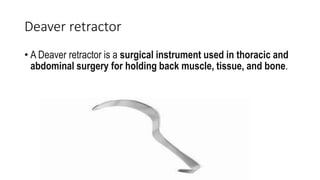
Deaver retractor
• A Deaver retractor is a surgical instrument used in thoracic and
abdominal surgery for holding back muscle, tissue, and bone.
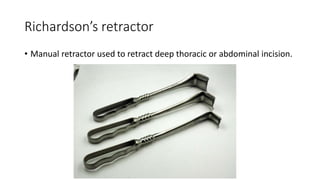
Richardson’s retractor
• Manual retractor used to retract deep thoracic or abdominal incision.
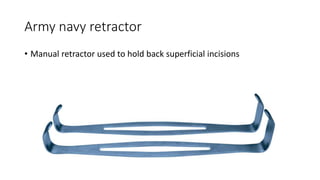
Army navy retractor
• Manual retractor used to hold back superficial incisions
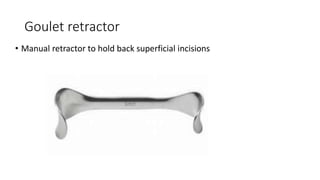
Goulet retractor
• Manual retractor to hold back superficial incisions
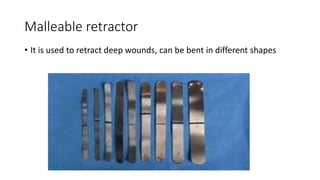
Malleable retractor
• It is used to retract deep wounds, can be bent in different shapes
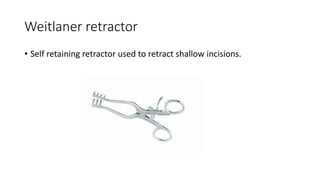
Weitlaner retractor
• Self retaining retractor used to retract shallow incisions.
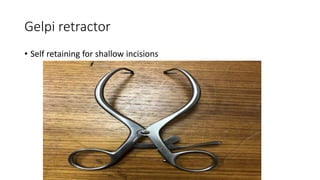
Gelpi retractor
• Self retaining for shallow incisions
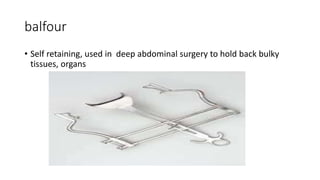
balfour
• Self retaining, used in deep abdominal surgery to hold back bulky
tissues, organs
Cutting and dissecting
instruments
Cont.
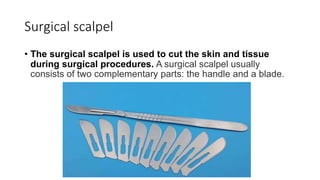
Surgical scalpel
• The surgical scalpel is used to cut the skin and tissue
during surgical procedures. A surgical scalpel usually
consists of two complementary parts: the handle and a blade.
Numbering system
• The numbering system goes back to Morgan Parker, who numbered
the handles from 1 to 9 and assigned the surgical blades a number
from 10 to 20. Surgical blades are often purchased separately from
the surgical blade handle. The surgeon selects the best surgical blade
handle for the procedure.
• Surgical blade handles vary in size, weight, and length to provide the
surgeon with optimal precision, balance, and visibility
Scalpels
• 7 handle with 15 blade
used to cut deep delicate tissue
• 3 handle with 10 blade
used to cut superficial tissue
• 4 handle with twenty blade
used to cut skin
scissors
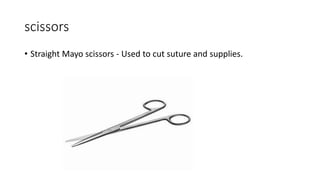
• Straight Mayo scissors - Used to cut suture and supplies.
Curved mayo scissors
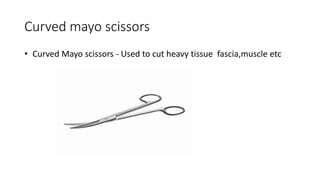
• Curved Mayo scissors - Used to cut heavy tissue fascia,muscle etc
Metzenbaum scissors
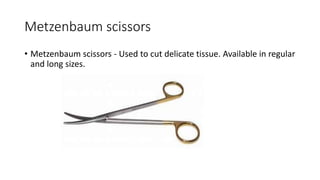
• Metzenbaum scissors - Used to cut delicate tissue. Available in regular
and long sizes.
According to shape
• Straight blunt
To cut and dissect muscles
• Straight pointed
to cut other tissues
• Lister bandage
to remove bandages and dressings
Bone cutters
• A bone cutter is a surgical instrument used to cut or remove bones. In
addition to surgery, they are also used in forensics
Unpowered – Unpowered bone cutting implements
include varieties of hacksaw and sabre saw.
cont
• Reciprocating – Usually a powered rotary oscillation is applied to a
specialised cutting implement to provide smooth controllable cuts
into bone, for applications, from skull cutting to rib cutting. A sternal
saw is a reciprocating bone cutter.[
cont
• Sonic (or sound cutting) – The sonic cutter is still experimental, but its
primary focus is to use high frequency, high amplitude sound to
remove material (in this case bone), providing the ability to cut. Some
tissue sonic cutters are being produced.
• A costotome in the open position
• Costotome – A costotome is a specialised rib cutter used to gain
access to the thoracic cavity. It has two levers; the first one to be
operated grasps the rib, and the second one cuts the rib.[4][5]
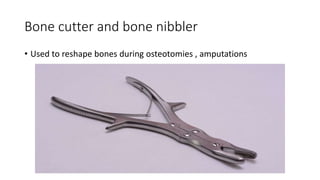
Bone cutter and bone nibbler
• Used to reshape bones during osteotomies , amputations
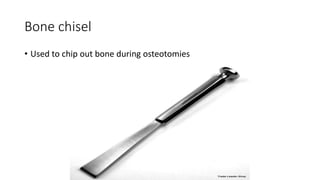
Bone chisel
• Used to chip out bone during osteotomies
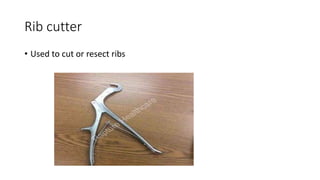
Rib cutter
• Used to cut or resect ribs
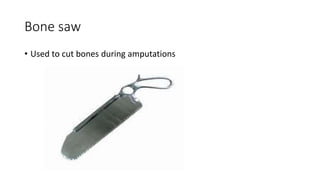
Bone saw
• Used to cut bones during amputations
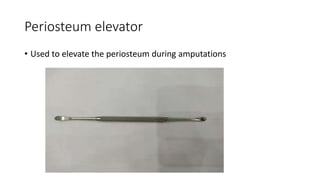
Periosteum elevator
• Used to elevate the periosteum during amputations

Classification of surgical instruments.pptx

  • 1.
  • 2.
    Surgical instruments • Acollective term used for those instruments which are used for surgical procedures. 1. Scissors 2. Tissue forceps 3. Towel clips 4. Scalpels and blades 5. Needles 6. Needle holders
  • 3.
  • 4.
    4 types • Retractingand exposing instuments • Cutting and dissecting • Clamping and occluding • Grasping and holding
  • 5.
    Retracting or exposinginstruments • Used to hold back or retract tissues to gain exposure to the surgery site. 1. Self retaining ; stay open on their own 1. Manual held by hand
  • 6.
    Deaver retractor • ADeaver retractor is a surgical instrument used in thoracic and abdominal surgery for holding back muscle, tissue, and bone.
  • 7.
    Richardson’s retractor • Manualretractor used to retract deep thoracic or abdominal incision.
  • 8.
    Army navy retractor •Manual retractor used to hold back superficial incisions
  • 9.
    Goulet retractor • Manualretractor to hold back superficial incisions
  • 10.
    Malleable retractor • Itis used to retract deep wounds, can be bent in different shapes
  • 11.
    Weitlaner retractor • Selfretaining retractor used to retract shallow incisions.
  • 12.
    Gelpi retractor • Selfretaining for shallow incisions
  • 13.
    balfour • Self retaining,used in deep abdominal surgery to hold back bulky tissues, organs
  • 14.
  • 15.
    Surgical scalpel • Thesurgical scalpel is used to cut the skin and tissue during surgical procedures. A surgical scalpel usually consists of two complementary parts: the handle and a blade.
  • 16.
    Numbering system • Thenumbering system goes back to Morgan Parker, who numbered the handles from 1 to 9 and assigned the surgical blades a number from 10 to 20. Surgical blades are often purchased separately from the surgical blade handle. The surgeon selects the best surgical blade handle for the procedure. • Surgical blade handles vary in size, weight, and length to provide the surgeon with optimal precision, balance, and visibility
  • 17.
    Scalpels • 7 handlewith 15 blade used to cut deep delicate tissue • 3 handle with 10 blade used to cut superficial tissue • 4 handle with twenty blade used to cut skin
  • 18.
    scissors • Straight Mayoscissors - Used to cut suture and supplies.
  • 19.
    Curved mayo scissors •Curved Mayo scissors - Used to cut heavy tissue fascia,muscle etc
  • 20.
    Metzenbaum scissors • Metzenbaumscissors - Used to cut delicate tissue. Available in regular and long sizes.
  • 21.
    According to shape •Straight blunt To cut and dissect muscles • Straight pointed to cut other tissues • Lister bandage to remove bandages and dressings
  • 22.
    Bone cutters • Abone cutter is a surgical instrument used to cut or remove bones. In addition to surgery, they are also used in forensics Unpowered – Unpowered bone cutting implements include varieties of hacksaw and sabre saw.
  • 23.
    cont • Reciprocating –Usually a powered rotary oscillation is applied to a specialised cutting implement to provide smooth controllable cuts into bone, for applications, from skull cutting to rib cutting. A sternal saw is a reciprocating bone cutter.[
  • 24.
    cont • Sonic (orsound cutting) – The sonic cutter is still experimental, but its primary focus is to use high frequency, high amplitude sound to remove material (in this case bone), providing the ability to cut. Some tissue sonic cutters are being produced. • A costotome in the open position • Costotome – A costotome is a specialised rib cutter used to gain access to the thoracic cavity. It has two levers; the first one to be operated grasps the rib, and the second one cuts the rib.[4][5]
  • 25.
    Bone cutter andbone nibbler • Used to reshape bones during osteotomies , amputations
  • 26.
    Bone chisel • Usedto chip out bone during osteotomies
  • 27.
    Rib cutter • Usedto cut or resect ribs
  • 28.
    Bone saw • Usedto cut bones during amputations
  • 29.
    Periosteum elevator • Usedto elevate the periosteum during amputations