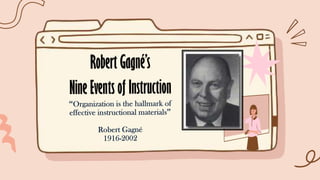
Gagné’s Theoretical Background
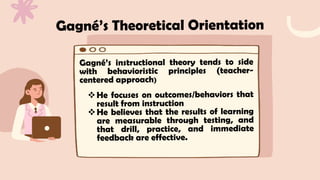
Robert Gagné is best known for his:
• Learning Outcomes
• Learning Conditions
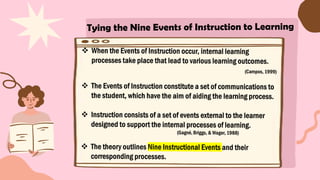
• Nine Events of Instruction
Gagné’s theories have been applied to
instructional design in many other areas:
• Military
• Instructional Systems Development
• Flying
• Lots of others
1. Gaining attention
Giving learner a
stimulus to ensure reception
of coming instruction
2. Informing the learner of
the objective
Telling learner what
they will be able to do for the
instruction
3. Stimulating recall of
prior learning
Asking for recall of
existing relevant knowledge
 Attention
 Expectancy
 Retrieval to
working memory
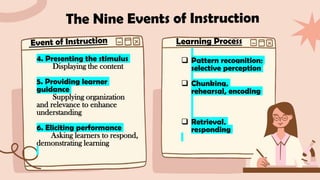
4. Presenting the stimulus
Displaying the content
5. Providing learner
guidance
Supplying organization
and relevance to enhance
understanding
6. Eliciting performance
Asking learners to respond,
demonstrating learning
 Pattern recognition;
selective perception
 Chunking,
rehearsal, encoding
 Retrieval,
responding
7. Providing Feedback
Giving immediate
feedback on learner's
performance.
8. Assessing performance
Assessing and providing
feedback to learners
9. Enhancing retention and
transfer
Providing diverse practice
to generalize the capability
 Reinforcement,
error correction
 Responding,
retention
 Retention, retrieval,
generalization
Instructional Design Model 2.pptx

Instructional Design Model 2.pptx

  • 2.
    Gagné’s Theoretical Background RobertGagné is best known for his: • Learning Outcomes • Learning Conditions • Nine Events of Instruction Gagné’s theories have been applied to instructional design in many other areas: • Military • Instructional Systems Development • Flying • Lots of others
  • 7.
    1. Gaining attention Givinglearner a stimulus to ensure reception of coming instruction 2. Informing the learner of the objective Telling learner what they will be able to do for the instruction 3. Stimulating recall of prior learning Asking for recall of existing relevant knowledge  Attention  Expectancy  Retrieval to working memory
  • 8.
    4. Presenting thestimulus Displaying the content 5. Providing learner guidance Supplying organization and relevance to enhance understanding 6. Eliciting performance Asking learners to respond, demonstrating learning  Pattern recognition; selective perception  Chunking, rehearsal, encoding  Retrieval, responding
  • 9.
    7. Providing Feedback Givingimmediate feedback on learner's performance. 8. Assessing performance Assessing and providing feedback to learners 9. Enhancing retention and transfer Providing diverse practice to generalize the capability  Reinforcement, error correction  Responding, retention  Retention, retrieval, generalization