Okwuo Ikechukwu (M.B.B.S Nig)
1
2
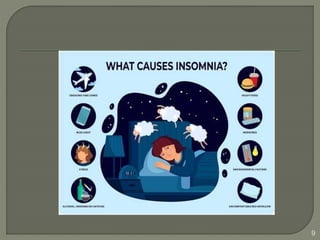
-Insomnia is one of the most common health
concerns among adults.
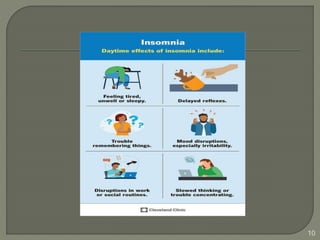
-Insomnia causes sleep issues that interfere
with daily life and can be debilitating for
some people.
-Many factors contribute may contribute to
this pathology.
3
 Insomnia is difficulty falling asleep or
staying asleep, even when a person has
the chance to do so.
4
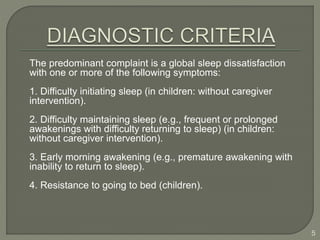
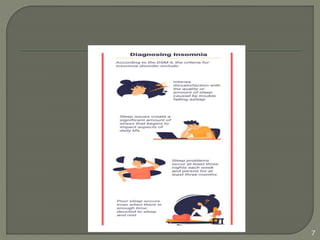
The predominant complaint is a global sleep dissatisfaction
with one or more of the following symptoms:
1. Difficulty initiating sleep (in children: without caregiver
intervention).
2. Difficulty maintaining sleep (e.g., frequent or prolonged
awakenings with difficulty returning to sleep) (in children:
without caregiver intervention).
3. Early morning awakening (e.g., premature awakening with
inability to return to sleep).
4. Resistance to going to bed (children).
5
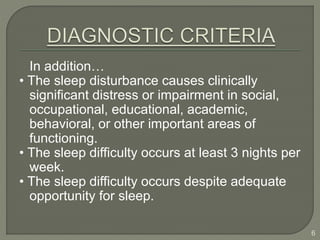
In addition…
• The sleep disturbance causes clinically
significant distress or impairment in social,
occupational, educational, academic,
behavioral, or other important areas of
functioning.
• The sleep difficulty occurs at least 3 nights per
week.
• The sleep difficulty occurs despite adequate
opportunity for sleep.
6
7
• Increasing age
• Females: menstruation and menopause
• Psychiatric illness
• Medical co-morbidities
• Impaired social relationships
• Shift workers
• Long distance travelers.
8
9
10
 Insomnia can be classified based on
duration into transient, acute, or chronic.
11
• Transient insomnia lasts for less than a
week.
• It can be caused by another disorder, by
changes in the sleep environment, by the
timing of sleep, severe depression, or by
stress.
• Its consequences – sleepiness and
impaired psychomotor performance – are
similar to those of sleep deprivation.
12
• It is the inability to consistently sleep well
for a period of less than a month.
• These problems occur despite adequate
opportunity and circumstances for sleep
and they must result in problems with
daytime function.
• Acute insomnia is also known as short term
insomnia or stress related insomnia.
13
• Situational stress (e.g. occupational,
interpersonal, financial, academic,
medical, jet lag)
• Withdrawal from substances
• Environmental stressors (e.g. noise,
hospitalization)
• Death or illness of a loved one
14
• Chronic insomnia lasts for longer than a
month.
• It can be caused by another disorder, or it can
be a primary disorder.
• People with high levels of stress hormones or
shifts in the levels of cytokines are more likely
than others to have chronic insomnia.
• Its effects include muscular weariness,
hallucinations, and/or mental fatigue.
• Chronic insomnia can cause double vision.
15
• Primary sleep disorder
Idiopathic, central sleep apnea, restless
leg syndrome
• Psychiatric conditions:
Anxiety, depression, mania, schizophrenia
16
-Medications and substances:
Anticholinergic agents,antidepressants
(SSRIs,bupropion, antiepileptics, nicotine ,
oral contraceptives, thyroid, ETOH withdrawal
-Medical disorders:
Cancer, chronic pain, congestive heart failure,
COPD, end-stage renal disease,
gastroesophageal reflux disease, HIV/AIDS,
hyperthyroidism, nocturia
17
Pharmacological and non-pharmacological.
Non-pharmacological:
-Cognitive behavioural therapy
-Relaxation therapy
-Sleep hygiene
-Alternative therapy
18
• Helps change incorrect beliefs and
attitudes about sleep (e.g., unrealistic
expectations, misconceptions amplifying
consequences of sleeplessness)
• Keeping regular bedtime and wake time
19
• Tensing and relaxing different muscle
groups
• Breathing exercises
• Guided imagery meditation
20
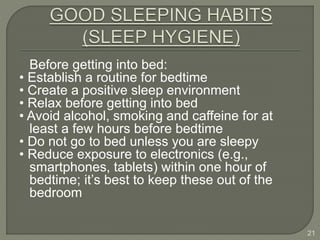
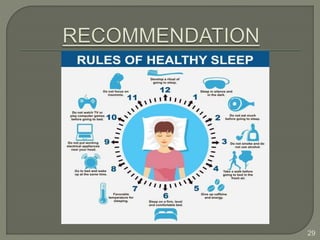
Before getting into bed:
• Establish a routine for bedtime
• Create a positive sleep environment
• Relax before getting into bed
• Avoid alcohol, smoking and caffeine for at
least a few hours before bedtime
• Do not go to bed unless you are sleepy
• Reduce exposure to electronics (e.g.,
smartphones, tablets) within one hour of
bedtime; it’s best to keep these out of the
bedroom
21
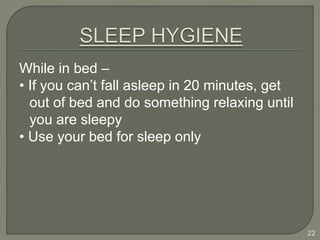
While in bed –
• If you can’t fall asleep in 20 minutes, get
out of bed and do something relaxing until
you are sleepy
• Use your bed for sleep only
22
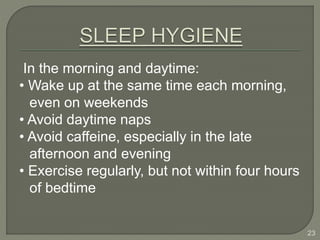
In the morning and daytime:
• Wake up at the same time each morning,
even on weekends
• Avoid daytime naps
• Avoid caffeine, especially in the late
afternoon and evening
• Exercise regularly, but not within four hours
of bedtime
23
• Acupuncture
• Yoga
• Meditation
24
Guidelines for Prescribing Hypnotics
• Initiate hypnotic use while identifying and
addressing specific behaviours,
circumstances, and underlying disorders
contributing to insomnia
• Prescribe the lowest effective dose of the
hypnotic
• Prescribe hypnotics for short durations (two
to four weeks) and intermittently (duration
based on patient's return to an acceptable
sleep cycle)
25
• Avoid hypnotic use or exercise caution if
patient has a history of substance abuse,
myasthenia gravis, respiratory impairment, or
acute CVA
• Watch for requests for escalating doses or
resistance to tapering or discontinuing
hypnotics
• Hypnotics should be discontinued gradually
(i.e., tapered); physician should be alert for
adverse effects (especially rebound insomnia)
and withdrawal phenomena
26
Benzodiazepams, non-benzodiazepams,
barbiturates, antihistamines,
antidepressants
27
28
29

INSOMNIA.pptx

  • 1.
  • 2.
  • 3.
    -Insomnia is oneof the most common health concerns among adults. -Insomnia causes sleep issues that interfere with daily life and can be debilitating for some people. -Many factors contribute may contribute to this pathology. 3
  • 4.
     Insomnia isdifficulty falling asleep or staying asleep, even when a person has the chance to do so. 4
  • 5.
    The predominant complaintis a global sleep dissatisfaction with one or more of the following symptoms: 1. Difficulty initiating sleep (in children: without caregiver intervention). 2. Difficulty maintaining sleep (e.g., frequent or prolonged awakenings with difficulty returning to sleep) (in children: without caregiver intervention). 3. Early morning awakening (e.g., premature awakening with inability to return to sleep). 4. Resistance to going to bed (children). 5
  • 6.
    In addition… • Thesleep disturbance causes clinically significant distress or impairment in social, occupational, educational, academic, behavioral, or other important areas of functioning. • The sleep difficulty occurs at least 3 nights per week. • The sleep difficulty occurs despite adequate opportunity for sleep. 6
  • 7.
  • 8.
    • Increasing age •Females: menstruation and menopause • Psychiatric illness • Medical co-morbidities • Impaired social relationships • Shift workers • Long distance travelers. 8
  • 9.
  • 10.
  • 11.
     Insomnia canbe classified based on duration into transient, acute, or chronic. 11
  • 12.
    • Transient insomnialasts for less than a week. • It can be caused by another disorder, by changes in the sleep environment, by the timing of sleep, severe depression, or by stress. • Its consequences – sleepiness and impaired psychomotor performance – are similar to those of sleep deprivation. 12
  • 13.
    • It isthe inability to consistently sleep well for a period of less than a month. • These problems occur despite adequate opportunity and circumstances for sleep and they must result in problems with daytime function. • Acute insomnia is also known as short term insomnia or stress related insomnia. 13
  • 14.
    • Situational stress(e.g. occupational, interpersonal, financial, academic, medical, jet lag) • Withdrawal from substances • Environmental stressors (e.g. noise, hospitalization) • Death or illness of a loved one 14
  • 15.
    • Chronic insomnialasts for longer than a month. • It can be caused by another disorder, or it can be a primary disorder. • People with high levels of stress hormones or shifts in the levels of cytokines are more likely than others to have chronic insomnia. • Its effects include muscular weariness, hallucinations, and/or mental fatigue. • Chronic insomnia can cause double vision. 15
  • 16.
    • Primary sleepdisorder Idiopathic, central sleep apnea, restless leg syndrome • Psychiatric conditions: Anxiety, depression, mania, schizophrenia 16
  • 17.
    -Medications and substances: Anticholinergicagents,antidepressants (SSRIs,bupropion, antiepileptics, nicotine , oral contraceptives, thyroid, ETOH withdrawal -Medical disorders: Cancer, chronic pain, congestive heart failure, COPD, end-stage renal disease, gastroesophageal reflux disease, HIV/AIDS, hyperthyroidism, nocturia 17
  • 18.
    Pharmacological and non-pharmacological. Non-pharmacological: -Cognitivebehavioural therapy -Relaxation therapy -Sleep hygiene -Alternative therapy 18
  • 19.
    • Helps changeincorrect beliefs and attitudes about sleep (e.g., unrealistic expectations, misconceptions amplifying consequences of sleeplessness) • Keeping regular bedtime and wake time 19
  • 20.
    • Tensing andrelaxing different muscle groups • Breathing exercises • Guided imagery meditation 20
  • 21.
    Before getting intobed: • Establish a routine for bedtime • Create a positive sleep environment • Relax before getting into bed • Avoid alcohol, smoking and caffeine for at least a few hours before bedtime • Do not go to bed unless you are sleepy • Reduce exposure to electronics (e.g., smartphones, tablets) within one hour of bedtime; it’s best to keep these out of the bedroom 21
  • 22.
    While in bed– • If you can’t fall asleep in 20 minutes, get out of bed and do something relaxing until you are sleepy • Use your bed for sleep only 22
  • 23.
    In the morningand daytime: • Wake up at the same time each morning, even on weekends • Avoid daytime naps • Avoid caffeine, especially in the late afternoon and evening • Exercise regularly, but not within four hours of bedtime 23
  • 24.
  • 25.
    Guidelines for PrescribingHypnotics • Initiate hypnotic use while identifying and addressing specific behaviours, circumstances, and underlying disorders contributing to insomnia • Prescribe the lowest effective dose of the hypnotic • Prescribe hypnotics for short durations (two to four weeks) and intermittently (duration based on patient's return to an acceptable sleep cycle) 25
  • 26.
    • Avoid hypnoticuse or exercise caution if patient has a history of substance abuse, myasthenia gravis, respiratory impairment, or acute CVA • Watch for requests for escalating doses or resistance to tapering or discontinuing hypnotics • Hypnotics should be discontinued gradually (i.e., tapered); physician should be alert for adverse effects (especially rebound insomnia) and withdrawal phenomena 26
  • 27.
  • 28.
  • 29.