SuccessRIGHTNow
LICENSINGSYSTEM
Pre-course workbook
Welcome to the Primerica SuccessRIGHTNow
Licensing System! You’ve made the right decision in
seeking financial freedom for you and your family.
Our goal is to help you obtain your insurance license
and get on the road to success!
	 It doesn’t matter what kind of educational background you have or how much you know about
financial services. Primerica’s pre-licensing courses are designed to meet you where you are
and help you get to where you want to be — a life licensed representative! Our highly qualified
Licensing Coaches will guide you through the entire licensing process — from what you need to
do before class, to passing your exam and getting your license. There’s no need to worry about
“going back to school.” Your Licensing Coach will be there for you every step of the way to help
you personalize your study plan and succeed.
WHAT DO I DO NEXT?
•	 Prepare for success by reviewing the Insurance Basics information on the next two
pages and watching the Pre-course video series. To watch the videos, log on to
www.primericaonline.com (POL) and click on the Education link under the Licensing
& Education tab. There are five short, easy-to-understand videos that will give you
an excellent overview of some of the important terms that will be covered in your
pre-licensing course.
•	 Schedule to take your state insurance exam within five days of completing class.
•	 Sign into POL (www.primericaonline.com) and get familiar with its benefits.
•	 Be sure to participate in your base shop and recruiter’s activities.
•	 Attend pre-licensing. Show up excited and ready to learn!
•	 Complete pre-licensing.
•	 “Go Green” on a Practice Test on POL’s PassNow.
•	 Most of all, dream big! You joined this business to do something amazing for yourself
and your family. Getting licensed is the first step. You can do it!
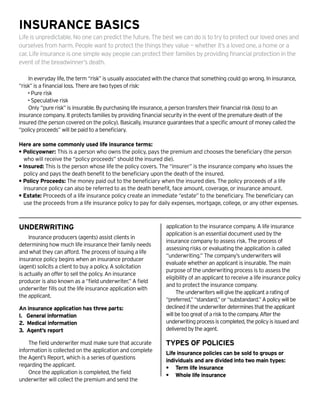
Insurance Basics
Life is unpredictable. No one can predict the future. The best we can do is to try to protect our loved ones and
ourselves from harm. People want to protect the things they value — whether it’s a loved one, a home or a
car. Life insurance is one simple way people can protect their families by providing financial protection in the
event of the breadwinner’s death.
	 In everyday life, the term “risk” is usually associated with the chance that something could go wrong. In insurance,
“risk” is a financial loss. There are two types of risk:
• Pure risk
• Speculative risk
	Only “pure risk” is insurable. By purchasing life insurance, a person transfers their financial risk (loss) to an
insurance company. It protects families by providing financial security in the event of the premature death of the
insured (the person covered on the policy). Basically, insurance guarantees that a specific amount of money called the
“policy proceeds” will be paid to a beneficiary.
Here are some commonly used life insurance terms:
• Policyowner: This is a person who owns the policy, pays the premium and chooses the beneficiary (the person
who will receive the “policy proceeds” should the insured die).
• Insured: This is the person whose life the policy covers. The “insurer” is the insurance company who issues the
policy and pays the death benefit to the beneficiary upon the death of the insured.
• Policy Proceeds: The money paid out to the beneficiary when the insured dies. The policy proceeds of a life
insurance policy can also be referred to as the death benefit, face amount, coverage, or insurance amount.
• Estate: Proceeds of a life insurance policy create an immediate “estate” to the beneficiary. The beneficiary can
use the proceeds from a life insurance policy to pay for daily expenses, mortgage, college, or any other expenses.
Underwriting
	 Insurance producers (agents) assist clients in
determining how much life insurance their family needs
and what they can afford. The process of issuing a life
insurance policy begins when an insurance producer
(agent) solicits a client to buy a policy. A solicitation
is actually an offer to sell the policy. An insurance
producer is also known as a “field underwriter.” A field
underwriter fills out the life insurance application with
the applicant.
An insurance application has three parts:
I. General information
2. Medical information
3. Agent’s report
	 The field underwriter must make sure that accurate
information is collected on the application and complete
the Agent’s Report, which is a series of questions
regarding the applicant.
	Once the application is completed, the field
underwriter will collect the premium and send the
application to the insurance company. A life insurance
application is an essential document used by the
insurance company to assess risk. The process of
assessing risks or evaluating the application is called
“underwriting.” The company’s underwriters will
evaluate whether an applicant is insurable. The main
purpose of the underwriting process is to assess the
eligibility of an applicant to receive a life insurance policy
and to protect the insurance company.
	 Theunderwriterswillgivetheapplicant aratingof
“preferred,”“standard,”or “substandard.”Apolicywillbe
declinediftheunderwriter determinesthat theapplicant
willbetoogreat ofa risktothecompany. Afterthe
underwritingprocessiscompleted, thepolicy isissuedand
deliveredbytheagent.
Types of Policies
Life insurance policies can be sold to groups or
individuals and are divided into two main types:
•	 Term life insurance
• 	 Whole life insurance
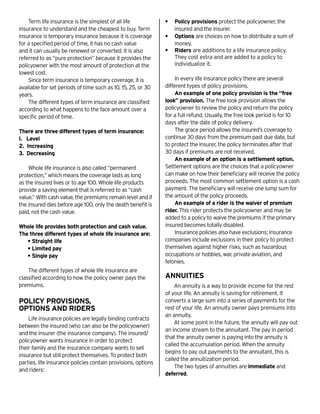
Term life insurance is the simplest of all life
insurance to understand and the cheapest to buy. Term
insurance is temporary insurance because it is coverage
for a specified period of time, it has no cash value
and it can usually be renewed or converted. It is also
referred to as “pure protection” because it provides the
policyowner with the most amount of protection at the
lowest cost.
	 Since term insurance is temporary coverage, it is
available for set periods of time such as 10, 15, 25, or 30
years.
	 The different types of term insurance are classified
according to what happens to the face amount over a
specific period of time.
There are three different types of term insurance:
I. Level
2. Increasing
3. Decreasing
	
	Whole life insurance is also called “permanent
protection,” which means the coverage lasts as long
as the insured lives or to age 100. Whole life products
provide a saving element that is referred to as “cash
value.” With cash value, the premiums remain level and if
the insured dies before age 100, only the death benefit is
paid, not the cash value.
Whole life provides both protection and cash value.
The three different types of whole life insurance are:
• Straight life
• Limited pay
• Single pay
	 The different types of whole life insurance are
classified according to how the policy owner pays the
premiums.
Policy Provisions,
Options and Riders
	 Life insurance policies are legally binding contracts
between the insured (who can also be the policyowner)
and the insurer (the insurance company). The insured/
policyowner wants insurance in order to protect
their family and the insurance company wants to sell
insurance but still protect themselves. To protect both
parties, life insurance policies contain provisions, options
and riders:
•	 Policy provisions protect the policyowner, the
insured and the insurer.
•	 Options are choices on how to distribute a sum of
money.
•	 Riders are additions to a life insurance policy.
They cost extra and are added to a policy to
individualize it.
	 In every life insurance policy there are several
different types of policy provisions.
	 An example of one policy provision is the “free
look” provision. The free look provision allows the
policyowner to review the policy and return the policy
for a full refund. Usually, the free look period is for 10
days after the date of policy delivery.
	 The grace period allows the insured’s coverage to
continue 30 days from the premium past due date, but
to protect the insurer, the policy terminates after that
30 days if premiums are not received.
	 An example of an option is a settlement option.
Settlement options are the choices that a policyowner
can make on how their beneficiary will receive the policy
proceeds. The most common settlement option is a cash
payment. The beneficiary will receive one lump sum for
the amount of the policy proceeds.
	 An example of a rider is the waiver of premium
rider. This rider protects the policyowner and may be
added to a policy to waive the premiums if the primary
insured becomes totally disabled.
	 Insurance policies also have exclusions; insurance
companies include exclusions in their policy to protect
themselves against higher risks, such as hazardous
occupations or hobbies, war, private aviation, and
felonies.
Annuities
An annuity is a way to provide income for the rest
of your life. An annuity is saving for retirement. It
converts a large sum into a series of payments for the
rest of your life. An annuity owner pays premiums into
an annuity.
At some point in the future, the annuity will pay out
an income stream to the annuitant. The pay in period
that the annuity owner is paying into the annuity is
called the accumulation period. When the annuity
begins to pay out payments to the annuitant, this is
called the annuitization period.
The two types of annuities are immediate and
deferred.

ins101_en

  • 1.
  • 2.
    Welcome to thePrimerica SuccessRIGHTNow Licensing System! You’ve made the right decision in seeking financial freedom for you and your family. Our goal is to help you obtain your insurance license and get on the road to success! It doesn’t matter what kind of educational background you have or how much you know about financial services. Primerica’s pre-licensing courses are designed to meet you where you are and help you get to where you want to be — a life licensed representative! Our highly qualified Licensing Coaches will guide you through the entire licensing process — from what you need to do before class, to passing your exam and getting your license. There’s no need to worry about “going back to school.” Your Licensing Coach will be there for you every step of the way to help you personalize your study plan and succeed. WHAT DO I DO NEXT? • Prepare for success by reviewing the Insurance Basics information on the next two pages and watching the Pre-course video series. To watch the videos, log on to www.primericaonline.com (POL) and click on the Education link under the Licensing & Education tab. There are five short, easy-to-understand videos that will give you an excellent overview of some of the important terms that will be covered in your pre-licensing course. • Schedule to take your state insurance exam within five days of completing class. • Sign into POL (www.primericaonline.com) and get familiar with its benefits. • Be sure to participate in your base shop and recruiter’s activities. • Attend pre-licensing. Show up excited and ready to learn! • Complete pre-licensing. • “Go Green” on a Practice Test on POL’s PassNow. • Most of all, dream big! You joined this business to do something amazing for yourself and your family. Getting licensed is the first step. You can do it!
  • 3.
    Insurance Basics Life isunpredictable. No one can predict the future. The best we can do is to try to protect our loved ones and ourselves from harm. People want to protect the things they value — whether it’s a loved one, a home or a car. Life insurance is one simple way people can protect their families by providing financial protection in the event of the breadwinner’s death. In everyday life, the term “risk” is usually associated with the chance that something could go wrong. In insurance, “risk” is a financial loss. There are two types of risk: • Pure risk • Speculative risk Only “pure risk” is insurable. By purchasing life insurance, a person transfers their financial risk (loss) to an insurance company. It protects families by providing financial security in the event of the premature death of the insured (the person covered on the policy). Basically, insurance guarantees that a specific amount of money called the “policy proceeds” will be paid to a beneficiary. Here are some commonly used life insurance terms: • Policyowner: This is a person who owns the policy, pays the premium and chooses the beneficiary (the person who will receive the “policy proceeds” should the insured die). • Insured: This is the person whose life the policy covers. The “insurer” is the insurance company who issues the policy and pays the death benefit to the beneficiary upon the death of the insured. • Policy Proceeds: The money paid out to the beneficiary when the insured dies. The policy proceeds of a life insurance policy can also be referred to as the death benefit, face amount, coverage, or insurance amount. • Estate: Proceeds of a life insurance policy create an immediate “estate” to the beneficiary. The beneficiary can use the proceeds from a life insurance policy to pay for daily expenses, mortgage, college, or any other expenses. Underwriting Insurance producers (agents) assist clients in determining how much life insurance their family needs and what they can afford. The process of issuing a life insurance policy begins when an insurance producer (agent) solicits a client to buy a policy. A solicitation is actually an offer to sell the policy. An insurance producer is also known as a “field underwriter.” A field underwriter fills out the life insurance application with the applicant. An insurance application has three parts: I. General information 2. Medical information 3. Agent’s report The field underwriter must make sure that accurate information is collected on the application and complete the Agent’s Report, which is a series of questions regarding the applicant. Once the application is completed, the field underwriter will collect the premium and send the application to the insurance company. A life insurance application is an essential document used by the insurance company to assess risk. The process of assessing risks or evaluating the application is called “underwriting.” The company’s underwriters will evaluate whether an applicant is insurable. The main purpose of the underwriting process is to assess the eligibility of an applicant to receive a life insurance policy and to protect the insurance company. Theunderwriterswillgivetheapplicant aratingof “preferred,”“standard,”or “substandard.”Apolicywillbe declinediftheunderwriter determinesthat theapplicant willbetoogreat ofa risktothecompany. Afterthe underwritingprocessiscompleted, thepolicy isissuedand deliveredbytheagent. Types of Policies Life insurance policies can be sold to groups or individuals and are divided into two main types: • Term life insurance • Whole life insurance
  • 4.
    Term life insuranceis the simplest of all life insurance to understand and the cheapest to buy. Term insurance is temporary insurance because it is coverage for a specified period of time, it has no cash value and it can usually be renewed or converted. It is also referred to as “pure protection” because it provides the policyowner with the most amount of protection at the lowest cost. Since term insurance is temporary coverage, it is available for set periods of time such as 10, 15, 25, or 30 years. The different types of term insurance are classified according to what happens to the face amount over a specific period of time. There are three different types of term insurance: I. Level 2. Increasing 3. Decreasing Whole life insurance is also called “permanent protection,” which means the coverage lasts as long as the insured lives or to age 100. Whole life products provide a saving element that is referred to as “cash value.” With cash value, the premiums remain level and if the insured dies before age 100, only the death benefit is paid, not the cash value. Whole life provides both protection and cash value. The three different types of whole life insurance are: • Straight life • Limited pay • Single pay The different types of whole life insurance are classified according to how the policy owner pays the premiums. Policy Provisions, Options and Riders Life insurance policies are legally binding contracts between the insured (who can also be the policyowner) and the insurer (the insurance company). The insured/ policyowner wants insurance in order to protect their family and the insurance company wants to sell insurance but still protect themselves. To protect both parties, life insurance policies contain provisions, options and riders: • Policy provisions protect the policyowner, the insured and the insurer. • Options are choices on how to distribute a sum of money. • Riders are additions to a life insurance policy. They cost extra and are added to a policy to individualize it. In every life insurance policy there are several different types of policy provisions. An example of one policy provision is the “free look” provision. The free look provision allows the policyowner to review the policy and return the policy for a full refund. Usually, the free look period is for 10 days after the date of policy delivery. The grace period allows the insured’s coverage to continue 30 days from the premium past due date, but to protect the insurer, the policy terminates after that 30 days if premiums are not received. An example of an option is a settlement option. Settlement options are the choices that a policyowner can make on how their beneficiary will receive the policy proceeds. The most common settlement option is a cash payment. The beneficiary will receive one lump sum for the amount of the policy proceeds. An example of a rider is the waiver of premium rider. This rider protects the policyowner and may be added to a policy to waive the premiums if the primary insured becomes totally disabled. Insurance policies also have exclusions; insurance companies include exclusions in their policy to protect themselves against higher risks, such as hazardous occupations or hobbies, war, private aviation, and felonies. Annuities An annuity is a way to provide income for the rest of your life. An annuity is saving for retirement. It converts a large sum into a series of payments for the rest of your life. An annuity owner pays premiums into an annuity. At some point in the future, the annuity will pay out an income stream to the annuitant. The pay in period that the annuity owner is paying into the annuity is called the accumulation period. When the annuity begins to pay out payments to the annuitant, this is called the annuitization period. The two types of annuities are immediate and deferred.