28 Plenary Ideas for
Mathematics
28 Plenary Ideas for
Mathematics
By Jean KnappBy Jean Knapp
04/13/16 J. Knapp 6/06 2
Plenary (1)Plenary (1)
• Work in pairs.
• List 3 things you learnt today.
• Share them with your partner.
• List 3 things your partner remembers.
• Is there anything additional you
remember?
• Ext: Rank these on a ladder from most
to least difficult.
• Work in pairs.
• List 3 things you learnt today.
• Share them with your partner.
• List 3 things your partner remembers.
• Is there anything additional you
remember?
• Ext: Rank these on a ladder from most
to least difficult.
04/13/16 J. Knapp 6/06 3
Plenary (2)Plenary (2)
The 60 Second Challenge!
• Turn to your partner and talk for 60
seconds about everything you
remember about the lesson.
• Use the success criteria to guide your
discussion.
• Then swap roles.
The 60 Second Challenge!
• Turn to your partner and talk for 60
seconds about everything you
remember about the lesson.
• Use the success criteria to guide your
discussion.
• Then swap roles.
04/13/16 J. Knapp 6/06 4
Plenary (3)Plenary (3)
Vocabulary Challenge:
• List all the Maths vocabulary covered in the lesson.
• Either:
- Draw pictures to represent each word.
- Act out the word.
- Link the word to another word in your list (or from previous
learning).
- Choose one from the list to describe and get your partner
to guess which one it is.
- Odd One Out.
- Aide memoirs – students devise their own
ideas/mnemonics e.g. picture/visual clues to the meaning
of key words (e.g. parallel or Never Eat Shredded Wheat)
linked to objective
Vocabulary Challenge:
• List all the Maths vocabulary covered in the lesson.
• Either:
- Draw pictures to represent each word.
- Act out the word.
- Link the word to another word in your list (or from previous
learning).
- Choose one from the list to describe and get your partner
to guess which one it is.
- Odd One Out.
- Aide memoirs – students devise their own
ideas/mnemonics e.g. picture/visual clues to the meaning
of key words (e.g. parallel or Never Eat Shredded Wheat)
linked to objective
04/13/16 J. Knapp 6/06 5
Plenary (3)Plenary (3)
Top Tips!
• Work as pairs.
• List 3-5 top tips for completing the
mathematics/success criteria you have
covered during the lesson.
• Compare your lists.
• Are there any different approaches you
might try?
Top Tips!
• Work as pairs.
• List 3-5 top tips for completing the
mathematics/success criteria you have
covered during the lesson.
• Compare your lists.
• Are there any different approaches you
might try?
04/13/16 J. Knapp 6/06 6
Plenary (5)Plenary (5)
Work in Pairs.
Take one minute to compose two
sentences in your head to explain:
• What we have learnt.
• How we have learnt it.
…using the key words from the lesson.
Share your findings with a partner.
Work in Pairs.
Take one minute to compose two
sentences in your head to explain:
• What we have learnt.
• How we have learnt it.
…using the key words from the lesson.
Share your findings with a partner.
04/13/16 J. Knapp 6/06 7
Plenary (6)Plenary (6)
Work in pairs.
Where can you use/apply this skill in
other areas of mathematics or in other
subjects?
Make a mind map to show the links to
different areas of mathematics and
other subjects.
Share your findings with a partner.
Work in pairs.
Where can you use/apply this skill in
other areas of mathematics or in other
subjects?
Make a mind map to show the links to
different areas of mathematics and
other subjects.
Share your findings with a partner.
04/13/16 J. Knapp 6/06 8
Plenary (7)Plenary (7)
• Work in pairs.
• Show your work to a partner.
• List two effective features of the work.
• Find 1-2 areas of improvement.
• How could you make improvements?
• Work in pairs.
• Show your work to a partner.
• List two effective features of the work.
• Find 1-2 areas of improvement.
• How could you make improvements?
04/13/16 J. Knapp 6/06 9
Plenary (8)Plenary (8)
Progression
• After covering the objectives we have
today, predict what you think the next
stage will be? Why?
• Turn to your partner to share your
thoughts.
Progression
• After covering the objectives we have
today, predict what you think the next
stage will be? Why?
• Turn to your partner to share your
thoughts.
04/13/16 J. Knapp 6/06 10
Plenary (9)Plenary (9)
• Imagine you are the teacher.
• What questions would you ask the
class to they have understood the
learning intentions?
• Share your questions with your
partner.
• Select 1-2 really effective questions
you could ask the whole class.
• Imagine you are the teacher.
• What questions would you ask the
class to they have understood the
learning intentions?
• Share your questions with your
partner.
• Select 1-2 really effective questions
you could ask the whole class.
04/13/16 J. Knapp 6/06 11
Plenary (10)Plenary (10)
Dice Roll
• Split your class into 6 groups and
number them 1-6.
• Roll the dice and the number indicates
the table chosen to start feeding back
findings from a
calculation/investigation.
• Throw the dice again after 30-60
seconds and allow another group to
take over.
Dice Roll
• Split your class into 6 groups and
number them 1-6.
• Roll the dice and the number indicates
the table chosen to start feeding back
findings from a
calculation/investigation.
• Throw the dice again after 30-60
seconds and allow another group to
take over.
04/13/16 J. Knapp 6/06 12
Plenary (11)Plenary (11)
• Write 3 statements from the
mathematics covered in today’s lesson
to be proved true or false.
• Number the class 1-3.
• The number indicates the statement you
must focus on first as an individual for
2-3 minutes and as a group (all the 1s,
2s and 3s in separate groups).
• Feedback an agreed answer and
explanation to the whole class.
• Write 3 statements from the
mathematics covered in today’s lesson
to be proved true or false.
• Number the class 1-3.
• The number indicates the statement you
must focus on first as an individual for
2-3 minutes and as a group (all the 1s,
2s and 3s in separate groups).
• Feedback an agreed answer and
explanation to the whole class.
04/13/16 J. Knapp 6/06 13
Plenary (12)Plenary (12)
• Work in pairs.
• Look at a photocopy of a past
Optional/SATs question with the mark
given.
• Discuss why that mark was given and
1-2 points for improvement (if needed).
• Work in pairs.
• Look at a photocopy of a past
Optional/SATs question with the mark
given.
• Discuss why that mark was given and
1-2 points for improvement (if needed).
04/13/16 J. Knapp 6/06 14
Plenary (13)Plenary (13)
• Make a deliberate mistake with a
similar
calculation/explanation/investigation.
• Work in pairs.
• Can you:
- Spot the mistake?
- Give the correct answer?
- (Ext: Suggest why the mistake may
have been made and what could be
done about it?)
• Make a deliberate mistake with a
similar
calculation/explanation/investigation.
• Work in pairs.
• Can you:
- Spot the mistake?
- Give the correct answer?
- (Ext: Suggest why the mistake may
have been made and what could be
done about it?)
04/13/16 J. Knapp 6/06 15
Plenary (14)Plenary (14)
Misconceptions
• Work in pairs.
• Where errors were made, list the
specific area.
• Why do you find this particularly
difficult?
• Share responses with the teacher/whole
class.
• Consider targets for next
lesson/week/term..
Misconceptions
• Work in pairs.
• Where errors were made, list the
specific area.
• Why do you find this particularly
difficult?
• Share responses with the teacher/whole
class.
• Consider targets for next
lesson/week/term..
04/13/16 J. Knapp 6/06 16
Plenary (15)Plenary (15)
• Take one of the
calculations/shapes/conversions you
may have looked at within the lesson.
• If we know ……………………, what else
do we know?
• Work in pairs and discuss related facts.
• Feedback to class.
• Ext: Give children a known fact and an
unknown fact – find a route from one to
the other.
• Take one of the
calculations/shapes/conversions you
may have looked at within the lesson.
• If we know ……………………, what else
do we know?
• Work in pairs and discuss related facts.
• Feedback to class.
• Ext: Give children a known fact and an
unknown fact – find a route from one to
the other.
04/13/16 J. Knapp 6/06 17
Plenary (16)Plenary (16)
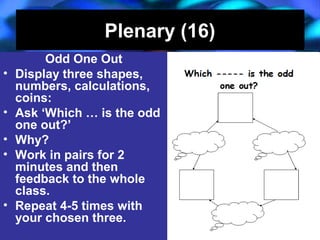
Odd One Out
• Display three shapes,
numbers, calculations,
coins:
• Ask ‘Which … is the odd
one out?’
• Why?
• Work in pairs for 2
minutes and then
feedback to the whole
class.
• Repeat 4-5 times with
your chosen three.
Odd One Out
• Display three shapes,
numbers, calculations,
coins:
• Ask ‘Which … is the odd
one out?’
• Why?
• Work in pairs for 2
minutes and then
feedback to the whole
class.
• Repeat 4-5 times with
your chosen three.
04/13/16 J. Knapp 6/06 18
Plenary (17)Plenary (17)
• Work in pairs.
• From lesson objective write 3 true and
3 false statements, give them to your
partner to sort out.
• Share one of the statements you found
particularly challenging. Why?
• Work in pairs.
• From lesson objective write 3 true and
3 false statements, give them to your
partner to sort out.
• Share one of the statements you found
particularly challenging. Why?
04/13/16 J. Knapp 6/06 19
Plenary (18)Plenary (18)
• Work in pairs.
• Give children a range of
numbers/shapes to sort into 2-3
groups (according to your own
classifications).
• Re-sort the numbers/shapes.
• Feedback findings after 5 minutes to
the whole class.
• Work in pairs.
• Give children a range of
numbers/shapes to sort into 2-3
groups (according to your own
classifications).
• Re-sort the numbers/shapes.
• Feedback findings after 5 minutes to
the whole class.
04/13/16 J. Knapp 6/06 20
Plenary (19)Plenary (19)
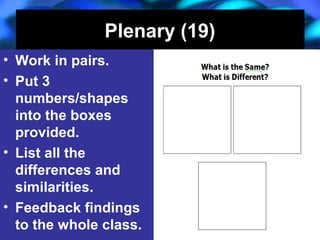
• Work in pairs.
• Put 3
numbers/shapes
into the boxes
provided.
• List all the
differences and
similarities.
• Feedback findings
to the whole class.
• Work in pairs.
• Put 3
numbers/shapes
into the boxes
provided.
• List all the
differences and
similarities.
• Feedback findings
to the whole class.
04/13/16 J. Knapp 6/06 21
Plenary (20)Plenary (20)
Show the Story
• Work in pairs.
• One of the pairs, points to different
parts in the completed
calculation/graph/investigation and the
other provides the commentary.
• Swap roles.
Show the Story
• Work in pairs.
• One of the pairs, points to different
parts in the completed
calculation/graph/investigation and the
other provides the commentary.
• Swap roles.
04/13/16 J. Knapp 6/06 22
Plenary (21)Plenary (21)
Self Evaluation Questions (comparing):
• How did you…?
• Why did you use…?
• If you did it again would you change
the way you did it? Why?
• What else might have helped you?
• Can you do it in two (or more) ways?
Which was the best way? Why?
Self Evaluation Questions (comparing):
• How did you…?
• Why did you use…?
• If you did it again would you change
the way you did it? Why?
• What else might have helped you?
• Can you do it in two (or more) ways?
Which was the best way? Why?
04/13/16 J. Knapp 6/06 23
Plenary (22)Plenary (22)
Take a calculation/shape/graph the
children have been working on and
change it.
Children work in pairs to answer these
questions:
• What might happen if we change…?
• What else might we change?
• Can you predict what would happen
then? Why?
Take a calculation/shape/graph the
children have been working on and
change it.
Children work in pairs to answer these
questions:
• What might happen if we change…?
• What else might we change?
• Can you predict what would happen
then? Why?
04/13/16 J. Knapp 6/06 24
Plenary (23)Plenary (23)
How will you remember this?
• Work in pairs.
• Look at words/knowledge you have
covered today.
• Suggest ways to help other children
remember them.
• Feedback ideas to the whole class.
How will you remember this?
• Work in pairs.
• Look at words/knowledge you have
covered today.
• Suggest ways to help other children
remember them.
• Feedback ideas to the whole class.
04/13/16 J. Knapp 6/06 25
Plenary (24)Plenary (24)
The block it review technique
• Pair up children and ask them to tell each
other:
• 3 things I learnt
• 2 questions I want to ask
• 1 thing I already knew
• Feedback to the class and direct responses
to the success criteria.
The block it review technique
• Pair up children and ask them to tell each
other:
• 3 things I learnt
• 2 questions I want to ask
• 1 thing I already knew
• Feedback to the class and direct responses
to the success criteria.
04/13/16 J. Knapp 6/06 26
Plenary (25)Plenary (25)
Self-Assessment Questions:
(Choose 1-2 as a focus for paired talk)
• Do you remember the learning intention of
the lesson?
• What did you find difficult?
• Did anyone or anything help you move on to
learn something new? (friend, equipment,
resources, teacher)
• What do you need more help with?
• What are you most pleased with?
• Did you learn anything new?
Self-Assessment Questions:
(Choose 1-2 as a focus for paired talk)
• Do you remember the learning intention of
the lesson?
• What did you find difficult?
• Did anyone or anything help you move on to
learn something new? (friend, equipment,
resources, teacher)
• What do you need more help with?
• What are you most pleased with?
• Did you learn anything new?
04/13/16 J. Knapp 6/06 27
Plenary (26)Plenary (26)
Metacognition Questions to Explore:
(Choose 1-2 as a focus for paired talk)
• What have you learnt about the way in which
you learn in this lesson?
• How did working with a partner help you?
• What did you do when you were stuck?
• What skills/techniques/strategies did you use
to learn . . .?
• How will you be able to remember what you
learnt . . .?
Metacognition Questions to Explore:
(Choose 1-2 as a focus for paired talk)
• What have you learnt about the way in which
you learn in this lesson?
• How did working with a partner help you?
• What did you do when you were stuck?
• What skills/techniques/strategies did you use
to learn . . .?
• How will you be able to remember what you
learnt . . .?
04/13/16 J. Knapp 6/06 28
Plenary (27)Plenary (27)
Box 1 and Box 2
• Use the paper boxes or draw 2 boxes on the board, label
box 1 and box 2.
• Put in one number.
• You can use shapes, angles, lines, graphs, calculations,
etc.
• Ask the children what category they think box 1 and box 2
is (in other words, how have I sorted the numbers?
• Now add another number to each box.
• Have you changed your opinion? What category could it be
now?
• Continue adding numbers to each box (limit 4-5 for
children in Years 5 & 6).
• When the children feel they have the category, they can
add a number they feel they can add to the box to
demonstrate full understanding of it.
• This activity allows children to use logic to categorise in
mathematics.
Box 1 and Box 2
• Use the paper boxes or draw 2 boxes on the board, label
box 1 and box 2.
• Put in one number.
• You can use shapes, angles, lines, graphs, calculations,
etc.
• Ask the children what category they think box 1 and box 2
is (in other words, how have I sorted the numbers?
• Now add another number to each box.
• Have you changed your opinion? What category could it be
now?
• Continue adding numbers to each box (limit 4-5 for
children in Years 5 & 6).
• When the children feel they have the category, they can
add a number they feel they can add to the box to
demonstrate full understanding of it.
• This activity allows children to use logic to categorise in
mathematics.
04/13/16 J. Knapp 6/06 29
Plenary (28)Plenary (28)
• Learners apply the five aspects of ALICE thinking to a
mathematical statement, e.g. ‘Everything in the world
can be explained using numbers’:
• A – And…? Put an ‘and’ after the statement then see
what comes to mind
• L – Likely…? How likely is the statement: from 0 =
Impossible to 1= Certain
• I - Imagine if… Being whackily creative, what could
happen as a result of the statement?
• C – Clue please. If the statement was hidden, what
clue could be given to find it out?
• E – Explosion! Throw up into the air the individual
words of the statement, let them fall back together in a
different organisation
• Learners apply the five aspects of ALICE thinking to a
mathematical statement, e.g. ‘Everything in the world
can be explained using numbers’:
• A – And…? Put an ‘and’ after the statement then see
what comes to mind
• L – Likely…? How likely is the statement: from 0 =
Impossible to 1= Certain
• I - Imagine if… Being whackily creative, what could
happen as a result of the statement?
• C – Clue please. If the statement was hidden, what
clue could be given to find it out?
• E – Explosion! Throw up into the air the individual
words of the statement, let them fall back together in a
different organisation

28 plenary ideas_for_mathematics by Jean Knapp

  • 1.
    28 Plenary Ideasfor Mathematics 28 Plenary Ideas for Mathematics By Jean KnappBy Jean Knapp
  • 2.
    04/13/16 J. Knapp6/06 2 Plenary (1)Plenary (1) • Work in pairs. • List 3 things you learnt today. • Share them with your partner. • List 3 things your partner remembers. • Is there anything additional you remember? • Ext: Rank these on a ladder from most to least difficult. • Work in pairs. • List 3 things you learnt today. • Share them with your partner. • List 3 things your partner remembers. • Is there anything additional you remember? • Ext: Rank these on a ladder from most to least difficult.
  • 3.
    04/13/16 J. Knapp6/06 3 Plenary (2)Plenary (2) The 60 Second Challenge! • Turn to your partner and talk for 60 seconds about everything you remember about the lesson. • Use the success criteria to guide your discussion. • Then swap roles. The 60 Second Challenge! • Turn to your partner and talk for 60 seconds about everything you remember about the lesson. • Use the success criteria to guide your discussion. • Then swap roles.
  • 4.
    04/13/16 J. Knapp6/06 4 Plenary (3)Plenary (3) Vocabulary Challenge: • List all the Maths vocabulary covered in the lesson. • Either: - Draw pictures to represent each word. - Act out the word. - Link the word to another word in your list (or from previous learning). - Choose one from the list to describe and get your partner to guess which one it is. - Odd One Out. - Aide memoirs – students devise their own ideas/mnemonics e.g. picture/visual clues to the meaning of key words (e.g. parallel or Never Eat Shredded Wheat) linked to objective Vocabulary Challenge: • List all the Maths vocabulary covered in the lesson. • Either: - Draw pictures to represent each word. - Act out the word. - Link the word to another word in your list (or from previous learning). - Choose one from the list to describe and get your partner to guess which one it is. - Odd One Out. - Aide memoirs – students devise their own ideas/mnemonics e.g. picture/visual clues to the meaning of key words (e.g. parallel or Never Eat Shredded Wheat) linked to objective
  • 5.
    04/13/16 J. Knapp6/06 5 Plenary (3)Plenary (3) Top Tips! • Work as pairs. • List 3-5 top tips for completing the mathematics/success criteria you have covered during the lesson. • Compare your lists. • Are there any different approaches you might try? Top Tips! • Work as pairs. • List 3-5 top tips for completing the mathematics/success criteria you have covered during the lesson. • Compare your lists. • Are there any different approaches you might try?
  • 6.
    04/13/16 J. Knapp6/06 6 Plenary (5)Plenary (5) Work in Pairs. Take one minute to compose two sentences in your head to explain: • What we have learnt. • How we have learnt it. …using the key words from the lesson. Share your findings with a partner. Work in Pairs. Take one minute to compose two sentences in your head to explain: • What we have learnt. • How we have learnt it. …using the key words from the lesson. Share your findings with a partner.
  • 7.
    04/13/16 J. Knapp6/06 7 Plenary (6)Plenary (6) Work in pairs. Where can you use/apply this skill in other areas of mathematics or in other subjects? Make a mind map to show the links to different areas of mathematics and other subjects. Share your findings with a partner. Work in pairs. Where can you use/apply this skill in other areas of mathematics or in other subjects? Make a mind map to show the links to different areas of mathematics and other subjects. Share your findings with a partner.
  • 8.
    04/13/16 J. Knapp6/06 8 Plenary (7)Plenary (7) • Work in pairs. • Show your work to a partner. • List two effective features of the work. • Find 1-2 areas of improvement. • How could you make improvements? • Work in pairs. • Show your work to a partner. • List two effective features of the work. • Find 1-2 areas of improvement. • How could you make improvements?
  • 9.
    04/13/16 J. Knapp6/06 9 Plenary (8)Plenary (8) Progression • After covering the objectives we have today, predict what you think the next stage will be? Why? • Turn to your partner to share your thoughts. Progression • After covering the objectives we have today, predict what you think the next stage will be? Why? • Turn to your partner to share your thoughts.
  • 10.
    04/13/16 J. Knapp6/06 10 Plenary (9)Plenary (9) • Imagine you are the teacher. • What questions would you ask the class to they have understood the learning intentions? • Share your questions with your partner. • Select 1-2 really effective questions you could ask the whole class. • Imagine you are the teacher. • What questions would you ask the class to they have understood the learning intentions? • Share your questions with your partner. • Select 1-2 really effective questions you could ask the whole class.
  • 11.
    04/13/16 J. Knapp6/06 11 Plenary (10)Plenary (10) Dice Roll • Split your class into 6 groups and number them 1-6. • Roll the dice and the number indicates the table chosen to start feeding back findings from a calculation/investigation. • Throw the dice again after 30-60 seconds and allow another group to take over. Dice Roll • Split your class into 6 groups and number them 1-6. • Roll the dice and the number indicates the table chosen to start feeding back findings from a calculation/investigation. • Throw the dice again after 30-60 seconds and allow another group to take over.
  • 12.
    04/13/16 J. Knapp6/06 12 Plenary (11)Plenary (11) • Write 3 statements from the mathematics covered in today’s lesson to be proved true or false. • Number the class 1-3. • The number indicates the statement you must focus on first as an individual for 2-3 minutes and as a group (all the 1s, 2s and 3s in separate groups). • Feedback an agreed answer and explanation to the whole class. • Write 3 statements from the mathematics covered in today’s lesson to be proved true or false. • Number the class 1-3. • The number indicates the statement you must focus on first as an individual for 2-3 minutes and as a group (all the 1s, 2s and 3s in separate groups). • Feedback an agreed answer and explanation to the whole class.
  • 13.
    04/13/16 J. Knapp6/06 13 Plenary (12)Plenary (12) • Work in pairs. • Look at a photocopy of a past Optional/SATs question with the mark given. • Discuss why that mark was given and 1-2 points for improvement (if needed). • Work in pairs. • Look at a photocopy of a past Optional/SATs question with the mark given. • Discuss why that mark was given and 1-2 points for improvement (if needed).
  • 14.
    04/13/16 J. Knapp6/06 14 Plenary (13)Plenary (13) • Make a deliberate mistake with a similar calculation/explanation/investigation. • Work in pairs. • Can you: - Spot the mistake? - Give the correct answer? - (Ext: Suggest why the mistake may have been made and what could be done about it?) • Make a deliberate mistake with a similar calculation/explanation/investigation. • Work in pairs. • Can you: - Spot the mistake? - Give the correct answer? - (Ext: Suggest why the mistake may have been made and what could be done about it?)
  • 15.
    04/13/16 J. Knapp6/06 15 Plenary (14)Plenary (14) Misconceptions • Work in pairs. • Where errors were made, list the specific area. • Why do you find this particularly difficult? • Share responses with the teacher/whole class. • Consider targets for next lesson/week/term.. Misconceptions • Work in pairs. • Where errors were made, list the specific area. • Why do you find this particularly difficult? • Share responses with the teacher/whole class. • Consider targets for next lesson/week/term..
  • 16.
    04/13/16 J. Knapp6/06 16 Plenary (15)Plenary (15) • Take one of the calculations/shapes/conversions you may have looked at within the lesson. • If we know ……………………, what else do we know? • Work in pairs and discuss related facts. • Feedback to class. • Ext: Give children a known fact and an unknown fact – find a route from one to the other. • Take one of the calculations/shapes/conversions you may have looked at within the lesson. • If we know ……………………, what else do we know? • Work in pairs and discuss related facts. • Feedback to class. • Ext: Give children a known fact and an unknown fact – find a route from one to the other.
  • 17.
    04/13/16 J. Knapp6/06 17 Plenary (16)Plenary (16) Odd One Out • Display three shapes, numbers, calculations, coins: • Ask ‘Which … is the odd one out?’ • Why? • Work in pairs for 2 minutes and then feedback to the whole class. • Repeat 4-5 times with your chosen three. Odd One Out • Display three shapes, numbers, calculations, coins: • Ask ‘Which … is the odd one out?’ • Why? • Work in pairs for 2 minutes and then feedback to the whole class. • Repeat 4-5 times with your chosen three.
  • 18.
    04/13/16 J. Knapp6/06 18 Plenary (17)Plenary (17) • Work in pairs. • From lesson objective write 3 true and 3 false statements, give them to your partner to sort out. • Share one of the statements you found particularly challenging. Why? • Work in pairs. • From lesson objective write 3 true and 3 false statements, give them to your partner to sort out. • Share one of the statements you found particularly challenging. Why?
  • 19.
    04/13/16 J. Knapp6/06 19 Plenary (18)Plenary (18) • Work in pairs. • Give children a range of numbers/shapes to sort into 2-3 groups (according to your own classifications). • Re-sort the numbers/shapes. • Feedback findings after 5 minutes to the whole class. • Work in pairs. • Give children a range of numbers/shapes to sort into 2-3 groups (according to your own classifications). • Re-sort the numbers/shapes. • Feedback findings after 5 minutes to the whole class.
  • 20.
    04/13/16 J. Knapp6/06 20 Plenary (19)Plenary (19) • Work in pairs. • Put 3 numbers/shapes into the boxes provided. • List all the differences and similarities. • Feedback findings to the whole class. • Work in pairs. • Put 3 numbers/shapes into the boxes provided. • List all the differences and similarities. • Feedback findings to the whole class.
  • 21.
    04/13/16 J. Knapp6/06 21 Plenary (20)Plenary (20) Show the Story • Work in pairs. • One of the pairs, points to different parts in the completed calculation/graph/investigation and the other provides the commentary. • Swap roles. Show the Story • Work in pairs. • One of the pairs, points to different parts in the completed calculation/graph/investigation and the other provides the commentary. • Swap roles.
  • 22.
    04/13/16 J. Knapp6/06 22 Plenary (21)Plenary (21) Self Evaluation Questions (comparing): • How did you…? • Why did you use…? • If you did it again would you change the way you did it? Why? • What else might have helped you? • Can you do it in two (or more) ways? Which was the best way? Why? Self Evaluation Questions (comparing): • How did you…? • Why did you use…? • If you did it again would you change the way you did it? Why? • What else might have helped you? • Can you do it in two (or more) ways? Which was the best way? Why?
  • 23.
    04/13/16 J. Knapp6/06 23 Plenary (22)Plenary (22) Take a calculation/shape/graph the children have been working on and change it. Children work in pairs to answer these questions: • What might happen if we change…? • What else might we change? • Can you predict what would happen then? Why? Take a calculation/shape/graph the children have been working on and change it. Children work in pairs to answer these questions: • What might happen if we change…? • What else might we change? • Can you predict what would happen then? Why?
  • 24.
    04/13/16 J. Knapp6/06 24 Plenary (23)Plenary (23) How will you remember this? • Work in pairs. • Look at words/knowledge you have covered today. • Suggest ways to help other children remember them. • Feedback ideas to the whole class. How will you remember this? • Work in pairs. • Look at words/knowledge you have covered today. • Suggest ways to help other children remember them. • Feedback ideas to the whole class.
  • 25.
    04/13/16 J. Knapp6/06 25 Plenary (24)Plenary (24) The block it review technique • Pair up children and ask them to tell each other: • 3 things I learnt • 2 questions I want to ask • 1 thing I already knew • Feedback to the class and direct responses to the success criteria. The block it review technique • Pair up children and ask them to tell each other: • 3 things I learnt • 2 questions I want to ask • 1 thing I already knew • Feedback to the class and direct responses to the success criteria.
  • 26.
    04/13/16 J. Knapp6/06 26 Plenary (25)Plenary (25) Self-Assessment Questions: (Choose 1-2 as a focus for paired talk) • Do you remember the learning intention of the lesson? • What did you find difficult? • Did anyone or anything help you move on to learn something new? (friend, equipment, resources, teacher) • What do you need more help with? • What are you most pleased with? • Did you learn anything new? Self-Assessment Questions: (Choose 1-2 as a focus for paired talk) • Do you remember the learning intention of the lesson? • What did you find difficult? • Did anyone or anything help you move on to learn something new? (friend, equipment, resources, teacher) • What do you need more help with? • What are you most pleased with? • Did you learn anything new?
  • 27.
    04/13/16 J. Knapp6/06 27 Plenary (26)Plenary (26) Metacognition Questions to Explore: (Choose 1-2 as a focus for paired talk) • What have you learnt about the way in which you learn in this lesson? • How did working with a partner help you? • What did you do when you were stuck? • What skills/techniques/strategies did you use to learn . . .? • How will you be able to remember what you learnt . . .? Metacognition Questions to Explore: (Choose 1-2 as a focus for paired talk) • What have you learnt about the way in which you learn in this lesson? • How did working with a partner help you? • What did you do when you were stuck? • What skills/techniques/strategies did you use to learn . . .? • How will you be able to remember what you learnt . . .?
  • 28.
    04/13/16 J. Knapp6/06 28 Plenary (27)Plenary (27) Box 1 and Box 2 • Use the paper boxes or draw 2 boxes on the board, label box 1 and box 2. • Put in one number. • You can use shapes, angles, lines, graphs, calculations, etc. • Ask the children what category they think box 1 and box 2 is (in other words, how have I sorted the numbers? • Now add another number to each box. • Have you changed your opinion? What category could it be now? • Continue adding numbers to each box (limit 4-5 for children in Years 5 & 6). • When the children feel they have the category, they can add a number they feel they can add to the box to demonstrate full understanding of it. • This activity allows children to use logic to categorise in mathematics. Box 1 and Box 2 • Use the paper boxes or draw 2 boxes on the board, label box 1 and box 2. • Put in one number. • You can use shapes, angles, lines, graphs, calculations, etc. • Ask the children what category they think box 1 and box 2 is (in other words, how have I sorted the numbers? • Now add another number to each box. • Have you changed your opinion? What category could it be now? • Continue adding numbers to each box (limit 4-5 for children in Years 5 & 6). • When the children feel they have the category, they can add a number they feel they can add to the box to demonstrate full understanding of it. • This activity allows children to use logic to categorise in mathematics.
  • 29.
    04/13/16 J. Knapp6/06 29 Plenary (28)Plenary (28) • Learners apply the five aspects of ALICE thinking to a mathematical statement, e.g. ‘Everything in the world can be explained using numbers’: • A – And…? Put an ‘and’ after the statement then see what comes to mind • L – Likely…? How likely is the statement: from 0 = Impossible to 1= Certain • I - Imagine if… Being whackily creative, what could happen as a result of the statement? • C – Clue please. If the statement was hidden, what clue could be given to find it out? • E – Explosion! Throw up into the air the individual words of the statement, let them fall back together in a different organisation • Learners apply the five aspects of ALICE thinking to a mathematical statement, e.g. ‘Everything in the world can be explained using numbers’: • A – And…? Put an ‘and’ after the statement then see what comes to mind • L – Likely…? How likely is the statement: from 0 = Impossible to 1= Certain • I - Imagine if… Being whackily creative, what could happen as a result of the statement? • C – Clue please. If the statement was hidden, what clue could be given to find it out? • E – Explosion! Throw up into the air the individual words of the statement, let them fall back together in a different organisation