INPUTS SOLICITING
Cases around the Globe
Location: New Zealand
Description: In 2000, in response to the New Zealand government’s
initiative to integrate public input into policy-making processes, the
New Zealand Department of Labour commenced a three year
collaborative project of community economic development involving
departmental policy makers, researchers, community development
workers and three identified communities (in rural, metropolitan and
urban areas) especially with the indigenous Maori tribes. The
Community Economic Development Action Research project (CEDAR)
spent time on planning, acting, observing and reflecting on the issues
of the community. Having established rapport with the community, the
team and community members identified issues that were impeding
economic development and presented policy recommendations to the
Minister of Social Development, and later the Cabinet.
The key aspect in this case is that the team “…worked at the pace of
the community, did not push time frames ... did not push an agenda …
and allowed common issues to emerge of its own accord”.
……Read More
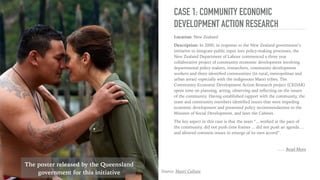
The poster released by the Queensland
government for this initiative Source: Maori Culture
CASE 1: COMMUNITY ECONOMIC
DEVELOPMENT ACTION RESEARCH
CASE 2: DEVELOPING A KNOWLEDGE BASED
CITIZEN PARTICIPATION PLATFORM
Location: Hamburg, Rome, RBK-London
Description: Citizen participation for social innovation and co-
creating urban regeneration proposals can be greatly facilitated by
innovative IT systems. Such systems can use Open Government Data,
visualise urban proposals in 3D models and provide automated
feedback on the feasibility of the proposals. Using such a system as a
communication platform between citizens and city administrations
provides an integrated top-down and bottom-up urban planning and
decision-making approach to smart cities. However, generating
automated feedback on citizens’ proposals requires modelling
domain-specific knowledge i.e., vocabulary and rules, which can be
applied on spatial and temporal 3D models.
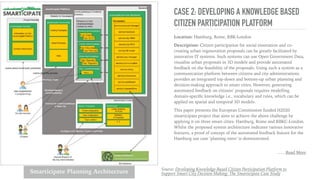
This paper presents the European Commission funded H2020
smarticipate project that aims to achieve the above challenge by
applying it on three smart cities: Hamburg, Rome and RBKC-London.
Whilst the proposed system architecture indicates various innovative
features, a proof of concept of the automated feedback feature for the
Hamburg use case ‘planting trees’ is demonstrated.

……Read More
Smarticipate Planning Architecture Source: Developing Knowledge-Based Citizen Participation Platform to
Support Smart City Decision Making: The Smarticipate Case Study
TOOLKITS AROUND THE WORLD
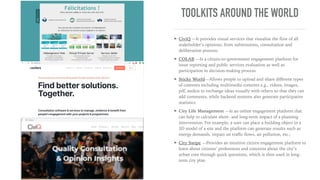
➤ CiviQ —It provides visual services that visualise the flow of all
stakeholder’s opinions, from submissions, consultation and
deliberation process;
➤ COLAB —Is a citizen-to-government engagement platform for
issue reporting and public services evaluation as well as
participation in decision-making process
➤ Sticky World—Allows people to upload and share different types
of contents including multimedia contents e.g., videos, images,
pdf, audios to exchange ideas visually with others so that they can
add comments, while backend systems also generate participative
statistics
➤ City Life Management —Is an online engagement platform that
can help to calculate short- and long-term impact of a planning
intervention. For example, a user can place a building object in a
3D model of a site and the platform can generate results such as
energy demands, impact on traffic flows, air pollution, etc.;
➤ City Swipe —Provides an intuitive citizen engagement platform to
learn about citizens’ preferences and concerns about the city’s
urban core through quick questions, which is then used in long-
term city plan

Inputs soliciting

  • 1.
  • 2.
    Location: New Zealand Description:In 2000, in response to the New Zealand government’s initiative to integrate public input into policy-making processes, the New Zealand Department of Labour commenced a three year collaborative project of community economic development involving departmental policy makers, researchers, community development workers and three identified communities (in rural, metropolitan and urban areas) especially with the indigenous Maori tribes. The Community Economic Development Action Research project (CEDAR) spent time on planning, acting, observing and reflecting on the issues of the community. Having established rapport with the community, the team and community members identified issues that were impeding economic development and presented policy recommendations to the Minister of Social Development, and later the Cabinet. The key aspect in this case is that the team “…worked at the pace of the community, did not push time frames ... did not push an agenda … and allowed common issues to emerge of its own accord”. ……Read More The poster released by the Queensland government for this initiative Source: Maori Culture CASE 1: COMMUNITY ECONOMIC DEVELOPMENT ACTION RESEARCH
  • 3.
    CASE 2: DEVELOPINGA KNOWLEDGE BASED CITIZEN PARTICIPATION PLATFORM Location: Hamburg, Rome, RBK-London Description: Citizen participation for social innovation and co- creating urban regeneration proposals can be greatly facilitated by innovative IT systems. Such systems can use Open Government Data, visualise urban proposals in 3D models and provide automated feedback on the feasibility of the proposals. Using such a system as a communication platform between citizens and city administrations provides an integrated top-down and bottom-up urban planning and decision-making approach to smart cities. However, generating automated feedback on citizens’ proposals requires modelling domain-specific knowledge i.e., vocabulary and rules, which can be applied on spatial and temporal 3D models. This paper presents the European Commission funded H2020 smarticipate project that aims to achieve the above challenge by applying it on three smart cities: Hamburg, Rome and RBKC-London. Whilst the proposed system architecture indicates various innovative features, a proof of concept of the automated feedback feature for the Hamburg use case ‘planting trees’ is demonstrated.
 ……Read More Smarticipate Planning Architecture Source: Developing Knowledge-Based Citizen Participation Platform to Support Smart City Decision Making: The Smarticipate Case Study
  • 4.
    TOOLKITS AROUND THEWORLD ➤ CiviQ —It provides visual services that visualise the flow of all stakeholder’s opinions, from submissions, consultation and deliberation process; ➤ COLAB —Is a citizen-to-government engagement platform for issue reporting and public services evaluation as well as participation in decision-making process ➤ Sticky World—Allows people to upload and share different types of contents including multimedia contents e.g., videos, images, pdf, audios to exchange ideas visually with others so that they can add comments, while backend systems also generate participative statistics ➤ City Life Management —Is an online engagement platform that can help to calculate short- and long-term impact of a planning intervention. For example, a user can place a building object in a 3D model of a site and the platform can generate results such as energy demands, impact on traffic flows, air pollution, etc.; ➤ City Swipe —Provides an intuitive citizen engagement platform to learn about citizens’ preferences and concerns about the city’s urban core through quick questions, which is then used in long- term city plan