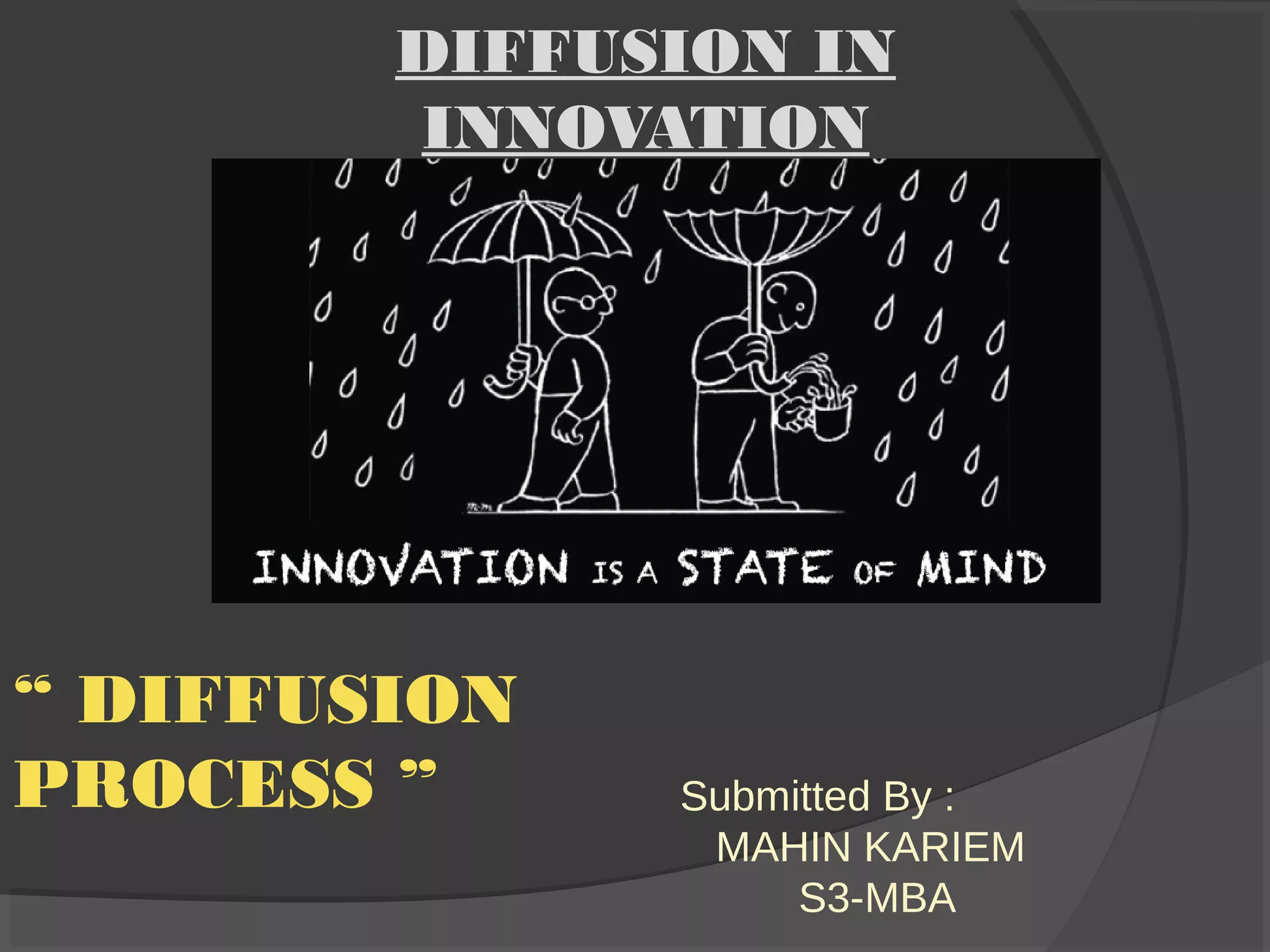
DIFFUSION IN
INNOVATION
“ DIFFUSION
PROCESS ” Submitted By :
MAHIN KARIEM
S3-MBA
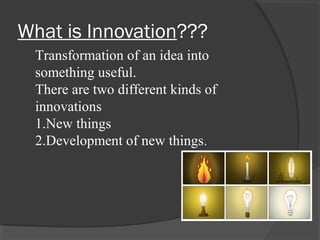
What is Innovation???
Transformation of an idea into
something useful.
There are two different kinds of
innovations
1.New things
2.Development of new things.
Diffusion of Innovation
 The diffusion of innovations theory
seeks to explain how and why new
ideas and practices are adopted, with
timelines potentially spread out over
long periods.
 It is designed in two process:
1. Diffusion
2. Adoption
New Product Adoption
Theory
ADOPTION PROCESS
- The consumer decision stages that lead
to innovation acceptance/rejection
- A micro process process that focuses on
internal forces of the consumer
* Intra Personal (Psych) Influences
* Inter Personal (Social) Influences
* Product Selection Criteria
New Product Diffusion Theory
DIFFUSION PROCESS.
- the spread of an innovation from its.
source to the ultimate consumer.
- a macro process that focuses on external.
forces on the consumer (change agents,
channels of information, types of.
information).
- occurs in a social system (a target.
audience, community, etc.
•PROESS B WHICH NEW IDEA OR PRODUCT
IS ACCEPTED BY MARKET
•RATE OF DIFFUSION IS THE SPEED IN
WHICH THE NEW IDEA SPREADS OVER
FROM ONE CONSUMER TO ANOTHER
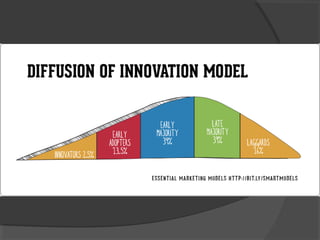
Stages in Diffusion
 Innovators
 Early adopters
 Early majority
 Late majority
 Laggards.
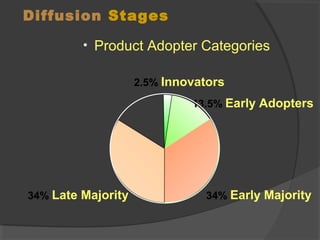
2.5% Innovators
13.5% Early Adopters
34% Early Majority34% Late Majority
Diffusion Stages
• Product Adopter Categories
Adopter Categories
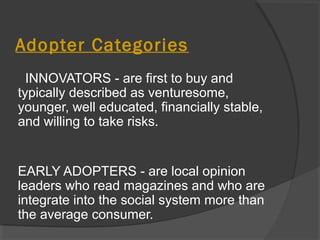
INNOVATORS - are first to buy and
typically described as venturesome,
younger, well educated, financially stable,
and willing to take risks.
EARLY ADOPTERS - are local opinion
leaders who read magazines and who are
integrate into the social system more than
the average consumer.
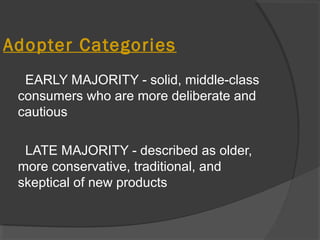
EARLY MAJORITY - solid, middle-class
consumers who are more deliberate and
cautious
LATE MAJORITY - described as older,
more conservative, traditional, and
skeptical of new products
Adopter Categories
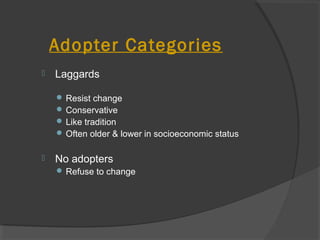
 Laggards
 Resist change
 Conservative
 Like tradition
 Often older & lower in socioeconomic status
 No adopters
 Refuse to change
Adopter Categories
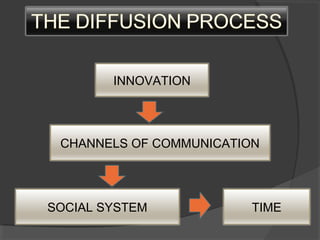
INNOVATION
CHANNELS OF COMMUNICATION
SOCIAL SYSTEM TIME
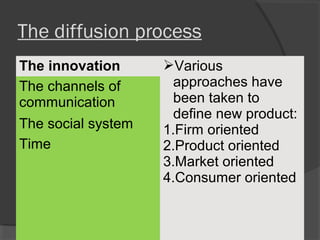
The diffusion process
The innovation Various
approaches have
been taken to
define new product:
1.Firm oriented
2.Product oriented
3.Market oriented
4.Consumer oriented
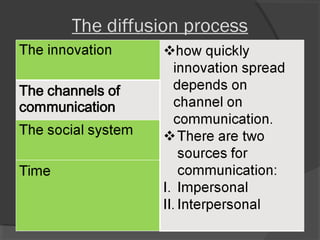
The channels of
communication
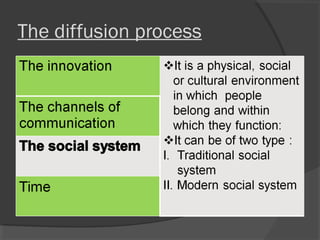
The social system
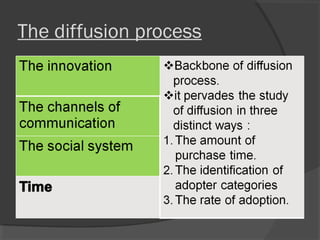
Time
The diffusion process
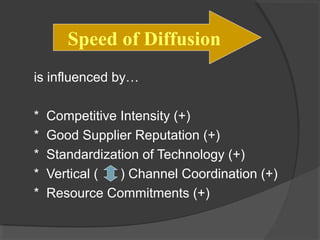
is influenced by…
* Competitive Intensity (+)
* Good Supplier Reputation (+)
* Standardization of Technology (+)
* Vertical ( ) Channel Coordination (+)
* Resource Commitments (+)
Speed of Diffusion
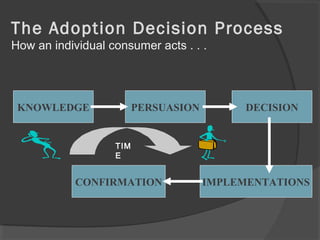
The Adoption Decision Process
How an individual consumer acts . . .
KNOWLEDGE PERSUASION DECISION
IMPLEMENTATIONSCONFIRMATION
TIM
E
•Consumer is exposed to the innovations existence and gains some
understanding of how it functions
.
•no judgment concerning the relevance of the product to a problem or
recognized need.
•perception is more likely to occur through the mass media than in late
stages which are more influenced by opinion leaders.
•In this stage, usually attitude formation takes place that is consumer forms
favorable or unfavorable attitudes toward the innovation.
•Consumer may mentally imagine how satisfactory new product might be in
use, i.e., “vicarious trial” of the product in consumer’s mind.
•evaluation of consequences of using the product
•Consumer engages in activities that lead to a choice to adopt or
reject the innovation (i.e., adoption or rejection).
•Adoption can be defined as a decision to make full use of an
innovation as the best course of action. This means continued
use of the product unless situational variables (lack of availability,
or money etc.) prevent usage.
•Rejection means not to adopt an innovation.
•There may be some persons who first consider adopting an
innovation or at least give a trial, but then deciding not to adopt it.
This is called an active rejection. Others never consider the use of
the innovation, known as passive rejection.
•Puts the innovation into use.
•Until this stage, the process is a mental exercise, but in
this stage behavioral change is required Marketing plan
is the determinant of whether a good product has been
communicated effectively (i.e., actually sales).
•Marketing mix planned should be such that purchase is
made easy. This means proper coordination of the
channels of distribution with new products and their
communication process.
•Consumer seeks approval/reinforcement for the
innovation decision, but may reverse this decision if
exposed to conflicting messages about the product.
•This stage is also influenced by communication
sources and consumers evaluate their purchase
experiences.
•After evaluating, they try to support their behaviour
and later decide to continue or discontinue using the
product.
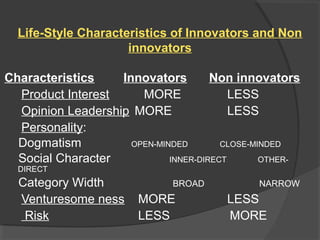
Life-Style Characteristics of Innovators and Non
innovators
Characteristics Innovators Non innovators
Product Interest MORE LESS
Opinion Leadership MORE LESS
Personality:
Dogmatism OPEN-MINDED CLOSE-MINDED
Social Character INNER-DIRECT OTHER-
DIRECT
Category Width BROAD NARROW
Venturesome ness MORE LESS
Risk LESS MORE
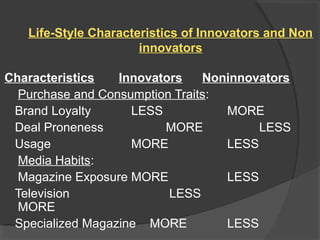
Life-Style Characteristics of Innovators and Non
innovators
Characteristics Innovators Noninnovators
Purchase and Consumption Traits:
Brand Loyalty LESS MORE
Deal Proneness MORE LESS
Usage MORE LESS
Media Habits:
Magazine Exposure MORE LESS
Television LESS
MORE
Specialized Magazine MORE LESS
Characteristics of New Product
Success
RELATIVE ADVANTAGE - is an enhanced
bundle of benefits or clear-cut advantages
over existing offerings (+)
Compatibility with existing habits,
values and consumption behavior,
similar usage as existing products
Characteristics of New Product
Success
Trial ability…experience
or see the newness
 Easily tested
 Low risk
 Inexpensive
 No special equipment
 Free samples or coupons
Characteristics of New Product
Success
OBSERVABILITY - is the opportunity for
buyers to see the newness (+)
COMPLEXITY - is a disadvantage for new
products which slows diffusion and may
be offset by simplifying usage or through
extensive education (-)
Characteristics of New Product
Success
Why Some New Products Fail and
Others Succeed
 Failure to Meet Customer Needs
 Poor Timing
 Market Conditions
 Ineffective or Inconsistent Branding
 Technical or Design Problems
 Overestimation of Market Size
 Poor Promotion
 Insufficient Distribution
80 to 90% Fail. Why?
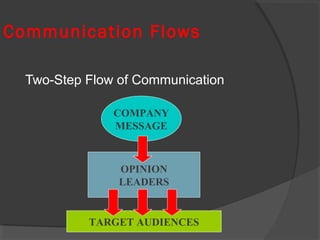
Communication Flows
Two-Step Flow of Communication
COMPANY
MESSAGE
OPINION
LEADERS
TARGET AUDIENCES
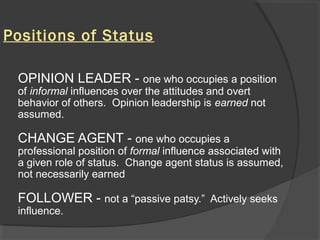
Positions of Status
OPINION LEADER - one who occupies a position
of informal influences over the attitudes and overt
behavior of others. Opinion leadership is earned not

assumed.
CHANGE AGENT - one who occupies a
professional position of formal influence associated with
a given role of status. Change agent status is assumed,
not necessarily earned
FOLLOWER - not a “passive patsy.” Actively seeks
influence.
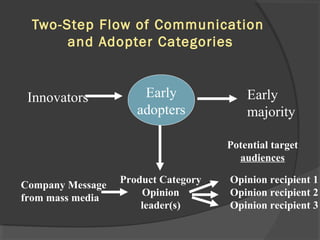
Two-Step Flow of Communication
and Adopter Categories
Early
adopters
Innovators Early
majority
Company Message
from mass media
Product Category
Opinion
leader(s)
Potential target
audiences
Opinion recipient 1
Opinion recipient 2
Opinion recipient 3
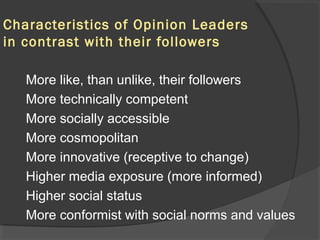
Characteristics of Opinion Leaders
in contrast with their followers
More like, than unlike, their followers
More technically competent
More socially accessible
More cosmopolitan
More innovative (receptive to change)
Higher media exposure (more informed)
Higher social status
More conformist with social norms and values
Consumer behavior for MBA

Consumer behavior for MBA

  • 1.
    DIFFUSION IN INNOVATION “ DIFFUSION PROCESS” Submitted By : MAHIN KARIEM S3-MBA
  • 2.
    What is Innovation??? Transformationof an idea into something useful. There are two different kinds of innovations 1.New things 2.Development of new things.
  • 3.
    Diffusion of Innovation The diffusion of innovations theory seeks to explain how and why new ideas and practices are adopted, with timelines potentially spread out over long periods.  It is designed in two process: 1. Diffusion 2. Adoption
  • 4.
    New Product Adoption Theory ADOPTIONPROCESS - The consumer decision stages that lead to innovation acceptance/rejection - A micro process process that focuses on internal forces of the consumer * Intra Personal (Psych) Influences * Inter Personal (Social) Influences * Product Selection Criteria
  • 5.
    New Product DiffusionTheory DIFFUSION PROCESS. - the spread of an innovation from its. source to the ultimate consumer. - a macro process that focuses on external. forces on the consumer (change agents, channels of information, types of. information). - occurs in a social system (a target. audience, community, etc.
  • 6.
    •PROESS B WHICHNEW IDEA OR PRODUCT IS ACCEPTED BY MARKET •RATE OF DIFFUSION IS THE SPEED IN WHICH THE NEW IDEA SPREADS OVER FROM ONE CONSUMER TO ANOTHER
  • 7.
    Stages in Diffusion Innovators  Early adopters  Early majority  Late majority  Laggards.
  • 8.
    2.5% Innovators 13.5% EarlyAdopters 34% Early Majority34% Late Majority Diffusion Stages • Product Adopter Categories
  • 10.
    Adopter Categories INNOVATORS -are first to buy and typically described as venturesome, younger, well educated, financially stable, and willing to take risks. EARLY ADOPTERS - are local opinion leaders who read magazines and who are integrate into the social system more than the average consumer.
  • 11.
    EARLY MAJORITY -solid, middle-class consumers who are more deliberate and cautious LATE MAJORITY - described as older, more conservative, traditional, and skeptical of new products Adopter Categories
  • 12.
     Laggards  Resistchange  Conservative  Like tradition  Often older & lower in socioeconomic status  No adopters  Refuse to change Adopter Categories
  • 13.
  • 14.
    The diffusion process Theinnovation Various approaches have been taken to define new product: 1.Firm oriented 2.Product oriented 3.Market oriented 4.Consumer oriented The channels of communication The social system Time
  • 15.
  • 16.
  • 17.
  • 18.
    is influenced by… *Competitive Intensity (+) * Good Supplier Reputation (+) * Standardization of Technology (+) * Vertical ( ) Channel Coordination (+) * Resource Commitments (+) Speed of Diffusion
  • 19.
    The Adoption DecisionProcess How an individual consumer acts . . . KNOWLEDGE PERSUASION DECISION IMPLEMENTATIONSCONFIRMATION TIM E
  • 20.
    •Consumer is exposedto the innovations existence and gains some understanding of how it functions . •no judgment concerning the relevance of the product to a problem or recognized need. •perception is more likely to occur through the mass media than in late stages which are more influenced by opinion leaders.
  • 21.
    •In this stage,usually attitude formation takes place that is consumer forms favorable or unfavorable attitudes toward the innovation. •Consumer may mentally imagine how satisfactory new product might be in use, i.e., “vicarious trial” of the product in consumer’s mind. •evaluation of consequences of using the product
  • 22.
    •Consumer engages inactivities that lead to a choice to adopt or reject the innovation (i.e., adoption or rejection). •Adoption can be defined as a decision to make full use of an innovation as the best course of action. This means continued use of the product unless situational variables (lack of availability, or money etc.) prevent usage. •Rejection means not to adopt an innovation. •There may be some persons who first consider adopting an innovation or at least give a trial, but then deciding not to adopt it. This is called an active rejection. Others never consider the use of the innovation, known as passive rejection.
  • 23.
    •Puts the innovationinto use. •Until this stage, the process is a mental exercise, but in this stage behavioral change is required Marketing plan is the determinant of whether a good product has been communicated effectively (i.e., actually sales). •Marketing mix planned should be such that purchase is made easy. This means proper coordination of the channels of distribution with new products and their communication process.
  • 24.
    •Consumer seeks approval/reinforcementfor the innovation decision, but may reverse this decision if exposed to conflicting messages about the product. •This stage is also influenced by communication sources and consumers evaluate their purchase experiences. •After evaluating, they try to support their behaviour and later decide to continue or discontinue using the product.
  • 25.
    Life-Style Characteristics ofInnovators and Non innovators Characteristics Innovators Non innovators Product Interest MORE LESS Opinion Leadership MORE LESS Personality: Dogmatism OPEN-MINDED CLOSE-MINDED Social Character INNER-DIRECT OTHER- DIRECT Category Width BROAD NARROW Venturesome ness MORE LESS Risk LESS MORE
  • 26.
    Life-Style Characteristics ofInnovators and Non innovators Characteristics Innovators Noninnovators Purchase and Consumption Traits: Brand Loyalty LESS MORE Deal Proneness MORE LESS Usage MORE LESS Media Habits: Magazine Exposure MORE LESS Television LESS MORE Specialized Magazine MORE LESS
  • 27.
    Characteristics of NewProduct Success RELATIVE ADVANTAGE - is an enhanced bundle of benefits or clear-cut advantages over existing offerings (+)
  • 28.
    Compatibility with existinghabits, values and consumption behavior, similar usage as existing products Characteristics of New Product Success
  • 29.
    Trial ability…experience or seethe newness  Easily tested  Low risk  Inexpensive  No special equipment  Free samples or coupons Characteristics of New Product Success
  • 30.
    OBSERVABILITY - isthe opportunity for buyers to see the newness (+) COMPLEXITY - is a disadvantage for new products which slows diffusion and may be offset by simplifying usage or through extensive education (-) Characteristics of New Product Success
  • 31.
    Why Some NewProducts Fail and Others Succeed  Failure to Meet Customer Needs  Poor Timing  Market Conditions  Ineffective or Inconsistent Branding  Technical or Design Problems  Overestimation of Market Size  Poor Promotion  Insufficient Distribution 80 to 90% Fail. Why?
  • 32.
    Communication Flows Two-Step Flowof Communication COMPANY MESSAGE OPINION LEADERS TARGET AUDIENCES
  • 33.
    Positions of Status OPINIONLEADER - one who occupies a position of informal influences over the attitudes and overt behavior of others. Opinion leadership is earned not assumed. CHANGE AGENT - one who occupies a professional position of formal influence associated with a given role of status. Change agent status is assumed, not necessarily earned FOLLOWER - not a “passive patsy.” Actively seeks influence.
  • 34.
    Two-Step Flow ofCommunication and Adopter Categories Early adopters Innovators Early majority Company Message from mass media Product Category Opinion leader(s) Potential target audiences Opinion recipient 1 Opinion recipient 2 Opinion recipient 3
  • 35.
    Characteristics of OpinionLeaders in contrast with their followers More like, than unlike, their followers More technically competent More socially accessible More cosmopolitan More innovative (receptive to change) Higher media exposure (more informed) Higher social status More conformist with social norms and values