Inner Source Webinar Series
Community Development Practices in Corporate IT
Inner Source Fundamentals:
Transparency, Collaboration and Self-Organization

Inner Source Fundamentals:
Egalitarianism, Meritocracy and Measuring Success
#innersourcing
1
Speakers

Guy Martin

Andrew Aitken

Managing Principal Architect
Red Hat Consulting

Managing Director
Black Duck Consulting

@guyma

@andrewolliance

@RedHat_Training

@black_duck_sw

#innersourcing
10/28/2013

2
Agenda

•
•
•
•

What Is Inner Source?
Why Use Inner Source?
Inner-Source vs. Agile
Inner-Source Characteristics & Best Practices
– Transparency
– Collaboration
– Self-Organization

– Egalitarianism
– Meritocracy

• Measuring Success
• Challenges
• Getting Started
10/28/2013

3
What is Inner-Source?
The application of best practices, processes, culture and
methodologies taken from the open source world and applied to
internal software development and innovation efforts.

http://www.keepcalm-o-matic.co.uk/
10/28/2013

4
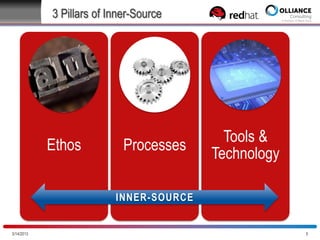
3 Pillars of Inner Source

Ethos

Processes

Tools &
Technology

INNER SOURCE

10/28/2013

5
Why Use Inner Source
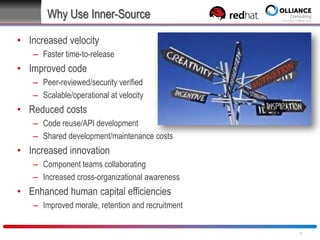
• Increased velocity
– Faster time-to-release

• Improved code
– Peer-reviewed/security verified
– Scalable/operational at velocity

• Reduced costs
– Code reuse/API development
– Shared development/maintenance costs

• Increased innovation
– Component teams collaborating
– Increased cross-organizational awareness

• Enhanced human capital efficiencies
– Improved morale, retention and recruitment
6
Inner Source & Agile

• Allies - not competitors
• Some overlap, but in general:
– Agile specifies process
– Inner Source informs culture

10/28/2013

7
Successful Inner Source Efforts
Inner Source Characteristics

• Transparency
• Collaboration
• Self-organization
– Hybrids
– Evangelists, catalysts

• Egalitarianism
• Meritocracy
10/28/2013

9
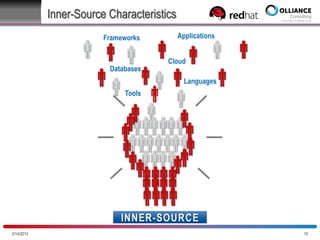
Inner Source Characteristics
Frameworks

Databases

Applications
Cloud
Languages

Tools

10/28/2013

10
Inner Source Characteristics
Why are Transparency, Collaboration and Self-organization important?
• Transparency
–
–
–
–

Establishes trust among current and potential participants
Lowers barriers to entry for potential contributors
Helps consumers validate project health (community, codebase, etc.)
Allows management to apply additional resources as required

• Collaboration
– Provides core processes/models for efficient work across team boundaries
– Allows for better idea generation and implementation
– Provides for an increased knowledge base of developer talent

• Self-Organization
– Encourages contributors to work on what motivates them the most
– Empowerment increases morale and retention of top talent
– Relieves some management burden for oversight of common components

10/28/2013

11
Transparency
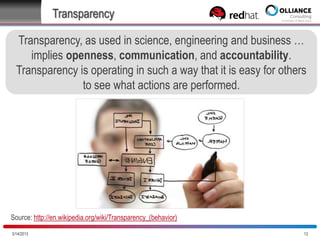
Transparency, as used in science, engineering and business …
implies openness, communication, and accountability.
Transparency is operating in such a way that it is easy for others
to see what actions are performed.

Source: http://en.wikipedia.org/wiki/Transparency_(behavior)
10/28/2013

12
Transparency Best Practices

• Code Transparency
– Fully readable code repositories

• Technical/Design Transparency
– Easily available design/architecture documentation

• Decision-making Transparency
– Project decisions made „in the open‟

• Communications Transparency
– All project discussions „in the open‟
10/28/2013

13
Collaboration
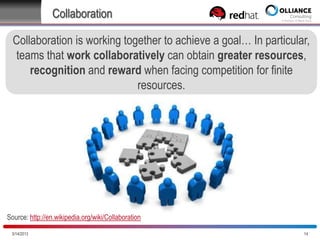
Collaboration is working together to achieve a goal… In
particular, teams that work collaboratively can obtain greater
resources, recognition and reward when facing competition for
finite resources.

Source: http://en.wikipedia.org/wiki/Collaboration
10/28/2013

14
Collaboration Best Practices

• Cultural Alignment
– Awaiting permission vs. taking initiative

• Development Cycle Alignment
– Waterfall, Agile, Hybrid

• Development Team Experience Alignment
– Experience/specialized vs. Youthful/general purpose

• Collaboration Tools Alignment
– Basic (email, IRC) vs. Evolved (Wiki, forums)
10/28/2013

15
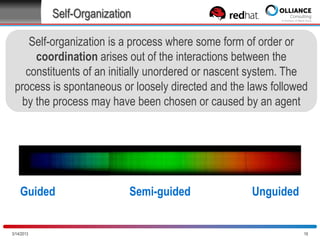
Self-Organization
Self-organization is a process where some form of order or
coordination arises out of the interactions between the
constituents of an initially unordered or nascent system. The
process is spontaneous or loosely directed and the laws followed
by the process may have been chosen or caused by an agent

Guided

10/28/2013

Semi-guided

Unguided

16
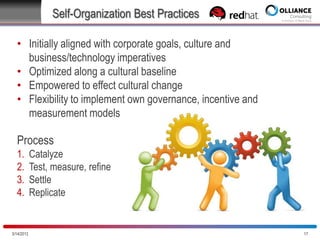
Self-Organization Best Practices
• Initially aligned with corporate goals, culture and
business/technology imperatives
• Optimized along a cultural baseline
• Empowered to effect cultural change
• Flexibility to implement own governance, incentive and
measurement models

Process
1.
2.
3.
4.

Catalyze
Test, measure, refine
Settle
Replicate

10/28/2013

17
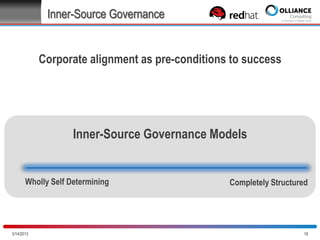
Inner Source Governance
Corporate alignment as pre-conditions to success

Inner Source Governance Models

Wholly Self Determining

10/28/2013

Completely Structured

18
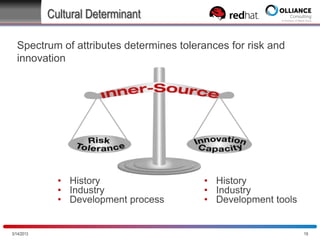
Cultural Determinant
Spectrum of attributes determines tolerances for risk and
innovation

• History
• Industry
• Development process

10/28/2013

• History
• Industry
• Development tools

19
Egalitarianism

All humans are equal in worth or social status… a positive
attitude toward group decision making… and
decentralization of power.

Source: http://en.wikipedia.org/wiki/Egalitarianism
10/28/2013

20
Egalitarianism
Why it’s important
• Breaks down „class barriers‟ to contributions
• Facilitates a wide variety of experiences/viewpoints
• Everyone starts on equal footing
• Enables fundamentally shared goals
Contribution model
• No limitations by organizational position
• Decisions made by consensus
• Technological diversity

10/28/2013

21
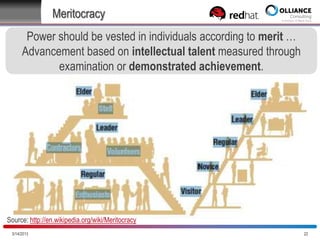
Meritocracy
Power should be vested in individuals according to merit …
Advancement based on intellectual talent measured through
examination or demonstrated achievement.

Source: http://en.wikipedia.org/wiki/Meritocracy
10/28/2013

22
Meritocracy
Why it’s important
• Project direction driven by most valuable contributions
• Provides an incentive structure for contributors
• Project has built-in peer review/feedback loop
Contribution Model
• Peer review/vetting of contributions
• Voting mechanism
• Constructive feedback – no bullying!
• Advancement path
• Management trust in self-organized leadership
10/28/2013

23
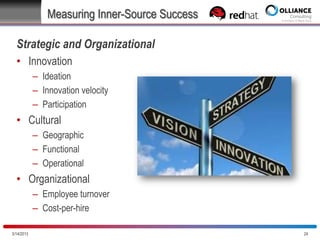
Measuring Inner Source Success
Strategic and Organizational
• Innovation
– Ideation
– Innovation velocity
– Participation

• Cultural
– Geographic
– Functional
– Operational

• Organizational
– Employee turnover
– Cost-per-hire
10/28/2013

24
Measuring Inner Source Success
Technical
–
–
–
–
–
–

Time-to-deployment
Support costs
Standardization
Code contributions
Developer productivity
Code quality
Establish a measurement framework and review regularly including
quantifiable; ROI/KPIs, technology/platform reuse,
retention/hiring metrics

10/28/2013

25
Measuring Inner Source Success

Bell Labs (Gurbani, et al.)
• Improved organizational model
• Trained developers
• Improved code quality and functionality

IBM (Community Source)
• Increased developer creativity and innovation
• 30% faster software development

Philips Healthcare (CTO – Frank van der linden)
• Improved technology utilization
• Improved product quality
• Reduced time-to-market
10/28/2013

26
Challenges
• Overall
–
–
–
–

Cultural gulf
Lack of clearly defined and communicated goals
HR concerns
Management “support”

• Egalitarianism
– Fear of loss of control

• Meritocracy
– Initial seeding of „project influencers‟

• Measuring Success
– Poorly designed and implemented KPIs
10/28/2013

27
Best Practices

• Realistic vision, articulated shared purpose and clearly
defined problems or opportunities being addressed
• (Initiators, catalysts, evangelists) need to have
collaborative experience/mindset
• Acculturation model for new participants
• Programmatically facilitated continuous interaction and
behavioral consistency
• Start with an intra-organizational group of people with
defined shared goals

10/28/2013

28
Getting Started
• Align Corporate Ethos
– Encourage egalitarianism through example
– Reward collaboration with appropriate incentives
– Facilitate meritocratic leadership

• Adjust Processes
– Transparent contribution policies
– Meritocratic governance model
– Allow/seed self-organization

• Deploy Tools/Technologies
– Evaluate/adjust tools based on feedback
– Standardize
– Simpler is sometimes better (phase)
10/28/2013

29
Estimating Investment
• Cost to include
– Program costs
•
•
•
•

Infrastructure
Governance
Training
Developer productivity

– Cost for code sharing
• COCOMO-based estimates
• Test by sampling of projects

• Costs best ignored
– Initial code development
• Cost was sunk for other purposes

– Support and maintenance
• Balanced by cost reduction on receiving side
• Under-estimated for unused, over-estimated for widely used
30
Questions

oss-enablement-info@redhat.com

aaitken@blackducksoftware.com

View the Full Recordings from this Webinar Series:
• Inner Sourcing: Community Development Practices in Corporate IT
• Understanding Inner Source Fundamentals:
Transparency, Collaboration and Self-Organization
• Inner Source Fundamentals: Egalitarianism, Meritocracy and
Measuring Success

10/28/2013

31

Inner Source Webinar Series: Open Source Community Development Methods

  • 1.
    Inner Source WebinarSeries Community Development Practices in Corporate IT Inner Source Fundamentals: Transparency, Collaboration and Self-Organization Inner Source Fundamentals: Egalitarianism, Meritocracy and Measuring Success #innersourcing 1
  • 2.
    Speakers Guy Martin Andrew Aitken ManagingPrincipal Architect Red Hat Consulting Managing Director Black Duck Consulting @guyma @andrewolliance @RedHat_Training @black_duck_sw #innersourcing 10/28/2013 2
  • 3.
    Agenda • • • • What Is InnerSource? Why Use Inner Source? Inner-Source vs. Agile Inner-Source Characteristics & Best Practices – Transparency – Collaboration – Self-Organization – Egalitarianism – Meritocracy • Measuring Success • Challenges • Getting Started 10/28/2013 3
  • 4.
    What is Inner-Source? Theapplication of best practices, processes, culture and methodologies taken from the open source world and applied to internal software development and innovation efforts. http://www.keepcalm-o-matic.co.uk/ 10/28/2013 4
  • 5.
    3 Pillars ofInner Source Ethos Processes Tools & Technology INNER SOURCE 10/28/2013 5
  • 6.
    Why Use InnerSource • Increased velocity – Faster time-to-release • Improved code – Peer-reviewed/security verified – Scalable/operational at velocity • Reduced costs – Code reuse/API development – Shared development/maintenance costs • Increased innovation – Component teams collaborating – Increased cross-organizational awareness • Enhanced human capital efficiencies – Improved morale, retention and recruitment 6
  • 7.
    Inner Source &Agile • Allies - not competitors • Some overlap, but in general: – Agile specifies process – Inner Source informs culture 10/28/2013 7
  • 8.
  • 9.
    Inner Source Characteristics •Transparency • Collaboration • Self-organization – Hybrids – Evangelists, catalysts • Egalitarianism • Meritocracy 10/28/2013 9
  • 10.
  • 11.
    Inner Source Characteristics Whyare Transparency, Collaboration and Self-organization important? • Transparency – – – – Establishes trust among current and potential participants Lowers barriers to entry for potential contributors Helps consumers validate project health (community, codebase, etc.) Allows management to apply additional resources as required • Collaboration – Provides core processes/models for efficient work across team boundaries – Allows for better idea generation and implementation – Provides for an increased knowledge base of developer talent • Self-Organization – Encourages contributors to work on what motivates them the most – Empowerment increases morale and retention of top talent – Relieves some management burden for oversight of common components 10/28/2013 11
  • 12.
    Transparency Transparency, as usedin science, engineering and business … implies openness, communication, and accountability. Transparency is operating in such a way that it is easy for others to see what actions are performed. Source: http://en.wikipedia.org/wiki/Transparency_(behavior) 10/28/2013 12
  • 13.
    Transparency Best Practices •Code Transparency – Fully readable code repositories • Technical/Design Transparency – Easily available design/architecture documentation • Decision-making Transparency – Project decisions made „in the open‟ • Communications Transparency – All project discussions „in the open‟ 10/28/2013 13
  • 14.
    Collaboration Collaboration is workingtogether to achieve a goal… In particular, teams that work collaboratively can obtain greater resources, recognition and reward when facing competition for finite resources. Source: http://en.wikipedia.org/wiki/Collaboration 10/28/2013 14
  • 15.
    Collaboration Best Practices •Cultural Alignment – Awaiting permission vs. taking initiative • Development Cycle Alignment – Waterfall, Agile, Hybrid • Development Team Experience Alignment – Experience/specialized vs. Youthful/general purpose • Collaboration Tools Alignment – Basic (email, IRC) vs. Evolved (Wiki, forums) 10/28/2013 15
  • 16.
    Self-Organization Self-organization is aprocess where some form of order or coordination arises out of the interactions between the constituents of an initially unordered or nascent system. The process is spontaneous or loosely directed and the laws followed by the process may have been chosen or caused by an agent Guided 10/28/2013 Semi-guided Unguided 16
  • 17.
    Self-Organization Best Practices •Initially aligned with corporate goals, culture and business/technology imperatives • Optimized along a cultural baseline • Empowered to effect cultural change • Flexibility to implement own governance, incentive and measurement models Process 1. 2. 3. 4. Catalyze Test, measure, refine Settle Replicate 10/28/2013 17
  • 18.
    Inner Source Governance Corporatealignment as pre-conditions to success Inner Source Governance Models Wholly Self Determining 10/28/2013 Completely Structured 18
  • 19.
    Cultural Determinant Spectrum ofattributes determines tolerances for risk and innovation • History • Industry • Development process 10/28/2013 • History • Industry • Development tools 19
  • 20.
    Egalitarianism All humans areequal in worth or social status… a positive attitude toward group decision making… and decentralization of power. Source: http://en.wikipedia.org/wiki/Egalitarianism 10/28/2013 20
  • 21.
    Egalitarianism Why it’s important •Breaks down „class barriers‟ to contributions • Facilitates a wide variety of experiences/viewpoints • Everyone starts on equal footing • Enables fundamentally shared goals Contribution model • No limitations by organizational position • Decisions made by consensus • Technological diversity 10/28/2013 21
  • 22.
    Meritocracy Power should bevested in individuals according to merit … Advancement based on intellectual talent measured through examination or demonstrated achievement. Source: http://en.wikipedia.org/wiki/Meritocracy 10/28/2013 22
  • 23.
    Meritocracy Why it’s important •Project direction driven by most valuable contributions • Provides an incentive structure for contributors • Project has built-in peer review/feedback loop Contribution Model • Peer review/vetting of contributions • Voting mechanism • Constructive feedback – no bullying! • Advancement path • Management trust in self-organized leadership 10/28/2013 23
  • 24.
    Measuring Inner SourceSuccess Strategic and Organizational • Innovation – Ideation – Innovation velocity – Participation • Cultural – Geographic – Functional – Operational • Organizational – Employee turnover – Cost-per-hire 10/28/2013 24
  • 25.
    Measuring Inner SourceSuccess Technical – – – – – – Time-to-deployment Support costs Standardization Code contributions Developer productivity Code quality Establish a measurement framework and review regularly including quantifiable; ROI/KPIs, technology/platform reuse, retention/hiring metrics 10/28/2013 25
  • 26.
    Measuring Inner SourceSuccess Bell Labs (Gurbani, et al.) • Improved organizational model • Trained developers • Improved code quality and functionality IBM (Community Source) • Increased developer creativity and innovation • 30% faster software development Philips Healthcare (CTO – Frank van der linden) • Improved technology utilization • Improved product quality • Reduced time-to-market 10/28/2013 26
  • 27.
    Challenges • Overall – – – – Cultural gulf Lackof clearly defined and communicated goals HR concerns Management “support” • Egalitarianism – Fear of loss of control • Meritocracy – Initial seeding of „project influencers‟ • Measuring Success – Poorly designed and implemented KPIs 10/28/2013 27
  • 28.
    Best Practices • Realisticvision, articulated shared purpose and clearly defined problems or opportunities being addressed • (Initiators, catalysts, evangelists) need to have collaborative experience/mindset • Acculturation model for new participants • Programmatically facilitated continuous interaction and behavioral consistency • Start with an intra-organizational group of people with defined shared goals 10/28/2013 28
  • 29.
    Getting Started • AlignCorporate Ethos – Encourage egalitarianism through example – Reward collaboration with appropriate incentives – Facilitate meritocratic leadership • Adjust Processes – Transparent contribution policies – Meritocratic governance model – Allow/seed self-organization • Deploy Tools/Technologies – Evaluate/adjust tools based on feedback – Standardize – Simpler is sometimes better (phase) 10/28/2013 29
  • 30.
    Estimating Investment • Costto include – Program costs • • • • Infrastructure Governance Training Developer productivity – Cost for code sharing • COCOMO-based estimates • Test by sampling of projects • Costs best ignored – Initial code development • Cost was sunk for other purposes – Support and maintenance • Balanced by cost reduction on receiving side • Under-estimated for unused, over-estimated for widely used 30
  • 31.
    Questions oss-enablement-info@redhat.com aaitken@blackducksoftware.com View the FullRecordings from this Webinar Series: • Inner Sourcing: Community Development Practices in Corporate IT • Understanding Inner Source Fundamentals: Transparency, Collaboration and Self-Organization • Inner Source Fundamentals: Egalitarianism, Meritocracy and Measuring Success 10/28/2013 31

Editor's Notes

  • #6 Ethos is a Greek word meaning "character" that is used to describe the guiding beliefs or ideals that characterize a community, nation, or ideology. The Greeks also used this word to refer to the power of music to influence its hearer's emotions, behaviors, and even morals.Ethos can simply mean the disposition, character, or fundamental values peculiar to a specific person, people, culture, or movement. The Ethos refers to the spirit which motivates the ideas and customs. As T.S. Eliot wrote, "The general ethos of the people they have to govern determines the behavior of politicians.”