TOPIC
INTRODUCTION TO E-COMMERCE
SESSION:-2023-24
CONTENTS
 Introduction of inheritance
 Types of inheritance
 Single inheritance
 Multiple inheritance
 Hierarchical inheritance
 Multilevel inheritance
 Hybrid inheritance
 Defining a derived class
INHERITANCE
• C++ strongly supports the concept of reusability. The
C++ classes can be reused in several ways. Once a
class has been written and tested, it can be adapted
by other programmers to suit their requirements .This
is basically done by creating new classes ,reusing the
properties of the existing ones .The mechanism of
deriving a new class from an old one is called
inheritance (or derivation) .The old class is referred to
as the base class and the new one is called the
derived
class or subclass.
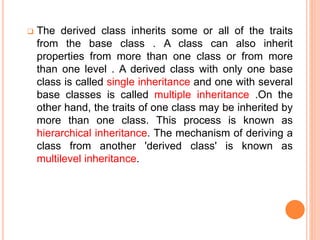
 The derived class inherits some or all of the traits
from the base class . A class can also inherit
properties from more than one class or from more
than one level . A derived class with only one base
class is called single inheritance and one with several
base classes is called multiple inheritance .On the
other hand, the traits of one class may be inherited by
more than one class. This process is known as
hierarchical inheritance. The mechanism of deriving a
class from another 'derived class' is known as
multilevel inheritance.
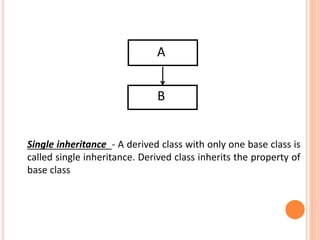
A
B
Single inheritance - A derived class with only one base class is
called single inheritance. Derived class inherits the property of
base class
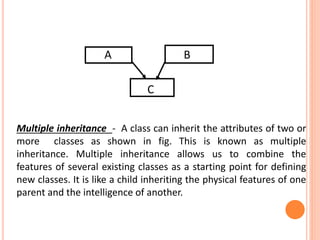
Multiple inheritance - A class can inherit the attributes of two or
more classes as shown in fig. This is known as multiple
inheritance. Multiple inheritance allows us to combine the
features of several existing classes as a starting point for defining
new classes. It is like a child inheriting the physical features of one
parent and the intelligence of another.
C
A B
C
B
A
D
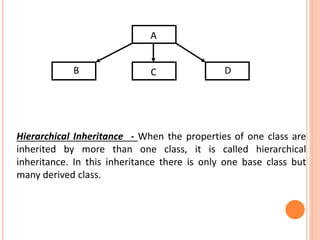
Hierarchical Inheritance - When the properties of one class are
inherited by more than one class, it is called hierarchical
inheritance. In this inheritance there is only one base class but
many derived class.
C
A
B
Multilevel Inheritance – It is not uncommon that a class is derived
from another derived class as shown in fig. The class A serves as a
base class for the derived class B, which in turn serves as a base
class for the derived class C. The class B is known as intermediate
base class since it provides a link for the inheritance between A
and C. Then chain ABC is known as inheritance path. So a class can
be derived from another derived class is known as multilevel
inheritance.
c
A
D
B C
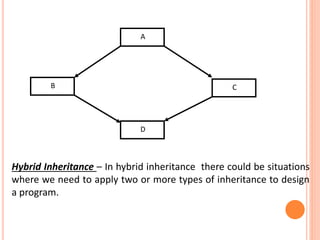
Hybrid Inheritance – In hybrid inheritance there could be situations
where we need to apply two or more types of inheritance to design
a program.
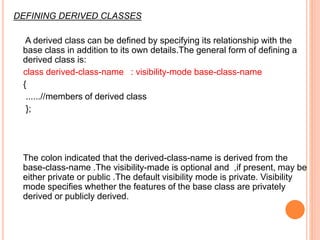
DEFINING DERIVED CLASSES
A derived class can be defined by specifying its relationship with the
base class in addition to its own details.The general form of defining a
derived class is:
class derived-class-name : visibility-mode base-class-name
{
......//members of derived class
};
The colon indicated that the derived-class-name is derived from the
base-class-name .The visibility-made is optional and ,if present, may be
either private or public .The default visibility mode is private. Visibility
mode specifies whether the features of the base class are privately
derived or publicly derived.
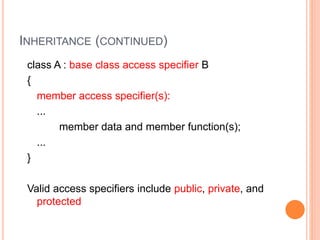
INHERITANCE (CONTINUED)
class A : base class access specifier B
{
member access specifier(s):
...
member data and member function(s);
...
}
Valid access specifiers include public, private, and
protected
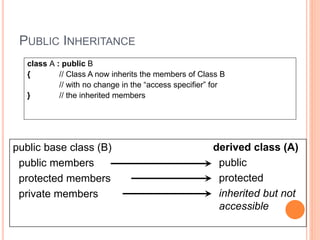
PUBLIC INHERITANCE
public base class (B)
public members
protected members
private members
derived class (A)
public
protected
inherited but not
accessible
class A : public B
{ // Class A now inherits the members of Class B
// with no change in the “access specifier” for
} // the inherited members
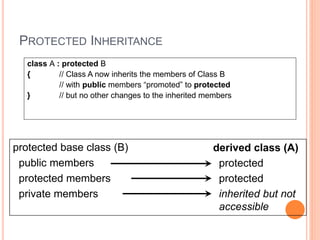
PROTECTED INHERITANCE
protected base class (B)
public members
protected members
private members
derived class (A)
protected
protected
inherited but not
accessible
class A : protected B
{ // Class A now inherits the members of Class B
// with public members “promoted” to protected
} // but no other changes to the inherited members
PRIVATE INHERITANCE
private base class (B)
public members
protected members
private members
derived class (A)
private
private
inherited but not
accessible
class A : private B
{ // Class A now inherits the members of Class B
// with public and protected members
} // “promoted” to private
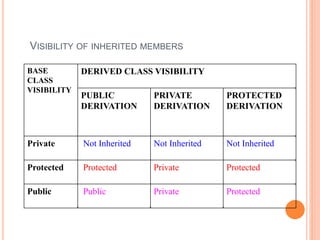
VISIBILITY OF INHERITED MEMBERS
BASE
CLASS
VISIBILITY
DERIVED CLASS VISIBILITY
PUBLIC
DERIVATION
PRIVATE
DERIVATION
PROTECTED
DERIVATION
Private Not Inherited Not Inherited Not Inherited
Protected Protected Private Protected
Public Public Private Protected
E -COMMERCE.ppt

E -COMMERCE.ppt

  • 1.
  • 2.
    CONTENTS  Introduction ofinheritance  Types of inheritance  Single inheritance  Multiple inheritance  Hierarchical inheritance  Multilevel inheritance  Hybrid inheritance  Defining a derived class
  • 3.
    INHERITANCE • C++ stronglysupports the concept of reusability. The C++ classes can be reused in several ways. Once a class has been written and tested, it can be adapted by other programmers to suit their requirements .This is basically done by creating new classes ,reusing the properties of the existing ones .The mechanism of deriving a new class from an old one is called inheritance (or derivation) .The old class is referred to as the base class and the new one is called the derived class or subclass.
  • 4.
     The derivedclass inherits some or all of the traits from the base class . A class can also inherit properties from more than one class or from more than one level . A derived class with only one base class is called single inheritance and one with several base classes is called multiple inheritance .On the other hand, the traits of one class may be inherited by more than one class. This process is known as hierarchical inheritance. The mechanism of deriving a class from another 'derived class' is known as multilevel inheritance.
  • 5.
    A B Single inheritance -A derived class with only one base class is called single inheritance. Derived class inherits the property of base class
  • 6.
    Multiple inheritance -A class can inherit the attributes of two or more classes as shown in fig. This is known as multiple inheritance. Multiple inheritance allows us to combine the features of several existing classes as a starting point for defining new classes. It is like a child inheriting the physical features of one parent and the intelligence of another. C A B
  • 7.
    C B A D Hierarchical Inheritance -When the properties of one class are inherited by more than one class, it is called hierarchical inheritance. In this inheritance there is only one base class but many derived class.
  • 8.
    C A B Multilevel Inheritance –It is not uncommon that a class is derived from another derived class as shown in fig. The class A serves as a base class for the derived class B, which in turn serves as a base class for the derived class C. The class B is known as intermediate base class since it provides a link for the inheritance between A and C. Then chain ABC is known as inheritance path. So a class can be derived from another derived class is known as multilevel inheritance. c
  • 9.
    A D B C Hybrid Inheritance– In hybrid inheritance there could be situations where we need to apply two or more types of inheritance to design a program.
  • 10.
    DEFINING DERIVED CLASSES Aderived class can be defined by specifying its relationship with the base class in addition to its own details.The general form of defining a derived class is: class derived-class-name : visibility-mode base-class-name { ......//members of derived class }; The colon indicated that the derived-class-name is derived from the base-class-name .The visibility-made is optional and ,if present, may be either private or public .The default visibility mode is private. Visibility mode specifies whether the features of the base class are privately derived or publicly derived.
  • 11.
    INHERITANCE (CONTINUED) class A: base class access specifier B { member access specifier(s): ... member data and member function(s); ... } Valid access specifiers include public, private, and protected
  • 12.
    PUBLIC INHERITANCE public baseclass (B) public members protected members private members derived class (A) public protected inherited but not accessible class A : public B { // Class A now inherits the members of Class B // with no change in the “access specifier” for } // the inherited members
  • 13.
    PROTECTED INHERITANCE protected baseclass (B) public members protected members private members derived class (A) protected protected inherited but not accessible class A : protected B { // Class A now inherits the members of Class B // with public members “promoted” to protected } // but no other changes to the inherited members
  • 14.
    PRIVATE INHERITANCE private baseclass (B) public members protected members private members derived class (A) private private inherited but not accessible class A : private B { // Class A now inherits the members of Class B // with public and protected members } // “promoted” to private
  • 15.
    VISIBILITY OF INHERITEDMEMBERS BASE CLASS VISIBILITY DERIVED CLASS VISIBILITY PUBLIC DERIVATION PRIVATE DERIVATION PROTECTED DERIVATION Private Not Inherited Not Inherited Not Inherited Protected Protected Private Protected Public Public Private Protected

Editor's Notes