Do Now
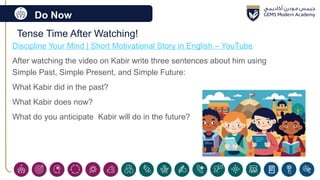
Tense TimeAfter Watching!
Discipline Your Mind | Short Motivational Story in English – YouTube
After watching the video on Kabir write three sentences about him using
Simple Past, Simple Present, and Simple Future:
What Kabir did in the past?
What Kabir does now?
What do you anticipate Kabir will do in the future?
3.
Learning Outcomes ToKnow
Students will be able to:
Identify future tense verbs in
sentences and texts. Understand the
formation of the future tense,
including the use of “will” and “going
to”.
Construct grammatically correct
sentences in the future tense for both
written and spoken communication.
Express and comprehend future actions, events, and
states with accuracy and clarity in both written and
spoken communication.
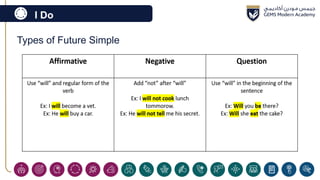
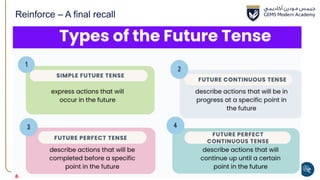
Simple Future Tens: Subject + will + base form of the v
erb.
Future Continuous Tense: Subject + will be + base
verb + ing.
Future Perfect Tense:Subject + will have + past
participle.
Future Perfect Continuous Tense:Subject + will have
been + base verb + ing.
4.
I Do, WeDo, You Do
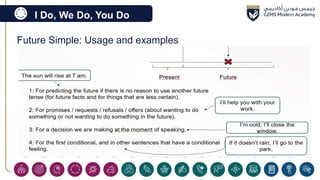
Future Simple: Usage and examples
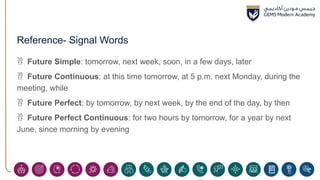
Reference- Signal Words
Future Simple: tomorrow, next week, soon, in a few days, later
Future Continuous: at this time tomorrow, at 5 p.m. next Monday, during the
meeting, while
Future Perfect: by tomorrow, by next week, by the end of the day, by then
Future Perfect Continuous: for two hours by tomorrow, for a year by next
June, since morning by evening
7.
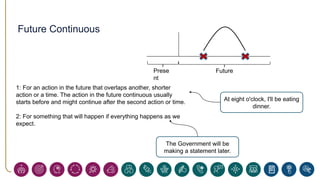
Future Continuous
Future
Prese
nt
1: Foran action in the future that overlaps another, shorter
action or a time. The action in the future continuous usually
starts before and might continue after the second action or time.
2: For something that will happen if everything happens as we
expect.
At eight o'clock, I'll be eating
dinner.
The Government will be
making a statement later.
8.
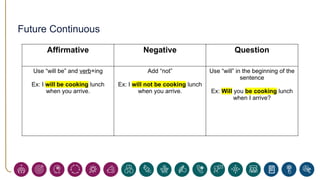
Future Continuous
Affirmative NegativeQuestion
Use “will be” and verb+ing
Ex: I will be cooking lunch
when you arrive.
Add “not”
Ex: I will not be cooking lunch
when you arrive.
Use “will” in the beginning of the
sentence
Ex: Will you be cooking lunch
when I arrive?
9.
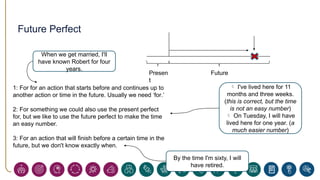
Future Perfect
Presen
t
Future
1: Forfor an action that starts before and continues up to
another action or time in the future. Usually we need ‘for.’
2: For something we could also use the present perfect
for, but we like to use the future perfect to make the time
an easy number.
3: For an action that will finish before a certain time in the
future, but we don't know exactly when.
When we get married, I'll
have known Robert for four
years.
I've lived here for 11
months and three weeks.
(this is correct, but the time
is not an easy number)
On Tuesday, I will have
lived here for one year. (a
much easier number)
By the time I'm sixty, I will
have retired.
10.
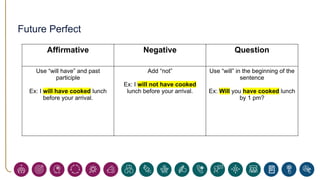
Future Perfect
Affirmative NegativeQuestion
Use “will have” and past
participle
Ex: I will have cooked lunch
before your arrival.
Add “not”
Ex: I will not have cooked
lunch before your arrival.
Use “will” in the beginning of the
sentence
Ex: Will you have cooked lunch
by 1 pm?
11.
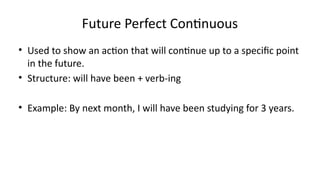
Future Perfect Continuous
•Used to show an action that will continue up to a specific point
in the future.
• Structure: will have been + verb-ing
• Example: By next month, I will have been studying for 3 years.
12.
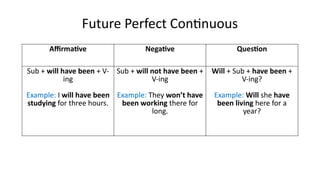
Future Perfect Continuous
AffirmativeNegative Question
Sub + will have been + V-
ing
Example: I will have been
studying for three hours.
Sub + will not have been +
V-ing
Example: They won’t have
been working there for
long.
Will + Sub + have been +
V-ing?
Example: Will she have
been living here for a
year?
13.
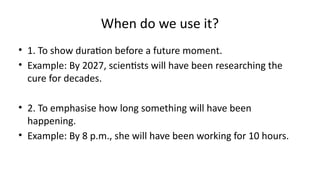
When do weuse it?
• 1. To show duration before a future moment.
• Example: By 2027, scientists will have been researching the
cure for decades.
• 2. To emphasise how long something will have been
happening.
• Example: By 8 p.m., she will have been working for 10 hours.
14.
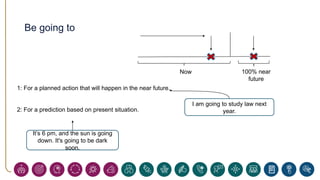
Be going to
100%near
future
1: For a planned action that will happen in the near future.
2: For a prediction based on present situation.
Now
It’s 6 pm, and the sun is going
down. It's going to be dark
soon.
I am going to study law next
year.
15.
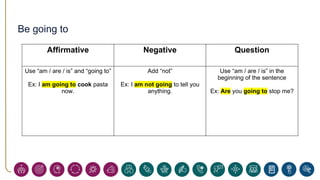
Be going to
AffirmativeNegative Question
Use “am / are / is” and “going to”
Ex: I am going to cook pasta
now.
Add “not”
Ex: I am not going to tell you
anything.
Use “am / are / is” in the
beginning of the sentence
Ex: Are you going to stop me?
16.
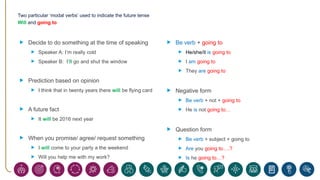
Two particular ‘modalverbs’ used to indicate the future tense
Will and going to
Decide to do something at the time of speaking
Speaker A: I’m really cold
Speaker B: I’ll go and shut the window
Prediction based on opinion
I think that in twenty years there will be flying card
A future fact
It will be 2016 next year
When you promise/ agree/ request something
I will come to your party a the weekend
Will you help me with my work?
Be verb + going to
He/she/it is going to
I am going to
They are going to
Negative form
Be verb + not + going to
He is not going to…
Question form
Be verb + subject + going to
Are you going to….?
Is he going to…?
17.
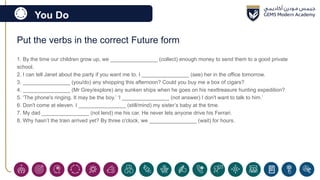
You Do
Put theverbs in the correct Future form
1. By the time our children grow up, we ________________ (collect) enough money to send them to a good private
school.
2. I can tell Janet about the party if you want me to. I ________________ (see) her in the office tomorrow.
3. ________________ (you/do) any shopping this afternoon? Could you buy me a box of cigars?
4. ________________ (Mr Grey/explore) any sunken ships when he goes on his nexttreasure hunting expedition?
5. ‘The phone's ringing. It may be the boy.’ ‘I ________________ (not answer) I don't want to talk to him.’
6. Don't come at eleven. I ________________ (still/mind) my sister’s baby at the time.
7. My dad ________________ (not lend) me his car. He never lets anyone drive his Ferrari.
8. Why hasn’t the train arrived yet? By three o'clock, we ________________ (wait) for hours.
18.
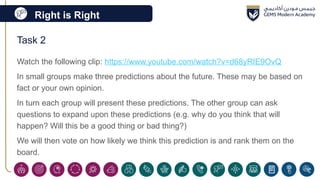
Right is Right
Task2
Watch the following clip: https://www.youtube.com/watch?v=d68yRIE9OvQ
In small groups make three predictions about the future. These may be based on
fact or your own opinion.
In turn each group will present these predictions. The other group can ask
questions to expand upon these predictions (e.g. why do you think that will
happen? Will this be a good thing or bad thing?)
We will then vote on how likely we think this prediction is and rank them on the
board.
19.
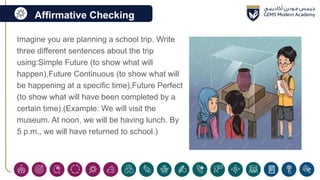
Affirmative Checking
Imagine youare planning a school trip. Write
three different sentences about the trip
using:Simple Future (to show what will
happen),Future Continuous (to show what will
be happening at a specific time),Future Perfect
(to show what will have been completed by a
certain time).(Example: We will visit the
museum. At noon, we will be having lunch. By
5 p.m., we will have returned to school.)
#3 Learning Outcomes
Identify the desired skill – Determine the specific skill or ability students should demonstrate by the end of the lesson. Start with “By the end of this lesson, you will be able to (verb)…”
Align with knowledge components – Consider the knowledge necessary to achieve the learning outcome and apply the skill effectively
Communicate the outcome – Share the learning outcome at the start of the lesson, ensuring students understand what they are working towards
To Know
Create a clear list – Develop a concise list of the knowledge components when planning the lesson
Introduce the components – Present the knowledge components at the beginning of the lesson, clearly explaining the importance of each component, how they connect to one another and directly support in achieving the learning outcome
Integrate into instruction – Incorporate the knowledge components throughout the lesson, reinforcing them during discussions, activities, and assessments
#4 Model the task (I Do) – Demonstrate the skill while thinking aloud and naming the steps; model your thinking and not just the procedure
Engage in guided practice
(We Do) – Work together with students using another example; ask questions, probe thinking, provide prompts, and give feedback. Be explicit about what students should be doing during this stage
Facilitate independent practice
(You Do) – Allow students to complete the task independently, providing minimal guidance. Use Affirmative Checking and offer constructive feedback to reinforce learning and address any misconceptions
#5 Model the task (I Do) – Demonstrate the skill while thinking aloud and naming the steps; model your thinking and not just the procedure
#17 will have collected
will see /
Will you do /will you be doing
Will Mr Grey explore / exploring
will not answer
will still be minding
will not lend
will have been waiting/ will have waited
#18 Set high expectations – Let students know you expect complete and accurate answers
Acknowledge partial correctness – If a response is partially right, affirm the correct part and highlight what is missing
Prompt further thinking – Ask probing questions to help students refine or complete their answers
Encourage self-correction – Allow students to build on their own or peers’ responses to achieve full accuracy
Celebrate correctness – Once the complete and correct answer is reached, reinforce it to solidify understanding
#19 will have collected
will see
Will you do Will Mr Grey explore will not answer will still be minding are going to lose are going to have will not lend will have been waiting
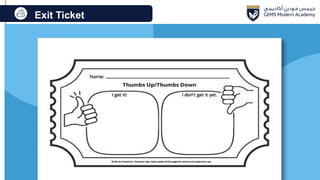
#20 Create Targeted Questions – Design no more than 1-3 brief and focused questions that assess the lesson’s core knowledge or skills
Distribute at the End – Share the exit tickets at the end of the lesson, ensuring everyone completes them
Collect and Review – Gather responses and quickly analyse responses to gauge overall understanding and individual student needs
Provide Feedback – Use the exit ticket data to give immediate feedback
Plan Next Steps – Adapt future lessons based on patterns or misconceptions identified through the exit tickets