.
SUBJECT: EDUCATIONAL TECHNOLOGY
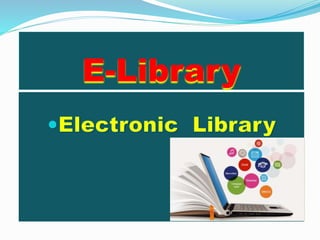
E-Library
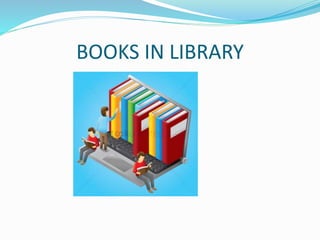
BOOKS IN LIBRARY
DEFENITION
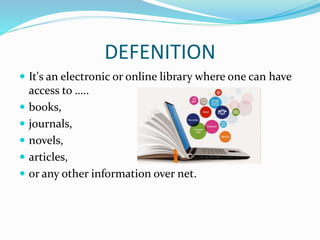
 It's an electronic or online library where one can have
access to …..
 books,
 journals,
 novels,
 articles,
 or any other information over net.
Contd…
 A digital library is a specialized library that can include
a centralized collection of digital objects, including
texts, visual materials, audio materials, video
materials, files stored as electronic media formats, and
ways to organize, store, and recover media. Digital
libraries can vary immensely in size and scope and can
be maintained with individuals, organizations, or
established physical library buildings or institutions
with approved or academic institutions. The electronic
content may be stored locally or accessed remotely via
computer networks. An electronic library is a type of
data retrieval system.
BENEFITS
 Before taking into consideration their 5 main benefits,
let’s try to give a definition of what digital libraries
are. A digital library is a collection of documents –
such as magazine articles, book, papers, images, sound
files and videos – organized in an electronic form
and available on the Internet or on a digital
support, for example a CD-ROM disk. Compared to
CD-ROM disks, Internet-based digital libraries have a
plus: they can be updated on a daily basis.
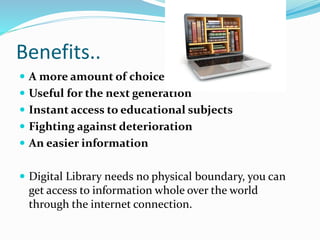
Benefits..
 A more amount of choice
 Useful for the next generation
 Instant access to educational subjects
 Fighting against deterioration
 An easier information
 Digital Library needs no physical boundary, you can
get access to information whole over the world
through the internet connection.
Contd…
 1. A more amount of choice
 Digital libraries give access to multiple contents
with a more number of resources and selections at
hand.
 2.Useful for the next generation
 Online libraries help the scientific society since
they act as a reservoir for the storage of important
research data, information and findings.
Contd..
 3. Instant access to educational subjects
 As long as an Internet connection is available, digital
libraries are accessible anywhere and at any
moment using a simple technological device, such as
a PC, a tablet or even a smartphone. This means
students can consult online books, images, videos and
all the other educational contents without having to
wait and go to the nearest physical library.
Contd..
 4. Fighting against deterioration
 The digital storage of books and, above all,
audios, solve the problem of deterioration, with
the risk of being subjected to breakages or other
damages.
 5. An easier information
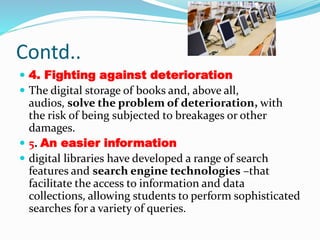
 digital libraries have developed a range of search
features and search engine technologies –that
facilitate the access to information and data
collections, allowing students to perform sophisticated
searches for a variety of queries.
DISADVANTAGES OF DIGITAL LIBRARY:
 violates the copyright law as the thought content of
one author can be freely transferred by others without
his acknowledgement.
 High initial cost. It costs more
 Digital library needs high bandwidth network for
transfer of multimedia resources, like internet,
modem, electricity, etc.
 Digital library cannot reproduce the environment of a
traditional library.
USAGE….
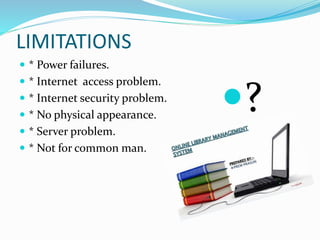
LIMITATIONS
 * Power failures.
 * Internet access problem.
 * Internet security problem.
 * No physical appearance.
 * Server problem.
 * Not for common man.
?
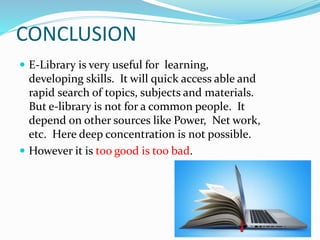
CONCLUSION
 E-Library is very useful for learning,
developing skills. It will quick access able and
rapid search of topics, subjects and materials.
But e-library is not for a common people. It
depend on other sources like Power, Net work,
etc. Here deep concentration is not possible.
 However it is too good is too bad.
REFERENCE
 Book: Malini.L
 https://www.ndl.iitkgp.ac.in/
 https://www.acerforeducation.acer.com
 https://en.wikipedia.org/wiki/Digital_library
 https://www.lisbdnetwork.com
.

Akshata Itagi

  • 1.
  • 2.
  • 3.
  • 4.
    DEFENITION  It's anelectronic or online library where one can have access to …..  books,  journals,  novels,  articles,  or any other information over net.
  • 5.
    Contd…  A digitallibrary is a specialized library that can include a centralized collection of digital objects, including texts, visual materials, audio materials, video materials, files stored as electronic media formats, and ways to organize, store, and recover media. Digital libraries can vary immensely in size and scope and can be maintained with individuals, organizations, or established physical library buildings or institutions with approved or academic institutions. The electronic content may be stored locally or accessed remotely via computer networks. An electronic library is a type of data retrieval system.
  • 6.
    BENEFITS  Before takinginto consideration their 5 main benefits, let’s try to give a definition of what digital libraries are. A digital library is a collection of documents – such as magazine articles, book, papers, images, sound files and videos – organized in an electronic form and available on the Internet or on a digital support, for example a CD-ROM disk. Compared to CD-ROM disks, Internet-based digital libraries have a plus: they can be updated on a daily basis.
  • 7.
    Benefits..  A moreamount of choice  Useful for the next generation  Instant access to educational subjects  Fighting against deterioration  An easier information  Digital Library needs no physical boundary, you can get access to information whole over the world through the internet connection.
  • 8.
    Contd…  1. Amore amount of choice  Digital libraries give access to multiple contents with a more number of resources and selections at hand.  2.Useful for the next generation  Online libraries help the scientific society since they act as a reservoir for the storage of important research data, information and findings.
  • 9.
    Contd..  3. Instantaccess to educational subjects  As long as an Internet connection is available, digital libraries are accessible anywhere and at any moment using a simple technological device, such as a PC, a tablet or even a smartphone. This means students can consult online books, images, videos and all the other educational contents without having to wait and go to the nearest physical library.
  • 10.
    Contd..  4. Fightingagainst deterioration  The digital storage of books and, above all, audios, solve the problem of deterioration, with the risk of being subjected to breakages or other damages.  5. An easier information  digital libraries have developed a range of search features and search engine technologies –that facilitate the access to information and data collections, allowing students to perform sophisticated searches for a variety of queries.
  • 11.
    DISADVANTAGES OF DIGITALLIBRARY:  violates the copyright law as the thought content of one author can be freely transferred by others without his acknowledgement.  High initial cost. It costs more  Digital library needs high bandwidth network for transfer of multimedia resources, like internet, modem, electricity, etc.  Digital library cannot reproduce the environment of a traditional library.
  • 12.
  • 13.
    LIMITATIONS  * Powerfailures.  * Internet access problem.  * Internet security problem.  * No physical appearance.  * Server problem.  * Not for common man. ?
  • 14.
    CONCLUSION  E-Library isvery useful for learning, developing skills. It will quick access able and rapid search of topics, subjects and materials. But e-library is not for a common people. It depend on other sources like Power, Net work, etc. Here deep concentration is not possible.  However it is too good is too bad.
  • 15.
    REFERENCE  Book: Malini.L https://www.ndl.iitkgp.ac.in/  https://www.acerforeducation.acer.com  https://en.wikipedia.org/wiki/Digital_library  https://www.lisbdnetwork.com
  • 16.