Information Security
Lecture 3
By
Usman Zia
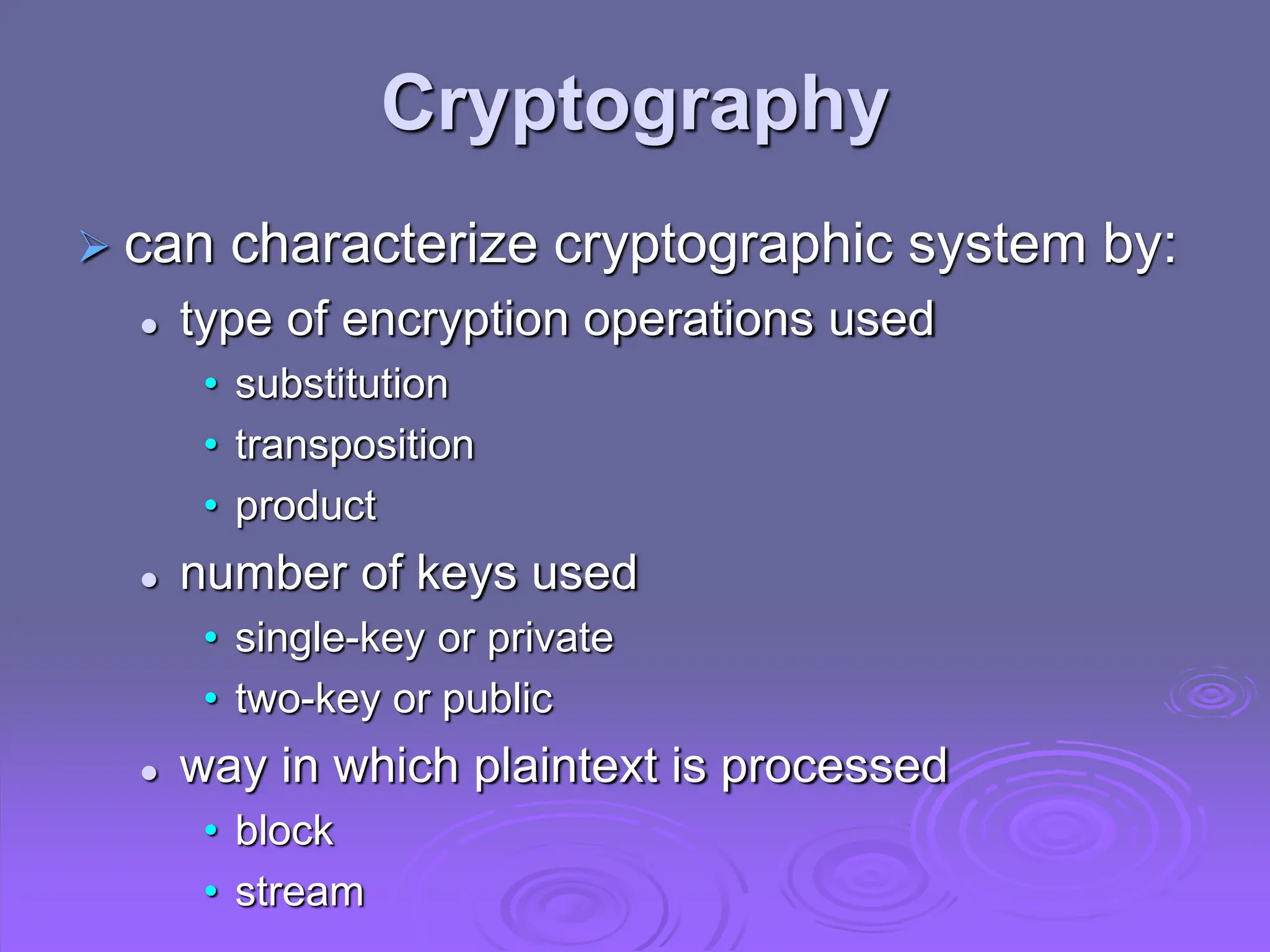
Cryptography
 can characterize cryptographic system by:
 type of encryption operations used
• substitution
• transposition
• product
 number of keys used
• single-key or private
• two-key or public
 way in which plaintext is processed
• block
• stream
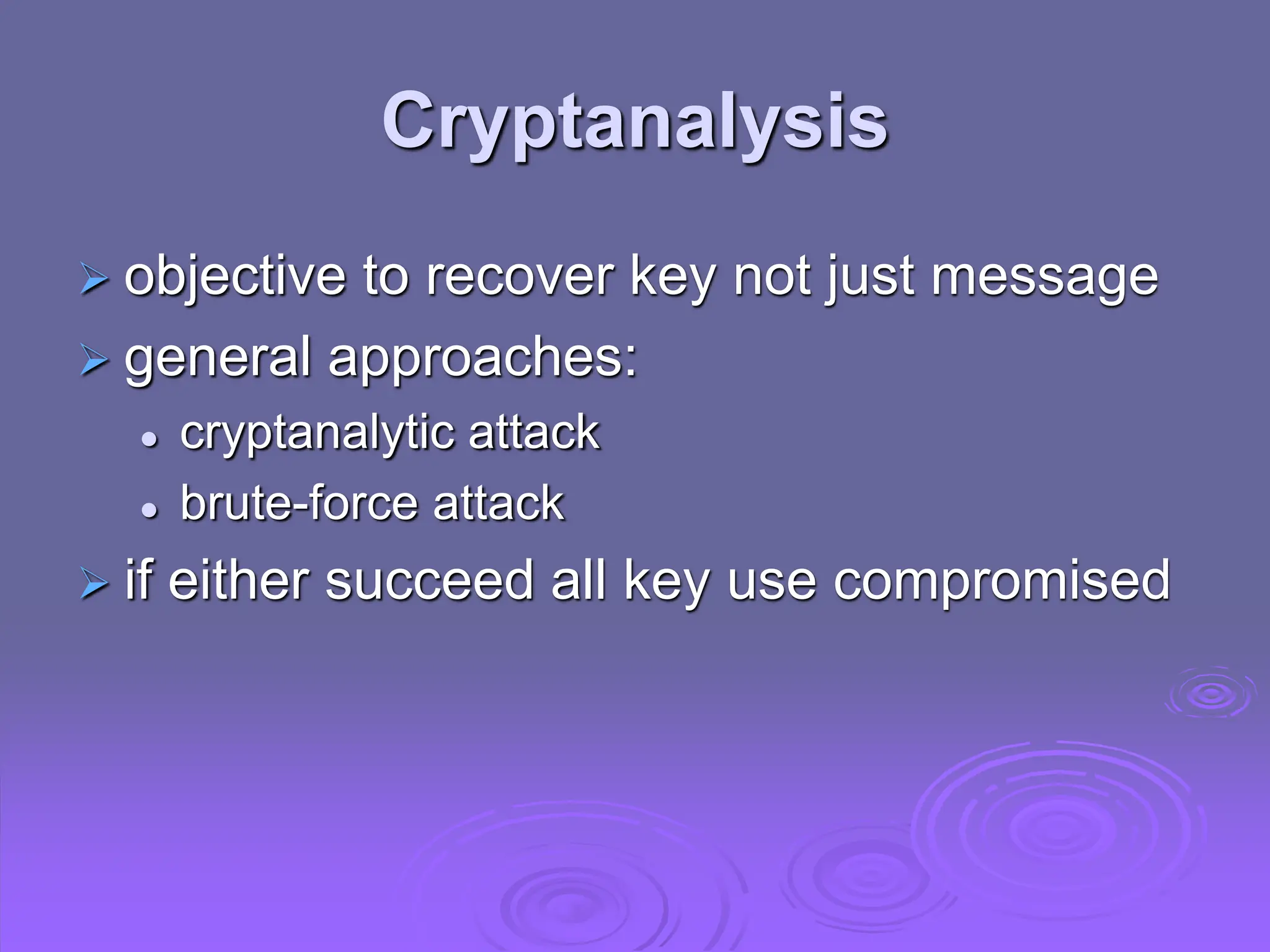
Cryptanalysis
 objective to recover key not just message
 general approaches:
 cryptanalytic attack
 brute-force attack
 if either succeed all key use compromised
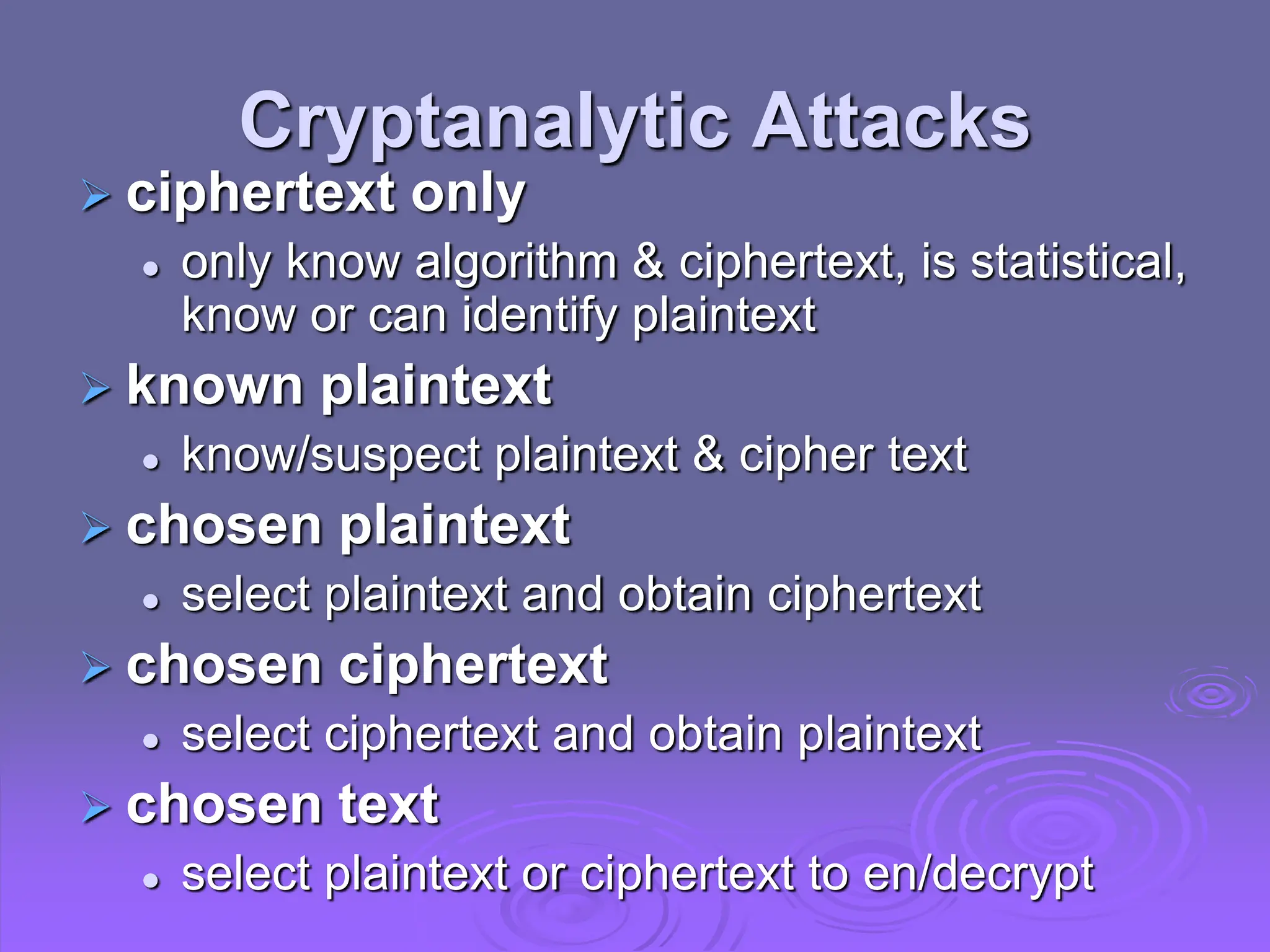
Cryptanalytic Attacks
 ciphertext only
 only know algorithm & ciphertext, is statistical,
know or can identify plaintext
 known plaintext
 know/suspect plaintext & cipher text
 chosen plaintext
 select plaintext and obtain ciphertext
 chosen ciphertext
 select ciphertext and obtain plaintext
 chosen text
 select plaintext or ciphertext to en/decrypt
 An encryption scheme: computationally
secure if
 The cost of breaking the cipher exceeds the
value of information
 The time required to break the cipher exceeds
the lifetime of information
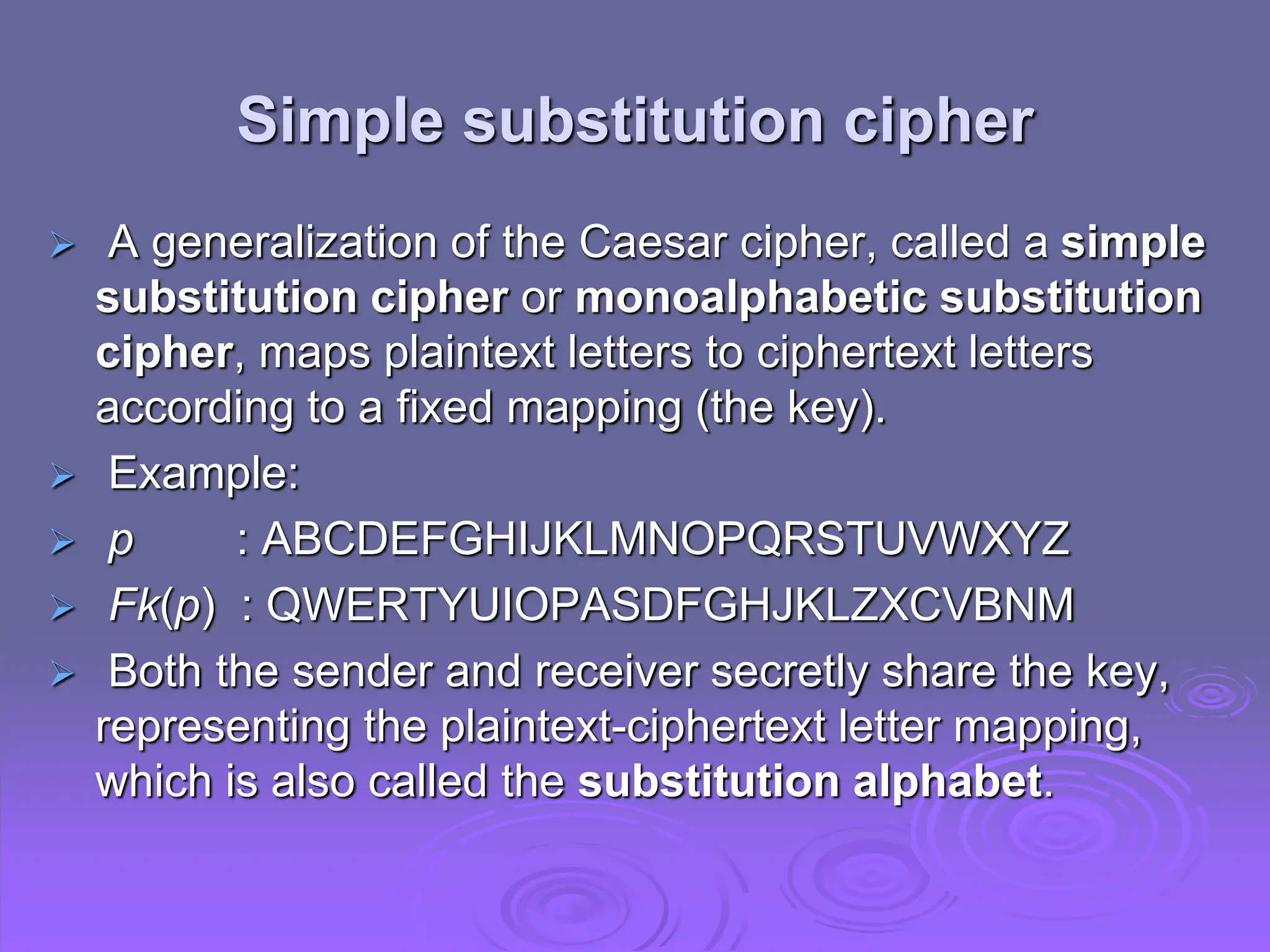
 A generalization of the Caesar cipher, called a simple
substitution cipher or monoalphabetic substitution
cipher, maps plaintext letters to ciphertext letters
according to a fixed mapping (the key).
 Example:
 p : ABCDEFGHIJKLMNOPQRSTUVWXYZ
 Fk(p) : QWERTYUIOPASDFGHJKLZXCVBNM
 Both the sender and receiver secretly share the key,
representing the plaintext-ciphertext letter mapping,
which is also called the substitution alphabet.
Simple substitution cipher
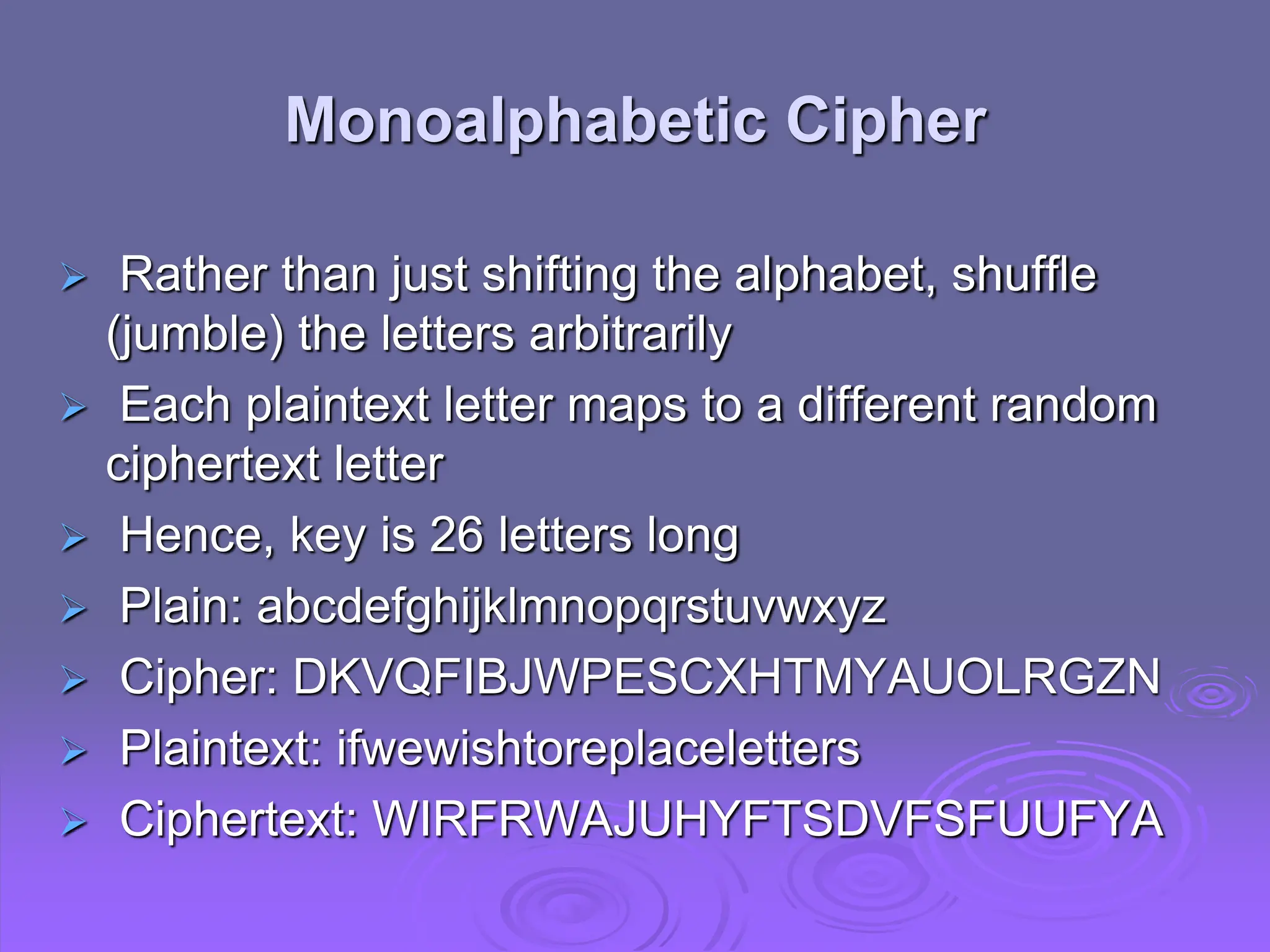
 Rather than just shifting the alphabet, shuffle
(jumble) the letters arbitrarily
 Each plaintext letter maps to a different random
ciphertext letter
 Hence, key is 26 letters long
 Plain: abcdefghijklmnopqrstuvwxyz
 Cipher: DKVQFIBJWPESCXHTMYAUOLRGZN
 Plaintext: ifwewishtoreplaceletters
 Ciphertext: WIRFRWAJUHYFTSDVFSFUUFYA
Monoalphabetic Cipher
 Now a total of 26! = 4 x 1026 keys
 With so many keys, might think its secure
 But it would be !!!WRONG!!!
 Problem is language characteristics
Monoalphabetic Cipher Security
 A transposition cipher rearranges the plaintext letters according to a
secret transformation defined by the key.
 The simplest example of this is the railfence cipher, in which the
plaintext is written in rows of n letter blocks (the number of columns n is
the key) and then the ciphertext is read in columns
 Example:
 Plaintext: TRANSPOSITIONCIPHERX
 In this example, the key is: 5
 Re-write as rows of 5-letter blocks:
 TRANS
 POSIT
 IONCI
 PHERX
 Ciphertext: TPIPROOHASNENICRSTIX
Transposition cipher
 Problems with the railfence cipher:
 The first and last letters of the plaintext do not move
 The key is a number that divides the total message length
 In a single columnar transposition cipher, the key is a word or phrase whose
letters, in alphabetic order, indicate the order of the columns as they are read
 Example:
 Plaintext: TRANSPOSITIONCIPHER
 Key is “SECRET”, so re-write as rows of 6-letter blocks:
 SECRET CEERST
 521436 123456
 TRANSP ARSNTP
 OSITIO ISITOO
 NCIPHE ICHPNE
 R R
 Ciphertext: AII$RSC$SIH$NTP$TONRPOE$
Transposition cipher

information security Lectures -03,04.ppt

  • 1.
  • 2.
    Cryptography  can characterizecryptographic system by:  type of encryption operations used • substitution • transposition • product  number of keys used • single-key or private • two-key or public  way in which plaintext is processed • block • stream
  • 3.
    Cryptanalysis  objective torecover key not just message  general approaches:  cryptanalytic attack  brute-force attack  if either succeed all key use compromised
  • 4.
    Cryptanalytic Attacks  ciphertextonly  only know algorithm & ciphertext, is statistical, know or can identify plaintext  known plaintext  know/suspect plaintext & cipher text  chosen plaintext  select plaintext and obtain ciphertext  chosen ciphertext  select ciphertext and obtain plaintext  chosen text  select plaintext or ciphertext to en/decrypt
  • 5.
     An encryptionscheme: computationally secure if  The cost of breaking the cipher exceeds the value of information  The time required to break the cipher exceeds the lifetime of information
  • 6.
     A generalizationof the Caesar cipher, called a simple substitution cipher or monoalphabetic substitution cipher, maps plaintext letters to ciphertext letters according to a fixed mapping (the key).  Example:  p : ABCDEFGHIJKLMNOPQRSTUVWXYZ  Fk(p) : QWERTYUIOPASDFGHJKLZXCVBNM  Both the sender and receiver secretly share the key, representing the plaintext-ciphertext letter mapping, which is also called the substitution alphabet. Simple substitution cipher
  • 7.
     Rather thanjust shifting the alphabet, shuffle (jumble) the letters arbitrarily  Each plaintext letter maps to a different random ciphertext letter  Hence, key is 26 letters long  Plain: abcdefghijklmnopqrstuvwxyz  Cipher: DKVQFIBJWPESCXHTMYAUOLRGZN  Plaintext: ifwewishtoreplaceletters  Ciphertext: WIRFRWAJUHYFTSDVFSFUUFYA Monoalphabetic Cipher
  • 8.
     Now atotal of 26! = 4 x 1026 keys  With so many keys, might think its secure  But it would be !!!WRONG!!!  Problem is language characteristics Monoalphabetic Cipher Security
  • 9.
     A transpositioncipher rearranges the plaintext letters according to a secret transformation defined by the key.  The simplest example of this is the railfence cipher, in which the plaintext is written in rows of n letter blocks (the number of columns n is the key) and then the ciphertext is read in columns  Example:  Plaintext: TRANSPOSITIONCIPHERX  In this example, the key is: 5  Re-write as rows of 5-letter blocks:  TRANS  POSIT  IONCI  PHERX  Ciphertext: TPIPROOHASNENICRSTIX Transposition cipher
  • 10.
     Problems withthe railfence cipher:  The first and last letters of the plaintext do not move  The key is a number that divides the total message length  In a single columnar transposition cipher, the key is a word or phrase whose letters, in alphabetic order, indicate the order of the columns as they are read  Example:  Plaintext: TRANSPOSITIONCIPHER  Key is “SECRET”, so re-write as rows of 6-letter blocks:  SECRET CEERST  521436 123456  TRANSP ARSNTP  OSITIO ISITOO  NCIPHE ICHPNE  R R  Ciphertext: AII$RSC$SIH$NTP$TONRPOE$ Transposition cipher