The Potential Use of  Information Systems and Knowledge Management to drive Desired Values and Behaviors  in People Systems (to Achieve Measurable Outputs with Performance Based Metrics)
A paradigm from current thinking on  Particle Physics ….. “Matter is a mere derivation, a subordinate phenomenon.  The fundamental essences are energy and information.  Information bounds energy into form, like will bounds volition into purpose. Alter the information, and the form is altered, while the substance remains unchanged. Energy is older than information, but formless and timeless without it.  Older than matter, but helpless and useless without it.  Replace one thought with another, one pattern with another. And you can effectively change the outcome without interfering with the form.”
A paradigm from current work on  How People Think ….. “People use cognitive rules or reasoning to design and implement their actions.  These rules can be thought of as a kind of “master program”, stored in the brain, governing all behavior.  These rules and reasoning are derived from memories made up of experiences, information, and derived knowledge, that very much control the attitude formation process - which directly relates to observable behavior. If you can change the information streams into the mind, and directly contribute to knowledge acquisition, you can dramatically impact on attitude formation and behavior.  Replace one thought with another, one pattern with another.  And you can effectively change the outcome without interfering with the form! ”
The hypothesis …... “In a Knowledge Society - the Information Age - accessibility to Information forces transparency in Human Relationships by enabling the Decision Maker to understand all the factors required in making the Decision”
“ This accessibility to Information in turn forces Honesty in Transactions, which force Value Statements, which forces adherence to Values and Behaviors - because Individuals can then compare Behavior and Performance from their Knowledge and Perceptions gained from exposure to  the Information Streams”
You could therefor say that accessibility to Information forces : -  Transparency in Transactions -  Underwrites Honesty -  Promotes Value Statements  and -  Adherence to Values and Behaviors or AI>TT>H>VS>V&B
“ AI>TT>H>VS>V&B” What this means for us is quite dramatic
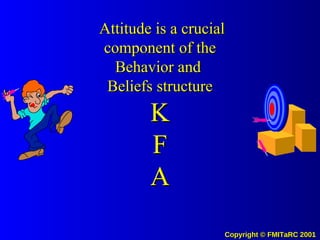
Attitude is a crucial component of the Behavior and  Beliefs structure K F A
The three components of Attitude formation : The Cognitive component  is Our knowledge about the Attitude Object, whether that knowledge is accurate or not. K
- Affective component  is Our feeling toward the Attitude Object. F
- Conative component  is the Action, or the intent of Action, We will take toward the Attitude Object. A
The model  of Attitude formation shows that Our subjective knowledge (beliefs) about an Object determines Our Attitude  toward it.
The variables in Attitude change are: 1.  Personality traits
2.  Credibility of the source of different opinions or  information countering existing Attitudes
3.  Group Membership
Traditionally a Change Management Process is centered around attacking the Group Dynamics component to eventually change individual Behavior. This is achieved by removing excuse bases, and empowerment processes that create different Patterns of Behavior at the Group Level, and therefore at the Individual level (by force of association with new group norms)
These types of Processes  usually do not succeed long-term due to the inability of  Senior Management to deliver  on one or more of  the three Trust Paradigms
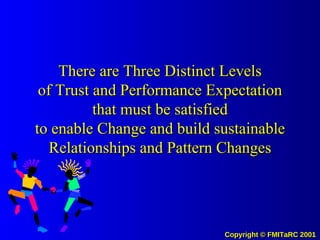
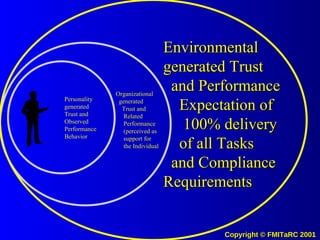
There are Three Distinct Levels of Trust and Performance Expectation that must be satisfied to enable Change and build sustainable Relationships and Pattern Changes
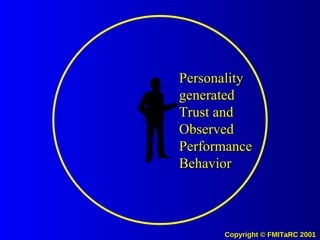
Personality generated Trust and Observed Performance Behavior
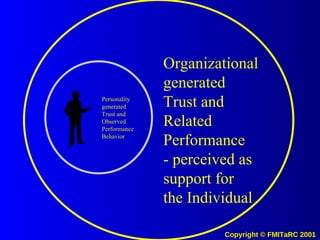
Personality generated Trust and Observed Performance Behavior Organizational generated Trust and Related Performance - perceived as support for the Individual
Personality generated Trust and Observed Performance Behavior Organizational generated Trust and Related Performance (perceived as support for the Individual Environmental generated Trust and Performance Expectation of 100% delivery of all Tasks and Compliance Requirements
If we look at Organizational Philosophy and the Decision Making Process we see an opportunity to use the power of Information as a Prime Change Agent and move away from the traditional group approach
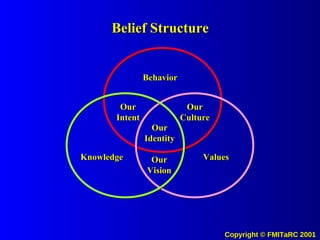
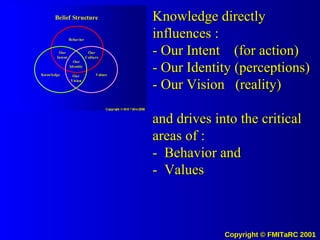
This approach could be tremendously powerful because of the role Knowledge plays in the Belief Structure Model
Behavior Values Knowledge Our Identity Our Vision Our Culture Our Intent Belief Structure
Knowledge directly influences : - Our Intent  (for action) - Our Identity (perceptions) - Our Vision  (reality) and drives into the critical areas of : -  Behavior and -  Values
If we now look at the Decision Making Process we see the real opportunity in using Information Systems and Knowledge Management to drive desired values and behavior in People Systems
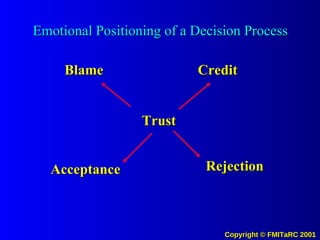
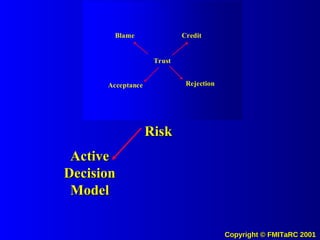
Blame Credit Acceptance Rejection Trust Emotional Positioning of a Decision Process
Risk Active Decision Model
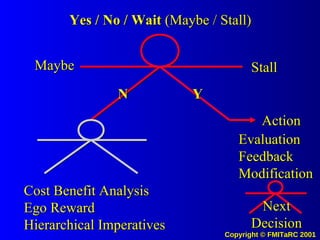
Yes / No / Wait  (Maybe / Stall) Maybe Stall Evaluation Feedback Modification Action Next Decision Cost Benefit Analysis Ego Reward Hierarchical  Imperatives N Y
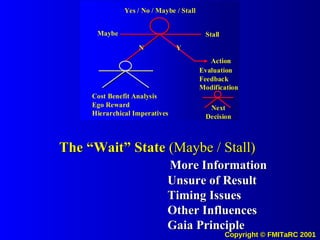
The “Wait” State  (Maybe / Stall)   More Information   Unsure of Result   Timing Issues   Other Influences   Gaia Principle
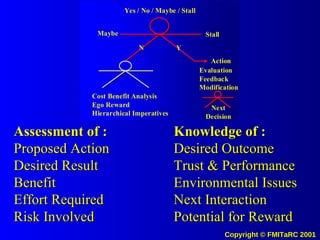
Assessment of : Knowledge of : Proposed Action Desired Outcome Desired Result Trust & Performance Benefit Environmental Issues Effort Required Next Interaction Risk Involved Potential for Reward
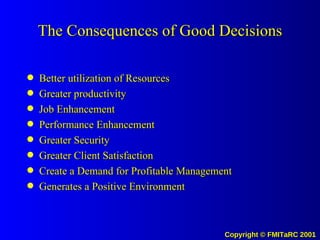
The Consequences of Good Decisions Better utilization of Resources Greater productivity Job Enhancement Performance Enhancement Greater Security Greater Client Satisfaction Create a Demand for Profitable Management Generates a Positive Environment
The Literal Truth about Decisions The lower down the Organizational Structure they occur, the better they are and the less they cost. The faster they can be made, the higher the quality, and the lower the cost. The simple keys to Organizational efficiency in Decision making are the free, timely, and simple access to appropriate data, information, and knowledge systems. A “smart” Organization is one where Information is fully distributed, and access is freely available to the lowest common denominator of the Organization on demand.
The effectiveness of a decision is the Quality of the Decision multiplied  by the Acceptance of it. Quality X Acceptance
The Area we can impact on immediately is the QUALITY of the Decision…. by providing Information Streams and Knowledge Management
Change   is the Absolute Value of One
The Gaia Principle of the Universal Linking Theory  suggests that  “Every individual person’s performance impacts on,  and in turn, is impacted on by, every other person’s  performance” .
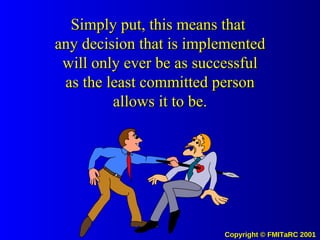
Simply put, this means that  any decision that is implemented will only ever be as successful as the least committed person allows it to be.
“People and Culture - the Human Systems of a Company -  are what make or break any Change Initiative” Arthur Wyatt, Founder Wyatt & Co.
The most frequently mentioned  barriers to Change  are Employee resistance, and Dysfunctional Corporate Culture. Dysfunctional Culture is one whose shared values and behavior are at odds with its long-term health.
“ The way in which someone or something functions ” “ .... to Perform ” Performance ….
The Concept of “a Balanced Universe” Simply doesn’t exist except in the minds of Politicians
Performance must be Observed to be Measured
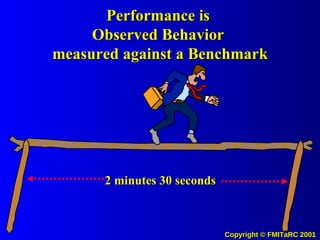
Performance is  Observed Behavior  measured against a Benchmark 2 minutes 30 seconds
bench·mark  (b  nch  märk  )  noun 1. A standard by which something can be measured or judged:  “Inflation . . . is a great distorter of seemingly fixed economic ideas and benchmarks”  (Benjamin M. Friedman).  bench·marked ,  bench·mark·ing ,  bench·marks To measure (a rival's product) according to specified standards in order to compare it with and improve one's own product.
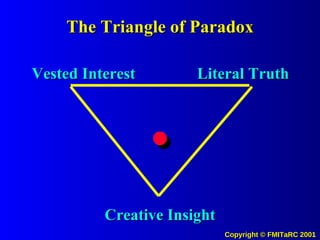
The Triangle of Paradox Vested Interest Literal Truth Creative Insight .
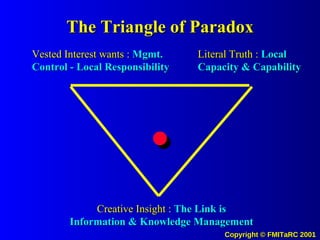
The Triangle of Paradox Vested Interest wants :  Mgmt. Control - Local Responsibility Literal Truth :  Local Capacity & Capability Creative Insight :  The Link is Information & Knowledge Management .
The real business that responsible Management  should be  involved in is the supply of Information Streams and Knowledge Management Processes to everyone involved in any Process that has a desired Outcome so that they can make Quality Decisions that have  maximum acceptability by the System Value of a Decision = Quality X Acceptance
Management changes the Information and the Knowledge base “ If you can change the information streams into the mind, and directly contribute to knowledge acquisition, you can dramatically impact on attitude formation and behavior.  Replace one thought with another, one pattern with another.  And you can effectively change the outcome without interfering with the form! ”     forces Transparency in Transactions forces Honesty forces Value Statements and adherence to Values and Behaviors “AI>TT>H>VS>V&B”
The Tools : Empowerment  - Have access to everything required to make an informed quality decision with the overt support of the impacted infrastructure and Organization Benchmarks  - The real metrics that enable genuine performance management and strategic decision processes to flourish Information  - Free and ready access to every attribute that could impact on a decision process with full 360 0  feedback Knowledge Management  - Processes and systems that encourage active learning and contribution to the benefit of the overall system
“ Without Resistance, There Can Be No Change.” Dr. Peter Hubbard
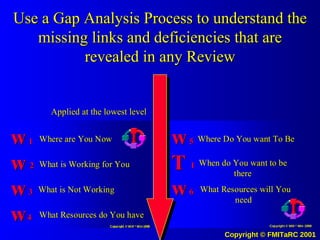
Use a Gap Analysis Process to understand the missing links and deficiencies that are revealed in any Review Applied at the lowest level
Training is about Skills. It is Task Orientated, and requires procedure, practice, and feedback. (“Getting the 80%”) You must provide the requisite Training ...
Coaching is about Performance. It is Achievement Orientated, and requires a program, feedback, peaking, arousal, and characteristic tension. (Getting the  extra  20%) You must provide the requisite Coaching ...
At the process level we need to explore what are the critical decisions our People need to make to achieve the desired Outcomes (at every level of the Organization) Establish Benchmarks and Milestones Establish what Information and Knowledge Management process they need to make Quality Decisions What the Access, Quality, Relevance, Timelines, and Feedback systems look like to them Provide Training and Coaching to enable the mind-shift required for acceptance Establish a “Mentoring” process to enable free and open exchange with 360 0  Feedback
We need to always be mindful of where Information and Knowledge Management fit on the Interaction Grid
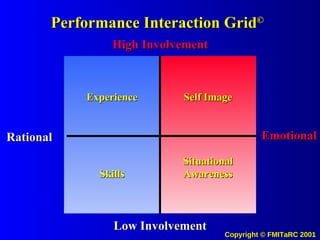
Performance Interaction Grid © Experience Skills Self Image Situational Awareness High Involvement Low   Involvement Rational Emotional
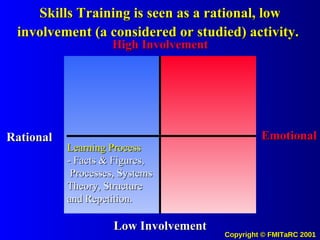
Skills Training is seen as a rational, low involvement (a considered or studied) activity.   High Involvement Low   Involvement Rational Emotional Learning Process   - Facts & Figures, Processes, Systems Theory, Structure and Repetition.
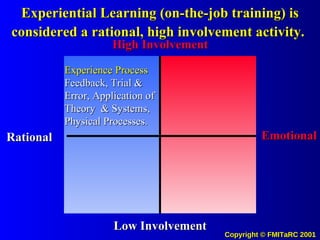
Experiential Learning (on-the-job training) is considered a rational, high involvement activity.   High Involvement Low   Involvement Rational Emotional Experience Process   Feedback, Trial & Error, Application of Theory  & Systems, Physical Processes.
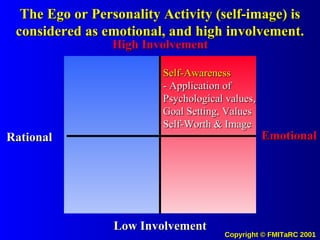
The Ego or Personality Activity (self-image) is considered as emotional, and high involvement. High Involvement Low   Involvement Rational Emotional Self-Awareness - Application of Psychological values, Goal Setting, Values Self-Worth & Image
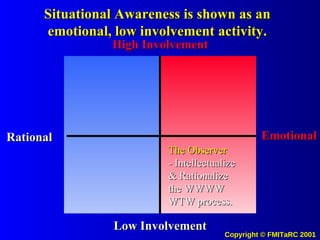
Situational Awareness is shown as an emotional, low involvement activity. High Involvement Low   Involvement Rational Emotional The Observer - Intellectualize & Rationalize  the WWWW WTW process.
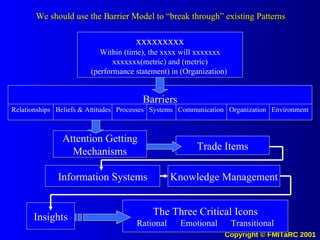
xxxxxxxxx Within (time), the xxxx will xxxxxxx xxxxxxx(metric) and (metric) (performance statement) in (Organization)  Barriers Relationships  Beliefs & Attitudes  Processes  Systems  Communication  Organization  Environment Attention Getting Mechanisms Trade Items Knowledge Management Information Systems Insights The Three Critical Icons Rational  Emotional  Transitional We should use the Barrier Model to “break through” existing Patterns
The hypothesis …... “In a Knowledge Society - the Information Age - accessibility to Information forces transparency in Human Relationships by enabling the Decision Maker to understand all the factors required in making the Decision”
“ This accessibility to Information in turn forces Honesty in Transactions, which force Value Statements, which forces adherence to Values and Behaviors - because Individuals can then compare Behavior and Performance from their Knowledge and Perceptions gained from exposure to  the Information Streams”
DATA Data is defined as any objective information of a statistical or descriptive nature that solely considers the facts and or specifications of an object or a situation relating to an object.  The purpose of DATA is to provide an unambiguous factual base of information from which cognitive and evaluative decisions can be made;  comparisons of like to like can be made;  assumptions concerning linear performance can be made;  and observations regarding trending can be made. Example :  The specification sheet for a piece of equipment;  A usage record indicating functionality against set parameters;  a maintenance record indicating elemental activity against a cost regimen .
INFORMATION I nformation is defined as any subjective information or observation that can be made about a situation relating to an object, or an event related to that object.  In the main, Information is experiential, and may take the form of reports, stories, anecdotes, comments, or observations made during the evaluation, purchasing, installation, maintenance, use, transportation, storage, observation or decommissioning phase of an object.  The purpose of INFORMATION is to provide an emotional context to the reality of using or experiencing an object, from which learning’s can be gained.  These learning’s can then be applied to implement change management systems aimed at increasing the efficiency and utilization of the respective object  or prevent someone else from experiencing the same conditions. Example :   “When you use this you must watch out for an over-temp situation.  If this exists, the quality of performance drops off appreciably, and it can be costly to repair.”  “We found that we had to change out the filter every 130 hours, which is not what the specs indicate.  If you let it go full term you could crack a manifold.”
KNOWLEDGE MANAGEMENT SYSTEMS are defined as those systems dedicated to the easy transmission and access of target-specific DATA and INFORMATION.  The key aspect of a KMS is that access is unlimited, open, transparent, simple, intuitive, and current.  360 0  Feedback loops are incorporated as a prime facet of the communication protocols, and a critical element in the value statement is the concept of Network Theory. Knowledge Management Systems must always be aimed at the lowest common denominator in terms of connectivity, and must not exclude by technology design parameters.  This may mean that the KMS exists in multiple distributed communication forms. A key aspect of any KMS is that the real needs and competencies of the Users are well understood before the design and implementation of any system, and that the relevance of the evolving Network is checked frequently.
Network Theory : The principle value of a Network is the number of People who make up that Network and the congruity of the network; The primary value is derived by the quality of the exchange between Users; The usefulness of a Network is proportional to the number of core and non-core tasks that look and feel the same to the user; It is accepted that in the best Network, there will be passive and active membership.
This new Behavioral Model suggests strongly that accessibility to Information forces : -  Transparency in Transactions -  Underwrites Honesty -  Promotes Value Statements  and -  Adherence to Values and Behaviors
The use of modern Information Technology Platforms and Multimedia Applications  gives us an unparalleled opportunity to affect behavior positively by fully distributing data and critical information  to as many people as it is possible to reach using congruent Networks
The Potential Use of  Information Systems and Knowledge Management to drive Desired Values and Behaviors  in People Systems (to Achieve Measurable Outputs with Performance Based Metrics) [email_address]

Information Km Attitude Change Model 00

  • 1.
    The Potential Useof Information Systems and Knowledge Management to drive Desired Values and Behaviors in People Systems (to Achieve Measurable Outputs with Performance Based Metrics)
  • 2.
    A paradigm fromcurrent thinking on Particle Physics ….. “Matter is a mere derivation, a subordinate phenomenon. The fundamental essences are energy and information. Information bounds energy into form, like will bounds volition into purpose. Alter the information, and the form is altered, while the substance remains unchanged. Energy is older than information, but formless and timeless without it. Older than matter, but helpless and useless without it. Replace one thought with another, one pattern with another. And you can effectively change the outcome without interfering with the form.”
  • 3.
    A paradigm fromcurrent work on How People Think ….. “People use cognitive rules or reasoning to design and implement their actions. These rules can be thought of as a kind of “master program”, stored in the brain, governing all behavior. These rules and reasoning are derived from memories made up of experiences, information, and derived knowledge, that very much control the attitude formation process - which directly relates to observable behavior. If you can change the information streams into the mind, and directly contribute to knowledge acquisition, you can dramatically impact on attitude formation and behavior. Replace one thought with another, one pattern with another. And you can effectively change the outcome without interfering with the form! ”
  • 4.
    The hypothesis …...“In a Knowledge Society - the Information Age - accessibility to Information forces transparency in Human Relationships by enabling the Decision Maker to understand all the factors required in making the Decision”
  • 5.
    “ This accessibilityto Information in turn forces Honesty in Transactions, which force Value Statements, which forces adherence to Values and Behaviors - because Individuals can then compare Behavior and Performance from their Knowledge and Perceptions gained from exposure to the Information Streams”
  • 6.
    You could thereforsay that accessibility to Information forces : - Transparency in Transactions - Underwrites Honesty - Promotes Value Statements and - Adherence to Values and Behaviors or AI>TT>H>VS>V&B
  • 7.
    “ AI>TT>H>VS>V&B” Whatthis means for us is quite dramatic
  • 8.
    Attitude is acrucial component of the Behavior and Beliefs structure K F A
  • 9.
    The three componentsof Attitude formation : The Cognitive component is Our knowledge about the Attitude Object, whether that knowledge is accurate or not. K
  • 10.
    - Affective component is Our feeling toward the Attitude Object. F
  • 11.
    - Conative component is the Action, or the intent of Action, We will take toward the Attitude Object. A
  • 12.
    The model of Attitude formation shows that Our subjective knowledge (beliefs) about an Object determines Our Attitude toward it.
  • 13.
    The variables inAttitude change are: 1. Personality traits
  • 14.
    2. Credibilityof the source of different opinions or information countering existing Attitudes
  • 15.
    3. GroupMembership
  • 16.
    Traditionally a ChangeManagement Process is centered around attacking the Group Dynamics component to eventually change individual Behavior. This is achieved by removing excuse bases, and empowerment processes that create different Patterns of Behavior at the Group Level, and therefore at the Individual level (by force of association with new group norms)
  • 17.
    These types ofProcesses usually do not succeed long-term due to the inability of Senior Management to deliver on one or more of the three Trust Paradigms
  • 18.
    There are ThreeDistinct Levels of Trust and Performance Expectation that must be satisfied to enable Change and build sustainable Relationships and Pattern Changes
  • 19.
    Personality generated Trustand Observed Performance Behavior
  • 20.
    Personality generated Trustand Observed Performance Behavior Organizational generated Trust and Related Performance - perceived as support for the Individual
  • 21.
    Personality generated Trustand Observed Performance Behavior Organizational generated Trust and Related Performance (perceived as support for the Individual Environmental generated Trust and Performance Expectation of 100% delivery of all Tasks and Compliance Requirements
  • 22.
    If we lookat Organizational Philosophy and the Decision Making Process we see an opportunity to use the power of Information as a Prime Change Agent and move away from the traditional group approach
  • 23.
    This approach couldbe tremendously powerful because of the role Knowledge plays in the Belief Structure Model
  • 24.
    Behavior Values KnowledgeOur Identity Our Vision Our Culture Our Intent Belief Structure
  • 25.
    Knowledge directly influences: - Our Intent (for action) - Our Identity (perceptions) - Our Vision (reality) and drives into the critical areas of : - Behavior and - Values
  • 26.
    If we nowlook at the Decision Making Process we see the real opportunity in using Information Systems and Knowledge Management to drive desired values and behavior in People Systems
  • 27.
    Blame Credit AcceptanceRejection Trust Emotional Positioning of a Decision Process
  • 28.
  • 29.
    Yes / No/ Wait (Maybe / Stall) Maybe Stall Evaluation Feedback Modification Action Next Decision Cost Benefit Analysis Ego Reward Hierarchical Imperatives N Y
  • 30.
    The “Wait” State (Maybe / Stall) More Information Unsure of Result Timing Issues Other Influences Gaia Principle
  • 31.
    Assessment of :Knowledge of : Proposed Action Desired Outcome Desired Result Trust & Performance Benefit Environmental Issues Effort Required Next Interaction Risk Involved Potential for Reward
  • 32.
    The Consequences ofGood Decisions Better utilization of Resources Greater productivity Job Enhancement Performance Enhancement Greater Security Greater Client Satisfaction Create a Demand for Profitable Management Generates a Positive Environment
  • 33.
    The Literal Truthabout Decisions The lower down the Organizational Structure they occur, the better they are and the less they cost. The faster they can be made, the higher the quality, and the lower the cost. The simple keys to Organizational efficiency in Decision making are the free, timely, and simple access to appropriate data, information, and knowledge systems. A “smart” Organization is one where Information is fully distributed, and access is freely available to the lowest common denominator of the Organization on demand.
  • 34.
    The effectiveness ofa decision is the Quality of the Decision multiplied by the Acceptance of it. Quality X Acceptance
  • 35.
    The Area wecan impact on immediately is the QUALITY of the Decision…. by providing Information Streams and Knowledge Management
  • 36.
    Change is the Absolute Value of One
  • 37.
    The Gaia Principleof the Universal Linking Theory suggests that “Every individual person’s performance impacts on, and in turn, is impacted on by, every other person’s performance” .
  • 38.
    Simply put, thismeans that any decision that is implemented will only ever be as successful as the least committed person allows it to be.
  • 39.
    “People and Culture- the Human Systems of a Company - are what make or break any Change Initiative” Arthur Wyatt, Founder Wyatt & Co.
  • 40.
    The most frequentlymentioned barriers to Change are Employee resistance, and Dysfunctional Corporate Culture. Dysfunctional Culture is one whose shared values and behavior are at odds with its long-term health.
  • 41.
    “ The wayin which someone or something functions ” “ .... to Perform ” Performance ….
  • 42.
    The Concept of“a Balanced Universe” Simply doesn’t exist except in the minds of Politicians
  • 43.
    Performance must beObserved to be Measured
  • 44.
    Performance is Observed Behavior measured against a Benchmark 2 minutes 30 seconds
  • 45.
    bench·mark (b nch  märk  ) noun 1. A standard by which something can be measured or judged: “Inflation . . . is a great distorter of seemingly fixed economic ideas and benchmarks” (Benjamin M. Friedman). bench·marked , bench·mark·ing , bench·marks To measure (a rival's product) according to specified standards in order to compare it with and improve one's own product.
  • 46.
    The Triangle ofParadox Vested Interest Literal Truth Creative Insight .
  • 47.
    The Triangle ofParadox Vested Interest wants : Mgmt. Control - Local Responsibility Literal Truth : Local Capacity & Capability Creative Insight : The Link is Information & Knowledge Management .
  • 48.
    The real businessthat responsible Management should be involved in is the supply of Information Streams and Knowledge Management Processes to everyone involved in any Process that has a desired Outcome so that they can make Quality Decisions that have maximum acceptability by the System Value of a Decision = Quality X Acceptance
  • 49.
    Management changes theInformation and the Knowledge base “ If you can change the information streams into the mind, and directly contribute to knowledge acquisition, you can dramatically impact on attitude formation and behavior. Replace one thought with another, one pattern with another. And you can effectively change the outcome without interfering with the form! ” forces Transparency in Transactions forces Honesty forces Value Statements and adherence to Values and Behaviors “AI>TT>H>VS>V&B”
  • 50.
    The Tools :Empowerment - Have access to everything required to make an informed quality decision with the overt support of the impacted infrastructure and Organization Benchmarks - The real metrics that enable genuine performance management and strategic decision processes to flourish Information - Free and ready access to every attribute that could impact on a decision process with full 360 0 feedback Knowledge Management - Processes and systems that encourage active learning and contribution to the benefit of the overall system
  • 51.
    “ Without Resistance,There Can Be No Change.” Dr. Peter Hubbard
  • 52.
    Use a GapAnalysis Process to understand the missing links and deficiencies that are revealed in any Review Applied at the lowest level
  • 53.
    Training is aboutSkills. It is Task Orientated, and requires procedure, practice, and feedback. (“Getting the 80%”) You must provide the requisite Training ...
  • 54.
    Coaching is aboutPerformance. It is Achievement Orientated, and requires a program, feedback, peaking, arousal, and characteristic tension. (Getting the extra 20%) You must provide the requisite Coaching ...
  • 55.
    At the processlevel we need to explore what are the critical decisions our People need to make to achieve the desired Outcomes (at every level of the Organization) Establish Benchmarks and Milestones Establish what Information and Knowledge Management process they need to make Quality Decisions What the Access, Quality, Relevance, Timelines, and Feedback systems look like to them Provide Training and Coaching to enable the mind-shift required for acceptance Establish a “Mentoring” process to enable free and open exchange with 360 0 Feedback
  • 56.
    We need toalways be mindful of where Information and Knowledge Management fit on the Interaction Grid
  • 57.
    Performance Interaction Grid© Experience Skills Self Image Situational Awareness High Involvement Low Involvement Rational Emotional
  • 58.
    Skills Training isseen as a rational, low involvement (a considered or studied) activity. High Involvement Low Involvement Rational Emotional Learning Process - Facts & Figures, Processes, Systems Theory, Structure and Repetition.
  • 59.
    Experiential Learning (on-the-jobtraining) is considered a rational, high involvement activity. High Involvement Low Involvement Rational Emotional Experience Process Feedback, Trial & Error, Application of Theory & Systems, Physical Processes.
  • 60.
    The Ego orPersonality Activity (self-image) is considered as emotional, and high involvement. High Involvement Low Involvement Rational Emotional Self-Awareness - Application of Psychological values, Goal Setting, Values Self-Worth & Image
  • 61.
    Situational Awareness isshown as an emotional, low involvement activity. High Involvement Low Involvement Rational Emotional The Observer - Intellectualize & Rationalize the WWWW WTW process.
  • 62.
    xxxxxxxxx Within (time),the xxxx will xxxxxxx xxxxxxx(metric) and (metric) (performance statement) in (Organization) Barriers Relationships Beliefs & Attitudes Processes Systems Communication Organization Environment Attention Getting Mechanisms Trade Items Knowledge Management Information Systems Insights The Three Critical Icons Rational Emotional Transitional We should use the Barrier Model to “break through” existing Patterns
  • 63.
    The hypothesis …...“In a Knowledge Society - the Information Age - accessibility to Information forces transparency in Human Relationships by enabling the Decision Maker to understand all the factors required in making the Decision”
  • 64.
    “ This accessibilityto Information in turn forces Honesty in Transactions, which force Value Statements, which forces adherence to Values and Behaviors - because Individuals can then compare Behavior and Performance from their Knowledge and Perceptions gained from exposure to the Information Streams”
  • 65.
    DATA Data isdefined as any objective information of a statistical or descriptive nature that solely considers the facts and or specifications of an object or a situation relating to an object. The purpose of DATA is to provide an unambiguous factual base of information from which cognitive and evaluative decisions can be made; comparisons of like to like can be made; assumptions concerning linear performance can be made; and observations regarding trending can be made. Example : The specification sheet for a piece of equipment; A usage record indicating functionality against set parameters; a maintenance record indicating elemental activity against a cost regimen .
  • 66.
    INFORMATION I nformationis defined as any subjective information or observation that can be made about a situation relating to an object, or an event related to that object. In the main, Information is experiential, and may take the form of reports, stories, anecdotes, comments, or observations made during the evaluation, purchasing, installation, maintenance, use, transportation, storage, observation or decommissioning phase of an object. The purpose of INFORMATION is to provide an emotional context to the reality of using or experiencing an object, from which learning’s can be gained. These learning’s can then be applied to implement change management systems aimed at increasing the efficiency and utilization of the respective object or prevent someone else from experiencing the same conditions. Example : “When you use this you must watch out for an over-temp situation. If this exists, the quality of performance drops off appreciably, and it can be costly to repair.” “We found that we had to change out the filter every 130 hours, which is not what the specs indicate. If you let it go full term you could crack a manifold.”
  • 67.
    KNOWLEDGE MANAGEMENT SYSTEMSare defined as those systems dedicated to the easy transmission and access of target-specific DATA and INFORMATION. The key aspect of a KMS is that access is unlimited, open, transparent, simple, intuitive, and current. 360 0 Feedback loops are incorporated as a prime facet of the communication protocols, and a critical element in the value statement is the concept of Network Theory. Knowledge Management Systems must always be aimed at the lowest common denominator in terms of connectivity, and must not exclude by technology design parameters. This may mean that the KMS exists in multiple distributed communication forms. A key aspect of any KMS is that the real needs and competencies of the Users are well understood before the design and implementation of any system, and that the relevance of the evolving Network is checked frequently.
  • 68.
    Network Theory :The principle value of a Network is the number of People who make up that Network and the congruity of the network; The primary value is derived by the quality of the exchange between Users; The usefulness of a Network is proportional to the number of core and non-core tasks that look and feel the same to the user; It is accepted that in the best Network, there will be passive and active membership.
  • 69.
    This new BehavioralModel suggests strongly that accessibility to Information forces : - Transparency in Transactions - Underwrites Honesty - Promotes Value Statements and - Adherence to Values and Behaviors
  • 70.
    The use ofmodern Information Technology Platforms and Multimedia Applications gives us an unparalleled opportunity to affect behavior positively by fully distributing data and critical information to as many people as it is possible to reach using congruent Networks
  • 71.
    The Potential Useof Information Systems and Knowledge Management to drive Desired Values and Behaviors in People Systems (to Achieve Measurable Outputs with Performance Based Metrics) [email_address]