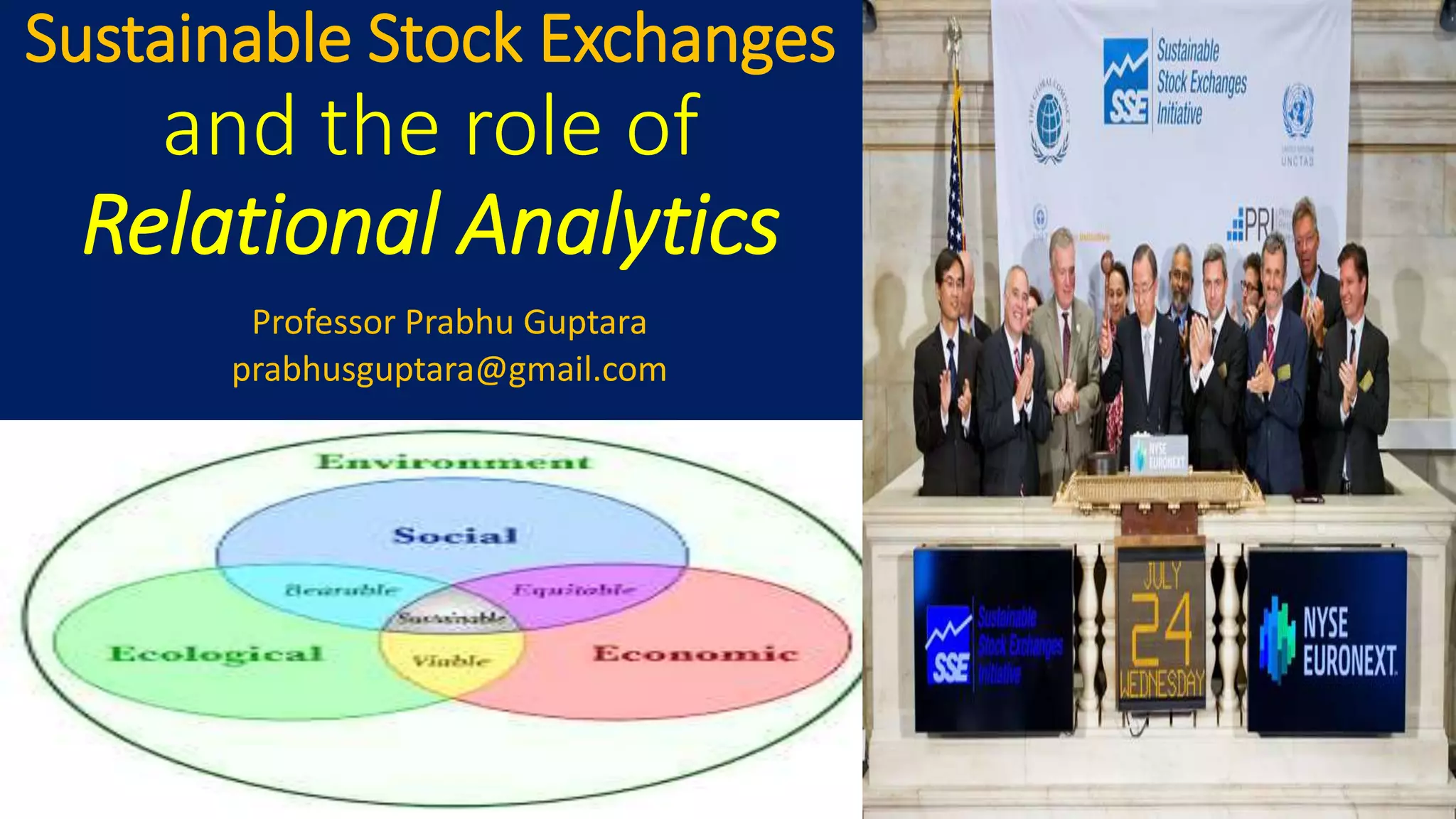
Sustainable Stock Exchanges
and the role of
Relational Analytics
Professor Prabhu Guptara
prabhusguptara@gmail.com
Sustainability has *many* dimensions
But *none* of the dimensions can move beyond rhetoric
if the ORGANIZATIONAL RELATIONSHIPS
(external and internal)
are sub-optimal
So: HOW to determine the current state of your
organizational relationships?
How to find out if they are IMPROVING or
DETERIORATING?
How to MANAGE these relationships
systematically?
How to MEASURE the relationships?
Relational Analytics measures
Relational Proximity®
The distance in the relationship between
people, groups or organisations.
That determines how well each can
understand the
thinking and behaviour of the other
– and therefore how well they will be able to
work together…
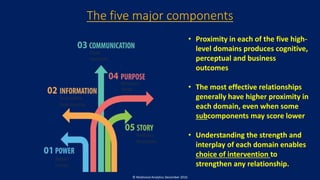
The five major components
• Proximity in each of the five high-
level domains produces cognitive,
perceptual and business
outcomes
• The most effective relationships
generally have higher proximity in
each domain, even when some
subcomponents may score lower
• Understanding the strength and
interplay of each domain enables
choice of intervention to
strengthen any relationship.
© Relational Analytics December 2016
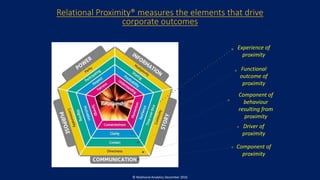
Relational Proximity® measures the elements that drive
corporate outcomes
Component of
proximity
Driver of
proximity
Component of
behaviour
resulting from
proximity
Functional
outcome of
proximity
Experience of
proximity
© Relational Analytics December 2016
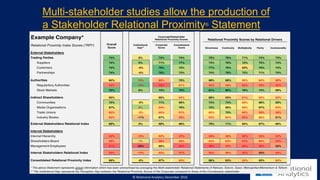
Multi-stakeholder studies allow the production of
a Stakeholder Relational Proximity® Statement
© Relational Analytics December 2016
Some organizations that have used the Analytics
Parkside
Community
Trust
© Relational Analytics December 2016

Can Stock Exchanges be Sustainable?

  • 1.
    Sustainable Stock Exchanges andthe role of Relational Analytics Professor Prabhu Guptara prabhusguptara@gmail.com
  • 2.
    Sustainability has *many*dimensions But *none* of the dimensions can move beyond rhetoric if the ORGANIZATIONAL RELATIONSHIPS (external and internal) are sub-optimal
  • 3.
    So: HOW todetermine the current state of your organizational relationships? How to find out if they are IMPROVING or DETERIORATING? How to MANAGE these relationships systematically? How to MEASURE the relationships?
  • 4.
    Relational Analytics measures RelationalProximity® The distance in the relationship between people, groups or organisations. That determines how well each can understand the thinking and behaviour of the other – and therefore how well they will be able to work together…
  • 5.
    The five majorcomponents • Proximity in each of the five high- level domains produces cognitive, perceptual and business outcomes • The most effective relationships generally have higher proximity in each domain, even when some subcomponents may score lower • Understanding the strength and interplay of each domain enables choice of intervention to strengthen any relationship. © Relational Analytics December 2016
  • 6.
    Relational Proximity® measuresthe elements that drive corporate outcomes Component of proximity Driver of proximity Component of behaviour resulting from proximity Functional outcome of proximity Experience of proximity © Relational Analytics December 2016
  • 7.
    Multi-stakeholder studies allowthe production of a Stakeholder Relational Proximity® Statement © Relational Analytics December 2016
  • 8.
    Some organizations thathave used the Analytics Parkside Community Trust © Relational Analytics December 2016

Editor's Notes

  • #5 Measuring Relational Distance provides a way to understand and adjust the relationship Distance matters in a relationship. We are familiar with geographical distance and emotional distance and perhaps even cultural distance. To assess effectively the quality of a relationship, we asked what are the key elements of relationships? Our model analyses relational capital positively: closeness or Relational Proximity®
  • #8 NB. THIS SLIDE COVERS ALL PARTIES – BUT YOU CAN DO ONLY ONE OR TWO, IF YOU WISH Numerical results enable clear interpretation and visual presentation The scores show how close the overall relationship is perceived to be by the parties, based on the average of their scores Gap in the Scores shows the size of the difference in perceptions of the quality of the relationship, based on the average score of the respondents in each party Driver & Sub-driver Scores show which aspects of the relationships are weak and strong. The interplay between the sub-drivers provides detailed diagnosis of what is happening, and what is likely to be most open to improvement Consensus shows the extent to which views are polarised within one party