Information Behaviors

How Information is More Important Than Knowledge
An Archestra notebook.
© 2014 Malcolm Ryder / archestra research
Relativity
Our “knowledge about knowledge” has led to scientific delineation of its elemental
structure, offering a production pattern for its synthesis.
The synthetic pattern features data as the smallest unit (“atoms”), combined in
defined relationships that create information (“molecules”), which in turn groups
and acts in specified contexts as a state of knowledge (‘objects” or “compounds”).

If data, information and knowledge are each already defined to structurally
distinguish them from each other, then how is it that one person’s information is
another person’s knowledge? That one person’s knowledge is merely another
person’s data? That one person’s data is another person’s information?
These conditions occur because they are the normal result of utilitarian matters,
where the way something needs to be used is what really decides how it is defined,
and at minimum the decision is borne out by the experience of the results.
A universe of intellectual content
Most interest in “knowledge” has to do with thinking, and most thinking is topical. There is always
high interest in building up a reliable coverage of the topic.
But most thinking does not begin with data.
Most thinking begins with expressions received as information.
As a starting point, information is processed into both data and knowledge. More processing of data
and knowledge can continue to occur; but without deliberate intent, that additional processing
does not necessarily link the derived data to the derived knowledge. At minimum, we know this is
the case because of rhetoric.
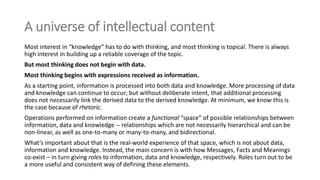
Operations performed on information create a functional “space” of possible relationships between
information, data and knowledge -- relationships which are not necessarily hierarchical and can be
non-linear, as well as one-to-many or many-to-many, and bidirectional.
What’s important about that is the real-world experience of that space, which is not about data,
information and knowledge. Instead, the main concern is with how Messages, Facts and Meanings
co-exist – in turn giving roles to information, data and knowledge, respectively. Roles turn out to be
a more useful and consistent way of defining these elements.
Information Operations:
substantiating the info

z

y

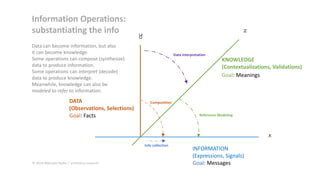
Data can become information, but also
it can become knowledge.
Some operations can compose (synthesize)
data to produce information.
Some operations can interpret (decode)
data to produce knowledge.
Meanwhile, knowledge can also be
modeled to refer to information.

DATA
(Observations, Selections)
Goal: Facts

Data interpretation

KNOWLEDGE
(Contextualizations, Validations)
Goal: Meanings

Composition
Reference Modeling

x
Info collection

© 2014 Malcolm Ryder / archestra research

INFORMATION
(Expressions, Signals)
Goal: Messages
Information Operations:
elaborating the info

z

y

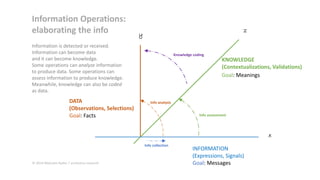
Information is detected or received.
Information can become data
and it can become knowledge.
Some operations can analyze information
to produce data. Some operations can
assess information to produce knowledge.
Meanwhile, knowledge can also be coded
as data.

DATA
(Observations, Selections)
Goal: Facts

Knowledge coding

KNOWLEDGE
(Contextualizations, Validations)
Goal: Meanings

Info analysis
Info assessment

x
Info collection

© 2014 Malcolm Ryder / archestra research

INFORMATION
(Expressions, Signals)
Goal: Messages
Field of Interest
In our ordinary conceptual life, we experience numerous different balances and
disparities of meanings, messages and facts.
These differences stem partly from where we are, “mentally”, when we encounter
those items, and partly from how they are being provided to us (both separately
and concurrently).
The initially experienced balances can subsequently change, either with our own
help or without.
When taken “as is”, without changing, the balances “cover” our interest in ways
that we can decide to accept and possibly even reinforce.
But we can also consider and attempt to change the balances in order to fit them
more closely to our immediate purposes. The purposes may be persuasive,
remedial, exploratory, conformational, etc.
Field Effects
In effect, it is behaviors that generate the coverage of our interest – by determining
the extent to which messages, facts and meanings respectively contribute.
Within the field of interest, coverage includes those items and any of their
potential concurrencies such as:
• Facts-with-facts; facts-with-messages; facts-with-meanings
• Messages-with-messages; messages-with-meanings
• Meanings-with-meanings
The manipulations, whether impending or already evident, operate on ideas to
variously render and manipulate them as messages, facts and meanings in the form
of information, data, or knowledge – thereby supporting the retention,
regeneration and reuse of the ideas.
Field Effects
The following sketches illustrate typical field manipulations and effects.
Each illustration is also associated with some typical issues regarding the availability
or uses of the items underlying the coverage in the field.
These illustrations and issues are neither “technical specialties” nor “standards”.
And they are not intended to be collectively exhaustive.
Instead, they are simply reflections of common experience.
In that light, it is common that “interested” behaviors are often goal-oriented,
constrained, and productive. This characteristic is also part of the annotations,
identifying how key operations on information are routinely distinctive.
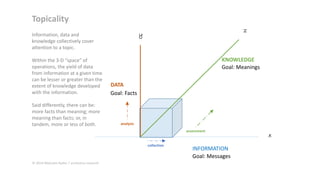
Topicality

Within the 3-D “space” of
operations, the yield of data
from information at a given time
can be lesser or greater than the
extent of knowledge developed
with the information.
Said differently, there can be:
more facts than meaning; more
meaning than facts; or, in
tandem, more or less of both.

z

y

Information, data and
knowledge collectively cover
attention to a topic.

KNOWLEDGE
Goal: Meanings
DATA
Goal: Facts

analysis
assessment

collection

© 2014 Malcolm Ryder / archestra research

INFORMATION
Goal: Messages

x
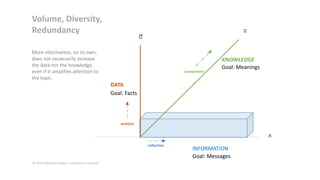
Volume, Diversity,
Redundancy

z

y

More information, on its own,
does not necessarily increase
the data nor the knowledge,
even if it amplifies attention to
the topic.

assessment

KNOWLEDGE
Goal: Meanings

DATA
Goal: Facts

analysis

x
collection

© 2014 Malcolm Ryder / archestra research

INFORMATION
Goal: Messages
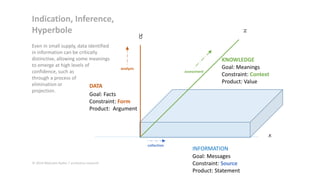
Indication, Inference,
Hyperbole
Even in small supply, data identified
in information can be critically
distinctive, allowing some meanings
to emerge at high levels of
confidence, such as
through a process of
elimination or
DATA
projection.

z

y

analysis

assessment

KNOWLEDGE
Goal: Meanings
Constraint: Context
Product: Value

Goal: Facts
Constraint: Form
Product: Argument

x
collection

© 2014 Malcolm Ryder / archestra research

INFORMATION
Goal: Messages
Constraint: Source
Product: Statement
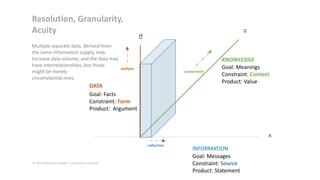
Resolution, Granularity,
Acuity
Multiple separate data, derived from
the same information supply, may
increase data volume; and the data may
have interrelationships, but those
might be merely
circumstantial ones.

z

y

analysis

assessment

DATA
Goal: Facts
Constraint: Form
Product: Argument

KNOWLEDGE
Goal: Meanings
Constraint: Context
Product: Value

x
collection

© 2014 Malcolm Ryder / archestra research

INFORMATION
Goal: Messages
Constraint: Source
Product: Statement
P.S. - Thinking about Content
The functional perspective on the “field of interest” allows us a certain further
understanding of the management of ideas.
We know that ideas are represented at various levels of language, itemization, and
specificity. Yet we also know that all of these representations are addressable as
“content”.
By understanding content as “the actor in the role” of message, fact or meaning, it
is understandable how the diversity of material seen in a given role by a population
of thinkers is neither unusual nor problematic.
Instead, it aligns comfortably with the diversity of “occupations” in that population
– while making each role variable and more widely approachable through differing
iterations via content. This also explains why content management is increasingly a
higher-level executive function in the community of interest.

Information Behaviors versus Knowledge

  • 1.
    Information Behaviors How Informationis More Important Than Knowledge An Archestra notebook. © 2014 Malcolm Ryder / archestra research
  • 2.
    Relativity Our “knowledge aboutknowledge” has led to scientific delineation of its elemental structure, offering a production pattern for its synthesis. The synthetic pattern features data as the smallest unit (“atoms”), combined in defined relationships that create information (“molecules”), which in turn groups and acts in specified contexts as a state of knowledge (‘objects” or “compounds”). If data, information and knowledge are each already defined to structurally distinguish them from each other, then how is it that one person’s information is another person’s knowledge? That one person’s knowledge is merely another person’s data? That one person’s data is another person’s information? These conditions occur because they are the normal result of utilitarian matters, where the way something needs to be used is what really decides how it is defined, and at minimum the decision is borne out by the experience of the results.
  • 3.
    A universe ofintellectual content Most interest in “knowledge” has to do with thinking, and most thinking is topical. There is always high interest in building up a reliable coverage of the topic. But most thinking does not begin with data. Most thinking begins with expressions received as information. As a starting point, information is processed into both data and knowledge. More processing of data and knowledge can continue to occur; but without deliberate intent, that additional processing does not necessarily link the derived data to the derived knowledge. At minimum, we know this is the case because of rhetoric. Operations performed on information create a functional “space” of possible relationships between information, data and knowledge -- relationships which are not necessarily hierarchical and can be non-linear, as well as one-to-many or many-to-many, and bidirectional. What’s important about that is the real-world experience of that space, which is not about data, information and knowledge. Instead, the main concern is with how Messages, Facts and Meanings co-exist – in turn giving roles to information, data and knowledge, respectively. Roles turn out to be a more useful and consistent way of defining these elements.
  • 4.
    Information Operations: substantiating theinfo z y Data can become information, but also it can become knowledge. Some operations can compose (synthesize) data to produce information. Some operations can interpret (decode) data to produce knowledge. Meanwhile, knowledge can also be modeled to refer to information. DATA (Observations, Selections) Goal: Facts Data interpretation KNOWLEDGE (Contextualizations, Validations) Goal: Meanings Composition Reference Modeling x Info collection © 2014 Malcolm Ryder / archestra research INFORMATION (Expressions, Signals) Goal: Messages
  • 5.
    Information Operations: elaborating theinfo z y Information is detected or received. Information can become data and it can become knowledge. Some operations can analyze information to produce data. Some operations can assess information to produce knowledge. Meanwhile, knowledge can also be coded as data. DATA (Observations, Selections) Goal: Facts Knowledge coding KNOWLEDGE (Contextualizations, Validations) Goal: Meanings Info analysis Info assessment x Info collection © 2014 Malcolm Ryder / archestra research INFORMATION (Expressions, Signals) Goal: Messages
  • 6.
    Field of Interest Inour ordinary conceptual life, we experience numerous different balances and disparities of meanings, messages and facts. These differences stem partly from where we are, “mentally”, when we encounter those items, and partly from how they are being provided to us (both separately and concurrently). The initially experienced balances can subsequently change, either with our own help or without. When taken “as is”, without changing, the balances “cover” our interest in ways that we can decide to accept and possibly even reinforce. But we can also consider and attempt to change the balances in order to fit them more closely to our immediate purposes. The purposes may be persuasive, remedial, exploratory, conformational, etc.
  • 7.
    Field Effects In effect,it is behaviors that generate the coverage of our interest – by determining the extent to which messages, facts and meanings respectively contribute. Within the field of interest, coverage includes those items and any of their potential concurrencies such as: • Facts-with-facts; facts-with-messages; facts-with-meanings • Messages-with-messages; messages-with-meanings • Meanings-with-meanings The manipulations, whether impending or already evident, operate on ideas to variously render and manipulate them as messages, facts and meanings in the form of information, data, or knowledge – thereby supporting the retention, regeneration and reuse of the ideas.
  • 8.
    Field Effects The followingsketches illustrate typical field manipulations and effects. Each illustration is also associated with some typical issues regarding the availability or uses of the items underlying the coverage in the field. These illustrations and issues are neither “technical specialties” nor “standards”. And they are not intended to be collectively exhaustive. Instead, they are simply reflections of common experience. In that light, it is common that “interested” behaviors are often goal-oriented, constrained, and productive. This characteristic is also part of the annotations, identifying how key operations on information are routinely distinctive.
  • 9.
    Topicality Within the 3-D“space” of operations, the yield of data from information at a given time can be lesser or greater than the extent of knowledge developed with the information. Said differently, there can be: more facts than meaning; more meaning than facts; or, in tandem, more or less of both. z y Information, data and knowledge collectively cover attention to a topic. KNOWLEDGE Goal: Meanings DATA Goal: Facts analysis assessment collection © 2014 Malcolm Ryder / archestra research INFORMATION Goal: Messages x
  • 10.
    Volume, Diversity, Redundancy z y More information,on its own, does not necessarily increase the data nor the knowledge, even if it amplifies attention to the topic. assessment KNOWLEDGE Goal: Meanings DATA Goal: Facts analysis x collection © 2014 Malcolm Ryder / archestra research INFORMATION Goal: Messages
  • 11.
    Indication, Inference, Hyperbole Even insmall supply, data identified in information can be critically distinctive, allowing some meanings to emerge at high levels of confidence, such as through a process of elimination or DATA projection. z y analysis assessment KNOWLEDGE Goal: Meanings Constraint: Context Product: Value Goal: Facts Constraint: Form Product: Argument x collection © 2014 Malcolm Ryder / archestra research INFORMATION Goal: Messages Constraint: Source Product: Statement
  • 12.
    Resolution, Granularity, Acuity Multiple separatedata, derived from the same information supply, may increase data volume; and the data may have interrelationships, but those might be merely circumstantial ones. z y analysis assessment DATA Goal: Facts Constraint: Form Product: Argument KNOWLEDGE Goal: Meanings Constraint: Context Product: Value x collection © 2014 Malcolm Ryder / archestra research INFORMATION Goal: Messages Constraint: Source Product: Statement
  • 13.
    P.S. - Thinkingabout Content The functional perspective on the “field of interest” allows us a certain further understanding of the management of ideas. We know that ideas are represented at various levels of language, itemization, and specificity. Yet we also know that all of these representations are addressable as “content”. By understanding content as “the actor in the role” of message, fact or meaning, it is understandable how the diversity of material seen in a given role by a population of thinkers is neither unusual nor problematic. Instead, it aligns comfortably with the diversity of “occupations” in that population – while making each role variable and more widely approachable through differing iterations via content. This also explains why content management is increasingly a higher-level executive function in the community of interest.