

Information about mine air
Department of mining engineering
ACE
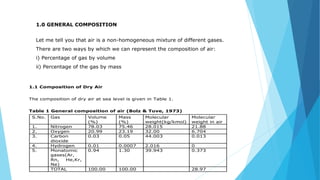
1.1 Composition of Dry Air
The composition of dry air at sea level is given in Table 1.
Table 1 General composition of air (Bolz & Tuve, 1973)
S.No. Gas Volume Mass Molecular Molecular
(%) (%) weight(kg/kmol) weight in air
1. Nitrogen 78.03 75.46 28.015 21.88
2. Oxygen 20.99 23.19 32.00 6.704
3. Carbon 0.03 0.05 44.003 0.013
dioxide
4. Hydrogen 0.01 0.0007 2.016 0
5. Monatomic 0.94 1.30 39.943 0.373
gases(Ar,
Rn, He,Kr,
Ne)
TOTAL 100.00 100.00 28.97
1.0 GENERAL COMPOSITION
Let me tell you that air is a non-homogeneous mixture of different gases.
There are two ways by which we can represent the composition of air:
i) Percentage of gas by volume
ii) Percentage of the gas by mass
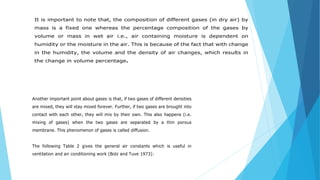
It is important to note that, the composition of different gases (in dry air) by
mass is a fixed one whereas the percentage composition of the gases by
volume or mass in wet air i.e., air containing moisture is dependent on
humidity or the moisture in the air. This is because of the fact that with change
in the humidity, the volume and the density of air changes, which results in
the change in volume percentage.
Another important point about gases is that, if two gases of different densities
are mixed, they will stay mixed forever. Further, if two gases are brought into
contact with each other, they will mix by their own. This also happens (i.e.
mixing of gases) when the two gases are separated by a thin porous
membrane. This phenomenon of gases is called diffusion.
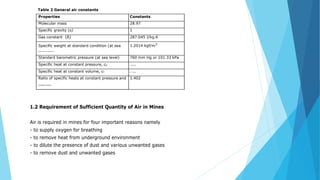
The following Table 2 gives the general air constants which is useful in
ventilation and air conditioning work (Bolz and Tuve 1973):
Table 2 General air constants
Properties Constants
Molecular mass 28.97
Specific gravity (s) 1
Gas constant (R) 287.045 J/kg.K
Specific weight at standard condition (at sea 1.2014 kgf/m3
level, 760 mm Hg and 70° )
Standard barometric pressure (at sea level) 760 mm Hg or 101.33 kPa
Specific heat at constant pressure, cp 1.006 kJ/kg °
Specific heat at constant volume, cv 0.717 kJ/kg °
Ratio of specific heats at constant pressure and 1.402
constant volume ,
1.2 Requirement of Sufficient Quantity of Air in Mines
Air is required in mines for four important reasons namely
- to supply oxygen for breathing
- to remove heat from underground environment
- to dilute the presence of dust and various unwanted gases
- to remove dust and unwanted gases
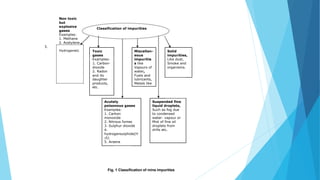
Fig. 1 Classification of mine impurities
Non toxic
but
explosive
gases
Examples:
1. Methane
2. Acetylene
3.
Hydrogenetc
Classification of impurities
Toxic Miscellan- Solid
gases eous impurities,
Examples: impuritie Like dust,
1. Carbon- s like Smoke and
dioxide Vapours of organisms.
2. Radon water,
and its Fuels and
daughter lubricants,
products, Metals like
etc.
Acutely Suspended fine
poisonous gases liquid droplets,
Examples: Such as fog due
1. Carbon to condensed
monoxide water- vapour or
2. Nitrous fumes Mist of fine oil
3. Sulphur dioxide droplets from
4. drills etc.
hydrogensulphide(H
2S)
5. Arsene
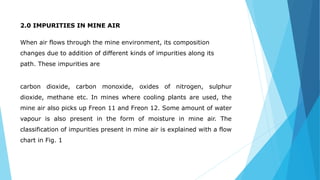
2.0 IMPURITIES IN MINE AIR
When air flows through the mine environment, its composition
changes due to addition of different kinds of impurities along its
path. These impurities are
carbon dioxide, carbon monoxide, oxides of nitrogen, sulphur
dioxide, methane etc. In mines where cooling plants are used, the
mine air also picks up Freon 11 and Freon 12. Some amount of water
vapour is also present in the form of moisture in mine air. The
classification of impurities present in mine air is explained with a flow
chart in Fig. 1
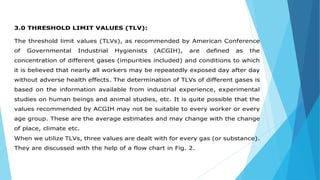
3.0 THRESHOLD LIMIT VALUES (TLV):
The threshold limit values (TLVs), as recommended by American Conference
of Governmental Industrial Hygienists (ACGIH), are defined as the
concentration of different gases (impurities included) and conditions to which
it is believed that nearly all workers may be repeatedly exposed day after day
without adverse health effects. The determination of TLVs of different gases is
based on the information available from industrial experience, experimental
studies on human beings and animal studies, etc. It is quite possible that the
values recommended by ACGIH may not be suitable to every worker or every
age group. These are the average estimates and may change with the change
of place, climate etc.
When we utilize TLVs, three values are dealt with for every gas (or substance).
They are discussed with the help of a flow chart in Fig. 2.
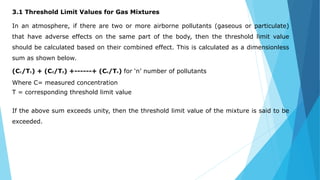
3.1 Threshold Limit Values for Gas Mixtures
In an atmosphere, if there are two or more airborne pollutants (gaseous or particulate)
that have adverse effects on the same part of the body, then the threshold limit value
should be calculated based on their combined effect. This is calculated as a dimensionless
sum as shown below.
(C1/T1) + (C2/T2) +------+ (Cn/Tn) for ‘n’ number of pollutants
Where C= measured concentration
T = corresponding threshold limit value
If the above sum exceeds unity, then the threshold limit value of the mixture is said to be
exceeded.
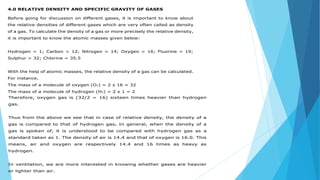
4.0 RELATIVE DENSITY AND SPECIFIC GRAVITY OF GASES
Before going for discussion on different gases, it is important to know about
the relative densities of different gases which are very often called as density
of a gas. To calculate the density of a gas or more precisely the relative density,
it is important to know the atomic masses given below:
Hydrogen = 1; Carbon = 12; Nitrogen = 14; Oxygen = 16; Fluorine = 19;
Sulphur = 32; Chlorine = 35.5
With the help of atomic masses, the relative density of a gas can be calculated.
For instance,
The mass of a molecule of oxygen (O2) = 2 x 16 = 32
The mass of a molecule of hydrogen (H2) = 2 x 1 = 2
Therefore, oxygen gas is (32/2 = 16) sixteen times heavier than hydrogen
gas.
Thus from the above we see that in case of relative density, the density of a
gas is compared to that of hydrogen gas. In general, when the density of a
gas is spoken of, it is understood to be compared with hydrogen gas as a
standard taken as 1. The density of air is 14.4 and that of oxygen is 16.0. This
means, air and oxygen are respectively 14.4 and 16 times as heavy as
hydrogen.
In ventilation, we are more interested in knowing whether gases are heavier
or lighter than air.
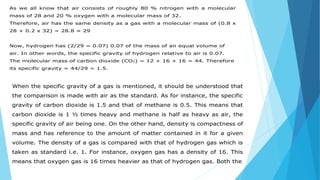
As we all know that air consists of roughly 80 % nitrogen with a molecular
mass of 28 and 20 % oxygen with a molecular mass of 32.
Therefore, air has the same density as a gas with a molecular mass of (0.8 x
28 + 0.2 x 32) = 28.8 ≈ 29
Now, hydrogen has (2/29 = 0.07) 0.07 of the mass of an equal volume of
air. In other words, the specific gravity of hydrogen relative to air is 0.07.
The molecular mass of carbon dioxide (CO2) = 12 + 16 + 16 = 44. Therefore
its specific gravity = 44/29 = 1.5.
When the specific gravity of a gas is mentioned, it should be understood that
the comparison is made with air as the standard. As for instance, the specific
gravity of carbon dioxide is 1.5 and that of methane is 0.5. This means that
carbon dioxide is 1 ½ times heavy and methane is half as heavy as air, the
specific gravity of air being one. On the other hand, density is compactness of
mass and has reference to the amount of matter contained in it for a given
volume. The density of a gas is compared with that of hydrogen gas which is
taken as standard i.e. 1. For instance, oxygen gas has a density of 16. This
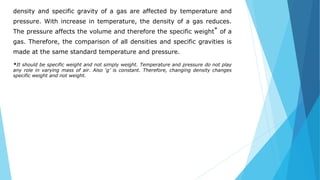
means that oxygen gas is 16 times heavier as that of hydrogen gas. Both the
density and specific gravity of a gas are affected by temperature and
pressure. With increase in temperature, the density of a gas reduces.
The pressure affects the volume and therefore the specific weight* of a
gas. Therefore, the comparison of all densities and specific gravities is
made at the same standard temperature and pressure.
*It should be specific weight and not simply weight. Temperature and pressure do not play
any role in varying mass of air. Also ‘g’ is constant. Therefore, changing density changes
specific weight and not weight.
Information about mine air

Information about mine air

  • 1.
    Information about mineair Department of mining engineering ACE
  • 2.
    1.1 Composition ofDry Air The composition of dry air at sea level is given in Table 1. Table 1 General composition of air (Bolz & Tuve, 1973) S.No. Gas Volume Mass Molecular Molecular (%) (%) weight(kg/kmol) weight in air 1. Nitrogen 78.03 75.46 28.015 21.88 2. Oxygen 20.99 23.19 32.00 6.704 3. Carbon 0.03 0.05 44.003 0.013 dioxide 4. Hydrogen 0.01 0.0007 2.016 0 5. Monatomic 0.94 1.30 39.943 0.373 gases(Ar, Rn, He,Kr, Ne) TOTAL 100.00 100.00 28.97 1.0 GENERAL COMPOSITION Let me tell you that air is a non-homogeneous mixture of different gases. There are two ways by which we can represent the composition of air: i) Percentage of gas by volume ii) Percentage of the gas by mass
  • 3.
    It is importantto note that, the composition of different gases (in dry air) by mass is a fixed one whereas the percentage composition of the gases by volume or mass in wet air i.e., air containing moisture is dependent on humidity or the moisture in the air. This is because of the fact that with change in the humidity, the volume and the density of air changes, which results in the change in volume percentage. Another important point about gases is that, if two gases of different densities are mixed, they will stay mixed forever. Further, if two gases are brought into contact with each other, they will mix by their own. This also happens (i.e. mixing of gases) when the two gases are separated by a thin porous membrane. This phenomenon of gases is called diffusion. The following Table 2 gives the general air constants which is useful in ventilation and air conditioning work (Bolz and Tuve 1973):
  • 4.
    Table 2 Generalair constants Properties Constants Molecular mass 28.97 Specific gravity (s) 1 Gas constant (R) 287.045 J/kg.K Specific weight at standard condition (at sea 1.2014 kgf/m3 level, 760 mm Hg and 70° ) Standard barometric pressure (at sea level) 760 mm Hg or 101.33 kPa Specific heat at constant pressure, cp 1.006 kJ/kg ° Specific heat at constant volume, cv 0.717 kJ/kg ° Ratio of specific heats at constant pressure and 1.402 constant volume , 1.2 Requirement of Sufficient Quantity of Air in Mines Air is required in mines for four important reasons namely - to supply oxygen for breathing - to remove heat from underground environment - to dilute the presence of dust and various unwanted gases - to remove dust and unwanted gases
  • 5.
    Fig. 1 Classificationof mine impurities Non toxic but explosive gases Examples: 1. Methane 2. Acetylene 3. Hydrogenetc Classification of impurities Toxic Miscellan- Solid gases eous impurities, Examples: impuritie Like dust, 1. Carbon- s like Smoke and dioxide Vapours of organisms. 2. Radon water, and its Fuels and daughter lubricants, products, Metals like etc. Acutely Suspended fine poisonous gases liquid droplets, Examples: Such as fog due 1. Carbon to condensed monoxide water- vapour or 2. Nitrous fumes Mist of fine oil 3. Sulphur dioxide droplets from 4. drills etc. hydrogensulphide(H 2S) 5. Arsene
  • 6.
    2.0 IMPURITIES INMINE AIR When air flows through the mine environment, its composition changes due to addition of different kinds of impurities along its path. These impurities are carbon dioxide, carbon monoxide, oxides of nitrogen, sulphur dioxide, methane etc. In mines where cooling plants are used, the mine air also picks up Freon 11 and Freon 12. Some amount of water vapour is also present in the form of moisture in mine air. The classification of impurities present in mine air is explained with a flow chart in Fig. 1
  • 7.
    3.0 THRESHOLD LIMITVALUES (TLV): The threshold limit values (TLVs), as recommended by American Conference of Governmental Industrial Hygienists (ACGIH), are defined as the concentration of different gases (impurities included) and conditions to which it is believed that nearly all workers may be repeatedly exposed day after day without adverse health effects. The determination of TLVs of different gases is based on the information available from industrial experience, experimental studies on human beings and animal studies, etc. It is quite possible that the values recommended by ACGIH may not be suitable to every worker or every age group. These are the average estimates and may change with the change of place, climate etc. When we utilize TLVs, three values are dealt with for every gas (or substance). They are discussed with the help of a flow chart in Fig. 2.
  • 8.
    3.1 Threshold LimitValues for Gas Mixtures In an atmosphere, if there are two or more airborne pollutants (gaseous or particulate) that have adverse effects on the same part of the body, then the threshold limit value should be calculated based on their combined effect. This is calculated as a dimensionless sum as shown below. (C1/T1) + (C2/T2) +------+ (Cn/Tn) for ‘n’ number of pollutants Where C= measured concentration T = corresponding threshold limit value If the above sum exceeds unity, then the threshold limit value of the mixture is said to be exceeded.
  • 9.
    4.0 RELATIVE DENSITYAND SPECIFIC GRAVITY OF GASES Before going for discussion on different gases, it is important to know about the relative densities of different gases which are very often called as density of a gas. To calculate the density of a gas or more precisely the relative density, it is important to know the atomic masses given below: Hydrogen = 1; Carbon = 12; Nitrogen = 14; Oxygen = 16; Fluorine = 19; Sulphur = 32; Chlorine = 35.5 With the help of atomic masses, the relative density of a gas can be calculated. For instance, The mass of a molecule of oxygen (O2) = 2 x 16 = 32 The mass of a molecule of hydrogen (H2) = 2 x 1 = 2 Therefore, oxygen gas is (32/2 = 16) sixteen times heavier than hydrogen gas. Thus from the above we see that in case of relative density, the density of a gas is compared to that of hydrogen gas. In general, when the density of a gas is spoken of, it is understood to be compared with hydrogen gas as a standard taken as 1. The density of air is 14.4 and that of oxygen is 16.0. This means, air and oxygen are respectively 14.4 and 16 times as heavy as hydrogen. In ventilation, we are more interested in knowing whether gases are heavier or lighter than air.
  • 10.
    As we allknow that air consists of roughly 80 % nitrogen with a molecular mass of 28 and 20 % oxygen with a molecular mass of 32. Therefore, air has the same density as a gas with a molecular mass of (0.8 x 28 + 0.2 x 32) = 28.8 ≈ 29 Now, hydrogen has (2/29 = 0.07) 0.07 of the mass of an equal volume of air. In other words, the specific gravity of hydrogen relative to air is 0.07. The molecular mass of carbon dioxide (CO2) = 12 + 16 + 16 = 44. Therefore its specific gravity = 44/29 = 1.5. When the specific gravity of a gas is mentioned, it should be understood that the comparison is made with air as the standard. As for instance, the specific gravity of carbon dioxide is 1.5 and that of methane is 0.5. This means that carbon dioxide is 1 ½ times heavy and methane is half as heavy as air, the specific gravity of air being one. On the other hand, density is compactness of mass and has reference to the amount of matter contained in it for a given volume. The density of a gas is compared with that of hydrogen gas which is taken as standard i.e. 1. For instance, oxygen gas has a density of 16. This means that oxygen gas is 16 times heavier as that of hydrogen gas. Both the
  • 11.
    density and specificgravity of a gas are affected by temperature and pressure. With increase in temperature, the density of a gas reduces. The pressure affects the volume and therefore the specific weight* of a gas. Therefore, the comparison of all densities and specific gravities is made at the same standard temperature and pressure. *It should be specific weight and not simply weight. Temperature and pressure do not play any role in varying mass of air. Also ‘g’ is constant. Therefore, changing density changes specific weight and not weight.