Informatics in Emergency Medicine:
         A Brief Introduction


    Nawanan Theera-Ampornpunt, MD, PhD
           Faculty of Medicine Ramathibodi Hospital
    http://www.slideshare.net/nawanan       Feb 1, 2012
Outline

    • Introduction about Biomedical & Health Informatics
    • Emergency Medicine & Implications for Informatics
    • Informatics Applications in Emergency Medicine
      –   EHRs & HIE
      –   PHRs
      –   mHealth
      –   Biosurveillance
    • Conclusion

2
Biomedical & Health Informatics
     • “[T]he field that is concerned with the optimal
       use of information, often aided by the use of
       technology, to improve individual health, health
       care, public health, and biomedical research”
       (Hersh, 2009)


     • “[T]he application of the science of information
       as data plus meaning to problems of
       biomedical interest” (Bernstam et al, 2010)

3
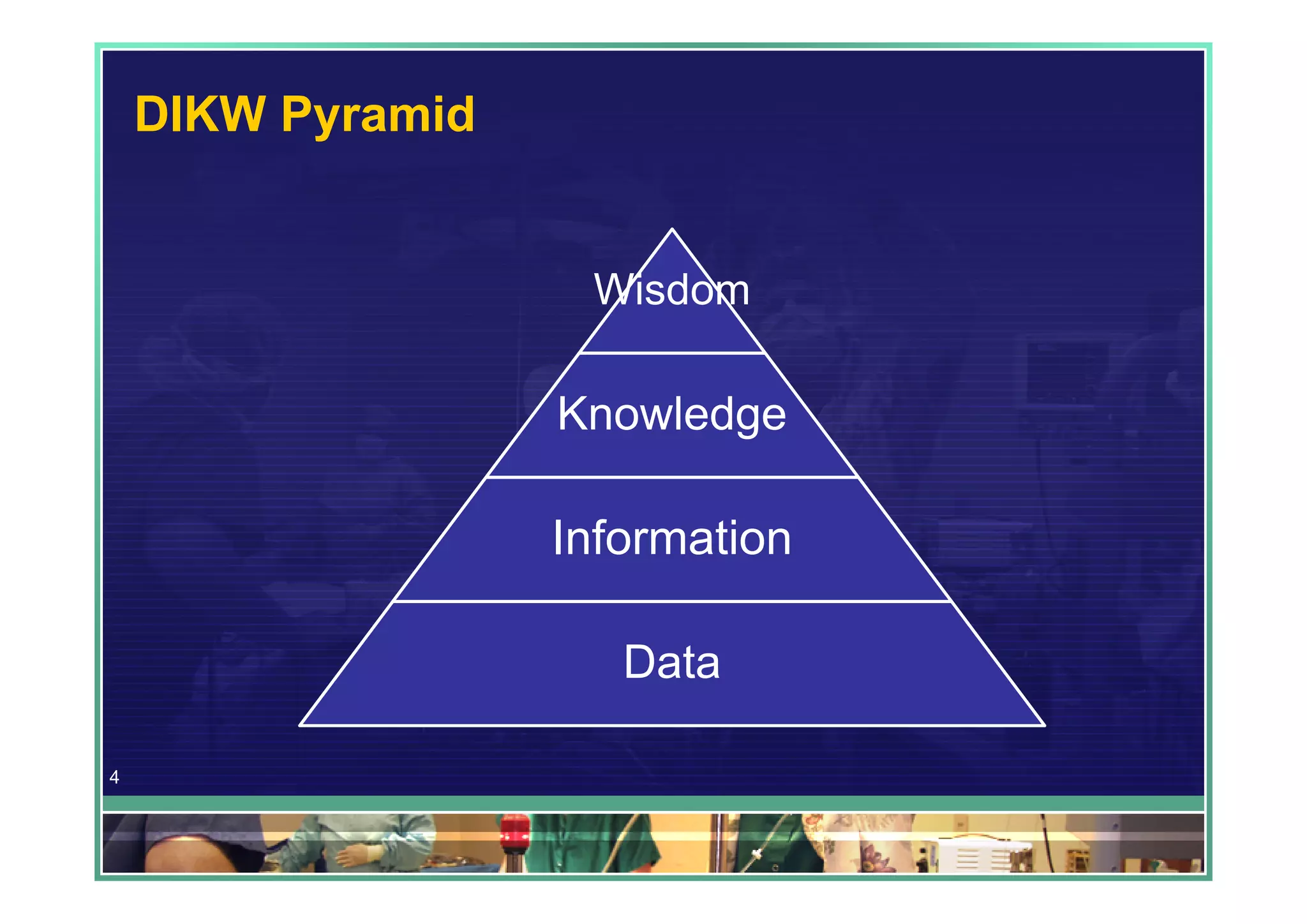
DIKW Pyramid


                    Wisdom

                   Knowledge

                   Information

                      Data

4
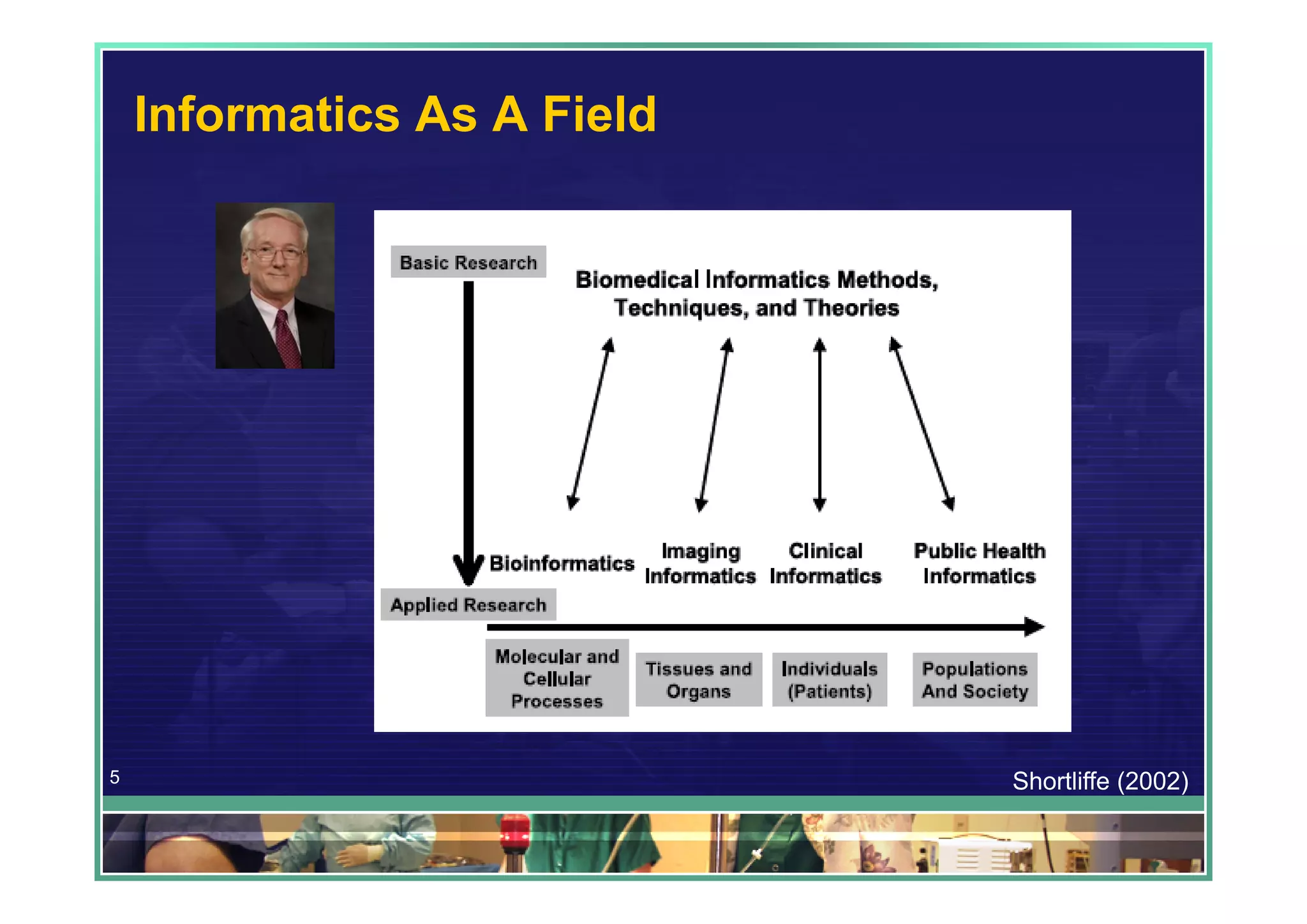
Informatics As A Field


5                            Shortliffe (2002)
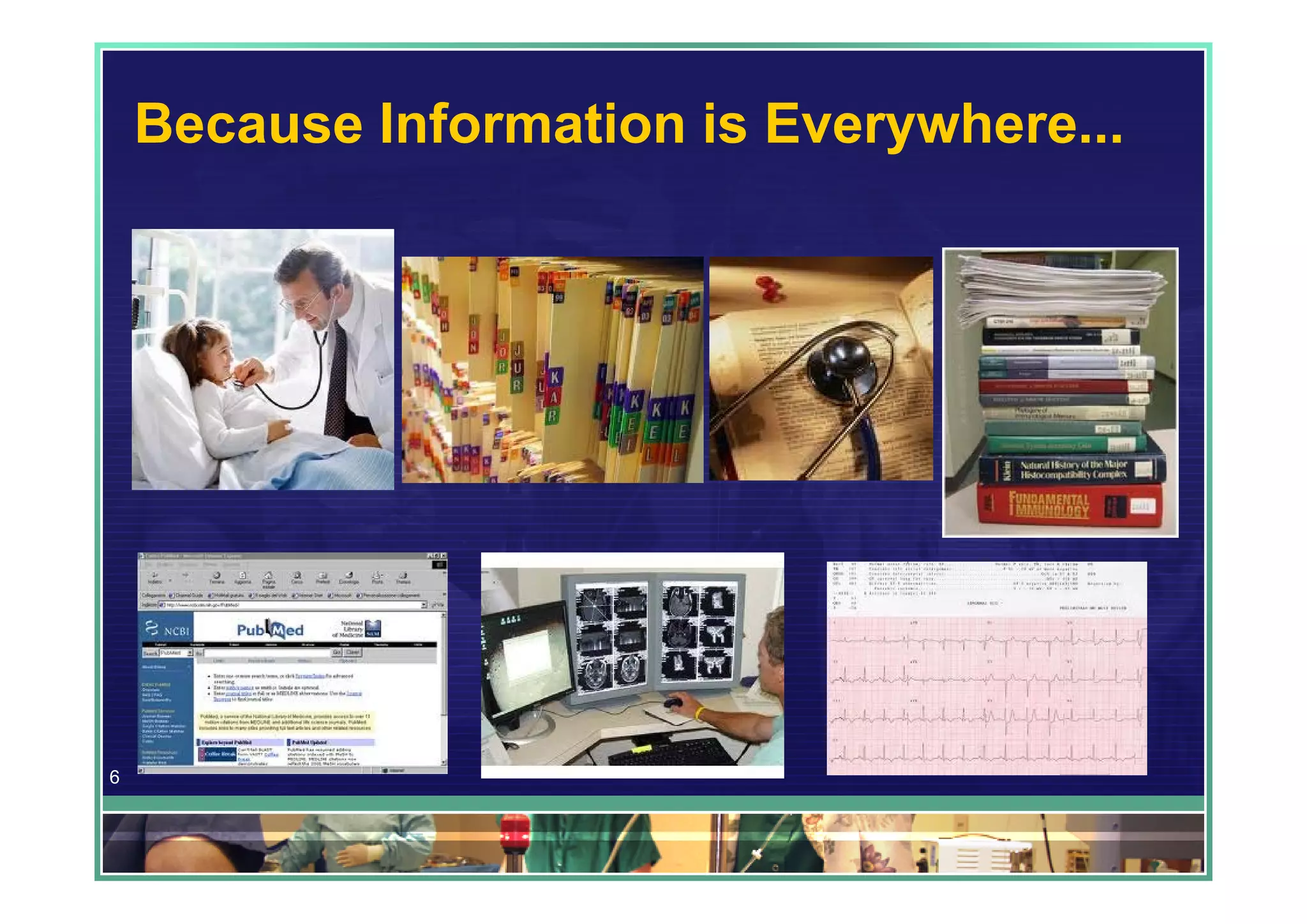
Because Information is Everywhere...


6
Emergency Departments (ED)
    • Prone to errors because of
      – Urgent nature
      – Limited & at times unreliable patient history
      – Time & resource constraints
    • Scale & unpredictability of mass casualties &
      disasters make it worse
    • 32% of ED visits had information gaps which can
      lead to prolonged ED stay (Stiell et al., 2003)

7
Informatics Roles in Emergency Medicine
    • Provide patient information critical to care
    • Information improves quality & efficiency of care
      in ED, at least for some conditions
      (e.g., Theera-Ampornpunt et al., 2009; Overhage et al., 2002;
      Connelly et al., 2012)

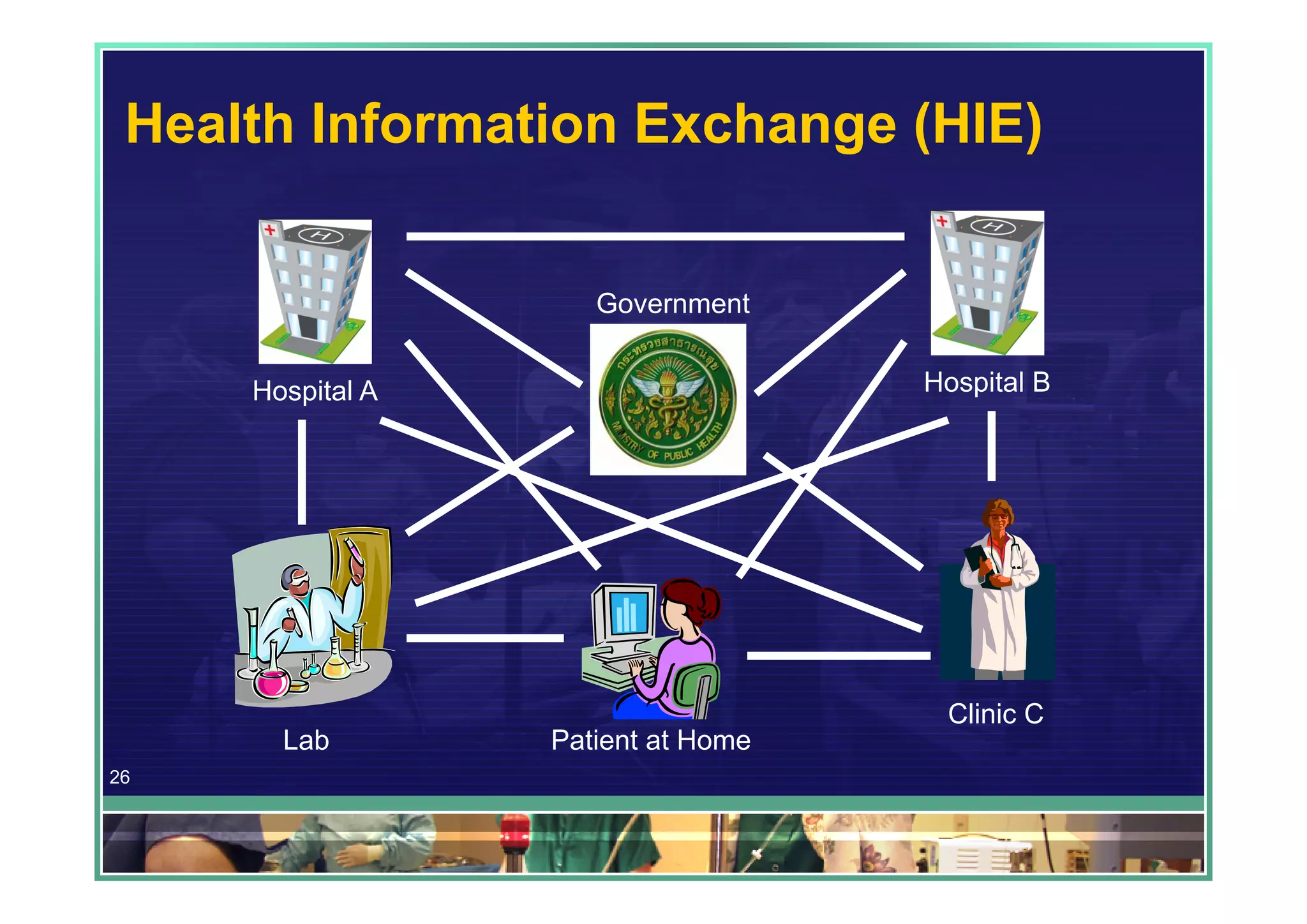
    • Role of health information exchange (HIE)
      highlighted
    • IT as transformational tools that improve care
      processes

8
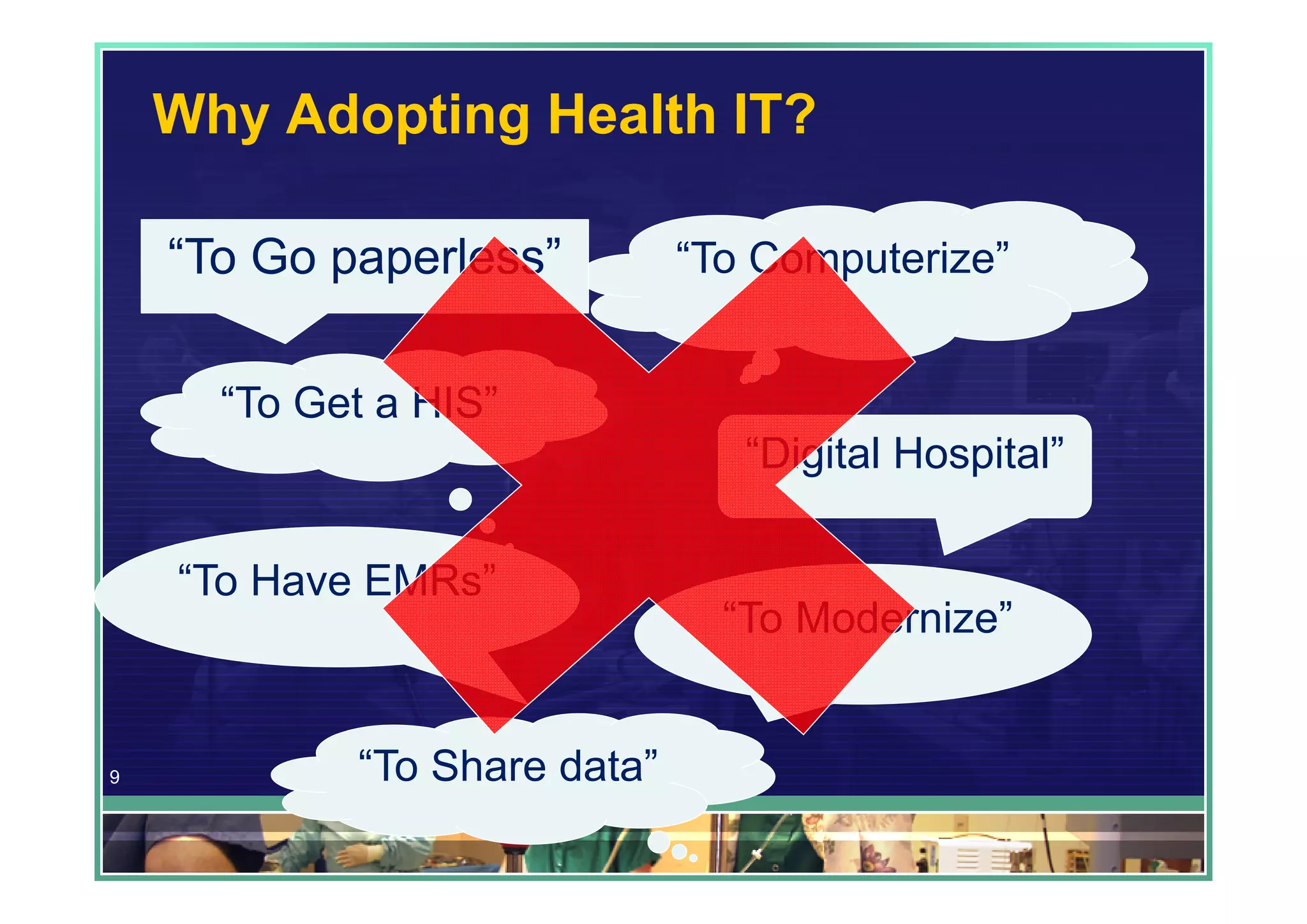
Why Adopting Health IT?

    “To Go paperless”         “To Computerize”


      “To Get a HIS”
                                 “Digital Hospital”

    “To Have EMRs”
                                “To Modernize”


9           “To Share data”
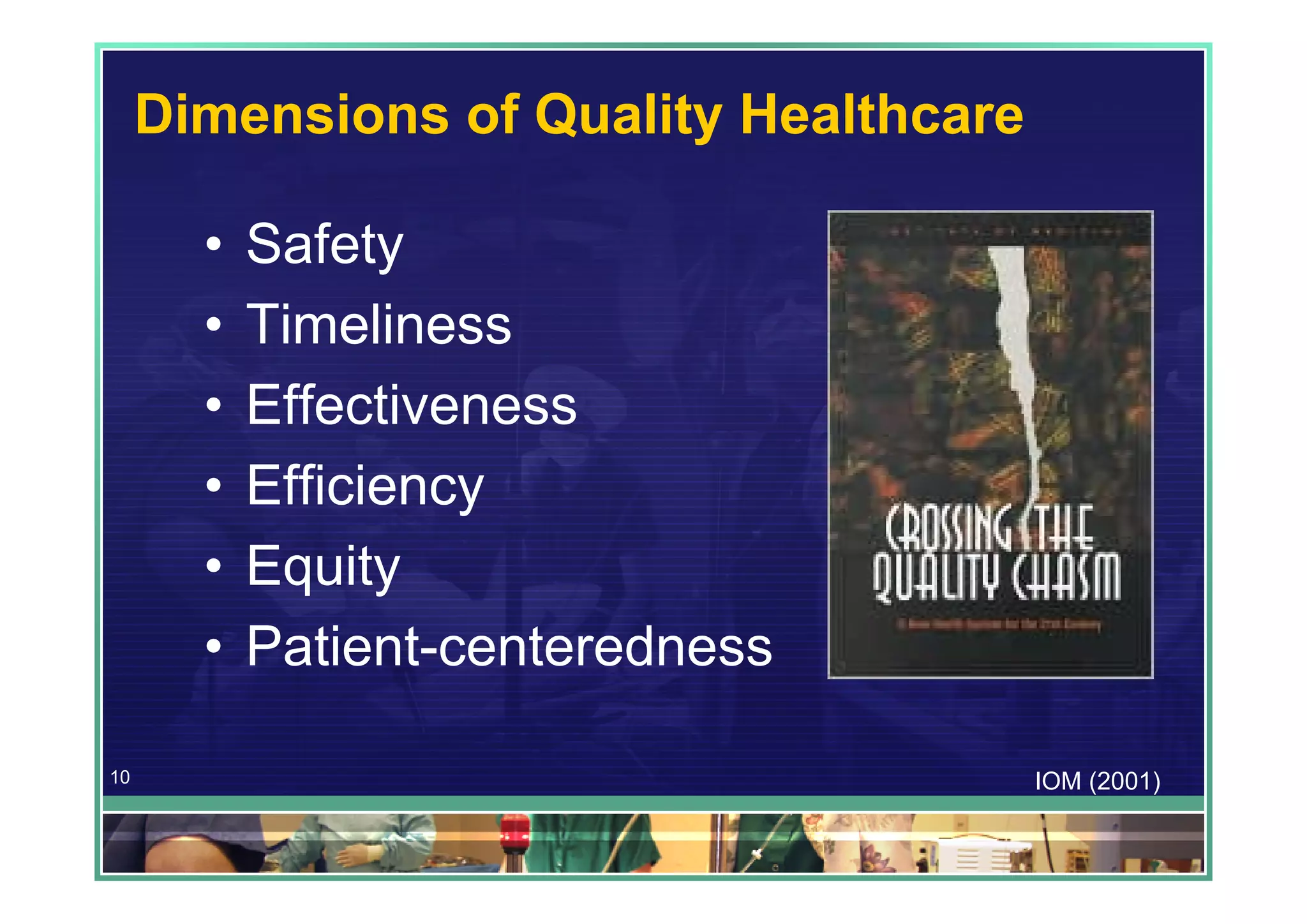
Dimensions of Quality Healthcare

       •   Safety
       •   Timeliness
       •   Effectiveness
       •   Efficiency
       •   Equity
       •   Patient-centeredness

10                                      IOM (2001)
Better Information Delivery Improves

     •   Safety (prevent allergies)
     •   Timeliness (have access to information early)
     •   Effectiveness (information for decision-making)
     •   Efficiency (prevent unnecessary/redundant lab)
     •   Equity
     •   Patient-centeredness
11
IT as Tools for Process Redesign

     •   Safety (no handwriting!!, allergies/DI alerts)
     •   Timeliness (faster internal processes)
     •   Effectiveness (CDSS alerts & reminders)
     •   Efficiency (faster care, better patient flow, better
         bed management)


12
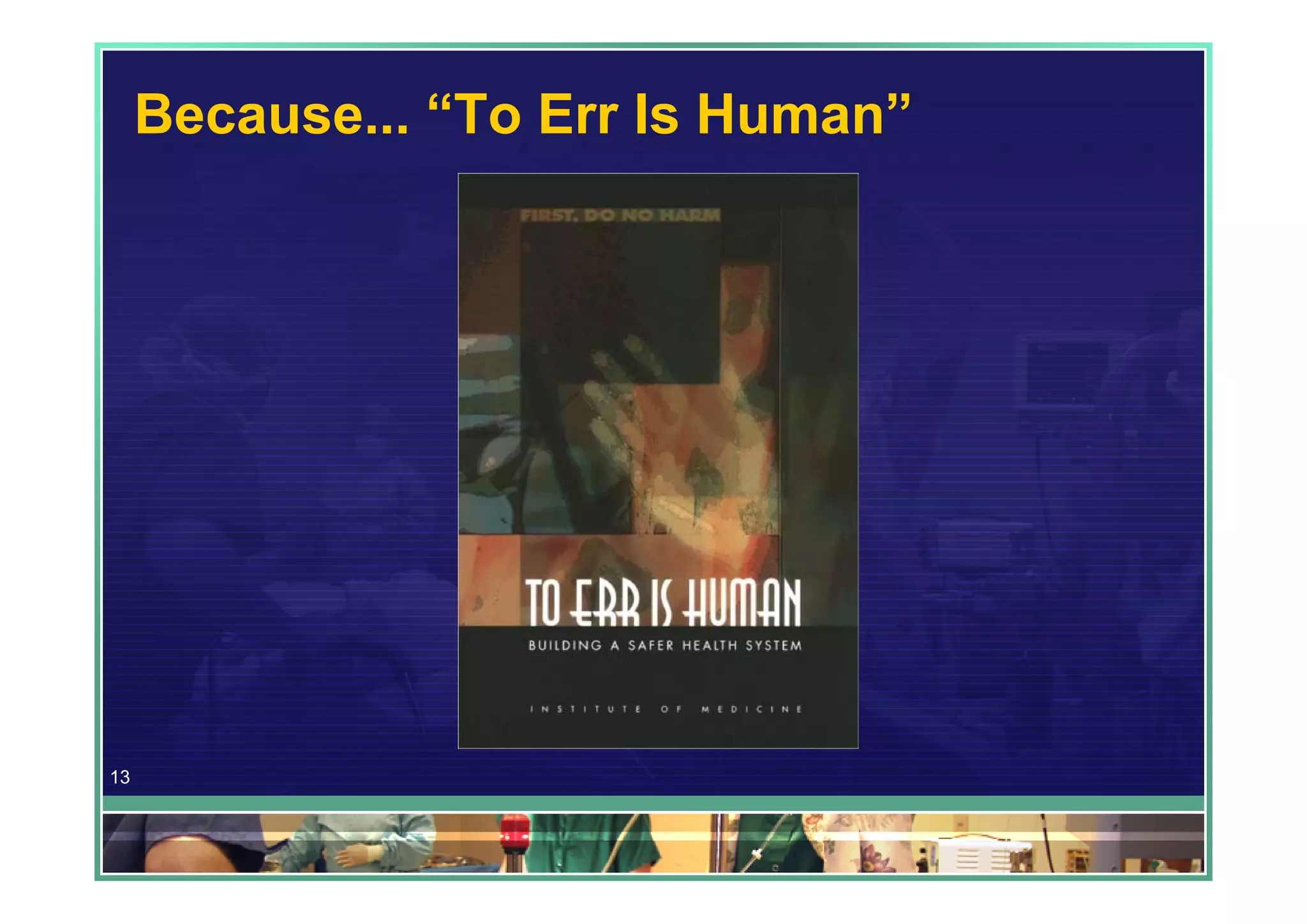
Because... “To Err Is Human”


13
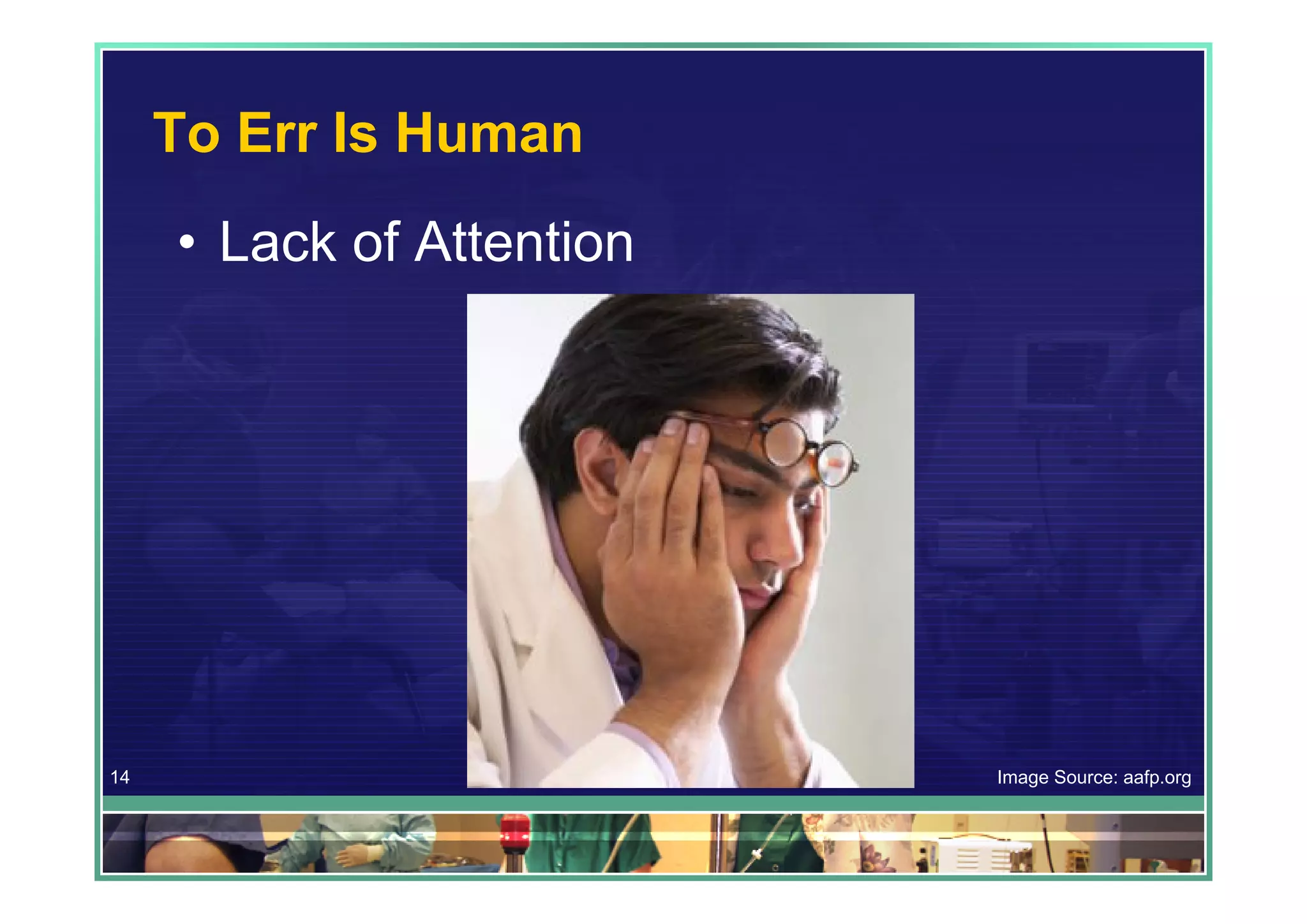
To Err Is Human
     • Lack of Attention


14                         Image Source: aafp.org
To Err Is Human

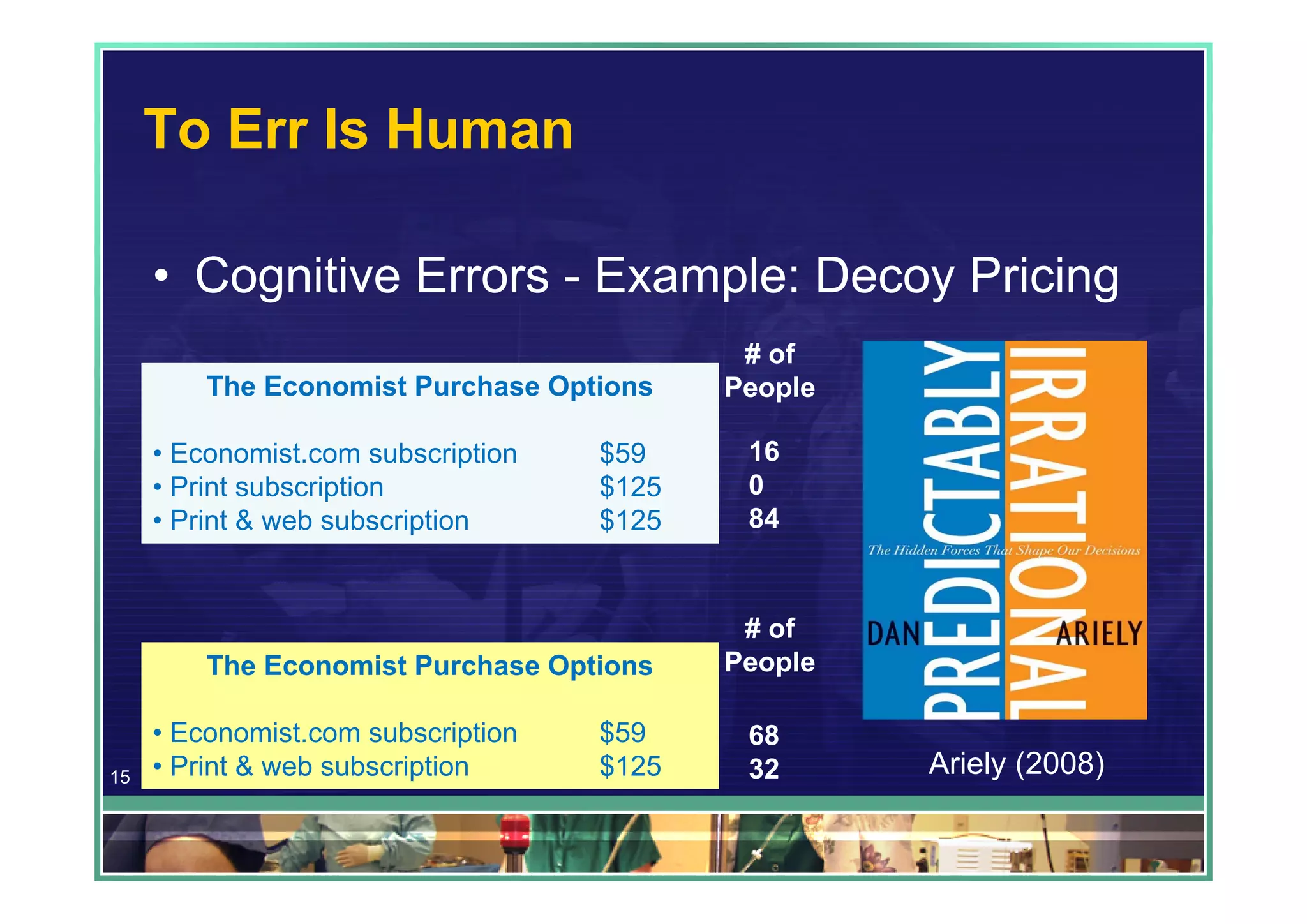
     • Cognitive Errors - Example: Decoy Pricing
                                            # of
         The Economist Purchase Options    People

     • Economist.com subscription   $59     16
     • Print subscription           $125    0
     • Print & web subscription     $125    84


                                            # of
         The Economist Purchase Options    People

     • Economist.com subscription   $59     68
15   • Print & web subscription     $125    32      Ariely (2008)
What If This Happens in Healthcare?


 • It already happens....
     (Mamede et al., 2010; Croskerry, 2003; Klein, 2005)


 • What if health IT can help?

16
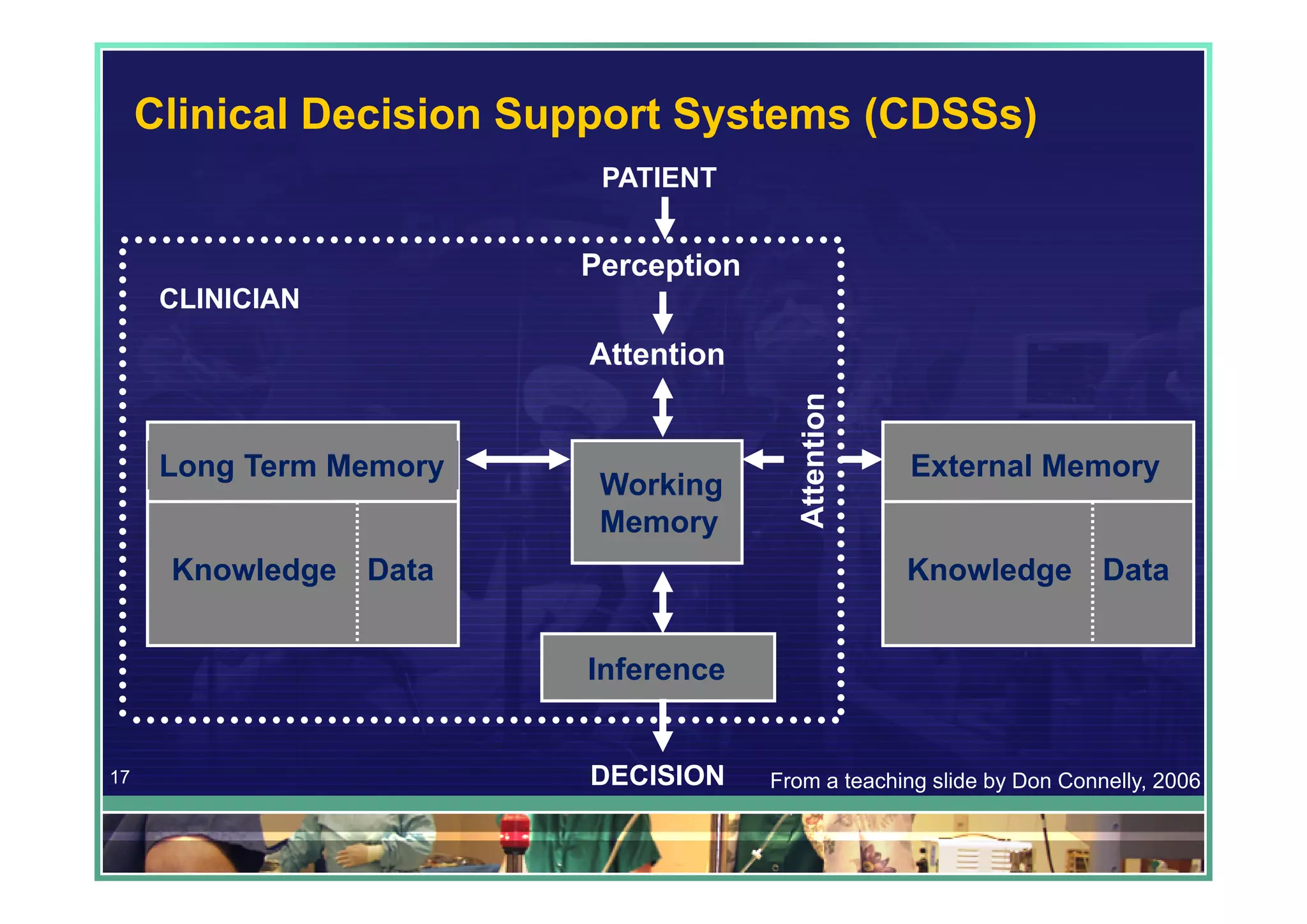
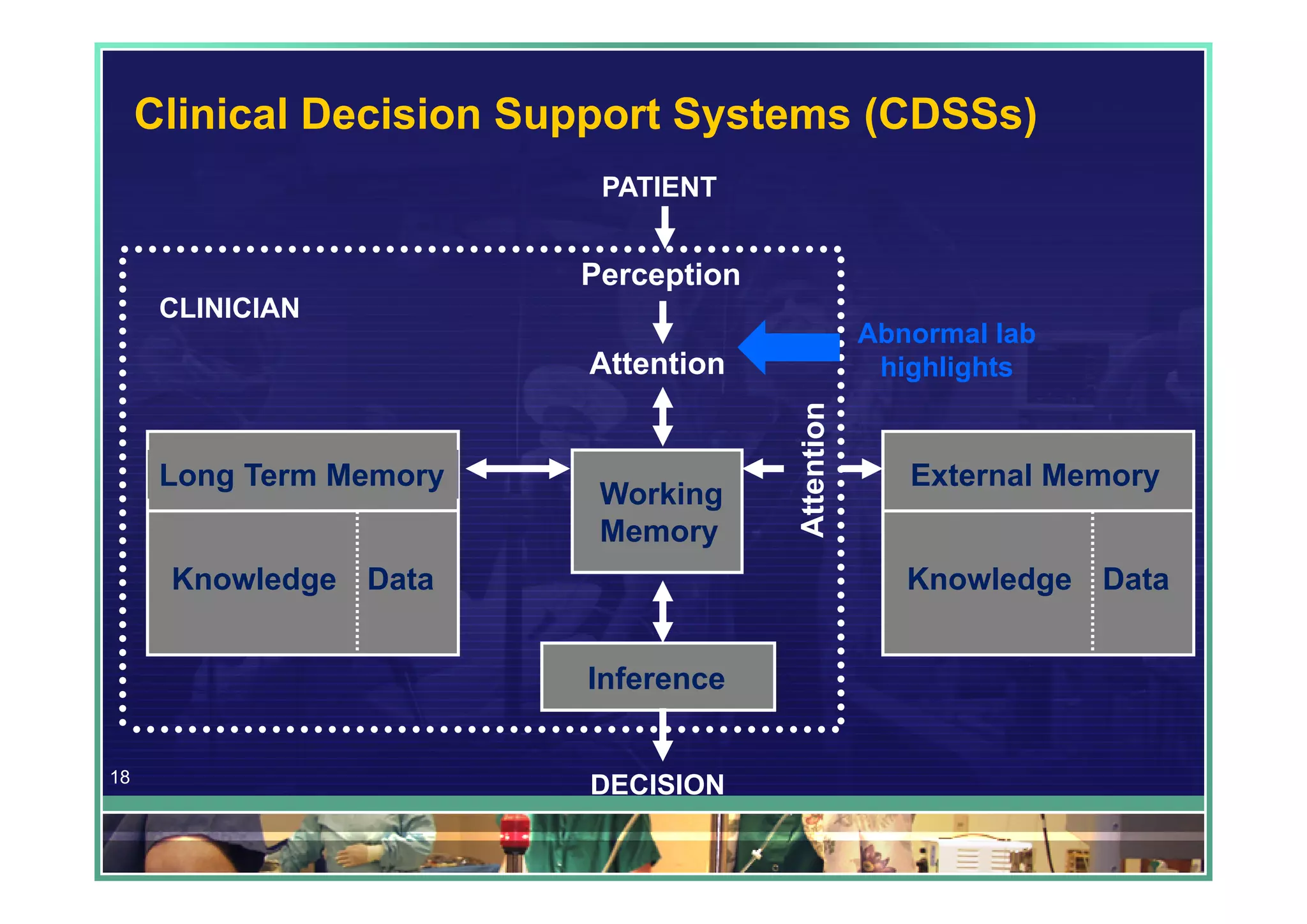
Clinical Decision Support Systems (CDSSs)
                          PATIENT


                         Perception
      CLINICIAN

                         Attention


      Long Term Memory                              External Memory
                          Working
                          Memory
      Knowledge Data                               Knowledge Data


                         Inference


17                       DECISION     From a teaching slide by Don Connelly, 2006
Clinical Decision Support Systems (CDSSs)
                          PATIENT


                         Perception
      CLINICIAN
                                      Abnormal lab
                         Attention     highlights


      Long Term Memory                   External Memory
                          Working
                          Memory
      Knowledge Data                     Knowledge Data


                         Inference


18
                         DECISION
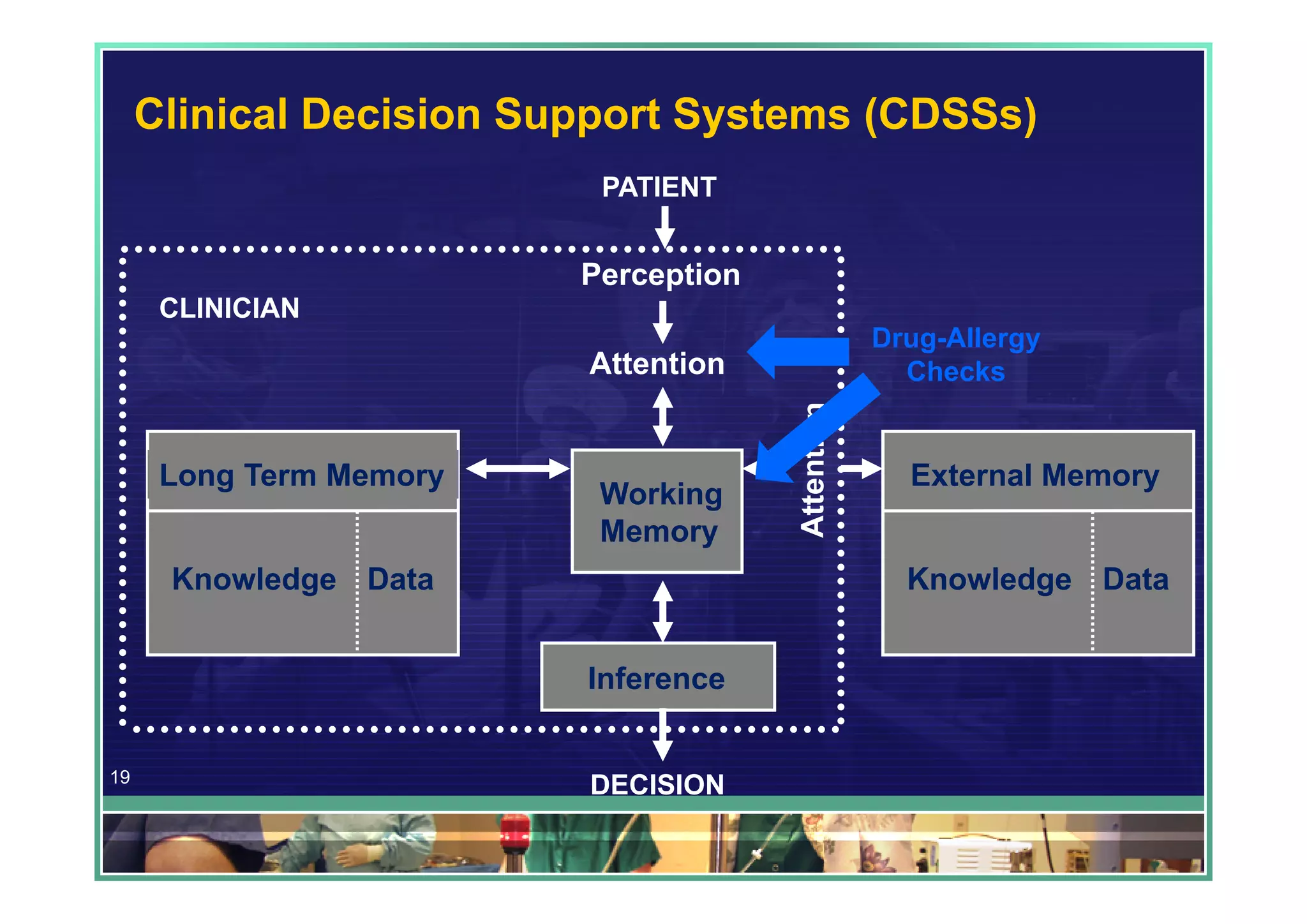
Clinical Decision Support Systems (CDSSs)
                          PATIENT


                         Perception
      CLINICIAN
                                      Drug-Allergy
                         Attention      Checks


      Long Term Memory                  External Memory
                          Working
                          Memory
      Knowledge Data                    Knowledge Data


                         Inference


19
                         DECISION
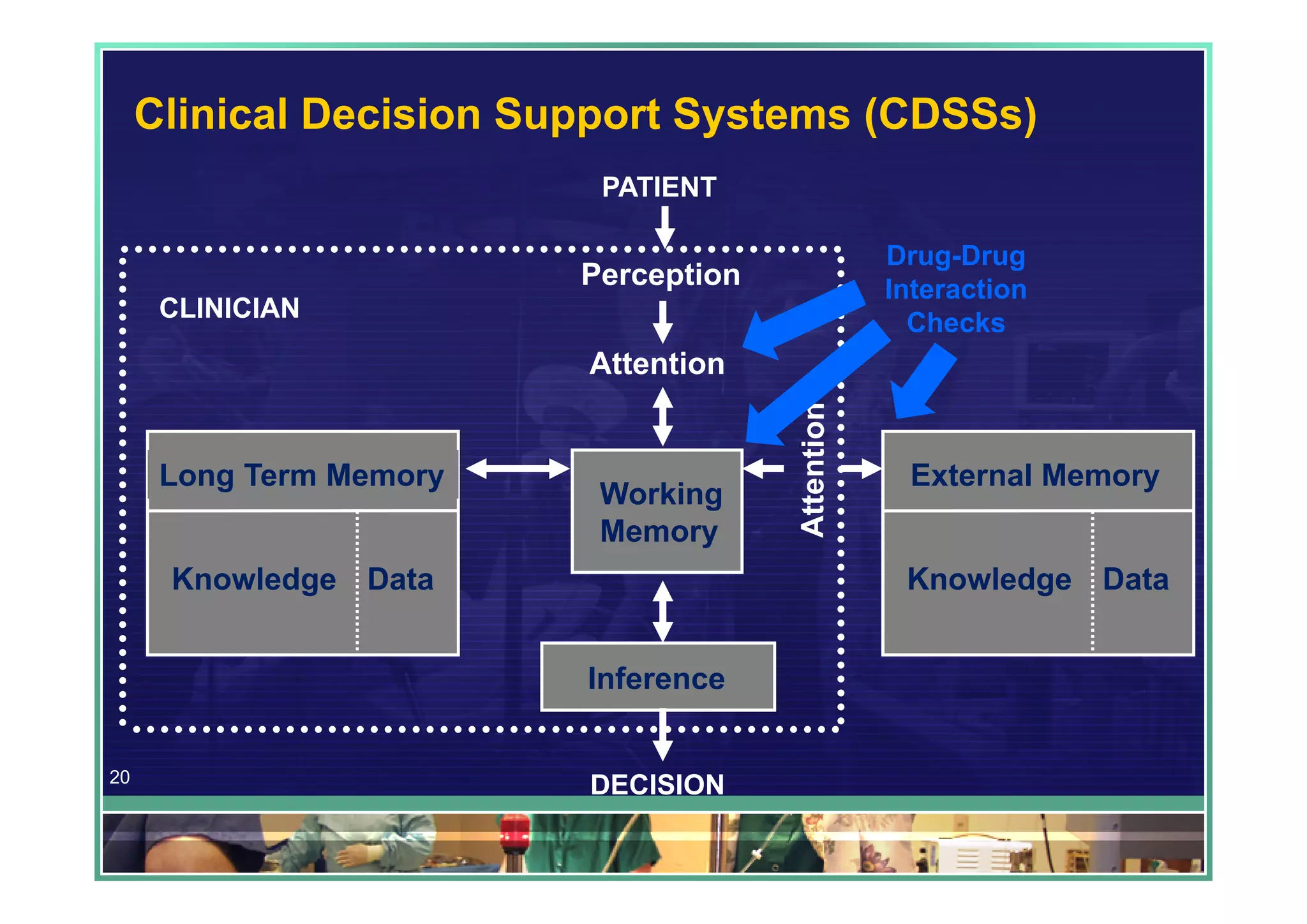
Clinical Decision Support Systems (CDSSs)
                          PATIENT

                                       Drug-Drug
                         Perception    Interaction
      CLINICIAN
                                         Checks
                         Attention


      Long Term Memory                  External Memory
                          Working
                          Memory
      Knowledge Data                    Knowledge Data


                         Inference


20
                         DECISION
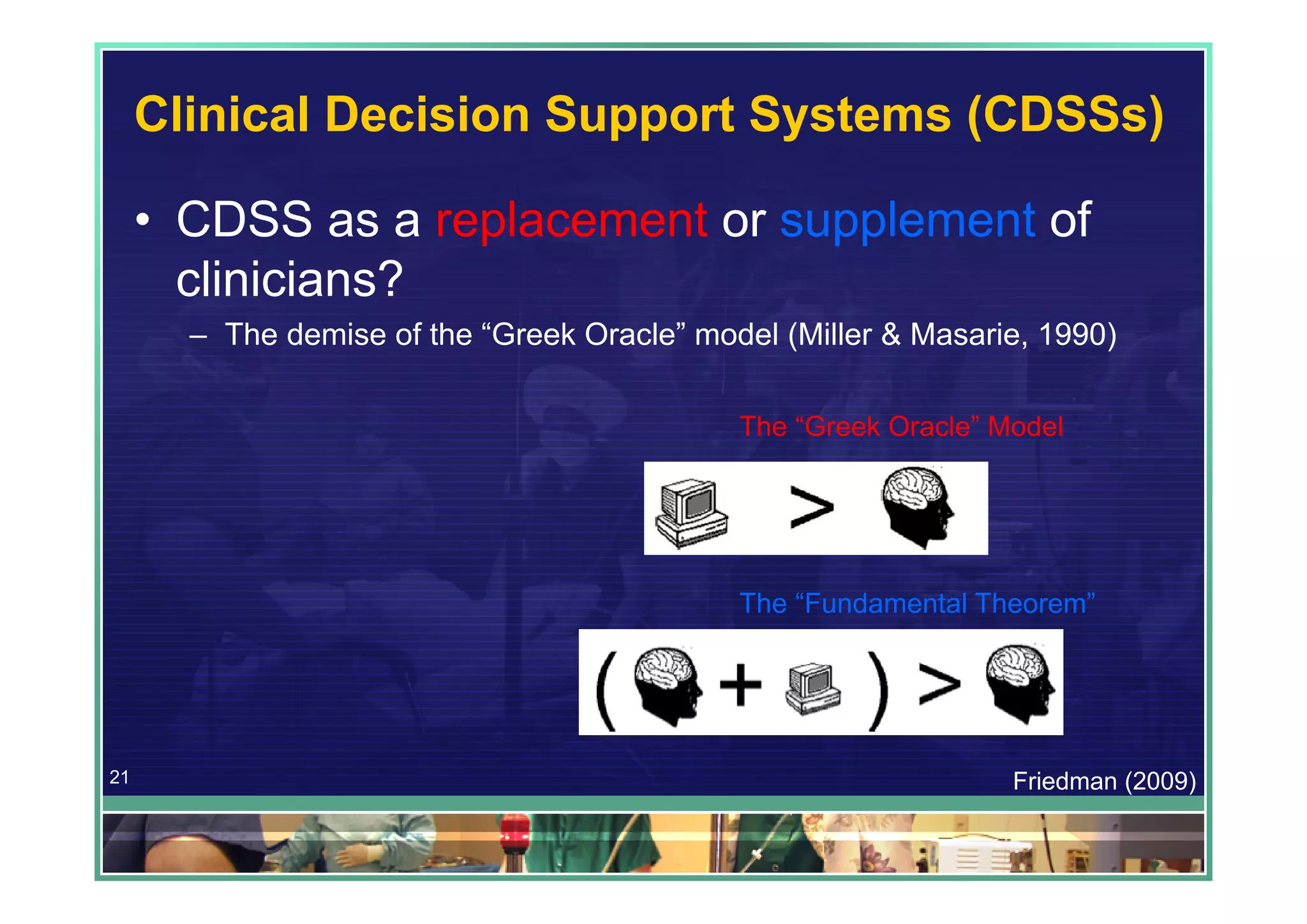
Clinical Decision Support Systems (CDSSs)

     • CDSS as a replacement or supplement of
       clinicians?
       – The demise of the “Greek Oracle” model (Miller & Masarie, 1990)

                                             The “Greek Oracle” Model


                                             The “Fundamental Theorem”


21                                                               Friedman (2009)
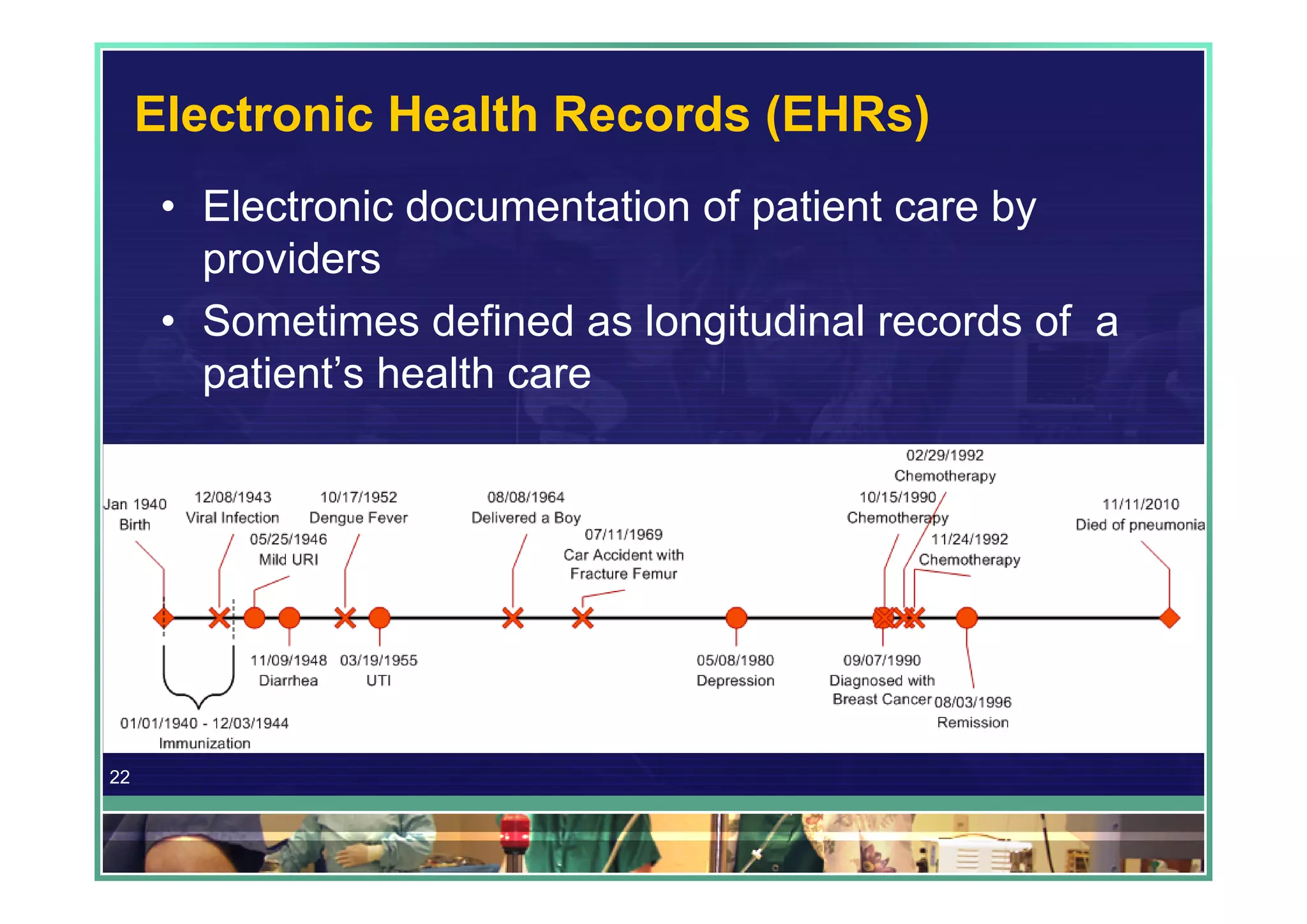
Electronic Health Records (EHRs)
      • Electronic documentation of patient care by
        providers
      • Sometimes defined as longitudinal records of a
        patient’s health care


22
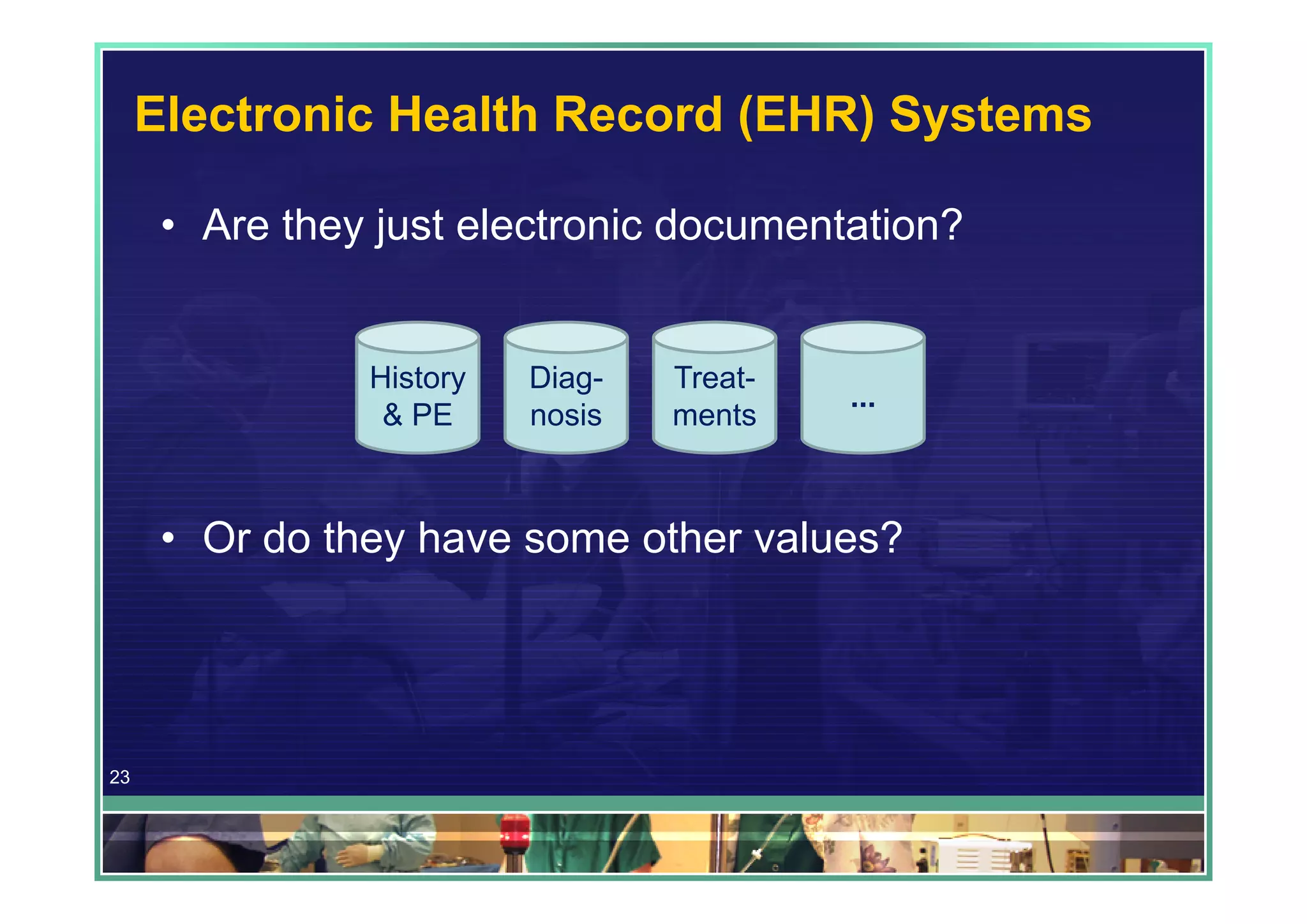
Electronic Health Record (EHR) Systems

      • Are they just electronic documentation?


                History   Diag-   Treat-
                                           ...
                 & PE     nosis   ments


      • Or do they have some other values?


23
Benefits of Health IT
     • Literature suggests improvement in health care
       through
        – Guideline adherence (Shiffman et al, 1999;Chaudhry et al, 2006)
        – Better documentation (Shiffman et al, 1999)
        – Practitioner decision making or process of care
           (Balas et al, 1996;Kaushal et al, 2003;Garg et al, 2005)
        – Medication safety (Kaushal et al, 2003;Chaudhry et al, 2006;van
           Rosse et al, 2009)
        – Patient surveillance & monitoring (Chaudhry et al, 2006)
        – Patient education/reminder (Balas et al, 1996)
        – Cost savings and better financial performance
           (Parente & Dunbar, 2001;Chaudhry et al, 2006;Amarasingham et al,
           2009;Borzekowski, 2009)
24
Functions that Should be Part of EHR Systems

      •   Computerized Medication Order Entry
      •   Computerized Laboratory Order Entry
      •   Computerized Laboratory Results
      •   Physician Notes
      •   Patient Demographics
      •   Problem Lists
      •   Medication Lists
      •   Discharge Summaries
      •   Diagnostic Test Results
      •   Radiologic Reports
25
                                   IOM (2003), Blumenthal et al (2006)
Health Information Exchange (HIE)


                     Government


     Hospital A                     Hospital B


                                     Clinic C
       Lab        Patient at Home
26
Personal Health Records (PHRs)
     • “An electronic application through which individuals can
       access, manage and share their health information,
       and that of others for whom they are authorized, in a
       private, secure, and confidential environment.” (Markle
       Foundation, 2003)


     • “A PHR includes health information managed by the
       individual... This can be contrasted with the clinician’s
       record of patient encounter–related information [a
       paperchart or EHR], which is managed by the clinician
       and/or health care institution.” (Tang et al., 2006)
27
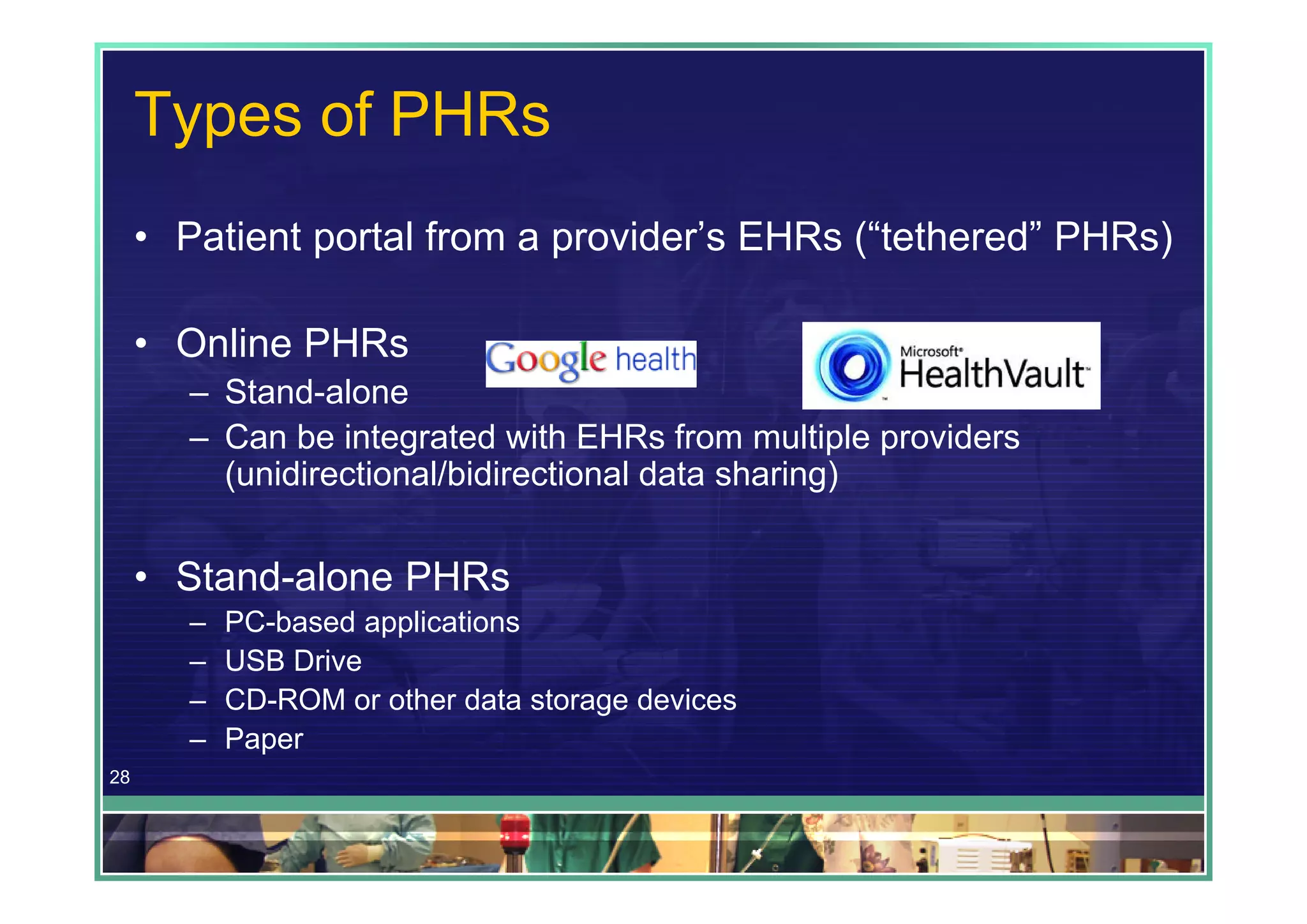
Types of PHRs
     • Patient portal from a provider’s EHRs (“tethered” PHRs)

     • Online PHRs
        – Stand-alone
        – Can be integrated with EHRs from multiple providers
          (unidirectional/bidirectional data sharing)


     • Stand-alone PHRs
        –   PC-based applications
        –   USB Drive
        –   CD-ROM or other data storage devices
        –   Paper
28
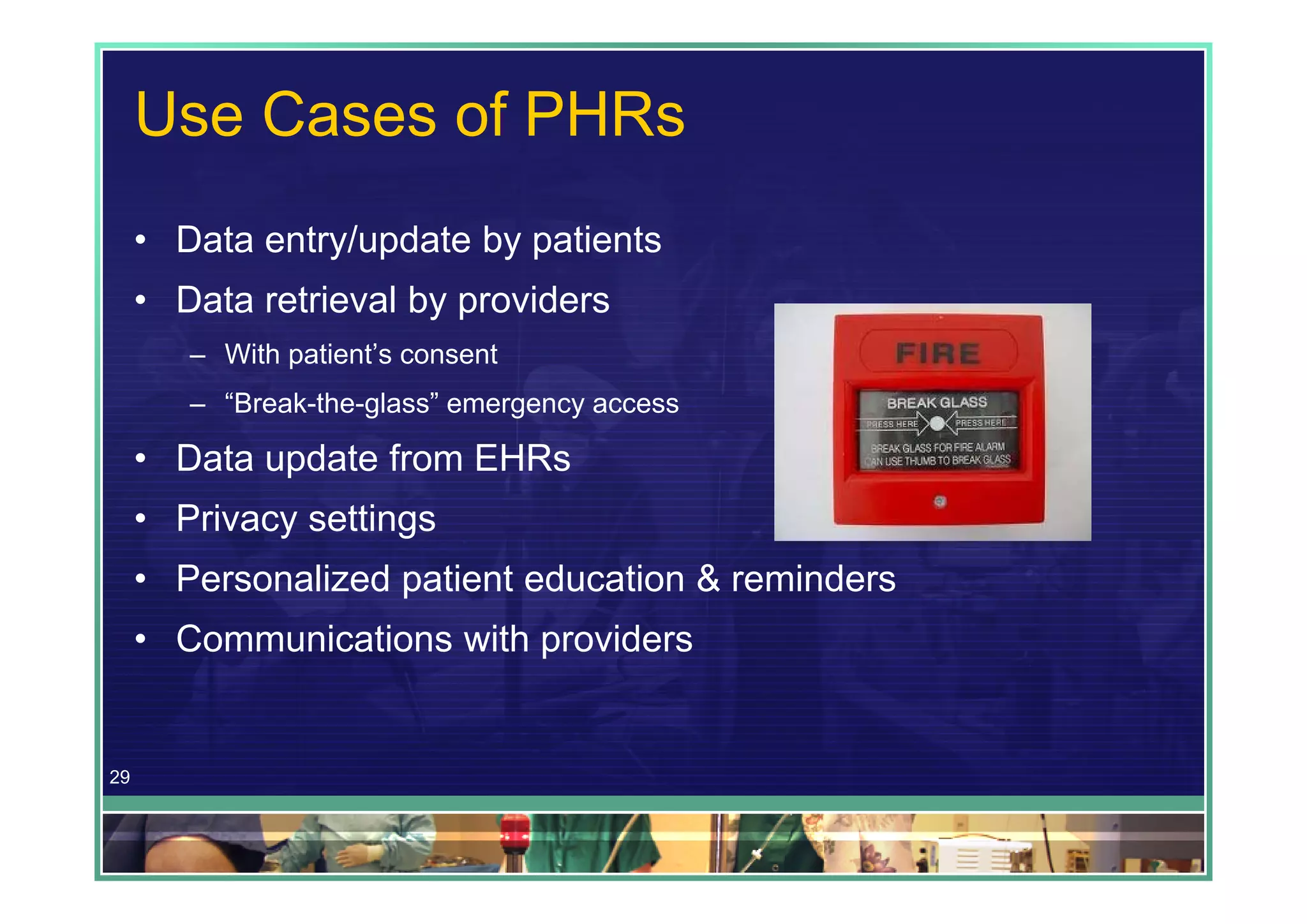
Use Cases of PHRs
     • Data entry/update by patients
     • Data retrieval by providers
        – With patient’s consent
        – “Break-the-glass” emergency access

     • Data update from EHRs
     • Privacy settings
     • Personalized patient education & reminders
     • Communications with providers


29
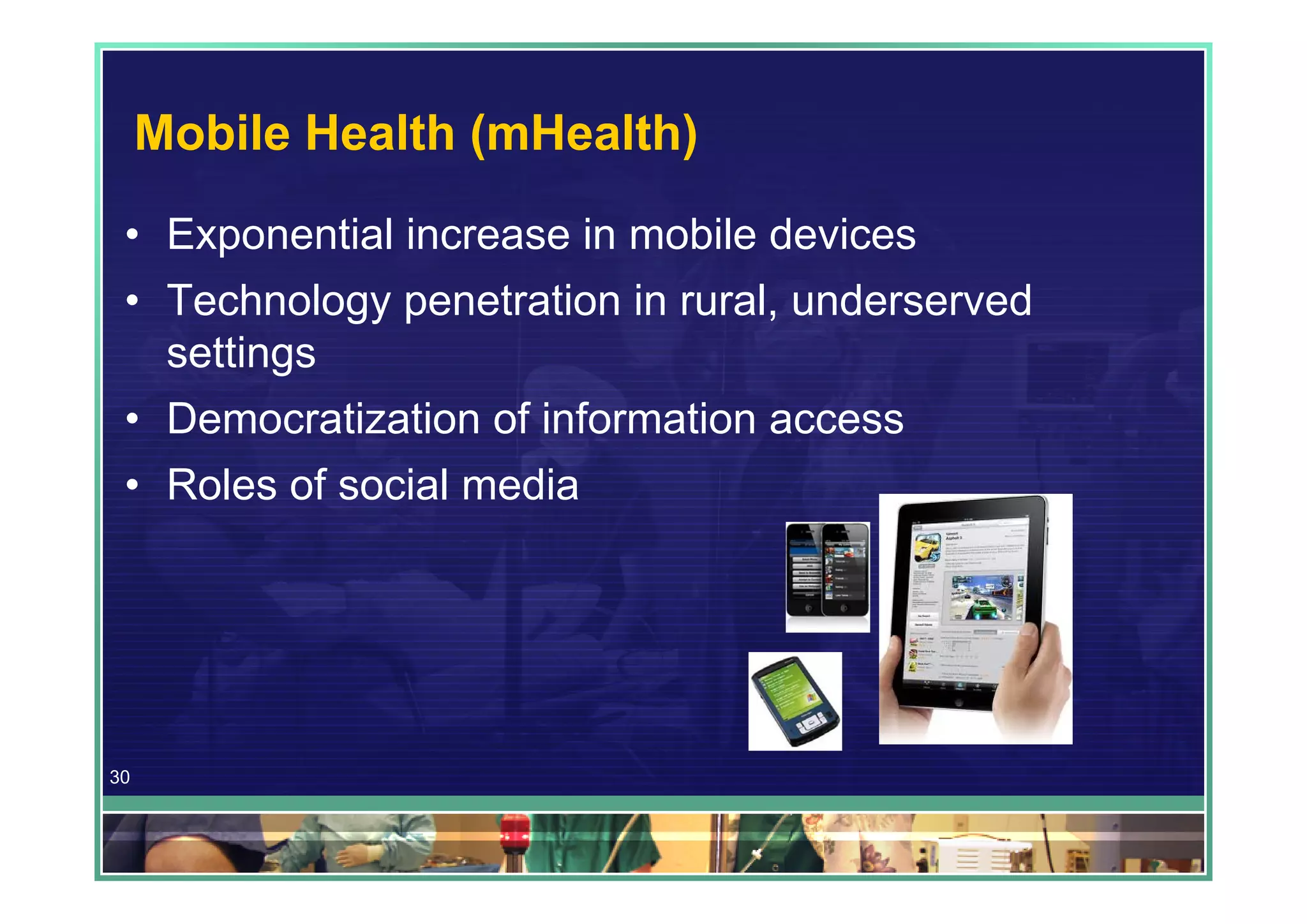
Mobile Health (mHealth)
 • Exponential increase in mobile devices
 • Technology penetration in rural, underserved
   settings
 • Democratization of information access
 • Roles of social media


30
mHealth & Social Media in Disaster Management

 • Communication, coordination & collaboration
   tools for relief workers, disaster managers,
   victims
 • Used heavily in
       – Haiti’s 2010 earthquake
       – Japan’s 2011 earthquake & tsunami
       – Thailand’s 2011 record flooding


31
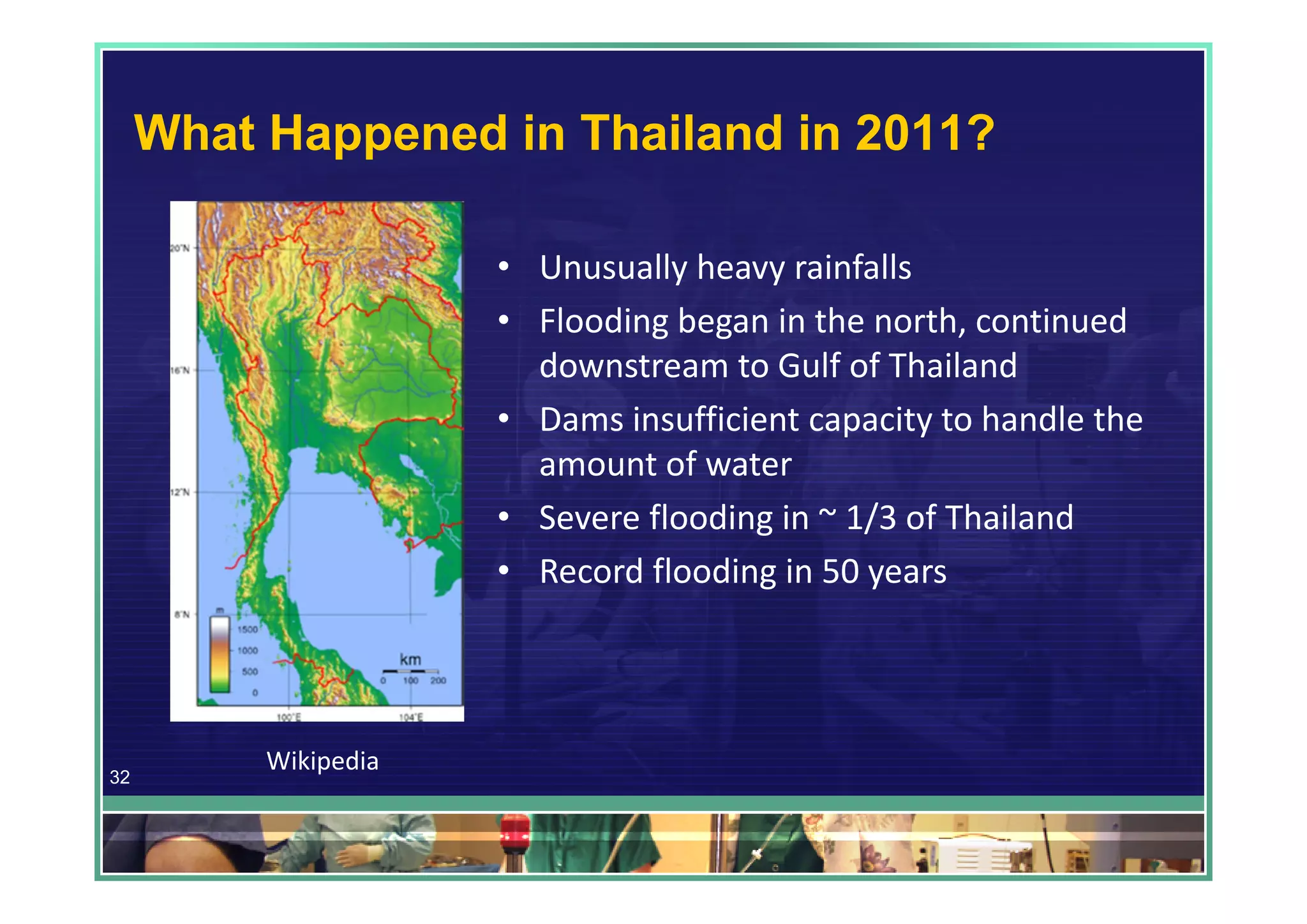
What Happened in Thailand in 2011?

                      • Unusually heavy rainfalls
                      • Flooding began in the north, continued 
                        downstream to Gulf of Thailand
                      • Dams insufficient capacity to handle the 
                        amount of water
                      • Severe flooding in ~ 1/3 of Thailand
                      • Record flooding in 50 years


          Wikipedia
32
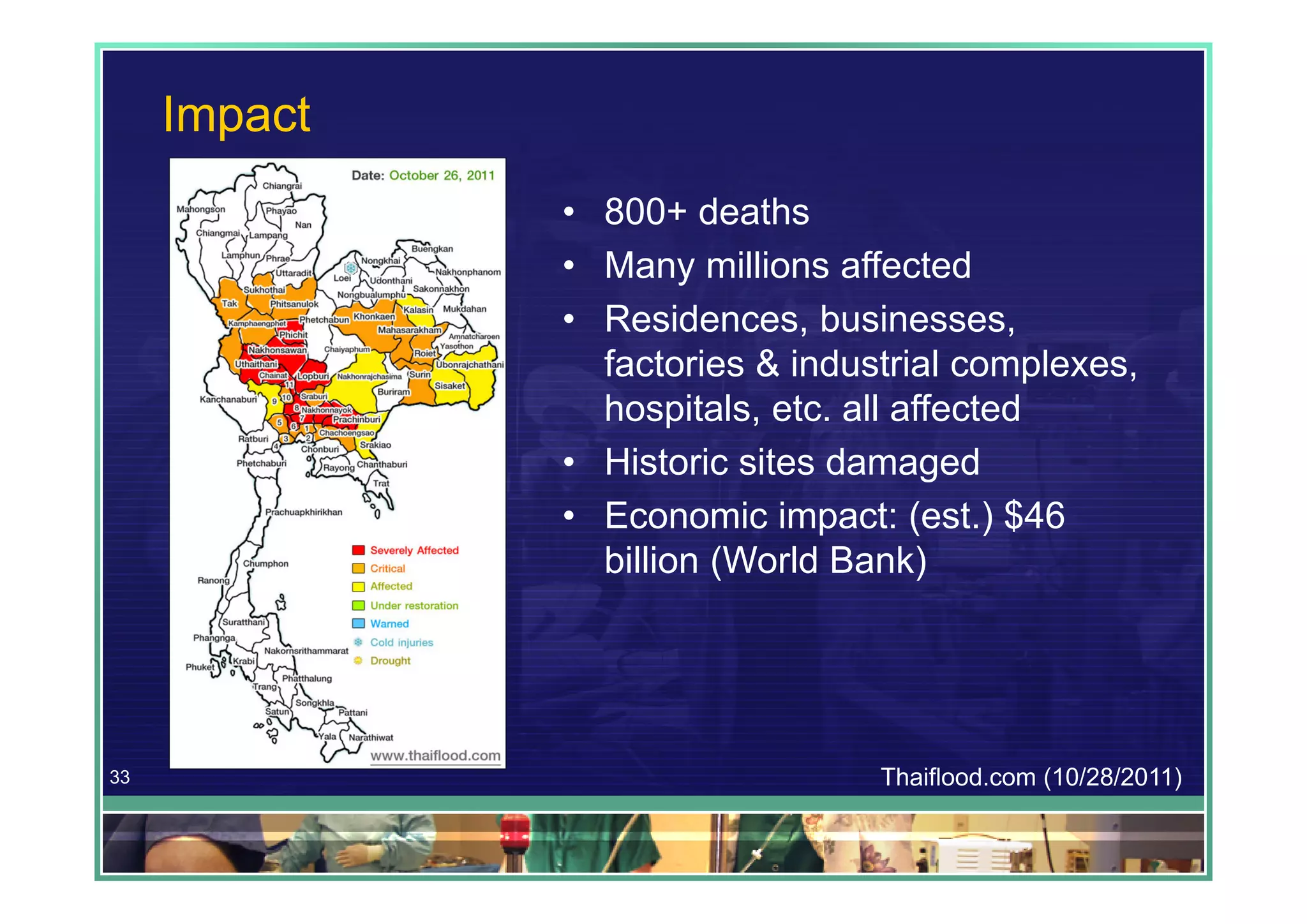
Impact
              • 800+ deaths
              • Many millions affected
              • Residences, businesses,
                factories & industrial complexes,
                hospitals, etc. all affected
              • Historic sites damaged
              • Economic impact: (est.) $46
                billion (World Bank)


33                               Thaiflood.com (10/28/2011)
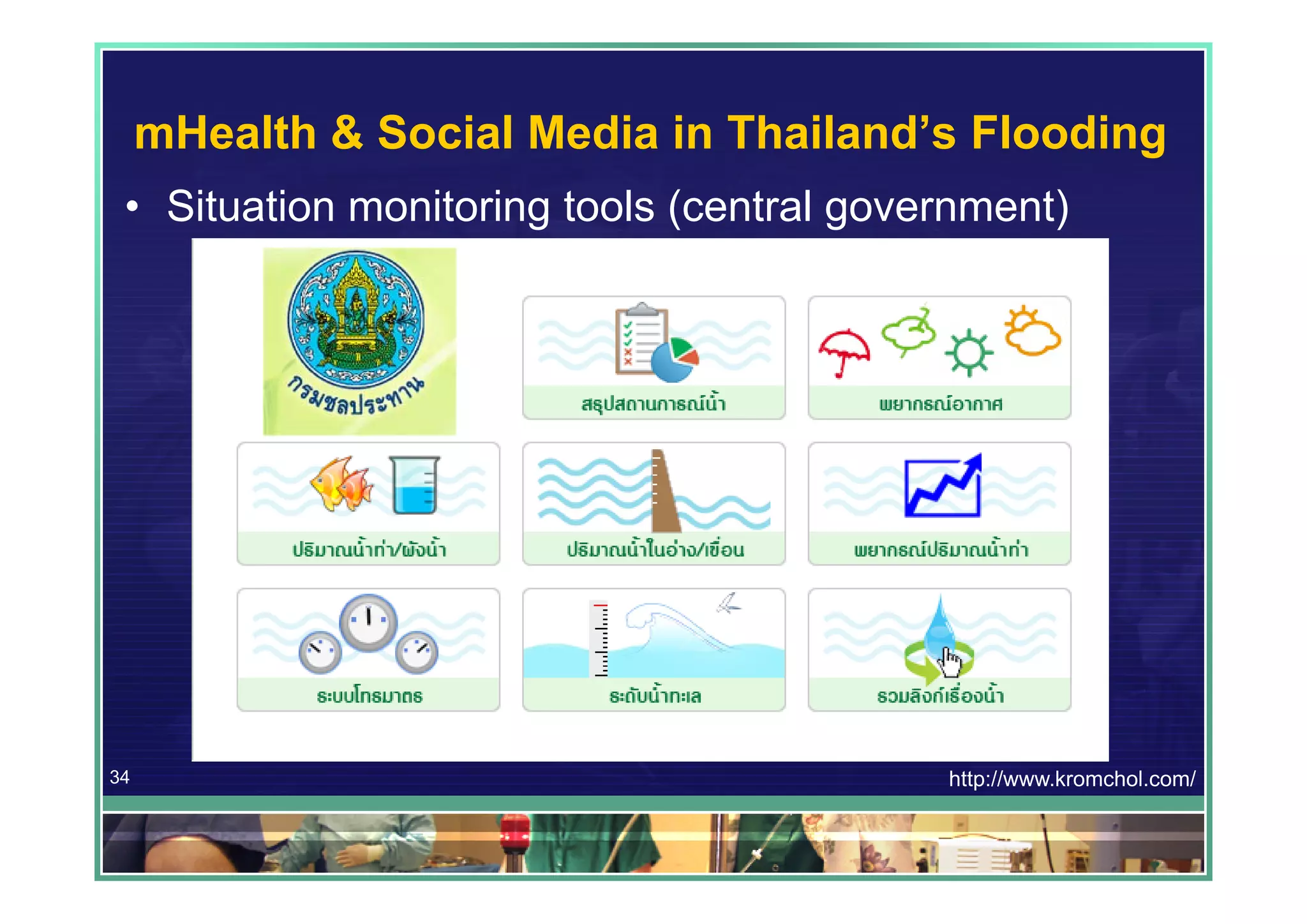
mHealth & Social Media in Thailand’s Flooding
 • Situation monitoring tools (central government)


34                                         http://www.kromchol.com/
mHealth & Social Media in Thailand’s Flooding
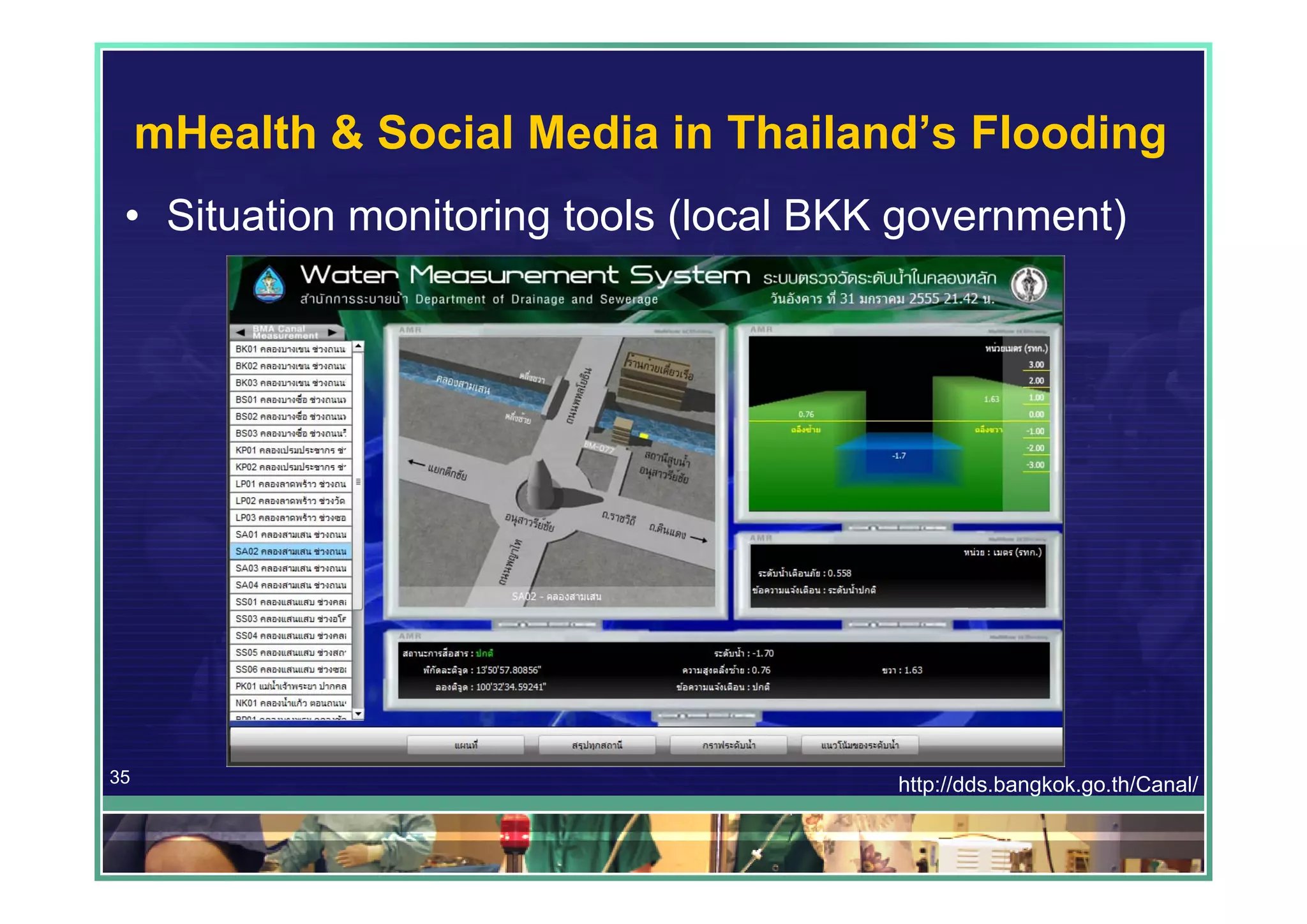
 • Situation monitoring tools (local BKK government)


35                                      http://dds.bangkok.go.th/Canal/
mHealth & Social Media in Thailand’s Flooding
 • Non-governmental information dissemination


36                                       http://www.thaiflood.com
mHealth & Social Media in Thailand’s Flooding
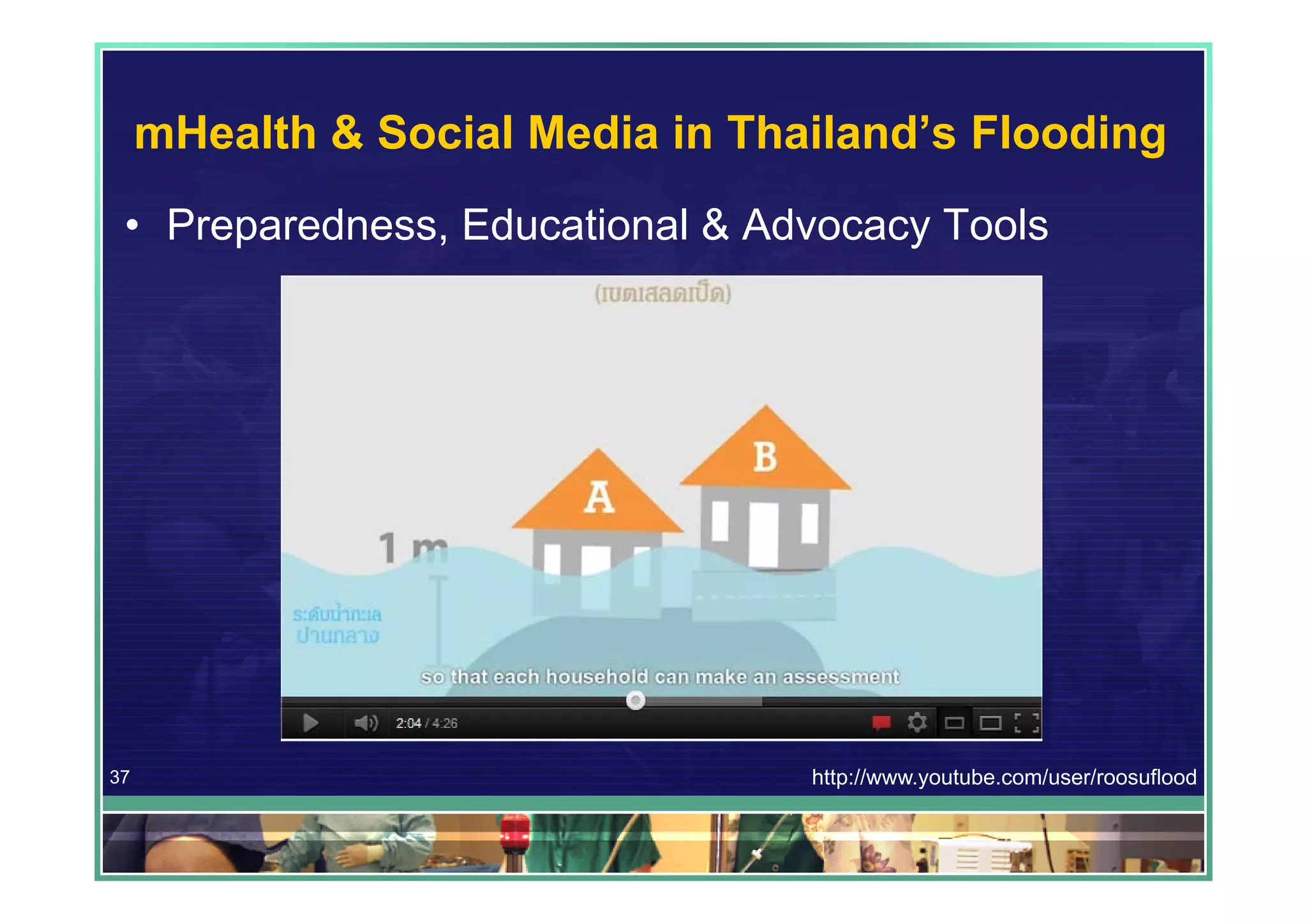
 • Preparedness, Educational & Advocacy Tools


37                                http://www.youtube.com/user/roosuflood
mHealth & Social Media in Thailand’s Flooding
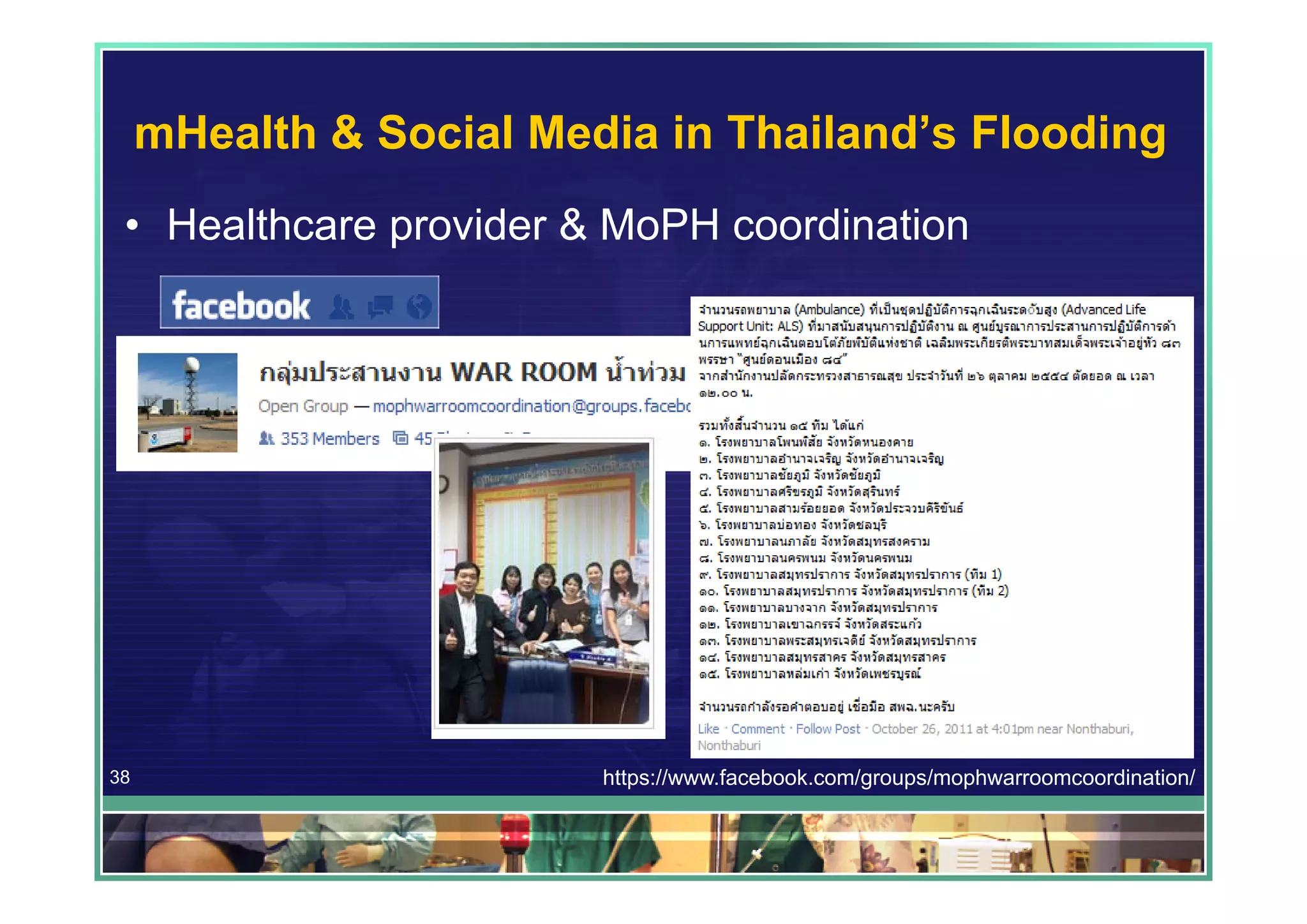
 • Healthcare provider & MoPH coordination


38                       https://www.facebook.com/groups/mophwarroomcoordination/
mHealth & Social Media in Thailand’s Flooding
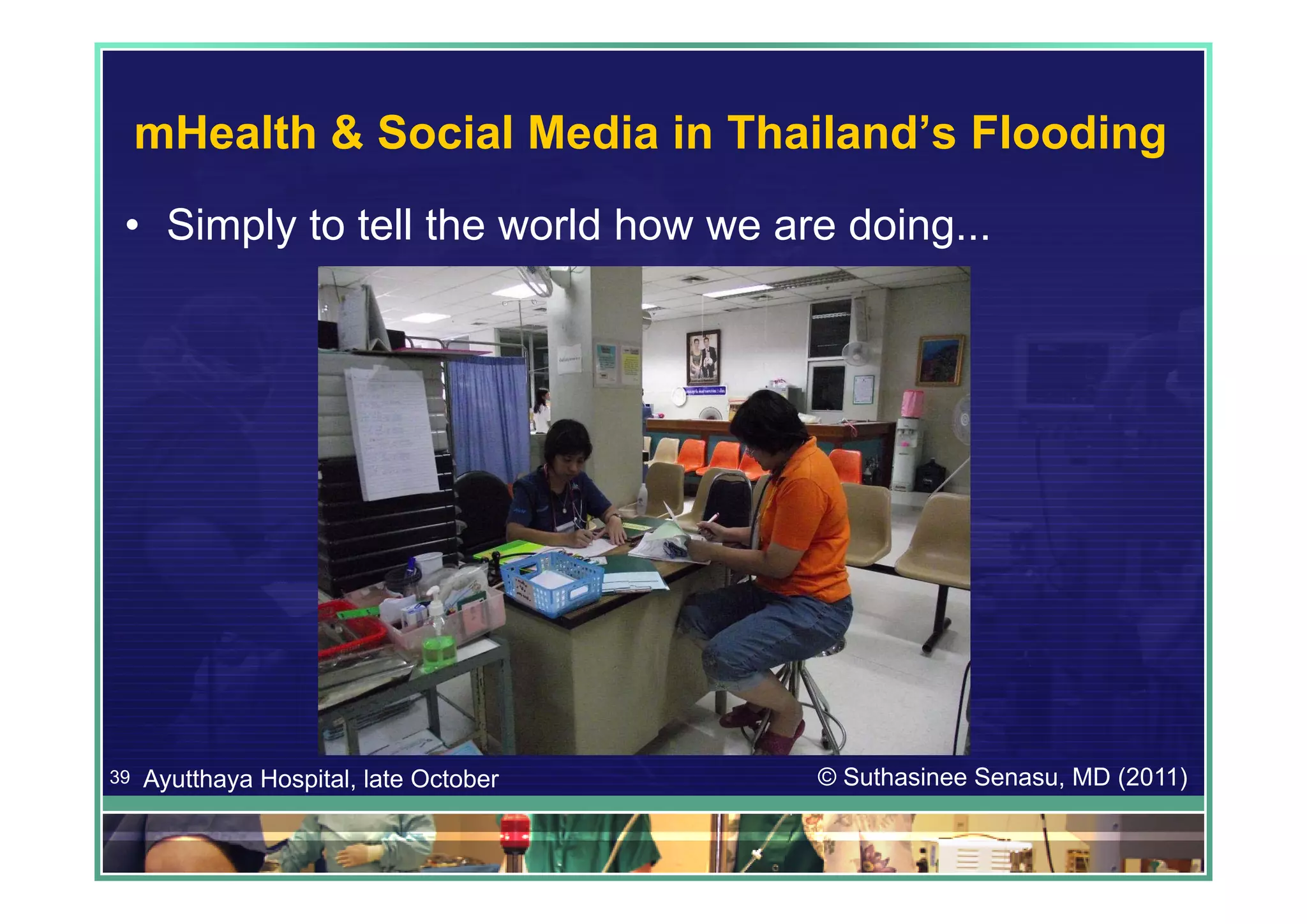
 • Simply to tell the world how we are doing...


39   Ayutthaya Hospital, late October   © Suthasinee Senasu, MD (2011)
mHealth & Social Media in Thailand’s Flooding
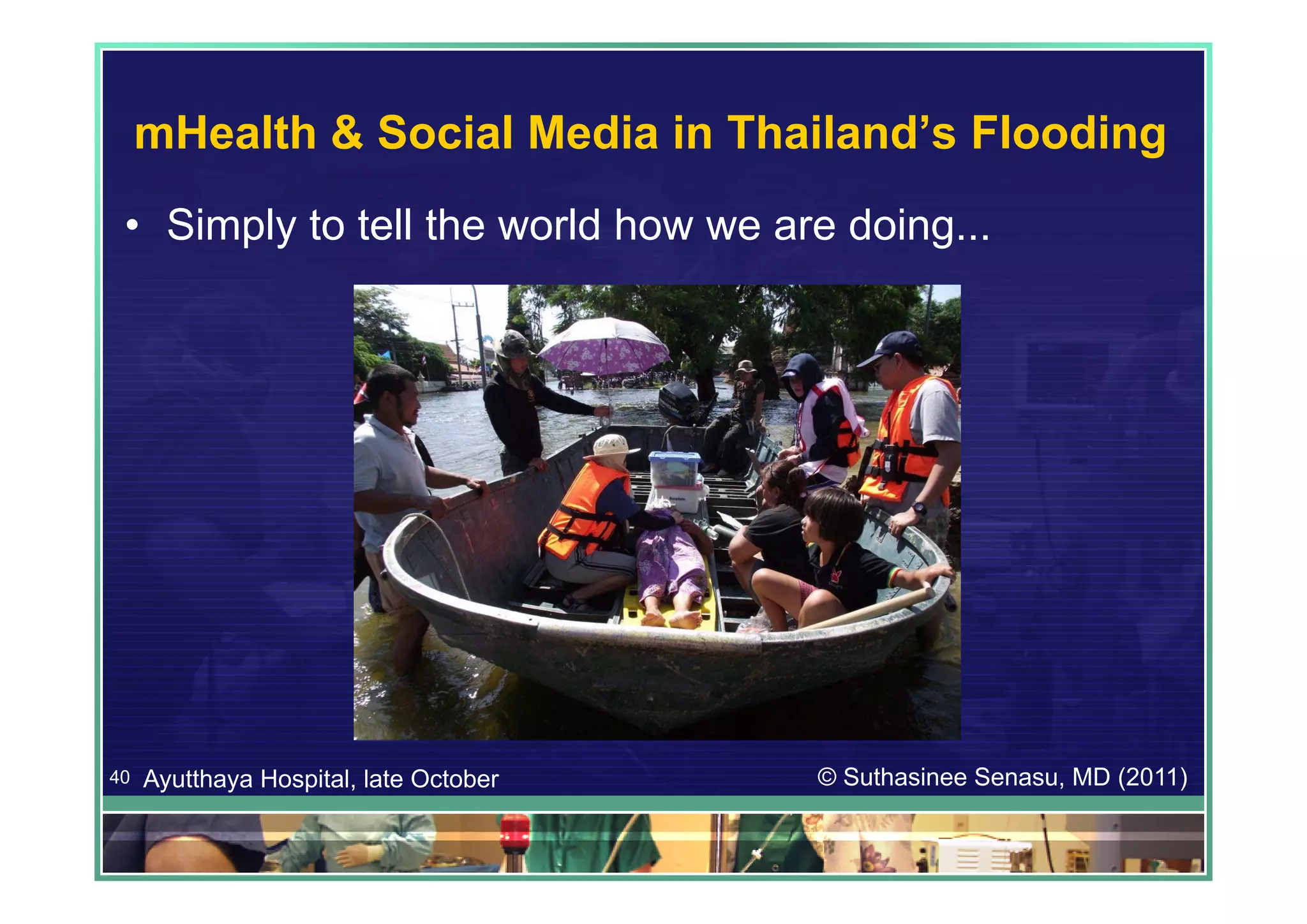
 • Simply to tell the world how we are doing...


40   Ayutthaya Hospital, late October   © Suthasinee Senasu, MD (2011)
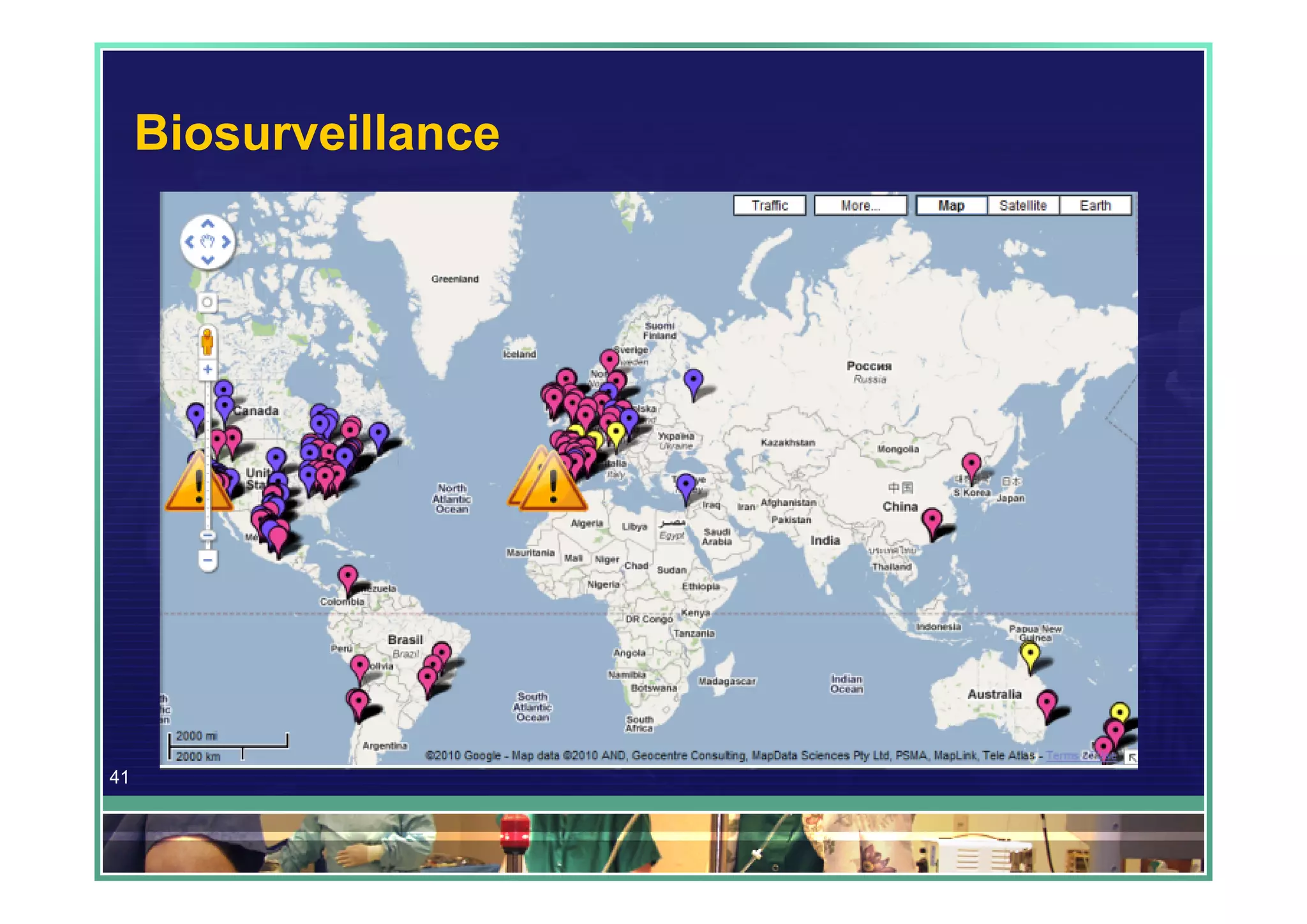
Biosurveillance


41
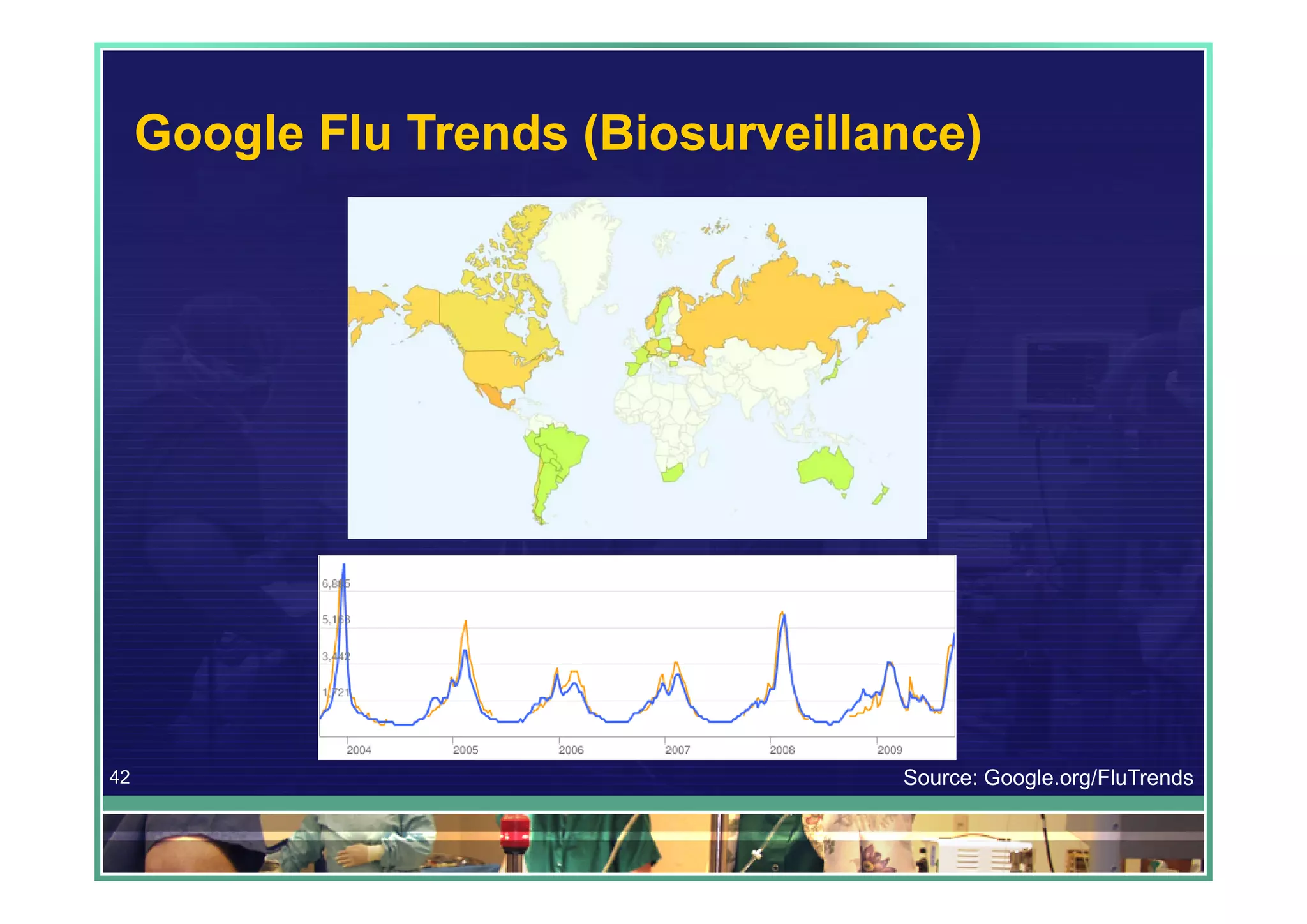
Google Flu Trends (Biosurveillance)


42                                  Source: Google.org/FluTrends
Conclusion
 • Health IT and informatics
    – Provide information for high quality emergency care
    – Have potential to transform care processes (not just
      computerizing patient care)
    – Come in various forms (EHRs, CDSS, HIE, PHRs,
      mHealth, biosurveillance)

 • Increasing roles of health IT and informatics for
   tomorrow’s emergency and disaster management

   • New innovations & new uses of IT discovered
43
     through every emergency situation
Questions?

44

Informatics in Emergency Medicine: A Brief Introduction (Presentation)

  • 1.
    Informatics in EmergencyMedicine: A Brief Introduction Nawanan Theera-Ampornpunt, MD, PhD Faculty of Medicine Ramathibodi Hospital http://www.slideshare.net/nawanan Feb 1, 2012
  • 2.
    Outline • Introduction about Biomedical & Health Informatics • Emergency Medicine & Implications for Informatics • Informatics Applications in Emergency Medicine – EHRs & HIE – PHRs – mHealth – Biosurveillance • Conclusion 2
  • 3.
    Biomedical & HealthInformatics • “[T]he field that is concerned with the optimal use of information, often aided by the use of technology, to improve individual health, health care, public health, and biomedical research” (Hersh, 2009) • “[T]he application of the science of information as data plus meaning to problems of biomedical interest” (Bernstam et al, 2010) 3
  • 4.
    DIKW Pyramid Wisdom Knowledge Information Data 4
  • 5.
    Informatics As AField 5 Shortliffe (2002)
  • 6.
    Because Information isEverywhere... 6
  • 7.
    Emergency Departments (ED) • Prone to errors because of – Urgent nature – Limited & at times unreliable patient history – Time & resource constraints • Scale & unpredictability of mass casualties & disasters make it worse • 32% of ED visits had information gaps which can lead to prolonged ED stay (Stiell et al., 2003) 7
  • 8.
    Informatics Roles inEmergency Medicine • Provide patient information critical to care • Information improves quality & efficiency of care in ED, at least for some conditions (e.g., Theera-Ampornpunt et al., 2009; Overhage et al., 2002; Connelly et al., 2012) • Role of health information exchange (HIE) highlighted • IT as transformational tools that improve care processes 8
  • 9.
    Why Adopting HealthIT? “To Go paperless” “To Computerize” “To Get a HIS” “Digital Hospital” “To Have EMRs” “To Modernize” 9 “To Share data”
  • 10.
    Dimensions of QualityHealthcare • Safety • Timeliness • Effectiveness • Efficiency • Equity • Patient-centeredness 10 IOM (2001)
  • 11.
    Better Information DeliveryImproves • Safety (prevent allergies) • Timeliness (have access to information early) • Effectiveness (information for decision-making) • Efficiency (prevent unnecessary/redundant lab) • Equity • Patient-centeredness 11
  • 12.
    IT as Toolsfor Process Redesign • Safety (no handwriting!!, allergies/DI alerts) • Timeliness (faster internal processes) • Effectiveness (CDSS alerts & reminders) • Efficiency (faster care, better patient flow, better bed management) 12
  • 13.
    Because... “To ErrIs Human” 13
  • 14.
    To Err IsHuman • Lack of Attention 14 Image Source: aafp.org
  • 15.
    To Err IsHuman • Cognitive Errors - Example: Decoy Pricing # of The Economist Purchase Options People • Economist.com subscription $59 16 • Print subscription $125 0 • Print & web subscription $125 84 # of The Economist Purchase Options People • Economist.com subscription $59 68 15 • Print & web subscription $125 32 Ariely (2008)
  • 16.
    What If ThisHappens in Healthcare? • It already happens.... (Mamede et al., 2010; Croskerry, 2003; Klein, 2005) • What if health IT can help? 16
  • 17.
    Clinical Decision SupportSystems (CDSSs) PATIENT Perception CLINICIAN Attention Long Term Memory External Memory Working Memory Knowledge Data Knowledge Data Inference 17 DECISION From a teaching slide by Don Connelly, 2006
  • 18.
    Clinical Decision SupportSystems (CDSSs) PATIENT Perception CLINICIAN Abnormal lab Attention highlights Long Term Memory External Memory Working Memory Knowledge Data Knowledge Data Inference 18 DECISION
  • 19.
    Clinical Decision SupportSystems (CDSSs) PATIENT Perception CLINICIAN Drug-Allergy Attention Checks Long Term Memory External Memory Working Memory Knowledge Data Knowledge Data Inference 19 DECISION
  • 20.
    Clinical Decision SupportSystems (CDSSs) PATIENT Drug-Drug Perception Interaction CLINICIAN Checks Attention Long Term Memory External Memory Working Memory Knowledge Data Knowledge Data Inference 20 DECISION
  • 21.
    Clinical Decision SupportSystems (CDSSs) • CDSS as a replacement or supplement of clinicians? – The demise of the “Greek Oracle” model (Miller & Masarie, 1990) The “Greek Oracle” Model The “Fundamental Theorem” 21 Friedman (2009)
  • 22.
    Electronic Health Records(EHRs) • Electronic documentation of patient care by providers • Sometimes defined as longitudinal records of a patient’s health care 22
  • 23.
    Electronic Health Record(EHR) Systems • Are they just electronic documentation? History Diag- Treat- ... & PE nosis ments • Or do they have some other values? 23
  • 24.
    Benefits of HealthIT • Literature suggests improvement in health care through – Guideline adherence (Shiffman et al, 1999;Chaudhry et al, 2006) – Better documentation (Shiffman et al, 1999) – Practitioner decision making or process of care (Balas et al, 1996;Kaushal et al, 2003;Garg et al, 2005) – Medication safety (Kaushal et al, 2003;Chaudhry et al, 2006;van Rosse et al, 2009) – Patient surveillance & monitoring (Chaudhry et al, 2006) – Patient education/reminder (Balas et al, 1996) – Cost savings and better financial performance (Parente & Dunbar, 2001;Chaudhry et al, 2006;Amarasingham et al, 2009;Borzekowski, 2009) 24
  • 25.
    Functions that Shouldbe Part of EHR Systems • Computerized Medication Order Entry • Computerized Laboratory Order Entry • Computerized Laboratory Results • Physician Notes • Patient Demographics • Problem Lists • Medication Lists • Discharge Summaries • Diagnostic Test Results • Radiologic Reports 25 IOM (2003), Blumenthal et al (2006)
  • 26.
    Health Information Exchange(HIE) Government Hospital A Hospital B Clinic C Lab Patient at Home 26
  • 27.
    Personal Health Records(PHRs) • “An electronic application through which individuals can access, manage and share their health information, and that of others for whom they are authorized, in a private, secure, and confidential environment.” (Markle Foundation, 2003) • “A PHR includes health information managed by the individual... This can be contrasted with the clinician’s record of patient encounter–related information [a paperchart or EHR], which is managed by the clinician and/or health care institution.” (Tang et al., 2006) 27
  • 28.
    Types of PHRs • Patient portal from a provider’s EHRs (“tethered” PHRs) • Online PHRs – Stand-alone – Can be integrated with EHRs from multiple providers (unidirectional/bidirectional data sharing) • Stand-alone PHRs – PC-based applications – USB Drive – CD-ROM or other data storage devices – Paper 28
  • 29.
    Use Cases ofPHRs • Data entry/update by patients • Data retrieval by providers – With patient’s consent – “Break-the-glass” emergency access • Data update from EHRs • Privacy settings • Personalized patient education & reminders • Communications with providers 29
  • 30.
    Mobile Health (mHealth) • Exponential increase in mobile devices • Technology penetration in rural, underserved settings • Democratization of information access • Roles of social media 30
  • 31.
    mHealth & SocialMedia in Disaster Management • Communication, coordination & collaboration tools for relief workers, disaster managers, victims • Used heavily in – Haiti’s 2010 earthquake – Japan’s 2011 earthquake & tsunami – Thailand’s 2011 record flooding 31
  • 32.
    What Happened inThailand in 2011? • Unusually heavy rainfalls • Flooding began in the north, continued  downstream to Gulf of Thailand • Dams insufficient capacity to handle the  amount of water • Severe flooding in ~ 1/3 of Thailand • Record flooding in 50 years Wikipedia 32
  • 33.
    Impact • 800+ deaths • Many millions affected • Residences, businesses, factories & industrial complexes, hospitals, etc. all affected • Historic sites damaged • Economic impact: (est.) $46 billion (World Bank) 33 Thaiflood.com (10/28/2011)
  • 34.
    mHealth & SocialMedia in Thailand’s Flooding • Situation monitoring tools (central government) 34 http://www.kromchol.com/
  • 35.
    mHealth & SocialMedia in Thailand’s Flooding • Situation monitoring tools (local BKK government) 35 http://dds.bangkok.go.th/Canal/
  • 36.
    mHealth & SocialMedia in Thailand’s Flooding • Non-governmental information dissemination 36 http://www.thaiflood.com
  • 37.
    mHealth & SocialMedia in Thailand’s Flooding • Preparedness, Educational & Advocacy Tools 37 http://www.youtube.com/user/roosuflood
  • 38.
    mHealth & SocialMedia in Thailand’s Flooding • Healthcare provider & MoPH coordination 38 https://www.facebook.com/groups/mophwarroomcoordination/
  • 39.
    mHealth & SocialMedia in Thailand’s Flooding • Simply to tell the world how we are doing... 39 Ayutthaya Hospital, late October © Suthasinee Senasu, MD (2011)
  • 40.
    mHealth & SocialMedia in Thailand’s Flooding • Simply to tell the world how we are doing... 40 Ayutthaya Hospital, late October © Suthasinee Senasu, MD (2011)
  • 41.
  • 42.
    Google Flu Trends(Biosurveillance) 42 Source: Google.org/FluTrends
  • 43.
    Conclusion • HealthIT and informatics – Provide information for high quality emergency care – Have potential to transform care processes (not just computerizing patient care) – Come in various forms (EHRs, CDSS, HIE, PHRs, mHealth, biosurveillance) • Increasing roles of health IT and informatics for tomorrow’s emergency and disaster management • New innovations & new uses of IT discovered 43 through every emergency situation
  • 44.