
Uploaded byD&I Business Support Services
Running Effective Board Meetings
The document outlines best practices for running effective board meetings, emphasizing the use of terms of reference to clarify meeting objectives and maintain focus. It advocates for maintaining an action log instead of traditional minutes to track commitments and holds participants accountable. Additionally, it highlights the importance of preparation, effective chairing, and post-meeting assessments to improve future meetings.
More Related Content


Similar to Running Effective Board Meetings


Running Effective Board Meetings
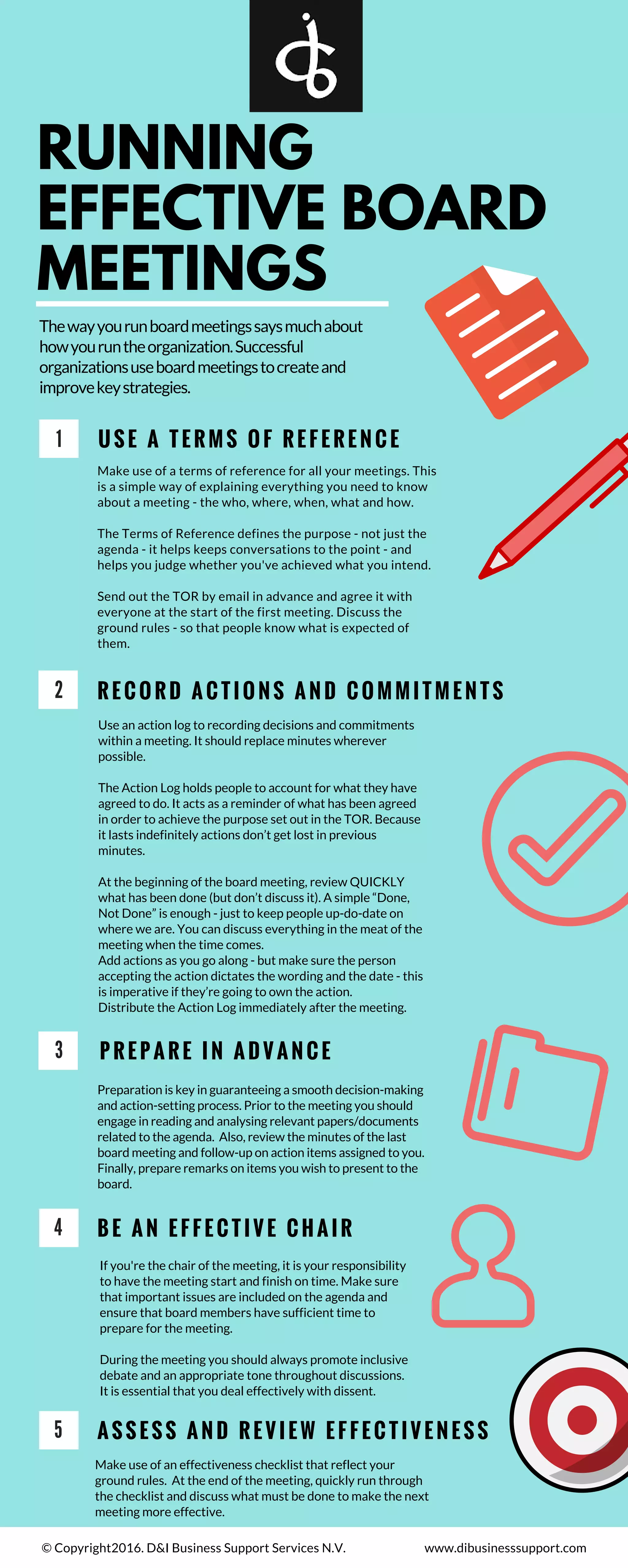
- 1. 1 U SE A T E R M S O F R E F E R E N C E Make use of a terms of reference for all your meetings. This is a simple way of explaining everything you need to know about a meeting - the who, where, when, what and how. The Terms of Reference defines the purpose - not just the agenda - it helps keeps conversations to the point - and helps you judge whether you've achieved what you intend. Send out the TOR by email in advance and agree it with everyone at the start of the first meeting. Discuss the ground rules - so that people know what is expected of them. 2 R E C O R D A C T I O N S A N D C O M M I T M E N T S Use an action log to recording decisions and commitments within a meeting. It should replace minutes wherever possible. The Action Log holds people to account for what they have agreed to do. It acts as a reminder of what has been agreed in order to achieve the purpose set out in the TOR. Because it lasts indefinitely actions don’t get lost in previous minutes. At the beginning of the board meeting, review QUICKLY what has been done (but don’t discuss it). A simple “Done, Not Done” is enough - just to keep people up-do-date on where we are. You can discuss everything in the meat of the meeting when the time comes. Add actions as you go along - but make sure the person accepting the action dictates the wording and the date - this is imperative if they’re going to own the action. Distribute the Action Log immediately after the meeting. Thewayyourunboardmeetingssaysmuchabout howyouruntheorganization.Successful organizationsuseboardmeetingstocreateand improvekeystrategies. P R E P A R E I N A D V A N C E Preparation is key in guaranteeing a smooth decision-making and action-setting process. Prior to the meeting you should engage in reading and analysing relevant papers/documents related to the agenda. Also, review the minutes of the last board meeting and follow-up on action items assigned to you. Finally, prepare remarks on items you wish to present to the board. B E A N E F F E C T I V E C H A I R If you're the chair of the meeting, it is your responsibility to have the meeting start and finish on time. Make sure that important issues are included on the agenda and ensure that board members have sufficient time to prepare for the meeting. During the meeting you should always promote inclusive debate and an appropriate tone throughout discussions. It is essential that you deal effectively with dissent. A S S E S S A N D R E V I E W E F F E C T I V E N E S S Make use of an effectiveness checklist that reflect your ground rules. At the end of the meeting, quickly run through the checklist and discuss what must be done to make the next meeting more effective. 3 4 5 RUNNING EFFECTIVE BOARD MEETINGS © Copyright2016. D&I Business Support Services N.V. www.dibusinesssupport.com