The document outlines the principles of writing meeting minutes and narrative reports, detailing their definitions, purposes, types, and essential components. It emphasizes the importance of clarity and structure in recording both meeting discussions and event recounting to ensure accurate and effective communication. Additionally, it provides step-by-step guidelines for preparing, writing, and editing each type of written document.
WRITING THE
MINUTES OFTHE MEETING
AND THE
NARRATIVE REPORT
Michael Bryan Z. Rayos
Course Lecturer, Technical Writing
Camarines Norte State College – Entienza Campus
2.
OUTLINE
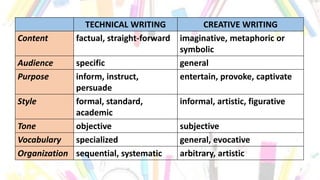
•Technical Writing ina Nutshell
•Minutes of the Meeting Defined
•Purpose of the Minutes
•Who Prepares the Minutes?
•What are the Requirements?
•Types of Minutes
•Essential Parts of the Minutes
•How to Write the Minutes
3.
OUTLINE
•Narrative Report Defined
•Purposeof the Narrative Report
•Types of Narration
•Basic Parts of a Narrative Report
•Structure of a Narrative Report
•Tips/Guidelines in Writing the Narrative Report
Minutes of theMeeting
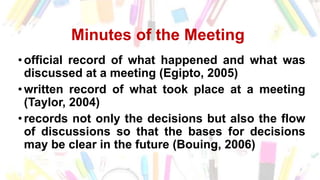
• official record of what happened and what was
discussed at a meeting (Egipto, 2005)
• written record of what took place at a meeting
(Taylor, 2004)
• records not only the decisions but also the flow
of discussions so that the bases for decisions
may be clear in the future (Bouing, 2006)
Purpose of Minutes
•Thebasic purpose is to provide a historical
account of official business conducted during a
meeting and supporting a group as it carries out
its responsibilities.
10.
Who Prepares theMinutes of the
Meeting?
• Normally, a person is formally designated as
secretary or a recorder to prepare the minutes.
• In some groups, a secretary or clerk performs
the task of taking the minutes.
Who Prepares the Minutes?
• Normally, a person is formally designated as
secretary or a recorder to prepare the minutes.
• In some groups, a secretary or clerk performs
the task of taking the minutes.
11.
Who Prepares theMinutes of the
Meeting?
• Normally, a person is formally designated as
secretary or a recorder to prepare the minutes.
• In some groups, a secretary or clerk performs
the task of taking the minutes.
What are the requirements?
Focus
Alertness
Comprehension
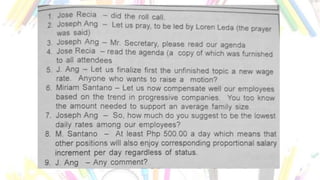
Verbatim Minutes
• areusually prepared by secretaries of a
government legislature, council, or lawmaking
body
• everything transpired during the meeting shall
exactly form the minutes even if it is time-
consuming and expensive
14.
Verbatim Minutes
• minutesof the annual meeting are also
transcribed in verbatim minutes to safeguard
the validity and reliability because it transpired
during a crucial meeting
15.
Verbatim Minutes
• recordof every single word said at a meeting
• will not always follow the agenda
• are often long and can be difficult
17.
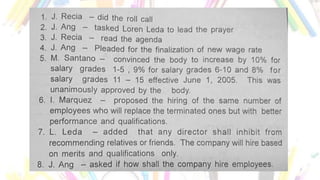
Summary Minutes
• providesa record of all information not
necessarily word for word but a summary of the
discussion and action on all agenda items
• usually contains the proceedings of meetings
conducted at shorter intervals of time
18.
Summary Minutes
• shortand free from the complexities
• most commonly used in the office
• normally written in full sentences rather than
bullet points
20.
Action Minutes
• containsidentifying information, brief summary
of discussions made and key information
presented
• emphasizes decisions, tasks, and actions to be
done related to the proceeding, thus making
this minutes quickly and easily prepared
21.
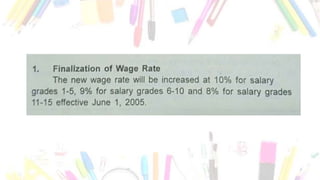
Action Minutes
• writtenin the form of a list of steps required,
who should take tem and when
• purpose of this is to provide only a record of
decisions that require an action
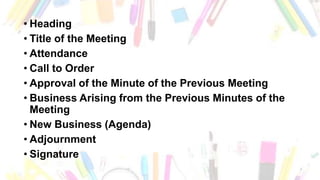
• Heading
• Titleof the Meeting
• Attendance
• Call to Order
• Approval of the Minute of the Previous Meeting
• Business Arising from the Previous Minutes of the
Meeting
• New Business (Agenda)
• Adjournment
• Signature
Present
- the completelist of names of all those who are
present at the meeting;
Regrets
- the complete list of names of those who have
contacted the chairman or presiding officer to let them
know that they will be unable to attend the scheduled
meeting;
Absent
- the complete list of those who are absent at the
meeting
31.
Note on theAttendance:
Usually the attendance of the meeting is being
checked, monitored, and approved by the secretary.
The general rule in establishing the quorum of
the meeting is half plus one of the total number of
attendees.
Call to Order
Inthis part, the complete name and position
of the one who set the meeting is stated;
you may refer to the Notice of Meeting for
the details needed in this part
34.
Approval of theMinutes of the
Previous Meeting
contains the motion to approve the minutes
of the previous or last meeting as circulated
to approve the minutes as amended; the
attendees of the meeting may correct or
revise the minutes of the previous meeting
35.
Business Arising fromthe
Previous Minutes of the Meeting
includes some agenda from the previous
meeting that are needed to be reviewed and
needed to take immediate action
36.
New Business
refers tothe agenda of the meeting;
you may refer to the Notice of the Meeting to
follow the flow of the agenda of the
meeting;
New Business
the heartof every minutes of the meeting;
this should be carefully written;
every detail should be included and
specified so that nothing will be overlooked
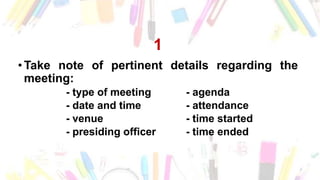
1
• Take noteof pertinent details regarding the
meeting:
- type of meeting - agenda
- date and time - attendance
- venue - time started
- presiding officer - time ended
44.
2
• For easyfacility, prepare your attendance
sheet.
1
• Be ableto know the name of each attendee by
making a map or tags for seating arrangement.
• You may also request unfamiliar participants to
identify themselves.
• This will help you to keep track of who said
what.
51.
2
• Concentrate ongetting the essential elements
of discussion and take enough notes to be
summarized later.
52.
3
• Ask forclarification if things are not
understood.
53.
4
• Do notfail to take note of the items discussed,
decisions reached, and action decided on.
What is aNarrative Report?
•It is an informational work made with the
intention of relaying information or recounting
certain events in a presentable manner.
60.
What is aNarrative Report?
•It present things or events that has happened in
the past through a logical progression of the
relevant information.
61.
What is aNarrative Report?
•Narrative Report is always written in a sequential
manner in order of occurrence.
62.
What is aNarrative Report?
•It is most widely used.
63.
What is aNarrative Report?
•Narration does not tell about the story, it tells the
story.
•It places the events before our eyes.
64.
Purpose of aNarrative Report
•The main purpose of a narrative report is to
present a clear and factual depiction of what has
occurred.
Basic Parts ofa Narrative Report
•Cover Page
•Content Page
- Heading
- Title
- Content
• Appendix / Appendices
67.
How to Writethe Narrative Report
•Generally, you should account all the details
while maintaining the logical sequence.
68.
How to Writethe Narrative Report
•A narrative report should have the following:
69.
Statement of thethesis or the event
•You should state the context of the focal event of
your report, its time, place, and actors.
70.
Any background informationrelated to
this thesis
•Sometimes, you can provide information about
events that preceded the key event, in case they
are relevant.
71.
Chronological account ofthe event or a
series of events
•It should be detailed as possible.
•Don’t forget to mention the exact time and all the
relevant numbers that can be applied.
•If there are accounts from other witnesses or
actors, your should quote them as well.
1
•Be a livingwitness of the activity.
•You cannot write the narrative report if you are
not present during the activity / event.
76.
2
•Before/during the event,gather all the available
materials relevant to the activity or event such as
the program.
•This can be of great help in writing the report.
77.
3
•Document the proceedingsof the activity.
•Take note all the activities that transpired during
the activity/event.
•Take photos and video-record the activity.