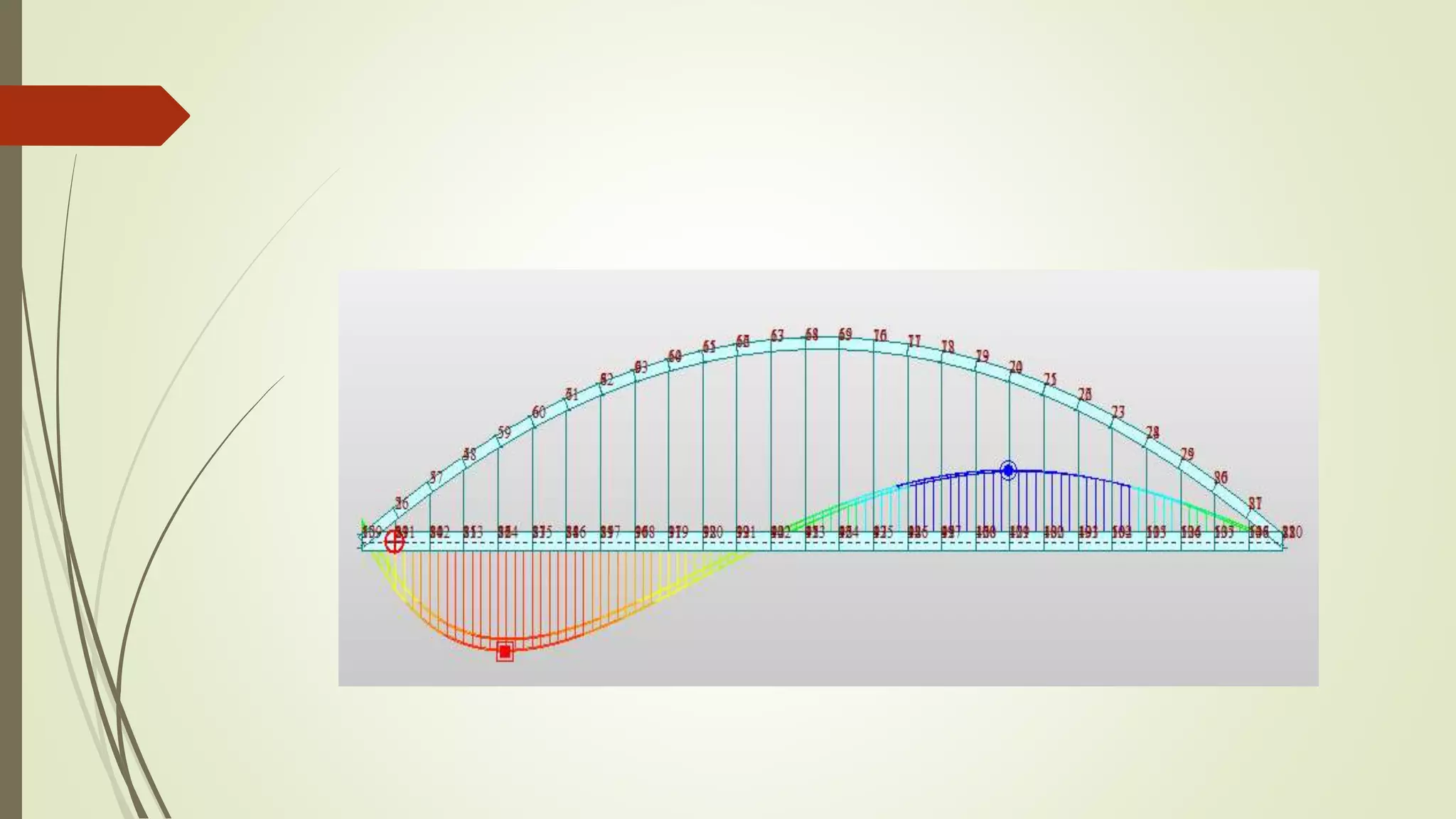
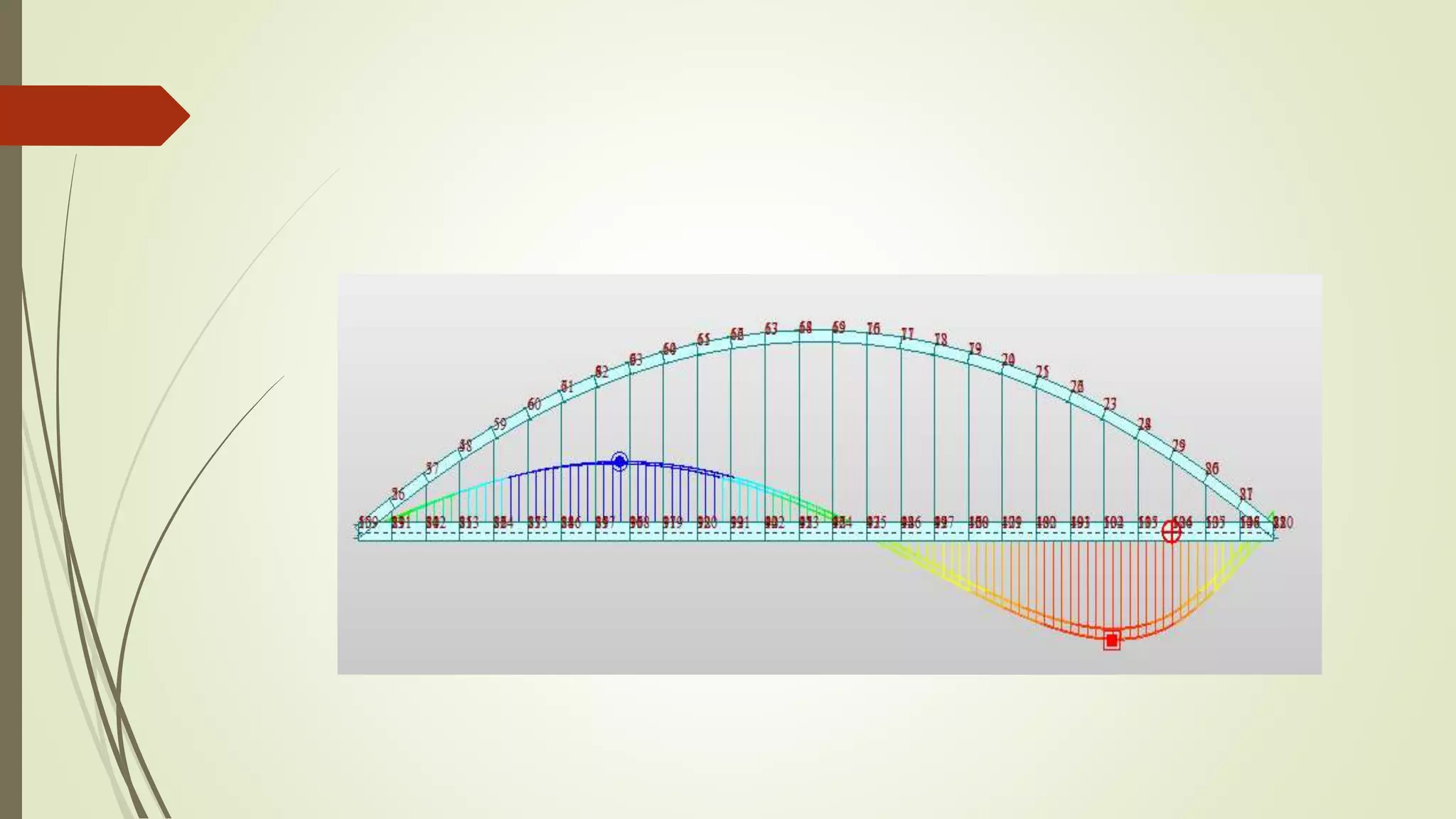
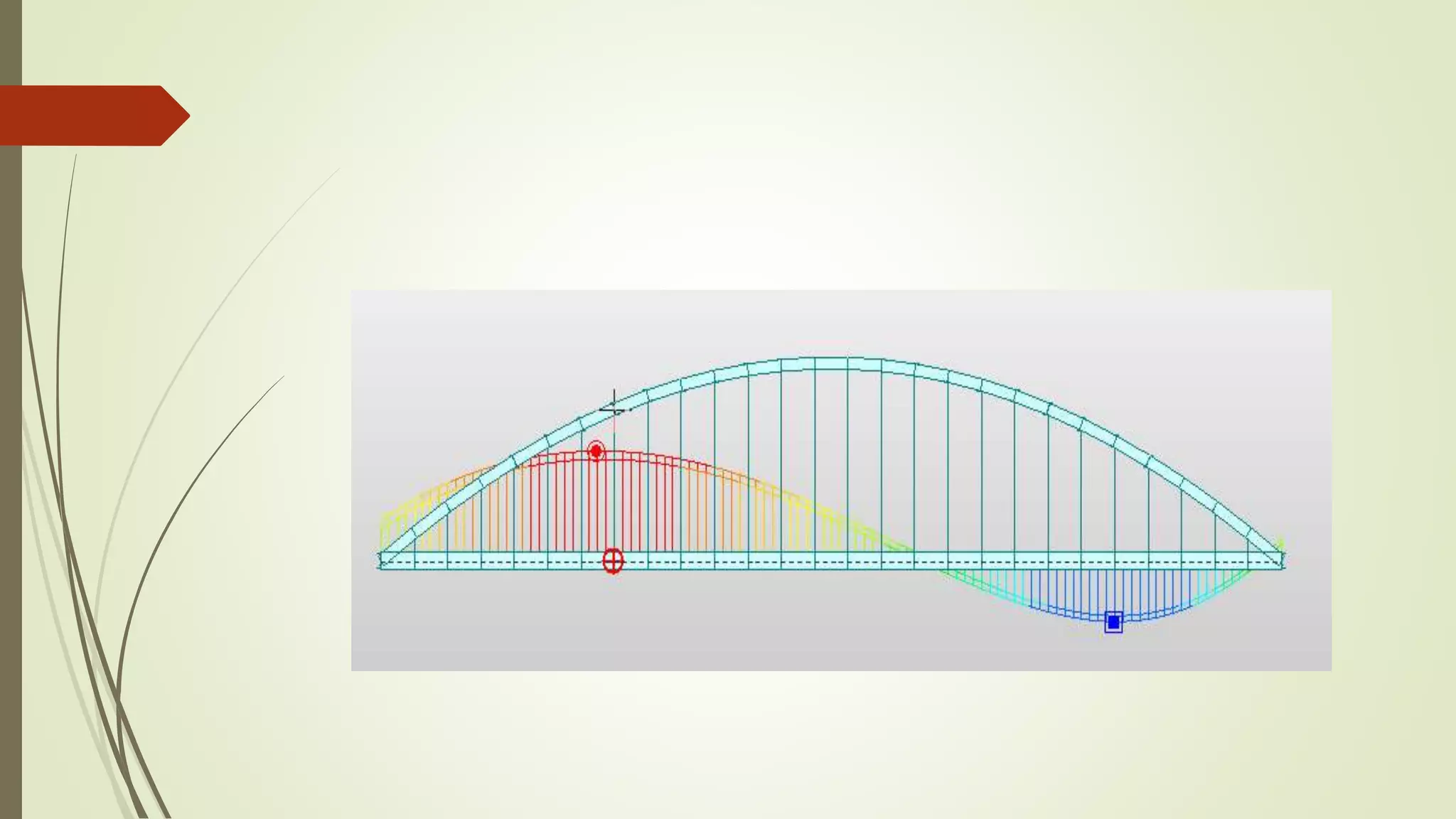
Influence line diagram of 
Model arch bridge
INTRODUCTION 
The Lupu Bridge is located in Shanghai, China. It is currently the seventh 
crossing to be constructed over the Huangpu River in the city. The bridge is 
located in the south of the city with the aim to ease congestion in the quickly 
developing areas around the southern side of the river and the city centre and 
also to help with the increasing traffic expected at the 2010 world Expo. The 
venue for this is set to be surrounding the river at the location of the bridge, so 
it will not only be a vital part of the infrastructure for this event, it will also act as 
a showpiece for Chinese engineering.The bridge was officially opened in June 
2003 at a total cost of $302 Million US. On completion the Lupu Bridge was the 
largest spanning arch bridge in the world with a main span of 550m overtaking 
the New River Gorge Bridge in the United States by 32m. This record is set to be 
broken in 2008 by the under construction Chaotianmen Bridge in China by 
only 2m.
The total length of the bridge is 3,900m including the approach bridges on 
either side of the river. The bridge was originally heavily criticized as it was seen 
as wasteful by many people in respect to the type of bridge that was actually 
needed for the project. Many feel that it is just a show piece for the city and 
the price tag reflected that status. Other designs were proposed that would 
have been more economical but were rejected in favor of the tied arch 
design. The Lupu Bridge is a steel box section through tied arch bridge. The 
central span of the deck is suspended from two sets of 28 double cables 
attached to the two inclined arches. The ground conditions on either side of 
the bridge are not suitable for the large thrusts that would be caused by a 
normal arch bridge and this is what lead to the decision of using a through 
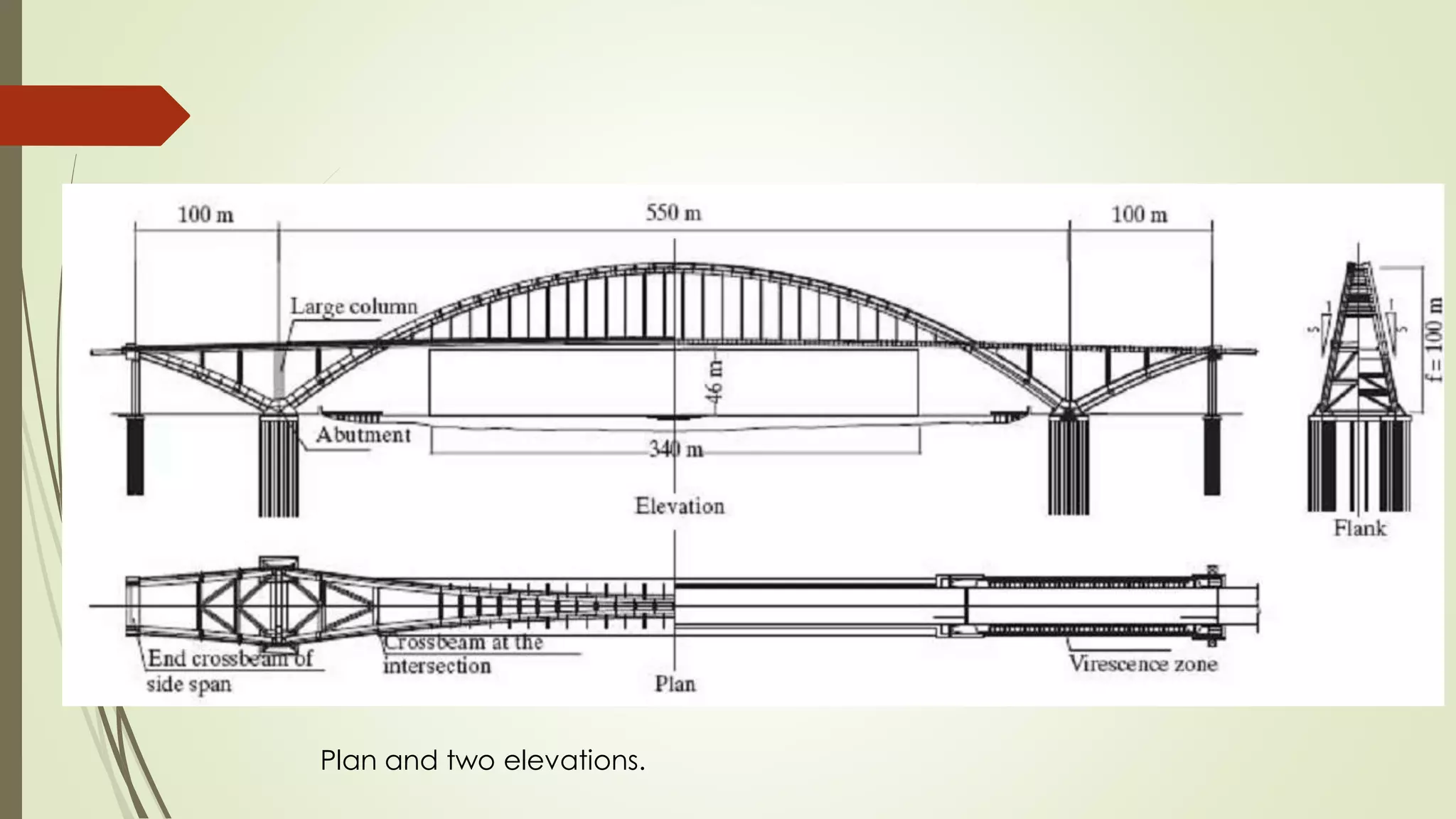
tied arch which will be discussed further later in this paper. Below are two 
elevations of the bridge, the side profile and a view looking longitudinally 
along the deck.
Plan and two elevations.
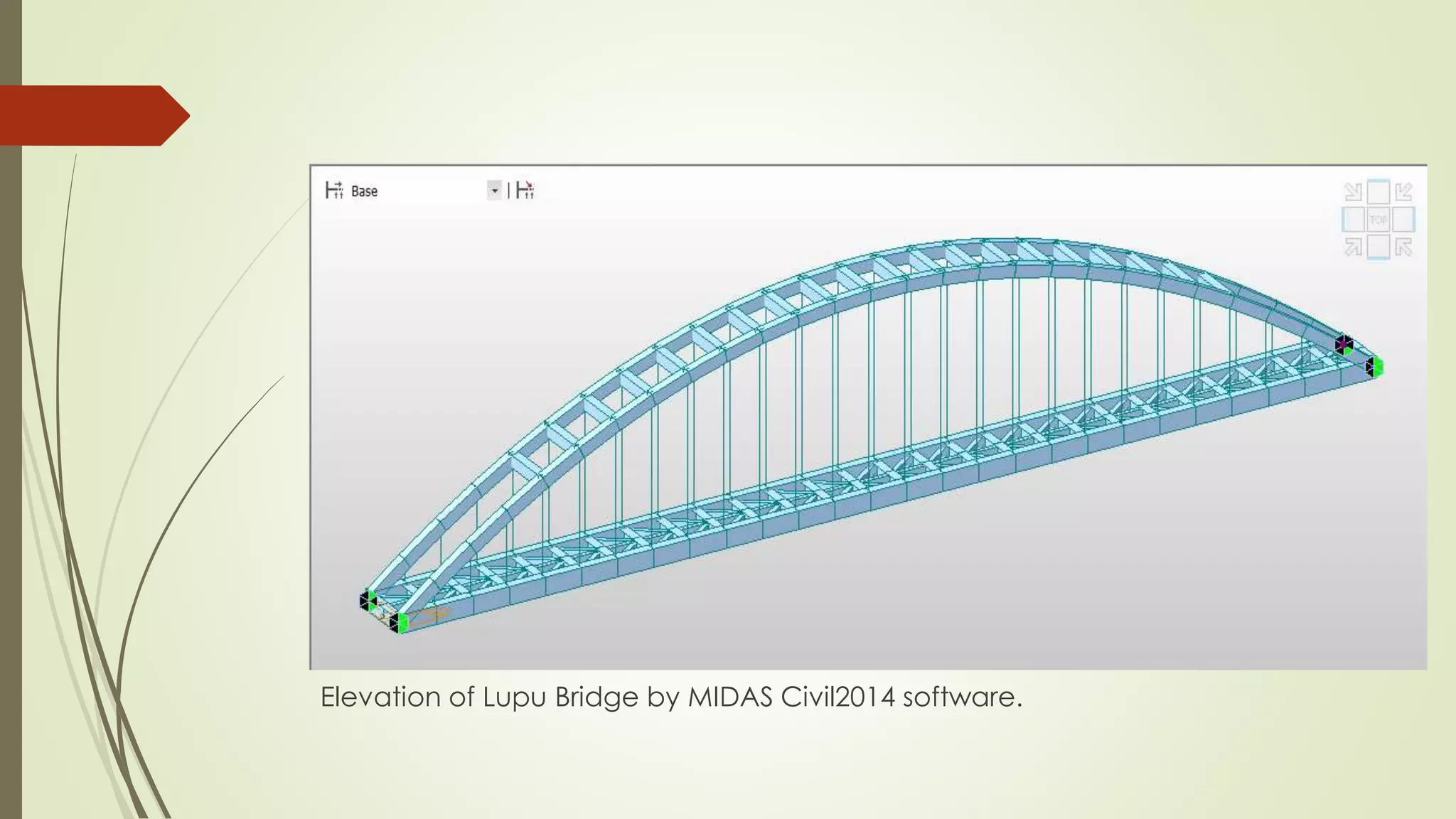
Elevation of Lupu Bridge by MIDAS Civil2014 software.
Working of Tied Arch Bridge 
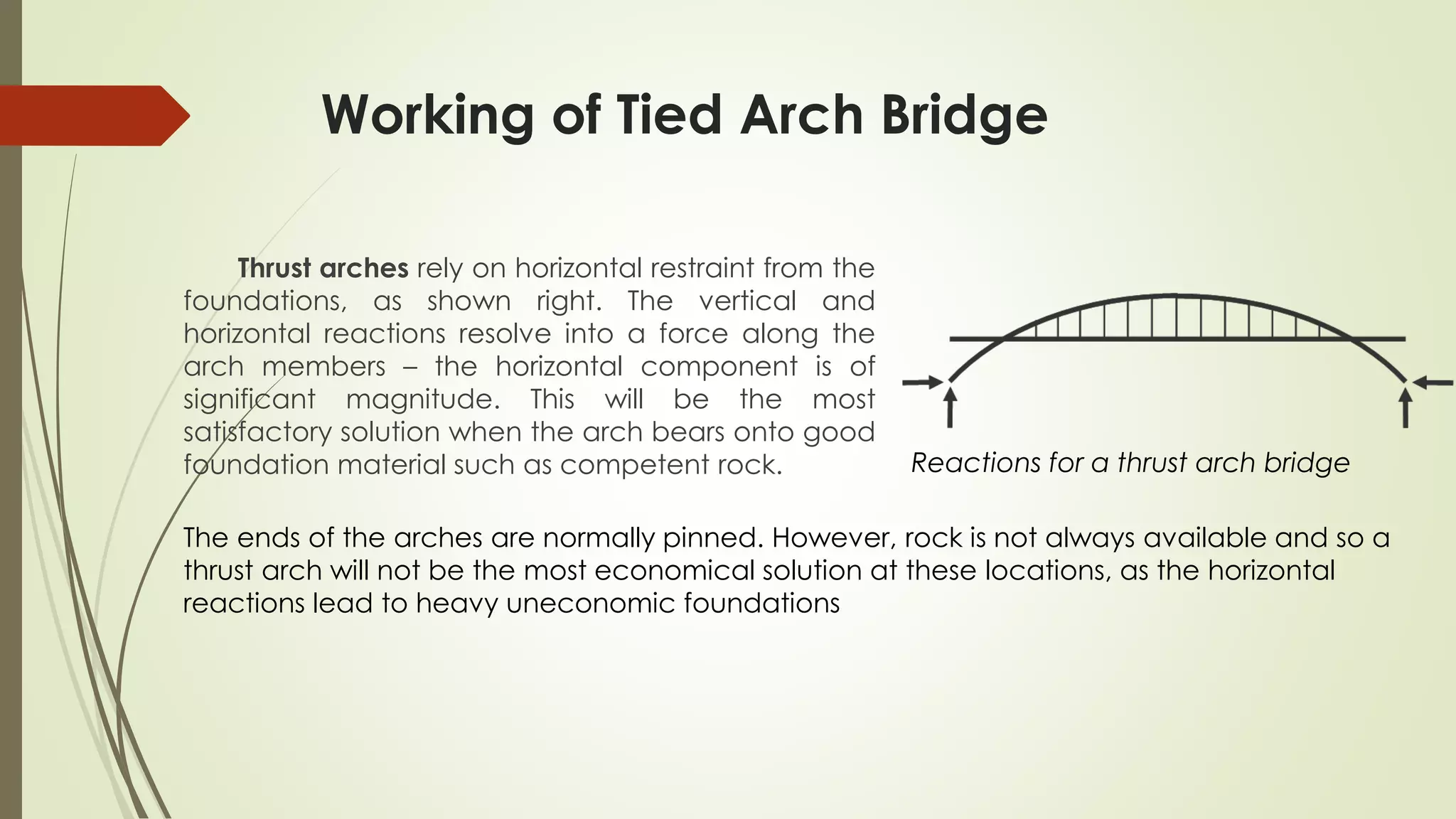
Thrust arches rely on horizontal restraint from the 
foundations, as shown right. The vertical and 
horizontal reactions resolve into a force along the 
arch members – the horizontal component is of 
significant magnitude. This will be the most 
satisfactory solution when the arch bears onto good 
foundation material such as competent rock. 
Reactions for a thrust arch bridge 
The ends of the arches are normally pinned. However, rock is not always available and so a 
thrust arch will not be the most economical solution at these locations, as the horizontal 
reactions lead to heavy uneconomic foundations
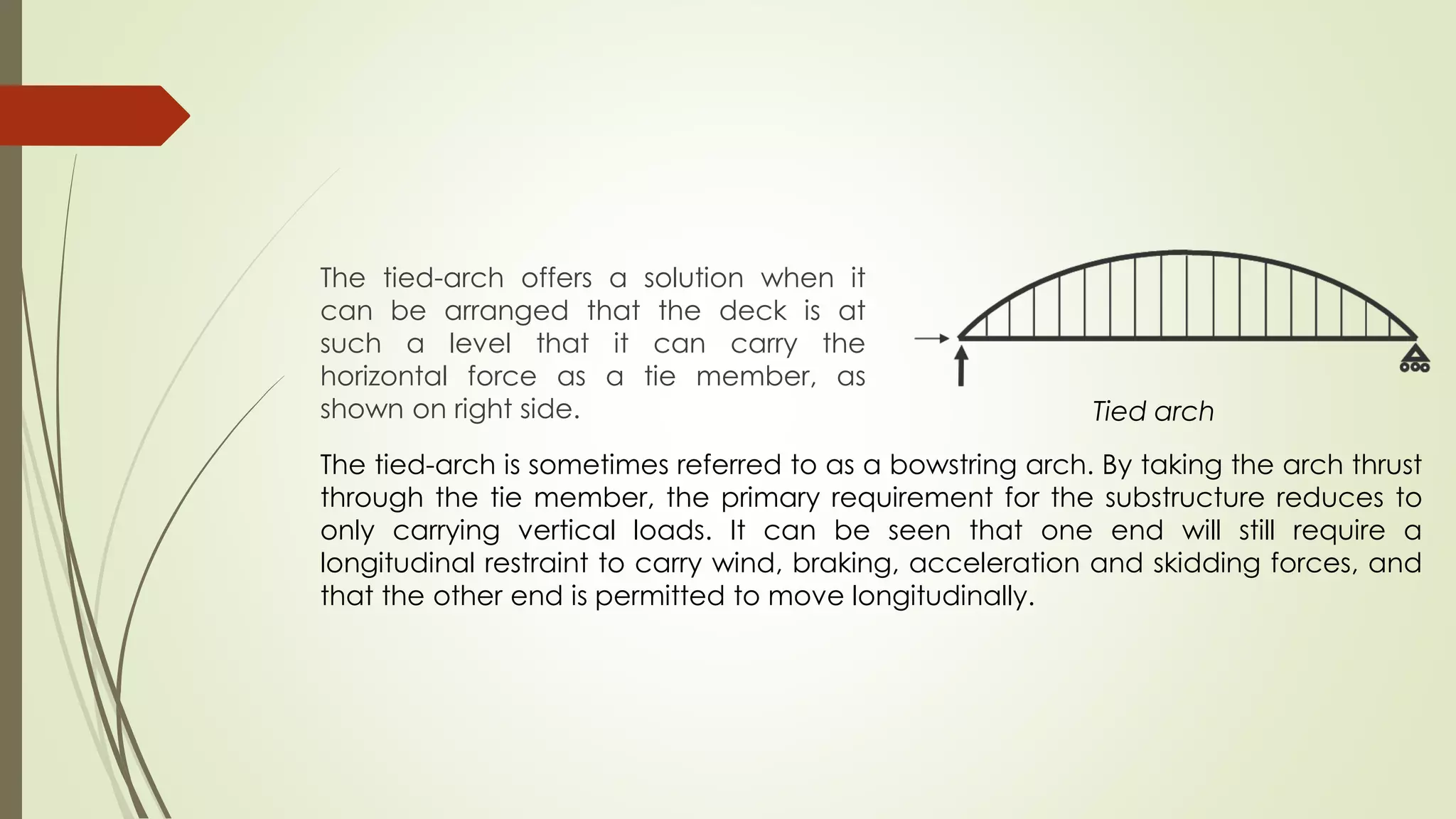
The tied-arch offers a solution when it 
can be arranged that the deck is at 
such a level that it can carry the 
horizontal force as a tie member, as 
shown on right side. 
Tied arch 
The tied-arch is sometimes referred to as a bowstring arch. By taking the arch thrust 
through the tie member, the primary requirement for the substructure reduces to 
only carrying vertical loads. It can be seen that one end will still require a 
longitudinal restraint to carry wind, braking, acceleration and skidding forces, and 
that the other end is permitted to move longitudinally.
Overall structural behaviour 
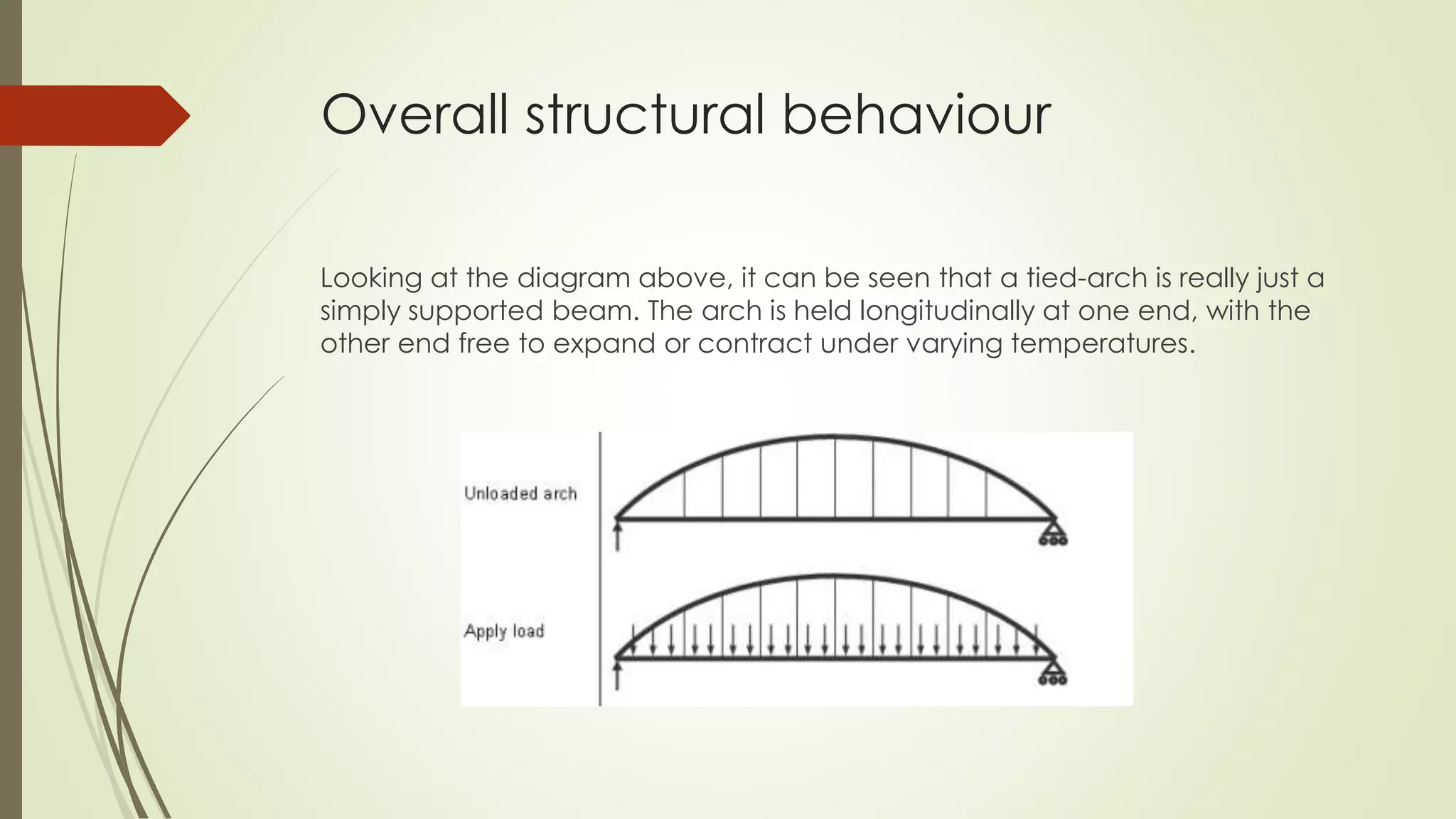
Looking at the diagram above, it can be seen that a tied-arch is really just a 
simply supported beam. The arch is held longitudinally at one end, with the 
other end free to expand or contract under varying temperatures.
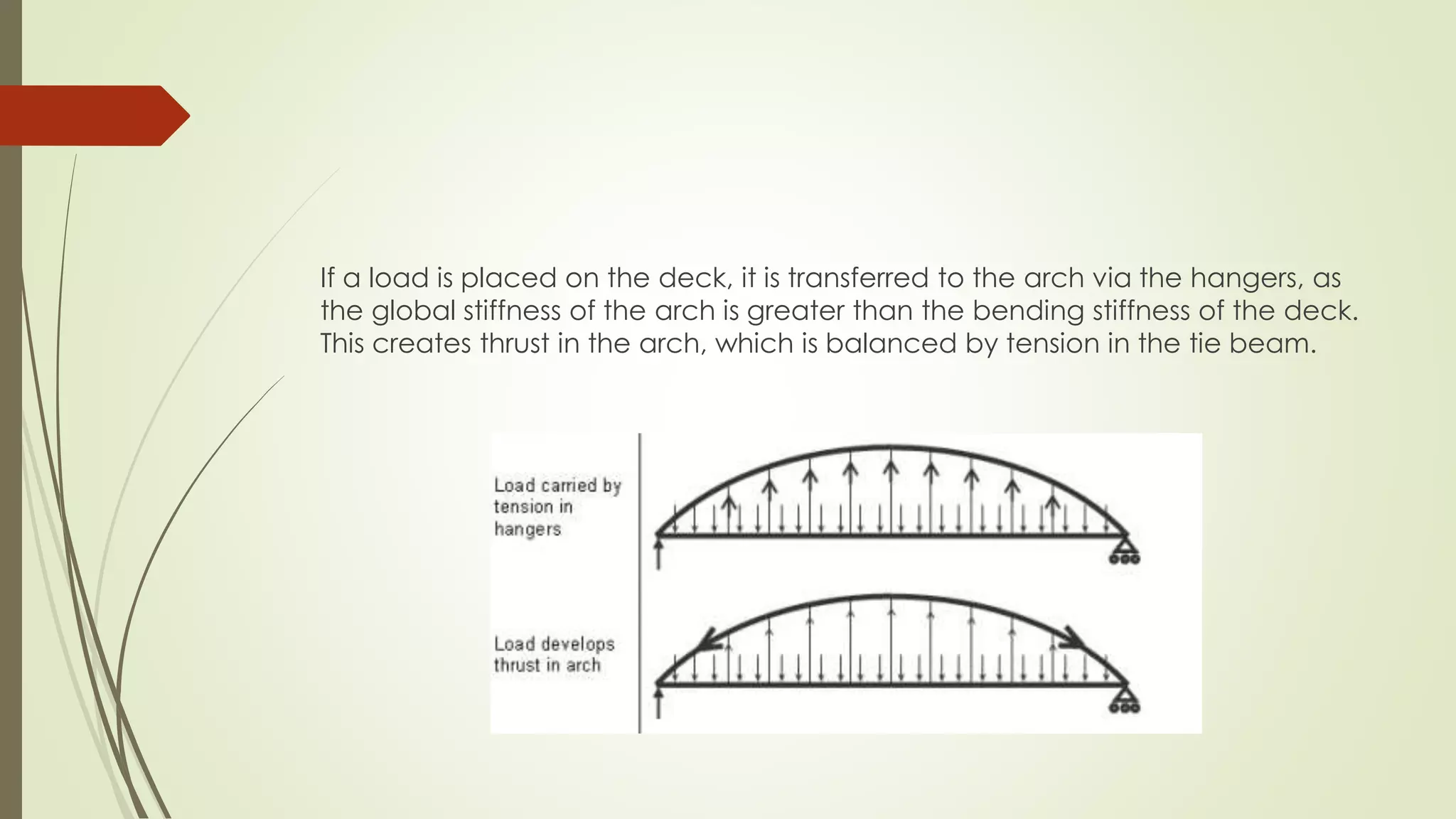
If a load is placed on the deck, it is transferred to the arch via the hangers, as 
the global stiffness of the arch is greater than the bending stiffness of the deck. 
This creates thrust in the arch, which is balanced by tension in the tie beam.
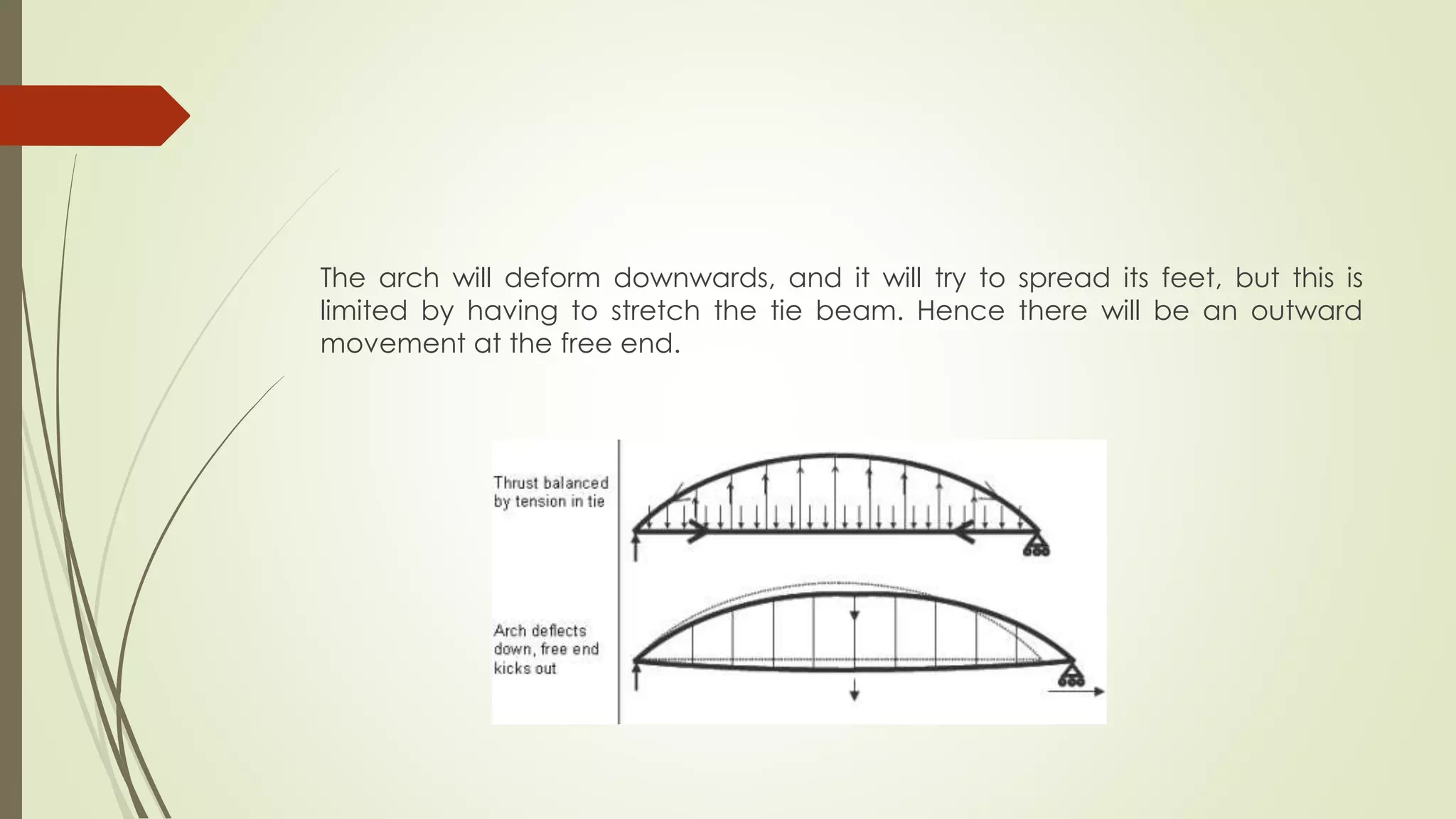
The arch will deform downwards, and it will try to spread its feet, but this is 
limited by having to stretch the tie beam. Hence there will be an outward 
movement at the free end.
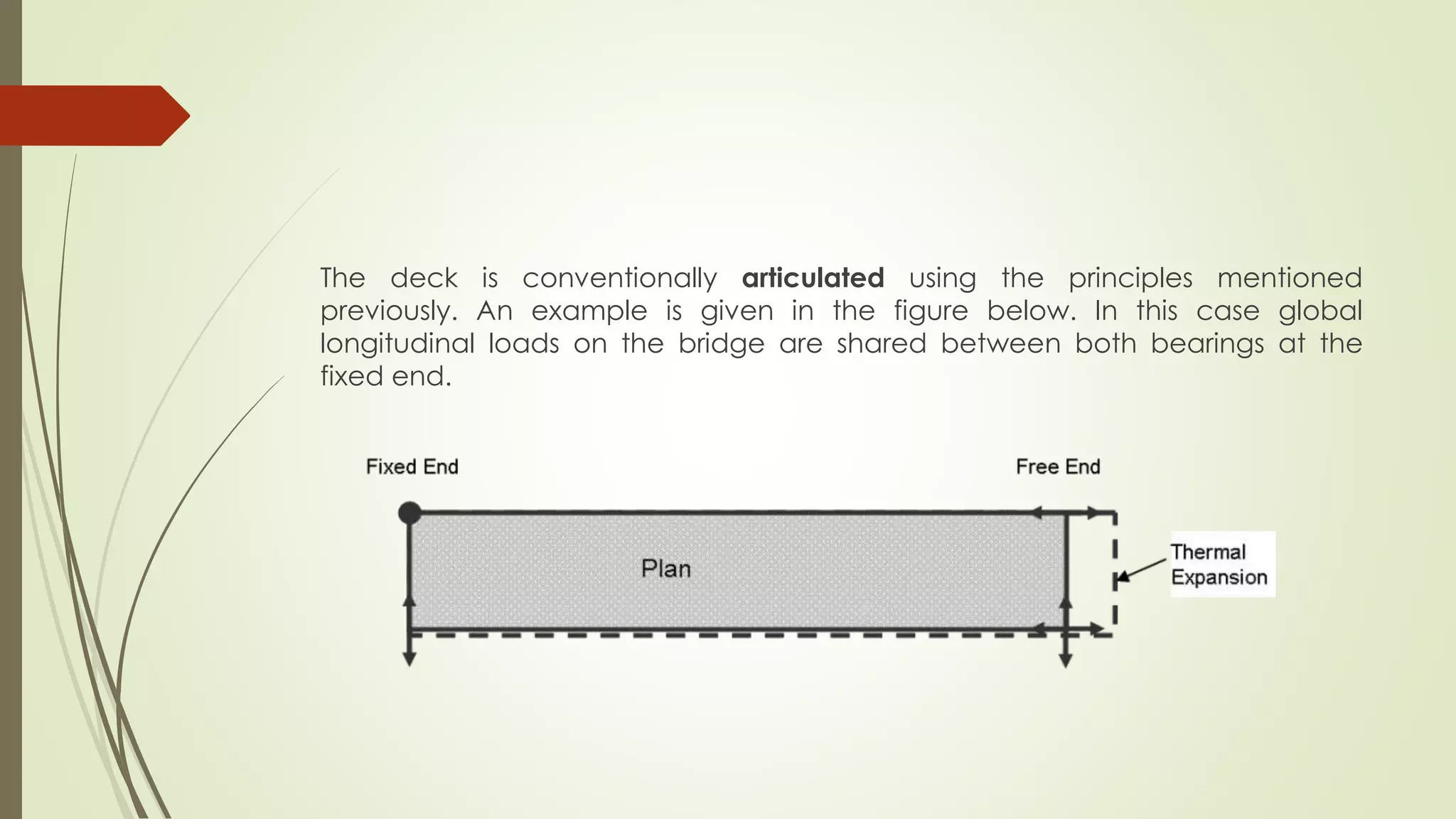
The deck is conventionally articulated using the principles mentioned 
previously. An example is given in the figure below. In this case global 
longitudinal loads on the bridge are shared between both bearings at the 
fixed end.
Components and choice of materials 
The arch is primarily a compression member and so a closed box section 
will be the most efficient. Steel S355 national standard has been used in the 
sections. There is a choice of whether the arch should be stiffened 
longitudinally or not. The balance to be considered is one between the loss of 
efficiency when using ‘thin’ plates (b/t >24), and the additional fabrication 
cost of stiffened panels. To minimize future internal maintenance, arches are 
frequently fabricated from weathering steel, painting the exterior, but leaving 
the interior unpainted. 
Bracing between the arches can take a number of forms, and can even be 
omitted in small to medium spans. Tubes are commonly used, and are 
generally too small for man access. They can either be sealed, or vented into 
the arch boxes with provision for drainage. Note that hot rolled hollow 
sections are not available in weathering steel.
Hangers 
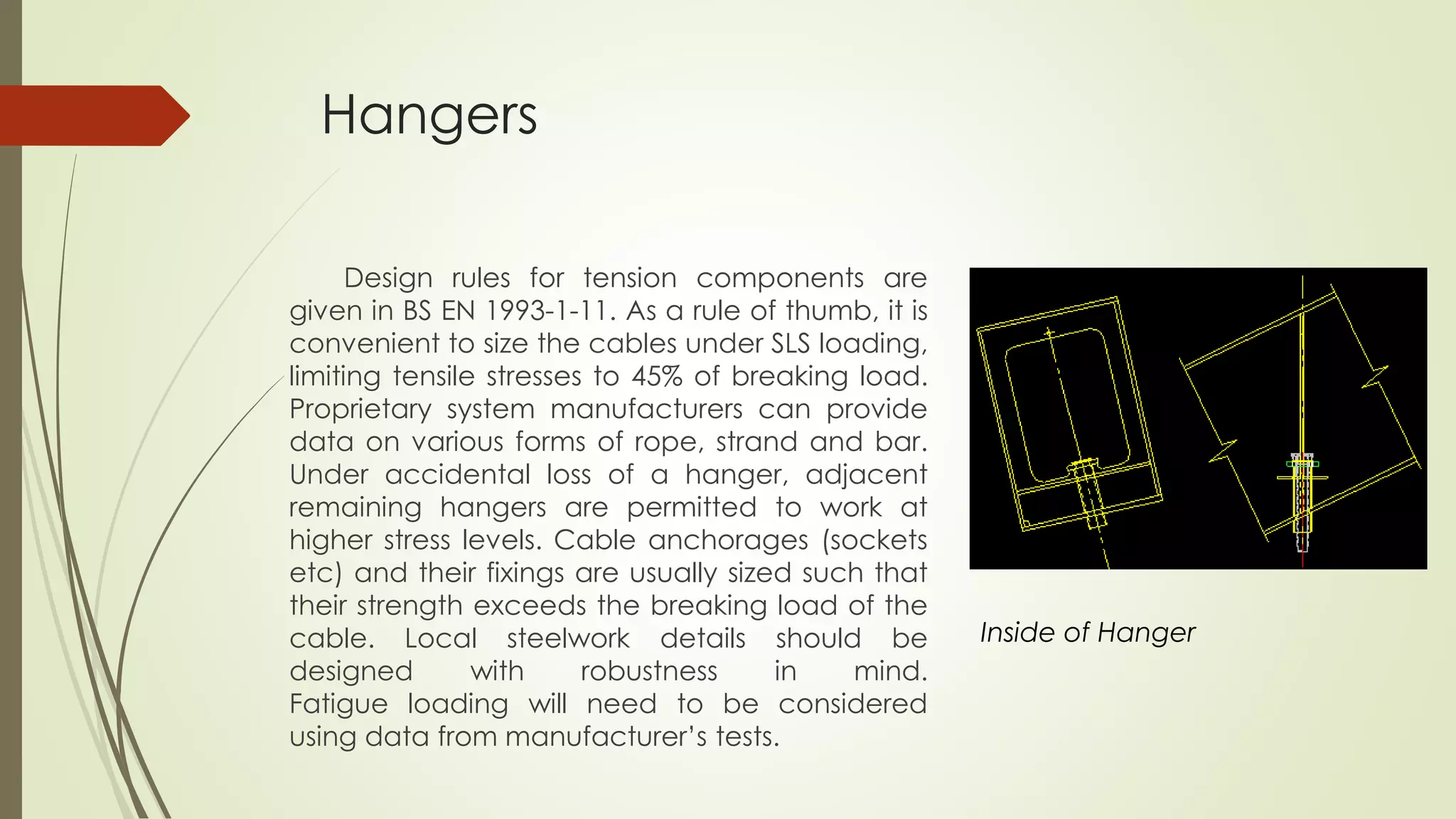
Design rules for tension components are 
given in BS EN 1993-1-11. As a rule of thumb, it is 
convenient to size the cables under SLS loading, 
limiting tensile stresses to 45% of breaking load. 
Proprietary system manufacturers can provide 
data on various forms of rope, strand and bar. 
Under accidental loss of a hanger, adjacent 
remaining hangers are permitted to work at 
higher stress levels. Cable anchorages (sockets 
etc) and their fixings are usually sized such that 
their strength exceeds the breaking load of the 
cable. Local steelwork details should be 
designed with robustness in mind. 
Fatigue loading will need to be considered 
using data from manufacturer’s tests. 
Inside of Hanger
 Hangers can be either terminated inside the arch or below it. This is a 
preference decision as there are pros and cons for both. 
Internal connections will be neatest, but requires installation and 
subsequent inspection and maintenance inside a confined space 
(assuming it is large enough to enter). External connections will require 
specialist access equipment such as cherry pickers, use of which may 
involve unacceptable disruption to traffic. 
 Hangers must be adjustable to allow for geometrical tolerances between 
arch and tie, and for initial stressing and subsequent adjustment. Allowance 
may need to be made for space to accommodate, and reactions from, 
jacking equipment.
Loading 
 Dead load effects will normally comprise a large proportion of the design 
stresses for main elements, and it becomes very important to allow fully for 
the erection method. This particularly applies to bending in the arch; for the 
tie beam, the locked in bending moment can be controlled by adjusting 
the hanger lengths. 
 The application of traffic load is straightforward, but there will be a variety 
of loaded lengths and positions of tandem axles and special vehicles must 
be chosen to suit the influence lines.
Aerodynamic instabilities are unlikely to be a problem due to the inherent 
stiffness and high natural frequency of the arch. However, for longer spans 
and when in doubt, wind tunnel tests should be considered. Depending on the 
type and nature of barriers between the highway and hangers, it may be 
necessary to design the bridge for the accidental loss of a hanger. The 
criterion is to prevent progressive collapse of the whole span. This is an 
accidental design situation and thus is normally considered with characteristic 
values of permanent and variable loads. However, it will be necessary to allow 
for the routine replacement of hangers. As this will be a planned action, it is 
usually possible to reduce traffic load for this transient design situation through 
traffic management (e.g. no abnormal loads, contraflow on opposite 
carriageway).
Material and Section properties 
 Material used – Steel S355 national standard section : 
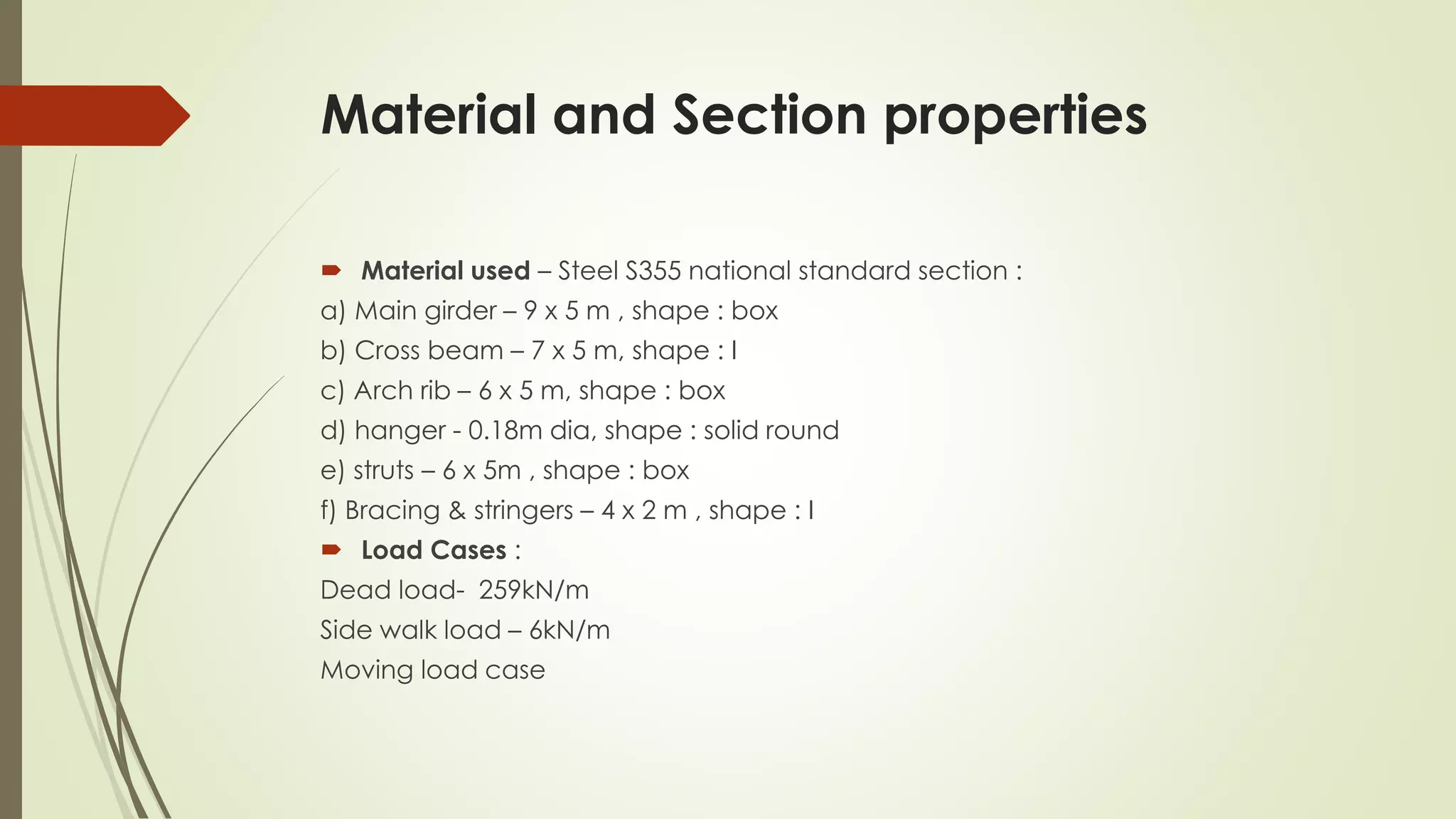
a) Main girder – 9 x 5 m , shape : box 
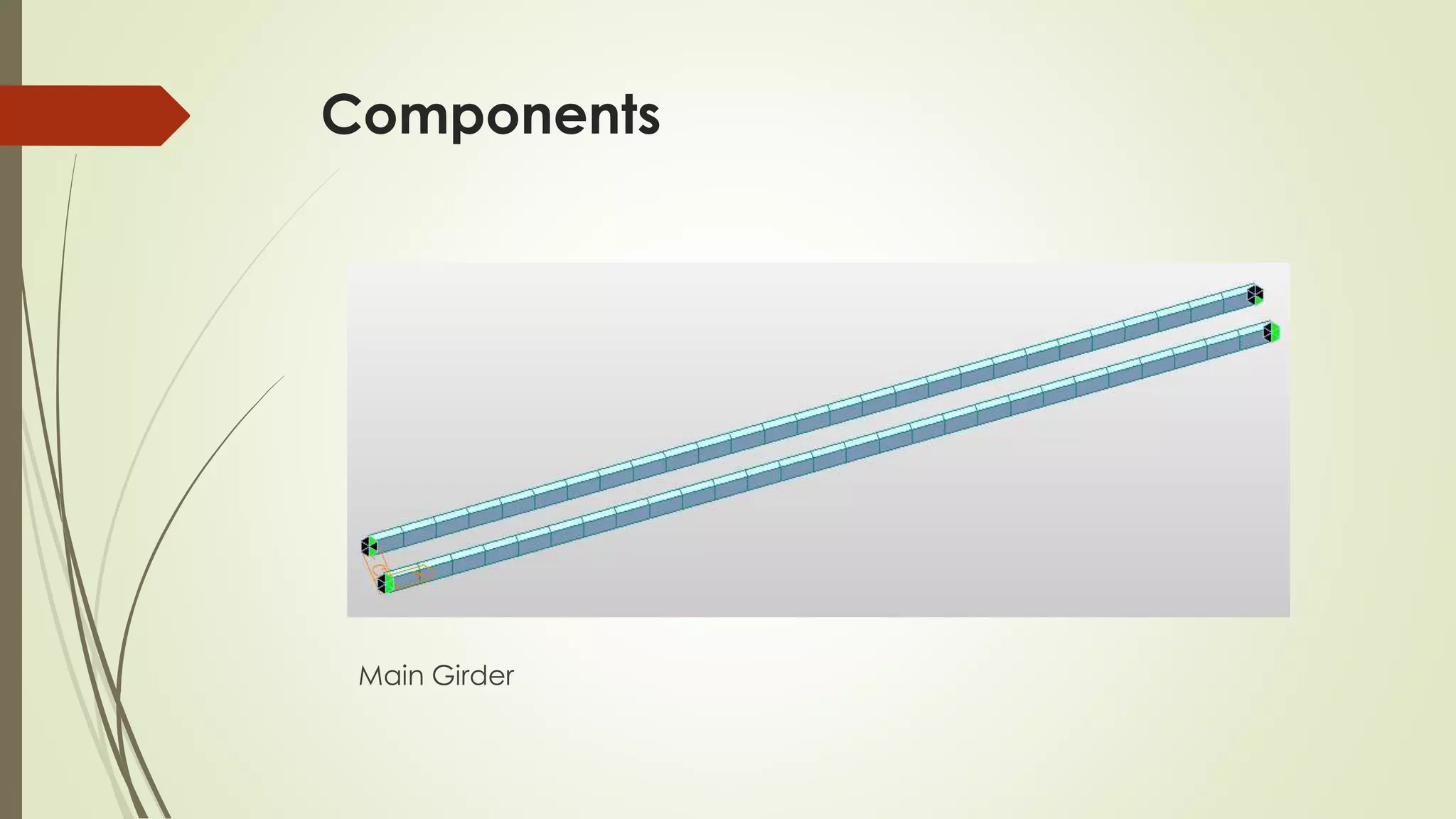
b) Cross beam – 7 x 5 m, shape : I 
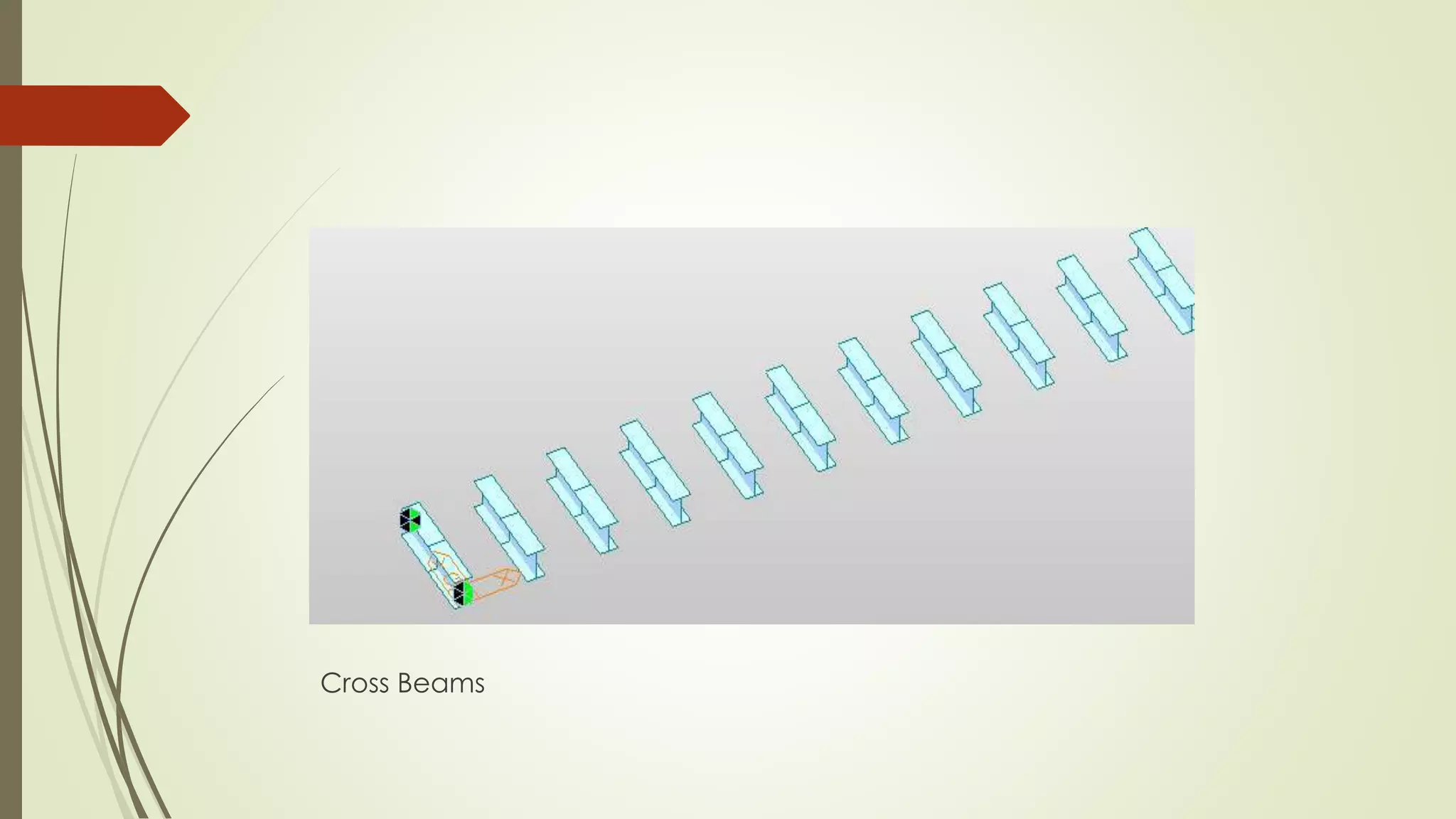
c) Arch rib – 6 x 5 m, shape : box 
d) hanger - 0.18m dia, shape : solid round 
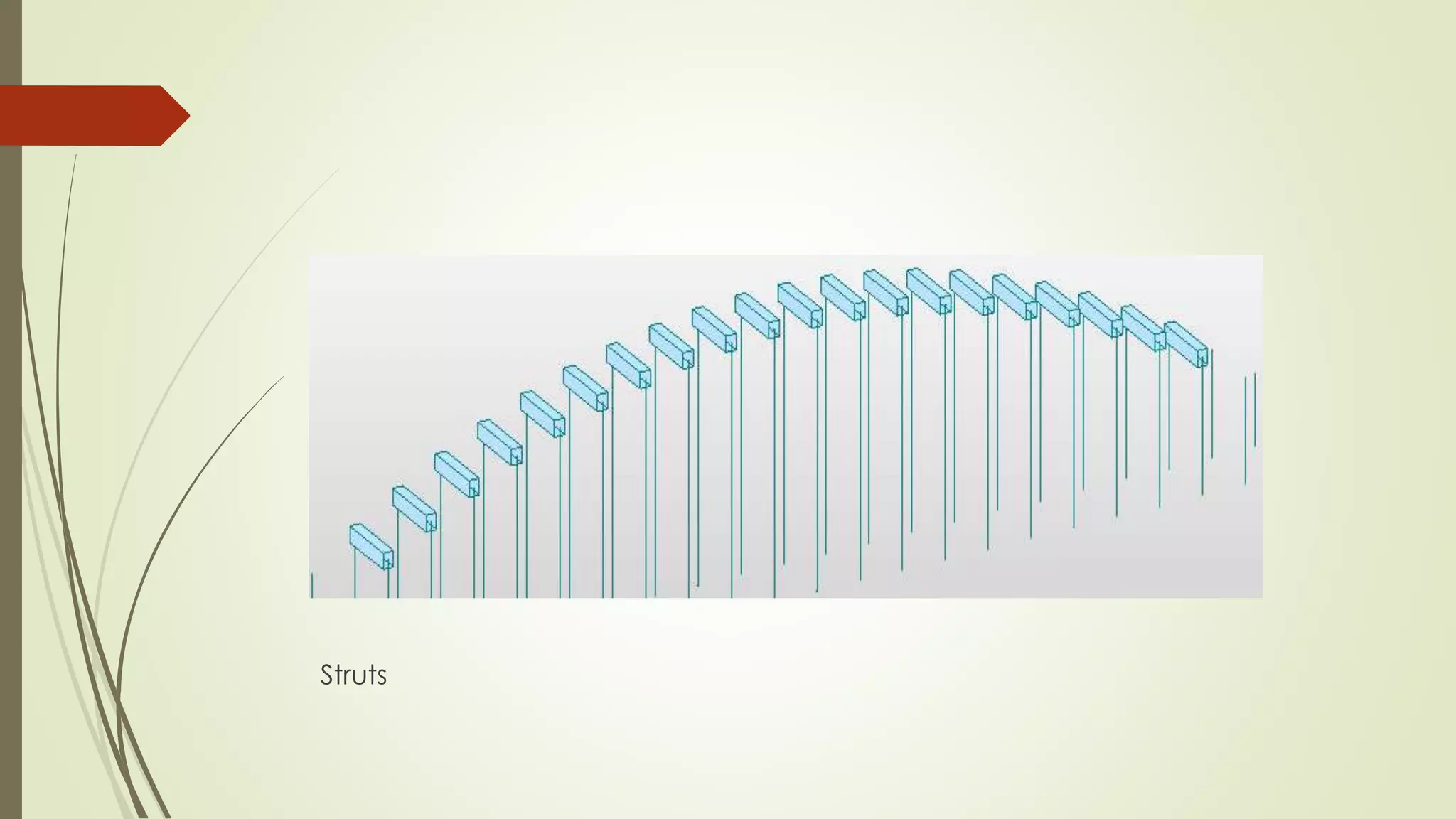
e) struts – 6 x 5m , shape : box 
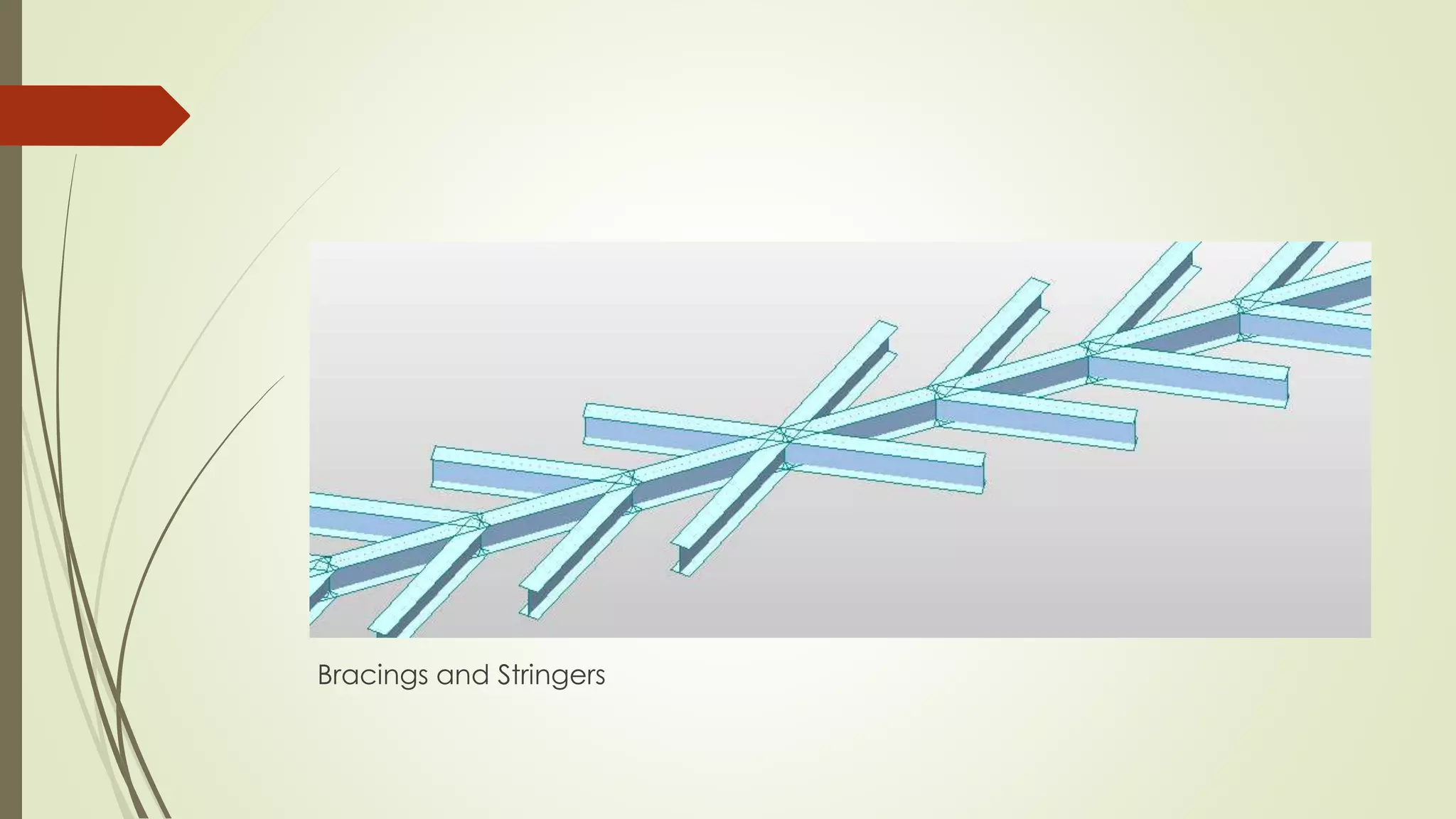
f) Bracing & stringers – 4 x 2 m , shape : I 
 Load Cases : 
Dead load- 259kN/m 
Side walk load – 6kN/m 
Moving load case
Components 
Main Girder
Cross Beams
Arch Rib and Hangers
Struts
Bracings and Stringers
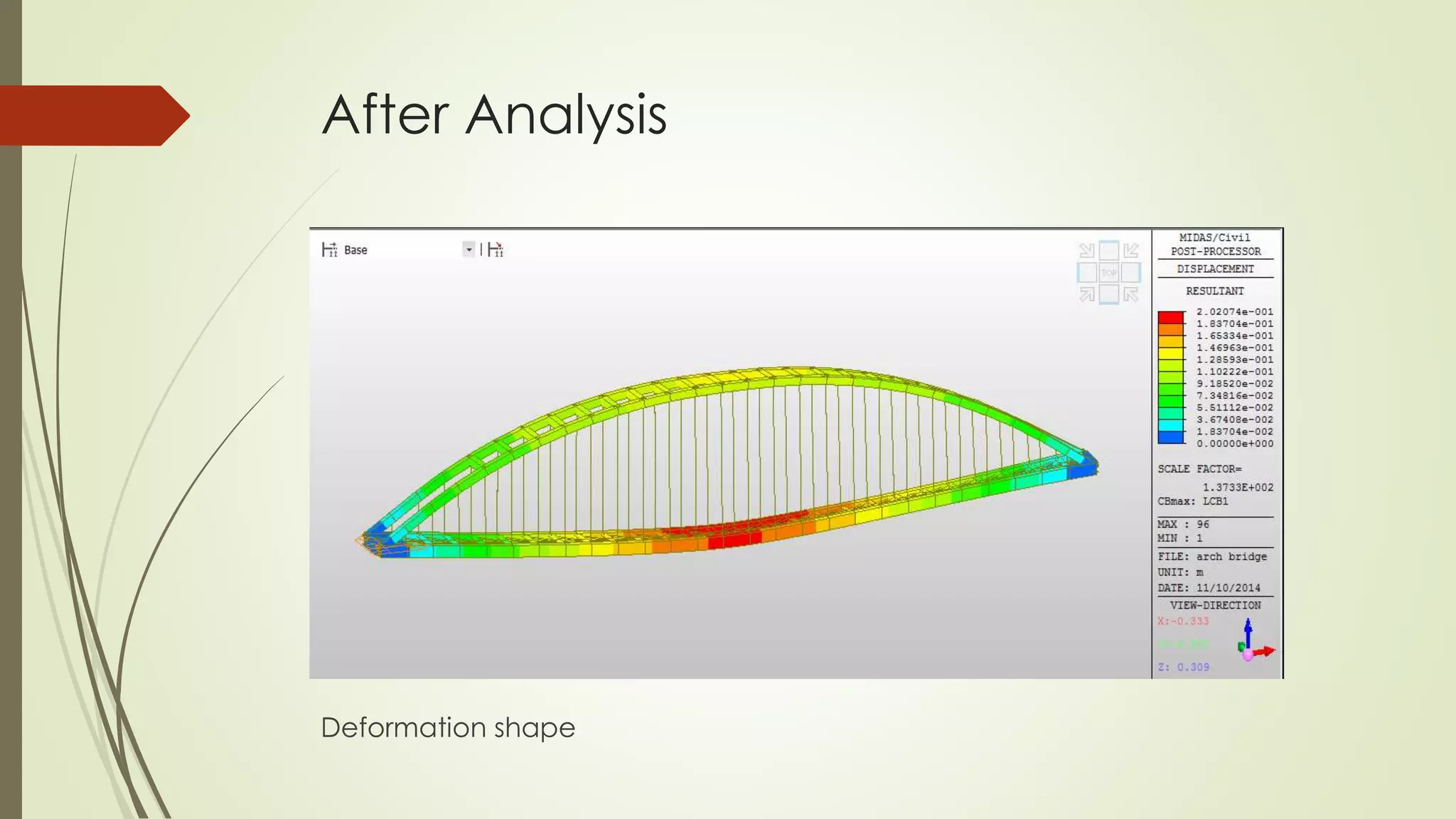
After Analysis 
Deformation shape
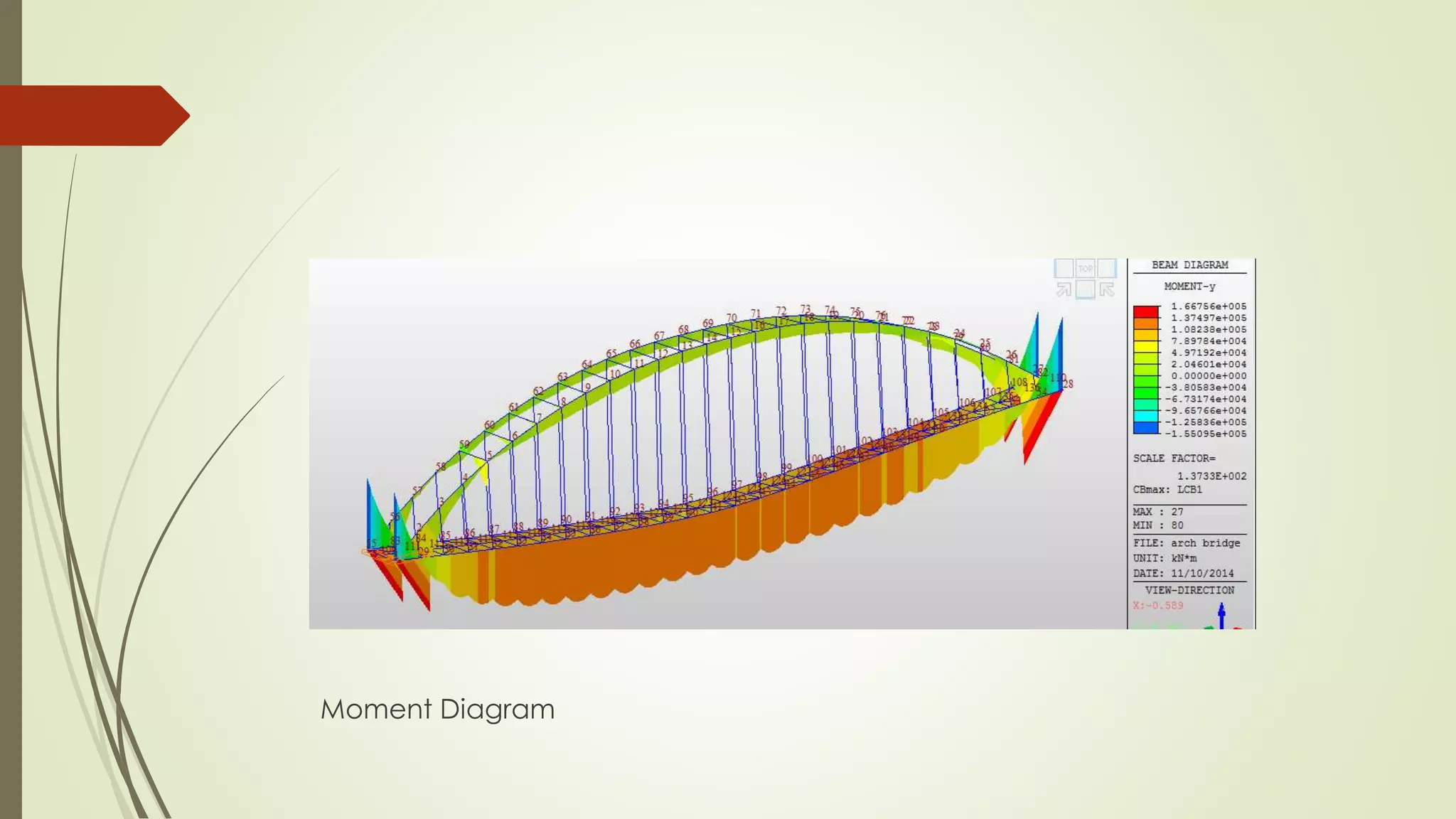
Moment Diagram
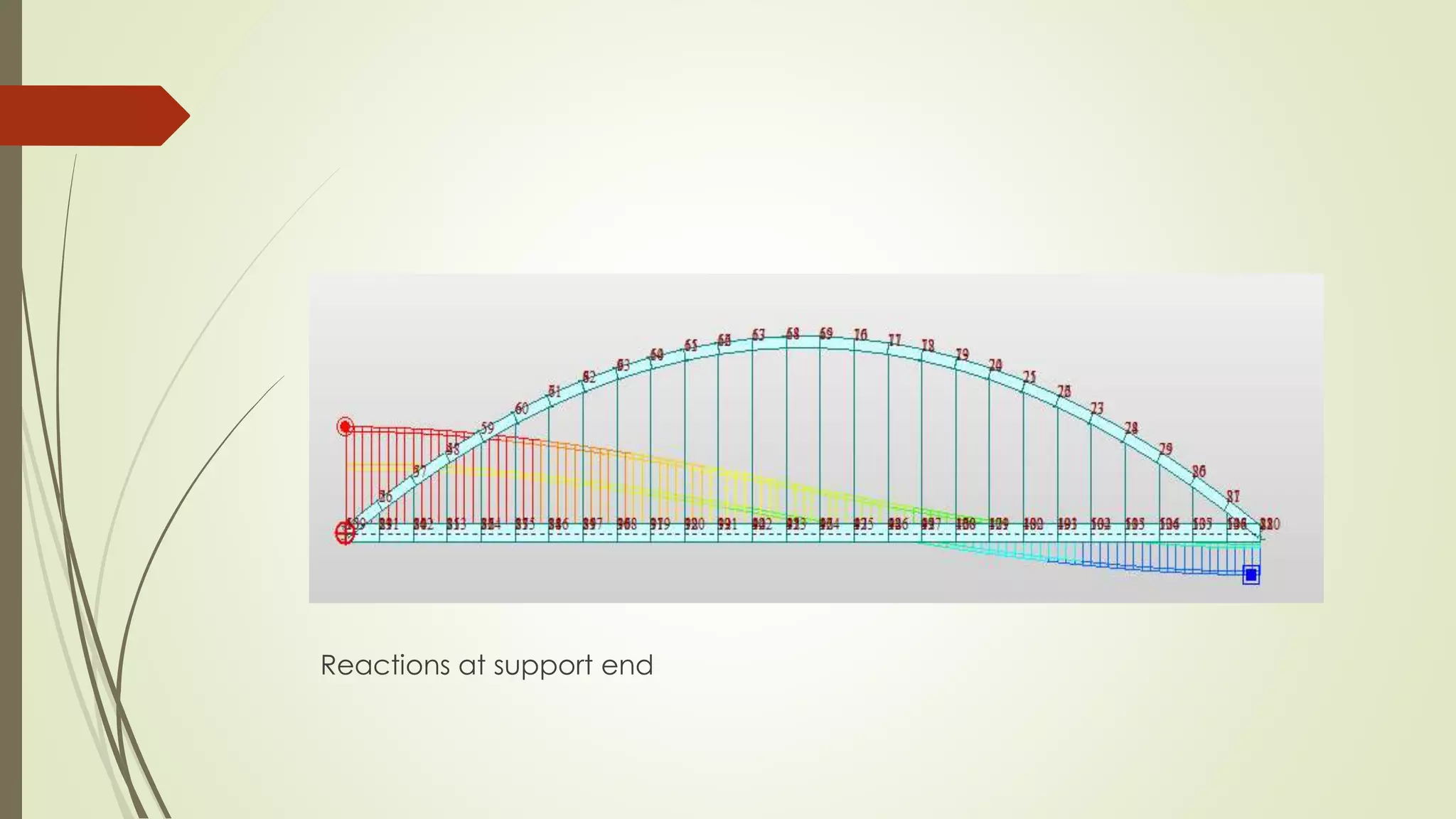
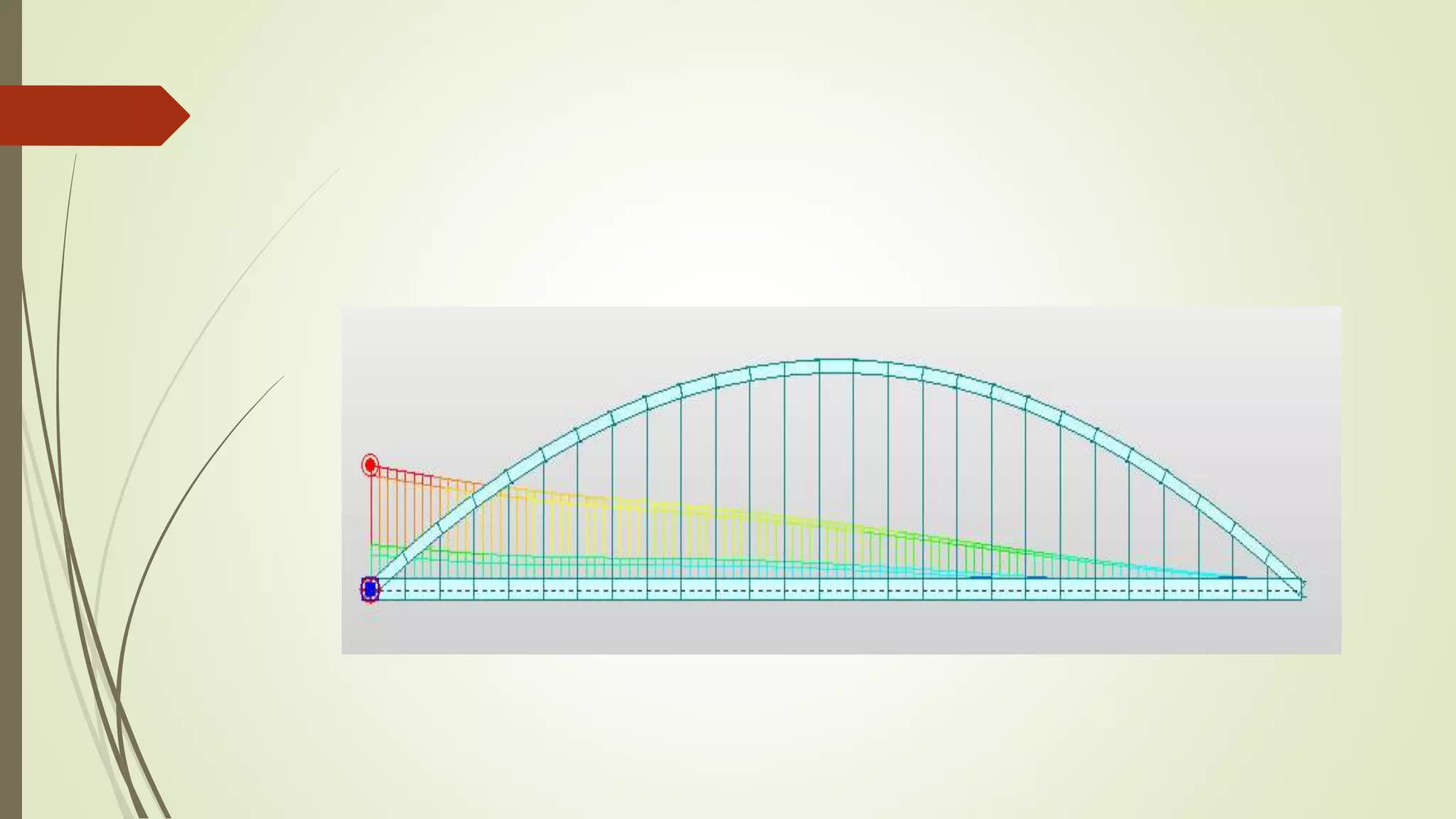
Reactions at support end
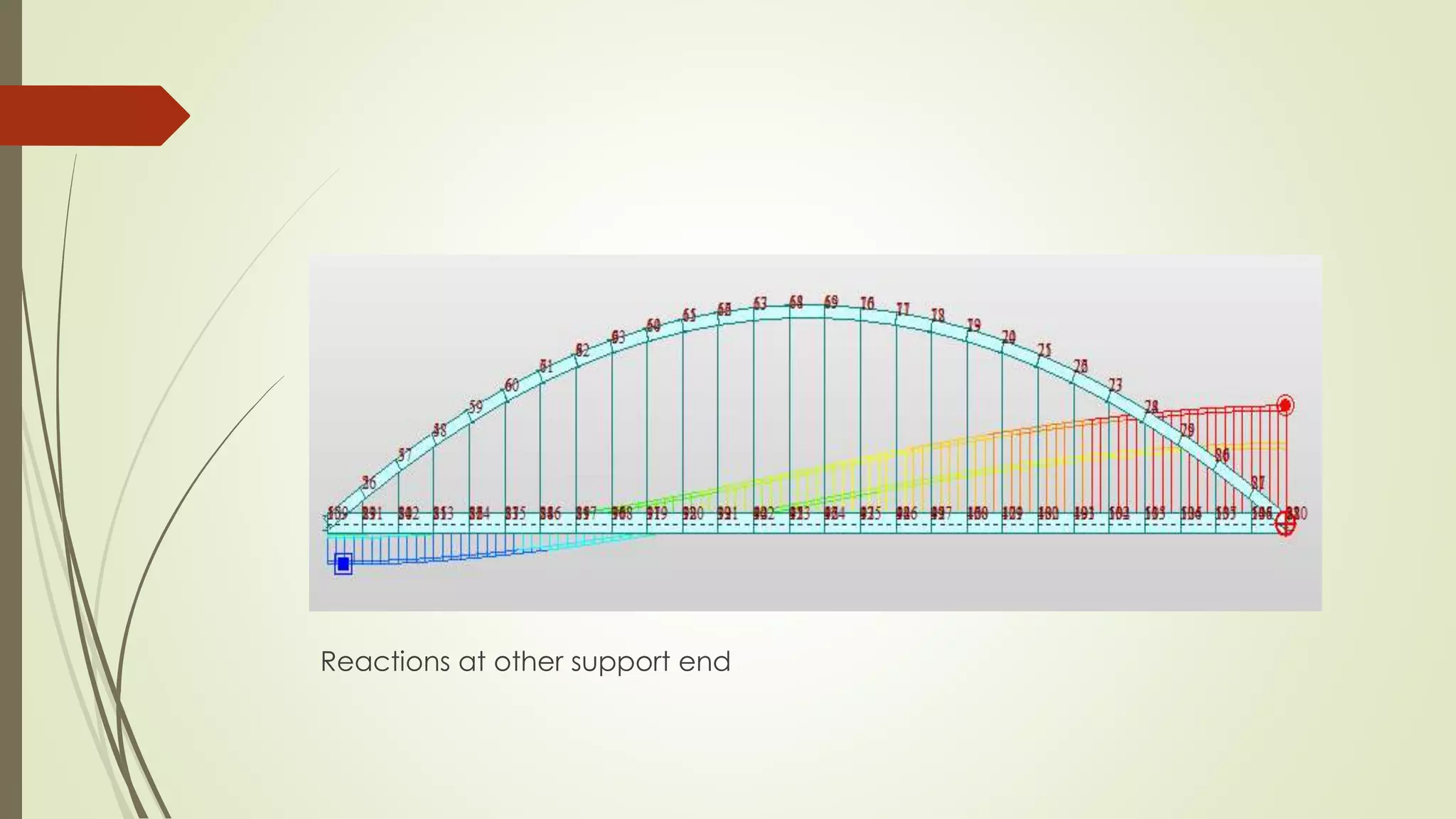
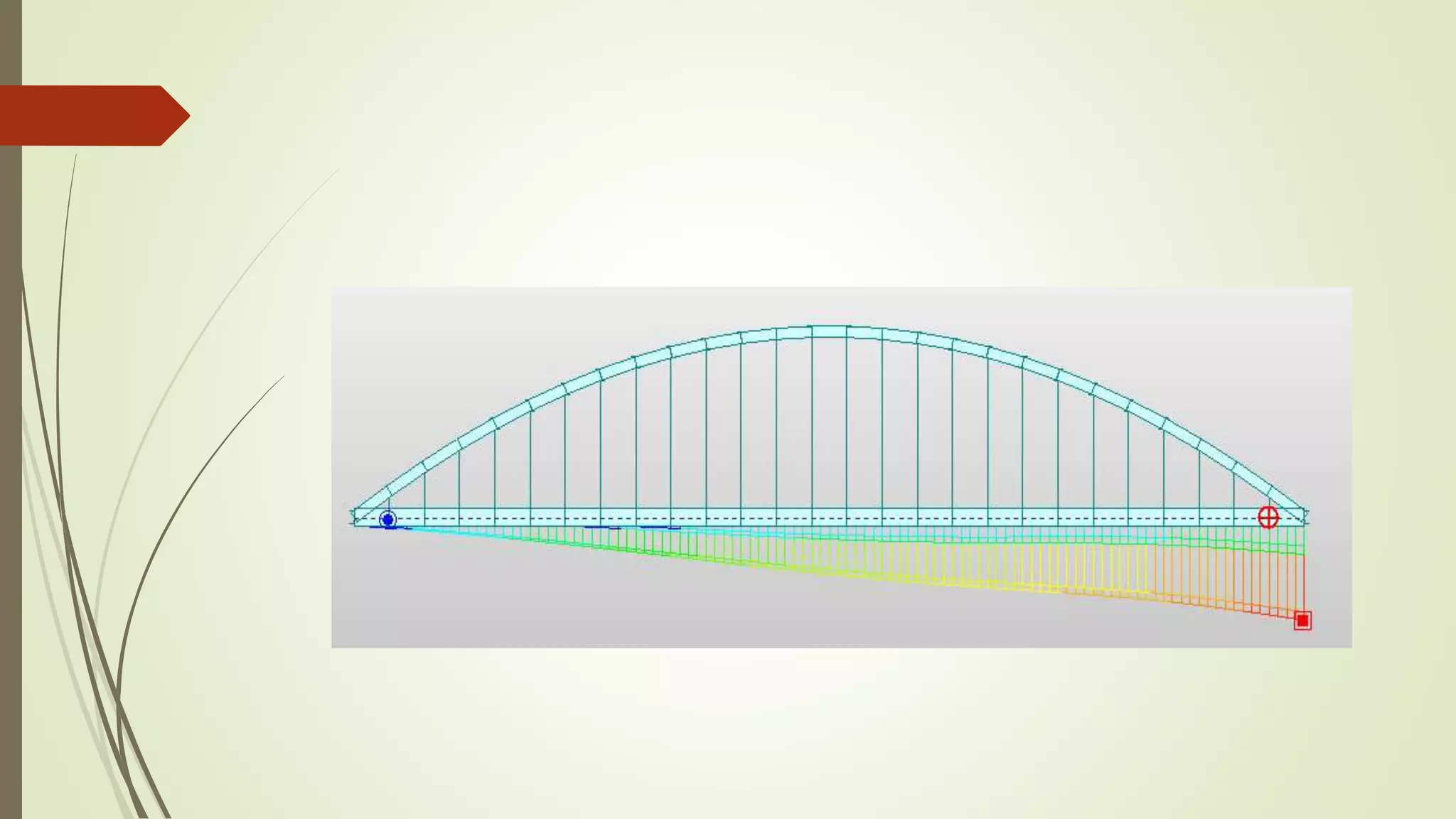
Reactions at other support end
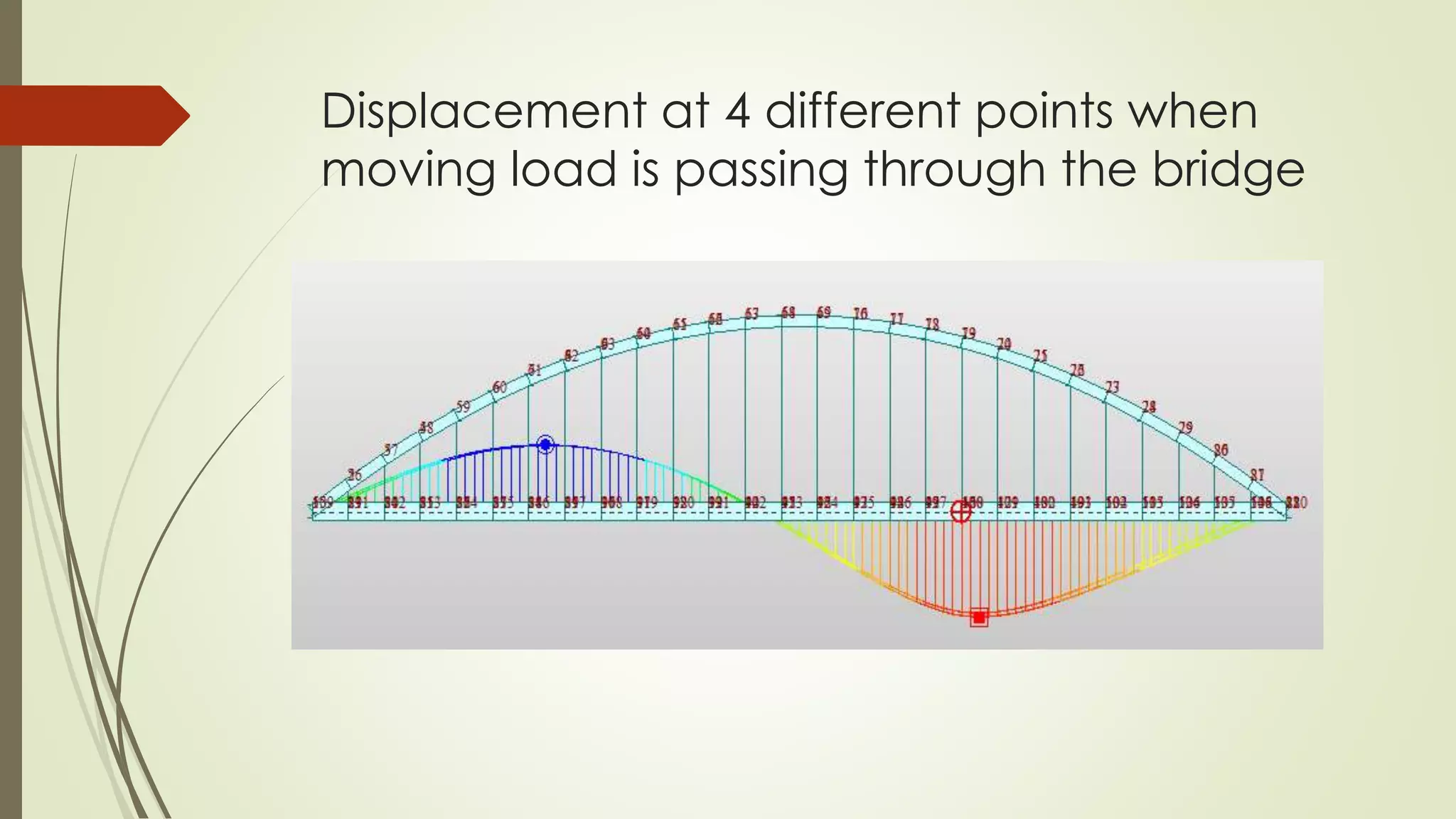
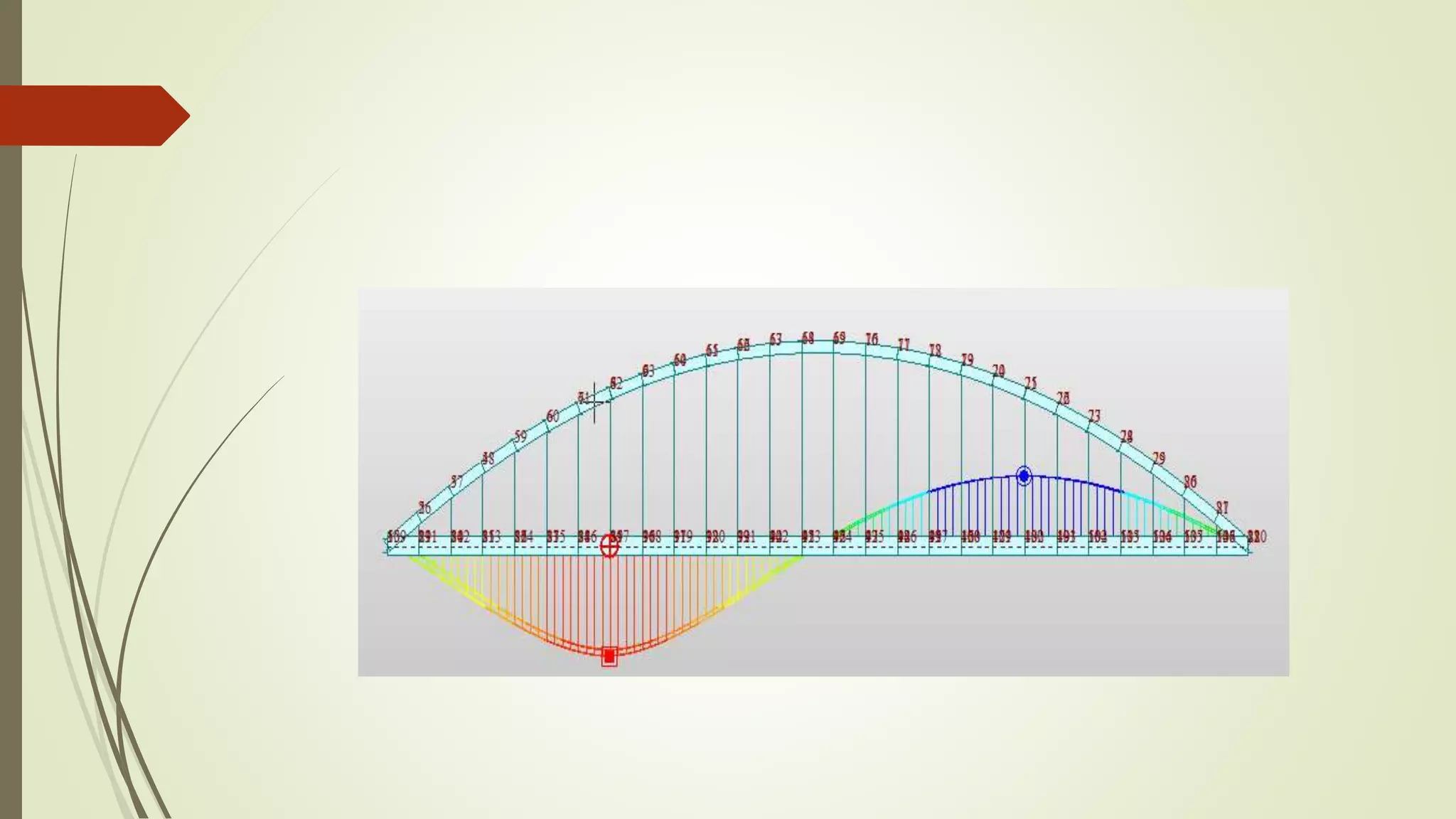
Displacement at 4 different points when 
moving load is passing through the bridge
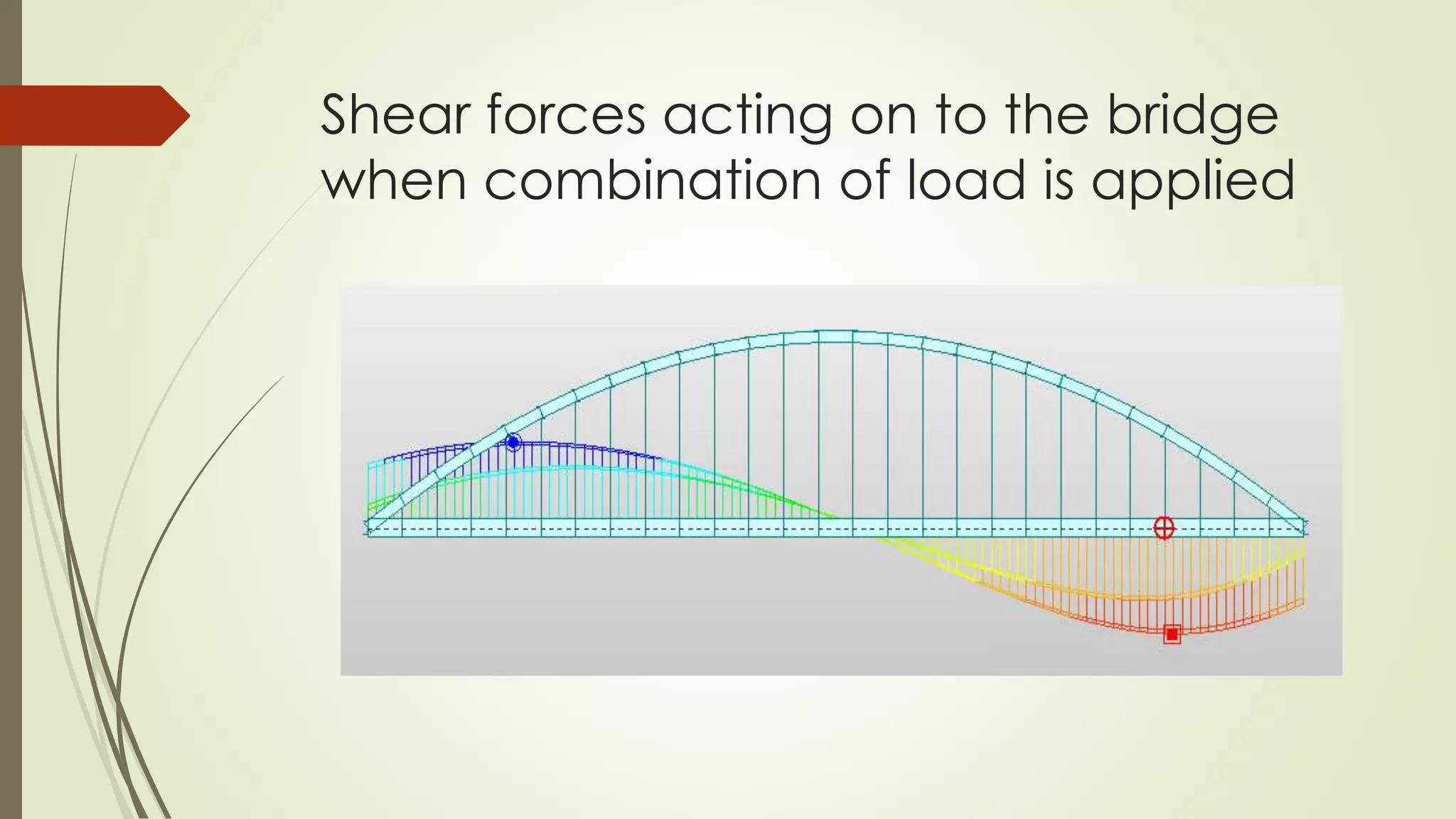
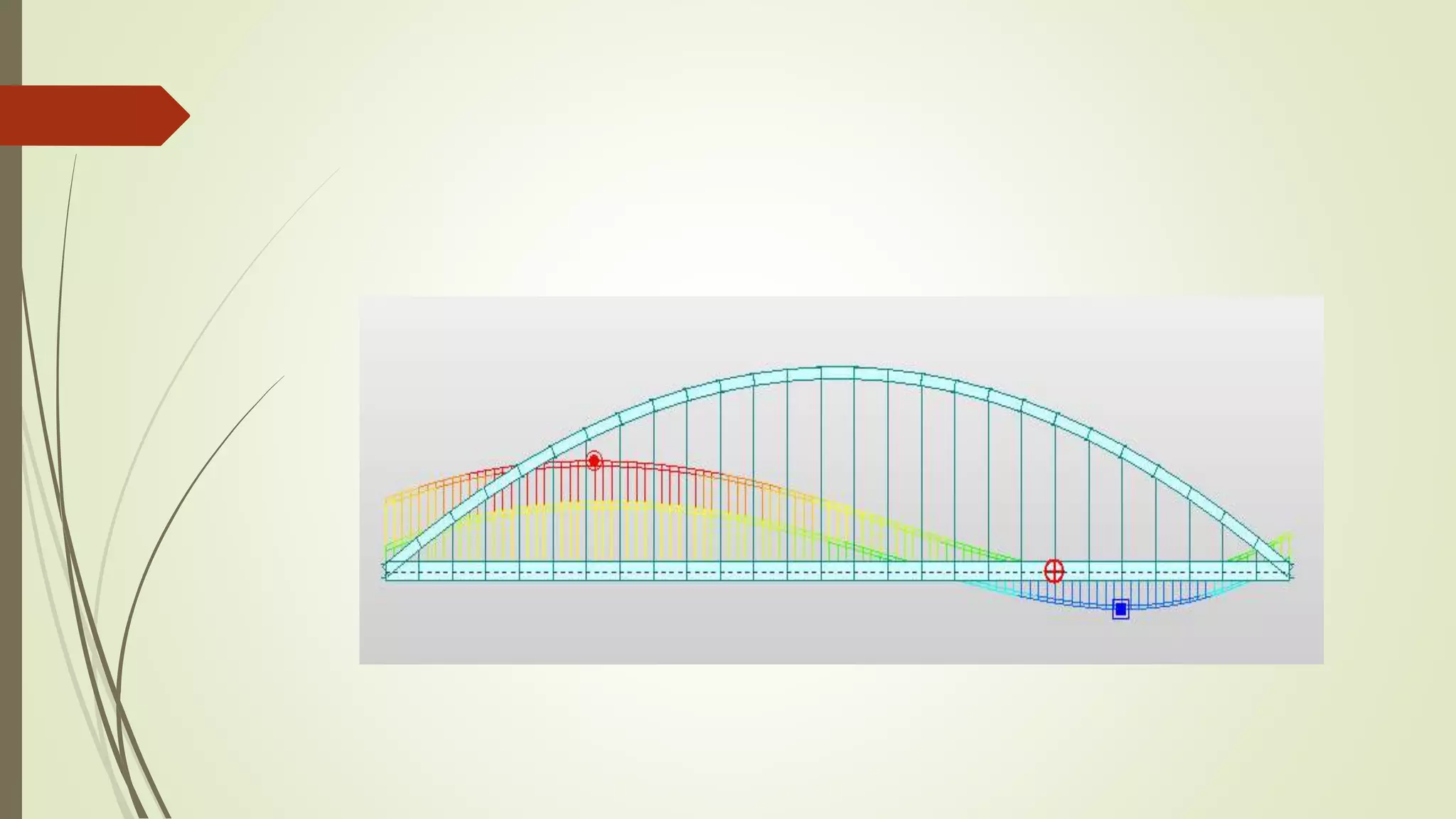
Shear forces acting on to the bridge 
when combination of load is applied
CONCLUSION 
The Lupu Bridge, as well as being a stunning, eye catching and graceful 
bridge, is also a remarkable feat of engineering. The carefully thought out 
aesthetics all work together to create what is a seemingly effortless structure 
across the water. From photographs it is hard to grasp the sheer scale of the 
elements which go to make up the Lupu Bridge, all of which are necessary to 
make the large spanning arch possible. Advances in welding techniques and 
technologies were created in the process of building this bridge and have 
done a great deal to promote the Chinese standing in the world of steel arch 
engineering. We also determined the different functions/ participation of the 
members in distributing the load of the deck to the arch of the bridge through 
hangers and then to the ground.

Influence line diagram for model arch bridge

  • 1.
    Influence line diagramof Model arch bridge
  • 2.
    INTRODUCTION The LupuBridge is located in Shanghai, China. It is currently the seventh crossing to be constructed over the Huangpu River in the city. The bridge is located in the south of the city with the aim to ease congestion in the quickly developing areas around the southern side of the river and the city centre and also to help with the increasing traffic expected at the 2010 world Expo. The venue for this is set to be surrounding the river at the location of the bridge, so it will not only be a vital part of the infrastructure for this event, it will also act as a showpiece for Chinese engineering.The bridge was officially opened in June 2003 at a total cost of $302 Million US. On completion the Lupu Bridge was the largest spanning arch bridge in the world with a main span of 550m overtaking the New River Gorge Bridge in the United States by 32m. This record is set to be broken in 2008 by the under construction Chaotianmen Bridge in China by only 2m.
  • 3.
    The total lengthof the bridge is 3,900m including the approach bridges on either side of the river. The bridge was originally heavily criticized as it was seen as wasteful by many people in respect to the type of bridge that was actually needed for the project. Many feel that it is just a show piece for the city and the price tag reflected that status. Other designs were proposed that would have been more economical but were rejected in favor of the tied arch design. The Lupu Bridge is a steel box section through tied arch bridge. The central span of the deck is suspended from two sets of 28 double cables attached to the two inclined arches. The ground conditions on either side of the bridge are not suitable for the large thrusts that would be caused by a normal arch bridge and this is what lead to the decision of using a through tied arch which will be discussed further later in this paper. Below are two elevations of the bridge, the side profile and a view looking longitudinally along the deck.
  • 4.
    Plan and twoelevations.
  • 5.
    Elevation of LupuBridge by MIDAS Civil2014 software.
  • 6.
    Working of TiedArch Bridge Thrust arches rely on horizontal restraint from the foundations, as shown right. The vertical and horizontal reactions resolve into a force along the arch members – the horizontal component is of significant magnitude. This will be the most satisfactory solution when the arch bears onto good foundation material such as competent rock. Reactions for a thrust arch bridge The ends of the arches are normally pinned. However, rock is not always available and so a thrust arch will not be the most economical solution at these locations, as the horizontal reactions lead to heavy uneconomic foundations
  • 7.
    The tied-arch offersa solution when it can be arranged that the deck is at such a level that it can carry the horizontal force as a tie member, as shown on right side. Tied arch The tied-arch is sometimes referred to as a bowstring arch. By taking the arch thrust through the tie member, the primary requirement for the substructure reduces to only carrying vertical loads. It can be seen that one end will still require a longitudinal restraint to carry wind, braking, acceleration and skidding forces, and that the other end is permitted to move longitudinally.
  • 8.
    Overall structural behaviour Looking at the diagram above, it can be seen that a tied-arch is really just a simply supported beam. The arch is held longitudinally at one end, with the other end free to expand or contract under varying temperatures.
  • 9.
    If a loadis placed on the deck, it is transferred to the arch via the hangers, as the global stiffness of the arch is greater than the bending stiffness of the deck. This creates thrust in the arch, which is balanced by tension in the tie beam.
  • 10.
    The arch willdeform downwards, and it will try to spread its feet, but this is limited by having to stretch the tie beam. Hence there will be an outward movement at the free end.
  • 11.
    The deck isconventionally articulated using the principles mentioned previously. An example is given in the figure below. In this case global longitudinal loads on the bridge are shared between both bearings at the fixed end.
  • 12.
    Components and choiceof materials The arch is primarily a compression member and so a closed box section will be the most efficient. Steel S355 national standard has been used in the sections. There is a choice of whether the arch should be stiffened longitudinally or not. The balance to be considered is one between the loss of efficiency when using ‘thin’ plates (b/t >24), and the additional fabrication cost of stiffened panels. To minimize future internal maintenance, arches are frequently fabricated from weathering steel, painting the exterior, but leaving the interior unpainted. Bracing between the arches can take a number of forms, and can even be omitted in small to medium spans. Tubes are commonly used, and are generally too small for man access. They can either be sealed, or vented into the arch boxes with provision for drainage. Note that hot rolled hollow sections are not available in weathering steel.
  • 13.
    Hangers Design rulesfor tension components are given in BS EN 1993-1-11. As a rule of thumb, it is convenient to size the cables under SLS loading, limiting tensile stresses to 45% of breaking load. Proprietary system manufacturers can provide data on various forms of rope, strand and bar. Under accidental loss of a hanger, adjacent remaining hangers are permitted to work at higher stress levels. Cable anchorages (sockets etc) and their fixings are usually sized such that their strength exceeds the breaking load of the cable. Local steelwork details should be designed with robustness in mind. Fatigue loading will need to be considered using data from manufacturer’s tests. Inside of Hanger
  • 14.
     Hangers canbe either terminated inside the arch or below it. This is a preference decision as there are pros and cons for both. Internal connections will be neatest, but requires installation and subsequent inspection and maintenance inside a confined space (assuming it is large enough to enter). External connections will require specialist access equipment such as cherry pickers, use of which may involve unacceptable disruption to traffic.  Hangers must be adjustable to allow for geometrical tolerances between arch and tie, and for initial stressing and subsequent adjustment. Allowance may need to be made for space to accommodate, and reactions from, jacking equipment.
  • 15.
    Loading  Deadload effects will normally comprise a large proportion of the design stresses for main elements, and it becomes very important to allow fully for the erection method. This particularly applies to bending in the arch; for the tie beam, the locked in bending moment can be controlled by adjusting the hanger lengths.  The application of traffic load is straightforward, but there will be a variety of loaded lengths and positions of tandem axles and special vehicles must be chosen to suit the influence lines.
  • 16.
    Aerodynamic instabilities areunlikely to be a problem due to the inherent stiffness and high natural frequency of the arch. However, for longer spans and when in doubt, wind tunnel tests should be considered. Depending on the type and nature of barriers between the highway and hangers, it may be necessary to design the bridge for the accidental loss of a hanger. The criterion is to prevent progressive collapse of the whole span. This is an accidental design situation and thus is normally considered with characteristic values of permanent and variable loads. However, it will be necessary to allow for the routine replacement of hangers. As this will be a planned action, it is usually possible to reduce traffic load for this transient design situation through traffic management (e.g. no abnormal loads, contraflow on opposite carriageway).
  • 17.
    Material and Sectionproperties  Material used – Steel S355 national standard section : a) Main girder – 9 x 5 m , shape : box b) Cross beam – 7 x 5 m, shape : I c) Arch rib – 6 x 5 m, shape : box d) hanger - 0.18m dia, shape : solid round e) struts – 6 x 5m , shape : box f) Bracing & stringers – 4 x 2 m , shape : I  Load Cases : Dead load- 259kN/m Side walk load – 6kN/m Moving load case
  • 18.
  • 19.
  • 20.
    Arch Rib andHangers
  • 21.
  • 22.
  • 23.
  • 24.
  • 25.
  • 26.
    Reactions at othersupport end
  • 27.
    Displacement at 4different points when moving load is passing through the bridge
  • 31.
    Shear forces actingon to the bridge when combination of load is applied
  • 36.
    CONCLUSION The LupuBridge, as well as being a stunning, eye catching and graceful bridge, is also a remarkable feat of engineering. The carefully thought out aesthetics all work together to create what is a seemingly effortless structure across the water. From photographs it is hard to grasp the sheer scale of the elements which go to make up the Lupu Bridge, all of which are necessary to make the large spanning arch possible. Advances in welding techniques and technologies were created in the process of building this bridge and have done a great deal to promote the Chinese standing in the world of steel arch engineering. We also determined the different functions/ participation of the members in distributing the load of the deck to the arch of the bridge through hangers and then to the ground.