RESEARCHApril 2011 Inflation WatchAn Eye on PricesApril 15, 2011Next Release: May 13, 2011
Inflation WatchInflation (price-level growth) is important for REALTORS® because it can lead to shifts in interest rate policy by the Federal Open Market Committee (FOMC).  Generally, the FOMC lowers interest rates to stimulate the economy.  However, rates that are too low may lead to inflation.  To combat inflation, the central bank increases interest rates but this policy may dampen economic growth.  For example, lower mortgage rates could bring home buyers into the market and create jobs while higher mortgage rates caused by inflation or central bank action could reduce demand among home buyers.RESEARCH
Inflation WatchDuring the recent financial crisis, fears of deflation (price-level decline) were rampant.  (Deflation caused a downward spiral of prices that destroyed the economy in the Great Depression.)With financial markets now stable, some fear that inflation is around the corner.  Stagflation, another unpleasant economic condition characterized by high unemployment and high inflation, is also a possibility.In stagflation, it is difficult for the central bank to raise interest rates to combat inflation due fear of further job market deterioration if demand is hurt by the increased interest rates. RESEARCH
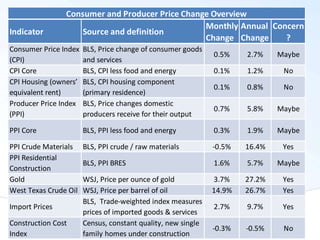
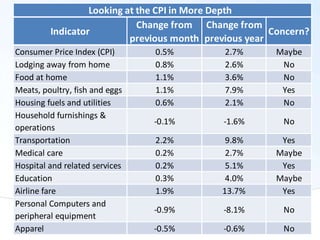
April 2011 HighlightsIncreases in producer prices are beginning to creep into consumer prices, especially in energy pricesHeadline consumer prices increased far too quickly in the month; only apparel, computers, and household furnishings have seen price declinesA survey of industry economists finds rising prices and the expectation of further price and cost increasesRESEARCH
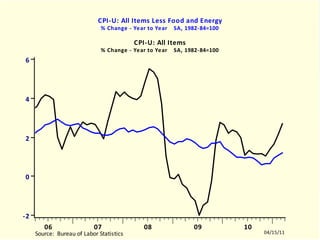
PCUSLFE	CPI-U: All Items Less Food and Energy		% Change - Year to Year    SA, 1982-84=100	CPI-U: All Items		% Change - Year to Year    SA, 1982-84=100	PCUSLFE.EMF  (USECON)  PCUSLFE / PCU  10603-11102
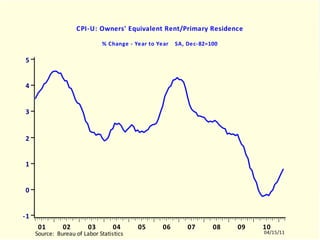
PCUHSHO	CPI-U: Owners' Equivalent Rent/Primary Residence		% Change - Year to Year    SA, Dec-82=100	PCUHSHO.EMF  (USECON)  PCUHSHO  10103-11102
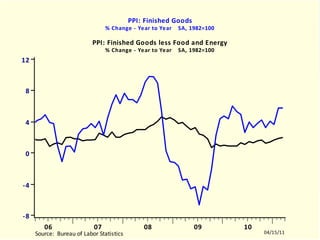
SP3000	PPI: Finished Goods		% Change - Year to Year    SA, 1982=100	PPI: Finished Goods less Food and Energy		% Change - Year to Year    SA, 1982=100	SP3000.EMF  (USECON)  SP3000 / SP3500  10603-11102
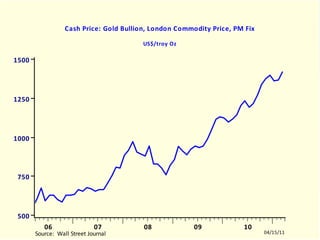
PZGOL	Cash Price: Gold Bullion, London Commodity Price, PM Fix		US$/troy Oz	PZGOL.EMF  (USECON)  PZGOL  10603-11102
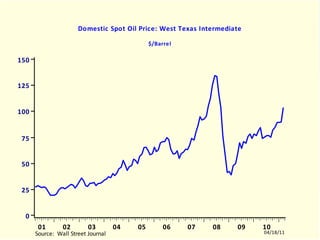
PZTEX	Domestic Spot Oil Price: West Texas Intermediate		% Change - Year to Year    $/Barrel	PZTEX.EMF  (USECON)  PZTEX  10103-11102
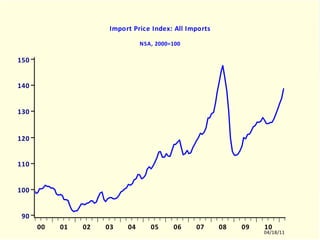
PMEA	Import Price Index: All Imports		NSA, 2000=100	PMEA.EMF  (USECON)  PMEA  10004-11103
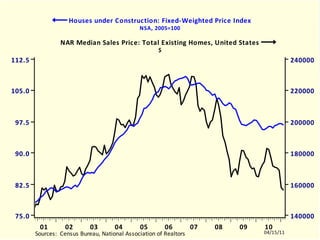
CCIHF	Houses under Construction: Fixed-Weighted Price Index		NSA, 2005=100	NAR Median Sales Price: Total Existing Homes, United States		$	CCIHF.EMF  (USECON)  CCIHF / USMNBDP  10102-11101

Inflation watch 4.18.11

  • 1.
    RESEARCHApril 2011 InflationWatchAn Eye on PricesApril 15, 2011Next Release: May 13, 2011
  • 2.
    Inflation WatchInflation (price-levelgrowth) is important for REALTORS® because it can lead to shifts in interest rate policy by the Federal Open Market Committee (FOMC). Generally, the FOMC lowers interest rates to stimulate the economy. However, rates that are too low may lead to inflation. To combat inflation, the central bank increases interest rates but this policy may dampen economic growth. For example, lower mortgage rates could bring home buyers into the market and create jobs while higher mortgage rates caused by inflation or central bank action could reduce demand among home buyers.RESEARCH
  • 3.
    Inflation WatchDuring therecent financial crisis, fears of deflation (price-level decline) were rampant. (Deflation caused a downward spiral of prices that destroyed the economy in the Great Depression.)With financial markets now stable, some fear that inflation is around the corner. Stagflation, another unpleasant economic condition characterized by high unemployment and high inflation, is also a possibility.In stagflation, it is difficult for the central bank to raise interest rates to combat inflation due fear of further job market deterioration if demand is hurt by the increased interest rates. RESEARCH
  • 4.
    April 2011 HighlightsIncreasesin producer prices are beginning to creep into consumer prices, especially in energy pricesHeadline consumer prices increased far too quickly in the month; only apparel, computers, and household furnishings have seen price declinesA survey of industry economists finds rising prices and the expectation of further price and cost increasesRESEARCH
  • 7.
    PCUSLFE CPI-U: All ItemsLess Food and Energy % Change - Year to Year SA, 1982-84=100 CPI-U: All Items % Change - Year to Year SA, 1982-84=100 PCUSLFE.EMF (USECON) PCUSLFE / PCU 10603-11102
  • 8.
    PCUHSHO CPI-U: Owners' EquivalentRent/Primary Residence % Change - Year to Year SA, Dec-82=100 PCUHSHO.EMF (USECON) PCUHSHO 10103-11102
  • 9.
    SP3000 PPI: Finished Goods %Change - Year to Year SA, 1982=100 PPI: Finished Goods less Food and Energy % Change - Year to Year SA, 1982=100 SP3000.EMF (USECON) SP3000 / SP3500 10603-11102
  • 10.
    PZGOL Cash Price: GoldBullion, London Commodity Price, PM Fix US$/troy Oz PZGOL.EMF (USECON) PZGOL 10603-11102
  • 11.
    PZTEX Domestic Spot OilPrice: West Texas Intermediate % Change - Year to Year $/Barrel PZTEX.EMF (USECON) PZTEX 10103-11102
  • 12.
    PMEA Import Price Index:All Imports NSA, 2000=100 PMEA.EMF (USECON) PMEA 10004-11103
  • 13.
    CCIHF Houses under Construction:Fixed-Weighted Price Index NSA, 2005=100 NAR Median Sales Price: Total Existing Homes, United States $ CCIHF.EMF (USECON) CCIHF / USMNBDP 10102-11101