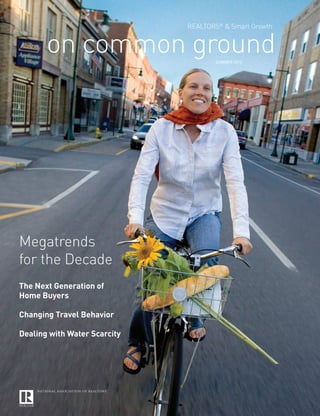
REALTORS® & Smart Growth


       on common ground              SUMMER 2010


Megatrends
for the Decade
The Next Generation of
Home Buyers

Changing Travel Behavior

Dealing with Water Scarcity
Megatrends Affecting Us All
                                        During the coming decade, demographic            Car sharing is increasing in popularity, giving
                                        changes, as well as changes in consumer          more people the freedom to not own a car.
                                        desires and behavior, will have a tremendous     Cities are making low-budget investments
                                        effect on real estate markets and on how our     to promote bicycle ridership, with many
                                        communities function and grow. As the baby       communities setting goals to increase the
                                        boomers begin to reach retirement age, they      share of trips taken by bicycle.
                                        are being replaced as the market bellwether
                                        by Generation Y, which represents today’s        Environmental factors will play a huge role
                                        20-somethings and teenagers.This group is        in the next decade. More energy-efficient
                                        larger than the baby boomer generation and       and green buildings will become standard,
                                        exhibits different tastes and attitudes about    as costs and benefits will become better
                                        where and how they want to live. Researchers     understood, and lenders will increasingly
                                        and savvy real estate professionals are aware    recognize the greater value of green
                                        of the different interests of this group, and    buildings. Water shortages will threaten
                                        corporate America is noticing too. An article    urban expansion in many parts of the
                                        in the May issue of the Harvard Business         country, resulting in developers being
                                        Review characterizes the increasing number       required to identify new water sources
                                        of businesses that are changing their focus      while producing developments that use
                                        to urban areas as “getting a jump on a major     much less water.
                                        cultural and demographic shift away from
                                                                                         Building communities for a new generation
                                        suburban sprawl.”
                                                                                         of consumers will require many parties,
                                        Travel behavior is changing remarkably,          including developers, lenders and
                                        as evidenced by the federal government’s         government regulators, to adopt new ways
                                        tracking of total vehicle miles traveled,        of doing business. And to keep pace with
                                        which has been declining since 2006. Transit     our needs, more money will need to be
                                        ridership has increased at a great pace,         invested in public transportation and water
                                        achieving a 52-year ridership high in 2008.      infrastructure. These megatrends will affect
                                                                                         us all in the new decade.


      Editor                                        For more information on NAR and smart growth,
                                                    go to www.realtor.org/smartgrowth.
      Joseph R. Molinaro
      Managing Director, Community                  On Common Ground is published twice a year by the Community and Political
      and Political Affairs
                                                    Affairs division of the NATIONAL ASSOCIATION OF REALTORS® (NAR),
      jmolinaro@realtors.org
                                                    and is distributed free of charge. The publication presents a wide range of
                                                    views on smart growth issues, with the goal of encouraging a dialogue among
      Assistant Editor                              REALTORS®, elected officials and other interested citizens. The opinions
                                                    expressed in On Common Ground are those of the authors and do not
      Hugh Morris
                                                    necessarily reflect the opinions or policy of the NATIONAL ASSOCIATION
      Smart Growth Outreach Representative
                                                    OF REALTORS®, its members or affiliate organizations.
      hmorris@realtors.org


      NATIONAL ASSOCIATION OF REALTORS®             Distribution
      500 New Jersey Avenue, NW
                                                    For more copies of this issue or to be placed on our mailing list for future
      Washington, DC 20001
                                                    issues of On Common Ground, please contact Ted Wright, NAR, at
                                                    (202) 383-1206 or twright@realtors.org.


2   ON COMMON GROUND          SUMMER 2010
On Common Ground
Summer 2010
Generation Y
The Future Generation of Home Buyers     4
by Brad Broberg

Are People Driving Less?
Studies indicate a reduction
in vehicle miles traveled               10
by Judy Newman

The Car Sharing Trend                   16
by Steve Wright

Promoting the
Active Living Benefits
of Walkable Neighborhoods               22
by Christine Jordan Sexton

A New Generation of Bikeways            28
by G.M. Filisko

Development Adapts
Water Scarcity and Urban Growth         34

Retrofitting the Suburbs	               40
by David Goldberg

Retiring to Your Home
Aging in Place support groups
provide seniors the option to
remain in their current neighborhoods   46
by John Van Gieson

The Costs and Benefits
of the Green Trend                      52
by Gary Fineout

A New Path to Financing
Energy Efficient Homes                  58
by Brad Broberg
                                             On Common Ground thanks the following contributors and organizations for photographs, illustrations
REALTORS® Take Action                        and artist renderings reprinted in this issue: Cassandra Allen, U-Haul, U Car Share; S. Rick Armstrong;
Making Smart Growth Happen              64   Donna Baron, The Gaithersburg North Potomac Rockville Coalition; Rick Belloli, South Side Local
                                             Development Company; Vicky Bergman, Community Without Walls; Dan Burden; Andy Cotugno, City of
                                             Portland; Jane M. Curry, Lincoln Park Village; Paul DeLong, car2go; Roger Geller, City of Portland Bureau
                                             of Transportation; Heather Kemp, PhillyCarShare; Mike Lydon, The Street Plans Collaborative; Andy
                                             Mollison, Palisades Village; Anne Myers, Partners In Care Maryland, Inc.; Matthew Ridgway, Fehr & Peers;
                                             Paula R. Rivera, The Hertz Corporation; Jola Szubielski; and Judy Willett, Beacon Hill Village.
www.pedbikeimages.org/Dan Burden


Generation Y
    The Future Generation of Home Buyers

       S. Rick Armstrong                                                  By Brad Broberg


                                                                          T
                                                                                        here are as many names for Generation Y
                                                                                        — Echo Boomers, Millenials, Generation
                                                                                        Next — as opinions about the specific years
                                                                                        this generation spans. But it’s not the names or
                                                                                        the exact years that matter. What matters is that
                                                                                        Generation Y, which trumps the baby boomers
                                                                          in size, is about to become a force in the housing market.
                                                                          Just don’t expect Generation Y to follow in anybody’s
                                                                          footsteps.
                                                                          “Especially now, Generation Y is paying more careful
                                                                          attention to whether buying a home is a good idea and,
       Photo courtesy of South Side Local Development Company             if so, where to buy,” says Arthur C. Nelson, presidential
                                                                          professor and director of the Metropolitan Research
                                                                          Center at the University of Utah.
       Generation Y has a different set
                                                                          Generation Y’s attitude is more than a response to vanish-
       of priorities in choosing a home.                                  ing equity, rising foreclosures and tight credit. It also re-
                                                                          flects a different set of priorities than the ones that led baby
                                                                          boomers to gravitate to farther and farther away suburbs.


   ON COMMON GROUND              SUMMER 2010
In survey after survey, today’s 20-somethings — the                 One thing’s for sure. When it comes to the world around
leading edge of Generation Y — express a strong desire              them, Generation Y doesn’t miss much. “The Gen Ys have
to live in urban environments close to jobs, entertain-             a lot more information than I had as a [young person],”
ment and each other — at least until they start having              Nelson says. “They are more attuned to their options and
children but perhaps beyond.                                        more capable of evaluating their options [through] social
“They don’t care about having a large home in the mid-              media, the Internet, different kinds of networking among
dle of nowhere,” says Rosie Derryberry, a 29-year-old               friends. It’s really quite remarkable.”
agent with Realty Executives in Scottsdale, Ariz. “They             Certainly the transformation of many city centers from
would rather have something smaller and more manage-                decaying to desirable hasn’t escaped Generation Y. And
able in order to be in the heart of the city.”                      neither has the fact that homes in city centers and inner
With a taste for urban living as well as an appetite for            suburbs have held their value far better than those in
public transportation and a strong green streak, Genera-            outer suburbs. By looking for homes close in, they’re
tion Y could very well be the first “smart growth genera-           gaining “peace of mind as well as quality of life,” says
tion,” says John McIlwain, senior resident fellow and J.            Derryberry. “It kind of goes hand in hand.”
Ronald Terwilliger chair for housing at the Urban Land              The two most important things to remember about most
Institute (ULI).                                                    Gen Ys are that they abhor homogeneity — think cookie-
                                                                    cutter suburbs — and refuse to waste time with long com-
                                                                    mutes, says Shyam Kannan, vice president at RCLCO,
With a taste for urban living                                       a leading real estate advisory firm. That’s why they’re
                                                                    drawn to neighborhoods in city centers and inner suburbs
as well as an appetite for
                                                                    “They’re convenient. They have a sense of community.
public transportation and a                                         And they have a sense of character,” Kannan says.
strong green streak, Generation
Y could very well be the first                                       S. Rick Armstrong


smart growth generation.


                                                S. Rick Armstrong

 Photos courtesy of South Side Local Development Company
Generation Y totals 91 million                                 on Gen Y before 2000, but the report’s author, Elwood
                                                                         Carlson, believes those timeframes are too compressed
          compared to 79.4 million for the                               to provide an apples-to-apples comparison with previ-
          baby boomers and 74.2 million                                  ous generations. Another reason to separate Generation
                                                                         X from Generation Y is the early 1980s: that’s when
          for Generation X.                                              the birth rate resumed climbing and when a defining
                                                                         economic and political reset of American society began,
          Who is Generation Y? Ask a different demographer and           Carlson says.
          you’ll get a different answer. In broad terms, it’s the sec-
                                                                         Carlson, the Charles B. Nam professor in sociology of
          ond generation — the first was Generation X — to follow
                                                                         population at Florida State University, calculates that
          the baby boomers. While most everyone agrees on who’s
                                                                         Generation Y totals 91 million compared to 79.4 mil-
          a baby boomer — anyone born between 1946-64 — the
                                                                         lion for the baby boomers and 74.2 million for Genera-
          boundaries of Generation X and Generation Y can be
                                                                         tion X. However, the numbers all depend on when you
          blurry. “There is no precise definition,” McIlwain says.
                                                                         catch them in their lives.
          A Population Research Bureau report defines Genera-
                                                                         If you measure generations at their birth, Carlson ex-
          tion X as people born from 1965-1982 and Generation
                                                                         plains, you include those who die as infants and young
          Y as people born from 1983-2001. That would make
                                                                         children (as much as one-fifth of early 20th century gen-
          Generation Y’s oldest members 27 and its youngest
                                                                         erations), but miss all the people who immigrate into
          members 9.
                                                                         the country as part of one generation or another (such
          Not everyone agrees. Some draw the line between Gen            as those who continue to inflate Generation X, which
          X and Gen Y in the late 1970s and close the curtain            started out much smaller).


                                                                                             www.pedbikeimages.org/Greg Griffin, AICP


           www.pedbikeimages.org/Dan Burden


   ON COMMON GROUND
Carlson took a snapshot of each birth cohort from each
                                                            generation at age 30 — i.e. the birth cohort of 1979
                                                            contained so many 30-year-olds in 2009 and the birth
                                                            cohort of 1980 will contain so many in 2010, etc. Why
                Photo courtesy of reconnectingamerica.org
                                                            measure 30-year-olds? It’s an age when people are set-
                                                            tling into careers, buying homes and raising families
                                                            — all significant socio-economic drivers.
                                                            Carlson calls Generation Y the New Boomers. The
                                                            name captures two key characteristics of Generation Y
                                                            — it contains a large number of new Americans who
                                                            have immigrated to this country and it brims with the
                                                            offspring of baby boomers. That one-two punch will
                                                            make the New Boomers “the demographic center of
                                                            gravity of American society” through at least the first
                                                            half of this century, Carlson says.
                                                            Now that we know how many there are, what is it that
                                                            makes New Boomers tick? They think quickly, multitask
                                                            easily and communicate — i.e. text and tweet — con-
                                                            stantly. They value community, welcome diversity and
                                                            crave a healthy work/life balance. And many of them
                Photo courtesy of reconnectingamerica.org
                                                            — whether they’re familiar with the term or not — are
                                                            looking for the kind of places to live that are consistent
                                        S. Rick Armstrong   with smart growth.
                                                            That’s why McIlwain refers to them as the smart growth
                                                            generation and predicts they will do more to lead the
                                                            demand for smart growth than any amount of advocacy
                                                            could ever do. “Regardless of what you or I or anyone
                                                            else who [supports] smart growth think, the fact is, there
                                                            is a shift in the market,” McIlwain says. “This is old-
                                                            fashioned American market capitalism at work.”
                                                            Surveys by RCLCO and another real estate advisory
                                                            firm, the Concord Group, show how strongly Gen-
                                                            eration Y is in tune with many key strategies of smart
                                                            growth. The most telling result: 77 percent of the New
                                                            Boomers surveyed by RCLCO said they plan to live in
Photo courtesy of South Side Local Development Company


New Boomers — whether they’re familiar with the term or not — are look-
ing for the kind of places to live that are consistent with smart growth.


                                                                                                                    SUMMER 2010
Photos by S. Rick
Armstrong and courtesy
of South Side Local
Development Company


                                                     an urban core, putting them squarely in sync with smart
                                                     growth’s emphasis on encouraging development where
                                                     it already exists.
                                                     Walkable communities with a mix of uses is another
                                                     building block of smart growth. Two-thirds of the New
                                                     Boomers surveyed by RCLCO said that living in a com-
                                                     munity where they could walk to work, shopping and
                                                     entertainment is important, and one-third said they
                                                     would pay more to do it.
                                                     Smart growth also encourages compact development.
                                                     More than half of RCLCO survey respondents said they
                                                     would trade lot size for proximity to shopping or work.
                                                     Even among families with children, one-third said they
                                                     would make that trade-off.
                                                     Providing transportation choices is yet one more smart
                                                     growth principle that New Boomers like. In the Con-
                                                     cord Group Survey, 81 percent said it was very or some-
                                                     what important to live near alternative modes of transit
                                                     such as bus and rail lines and 67 percent said they would
                                                     pay a premium to do it.
                                                     Generation Y’s affinity with smart growth flows at least
                                                     partially from being the first generation born with an
                                                     awareness of the pressure that development as usual
                                                     — i.e. auto-dependent suburban sprawl — puts on the
                                                     environment. More than half of the RCLCO survey
                                                     respondents said that having a home and community
                                                     designed to meet certain green objectives plays an im-
                         Two-thirds of the New       portant role in their housing decisions.
                             Boomers surveyed        “The environmental movement didn’t begin until the
                                                     late 1960s so [baby boomers] had to learn it,” McIlwain
                             said that living in a   says. “Generation Y has grown up with it.” Another in-
                             community where         fluence on their thinking: the knowledge that the days
                                                     of affordable and plentiful oil supplies are dwindling.
                             they could walk to      “They are extremely aware that energy prices are going
                            work, shopping and       up,” he says.
                                                     The Martin Prosperity Institute, a think tank affiliated
                               entertainment is
                                                     with the University of Toronto, compiled a list of best
                           important, and one-       places to live for young singles ages 20-29 — a giant
                                                     subset of Generation Y. College towns and big cities
                          third said they would      dominated the list led by Boulder; San Francisco; Wash-
                              pay more to do it.     ington, D.C.; Madison, Wis.; and Boston.


       ON COMMON GROUND
www.pedbikeimages.org/Dan Burden


Unfortunately for Generation Y, retiring baby boom-
ers have also become interested in urban living after a
lifetime in the suburbs. “In a sense, we’ll have a compe-
tition for [the same housing] between the aging popula-
tion and Gen Y,” Nelson says.
                                                             Photo courtesy of reconnectingamerica.org
Because most are not earning a lot right now, that spells
trouble for New Boomers in the form of higher prices as
the supply of urban housing is not keeping up with de-      A compact, walkable lifestyle
mand. “Most communities are trying to figure out how
to implement development like that, but there’s not         that is affordable will be
enough going on to meet the demand,” McIlwain says.         attractive … especially if it
In a report for the ULI titled “Housing in America:
                                                            has transportation alternatives.
The Next Decade,” McIlwain writes that many Gen
Ys are deferring home ownership out of both necessity
— because they can’t afford to buy in the urban neigh-      and be forced to consider less expensive outer suburbs — a
borhoods they desire — and by choice — because they         big change from the past when people moved there by choice
see people upside down with their mortgages and realize     to find newer and bigger homes, McIlwain explained.
that a house can be a trap.                                 There is, however, a smart growth solution. “This provides
That scenario is unfolding in Dallas, where the rental      a major opportunity for developers to create new outer-
market in popular urban neighborhoods is “rocking,”         edge communities with real town centers and urban ame-
says Rogers Healy, the 30-year-old broker owner of          nities,” McIlwain says. “Even on the outer edges a compact,
Rogers Healy and Associates Residential Real Estate.        walkable lifestyle that is affordable will be attractive ... espe-
“No one wants to give up their life savings just to buy     cially if it has transportation alternatives.” 
a condo.”                                                   Brad Broberg is a Seattle-based freelance writer spe-
                                                            cializing in business and development issues. His work
RCLCO predicts Generation Y’s transition from renters       appears regularly in the Puget Sound Business Jour-
to buyers will start to accelerate in 2012. Yet many will   nal and the Seattle Daily Journal of Commerce.
remain unable to afford buying in urban neighborhoods


                                                                                                             SUMMER 2010
Are People
         Driving Less?
                                                       Current studies indicate a reduction in vehicle miles
                                                       traveled, but experts wonder if it’s sustainable.


                                                       By Judy Newman


                                                       I
                                                            f you have walked to the coffee shop instead of driv-
                                                            ing, if you have carpooled to work with a friend or
                                                            if you have hopped on a bus to go shopping, you
                                                            are part of a growing trend.
          Photo courtesy of reconnectingamerica.org
                                                            Americans are keeping their cars in the garage a bit
                                                            more than they used to. The government’s measur-
                                                       ing stick, vehicle miles traveled (VMT), has reversed
                                                       more than half a century of annual increases and has
                                                       inched downward since 2006 — even before gasoline
                                                       prices spiked in 2008, topping $4 a gallon for a while.
                                                       As a result, “2006 was a turning point in the long road
                                                       that really started at the end of World War II,” transpor-
                                                       tation planner Jim Charlier, president of the Charlier
                                                       Associates consulting group, in Boulder, Colo., said.
                                                       Will the driving downturn continue? Experts say it’s too
                                                       soon to tell. But, they say, as states start to pass climate
                                                       change legislation, gas prices head back up, and high-
                                                       ways become ever more clogged, it’s not likely the U.S.
                                                       will return to the days when motorists put more and
                                                       more miles on their cars every year.
                                                       “At some point, you start getting some saturation,”
                                                       Brian Smith, director of strategic planning and
                                                       development for the Washington State Department of
                                                       Transportation said.

                                                       Americans are keeping their
                                                       cars in the garage a bit more
           Photo courtesy of reconnectingamerica.org   than they used to.


10 ON COMMON GROUND           SUMMER 2010
Nationwide, from 1955 to 2005, vehicle
                                                               miles traveled expanded by 500 percent.
America’s Dependence on the Automobile
Other than a brief blip in the late 1970s, the number of
vehicle miles traveled rose more than 3 percent a year
starting in the mid-1970s, gaining as much as 3.6 percent
during the early 1990s, according to government figures.
American’s increasing reliance on their cars was reflected
in the number of miles driven, which increased at a much
greater rate than population growth.
Nationwide, from 1955 to 2005, the population grew
by 178 percent. But vehicle miles traveled expanded by
500 percent. That means the swelling U.S. population
accounted for about one-third of the growth while the
rest came from increased daily travel per capita: more
cars on the road and more time spent behind the wheel,                                                Photo courtesy of
                                                               www.pedbikeimages.org/Dan Burden       reconnectingamerica.org
Charlier said.
There were some clear reasons for driving more, includ-
ing more women were working outside the home.
“Women joining the work force has had, over the past
generation or so, a huge effect,” said Steven Polzin, direc-
tor of mobility policy research at the University of South
Florida’s Center for Urban Transportation Research.
Two-income families were becoming two-car families, of-
ten with homes in the suburbs, children to chauffeur to ac-
tivities, and money left over to indulge in vacations — for
many people, driving to their destinations, Polzin said.
Teenagers also became an increasing percentage of car
owners, in a trend that began to take root in the 1960s,
Charlier said. “In the [U.S.] Constitution, it says when
you turn 16, you get a driver’s license and a car,” he
said, with tongue in cheek. One practical reason is that
a lot of teens work, particularly those in college. “And
in America today, in most places, if you have a job, you
need a car,” Charlier said.
But perhaps even more important, he said, have been
land use patterns, with housing developments and
shopping situated farther and farther from city centers.
“Those forces have driven growth in vehicle miles trav-
eled,” Charlier said. “The development trend, in my
opinion is about half of the increase in VMT.”                 www.pedbikeimages.org/Heather Bowden


                                                                                                                                11
The Road Less Traveled
      But trends have begun to change. Even before the reces-           The aging of baby boomers also means fewer are com-
      sion hit in late 2008, Americans have not been so quick           muting to jobs, herding family members to activities or
      to jump into their cars.                                          even traveling, in general, said Polzin, of the University
      “We haven’t seen increases in real per-capita VMT in the          of South Florida, in Tampa. “A slightly older population
      U.S. for over a decade,” Charlier said. Personal income           tends to travel a little bit less,” he said.
      has not grown significantly since the Sept. 11, 2001 ter-         Another fundamental trend: as households have added
      rorist attacks, if not earlier. Participation of women in         vehicles, the nation’s highways have become increasingly
      the work force has peaked and so has auto ownership,              crowded. “Historically, we’ve been able to travel faster
      he said.                                                          and faster. Now, we have filled up our system, congested
      Meanwhile, cultural changes have become evident. Two of           our network. We can no longer travel more miles in the
      the largest segments of the population are the baby boom-         same amount of time because everything is clogged, at
      ers, many of whom are now retirement age, and the so-             peak times and nonpeak times,” Polzin said.
      called Millennials (or Generation Y), or those who were ex-       Environmental consciousness may have helped avoid
      pected to graduate from high school around the year 2000.         even greater increases in vehicle miles driven over the
      They are the two biggest portions of the population who           past couple of decades with some people taking alterna-
      are buying homes, Charlier said, and they are commonly            tive types of transportation. But most of those options
      choosing to live in urban, rather than suburban areas, often      “appear to have stabilized,” Polzin said. While transit
      in walkable, mixed-use neighborhoods or developments.             use is up and people are walking a bit more, ride-sharing
      “Living in a three-bedroom ranch in a suburban tract              has not increased nationwide; in fact, vehicle occupancy
      subdivision is not what either of those two populations           has declined slightly in recent years, he said.
      is looking for,” Charlier said. “We’re seeing people
      changing where they’re choosing to live and that’s going          Baby boomers and the Millennial
      to influence driving.”
                                                                        generation are commonly choosing
                                                                        to live in urban, walkable, mixed-use
                                                                        neighborhoods or developments.


                                                                     City of Portland, Ore.


12 ON COMMON GROUND
www.pedbikeimages.org/Paul Halicki
 Ride Your Bike to Work Day in
  downtown Fort Worth, Texas.


Governmental Actions
There are some exceptions, though, as states take steps
                                                            States are taking steps to reduce
to reduce greenhouse gases and encourage alternatives to
driving, particularly Washington and California.            greenhouse gases and encourage
In 2008, the Washington state legislature passed a bill,    alternatives to driving.
which was signed by the governor, that called for reduc-
ing vehicle miles traveled 18 percent by 2030 and 50
percent by 2050.                                            “I think Washington state is on the leading edge of try-
                                                            ing to address climate change and greenhouse gas and
“It’s very ambitious,” said the state DOT’s Brian Smith.
                                                            sustainability head-on,” he said. But Smith said it is too
“We’ve got a variety of programs to try and help people
                                                            soon to tell if the benchmarks for reducing driving are
not to drive.”
                                                            realistic. “In a lot of places, it’s going to be very tough.
They include vanpooling — “probably one of the largest      Some trips are discretionary; some are not. We need to
and most successful vanpool programs in the country,”       look at proportions,” he said.
Smith said — as well as mass transit options such as
                                                            In California, a bill also passed in 2008 aimed at reduc-
light rail, buses and ferries.
                                                            ing VMT by providing incentives for compact develop-
The Washington DOT’s Web site features a category,          ment so residents can more easily walk, ride bicycles or
Reinvent Your Commute, an online effort to show             use mass transit within neighborhoods.
motorists alternatives to driving alone. It even offers a
                                                            Cities such as Portland, Ore., have taken matters into
carpooling match-up service.
                                                            their own hands. With buses, streetcars, light rail and
By executive order from the governor, the department        commuter rail, Portland has cut per capita VMT, which
has been told to look at strategies for reducing vehicle    topped 20 miles a day for most of the past 20 years. In
miles traveled and greenhouse gases. Promoting alterna-     recent years, the daily VMT peaked at 21.7 in 1996.
tive fuel vehicles and compact urban development will       But in 2008, the figure fell to 19.3 miles driven per day
be on the review list, Smith said.                          per person.


                                                                                                           SUMMER 2010 13
Due to our compact footprint in
                                                  Portland, destinations are closer
                                                  together, average trips are shorter,
                                                  the duration of travel in the
                                                  congested conditions is less and
                                                  the impact per traveler is less.


                                                  Portland has been making a concerted effort to reduce
                                                  driving for many years, using a comprehensive approach,
                                                  said Andy Cotugno, director of planning. As far back as
                                                  1991, Oregon’s land use agency mandated that regional
                                                  and local transportation system plans demonstrate their
                                                  ability to slash per capita vehicle miles traveled by 20
                                                  percent within 20 years.
                                                  “The most important tool that we have employed to get
                                                  there is maintenance of a tight urban growth boundary
                                                  restricting outward expansion,” Cotugno said. Within
                                                  that boundary, there has been an “aggressive” expan-
                                                  sion of light rail and bus routes to serve the higher
                                                  density population, he said. As a result, Portland now
                                                  has the seventh highest per capita transit use in the U.S.,
                                                  Cotugno said.
                                                  The city also has significantly expanded its bicycle route
   City of Portland, Ore.
                                                  network, from 83 miles of bikeways in 1992 to more
                                                  than 300 miles of bikeways in 2008. The number of
                                                  daily bike trips in Portland has more than quintupled
                                                  over that period, from 2,850 daily bike trips in 1992 to
                                                  16,711 in 2008, Cotugno said.
                                                  “Due to our compact footprint, destinations are closer
                                                  together, average trips are shorter, the duration of travel
                                                  in the congested conditions is less and the impact per
                                                  traveler is less,” he said.
                                                  Portland even experimented with the idea of a VMT tax as
                                                  a replacement for the state’s gas tax in 2006-2007 but has
                                                  not implemented it as a full-fledged program. The pilot
                       Photo courtesy of Trimet
                                                  project was a way to test the technology, Cotugno said.


14 ON COMMON GROUND
Photo courtesy of reconnectingamerica.org


Economic Factors
For now, the recession has dampened the amount of ve-
                                                               The recession has dampened the
hicle miles traveled. People who are out of work are not       amount of vehicle miles traveled.
commuting to jobs and they don’t have the money for as
much discretionary travel.
As for the long term: “My personal forecast is that the        “Gas could roll between $3 and $5 a gallon, rapidly and
most important force influencing VMT over the next 10          repeatedly,” Charlier cautioned. “We’re headed to $5 a
years is going to be fuel prices,” consultant Charlier said.   gallon and probably $7 a gallon within a decade.”
Expect a lot of volatility in the price of gasoline, as        Electric vehicles will barely put a dent in the problem, he
demand for gas and other petroleum products exceeds            said. Nationwide, there are currently about 250 million
production capability, he said. China is driving a lot of      motor vehicles of all types in use. Estimates are that by
this; in 2009, for the first time, more cars were sold in      2012, 100,000 electric vehicles will be in service — only
China than in the U.S., and that will probably be the          a fraction of a percent. “We ought to push hybrids and
new norm, Charlier said. So any major disruption to            electrics as hard as we can but it’s not going to save us
oil production, such as a damaging storm or a politi-          from petroleum prices,” Charlier said. 
cal standoff with an oil-producing nation, could have a        Judy Newman is a newspaper reporter in Madison, Wis.
major impact on prices.


                                                                                                           SUMMER 2010 15
THE
         Car Sharing
                                      TREND
                                          Urban Dwellers Seek
                                          Inexpensive Alternative
                                          to the High Price of
                                          Ve h i c l e O w n e r s h i p


                                             By Steve Wright


                                             A
                                                               young couple in the city uses tran-
                                                               sit to get to work, but needs a car
                                                               on the weekends. A 30-something
                                                               lawyer lives downtown without a
                                                               car, but still needs to pick up clients
                                                               and travel for cases. Or maybe, a
                                             single parent doesn’t have the funds to own a car, but
                                             just cannot manage more than two bags of groceries
                                             on the bus. Do these scenarios sound familiar? Now,
                                             there is a simple solution, of an environmentally-
                                             friendly, walkable-neighborhood-enhancing trend,
                                             called car sharing.
                                             Car sharing is rapidly growing in the United States as
                                             a way of reducing the high cost of buying, insuring,
                                             garaging and maintaining a car with the added ben-
                                             efits of meeting smart growth needs.
                                             It’s a service that provides members with access to a
                                             fleet of vehicles on an hourly basis. Members reserve
                                             a car online or by phone, walk to the nearest parking
     Car sharing is rapidly growing          space, open the doors with an electronic key card and
                                             drive off.
     as a way of reducing the high           Members are billed by the hour or by a combina-
     cost of buying, insuring, garaging      tion of an hourly rate plus mileage. Car sharing can
                                             substitute for car ownership, especially for those who
     and maintaining a car.                  can commute to work and shopping by taking transit,


16 ON COMMON GROUND   SUMMER 2010
Car sharing can substitute for car ownership, especially for those who can
commute to work and shopping by taking transit, walking or bicycling.

walking or bicycling. At the workplace, it provides ac-        PhillyCarShare is one of the most successful nonprofit
cess to a vehicle for business use and personal errands        car sharing organizations in the United States.
during the day, allowing employees to avoid driving to         In addition to individual consumers, PhillyCarShare has
work — which in turn reduces traffic congestion.               developed a substantial business clientele, with more than
Zipcar is by far the nation’s largest for-profit car sharing   1,200 businesses using the pay-by-the-hour service.
service. Since 2004, Zipcar has experienced 100-per-           “Several large REALTORS® in the Philadelphia area
cent-plus growth annually in its membership base. In a         use PhillyCarShare,” PhillyCarShare Executive Director
difficult economy, car sharing is on the rise; more than       Gerald A. Furgione said. “They use them for picking
10,000 new members join Zipcar’s service each month.           up clients, for doing business. They also show people
Unlike rental cars that come with lots of extra charges,       newly moving to the city that they can have access to a
car sharing is all-inclusive. Zipcar’s rates start at $6 per   car without making car payments, insurance, paying for
hour and include gas, parking, insurance and mainte-           garaging, maintenance, gas and parking.”
nance. Zipcar offers more than 30 makes and models             Like most car sharing firms, PhillyCarShare has worked
of self‐service vehicles by the hour or day to its 350,000     with the city of Philadelphia to get reserved on-street
members. It has 6,000 cars located in urban areas and          and garage spaces for their vehicles at a nominal price.
college campuses throughout 28 North American states           The various vehicles are near transit stations and areas of
and provinces.                                                 high urban density.
Car sharing has become so popular that auto giants             “People can park our cars closer to their house [in re-
Hertz, Enterprise, U-Haul and Daimler have jumped              served car sharing spaces] than they could find a spot
into the business alongside other successful nonprofit         for their own car,” Furgione said. “They save money
car sharing organizations in several major cities.             and find they can buy more house. They also cut down
With rates starting at $4.45 per hour plus 25 cents            on emissions — which is very important to many city
per mile and a fleet of 250 vehicles ranging from super        residents and all of us.”
fuel-efficient hybrids to trucks for hauling large items,


                                                                                                                             17
PhillyCarShare also has worked with more than 100 lo-       Rub lives within a mile of his office and has good access
      cal merchants to provide its members with discounts at      to Metro train stations for community traveling. He
      everything from comedy clubs and restaurants to hair        uses car sharing almost exclusively for business — driv-
      salons, lawyers and accountants. Furgione said well-        ing clients to look at commercial properties, foreclosures
      marked spaces and logos on cars are just a part of the      and other real estate investment opportunities.
      marketing for the growing trend.                            “I definitely bring up car sharing as an asset to a prop-
      “We partnered with the city of Philadelphia with a          erty, when there’s a good Zipcar spot nearby,” he said.
      major program that helped them reduce their fleet cars      “Right now, I have an 8,000-square-foot space that has
      by giving city employees access to PhillyCarShare cars,’’   been used as a charter school and day care. But it has
      Furgione said. “The city reduced its municipal fleet by     very tight parking. So I sell the availability of transit and
      330 cars and saved more than $6 million over a four-        Zipcar right across the street. That way, workers can take
      year period. Now several cities are following that lead.”   transit, save the $200 a month they’d be spending for a
      As managing director of Brandon Green Companies             parking space, and have Zipcar to use if an emergency
      Commercial Real Estate and Investment Group,                comes up and they need access to a car.”
      Washington, D.C.-based REALTOR® Ken Rub can                 Cassandra Allen, U-Haul U Car Share program manag-
      certainly afford to own a luxury automobile. In fact, he    er, said studies show the average cost to develop one new
      had a beloved convertible and owned a parking space         parking space can be upwards of $50,000. Car sharing
      in his apartment building — but he gave them both up        can reduce that spiraling urban cost while adding greater
      and traded them in for a Vespa scooter, public transit,     value to public transportation — “so that the idea of
      healthful walking and a Zipcar membership.                  having fewer cars on the streets can become a reality.”
      “I had a convertible that I loved, but I had a $600 per     “With the number of residents increasing each year, cit-
      month payment, $200 per month insurance — with              ies are faced with limited resources to make room for
      maintenance, it was costing $900 a month at least           additional cars on city streets. It makes sense for cities
      — and I was using it just once or twice a week,” Rub        to be creative and innovative in their attempts to meet
      said. “For Zipcar, I pay about 11 bucks an hour and my      the needs of residents and be sensitive to the community
      monthly usage costs maybe $200 a month total — with         and environment around them,” Allen said. “This need
      gas, insurance and everything included.”                    has spurred new forms of transportation and greater


18 ON COMMON GROUND
sustainability in the way people go about their daily       Salt Lake City entered into a two-year agreement with U
commute. Car sharing meets both needs for new trans-        Car Share and agreed to provide on-street parking spaces
portation and greater sustainability.”                      at no cost. The city also modified its laws to permit the
Allen said U-Haul U Car Share is actively pursuing          car sharing vehicles to be parked in the same parking
contracts with universities. She said some car sharing      stalls for periods longer than 48 hours. The Utah Transit
companies do not accept members under 21 years of           Authority and the University of Utah also entered into
age, or require drivers 18 to 20 to use their own insur-    separate two-year agreements with U Car Share to pro-
ance, while all members 21 and over are covered by the      vide car sharing services on their properties.
free inclusive insurance.                                   “Car sharing is beneficial to Salt Lake City for the fol-
U Car Share covers younger drivers and doesn’t charge a     lowing reasons: it supports the long-term economic,
yearly membership fee, making its service very attractive   environmental and social sustainability of the region
to university students. “Universities are the best place    through balanced transportation that encourages wise
to plant the seed for car sharing as a part of lifestyle    land use and increases public transportation connec-
choice,” Allen observed.                                    tions and mobility across the Wasatch Front,” said Salt
                                                            Lake City Mayor Ralph Becker. The Wasatch Front
“Car sharing is a great savings mechanism for cities and    includes Salt Lake City, Provo and Ogden, where about
universities,” she said. “Institutions can save money       three-quarters of Utah’s population lives.
through car sharing by reducing the need for additional
parking structures. Car sharing reduces parking conges-     “Car sharing helps improve air quality by reducing the
tion by taking vehicles off the road — one car share        number of vehicle miles traveled; provides an alternative
vehicle can take 15-20 personally owned vehicles off the    to the high costs of owning a personal vehicle; encourag-
road, thus redirecting those funds to more revenue-gen-     es more transit-oriented development and multi-modal
erating projects.”                                          travel; eases road traffic congestion and demand for new


Car sharing supports the long-term economic, environmental and
social sustainability of the region through balanced transportation
that encourages wise land use and increases public transportation
connections and mobility.


                                                                                                          SUMMER 2010 19
per trip, they walk and use transit more than driving.
                                                                     Even if you use it every day for an hour a day, car shar-
                                                                     ing adds up to about $4,000 per year — about half the
                                                                     total price of car ownership, parking and maintenance
                                                                     in an urban area.
                                                                     “From our experience, car sharing integrates well with
                                                                     an urban transportation system,” he added. “It works
                                                                     especially well for cities with limited space for parking
                                                                     because there may be 20 members sharing one car versus
                                                                     20 individual cars on the street.”
                                                                     Connect by Hertz is in many areas including New York,
                                                                     Boston, Chicago, San Francisco, several college campus-
                                                                     es and major cities in Europe. Griff Long, senior direc-
        Car sharing integrates well with                             tor of global carsharing, said Connect by Hertz started
        an urban transportation system.                              with 40 cars in 10 locations in New York and quickly
                                                                     grew to more than 350 cars in about 100 locations.
        parking; and longer term — may possibly replace some         “While operating for a little more than one year, we’ve
        dedicated fleet vehicles with shared cars.”                  signed on more than 6,000 members in New York City
        Jim Sebastian, transportation planner for the District       alone,” Long noted. “We also notice that some mem-
        of Columbia Department of Transportation, said the           bers are car owners, but use Connect as a second car, or
        District wanted to promote car sharing so much, that         to simply try out a vehicle they have always wanted to
        it granted 86 valuable on-street spaces for free to Zipcar   drive, like a Smart Car or Mercedes.”
        and Flexcar in 2005. The District also provided large        Connect cars are all equipped with NeverLost®, Hertz’s
        orange poles to identify the reserved spaces and prepared    in-car navigation system, an iPod adapter and an in-car
        car sharing brochures. Car sharing has grown so much         system that provides drivers with the ability to interact
        in the last 5 years — Zipcar merged with Flexcar and         with Connect by Hertz representatives.
        has hundreds of private spaces for cars in D.C. — that
                                                                     Long said the average car owner spends at least $700 to
        now the District is looking at charging a fee for the on-
                                                                     $800 on payments, insurance, maintenance, parking,
        street spaces.
                                                                     gas, etc. per month per car while often driving for only
        The District of Columbia requires that car sharing com-      an hour a day.
        panies place cars in each of its eight wards — ensuring
                                                                     “Regardless of the location — urban, suburban or ru-
        that the benefits of car sharing can be accessed by low-,
                                                                     ral — the benefits of car sharing are the same. It is an
        medium- and high-income neighborhoods.
                                                                     alternative route to owning a car and simply paying for
        “We understand Zipcar has done well in lower-income          the usage of the car as opposed to all of the expenses
        areas,” Sebastian said. “Car sharing users usually help      that are generally included [in automobile ownership],”
        cut down on traffic congestion because they are paying       Long said. “For those who are conscious of their ‘carbon


20 ON COMMON GROUND
footprint’, car sharing is a means to reduce it with eco-        let us know that thanks to Zipcar, the family sold their
friendly cars.”                                                  second car and due to those savings the wife was able to
Daimler’s “car2go” service launched in Austin, Texas,            cut back her hours to part time so that she could spend
with several features unique to car sharing. Members are         more time with their infant. To be able to directly affect
not required to commit to a specified time or location to        the quality of that family’s life is very powerful.”
return the vehicle, but rather have the flexibility to use the   Zipcar is most successful working in tandem with other
vehicle as needed in an open-ended fashion. The member           transportation and infrastructure providers, Williams
is charged for actual usage per minute, with discounted          explained, noting the company partners across the
rates for hourly and daily use. Rates include costs for fuel,    “value chain” with bike clubs, ridesharing organizations,
parking, mileage, maintenance and insurance.                     government agencies, parking facilities, transit authori-
The car2go fleet of free-floating, low-emissions, fuel ef-       ties and more.
ficient (41 mpg), self-service “Smart fortwo” cars is dis-       “We know that Zipcar’s vision is a world where there are
tributed all over the city. The Smart fortwo cars — the          more car sharers than car owners in major cities around
most fuel-efficient non-hybrid vehicles in the United            the world,” he said. “Will that be true in a decade? We
States — can be accessed spontaneously, or reserved              hope so!” 
up to 24 hours in advance. For “on-demand” access,               Steve Wright frequently writes about smart growth
members simply swipe their membership card against               and sustainable communities. He recently partici-
the vehicle’s windshield.                                        pated in the prestigious Forum on Land and the Built
More than 200 car2go vehicles are accessible to the              Environment: The Reinvented City sponsored by the
13,000 city of Austin employees for both business and in-        Nieman Foundation for Journalism at Harvard Uni-
dividual use, making it one of the largest deployments of        versity, Lincoln Institute of Land Policy, and Harvard
fuel efficient vehicles in a car sharing program in a single     University Graduate School of Design. Contact him
North American city. Anyone with a car2go membership             at: stevewright64@yahoo.com.
can easily locate available Smart Cars by using the Inter-
net, a mobile device, or the car2go call center.
Zipcar members report spending, on average, about six per-
cent of income on transportation, compared to the U.S. av-
erage of 19 percent, said Zipcar spokesman John Williams.
“For anyone looking to decrease monthly expenses,
Zipcar represents a great option,” said Williams, who
said many customers write to the company to praise the
money it saved them. “A family in Seattle wrote to us to


                                                                                                                SUMMER 2010 21
Promoting the
   Active Living Benefits
     of Walkable Neighborhoods
                Studies are showing smar t growth leads to healthier lifestyles


       By Christine Jordan Sexton


       D
                          o you have to swim laps, lift weights or       “The more active people are, the more inclined they are
                          Zumba at the gym to be fit and healthy?        to walk throughout their life and the longer they will live,
                          The answer to that question could lie          said Dan Burden, founder and chief executive officer of
                          in the neighborhood where you live.            the consulting company, Walkable Communities.

                           To improve the health of Americans, the       Burden is a Washington state consultant who works
                           Centers for Disease Control and Preven-       with local planning and health departments across the
       tion 2008 guidelines indicate that adults need 150 minutes        nation to help promote smart growth. He is a believer
       of moderate-intensity aerobic activity every week and mus-        that high-density, mixed-use neighborhoods near public
       cle-training activities on two or more days a week. For chil-     transportation options can be a major weapon in im-
       dren the guidelines are set at 60 or more minutes of physical     proving the health of Americans.
       activity each day, which can include brisk walking.
       With the emphasis that “ten minutes at a time is fine,” there’s   The more active people are, the
       a growing number of analyses that show the built environ-         more inclined they are to walk
       ments around you play a role in the fight against obesity.
       That means pushing baby strollers en route to schools and         throughout their life and the
       taking a brisk walk to public transportation counts toward
                                                                         longer they will live.
       those requisite cardio requirements for good health.


        Photos courtesy of South Side Local Development Company
        and S. Rick Armstrong


22 ON COMMON GROUND             SUMMER 2010
People who used public
     transportation for any reason
                                                             Photo courtesy of
    were less likely to be sedentary                         reconnectingamerica.org


           than those who did not.                          Photo courtesy of reconnectingamerica.org


There is plenty of data to back up Burden’s assertions.
A 2009 Active Living Research brief, dubbed “Active
Transportation – Making the Link from Transportation
to Physical Activity and Obesity,” compiles some of the
latest data on built environments and active transporta-
tion. Some of the findings in the research brief show
that: people who used public transportation for any rea-
son were less likely to be sedentary than those who did
not and those who use mass transit walked 8.3 minutes
more per day than those who primarily drive.
Funded by the Robert Wood Johnson Foundation, Ac-
tive Living Research is an association that studies how
built environments can increase physical activity and
prevent childhood obesity, particularly in low-income
and racial or ethnic minority communities.
Another 2009 Active Living Research brief, “Walking
and Biking to School, Physical Activity and Health
Outcomes,” notes that a study of South Carolina 5th
graders who walked to school had 25 more minutes of
moderate to physical activity than children who were
driven to school.                                                                                  Photo courtesy of
                                                             Photo courtesy of Trimet
                                                                                                   reconnectingamerica.org
And yet another study, the 2007 SMARTRAQ (Strate-
gies for Metro Atlanta’s Transportation and Air Quality)
showed that 37 percent of the people in high-walk-          was conducted on behalf of CEOs for Cities, a group that
ability neighborhoods in Atlanta met the U.S. Surgeon       promotes the building and sustaining of cities.
General’s recommendations for physical activity com-        The study measures how walking friendly an environ-
pared to just 18 percent of residents living in the least   ment is by using an algorithm that takes into consid-
walkable neighborhoods.                                     eration how close a property is to 13 different public
In addition to being good for your physical health,         destinations, such as schools, movie theaters, libraries,
wellbuilt environments that promote activity can also be    gyms, bars and restaurants. It gives a property a score
good for your financial health. That’s one of the conclu-   between zero and 100. A zero score means that the
sions from a June 2009 study, “Walking the Walk, How        neighborhood is completely auto-oriented and nothing
Walkability Raises Home Values in U.S. Cities,” which       is within walking distance.


                                                                                                                             23
More than half of the REALTORS® and homebuilders surveyed believe there
   is growing interest among their clients for traditional neighborhoods.

                                                              Houses in walking friendly neighborhoods can fetch
                                                              anywhere between $4,000 to $34,000 more than homes
                                                              that are further away from public spaces where jumping
                                                              into a car is a daily requirement for living. In the typi-
                                                              cal market, the study showed each additional point for
                                                              walking friendly homes meant a premium increase of
S. Rick Armstrong                                             between $500 and $3,000.
                                                              So does the promise of good health and increased
                                                              property values drive — no pun intended — people
                                                              to walkable neighborhoods? Does the volatile housing
                                                              market offer a unique opportunity to improve the built
                                                              environment and improve land use?
                                                              REALTORS® and home builders/developers were
                                                              surveyed in 2009 to get the answer to those questions
                                                              as well as to gain insight on the factors that influence
                                                              homebuyers’ decisions. The analysis entitled “Developer
                                                              and REALTOR® Perspectives on Factors That Influence
                                                              Development, Sale and Perceived Demand for Activity
                                                              Friendly Communities,” is a mixed bag of sorts.
                                                              According to the analysis more than half of the REAL-
                                                              TORS® and homebuilders surveyed believe there is grow-
                                                              ing interest among their clients for traditional neighbor-
                                                              hoods. The analysis will be published in the May edition
    Photo courtesy of South Side Local Development Company
                                                              of the “Journal of Physical Activity and Health.”


                        www.pedbikeimages.org/Sara E. Lewis                        Photo courtesy of reconnectingamerica.org


   24 ON COMMON GROUND
But the survey also showed that the perception of the
respondents was that the dominant market continues
                                                             Houses in walking friendly
to be for an auto-oriented environment. Specifically,        neighborhoods can fetch any-
REALTORS®’ responses show that affordability/value,
safety from crime, and quality of schools were the most      where between $4,000 to $34,000
influential factors homeowners looked for.                   more than homes that are further
The least influential factors, REALTORS® reported,
                                                             away from public spaces.
were ease of walking, “green” living and closeness to
public transportation.
Tallahassee, Florida REALTOR® Penny Herman agrees.
Herman sells homes throughout Tallahassee including
in the historic Lafayette Park area. There are 500 homes
in the historic community, which was built between the
1920s and 1940s, and homes range in style from Crafts-
man Bungalows to Mediterranean revival, with frame
and brick vernacular in between.
Lafayette Park Arts and Crafts Center, a city-supported
recreational site with an after-school program, is in the
epicenter of the neighborhood, and the neighborhood
is within walking and bicycling distance of the public
elementary, middle and high school. A movie theatre
and restaurants are within walking distance and the
hospital is less about a mile away.
The perks and conveniences, though, aren’t always
enough to sell a home in the neighborhood or in the
adjoining Old Town or Betton Hills areas said Herman,
a Tallahassee native who grew up in Lafayette Park and
walked to school.
While the location is desirable, she said, her clients are
still attracted to the amenities. She recently spent 18
months showing one couple in-town neighborhoods
close to the hospital where the husband worked. After
an exhaustive tour of homes the couple gravitated to
a house in a high-end neighborhood on a golf course
located miles from the town center. “The golf course
and the lake trumped their drive times,” said Herman,
owner broker of Herman Realty.
                                                                      www.pedbikeimages.org/Reuben E. Moore PE


                                                                                                     SUMMER 2010 25
www.pedbikeimages.org/Dan Burden                            Photo courtesy of reconnectingamerica.org


        The REALTOR®/developer survey also showed that               And to promote neighborhoods that are close to trans-
        developers reported that clients are looking for more        portation lines — an important cornerstone principle of
        energy-efficient homes in more walkable neighborhoods        smart growth — Front Seat launched CityGoRound.org,
        and less traffic congestion. Those responses indicate that   which lists more than 60 public transit applications, in-
        now may be a good time to increase “social marketing”        cluding real time arrival information as well as portable
        efforts for traditional neighborhood design.                 schedules and features that are designed to shorten pub-
        Unlike traditional marketing — used to sell a product        lic transit trips.
        — social marketing is a tactic used to promote a behav-      North Carolina-based Active Living by Design has been
        ior usually to the betterment of society. It is often used   on the leading edge of promoting increasing physical ac-
        in public health campaigns and could be applied to a         tivity through community design. Active Living by De-
        particular neighborhood’s healthy living benefit.            sign is a sister organization to Active Living Research.
        The social campaign already is underway if the success       The group has worked with more than 180 communi-
        of the WalkScore.com site is any indicator. Front Seat, a    ties throughout the nation to support active living and
        Seattle-based software company that launched the walk        healthy eating. The efforts were initially funded through a
        score product in 2007 boasts that 2.5 million scores are     $14.5 million Robert Wood Johnson Foundation grant.
        examined daily. The scores also are available on 700 real    Philip Bors, a project officer for Active Living By De-
        estate Web sites nationwide.                                 sign, has watched health promotion evolve in his 15


        Developers reported that clients are looking for more energy efficient
        homes in more walkable neighborhoods and less traffic congestion.


26 ON COMMON GROUND
years in public health. Bors said county health depart-    The first goal was creating more walkable destinations
ments once promoted physical activity by underwriting      through the use of close-knit communities and smart
things like the occasional 5K race or health fairs — one   growth principles.
shot events that are easily forgotten with no long term    “We are starting to look at the importance of how we
benefits. Now, he said, health advocates are focused on    build communities,’’ said Bors. “It’s developing into a
land use, growth management and how the built envi-        real movement.” 
ronment impacts physical and mental health.
                                                           Christine Jordan Sexton is a Tallahassee-based free-
In a recent presentation he made to the North Carolina     lance reporter who has done correspondent work
Legislature on childhood obesity Bors and fellow UNC       for the Associated Press, the New York Times, Florida
                                                           Medical Business and a variety of trade magazines,
associate professor of epidemiology Kelly Evenson, Ph.D,   including Florida Lawyer and National Underwriter.
outlined six goals North Carolina lawmakers should
adopt to combat growing childhood obesity trends.


 Health advocates are focused on land use, growth management and
 how the built environment impacts physical and mental health.


                                                                                           www.pedbikeimages.org/Dan Burden


                                                                                                    SUMMER 2010 27
City planners are increasingly
                                                                                   installing separated bike paths as
                                                                                   a way to accommodate smart,
                                                                                   sustainable urban growth.


                                                                                                    Mike Lydon, The Street Plans Collaborative

 8th Ave. Cycle Track, New York City.


           By G.M. Filisko


           B
                         icycle lanes are getting an extreme makeover.     “New York City has a sustainability plan called PLANYC
                         No longer are new bike lanes painted strips       2030 to reduce greenhouse gas emissions by 30 percent
                         hugging auto lanes. In a growing number           in 2030,” explains Commissioner Janette Sadik-Kahn of
                         of cities, bicycle lanes have achieved a status   the city’s department of transportation. “There will be
                         entirely independent from their car-lane          1 million more people in New York City by then. How
                         kin through physical separation created by        do we make a New York City with a 9 million popula-
           parked cars, curbs or other barriers.                           tion work better than one with an 8 million population?
           The push for independence for bicyclists comes from             Getting people out of cars and onto bikes is one way to
           today’s combined emphasis on sustainability and en-             do that, and it has a dramatic effect on emissions.”
           hanced quality of life in the face of continued popula-         The focus is on making people who’d love to bike
           tion growth in many cities across the United States.            — but are wary of doing it on busy city streets — feel
           Mike Lydon, The Street Plans Collaborative


28 ON COMMON GROUND                  SUMMER 2010
A growing number of urban                                                 Two-way
                                                                     protected bike
planners are convinced more                                             path, Sand
                                                                       Street, New
Americans would take to their                                        York City, N.Y.
bikes if they felt safer doing so.

safer. In 2009, New York City unveiled the 9th Avenue
bike lane. It’s separated from street traffic by a floating
parking lane so that space which once held curbside
parking now houses a bike path, and a floating parking                                   Mike Lydon, The Street Plans Collaborative

lane serves as a buffer between the now-curbside bike
lane and moving cars. At the same time, the city broke
ground on another separated bike path on 2nd Avenue
and began restricting every fifth cross street to bicyclists
and pedestrians. By 2011, the city expects to complete a
segregated bike lane on every other avenue.
There are critics, but advocates are pushing forward.
“I take a populist approach,” says Mike Lydon, found-
ing principal of The Street Plans Collaborative, a New
York City planning and design firm focusing on making
streets more bike and pedestrian friendly. “By not hav-
ing separated bicycle facilities, you’re not inviting people
who aren’t already experts on bikes to become cyclists.
Separated bicycle facilities are environmentally friendly,
cheap and easy.”
Why don’t more Americans bike?                                                           www.pedbikeimages.org/Dan Burden

Bicycle ridership has long been higher in Europe than
                                                               sidewalks, but the common design practice is to avoid
in the United States. In the Netherlands, 30 percent of
                                                               that,” explains Matthew Ridgway, a principal and leader
all trips are made by bicycle, according to the Seattle-
                                                               of the pedestrian and bicycle discipline group at Fehr
based International Bicycle Fund. Twenty percent of
                                                                Peers in San Francisco. “The American Traffic Safety
trips in Denmark are by bike, followed by 12 percent in
                                                               Services Association’s bike guide also strongly discourag-
Germany, and 10 percent in Switzerland and Sweden.
                                                               es the use of separated bikeways, either on the roadway
In the United States, only about one percent of trips are
                                                               or immediately adjacent but separated by vehicles. The
made by bicycle.
                                                               argument is that by removing bikes from the road, you
A growing number of urban planners are convinced               reduce their visibility, and when bikers come to intersec-
more Americans would take to their bikes if they felt          tions — where they’re most likely to be involved in an
safer doing so. “For more than a decade, people have           accident — you’re introducing a user the vehicle driver
been telling us bike planners they’d prefer to ride on         didn’t know was, or expect to be, in that location.”


                                                                                                                                      29
That view is changing. “For the last five years, the argu-       What’s being done?
        ment that we need separated bikeways has been making             If you build separate bike lanes, who will come? Roger
        more progress,” says Ridgway. “We’re recognizing, but            Geller, bicycle coordinator for the Portland, Ore., bu-
        we’d like more data on it, that having separate bikeways         reau of transportation, says Americans fall into one of
        is a major contributor to people riding.”                        four categories when it comes to cycling. About one-
        That’s true, says Andy Clarke, president of the League of        third won’t ride no matter what facilities you provide.
        American Bicyclists in Washington, D.C. “There are places        Roughly one percent are “strong and fearless,” and they’ll
        that have done separated bike lanes really well, and there       ride anywhere. About 10-15 percent are “enthused and
        are lots of ways you can screw it up by not getting the de-      confident,” and they’ll bike on the street, but they’ll also
        tails quite right,” he explains. “But it may only be wonks       move to bike lanes if they’re available.
        like me who see the difference. For most people, the separa-     “Interested but concerned” Americans make up the rest
        tion from motor vehicle traffic is a heaven-sent opportunity     of the population. “They’re average people who right now
        to get out and ride without fear for your life.”                 are driving cars,” says Geller. “They’re interested in riding,
                                                                         but they don’t feel comfortable in a standard bike lane.
        Having separate bikeways is a                                    That’s the group we’ve created our bike plan around.”
        major contributor to people riding.                              Portland is expanding its number of bike lanes by install-
                                                                         ing a combination of lanes separated by floating parking
                                                                         or buffered by a several-foot-wide painted strip of pave-
                                                      Left:
                                                      New York City      ment between bike and auto lanes. It’s also building a
                                                                         1.25-mile road with grade separation for auto, pedes-
                                                                         trian and bike facilities. “There will be a sidewalk at one
                                                                         level, a step down will be the bike track, another step
                                                                         down will have on-street parking, and outside of that
                                                      Below:             we’ll have the travel lane,” explains Geller. “The entire
         www.pedbikeimages.org/Jim Kalchbrenner       Carrboro, N.C.     project will cost about $5 million, but some engineering
                                                                         estimates show we could retrofit existing roadways for
                                                                         $1-$2 million per mile.”
                                                                         Washington, D.C., is also working to expand use among
                                                                         wannabe bicyclists. “Our audacious goal is to capture an
                                                                         11 percent bicycle mode share in the next 10 years, and
                                                                         we’re at two percent now,” says Karina Ricks, associate
                                                                         director in the Washington, D.C., department of trans-
                                                                         portation. “We’re looking at capturing the mode share
                                                                         of your everyday commuter. We want to make bicycling
                                                                         the mode of choice for trips under three miles, which are
                                                                         a little too far to walk but comfortable to do on a bike.
                                                                         To do that, we need to have comfortable, attractive fa-
                                                                         cilities, some of which are dedicated exclusively to bikes,
                                    www.pedbikeimages.org/Austin Brown   and some are not.”


30 ON COMMON GROUND
Cycle Track,
        Portland, Ore.     Mike Lydon, The Street Plans Collaborative


Bicycle facilities are among the cheapest transportation improvements
you can make on a per-head-basis.

Bike paths in Washington, D.C., include a lane on 15th                  Transforming drivers into bikers also reduces road main-
Street that opened in fall 2009 and is separated by yellow              tenance costs. “Road maintenance is extremely expensive,
posts with parking on the other side of the posts. “That’s              and bikes have very little impact on that,” says Lydon.
been greeted with wild success within the biking commu-                 “Shipping road maintenance money to a more sustain-
nity,” says Ricks. “Bikes are biking toward cars, so there’s a          able mode of transportation is a wise investment.”
little bit of a learning curve. But we’ve had no crashes.”              Skeptics: You’re not our demographic
Dedicated lanes are also penciled in for I and L or M                   Separate bike lanes aren’t universally accepted. Some
streets, but planners haven’t yet chosen the method of                  cities that are serious about bikeways aren’t interested.
separating those lanes from traffic. On Pennsylvania                    “We looked at those and discarded them because they
Avenue, the center lane — where a median would                          didn’t really work well,” says Tara Goddard, bicycle/
typically sit — is being designated as a bike lane. “We’ll              pedestrian coordinator for Davis, Calif. “They’re good if
separate it through design treatments,” says Ricks. “It                 you’re trying to go from point A to point B. But they’re
might be highly visible paint or tactile warnings like                  very difficult to turn on and off of, and if you have a
rumble strips. We’re also separating signals so bikes will              lot of driveways, alleys or entranceways to buildings,
go through on their own green light, and cars will go                   you set up many more conflict points than if bikers use
through on a green arrow.”                                              the street. We’re small and have a good grid system, so
Major projects that involve redesigning entire                          we don’t have any place where the application makes
streetscapes can be expensive, but it costs very little to              sense.”
create most separate bike lanes. “Bicycle facilities are                Cities that have installed separate bike lanes, however,
among the cheapest transportation improvements you                      haven’t seen an increase in accidents. “We did before-
can make on a per-head basis,” says Ricks. “Generally                   and-after studies on the impact of these routes,” says
it’s the cost of paint, reflective tape or posts.”                      Sadik-Kahn of New York City. “In every corridor, we
                                                                        saw a 54 percent decrease in all injuries.”


                                                                                                                        SUMMER 2010 31
Taking Baby Steps
 Cycle Track, Vassar Street, MIT Campus, Cambridge, Mass.
                                                                      Toward Bike Sharing
                                                                      Learning from European cities, U.S. cities
                                                                      dip their toes into bike sharing.

                                                                      The French probably started it.
                                                                      “It” is bike sharing, a trend that has taken off in many
                                                                      European cities and is slowly taking shape in the United
                                                                      States. The idea is that by making bikes available for
                                                                      short trips at a reasonable cost to residents and visitors,
                                                                      cities reduce both traffic congestion and the amount of
                                                                      pollutants emitted by cars every day.


                         Mike Lydon, The Street Plans Collaborative


  There’s also pushback from the general public and serious
  cyclists. “We find far more resistance to bike facilities than
  to dedicated bus lanes,” says Ricks. “It’s also perceived
  that we’re designing for the yuppie youngins, not folks
  who’ve been around for a long time. That’s not the case,
  so we need to do more communication around it.”
  John Forester, an avid bicyclist and independent bicycle
  transportation engineer in Lemon Grove, Calif., is an
  opponent. He says separate bike facilities slow down
  dedicated, law-abiding bicyclists, and he’s frustrated
  that some states, including California, require bicyclists
  to get off the road and onto available bike lanes. “I don’t
  want to be treated like a child,” he says.
  In response to hard-core bikers, some areas, like Wash-
  ington, D.C., allow bicycle riders to continue to ride in           Washington, D.C., launched its bike-sharing program,
  streets. Oregon, however, doesn’t. “To those who don’t              SmartBike, in 2008 and is now expanding it into a re-
  want to ride in designated bike lanes, I say, ‘Go out and           gional system. Denver followed suit in April 2010, and
  change our state law,’” says Geller. “I’m sorry, but we’re re-      Minneapolis will, too, in June 2010. Other cities are
  ally not designing these bike lanes for you. We’re building         awaiting the results of those first American programs.
  cycle tracks for the vast majority of the population.”
                                                                      “The key and most wonderful part of bike sharing is
  That group is responding. “In the past two years, we’ve             that it starts people thinking about bicycles as a regular
  seen a 66 percent increase in the number of cyclists on             part of transportation,” says Russell Meddin, founder
  our streets,’ says Sadik-Kahn. “People feel safer in sepa-          of Bikeshare Philadelphia, an organization working
  rated bike lanes.”                                                 to build support for a 5,000-bike citywide program.
  G.M. Filisko is an attorney and freelance writer                    “That’s the real green — the real sustainability — of
  who writes frequently on real estate, business and                  bike sharing.”
  legal issues. Ms. Filisko served as an editor at NAR’s
  REALTOR® Magazine for 10 years.


32 ON COMMON GROUND
Bike sharing, American style                                In May, the city announced it would expand its pro-
Though there’s debate on where bike sharing originated      gram in coordination with municipalities throughout
— in the 1960s in Amsterdam; in the late 1990s in           the region to 1,000 bikes at 100 stations. “That will
Rennes, France; or somewhere else altogether — most         dramatically expand the system and make it available to
experts agree it picked up speed when it became a rous-     many more users, including visitors,” says Karina Ricks,
ing success in Paris.                                       associate director in the Washington, D.C., department
                                                            of transportation.
When the Paris program, Velib, kicked off in 2007,
doubters grumbled that nobody would ride and bikes          Denver’s program, Denver B-cycle, launched on Earth
would be stolen. True, some Velib bikes have been           Day, April 22, 2010. “By the end of June, we’ll have 45
stolen, but riders have embraced the system. Today,         to 50 stations and 500 bikes,” says Brent Tongco, a city
Velib offers 20,000 bicycles at more than 1,400 stations    spokesperson. “Our expected use per bike per day is four
throughout Paris. Other cities have also followed suit,     rides.” The cost ranges from $5 for a 24-hour member-
including Barcelona, Spain, which created Bicing in         ship to $65 annually.
2007, and Rome with Roma-n-Bike in 2008.                    Other cities are watching the results in the early adapter
                                                            U.S. cites before creating their own programs, in part
                                                            because of funding issues, but also because there’s a
                                                            question of how Americans will take to bike sharing,
                                                            especially in cities that already have a respectable share
                                                            of bike traffic. “We’re excited about bike sharing and are
                                                            moving forward cautiously,” says Steve Hoyt-McBeth,
                                                            SmartTrips business project manager for the Portland,
                                                            Ore., bureau of transportation, where six percent of
                                                            trips are already made by bike.
                                                            “Bike sharing can act like a shot of adrenaline for a city
                                                            with very little existing bike ridership,” adds Hoyt-McBeth.
                                                            “However, there are no bike sharing cities we’ve found with
                                                            the percentage of trips made by bike of five percent or
                                                            more that experienced an increase in mode share from the
                                                            introduction of bike sharing. Assuming that bike sharing in
                                                            Portland would substantially increase the number of bike
www.pedbikeimages.org/Reed Huegerich
                                                            trips requires a leap of faith. So we’re eagerly awaiting the
                                                            results in Minneapolis and Denver.” 
There’s growing interest in bike
                                                                                        www.pedbikeimages.org/Dan Burden
sharing in the United States.

There’s growing interest in bike sharing in the United
States, but program launches have been slow in coming.
The Washington, D.C., system began with 100 bikes at
10 stations, with residents paying $40 annually to access
the bikes for two-hour stints. About 1,500 users have
done that, making about 120 trips per day, according
to Jim Sebastian, bicycle program manager at the city’s
department of transportation.


                                                                                                                SUMMER 2010 33
DEVELOPMENT ADAPTS:


                      WATER SCARCITY AND
                                URBAN GROWTH


                                        C
                                                            lean and reliable water supplies are funda-
                                                            mental to urban growth and prosperity. In
                                                            the last decade, growth regions worldwide
                                                            faced a growing strain as water supplies
                                                            dwindled and demand for urban, en-
                                                            ergy, agricultural and environmental uses
                                        soared. Many American cities now face conditions of water
                                        scarcity — which will become more widespread with the onset
            Cities and developers       of global climate change.
              facing water scarcity     While the international community debates a long-term ap-
                                        proach to climate change, real estate developers in water-scarce
         are finding there are few      communities are finding it necessary to adapt to its impacts on
          “silver bullet” projects to   urban water supplies today.
                                        The U.S. General Accounting Office projected two years ago
         solve their problems, and      that at least 36 states would experience water shortages by
                are moving toward       2013. Many are arid western states, but water scarcity is also
                                        triggering growing concern in the eastern half of the nation.
               better management        Even water-rich Florida, where vast swamps were drained in
                of existing supplies.   the last century to facilitate development and flood control,
                                        is projected to run short of drinking water in its major metro-
                                        politan areas by 2030 without a change in course.


34 ON COMMON GROUND   SUMMER 2010
The severity of the recent western drought, the worst
10-year episode in recorded history, stunned even some
                                                            Most of the really important impacts
seasoned water managers despite pervasive aridity in the    of climate change are not going
region.
                                                            to come directly from temperature
Jeffrey Kightlinger, the Metropolitan Water District of
Southern California’s general manager, supplies water to    increases but because of changes
19 million people in the Los Angeles and San Diego re-
                                                            to the water cycle.
gions. Kightlinger reported, “We plan for droughts but
nonetheless expect to get a reliable baseline supply from
                                                            An abundance of scientific research now shows that
the Colorado River and California Aqueduct. These as-
                                                            climate change introduces volatility to water supplies
sumptions really started to change in 2003, when we
                                                            by altering the averages and extremes of precipitation,
lost half of our supply because of a tremendous drought
                                                            evaporation and river volumes. This upends the idea that
on both systems.”
                                                            natural water systems fluctuate within an unchanging
Today, water levels at Lake Mead, for example, are drop-    envelope of variability, which is a fundamental assump-
ping rapidly and could fall below the intake valve that     tion to most water-resource management practices.
supplies 90 percent of Las Vegas’ needs by 2012. Within
                                                            Even without climate change, mismanagement of water
a half-century, the influence of climate change means
                                                            supplies, in the long-term, can pit neighboring states
that Mead has a 50-50 chance of becoming a “dead
                                                            and regions against each other in a high stakes battle for
pool” behind the Hoover Dam, depriving Arizona, Ne-
                                                            growth. Most of the metropolitan Atlanta water supply,
vada and Southern California of a vital water source for
                                                            serving up to 5 million people, is at stake in a 20-year-
30 million people and, on average, enough clean hydro-
                                                            old water war pitting Florida and Alabama against Geor-
power for 374,000 homes.
                                                            gia. Siding with Florida and Alabama, a federal judge
Even after these droughts subside, “normal” as defined      ruled last year that the U.S. Army Corps of Engineers
by 20th century terms is a thing of the past. Brad Udall,   had illegally drawn water from Lake Lanier, a sprawling
director of the Western Water Assessment, and a lead-       manmade reservoir northeast of Atlanta, to meet much
ing water scientist, warned that, “most of the really       of metro Atlanta’s water needs. The judge gave the three
important impacts of climate change are not going to        states three years to resolve the dispute. If they can’t, At-
come directly from temperature increases but because of     lanta will lose its access to that water source.
changes to the water cycle.”


                                                                                                                            35
Georgia and suburban Gwinnett County appealed, with               In lieu of a national strategy, state and local authorities
     the county’s lawyers asserting that the ruling imposed            have applied a jumble of incremental policies to cope
     “what can only be termed the death penalty for sub-               with threats to their water supplies. Due to their precari-
     sistence by existing households and business, as well as          ous position at the bottom of the western water “food
     future economic growth within Gwinnett.”                          chain,” municipal users, and the real estate development
     Florida Environmental Protection Secretary Michael                industry, in particular, face the greatest risks.
     Sole said the drought that lowered Lake Lanier to record          Western surface waters are, in general, apportioned
     levels has eased “but even now the amount of water in             based on a legal doctrine of “last in time, last in right.”
     the system is limited. Particularly during dry periods,           This means that long-term water rights vested to agri-
     there is not enough water to meet everyone’s uncon-               cultural owners will remain secure during a drought
     strained needs.”                                                  while municipal users with newer rights stand to lose
     In the West, water resources are governed by a 19th               their supplies — even if these rights were acquired and
     century legal structure and the region’s major water in-          transferred from agricultural lands.
     frastructure was built assuming that climate conditions           Local governments could relieve some pressure on their
     in the 20th century, the wettest in a millennium, would           water supplies by raising water rates to a level that would
     remain constant.                                                  promote conservation or by mandating it outright —
     The Federal government’s efforts to lead a rational water         though either approach can be politically unpalatable in
     policy response are stymied by a lack of reliable data.           communities that are accustomed to cheap and plentiful
     Deanna Archuleta, Deputy Assistant Secretary at the U.S.          water. Instead, these burdens are often shifted to new
     Department of Interior, said, “The United States has not          development and, in turn, future residents.
     conducted a comprehensive water study since the Carter
     Administration. We don’t know how much water is avail-           Municipalities are simply running out of
     able, where it is located, or if it is of acceptable quality.”
                                                                      water supplies in their portfolios … so
                                                                      they are now requiring that developers
                                                                      acquire and transfer new water rights
                                                                      before granting land use entitlements.

                                                                       http://flickr.com/photos/bhursey   http://flickr.com/photos/bhursey


                                                                        Before                            After


                                                                  Above: Water depletion from Lake Lanier near Atlanta, Ga.


36 ON COMMON GROUND
Clay Landry, managing director of WestWater, a leading
water marketing firm, commented that “Municipalities          Lake Oroville, Calif.
are simply running out of water supplies in their portfo-
lios … so they are now requiring that developers acquire
and transfer new water rights before granting land use
entitlements.”
Merritt Brown, owner at SF Brown, a New Mexico-based
developer of mixed-use projects, explained, “transferring
a water right in New Mexico is, at minimum, a two-year
process. You have to go to a farmer, buy his water right,
then sit two years, hope it’s going to get approved and
then go back into the city, and ask them for [permission
to build] a project.”
Meanwhile, the price of water is skyrocketing in some
markets, like in Santa Fe where an acre-foot of water
now costs roughly $30,000 ($7,500 per new household)
up from $4,200 per acre-foot ($1,100 per new house-
hold) in 2002.
Even if water scarcity, in parts of the West and Sunbelt,
has important ramifications for the national economy, it
is not fundamentally an issue of inadequate water sup-
plies, at least from a national perspective. The problem
is that water supplies are misallocated, by environmental
and legal processes, in terms of where it can be put to     Great Lakes Basin boundary, meaning it needs the ap-
“highest and best use.” Yet, it can be expensive and en-    proval of all eight governors to get its water from Lake
ergy intensive to transport water because it is heavy and   Michigan. There is serious opposition to the plan.
cannot be compressed.                                       “If we say yes to Waukesha County, it’s hypocritical to
Nonetheless, water shortages in the West and elsewhere      say ‘no’ to the West, or Asia,” said Cameron David, ex-
have occasionally prompted discussions of shipping          ecutive director of the Lake Michigan Federation.
water from distant locations where it is more abundant.     A business group’s 2003 plan to transport water south
Just as water managers in the West focus on finding new     from North Florida’s Suwannee River to relieve scarci-
water, water managers and environmentalists in the          ties in the state’s major cities set off a storm of protest,
Great Lakes Basin, which contains 20 percent of the         even in South Florida, and died a swift death. Now four
world’s surface fresh water supply, are concerned with      of the state’s five water management districts are warn-
protecting this crown jewel of fresh water supplies.        ing that groundwater supplies are running low and the
Motivated by the public outcry over a proposal by a Ca-     state will need to find alternatives such as desalinization
nadian firm to ship water to Asia by tanker, eight states   plants turning salt water from the Atlantic Ocean and
bordering the Great Lakes have formed the Great Lakes       the Gulf of Mexico into drinking water.
Compact to prevent large-scale diversions of water from     Three water management districts have adopted an
the Great Lakes outside of the basin.                       action plan capping groundwater withdrawals in the
In the first test of the compact, the city of Waukesha,     Orlando metropolitan area at 2013 levels. “Beyond the
Wis., has applied for a permit to draw water from Lake      2013 level of demand, [alternative water supply] sources
Michigan because its local water supply is contaminated     must be developed to meet future demands,” the plan
by radium pollution. Waukesha is five miles west of the     said, informing Central Florida water utilities that they


                                                                                                           SUMMER 2010 37
The trend is moving away from                          “must be prepared to move to alternative water supplies
                                                                 as a critical component of meeting future demands.”
                 engineering new supply                          Pinellas County, Florida, (St. Petersburg) ran out of
          projects, to finding better ways                       ground water years ago and drilled wells in two neigh-
                                                                 boring counties to meet its needs. Groundwater sup-
            to manage existing supplies.                         plies dwindled in those counties, however, touching off
                                                                 a bitter, prolonged water battle between Pinellas and its
                                                                 neighbors. They ended the fight by creating a regional
                                                                 water authority. One of its key solutions was to build a
                                                                 $148 million desalinization plant in 2003, but it has been
                                                                 plagued by operating problems for much of its history,
                                                                 Florida water managers have responded to drought
                                                                 conditions over the past decade by imposing restrictions
                                                                 on watering lawns and other uses. At the same time,
                                                                 however, officials continued to approve water permits
                                                                 for new developments.
                                                                 In her book “Mirage: Florida and the Vanishing Water
                                                                 of the Eastern U.S.” journalist Cynthia Barnett wrote
                                                                 that developers ruled the day. “The state’s powerful
                                                                 home builders were insisting that Florida’s leaders find
                                                                 them more water,” she said. “And, despite water short-
www.pedbikeimages.org/Dan Burden                                 ages, they were insisting the leaders work to lure more
                                                                 people down to Florida, too. Only with increasing
                                                                 populations and new water supplies could Florida grow
                                                                 its most important crop: rooftops.”
                                                                 However, in South Florida, the Corps of Engineers has,
                                                                 in some cases, reversed course, tearing up the devel-
                                                                 opment-enhancing dikes and canals it built for flood
                                                                 control in the last century, to restore the natural flow of
                                                                 water as part of the $10.5 billion Comprehensive Ever-
                                                                 glades Restoration Plan. More than 1.7 billion gallons
                                                                 of water a day that currently flows out channelized rivers
                                                                 to the Atlantic and Gulf will be stored in the Everglades
                          http://www.flickr.com/photos/dfoster   and provide new water resources for South Florida’s
                                                                 large urban population.
                                                                 It is a monumental undertaking that has generated lot
                                                                 of political and public interest. Yet, most communities
                                                                 dealing with water scarcity are finding there are few
                                                                 “silver bullet” projects to solve their problems. Instead,
                                                                 the trend is moving away from engineering new sup-
                                                                 ply projects, to finding better ways to manage existing
                                                                 supplies that can sustain continued population growth.
                                                                 Some water managers, particularly in the Southwest,


38 ON COMMON GROUND
have started looking at a comprehensive strategy that       Developers are pushing the
requires water utilities, municipal governments and the
development industry to embrace new land use and de-        envelope by applying these
velopment practices as part of the solution. Kightlinger
                                                            novel conservation strategies,
noted, “The Metropolitan Water District is now work-
ing with the development community and urban plan-          and time tested methods.
ners to figure out how to manage smart growth over the
next decade even though we can’t say for sure how the        http://www.flickr.com/photos/ssanyal

future is going to pan out.”
New thinking is already taking hold in communities
facing the most pressing scarcity issues — where every
piece of land and each building play a role in augment-
ing and stretching finite water supplies further.
Michael Ogden, founding principal of Natural Systems
International, Santa Fe, argued that a new model is
needed, “The regulations handle potable water, waste-
water and rainwater discretely. It’s all water, and we’ve
got to start using more integrative thinking when de-
signing our projects and communities.”
                                                              San Luis Reservoir, Calif.
Trevor Hill, president of Global Water, a private water
utility based in Tempe, Ariz., described the conservation
potential of new development, “There is a tremendous        water strategy. Instead of putting 60,000 gallons per day
opportunity on the demand management side — we              of water discharge from building cooling equipment
can integrate water, wastewater, recycled water systems     into the sanitary sewer, they’ve decided to bring it across
into communities at the outset with a material reduc-       the campus for toilet flushing among other uses. This
tion in water use and rates.”                               reduced the need to treat and transport potable water.”
In some cases, developers are pushing the envelope by       Ultimately, adapting to water scarcity will come, in part,
applying these novel conservation strategies, and time      by creating projects that forge more resilient connec-
tested methods like low-water landscaping, to prevent       tions between people, place and water.
water shortages from becoming building moratoria, but
                                                            Harold Smethills, developer of Sterling Ranch, a 3,100-
they must first win-over local and state regulators.
                                                            acre master planned community in Douglas County,
Bob Taunton, reflecting on his tenure as former presi-      Colo., remarked, “There is absolutely no question that
dent of Suncor New Mexico in Santa Fe, commented,           making a future for real estate development means that
“We needed to increase the number of units we could         we’ll have to deal with water now.” 
get out of an acre-foot of water at Rancho Viejo [Santa
Fe], or we were out-of-business. The county eventually      The preceding article was adapted with permission
approved us to build five units per acre-foot of water      from an original version by David Stocker. Stocker is a
after we proposed the use of cisterns, which kept the       Research Director with the ULI Center for Balanced
project going with enough time to acquire additional        Development in the West which is headquartered in
water rights for 1,300 more units.”                         Los Angeles, Calif. Stocker’s article includes material
                                                            originally presented at a Center for the West sympo-
District and building water retrofits can offer similar
                                                            sium, “Adapting to a Drier West”, held in December
gains as well. Grant McInnes, associate principal at
                                                            2009. His original version can be found in its entirety
ARUP in San Francisco, offered an example, “Stanford
                                                            at www.uli.org/centerwest.
University understood the benefit of an overall campus


                                                                                                            SUMMER 2010 39
www.pedbikeimages.org/Dan Burden                                                         www.pedbikeimages.org/Dan Burden


    Retrofitting the Suburbs:
                The Next Boom, or Last Decade’s Megatrend?
                 By David Goldberg


                P
                              rognosticating during a recession as long        Demographic, cultural and myriad other factors seemed
                              and deep as we have seen the last couple         to point in this direction. First, the traditional market
                              of years is a tricky business, indeed. Is this   for conventional, new suburbs on the metropolitan
                              a pause in pre-existing trends that will re-     fringe was beginning to shrink, as the share of house-
                              sume once the down cycle ends? Or is it a        holds without children began to dwarf the share of those
                              reset that creates entirely new conditions,      with kids. In the coming years, up to 85 percent of new
                the period at the end of one sentence and the capital          households will be without children, demographers
                letter of the next?                                            predict. In part this is because the baby boomers — for
                Prior to the real estate crash, one of the hottest new         whom the now-aging suburbs were built as child-rearing
                trends in development brought us projects and propos-          havens — are moving beyond child-rearing themselves
                als aimed at “retrofitting” conventional, automobile-ori-      and looking toward retirement, while younger couples
                ented suburbs into more walkable, transit-ready urban          are delaying childbearing.
                places. Suburban communities from Smyrna, Ga., to              At the same time, crushing commute times in the large
                Lakewood, Colo., were building the town centers they           metros were leading many to look for homes closer in,
                had never had before. Plans were drawn up to re-imag-          and the older, inner-ring suburbs suggested themselves
                ine aging commercial strips as strings of compact new          as likely locations. They are closer to job centers, gener-
                neighborhoods of multistory apartments, condomini-             ally, and often can be connected to existing public tran-
                ums and offices over street-level shops and restaurants.       sit lines. Some local governments — seeking to reverse

                 www.pedbikeimages.org/Dan Burden                              Prior to the real estate crash,
                                                                               one of the hottest new trends
                                                                               in development brought us
                                                                               projects and proposals aimed
                                                                               at “retrofitting” conventional,
                                                                               automobile-oriented suburbs
                                                                               into more walkable, transit-
                                                                               ready urban places.


40 ON COMMON GROUND              SUMMER 2010
the blight that followed when older shopping centers
were abandoned for sleek, new locations farther out
— also were bending over backward to make redevel-
opment happen, offering tax-increment financing and
other incentives to lure redevelopment.
Even those enticements, though, have not been enough
to make deals happen in a real estate recession that has
made financing for new projects nearly impossible.
Some of the projects that did get underway sit half-
completed, or completed and half-empty. Now, some
wonder whether suburban retrofits were more a product
of speculative over-development than response to real
market demand, and question their future.
One who does not is June Williamson, who last year
co-authored with Ellen Dunham-Jones, a book on the
                                                            www.flicker.com/photos/sp8254
topic, titled “Retrofitting Suburbia: Urban Design Solu-
tions for Retrofitting Suburbs.”
“There is no doubt that we will need new construction
as the population grows in the coming years, and the
overwhelming percentage of that growth will be house-
holds without children,” says Williamson, associate
professor of architecture at City College of New York/
CUNY. “That demand will be met with smaller units or
multifamily, and most are likely to be in suburbs.”
A “50-year project” in need of a quick start
Williamson and Dunham-Jones, former director of the
architecture program at Georgia Tech, expect the refash-
                                                           We will need new construction
ioning of older suburbs to be a 50-year project akin to    as the population grows. That
the building of suburban America itself. But they also
feel a sense of urgency about laying the groundwork for    demand will be met with smaller
that project. While population is surging toward an ex-    units or multifamily, and most are
pected 400 million by mid-century, vast swaths of fail-
ing commercial development are hammering property          likely to be in suburbs.
values and local budgets. Meanwhile, rising fuel prices,
combined with a national need to reduce oil consump-
                                                           www.pedbikeimages.org/Dan Burden
tion and climate-harming emissions, augur an urgent
need to reduce commute distances and over-dependence
on cars, they argue.
The authors acknowledge, however, that many chal-
lenges remain before retrofitting suburbia can begin to
match the scale and pace of the original wave of subur-
banization, and that not every metro market is ready.
Those that have seen the most activity tend to be two
types. Some are older markets, mostly in the Northeast,
that are so “built out” that parking lots and dead shop-
ping centers represent the most viable locations for new


                                                                                                41
housing. The most active have been the coastal cities        Redevelopment
       and Sunbelt boomtowns that have seen rapid growth            The most transformative — but also complex — retro-
       and are attracting the younger workers who seek urban        fits are wholesale redevelopments of dead or dying malls
       locations. The most successful have made a commit-           or strip corridors. One of the best examples attempted
       ment to rail transit — light rail, subways or streetcars     so far, Dunham-Jones says, has been the transformation
       — and have some constraints on outward sprawl,               of the failed Villa Italia mall in Lakewood, Colo., into
       whether because of geography, overly long car com-           Belmar. After the mall died in the late 1990s, the town
       mutes or regulatory limits. The other X factor is whether    tried in vain to find a developer willing to update and
       local governments are active and flexible enough to cre-     reopen it.
       ate the zoning, taxing and financing conditions to make
       complex development projects possible.                       “A developer, Continuum Partners, said ‘I won’t fix the
                                                                    mall but I’ll give you the downtown you never had,’”
       “The hot metro areas for suburban retrofits so far are       Dunham-Jones recounts. Now about two-thirds com-
       Washington, D.C., Denver and Atlanta,” says Dun-             plete, the former mall site has been converted to 22 city
       ham-Jones. Washington’s concentration of federal work-       blocks on 103 acres, with shops, restaurants, cafes, the-
       ers, high in-town housing prices and extensive Metro         aters, offices, residences, artist studios, parks and plazas.
       rail network have led to major developments around
       suburban rail stations. In Denver, the Rocky Moun-           “Some may complain that building everything at once
       tains partially constrain sprawl while a burgeoning light    makes it feel less than authentic,” says Dunham-Jones.
       rail system is drawing development to some suburban          “But the construction and architectural detailing are
       nodes. And in Atlanta, limits to extending transporta-       good enough that it creates the bones for urbanization
       tion and water infrastructure, combined with increas-        over time.” She also praised the project for connecting
       ingly punishing commutes are conspiring with an influx       well to surrounding neighborhoods so that the project
       of younger, urban-oriented workers.                          does not feel like an isolated development.

       Efforts to retrofit suburban areas have taken several re-    Re-inhabitation
       forms. Future projects are likely to build off some of the   Full-scale redevelopment is incredibly complex, requir-
       models that follow, Williamson and Dunham-Jones say.         ing a combination of the right property at the right
                                                                    price, local government participation, patient capital
                                                                    and market conditions. The low-hanging fruit of sub-
           The former mall site has been
                                                                    urban retrofits are what Dunham-Jones calls “re-inhabi-
         converted to 22 city blocks on                             tation,” or the adaptive reuse of former retail spaces.
                                                                    “You’ll see a dead mall becoming a community college,
       103 acres, with shops, restaurants,                          an old grocery store becoming a library. Many of those
      cafes, theaters, offices, residences,                         that are adapted become community serving — librar-
                                                                    ies, schools, churches.”
         artist studios, parks and plazas.
                                                                    “Part of what we’re seeing in older suburbs is a welcome
                                                                    rounding out of more community-serving uses,” Dun-
                                                                    ham-Jones adds. “You’re seeing mom and pop retail
                                                                    coming in places that used to be exclusively national
                                     Belmar in Lakewood, Colo.      retailers. These are becoming more unique places, at-
                                                                    tracting immigrant populations.”
                                                                    However, one challenge to re-inhabitation and this
                                                                    incremental overhauling is for communities to find the
                                                                    resources to retrofit dangerous arterial highways to be
                                                                    more hospitable to neighborhood uses, so that a kid
                                                                    might be able to bike safely to a library, or an older adult
                                                                    cross the road to a senior center.


42 ON COMMON GROUND
Re-greening
                                   Not only are dead and dying malls visual eyesores and a
                                   drain on the local tax base, but ecologists consider their
                                   surface parking to be one of the built environment’s
                                   gravest insults to the natural environment, smother-
                                   ing life, reflecting heat, fouling watersheds. But many
                                   communities are taking advantage of the availability of
                                   these parcels to create new parks, wetland reserves, com-
                                   munity gardens and other open space. Think of it as
                                   the reverse of the Joni Mitchell line in “Big Yellow Taxi”
                                   — “They paved paradise and put up a parking lot.”
                                   In Phalen, a suburban area outside St. Paul, Minn., the
                                   city bought a failed, 1959 strip shopping center and cre-
                                   ated a new public park by uncovering the wetlands and
www.flicker.com/photos/yourdon
                                   creek that had been covered by the parking lot. “Before
                                   the Clean Water Act, building over wetlands and creeks
                                   was very common in suburbs, because high land was
                                   used for residential,” Dunham-Jones says. “As culverts
                                   begin to fail, as happened here, it makes sense, rather
                                   than try to fix it, to restore it to wetland. The resulting
                                   lakefront can then become desirable property in what
                                   had been rundown area.”
Below: Snoqualmie, Wash.           Rezoning
                                   Many communities across the country are using the lull
www.pedbikeimages.org/Dan Burden
                                   in real estate activity as an opportunity to lay the frame-
                                   work for future development. “Now is the time to do the
                                   planning,” Dunham-Jones says. A number of communi-
                                   ties have taken this to heart in the Washington, D.C. area,
                                   alone. Arlington, Va., of course, led the way in suburban
                                   retrofits 30 years ago with its plans to reshape a corridor
                                   characterized by strip centers and auto lots into a series of
                                   new town centers along the Metro rail line.
                                   A few miles away, Arlington County is trying to replicate
                                   the success along the Columbia Pike commercial corridor.
                                   But this time, rather than follow planned transit, they are
                                   using zoning codes and other inducements to create dense
                                   nodes that can serve as enticement to light rail or streetcar.
                                   By upzoning at intersections and coding for mixed-use,
                                   multistory buildings, planners already have lured eight-
                                   plus-story buildings. It is hoped that the taxes from those
                                   nodal developments will support future rail.


Many communities are taking advantage of the availability of these
parcels to create new parks, wetland reserves, community gardens
and other open space.


                                                                                     SUMMER 2010 43
www.flicker.com/photos/
         churchstreetmarketplace            Courtesy of DPZ                                Courtesy of DPZ


         Just this March, nearby Montgomery County, Md.,                 The charrette produced
         unanimously adopted a plan to transform aging sub-
         urban commercial development into a new town at the             conceptual master plans for
         White Flint Metro station. The White Flint Sector plan
                                                                         each site, incorporating mixed-use,
         calls for 2,600 affordable housing units, parks and pla-
         zas, daycare centers, hotels, retail, a conference center,      mixed-income, multigenerational
         and walking and bicycling trails. It creates a new zon-
         ing designation that requires developers to select from
                                                                         designs that promote physical
         a list of amenities that must be provided in exchange           activity and healthy living.
         for maximum allowable densities. Buildings will be per-
         mitted to reach 30 stories in the core area at the Metro
         station, while tapering down to match the conventional          In metro Atlanta, where the over-60 population is
         suburban densities of surrounding neighborhoods.                expected to double from 2005 to 2020, the regional
                                                                         planning agency sought to address the issues in a unique
         Upon passage, Montgomery County Council member                  planning exercise last year. The Atlanta Regional Com-
         Roger Berliner said in a prepared statement: “When you          mission brought together experts in health care, aging,
         look at the area today, it is hard not to be struck by the      transportation, accessibility, architecture, planning and
         large amount of asphalt found in the strip malls and sur-       urban design to explore the challenges of retrofitting the
         face parking lots. Asphalt is not the highest and best use of   suburban landscape — where most baby boomers live
         this incredibly important real estate. … Those who live in      — into “lifelong communities” that support people of
         and around White Flint will be able to take advantage of        all ages. The work began with an intensive, multiday
         the numerous public spaces, bike trails and walking paths       charrette — a collaborative planning and design pro-
         as well as the public amenities that make a neighborhood        cess — that used five prototypical sites throughout the
         feel like a neighborhood — a library, a recreation center,      region as living laboratories for retrofits. Led by noted
         a new school and a beautiful, substantial civic green that      new urbanist Andres Duany, the charrette produced
         will serve as a meeting place for the community.”               conceptual master plans for each site, incorporating
         Repurposing                                                     mixed-use, mixed-income, multigenerational designs
         The suburbs most in need of retrofitting today are those        that promote physical activity and healthy living; model
         that sprang up in the 1950s and ‘60s to accommodate             standards and zoning codes for other such “lifelong
         the post-war surge in families with children. In one of         communities;” and principles for regional planning and
         the supreme ironies of our era, the urban form propa-           development to meet the needs of older adults.
         gated in order to raise up this cadre of baby boomers           Scott Ball, a senior project manager at Duany Plater-Zy-
         now has to be remade as a place where many of them              berk  Company who was the project manager for the
         will live out their last days. Accommodating this “silver       charrette, said that one of the first principles to emerge
         tsunami” is one of our greatest planning challenges, says       was that “aging is a litmus test for livability for all. The
         Scott Ball, an architect and urban designer and author          whole principle is to integrate older adults as long as
         of the forthcoming “Longevity and Urbanism.”                    possible into the community. When you start to deal


44 ON COMMON GROUND
with their issues as separate from those of others in the      Reality
urban environment, you get age-restricted communities          While market forces will continue to drive the trend,
and specialized housing that disconnects people from           and existing models show the way, retrofits are likely to
the larger community.”                                         continue to be hampered into the next real estate cycle.
Indeed, connecting homes to services, to opportunities         Conventional suburban development is highly standard-
for exercise, to places to see and be with other people, is    ized into a relative handful of product types — whether
paramount. “The first thing you have to deal with is the       big-box centers, garden apartments or office parks —
connectivity issue: weaving in a functional street grid        that make financial underwriting relatively easy. With
that connects to other neighborhoods and is less reliant       retrofits, every deal is custom, and often complicated by
on large arterials,” Ball says. “In cul de sac development     public participation, through tax increment financing or
you get isolation, from people, from services. There are       other tax credit programs, says Williamson.
important details to remember — putting in a curb cut          “Over time, there is a likelihood that there will be more
for wheelchairs, the right kind of entry way and so on         standardization. But by its very nature, having a mixed
— but you have to have the street grid first.”                 use, walkable place requires paying attention to the con-
“There’s no doubt that the market for ‘lifelong com-           text, so the design and operations will be as multiple as
munities’ is vast,” Ball said. “Since the Atlanta charrette,   the places,” she adds. “Once there is a track record there
requests for advice and consultation have been coming          should be less hesitancy, and already there is evidence
fast and furious from communities across the country.”         that blending the uses can hedge the risk.”
                                                               There are policy challenges as well. The last boom saw
In order to retrofit commercial                                premium prices applied to almost any formerly “transi-
                                                               tional” neighborhoods that were close to jobs and rail
corridors to support walkable                                  transit, even as cities began to replace public housing
                                                               projects with mixed-income developments. The older
neighborhoods, older suburban
                                                               suburbs today are the repositories of affordable hous-
communities are likely to need                                 ing for low-wage workers. One of the tricks will be
                                                               building denser, more walkable nodes that can sustain
a share of the federal                                         more reliable transit service, without displacing the
transportation resources.                                      very populations who most need that service. In order
                                                               to retrofit commercial corridors to support walkable
                                                               neighborhoods, older suburban communities are likely
                                                               to need a share of the federal transportation resources
                                                               that traditionally have gone to build highways in emerg-
                                                               ing suburbs.
                                                               These are challenges that will be addressed, because they
                                                               have to be, Williamson argues.
                                                               “The same environmental and demographic conditions
                                                               exist as before, only perhaps more so,” she says. “Popu-
                                                               lation will grow, it will shift, and more commercial
                                                               properties will fail. So there’s a range of interesting op-
www.pedbikeimages.org/Dan Burden
                                                               portunities, and a lot of impetus to retrofit suburbia for
                                                               a future that looks very different from the past.” 
Bridgeport, Conn.                                              David A. Goldberg is the communications director
                                                               for Smart Growth America, a nationwide coalition
                                                               based in Washington, D.C. that advocates for land-
                                                               use policy reform. In 2002, Mr. Goldberg was award-
                                                               ed a Loeb Fellowship at Harvard University, where he
                                                               studied urban policy.


                                                                                                                   SUMMER 2010 45
Retiring to Your Home
                                                     Aging in Place support groups
                                                     provide seniors the option to remain
                                                     in their current neighborhoods


                                                      By John Van Gieson


                                                     J
                                                                 udy and Michael Spock wanted to age in
                                                                 place in the home where they have lived for
                                                                 25 years in Chicago’s Lincoln Park neighbor-
                                                                 hood, but weren’t sure they could manage it.
                                                                 In their late 70s, they had health issues and
                                                                 were slowing down. Michael has had two
                                                     heart attacks and a stroke. Judy has had a heart attack,
                                                     two mini strokes and needs knee surgery.
                                                     “We looked into retirement communities,” Judy said.
                                                     “We found them sort of reassuring, but also sort of chill-
                                                     ing. What we really wanted was to live in our house and
                                                     stay in our house a while longer.”
                                                     Partnering with two other couples in the neighborhood,
                                                     the Spocks decided to create a nonprofit community
                                                     called Lincoln Park Village to provide services and sup-
                                                     port to members who wanted to age in place in their
                                                     own homes, but already needed, or soon would, some
                                                     level of assistance to make it work.
                                                     AARP polls show that a large majority of elder Ameri-
                                                     cans want to age in place in their own homes.
 Courtesy of Lincoln Park Village in Chicago


                  “We looked into retirement communities, we found them sort of
                  reassuring, but also sort of chilling. What we really wanted was
                  to live in our house and stay in our house a while longer.”


46 ON COMMON GROUND                SUMMER 2010
Under the village concept, members pay annual dues            Beacon Hill Village in Boston
— with reduced rates for lower-income members — in
return for free services provided either by volunteers or
“concierge” services by vetted providers such as plumb-
ers and electricians. Services villages provide to members
include transportation, meals, home repairs, yard work,
computer training, health care and financial advice, ex-
ercise, informational programs and social gatherings.
“You call the village, and we’re going to help you no
matter what it is,” said Jane Curry, a member of the Lin-
coln Park Village Board of Directors. “You call, we will
always have a volunteer first if we can do it. If we don’t
have a volunteer, we will find that person you need and
provide that person.”
There are as many ways of providing volunteer and paid
services to members as there are villages. “If you’ve seen
one village, you’ve only seen one village,” said Candace
Baldwin, an adviser to elders who are starting villages.
Initiated by Beacon Hill Village in Boston in 2001,
aging in place villages are growing rapidly all over the
country, serving communities in at least 19 states and       “We know of 50 villages that are actually open and oper-
Washington, D.C.                                             ating and serving their members,” Baldwin said. “About
                                                             100 others are in various stages of development.”
                                                             Baldwin is a senior policy adviser at NCB Capital Im-
                                                             pact, a nonprofit community development organization
                                                             based in Arlington, Va. NCB has partnered with Beacon
                                                             Hill Village to develop the Village to Village Network,
                                                             which advises developing villages and helps them man-
                                                             age their affairs more efficiently.
                                                             Individual memberships at Beacon Hill Village cost
                                                             $660 a year and household memberships are $850,
                                                             about the same range as other villages. Most also offer
                                                             membership-plus options to lower-income residents of
                                                             the neighborhood, charging about $100 for individuals
                                                             and $150 for households.


                                                                                        Beacon Hill Village in Boston


                                                                                                                        47
Palisades Village
                                                                                               in northwest
                                                                                               Washington, D.C.


    Village officials say the No. 1 service they provide to members is transpor-
    tation, typically rides to the doctor’s office, pharmacy or grocery store.

    The threshold for membership in a village is usually         Judy Spock participates in three village exercise programs a
    either 50 or 60 years old. Membership typically ranges       week, t’ai chi, nia (non-impact aerobics) and swimming.
    from a few dozen to several hundred. Beacon Hill Vil-        Some villages connect their members to geriatric physi-
    lage has about 450 members.                                  cians, if that’s what they want. Lincoln Park Village has
    The volunteers who provide free services to village mem-     a partnership with the geriatric program at the Rush
    bers are either members themselves or members of the         University Medical Center in Chicago, and the Spocks
    larger community. Many are active seniors, but high school   were seeing a doctor there until she took another job.
    and college students also serve villages as volunteers.      Beacon Hill Village has a partnership with the geriatric
    Sonia Crow, executive director of the Palisades Village      program at Massachusetts General Hospital and also
    in northwest Washington, D.C., joked that it has some        connects members to home health care and personal
    four-year-old volunteers. They are pupils at a neighbor-     care providers.
    hood school who have befriended a 96-year-old member         Village officials say the No. 1 service they provide to
    known as Miss Betty.                                         members is transportation, typically rides to the doctor’s
    Crow said the kids visited Miss Betty before Christmas,      office, pharmacy or grocery store.
    singing Christmas carols and the Dreidel Song, and were      “When they get in the car with a member it’s not like
    rewarded with milk and cookies. The children have re-        Driving Miss Daisy, it’s a conversation between two people
    turned on several occasions, including St. Patrick’s Day     that enriches both of their lives,” said Gail Kohn, executive
    and an egg hunt at Easter.                                   director of the Capitol Hill Village in Washington, D.C.
    The Spocks said they were surprised at how often they        Volunteers transporting members typically drive their
    have taken advantage of Lincoln Park Village services,       own cars, but Beacon Hill Village also pays some of its
    including transportation, wellness programs, financial       drivers $20 an hour and asks members to help defray the
    advice, home maintenance and health care. A consul-          cost of gasoline.
    tant provided by the village is developing a master plan     Palisades Village has a different model. “There’s no
    for maintenance and modifications on their home, built       compensation, no tips, nothing,” Crow said. “They do it
    in 1891.


48 ON COMMON GROUND
because they feel it’s the right thing to do. They’re helping   “It’s the concept that you help others for a couple of
others, and one day other people will be helping them.”         hours, you’ll get help back when you need it,” said Anne
                                                                Myers, marketing director for Partners in Care. Mem-
Safety and security are important considerations for vil-
                                                                bers who receive services are expected but not required
lage members who need some assistance, and members
                                                                to provide services to other members.
want assurance that the volunteers and service provid-
ers are reliable. Village officials stress that they protect    “We will say to you that our concept is reciprocity, and
members by carefully vetting both service providers             we hope that there will be a time and way that you will
and volunteers. The Beacon Hill vetting process checks          give back,” Myers said.
criminal records, driving records, insurance coverage,          Partners in Care and Community Without Walls in
bonding if applicable and references, Willett said.             Princeton, N. J., were developed by seniors seeking ag-
“In addition, we get them [village members] a 10- to 50-        ing in place options before the village model originated
percent discount [from the service providers],” she said.       in Boston.
“Most of the discounts are around 20 percent.”                  Dating to 1992, Community Without Walls emphasizes
While most villages depend on dues and volunteers to            social and educational programs and encourages its mem-
pay expenses and provide services, there are other mod-         bers to care for and assist each other. The community is
els. Partners in Care, based in Anne Arundel County,            organized into six houses with 60 to 90 members each.
Md., and serving members in four Maryland communi-              The houses charge dues ranging from $25 to $35 a year
ties, including Baltimore, is free for its 2,600 members        and decide what programs they want to offer members.
— no dues whatsoever.                                           “We intended it as a sort of mutual support organiza-
Partners in Care keeps track of the amount of time its          tion,” said Vicky Bergman, the community’s first presi-
members spend on volunteer projects, a concept known            dent. “We do not have volunteers. We have personal
as time-banking.                                                connections. We do lots of things with each other.”


Partners in Care and Community
Without Walls were developed by
seniors seeking aging in place options.


  Partners In Care, Anne Arundel County, Maryland


                                                                                                             SUMMER 2010 49
“It’s building that level of support and trust that enables    Some villages have received government grants, but they
        us to reach out to somebody else and also to be more           are few and far between. Midtown Village in Lincoln,
        receiving ourselves,” she said. “It’s sort of awkward if       Neb., was awarded $60,000 in stimulus funds to pay for
        somebody you don’t know shows up at your door and              energy efficiency improvements to the homes of members.
        says, ‘I’m here to feed you your lunch.’”                      Capitol Hill Village received a $50,000 grant from the city
        At Community Without Walls, friends feed lunch to              of Washington to support lower-income memberships.
        friends.                                                       Andrew Mollison, a charter member of Palisades Village,
        Following a series of forums on improving its services         said foundations are helpful but are not the solution to
        to members, Community Without Walls contracted with            the ongoing need to raise funds to pay a large share of
        Jewish Family and Children’s Services of Greater Mer-          the cost of village operations.
        cer County to develop a fee-for-services program called        “We know very well that the foundation money will all
        Secure@Home, providing a variety of aging in place services    be spent in the first couple of years, and we’ll never get
        to community members. After one year, the program was          any more after that,” he said. “We have to depend on
        opened to the Princeton area community at large.               our dues and neighborhood contributions for the vast
        Village officials say member dues typically cover 50 to        majority of our revenue.
        60 percent of their operating expenses, making fundrais-       “I think the biggest issue is whether the villages will be
        ing from outside sources critical to their success.            sustainable,” said Michael Spock. “At some level there
        “There’s not one village right now getting any money           is going to have to be government support in making it
        from government for operating expenses,” Baldwin said.         possible for villages to be able to pull this off.” 
        “These are very strong opinionated individuals. They’ve        John Van Gieson is a freelance writer based in
                                                                       Tallahassee, Fla. He owns and runs Van Gieson
        already realized that the public sector doesn’t help them,
                                                                       Media Relations, Inc.
        so they’re going to go out and do it on their own.”


                                                           Left: Volunteers
                                                           in Palisades
                                                           Village
                                                           Right:
                                                           Community
                                                           Without Walls
                                                           in Princeton,
                                                           New Jersey


                                                                              Courtesy of The Bergman Collection


50 ON COMMON GROUND
Government Must Engage for
Communities to Age in Place
With the country facing a huge increase in its senior
population, smart growth principles and local govern-
ments will play vital roles in determining whether older
Americans can age in place in dignity and security in
their own homes.
The first baby boomers turn 65 this year, soon to be
followed by millions more as the country experiences an
unprecedented surge in its senior population. The num-
ber of Americans 65 and older is projected to double to
71.5 million in just a couple of decades.
                                                              S. Rick Armstrong
New and redeveloped communities that rely on smart            Photos courtesy of South Side Local Development Company

growth principles, including compact, mixed-used
neighborhoods featuring a variety of housing styles and       “Only 46 percent of American communities have begun to
prices and smart transportation options, will provide         address the needs of the rapidly increasing aging popula-
the physical amenities that seniors who live there need       tion,” the study said.
to age in place. That may be a relatively small portion of    The n4a plans to conduct another survey this year to see
the overall senior population, however.                       how much progress has been made since 2007.
“By adopting smart growth principles, communities             “Some preliminary steps have been taken, but they are not
can design places that increase mobility and improve          really enough,” said Jo Reed, senor program manager at
our quality of life,” the U.S. Environmental Protection       n4a. “Part of what our survey is about is calling attention to
Agency said on its Web site linking smart growth to its       the good things being done and to provide actual tools for
Aging in Place Initiative. “Neighborhoods that integrate      communities to use in going forward.”
homes with shops, services, and parks and recreational
                                                              The EPA’s initiative, www.epa.gov/aging, focuses on things
facilities allow residents — especially older adults — to
                                                              seniors should do to make aging in place in their homes
pursue an interesting and active life without depending
                                                              work for them and also spotlights best practices in com-
on a car.”
                                                              munities around the country. The n4a’s Aging in Place ini-
Much of the responsibility for designing and re-design-       tiative, www.aginginplaceinitiative.org focuses primarily on
ing communities to meet smart growth principles, how-         things cities and counties should do to support seniors who
ever, falls on local governments. It’s largely up to cities   want to grow old in their own homes.
and counties to adopt the policies, design the programs
                                                              “Every part of government and every sector of the com-
and provide the services that seniors need to age in place
                                                              munity has a role to play in building livable communities
in their own homes and communities.
                                                              for all ages,” n4a said in its manual ‘A Blueprint for Action:
But a 2005 survey, issued as a report in 2006 by the Na-      Developing a Livable Community for All Ages.’
tional Association of Area Agencies for the Aging (n4a)
                                                              “Certainly, community-wide initiatives focused on aging in
in partnership with the associations representing cities,
                                                              place can be initiated by civic leaders, community activists,
counties, city/county managers and Partners for Livable
                                                              and nonprofit organizations. At some point, whether at the
Communities found local governments are far from
                                                              beginning of the process or somewhat later, local govern-
ready to meet the needs of a rapidly aging population.
                                                              ment leadership is critical to sustaining such initiatives and
The Metlife Foundation supported the original study
                                                              engaging the entire community.” 
and is supporting the followup.


                                                                                                                        SUMMER 2010 51
http://www.solaramericacities.energy.gov/resources/photo_gallery/


     By Gary Fineout


     T
                he way that Scott Muldavin sees it — going
                green is not just a trendy buzzword.
                It’s a significant trend that everyone who deals
                with real estate must know about and under-
                stand. Governments across the entire nation
                are embracing programs and regulations meant
     to encourage both energy efficiency and sustainability.
                                                                   Muldavin this past spring released “Value Beyond Cost
     Some states, for example, have altered building codes,        Savings: How to Underwrite Sustainable Properties”
     while 16 states have passed PACE programs, or Property        — which is available at www.greenbuildingfc.com — in
     Assessed Clean Energy, which creates a way for local gov-     an effort to help people do just that.
     ernments to encourage property owners to reduce energy
                                                                   The book has gotten rave reviews from those in the in-
     consumption and increase efficiency. The main idea is to
                                                                   dustry. Leanne Tobias, founder and managing principal
     let local governments issue bonds which are then used
                                                                   of Malachite LLC, called the book “the authoritative
     to provide the upfront money that homeowners and
                                                                   work on green building underwriting for the commer-
     business owners can use to make improvements. These
                                                                   cial real estate industry.”
     improvements are then paid back through assessments or
     charges on property tax bills. (See article on page 58).
                                                                   Governments across the entire nation
     Muldavin, who in 2006 founded the Green Building
     Finance Consortium, says that everyone involved in            are embracing programs and regulations
     real estate — whether they are a lender, an investor, a
                                                                   meant to encourage both energy
     regulator or those selling property — needs to be able
     to figure out how these trends will affect the real estate    efficiency and sustainability.
     market into the future.


52 ON COMMON GROUND             SUMMER 2010
Investors and tenants realize that sustainable
properties have all sorts of benefits.

“This is the most comprehensive and up-to-date publi-
cation on this topic that I am aware of,” said Dr. David
P. Lorenz, principal and founder of Dr. Lorenz Property
Advisors and a professional member of the Royal Insti-
tution of Chartered Surveyors (RICS).
While the book itself may seem somewhat academic and
dry, Muldavin explains that it is written in a way that
reflects how “people with money and real estate think
about” property. It includes lengthy references to studies
and check lists that could help people evaluate sustain-
able properties.
“It’s about ‘How will I modify my current underwriting       Photo courtesy of South Side Local Development Company
practices to accommodate sustainable projects,’” he said.
                                                             www.pedbikeimages.org/Dan Burden
But one clear conclusion that he reaches in the book is
that “sustainable properties should be more valuable.”
“Development costs are only marginally higher, and
can often be mitigated or successfully managed,” Mul-
davin writes. “Operator costs are lower. Revenues are
higher as a result of regulator incentives and subsidies
and enhanced space user demand. Investor demand is
up as they begin to respond to potential regulator and
space user demand increases and other investor climate
change pressures.”
Muldavin has had a lengthy career in real estate and has
been involved in underwriting for more than 25 years.
He was a founding principal and served for three years
on the investment committee of Guggenheim Real Es-
tate. He was also a partner and leader of the real estate
                                                             http://www.solaramericacities.energy.gov/resources/photo_gallery/
consulting practice at Deloitte  Touche before he
founded his own company in 1999. He is a frequent
speaker on real estate and sustainability and authored
more than 225 articles published in various real estate
and property publications.
Muldavin’s introductory chapter says his book comes
at a time when investors and tenants realize that sus-
tainable properties have all sorts of benefits, but they
“struggle to integrate benefits beyond cost savings.”


                                                                                                                       SUMMER 2010 53
http://www.flickr.com/photos/44085838@N03


      Muldavin says there are 10 key principles for sustainable      Sustainable projects have energy
      projects. The first one is that those looking to invest in
      sustainable projects don’t need to change everything           savings of 30 percent or more,
      they are doing now. Instead they just need to incorpo-         which can translate into at least
      rate some new ways to evaluate sustainable properties.
      He also points out that no single definition of sustain-
                                                                     a 2 percent increase in the value
      ability is sufficient. But he also cautions that existing      of the building.
      classifications, such as LEED or Green Star, measure
      environmental outcomes and not financial outcomes,
                                                                     http://www.flickr.com/photos/kqedquest/
      although studies have suggested that buildings that get        446542930/in/set-72157600048063659/
      rated as green may be able to command higher rents.
      Still he does conclude that many sustainable projects
      have energy savings of 30 percent or more, which can
      translate into at least a 2 percent increase in the value of
      the building.
      But he also says that those looking to develop, build or
      retrofit existing property must understand that sustain-
      ability means more than just cutting down electric or
      water bills. He noted in a paper last year that “regulators
                                                                     www.pedbikeimages.org/Dan Burden
      across all levels of government and national boundaries
      have embraced the property sector as ‘low hanging fruit’
      in the battle against climate change.” That has translated
      into certain businesses deciding that they need to look
      for sustainable property.
      His book offers up a list of all the potential public ben-
      efits of sustainable buildings, ranging from conservation
      of natural resources to reducing traffic congestion to
      increasing worker productivity. The book includes a
      lengthy cost-benefit checklist that points out that going
      green means access to more incentives, reduced energy
      use and even better private financing.


54 ON COMMON GROUND
Muldavin’s book is aimed primarily at those in the com-      only one of many issues that may be important to buy-
mercial real estate industry, noting for example that        ers — and is definitely a secondary concern to schools,
certain types of businesses such as law firms and those in   floor plans, number of bedrooms or bathrooms, and
the insurance and financial sector are those who already     other features.”
lease the highest percentage of green office space.          But he notes that homeowners may have to become
He says there are applications in his book that can be       more cognizant of sustainability if governments con-
applied to those looking to buy their next home. But he      tinue to add new requirements or add new incentives
recognizes that right now sustainability concerns may        like the PACE programs.
not be as important as other factors such as schools and     “It is important to look at government regulations to see
the size of the home.                                        if sustainable investment can be subsidized through tax
“For single-family, the users and the investors are the      benefits, entitlement benefits, and outright grants and
same, so it is important to think about the realistic de-    other incentives,” said Muldavin. “Protection against
mand for sustainable-energy efficient investment by ho-      value declines if governments increase the regulation
meowners in a particular community,” said Muldavin.          of sustainability on new buyers is also a concern. For
“It is also important to understand that sustainability is   example, PACE financing that allows 15-20 years to


Homeowners may have to become more cognizant of sustainability if
governments continue to add new requirements or add new incentives.


www.pedbikeimages.org/Dan Burden


http://www.flickr.com/photos/haglundc/2480983705/sizes/l/


                                                                                                          SUMMER 2010 55
http://www.flickr.com/photos/kqedquest/
           446542634/in/set-72157600048063659/                                 www.pedbikeimages.org/Dan Burden


                                                     pay back investment at low rates, and eliminates the
                                                     up-front capital expenditures for homeowners is an
                                                     important benefit that is starting to be available through
                                                     many municipalities.”
                                                     Muldavin added that homeowners will probably be given
                                                     more information in the future that will help them evalu-
                                                     ate if it makes sense to move into a particular home.
                                                     “The most important issue is not that a home be energy
                                                     efficient or sustainable, but that the cost to make the
                                                     property meet future government or buyer requirements
                                                     be reasonable,” he said.
                    Homeowners will be
                                                     The book goes into great detail as to what makes a
                 given more information              sustainable project, whether it’s an efficient heating and
                                                     cooling system, low-flow toilets, building on a brown-
                    in the future that will          field or using solar energy to help power the building.
                 help them evaluate if it            He mentions important aspects of sustainable types of
                                                     development, whether it’s green roofs that incorporate
                   makes sense to move               vegetation or daylighting that encourages the use of
                 into a particular home.             natural light.


56 ON COMMON GROUND
• US EPA’s Guidebook of Financial Tools – Paying for Sustain-
                                                                        able Environmental Systems: http://www.epa.gov/efinpage/
                                                                        guidebook.htm

                                                                      • Property Assesses Clean Energy (PACE) Bonds – Innovative
Muldavin lists items that should be considered at each                  funding to accelerate the retrofitting of America’s buildings for
stage of development, whether it’s landscaping that re-                 energy independence: www.pacenow.org
quires no irrigation or deciding what type of windows                 • CPC Green Financing Initiative: http://www.communityp.com/
should be installed.                                                    energy_efficient.php
Muldavin and his consortium have also reviewed more than
                                                                      • DSIRE – Database of State Incentives for Renewables  Effi-
200 health and productivity studies and have concluded
                                                                        ciency is a comprehensive source of information on state, local,
that “there is a clear positive relationship between sustain-
                                                                        utility and federal incentives and policies that promote renew-
able property investment and occupant performance.”
                                                                        able energy and energy efficiency: http://www.dsireusa.org
“Sustainable buildings that control moisture, control pol-
lutant sources, improve ventilation and access to outside             • US Department of Energy, Energy Efficiency and Renewable En-
air, promote access to the natural environment … have                   ergy – Financial Opportunities: http://www1.eere.energy.gov/
been documented to improve health,” notes Muldavin.                     buildings/financial_opportunities.html

                                                                      • NATIONAL ASSOCIATION OF REALTORS® – NAR’s
www.pedbikeimages.org/Carl Sundstrom                                    Smart Growth program has resources to help you and your
                                                                        REALTOR® association to build better communities: http:
                                                                        //www.realtor.org/government_affairs/smart_growth


                                                                    But Muldavin also puts in a word of caution to devel-
                                                                    opers, telling them they have to make sure that they do
                                                                    not make claims that are “untrue at the time they make
                                                                    them.” He notes that sometimes projects change and that
                                                                    it’s important to not cite studies without all the caveats.
                                                                    “Many studies show that actual energy performance is
                                                                    quite volatile with a wide divergence among the indi-
http://www.solaramericacities.energy.gov/resources/photo_gallery/
                                                                    vidual results that make up an average energy savings,”
                                                                    he writes. “Consequently, if an owner cites these average
                                                                    energy savings in marketing their project, there is a high
                                                                    likelihood they will be wrong.”
                                                                    Muldavin suggests that there be staff training and review of
                                                                    all promotional and marketing materials to limit the chances
                                                                    that something wrong will be told to would-be buyers. 
                                                                    Gary Fineout is an award-winning journal-
                                                                    ist who covered politics and government for
                                                                    nearly 20 years. He previously worked in the
                                                                    Tallahassee bureau of The Miami Herald and his
                                                                    work has also appeared in The New York Times
                                                                    and several other Florida newspapers. He is now an
                                                                    independent journalist.


                                                                                                                      SUMMER 2010 57
A   N e w             P A t h                 t o   Energy Efficient Homes
                                                    P R o P E R T y TA x E S A R E A S o l u T I o N To F I N A N C I N G
                                                    THE CoST oF HoME ENERGy RETRoFITS


                                                    By Brad Broberg


                                                    C
                                                                          ommunities across the country are
                                                                          picking up the PACE.
                                                                         Short for Property Assessed Clean
       http://www.flickr.com/photos/berkeleylab/
                                                                         Energy, PACE programs enable cit-
                                                                         ies and counties to provide loans to
                                                                         homeowners — and in some cases
                                                    business owners — who want to go green and save green by
                                                    making energy-conscious upgrades. But not just any loans.
                                                    These loans are repaid through property tax assessments.
                                                    Improving energy performance can be expensive. Over
                                                    time, lower utility bills will offset the cost, but people
                                                    don’t always stay in their homes long enough to make
                                                    the investment pay. While everybody wants an energy-
                                                    efficient home, nobody wants to pay full boat if they’re
                                                    not going to reap the full benefit.


                                                    http://www.flickr.com/photos/44085838@N03


                                                    PACE programs enable cities and
                                                    counties to provide loans to
                                                    homeowners who want to go
                                                    green and save green by making
                                                    energy-conscious upgrades.


58 ON COMMON GROUND                SUMMER 2010
That’s where PACE programs come in. If homeowners            monthly basis. When the assessments end in 5 or 10 or
borrow from a bank to pay for energy upgrades, they’re       20 years depending on the cost of improvements, the
on the hook for the entire loan whether they move be-        savings are all gravy.
fore the costs are amortized or not. On the other hand,      To fund the loans, cities and counties sell bonds to pri-
PACE loans — because they’re financed by property tax        vate investors. Some also tap reserve funds and/or obtain
assessments — are repaid by whoever owns the property.       grants. One thing all PACE programs share in common:
If the property is sold before the loan is repaid, the new   they’re voluntary. Property owners are only assessed if/
owner makes the remaining payments.                          when they decide to obtain a loan.
The terms are typically structured so that the incre-        Attaching the loan to the property is the secret sauce
mental savings on utility bills are slightly greater than    that sets PACE apart, but it’s not the only benefit. PACE
the incremental cost of the loan. In other words, you        loans typically offer longer terms than bank loans, gen-
get what you pay for — and a little bit more — on a          erate tax credits and do not rely on or impact a person’s
                                                             credit score because the debt is not on their personal
http://www.flickr.com/photos/44085838@N03                    plate. Plus the interest is tax deductible and the rates are
                                                             relatively low, although administrative fees sometimes
                                                             push rates above what a bank might charge.
                                                             In many cases, cities and counties are turning to PACE
                                                             to help them meet goals to reduce greenhouse gas emis-
                                                             sions, but there’s plenty to like about PACE regardless
                                                             of a person’s environmental politics, says Kathy Hayes,
                                                             executive vice president of the North Bay Association of
                                                             REALTORS® in Sonoma County, Calif. “If you believe
                                                             in [climate change], great. If you want to lower your
http://www.flickr.com/photos/berkeleylab/
                                                             energy bill, great,” she says.
                                                             The association is a strong supporter of the Sonoma
                                                             County Energy Independence Program, which turned
                                                             to PACE to help it meet an ambitious goal of retrofit-
                                                             ting 80 percent of the county’s existing housing stock
                                                             by 2015. Why support PACE? “REALTORS® need
                                                             to reflect the values of the community that they live
                                                             and work in,” Hayes explains. “Environmental issues,
                                                             energy conservation issues are things that are valued by
                                                             our community.”


PACE loans offer longer terms than bank loans, generate tax credits
and do not rely on or impact a person’s credit score.


                                                                                                                            59
http://www.flickr.com/photos/44085838@N03   The strategy [PACE] has
                                                                           migrated to 17 states, where
                                                                           more than 200 cities and counties
                                                                           have either started programs or
                                                                           are considering it.
                                                                           Skeptics wonder whether the assessment will be an an-
                                                                           chor on the property if/when the owner goes to sell, but
                                                                           Hayes doesn’t think so because the new owner will “not
                                                                           only get a better house, but the improvements will lower
                                                                           their monthly costs.”
                                                                           The first PACE program was launched in Berkeley,
                                                                           Calif., in 2007. Since then, the strategy has migrated to
                                                                           17 states, where more than 200 cities and counties have
                                                                           either started programs or are considering it. In April,
                                                                           San Francisco became the largest city so far to launch a
                                                                           PACE program when it rolled out GreenFinanceSF.
                                                                           The federal government has also jumped on board. The
                                                                           Recovery Through Retrofit plan provides block grants
                                                                           to support the development of PACE programs. “For
                                                                           a little idea in Berkeley, it’s traveled a long ways,” says
                                                                           Cisco DeVries, originator of the PACE concept.

http://www.flickr.com/photos/44085838@N03


 In floor heating


http://www.flickr.com/photos/12394349@N06                                      http://www.flickr.com/photos/44085838@N03


   60 ON COMMON GROUND
Today, DeVries is president of Renewable Funding, a pri-          stunned by the $30,000 price tag. “I wanted solar on my
vate company that helps communities develop, finance              home, but frankly, I was uncomfortable writing a giant
and administer PACE programs. Back in 2007, he was                check,” DeVries recalls.
chief of staff for Berkeley’s mayor and was responsible           The alternative, getting a loan from a bank, also wasn’t
for the city’s greenhouse gas reduction program. The              very appealing because it takes many years before the
goal: slash emissions by 80 percent by 2050.                      savings from going solar offsets the cost — longer than
Electric power generation is the nation’s biggest source          people typically stay in any one home.
of greenhouse gas emissions. While electricity-related            Then, while DeVries was working on a seemingly unre-
industrial emissions have remained relatively stable since        lated issue, a light bulb went on. A Berkeley neighbor-
1990, residential emissions have risen an average of 1.4          hood wanted to bury utility lines and was trying to form
percent a year, according to the U.S. Energy Informa-             a local improvement district to pay for the project — a
tion Administration.                                              common approach to funding public improvements
Given that stat, what better way to start reducing green-         that relies on property tax assessments that become the
house gas emissions than reducing the power consumed              new owner’s obligation if the property is sold.
by homes? “It’s is not just low-hanging fruit,” DeVries           Wait a second, thought DeVries. If property tax assess-
says. “It’s the fruit that’s fallen on the ground.”               ments can be used to finance underground utilities, why
DeVries began to focus on helping Berkeley homeown-               can’t they be used to finance solar energy systems? “I was
ers install solar energy systems. The stumbling block?            pretty sure somebody would have thought of it before,
The upfront cost. The problem hit home when he                    but they hadn’t,” he recalls.
sought bids for a solar system for his own house and was

If property tax assessments can be used to finance underground
utilities, why can’t they be used to finance solar energy systems?
               http://www.flickr.com/photos/44085838@N03   http://www.flickr.com/photos/the_tahoe_guy/3037934127


                                                                                                                   SUMMER 2010 61
That epiphany led to the creation of BerkeleyFIRST (Fi-        ClimateSmart in Boulder County lists 40 eligible up-
         nancing Initiative for Renewable and Solar Technology).        grades ranging from tubular skylights to reflective roofs
         Launched in 2008, BerkeleyFIRST has made 38 loans              to radiant heating — each with a minimum efficiency
         totaling $1 million to help city residents solarize their      standard and a requirement that they have a useful life
         homes, blazing a trail for other cities and counties that      of 15 years. “That assures us that people will get a good
         want to establish PACE programs of their own.                  bang for the buck in terms of payback on these things,”
         BerkeleyFIRST focuses on solar energy systems, but             says Susie Strife, sustainability education specialist with
         other PACE programs fund a wide range of energy up-            the county. Launched in 2009, ClimateSmart has made
         grades such as insulation, storm doors and new furnaces.       more than 600 loans.
         Some even include water conservation measures. In any          In most cases, states must pass enabling legislation
         case, they must be permanent improvements to the               before PACE programs can get off the ground. That’s
         home. Appliances, for example, are not eligible.               because existing statutes don’t provide for cities and
         A number of programs require energy audits to deter-           counties to collect a property tax assessment to pay for
         mine which upgrades are eligible for a loan. Maximum           energy upgrades.
         loan amounts vary. Some are based on a percentage of a         The main opposition to PACE programs comes from
         home’s value and some are capped at a fixed amount.            mortgage lenders. Existing statutes typically treat prop-
         “There’s no one PACE model that says you have to fol-          erty tax assessments as senior to a home’s mortgage debt.
         low this protocol,” says Ben Taube, executive director         Whether the same holds true for PACE assessments
         of the Southeast Energy Alliance. “The market hasn’t           depends on each state’s enabling legislation. Mortgage
         had enough time to establish a template for this. We are       lenders worry that if PACE assessments are considered
         creating it as we go.”                                         senior to mortgage debt, they’ll take a bigger hit in the
                                                                        event of a foreclosure.

          PACE programs fund a wide range of energy upgrades such as
          insulation, storm doors and new furnaces.

                                         http://www.flickr.com/photos/44085838@N03


62 ON COMMON GROUND
While not absolutely fatal, losing seniority diminishes          Since the Babylon, N.y., program
the appeal of PACE bonds to investors. “We’re hav-
ing good, but sometimes difficult, conversations with            began in 2008, more than 250
mortgage lenders,” DeVries says. His argument: only              homeowners have upgraded
the amount that is in arrears — typically a year’s worth
of assessments — is paid ahead of the mortgage when              their homes with PACE loans.
a home is foreclosed on, not the entire balance. Plus,
PACE actually lessens a lender’s risk because it raises
the value of the home and puts a few extra bucks in the
pockets of homeowners teetering on the financial brink,
he says.
Another question is whether property owners who are
underwater on their mortgages should qualify for PACE
loans. The feds have published guidelines for PACE
based on best practices. Cities and counties that accept
federal funds to support PACE programs must follow
                                                                   http://www.flickr.com/photos/44085838@N03/4225029963
them. One of the guidelines states property owners
must have equity rather than simply be current with
their property taxes and their mortgage payments.
In today’s environment, that will exclude an awful lot
of homeowners, Hayes says. “We need to make the pro-
gram as flexible as possible so as many homeowners as
possible can take advantage of it,” she says.
DeVries suspects the “equity test” may disappear once
PACE establishes enough of a track record to show that
equity is not a factor in predicting whether a borrower
has trouble paying the assessments. “This is a strange
situation and time in the housing market and [PACE]
is just getting started,” he says. “The idea is to be a little
conservative and see over time what’s needed.”
Some local governments don’t have to worry about how             and another 140-plus are in the process of doing so, says
to fund PACE programs because they have the where-               Sammy Chu, program director. Saving money and reduc-
withal to make the loans directly. That’s how the Long           ing emissions is not their only reward. “People who’ve
Island Green Homes Program in Babylon, N.Y., works.              been in the program speak to how much more comfort-
The town put energy waste in the same basket as solid            able their home is,” Chu says. “They don’t have to wear
waste so that it could fund loans through its solid waste        wool socks to watch TV in their den anymore.” 
reserve account.                                                 Brad Broberg is a Seattle-based freelance writer spe-
                                                                 cializing in business and development issues. His work
Since the program began in 2008, more than 250 ho-               appears regularly in the Puget Sound Business Jour-
meowners have upgraded their homes with PACE loans               nal and the Seattle Daily Journal of Commerce.


                                                                                                            SUMMER 2010 63
REAlToRS Take Action                             ®

        Making Smart Growth Happen

            Charrettes Are Important
            for Proper Planning
            The timing of a $5,000 grant from the NATIONAL              The forum, called a charrette, is used by the archi-
            ASSOCIATION OF REALTORS® couldn’t have                      tectural community to bring together design experts,
            been any better for the city of Riverton.                   community planning professionals and the commu-
                                                                        nity at large to design projects.
            The year was 2008. Local REALTOR® Steven Beaz-
            ley recalls that the city was considering some zoning       The city of Riverton lies in Fremont County, east of
            changes in Riverton, Wyo. The changes had been              the Wind River Mountains and Jackson Hole. There
            published and were slated for discussion at City Hall.      are 22,500 acres in the county, but the city is just
                                                                        6,250 acres. The current county population is roughly
            Beazley, who was active in the Fremont County Board
                                                                        36,000. It is expected to grow by 2,200 in five years.
            of REALTORS® at the time, remembers thinking
            that the proposal, although voluminous, was lacking.        Bill Urbigkit, director of public services for the city
            “I remember thinking that it hadn’t had much fore-          of Riverton, knows that the master plan that was ul-
            thought or insight,” he said.                               timately unanimously adopted in 2009 wouldn’t have
                                                                        had as much community input or support had the
            With the city council poised to consider the proposed
                                                                        Fremont County Board of REALTORS® not spon-
            changes, the Fremont County Board of REALTORS®
                                                                        sored the charrette.
            made a presentation on smart growth to city officials
            and local planners that included an irresistible offer:     While zoning and planning discussions in Riverton,
            The Fremont REALTORS® put up a $5,000 Smart                 as in other areas, do draw somewhat of a crowd, he
            Growth Action Grant it had received from the NA-            said, those who attend the meetings usually are react-
            TIONAL ASSOCIATION OF REALTORS® to help                     ing to an issue or lodging a complaint. The charrette,
            fund a forum for discussion. The goal was for the city      by contrast, draws a larger crowd of people — and not
            to get input from the people who lived there and, ulti-     just the usual suspects — who are being proactive.
            mately, to develop a growth management plan.


                                                             http://www.flickr.com/photos/jose1jose2jose3


64 ON COMMON GROUND      SUMMER 2010
more coordinated approach than the proposed changes
                                                            to the codes that were in the first proposal unveiled by
                                                            the city. The reason? Beazley credits the charrette with
                                                            bringing people with fresh ideas to the table.

                                                            Urbigkit said a mixed use development, the Wicklow
“What it did for us is that it brought in a real wide va-   Senior Citizens Apartments, wouldn’t have been
riety of people who are not the type to normally show       possible had the city not adopted the growth
up to a city council or planning meeting,” Urbigkit         management plan. The development will have 48
said. “It gave us real good representation from senior      apartments tailor-made for senior citizens and next
citizens, retired lawyers and dentists, and people who      to the development are two lots where professional
have contributed a lot to the community over the            office buildings will be erected, most likely for doctors
years who were able to give us feedback. It’s very re-      offices. The development is near a high school and the
warding from that standpoint.”                              Riverton Hospital. Without the growth management
                                                            plan, Urbigkit said, the senior apartments wouldn’t
The money was used to help sponsor the two-day
                                                            have been authorized and the land would have been
event as well as to feed the citizens who showed up.
                                                            zoned commercial only.
There was a dynamic flow of people in and out of City
Hall throughout the event. According to Urbigkit,           “That exercise gave the planning commission and the
“We discovered that if you want people to show up, it       city council and everyone else a vision,” he said. “It
really helps if you feed them.”                             gave them a target to direct their attention.”
After discussing the growth management plan for             Beazley said the Wyoming Association of REAL-
10 months, the city unanimously approved the plan           TORS® plans on applying to the NATIONAL AS-
in 2009. Beazley, who now serves as president of the        SOCIATION OF REALTORS® for funds that will
Wyoming Association of REALTORS®, points out that           enable it to sponsor charrettes in other Wyoming
the plan that was ultimately adopted by the city is a       cities, such as Evanston. 


                                                                                                                        65
REAlToRS Take Action                                ®

        Making Smart Growth Happen

            Disparate Groups Come Together
            for a Smart Growth Alliance
            For some, Reading, Pennsylvania conjures up images of the   was attended by about 100 people, including elected
            iconic American game, Monopoly, and its four railroads.     officials, developers and REALTORS®. The walking
            Area REALTORS®, though, are working hard to ce-             tour featured the Wyomissing Square redevelopment,
            ment Reading, in Berks County, Pa., as a leader in          spearheaded by Brickstone Realty Company.
            the smart growth movement. The Reading-Berks As-            The building was once owned by the Mitten Manu-
            sociation of REALTORS® (R-BAR) has received three           facturing Company and evolved into the silk mill
            Smart Growth Action Grants from the NATIONAL                company that emerged as Vanity Fair, now known as
            ASSOCIATION OF REALTORS® (NAR) and is                       VF. Brickstone redeveloped 330,000 square feet on
            helping lead the effort to promote well-designed com-       the 13-acre site into a mixed-use condominium that
            munities in Eastern Pennsylvania.                           boasts luxury apartments, a 14,000 square foot restau-
                                                                        rant and a 135-room Marriott hotel and lounge.
            R-BAR Director of Government Affairs Chuck Lie-
            dike said his members are on board with smart growth        Brickstone Realty Company President John Connors
            principles. “We know it provides for intelligent op-        said Wyomissing Square is the first project in the
            portunities and a strong economic future,” he said.         borough to receive a redevelopment zoning overlay.
            But, with a down economy, his members were con-             The designation allowed the developers of the site
            cerned that developers would revert to planning and         — initially zoned commercial industrial — to have
            construction that would encourage sprawl.                   multifamily and residential spaces. It also allowed
                                                                        greater density and flexibility for parking.
            That’s why the association continues to promote
            smart growth through educational conferences.               Connors said Wyomissing Square has a flow of people
                                                                        in and out of the development with different parking
            R-BAR used its most recent grant to host a smart
                                                                        needs. People staying at the hotel need parking dur-
            growth educational seminar and walking tour that


                                                                                  http://www.flickr.com/photos/dougtone/4189439077


66 ON COMMON GROUND
http://www.flickr.com/photos/dougtone/4189439077   http://www.flickr.com/photos/dougtone/4189439077


ing the night while they sleep. People who shop at            “It was a very forward-looking approach,” Connors said
the retail stores in Wyomissing Square need parking           of the umbrella group working together. “You get a lot
through the day and don’t utilize the spaces at night         more done that way than everyone going on their own.”
when the hotel needs them.                                    R-BAR’s Liedike maintains that the Wyomissing
Connors credits the success of the project to a coordi-       Square experience can be emulated in other nearby
nated effort between the REALTORS® and the local              boroughs and that the REALTORS® play a key role in
economic development association, as well as Wyo-             making that happen.
missing Borough Councilman Fred Levering. It also             “We’re using it as more of an education piece for fu-
was wise for the interested parties to band together          ture smart growth planning. We are selling it to the
and operate under the umbrella group, Berks County            individuals who want to know how to do it,” said
Smart Growth Alliance, he said.                               Liedike. “All three [NAR] grants have been used to
The alliance includes a disparate group of players            educate elected officials and developers on how to cre-
— from homebuilders to the Berks County Agricul-              ate smart growth projects.”
tural Land Preservation, whose mission is to perma-           Levering, a past president of the association, said the
nently preserve agricultural conservation easements in        REALTORS® are much more engaged in growth
the eastern Pennsylvania county. Agriculture is still a       management issues than in the past. “There’s no
thriving business in Berks County, which ranks third          doubt about it,” said Levering. “They have come to
among all Pennsylvania counties in cash receipts from         grips with the fact we need to be involved.” 
agriculture, totaling $73.9 million annually.


                                                                                                                    SUMMER 2010 67
REALTORS®  Smart Growth


on common ground

On Common Ground: Summer 2010

  • 1.
    REALTORS® & SmartGrowth on common ground SUMMER 2010 Megatrends for the Decade The Next Generation of Home Buyers Changing Travel Behavior Dealing with Water Scarcity
  • 2.
    Megatrends Affecting UsAll During the coming decade, demographic Car sharing is increasing in popularity, giving changes, as well as changes in consumer more people the freedom to not own a car. desires and behavior, will have a tremendous Cities are making low-budget investments effect on real estate markets and on how our to promote bicycle ridership, with many communities function and grow. As the baby communities setting goals to increase the boomers begin to reach retirement age, they share of trips taken by bicycle. are being replaced as the market bellwether by Generation Y, which represents today’s Environmental factors will play a huge role 20-somethings and teenagers.This group is in the next decade. More energy-efficient larger than the baby boomer generation and and green buildings will become standard, exhibits different tastes and attitudes about as costs and benefits will become better where and how they want to live. Researchers understood, and lenders will increasingly and savvy real estate professionals are aware recognize the greater value of green of the different interests of this group, and buildings. Water shortages will threaten corporate America is noticing too. An article urban expansion in many parts of the in the May issue of the Harvard Business country, resulting in developers being Review characterizes the increasing number required to identify new water sources of businesses that are changing their focus while producing developments that use to urban areas as “getting a jump on a major much less water. cultural and demographic shift away from Building communities for a new generation suburban sprawl.” of consumers will require many parties, Travel behavior is changing remarkably, including developers, lenders and as evidenced by the federal government’s government regulators, to adopt new ways tracking of total vehicle miles traveled, of doing business. And to keep pace with which has been declining since 2006. Transit our needs, more money will need to be ridership has increased at a great pace, invested in public transportation and water achieving a 52-year ridership high in 2008. infrastructure. These megatrends will affect us all in the new decade. Editor For more information on NAR and smart growth, go to www.realtor.org/smartgrowth. Joseph R. Molinaro Managing Director, Community On Common Ground is published twice a year by the Community and Political and Political Affairs Affairs division of the NATIONAL ASSOCIATION OF REALTORS® (NAR), jmolinaro@realtors.org and is distributed free of charge. The publication presents a wide range of views on smart growth issues, with the goal of encouraging a dialogue among Assistant Editor REALTORS®, elected officials and other interested citizens. The opinions expressed in On Common Ground are those of the authors and do not Hugh Morris necessarily reflect the opinions or policy of the NATIONAL ASSOCIATION Smart Growth Outreach Representative OF REALTORS®, its members or affiliate organizations. hmorris@realtors.org NATIONAL ASSOCIATION OF REALTORS® Distribution 500 New Jersey Avenue, NW For more copies of this issue or to be placed on our mailing list for future Washington, DC 20001 issues of On Common Ground, please contact Ted Wright, NAR, at (202) 383-1206 or twright@realtors.org. 2 ON COMMON GROUND SUMMER 2010
  • 3.
    On Common Ground Summer2010 Generation Y The Future Generation of Home Buyers 4 by Brad Broberg Are People Driving Less? Studies indicate a reduction in vehicle miles traveled 10 by Judy Newman The Car Sharing Trend 16 by Steve Wright Promoting the Active Living Benefits of Walkable Neighborhoods 22 by Christine Jordan Sexton A New Generation of Bikeways 28 by G.M. Filisko Development Adapts Water Scarcity and Urban Growth 34 Retrofitting the Suburbs 40 by David Goldberg Retiring to Your Home Aging in Place support groups provide seniors the option to remain in their current neighborhoods 46 by John Van Gieson The Costs and Benefits of the Green Trend 52 by Gary Fineout A New Path to Financing Energy Efficient Homes 58 by Brad Broberg On Common Ground thanks the following contributors and organizations for photographs, illustrations REALTORS® Take Action and artist renderings reprinted in this issue: Cassandra Allen, U-Haul, U Car Share; S. Rick Armstrong; Making Smart Growth Happen 64 Donna Baron, The Gaithersburg North Potomac Rockville Coalition; Rick Belloli, South Side Local Development Company; Vicky Bergman, Community Without Walls; Dan Burden; Andy Cotugno, City of Portland; Jane M. Curry, Lincoln Park Village; Paul DeLong, car2go; Roger Geller, City of Portland Bureau of Transportation; Heather Kemp, PhillyCarShare; Mike Lydon, The Street Plans Collaborative; Andy Mollison, Palisades Village; Anne Myers, Partners In Care Maryland, Inc.; Matthew Ridgway, Fehr & Peers; Paula R. Rivera, The Hertz Corporation; Jola Szubielski; and Judy Willett, Beacon Hill Village.
  • 4.
    www.pedbikeimages.org/Dan Burden Generation Y The Future Generation of Home Buyers S. Rick Armstrong By Brad Broberg T here are as many names for Generation Y — Echo Boomers, Millenials, Generation Next — as opinions about the specific years this generation spans. But it’s not the names or the exact years that matter. What matters is that Generation Y, which trumps the baby boomers in size, is about to become a force in the housing market. Just don’t expect Generation Y to follow in anybody’s footsteps. “Especially now, Generation Y is paying more careful attention to whether buying a home is a good idea and, Photo courtesy of South Side Local Development Company if so, where to buy,” says Arthur C. Nelson, presidential professor and director of the Metropolitan Research Center at the University of Utah. Generation Y has a different set Generation Y’s attitude is more than a response to vanish- of priorities in choosing a home. ing equity, rising foreclosures and tight credit. It also re- flects a different set of priorities than the ones that led baby boomers to gravitate to farther and farther away suburbs. ON COMMON GROUND SUMMER 2010
  • 5.
    In survey aftersurvey, today’s 20-somethings — the One thing’s for sure. When it comes to the world around leading edge of Generation Y — express a strong desire them, Generation Y doesn’t miss much. “The Gen Ys have to live in urban environments close to jobs, entertain- a lot more information than I had as a [young person],” ment and each other — at least until they start having Nelson says. “They are more attuned to their options and children but perhaps beyond. more capable of evaluating their options [through] social “They don’t care about having a large home in the mid- media, the Internet, different kinds of networking among dle of nowhere,” says Rosie Derryberry, a 29-year-old friends. It’s really quite remarkable.” agent with Realty Executives in Scottsdale, Ariz. “They Certainly the transformation of many city centers from would rather have something smaller and more manage- decaying to desirable hasn’t escaped Generation Y. And able in order to be in the heart of the city.” neither has the fact that homes in city centers and inner With a taste for urban living as well as an appetite for suburbs have held their value far better than those in public transportation and a strong green streak, Genera- outer suburbs. By looking for homes close in, they’re tion Y could very well be the first “smart growth genera- gaining “peace of mind as well as quality of life,” says tion,” says John McIlwain, senior resident fellow and J. Derryberry. “It kind of goes hand in hand.” Ronald Terwilliger chair for housing at the Urban Land The two most important things to remember about most Institute (ULI). Gen Ys are that they abhor homogeneity — think cookie- cutter suburbs — and refuse to waste time with long com- mutes, says Shyam Kannan, vice president at RCLCO, With a taste for urban living a leading real estate advisory firm. That’s why they’re drawn to neighborhoods in city centers and inner suburbs as well as an appetite for “They’re convenient. They have a sense of community. public transportation and a And they have a sense of character,” Kannan says. strong green streak, Generation Y could very well be the first S. Rick Armstrong smart growth generation. S. Rick Armstrong Photos courtesy of South Side Local Development Company
  • 6.
    Generation Y totals91 million on Gen Y before 2000, but the report’s author, Elwood Carlson, believes those timeframes are too compressed compared to 79.4 million for the to provide an apples-to-apples comparison with previ- baby boomers and 74.2 million ous generations. Another reason to separate Generation X from Generation Y is the early 1980s: that’s when for Generation X. the birth rate resumed climbing and when a defining economic and political reset of American society began, Who is Generation Y? Ask a different demographer and Carlson says. you’ll get a different answer. In broad terms, it’s the sec- Carlson, the Charles B. Nam professor in sociology of ond generation — the first was Generation X — to follow population at Florida State University, calculates that the baby boomers. While most everyone agrees on who’s Generation Y totals 91 million compared to 79.4 mil- a baby boomer — anyone born between 1946-64 — the lion for the baby boomers and 74.2 million for Genera- boundaries of Generation X and Generation Y can be tion X. However, the numbers all depend on when you blurry. “There is no precise definition,” McIlwain says. catch them in their lives. A Population Research Bureau report defines Genera- If you measure generations at their birth, Carlson ex- tion X as people born from 1965-1982 and Generation plains, you include those who die as infants and young Y as people born from 1983-2001. That would make children (as much as one-fifth of early 20th century gen- Generation Y’s oldest members 27 and its youngest erations), but miss all the people who immigrate into members 9. the country as part of one generation or another (such Not everyone agrees. Some draw the line between Gen as those who continue to inflate Generation X, which X and Gen Y in the late 1970s and close the curtain started out much smaller). www.pedbikeimages.org/Greg Griffin, AICP www.pedbikeimages.org/Dan Burden ON COMMON GROUND
  • 7.
    Carlson took asnapshot of each birth cohort from each generation at age 30 — i.e. the birth cohort of 1979 contained so many 30-year-olds in 2009 and the birth cohort of 1980 will contain so many in 2010, etc. Why Photo courtesy of reconnectingamerica.org measure 30-year-olds? It’s an age when people are set- tling into careers, buying homes and raising families — all significant socio-economic drivers. Carlson calls Generation Y the New Boomers. The name captures two key characteristics of Generation Y — it contains a large number of new Americans who have immigrated to this country and it brims with the offspring of baby boomers. That one-two punch will make the New Boomers “the demographic center of gravity of American society” through at least the first half of this century, Carlson says. Now that we know how many there are, what is it that makes New Boomers tick? They think quickly, multitask easily and communicate — i.e. text and tweet — con- stantly. They value community, welcome diversity and crave a healthy work/life balance. And many of them Photo courtesy of reconnectingamerica.org — whether they’re familiar with the term or not — are looking for the kind of places to live that are consistent S. Rick Armstrong with smart growth. That’s why McIlwain refers to them as the smart growth generation and predicts they will do more to lead the demand for smart growth than any amount of advocacy could ever do. “Regardless of what you or I or anyone else who [supports] smart growth think, the fact is, there is a shift in the market,” McIlwain says. “This is old- fashioned American market capitalism at work.” Surveys by RCLCO and another real estate advisory firm, the Concord Group, show how strongly Gen- eration Y is in tune with many key strategies of smart growth. The most telling result: 77 percent of the New Boomers surveyed by RCLCO said they plan to live in Photo courtesy of South Side Local Development Company New Boomers — whether they’re familiar with the term or not — are look- ing for the kind of places to live that are consistent with smart growth. SUMMER 2010
  • 8.
    Photos by S.Rick Armstrong and courtesy of South Side Local Development Company an urban core, putting them squarely in sync with smart growth’s emphasis on encouraging development where it already exists. Walkable communities with a mix of uses is another building block of smart growth. Two-thirds of the New Boomers surveyed by RCLCO said that living in a com- munity where they could walk to work, shopping and entertainment is important, and one-third said they would pay more to do it. Smart growth also encourages compact development. More than half of RCLCO survey respondents said they would trade lot size for proximity to shopping or work. Even among families with children, one-third said they would make that trade-off. Providing transportation choices is yet one more smart growth principle that New Boomers like. In the Con- cord Group Survey, 81 percent said it was very or some- what important to live near alternative modes of transit such as bus and rail lines and 67 percent said they would pay a premium to do it. Generation Y’s affinity with smart growth flows at least partially from being the first generation born with an awareness of the pressure that development as usual — i.e. auto-dependent suburban sprawl — puts on the environment. More than half of the RCLCO survey respondents said that having a home and community designed to meet certain green objectives plays an im- Two-thirds of the New portant role in their housing decisions. Boomers surveyed “The environmental movement didn’t begin until the late 1960s so [baby boomers] had to learn it,” McIlwain said that living in a says. “Generation Y has grown up with it.” Another in- community where fluence on their thinking: the knowledge that the days of affordable and plentiful oil supplies are dwindling. they could walk to “They are extremely aware that energy prices are going work, shopping and up,” he says. The Martin Prosperity Institute, a think tank affiliated entertainment is with the University of Toronto, compiled a list of best important, and one- places to live for young singles ages 20-29 — a giant subset of Generation Y. College towns and big cities third said they would dominated the list led by Boulder; San Francisco; Wash- pay more to do it. ington, D.C.; Madison, Wis.; and Boston. ON COMMON GROUND
  • 9.
    www.pedbikeimages.org/Dan Burden Unfortunately forGeneration Y, retiring baby boom- ers have also become interested in urban living after a lifetime in the suburbs. “In a sense, we’ll have a compe- tition for [the same housing] between the aging popula- tion and Gen Y,” Nelson says. Photo courtesy of reconnectingamerica.org Because most are not earning a lot right now, that spells trouble for New Boomers in the form of higher prices as the supply of urban housing is not keeping up with de- A compact, walkable lifestyle mand. “Most communities are trying to figure out how to implement development like that, but there’s not that is affordable will be enough going on to meet the demand,” McIlwain says. attractive … especially if it In a report for the ULI titled “Housing in America: has transportation alternatives. The Next Decade,” McIlwain writes that many Gen Ys are deferring home ownership out of both necessity — because they can’t afford to buy in the urban neigh- and be forced to consider less expensive outer suburbs — a borhoods they desire — and by choice — because they big change from the past when people moved there by choice see people upside down with their mortgages and realize to find newer and bigger homes, McIlwain explained. that a house can be a trap. There is, however, a smart growth solution. “This provides That scenario is unfolding in Dallas, where the rental a major opportunity for developers to create new outer- market in popular urban neighborhoods is “rocking,” edge communities with real town centers and urban ame- says Rogers Healy, the 30-year-old broker owner of nities,” McIlwain says. “Even on the outer edges a compact, Rogers Healy and Associates Residential Real Estate. walkable lifestyle that is affordable will be attractive ... espe- “No one wants to give up their life savings just to buy cially if it has transportation alternatives.”  a condo.” Brad Broberg is a Seattle-based freelance writer spe- cializing in business and development issues. His work RCLCO predicts Generation Y’s transition from renters appears regularly in the Puget Sound Business Jour- to buyers will start to accelerate in 2012. Yet many will nal and the Seattle Daily Journal of Commerce. remain unable to afford buying in urban neighborhoods SUMMER 2010
  • 10.
    Are People Driving Less? Current studies indicate a reduction in vehicle miles traveled, but experts wonder if it’s sustainable. By Judy Newman I f you have walked to the coffee shop instead of driv- ing, if you have carpooled to work with a friend or if you have hopped on a bus to go shopping, you are part of a growing trend. Photo courtesy of reconnectingamerica.org Americans are keeping their cars in the garage a bit more than they used to. The government’s measur- ing stick, vehicle miles traveled (VMT), has reversed more than half a century of annual increases and has inched downward since 2006 — even before gasoline prices spiked in 2008, topping $4 a gallon for a while. As a result, “2006 was a turning point in the long road that really started at the end of World War II,” transpor- tation planner Jim Charlier, president of the Charlier Associates consulting group, in Boulder, Colo., said. Will the driving downturn continue? Experts say it’s too soon to tell. But, they say, as states start to pass climate change legislation, gas prices head back up, and high- ways become ever more clogged, it’s not likely the U.S. will return to the days when motorists put more and more miles on their cars every year. “At some point, you start getting some saturation,” Brian Smith, director of strategic planning and development for the Washington State Department of Transportation said. Americans are keeping their cars in the garage a bit more Photo courtesy of reconnectingamerica.org than they used to. 10 ON COMMON GROUND SUMMER 2010
  • 11.
    Nationwide, from 1955to 2005, vehicle miles traveled expanded by 500 percent. America’s Dependence on the Automobile Other than a brief blip in the late 1970s, the number of vehicle miles traveled rose more than 3 percent a year starting in the mid-1970s, gaining as much as 3.6 percent during the early 1990s, according to government figures. American’s increasing reliance on their cars was reflected in the number of miles driven, which increased at a much greater rate than population growth. Nationwide, from 1955 to 2005, the population grew by 178 percent. But vehicle miles traveled expanded by 500 percent. That means the swelling U.S. population accounted for about one-third of the growth while the rest came from increased daily travel per capita: more cars on the road and more time spent behind the wheel, Photo courtesy of www.pedbikeimages.org/Dan Burden reconnectingamerica.org Charlier said. There were some clear reasons for driving more, includ- ing more women were working outside the home. “Women joining the work force has had, over the past generation or so, a huge effect,” said Steven Polzin, direc- tor of mobility policy research at the University of South Florida’s Center for Urban Transportation Research. Two-income families were becoming two-car families, of- ten with homes in the suburbs, children to chauffeur to ac- tivities, and money left over to indulge in vacations — for many people, driving to their destinations, Polzin said. Teenagers also became an increasing percentage of car owners, in a trend that began to take root in the 1960s, Charlier said. “In the [U.S.] Constitution, it says when you turn 16, you get a driver’s license and a car,” he said, with tongue in cheek. One practical reason is that a lot of teens work, particularly those in college. “And in America today, in most places, if you have a job, you need a car,” Charlier said. But perhaps even more important, he said, have been land use patterns, with housing developments and shopping situated farther and farther from city centers. “Those forces have driven growth in vehicle miles trav- eled,” Charlier said. “The development trend, in my opinion is about half of the increase in VMT.” www.pedbikeimages.org/Heather Bowden 11
  • 12.
    The Road LessTraveled But trends have begun to change. Even before the reces- The aging of baby boomers also means fewer are com- sion hit in late 2008, Americans have not been so quick muting to jobs, herding family members to activities or to jump into their cars. even traveling, in general, said Polzin, of the University “We haven’t seen increases in real per-capita VMT in the of South Florida, in Tampa. “A slightly older population U.S. for over a decade,” Charlier said. Personal income tends to travel a little bit less,” he said. has not grown significantly since the Sept. 11, 2001 ter- Another fundamental trend: as households have added rorist attacks, if not earlier. Participation of women in vehicles, the nation’s highways have become increasingly the work force has peaked and so has auto ownership, crowded. “Historically, we’ve been able to travel faster he said. and faster. Now, we have filled up our system, congested Meanwhile, cultural changes have become evident. Two of our network. We can no longer travel more miles in the the largest segments of the population are the baby boom- same amount of time because everything is clogged, at ers, many of whom are now retirement age, and the so- peak times and nonpeak times,” Polzin said. called Millennials (or Generation Y), or those who were ex- Environmental consciousness may have helped avoid pected to graduate from high school around the year 2000. even greater increases in vehicle miles driven over the They are the two biggest portions of the population who past couple of decades with some people taking alterna- are buying homes, Charlier said, and they are commonly tive types of transportation. But most of those options choosing to live in urban, rather than suburban areas, often “appear to have stabilized,” Polzin said. While transit in walkable, mixed-use neighborhoods or developments. use is up and people are walking a bit more, ride-sharing “Living in a three-bedroom ranch in a suburban tract has not increased nationwide; in fact, vehicle occupancy subdivision is not what either of those two populations has declined slightly in recent years, he said. is looking for,” Charlier said. “We’re seeing people changing where they’re choosing to live and that’s going Baby boomers and the Millennial to influence driving.” generation are commonly choosing to live in urban, walkable, mixed-use neighborhoods or developments. City of Portland, Ore. 12 ON COMMON GROUND
  • 13.
    www.pedbikeimages.org/Paul Halicki RideYour Bike to Work Day in downtown Fort Worth, Texas. Governmental Actions There are some exceptions, though, as states take steps States are taking steps to reduce to reduce greenhouse gases and encourage alternatives to driving, particularly Washington and California. greenhouse gases and encourage In 2008, the Washington state legislature passed a bill, alternatives to driving. which was signed by the governor, that called for reduc- ing vehicle miles traveled 18 percent by 2030 and 50 percent by 2050. “I think Washington state is on the leading edge of try- ing to address climate change and greenhouse gas and “It’s very ambitious,” said the state DOT’s Brian Smith. sustainability head-on,” he said. But Smith said it is too “We’ve got a variety of programs to try and help people soon to tell if the benchmarks for reducing driving are not to drive.” realistic. “In a lot of places, it’s going to be very tough. They include vanpooling — “probably one of the largest Some trips are discretionary; some are not. We need to and most successful vanpool programs in the country,” look at proportions,” he said. Smith said — as well as mass transit options such as In California, a bill also passed in 2008 aimed at reduc- light rail, buses and ferries. ing VMT by providing incentives for compact develop- The Washington DOT’s Web site features a category, ment so residents can more easily walk, ride bicycles or Reinvent Your Commute, an online effort to show use mass transit within neighborhoods. motorists alternatives to driving alone. It even offers a Cities such as Portland, Ore., have taken matters into carpooling match-up service. their own hands. With buses, streetcars, light rail and By executive order from the governor, the department commuter rail, Portland has cut per capita VMT, which has been told to look at strategies for reducing vehicle topped 20 miles a day for most of the past 20 years. In miles traveled and greenhouse gases. Promoting alterna- recent years, the daily VMT peaked at 21.7 in 1996. tive fuel vehicles and compact urban development will But in 2008, the figure fell to 19.3 miles driven per day be on the review list, Smith said. per person. SUMMER 2010 13
  • 14.
    Due to ourcompact footprint in Portland, destinations are closer together, average trips are shorter, the duration of travel in the congested conditions is less and the impact per traveler is less. Portland has been making a concerted effort to reduce driving for many years, using a comprehensive approach, said Andy Cotugno, director of planning. As far back as 1991, Oregon’s land use agency mandated that regional and local transportation system plans demonstrate their ability to slash per capita vehicle miles traveled by 20 percent within 20 years. “The most important tool that we have employed to get there is maintenance of a tight urban growth boundary restricting outward expansion,” Cotugno said. Within that boundary, there has been an “aggressive” expan- sion of light rail and bus routes to serve the higher density population, he said. As a result, Portland now has the seventh highest per capita transit use in the U.S., Cotugno said. The city also has significantly expanded its bicycle route City of Portland, Ore. network, from 83 miles of bikeways in 1992 to more than 300 miles of bikeways in 2008. The number of daily bike trips in Portland has more than quintupled over that period, from 2,850 daily bike trips in 1992 to 16,711 in 2008, Cotugno said. “Due to our compact footprint, destinations are closer together, average trips are shorter, the duration of travel in the congested conditions is less and the impact per traveler is less,” he said. Portland even experimented with the idea of a VMT tax as a replacement for the state’s gas tax in 2006-2007 but has not implemented it as a full-fledged program. The pilot Photo courtesy of Trimet project was a way to test the technology, Cotugno said. 14 ON COMMON GROUND
  • 15.
    Photo courtesy ofreconnectingamerica.org Economic Factors For now, the recession has dampened the amount of ve- The recession has dampened the hicle miles traveled. People who are out of work are not amount of vehicle miles traveled. commuting to jobs and they don’t have the money for as much discretionary travel. As for the long term: “My personal forecast is that the “Gas could roll between $3 and $5 a gallon, rapidly and most important force influencing VMT over the next 10 repeatedly,” Charlier cautioned. “We’re headed to $5 a years is going to be fuel prices,” consultant Charlier said. gallon and probably $7 a gallon within a decade.” Expect a lot of volatility in the price of gasoline, as Electric vehicles will barely put a dent in the problem, he demand for gas and other petroleum products exceeds said. Nationwide, there are currently about 250 million production capability, he said. China is driving a lot of motor vehicles of all types in use. Estimates are that by this; in 2009, for the first time, more cars were sold in 2012, 100,000 electric vehicles will be in service — only China than in the U.S., and that will probably be the a fraction of a percent. “We ought to push hybrids and new norm, Charlier said. So any major disruption to electrics as hard as we can but it’s not going to save us oil production, such as a damaging storm or a politi- from petroleum prices,” Charlier said.  cal standoff with an oil-producing nation, could have a Judy Newman is a newspaper reporter in Madison, Wis. major impact on prices. SUMMER 2010 15
  • 16.
    THE Car Sharing TREND Urban Dwellers Seek Inexpensive Alternative to the High Price of Ve h i c l e O w n e r s h i p By Steve Wright A young couple in the city uses tran- sit to get to work, but needs a car on the weekends. A 30-something lawyer lives downtown without a car, but still needs to pick up clients and travel for cases. Or maybe, a single parent doesn’t have the funds to own a car, but just cannot manage more than two bags of groceries on the bus. Do these scenarios sound familiar? Now, there is a simple solution, of an environmentally- friendly, walkable-neighborhood-enhancing trend, called car sharing. Car sharing is rapidly growing in the United States as a way of reducing the high cost of buying, insuring, garaging and maintaining a car with the added ben- efits of meeting smart growth needs. It’s a service that provides members with access to a fleet of vehicles on an hourly basis. Members reserve a car online or by phone, walk to the nearest parking Car sharing is rapidly growing space, open the doors with an electronic key card and drive off. as a way of reducing the high Members are billed by the hour or by a combina- cost of buying, insuring, garaging tion of an hourly rate plus mileage. Car sharing can substitute for car ownership, especially for those who and maintaining a car. can commute to work and shopping by taking transit, 16 ON COMMON GROUND SUMMER 2010
  • 17.
    Car sharing cansubstitute for car ownership, especially for those who can commute to work and shopping by taking transit, walking or bicycling. walking or bicycling. At the workplace, it provides ac- PhillyCarShare is one of the most successful nonprofit cess to a vehicle for business use and personal errands car sharing organizations in the United States. during the day, allowing employees to avoid driving to In addition to individual consumers, PhillyCarShare has work — which in turn reduces traffic congestion. developed a substantial business clientele, with more than Zipcar is by far the nation’s largest for-profit car sharing 1,200 businesses using the pay-by-the-hour service. service. Since 2004, Zipcar has experienced 100-per- “Several large REALTORS® in the Philadelphia area cent-plus growth annually in its membership base. In a use PhillyCarShare,” PhillyCarShare Executive Director difficult economy, car sharing is on the rise; more than Gerald A. Furgione said. “They use them for picking 10,000 new members join Zipcar’s service each month. up clients, for doing business. They also show people Unlike rental cars that come with lots of extra charges, newly moving to the city that they can have access to a car sharing is all-inclusive. Zipcar’s rates start at $6 per car without making car payments, insurance, paying for hour and include gas, parking, insurance and mainte- garaging, maintenance, gas and parking.” nance. Zipcar offers more than 30 makes and models Like most car sharing firms, PhillyCarShare has worked of self‐service vehicles by the hour or day to its 350,000 with the city of Philadelphia to get reserved on-street members. It has 6,000 cars located in urban areas and and garage spaces for their vehicles at a nominal price. college campuses throughout 28 North American states The various vehicles are near transit stations and areas of and provinces. high urban density. Car sharing has become so popular that auto giants “People can park our cars closer to their house [in re- Hertz, Enterprise, U-Haul and Daimler have jumped served car sharing spaces] than they could find a spot into the business alongside other successful nonprofit for their own car,” Furgione said. “They save money car sharing organizations in several major cities. and find they can buy more house. They also cut down With rates starting at $4.45 per hour plus 25 cents on emissions — which is very important to many city per mile and a fleet of 250 vehicles ranging from super residents and all of us.” fuel-efficient hybrids to trucks for hauling large items, 17
  • 18.
    PhillyCarShare also hasworked with more than 100 lo- Rub lives within a mile of his office and has good access cal merchants to provide its members with discounts at to Metro train stations for community traveling. He everything from comedy clubs and restaurants to hair uses car sharing almost exclusively for business — driv- salons, lawyers and accountants. Furgione said well- ing clients to look at commercial properties, foreclosures marked spaces and logos on cars are just a part of the and other real estate investment opportunities. marketing for the growing trend. “I definitely bring up car sharing as an asset to a prop- “We partnered with the city of Philadelphia with a erty, when there’s a good Zipcar spot nearby,” he said. major program that helped them reduce their fleet cars “Right now, I have an 8,000-square-foot space that has by giving city employees access to PhillyCarShare cars,’’ been used as a charter school and day care. But it has Furgione said. “The city reduced its municipal fleet by very tight parking. So I sell the availability of transit and 330 cars and saved more than $6 million over a four- Zipcar right across the street. That way, workers can take year period. Now several cities are following that lead.” transit, save the $200 a month they’d be spending for a As managing director of Brandon Green Companies parking space, and have Zipcar to use if an emergency Commercial Real Estate and Investment Group, comes up and they need access to a car.” Washington, D.C.-based REALTOR® Ken Rub can Cassandra Allen, U-Haul U Car Share program manag- certainly afford to own a luxury automobile. In fact, he er, said studies show the average cost to develop one new had a beloved convertible and owned a parking space parking space can be upwards of $50,000. Car sharing in his apartment building — but he gave them both up can reduce that spiraling urban cost while adding greater and traded them in for a Vespa scooter, public transit, value to public transportation — “so that the idea of healthful walking and a Zipcar membership. having fewer cars on the streets can become a reality.” “I had a convertible that I loved, but I had a $600 per “With the number of residents increasing each year, cit- month payment, $200 per month insurance — with ies are faced with limited resources to make room for maintenance, it was costing $900 a month at least additional cars on city streets. It makes sense for cities — and I was using it just once or twice a week,” Rub to be creative and innovative in their attempts to meet said. “For Zipcar, I pay about 11 bucks an hour and my the needs of residents and be sensitive to the community monthly usage costs maybe $200 a month total — with and environment around them,” Allen said. “This need gas, insurance and everything included.” has spurred new forms of transportation and greater 18 ON COMMON GROUND
  • 19.
    sustainability in theway people go about their daily Salt Lake City entered into a two-year agreement with U commute. Car sharing meets both needs for new trans- Car Share and agreed to provide on-street parking spaces portation and greater sustainability.” at no cost. The city also modified its laws to permit the Allen said U-Haul U Car Share is actively pursuing car sharing vehicles to be parked in the same parking contracts with universities. She said some car sharing stalls for periods longer than 48 hours. The Utah Transit companies do not accept members under 21 years of Authority and the University of Utah also entered into age, or require drivers 18 to 20 to use their own insur- separate two-year agreements with U Car Share to pro- ance, while all members 21 and over are covered by the vide car sharing services on their properties. free inclusive insurance. “Car sharing is beneficial to Salt Lake City for the fol- U Car Share covers younger drivers and doesn’t charge a lowing reasons: it supports the long-term economic, yearly membership fee, making its service very attractive environmental and social sustainability of the region to university students. “Universities are the best place through balanced transportation that encourages wise to plant the seed for car sharing as a part of lifestyle land use and increases public transportation connec- choice,” Allen observed. tions and mobility across the Wasatch Front,” said Salt Lake City Mayor Ralph Becker. The Wasatch Front “Car sharing is a great savings mechanism for cities and includes Salt Lake City, Provo and Ogden, where about universities,” she said. “Institutions can save money three-quarters of Utah’s population lives. through car sharing by reducing the need for additional parking structures. Car sharing reduces parking conges- “Car sharing helps improve air quality by reducing the tion by taking vehicles off the road — one car share number of vehicle miles traveled; provides an alternative vehicle can take 15-20 personally owned vehicles off the to the high costs of owning a personal vehicle; encourag- road, thus redirecting those funds to more revenue-gen- es more transit-oriented development and multi-modal erating projects.” travel; eases road traffic congestion and demand for new Car sharing supports the long-term economic, environmental and social sustainability of the region through balanced transportation that encourages wise land use and increases public transportation connections and mobility. SUMMER 2010 19
  • 20.
    per trip, theywalk and use transit more than driving. Even if you use it every day for an hour a day, car shar- ing adds up to about $4,000 per year — about half the total price of car ownership, parking and maintenance in an urban area. “From our experience, car sharing integrates well with an urban transportation system,” he added. “It works especially well for cities with limited space for parking because there may be 20 members sharing one car versus 20 individual cars on the street.” Connect by Hertz is in many areas including New York, Boston, Chicago, San Francisco, several college campus- es and major cities in Europe. Griff Long, senior direc- Car sharing integrates well with tor of global carsharing, said Connect by Hertz started an urban transportation system. with 40 cars in 10 locations in New York and quickly grew to more than 350 cars in about 100 locations. parking; and longer term — may possibly replace some “While operating for a little more than one year, we’ve dedicated fleet vehicles with shared cars.” signed on more than 6,000 members in New York City Jim Sebastian, transportation planner for the District alone,” Long noted. “We also notice that some mem- of Columbia Department of Transportation, said the bers are car owners, but use Connect as a second car, or District wanted to promote car sharing so much, that to simply try out a vehicle they have always wanted to it granted 86 valuable on-street spaces for free to Zipcar drive, like a Smart Car or Mercedes.” and Flexcar in 2005. The District also provided large Connect cars are all equipped with NeverLost®, Hertz’s orange poles to identify the reserved spaces and prepared in-car navigation system, an iPod adapter and an in-car car sharing brochures. Car sharing has grown so much system that provides drivers with the ability to interact in the last 5 years — Zipcar merged with Flexcar and with Connect by Hertz representatives. has hundreds of private spaces for cars in D.C. — that Long said the average car owner spends at least $700 to now the District is looking at charging a fee for the on- $800 on payments, insurance, maintenance, parking, street spaces. gas, etc. per month per car while often driving for only The District of Columbia requires that car sharing com- an hour a day. panies place cars in each of its eight wards — ensuring “Regardless of the location — urban, suburban or ru- that the benefits of car sharing can be accessed by low-, ral — the benefits of car sharing are the same. It is an medium- and high-income neighborhoods. alternative route to owning a car and simply paying for “We understand Zipcar has done well in lower-income the usage of the car as opposed to all of the expenses areas,” Sebastian said. “Car sharing users usually help that are generally included [in automobile ownership],” cut down on traffic congestion because they are paying Long said. “For those who are conscious of their ‘carbon 20 ON COMMON GROUND
  • 21.
    footprint’, car sharingis a means to reduce it with eco- let us know that thanks to Zipcar, the family sold their friendly cars.” second car and due to those savings the wife was able to Daimler’s “car2go” service launched in Austin, Texas, cut back her hours to part time so that she could spend with several features unique to car sharing. Members are more time with their infant. To be able to directly affect not required to commit to a specified time or location to the quality of that family’s life is very powerful.” return the vehicle, but rather have the flexibility to use the Zipcar is most successful working in tandem with other vehicle as needed in an open-ended fashion. The member transportation and infrastructure providers, Williams is charged for actual usage per minute, with discounted explained, noting the company partners across the rates for hourly and daily use. Rates include costs for fuel, “value chain” with bike clubs, ridesharing organizations, parking, mileage, maintenance and insurance. government agencies, parking facilities, transit authori- The car2go fleet of free-floating, low-emissions, fuel ef- ties and more. ficient (41 mpg), self-service “Smart fortwo” cars is dis- “We know that Zipcar’s vision is a world where there are tributed all over the city. The Smart fortwo cars — the more car sharers than car owners in major cities around most fuel-efficient non-hybrid vehicles in the United the world,” he said. “Will that be true in a decade? We States — can be accessed spontaneously, or reserved hope so!”  up to 24 hours in advance. For “on-demand” access, Steve Wright frequently writes about smart growth members simply swipe their membership card against and sustainable communities. He recently partici- the vehicle’s windshield. pated in the prestigious Forum on Land and the Built More than 200 car2go vehicles are accessible to the Environment: The Reinvented City sponsored by the 13,000 city of Austin employees for both business and in- Nieman Foundation for Journalism at Harvard Uni- dividual use, making it one of the largest deployments of versity, Lincoln Institute of Land Policy, and Harvard fuel efficient vehicles in a car sharing program in a single University Graduate School of Design. Contact him North American city. Anyone with a car2go membership at: stevewright64@yahoo.com. can easily locate available Smart Cars by using the Inter- net, a mobile device, or the car2go call center. Zipcar members report spending, on average, about six per- cent of income on transportation, compared to the U.S. av- erage of 19 percent, said Zipcar spokesman John Williams. “For anyone looking to decrease monthly expenses, Zipcar represents a great option,” said Williams, who said many customers write to the company to praise the money it saved them. “A family in Seattle wrote to us to SUMMER 2010 21
  • 22.
    Promoting the Active Living Benefits of Walkable Neighborhoods Studies are showing smar t growth leads to healthier lifestyles By Christine Jordan Sexton D o you have to swim laps, lift weights or “The more active people are, the more inclined they are Zumba at the gym to be fit and healthy? to walk throughout their life and the longer they will live, The answer to that question could lie said Dan Burden, founder and chief executive officer of in the neighborhood where you live. the consulting company, Walkable Communities. To improve the health of Americans, the Burden is a Washington state consultant who works Centers for Disease Control and Preven- with local planning and health departments across the tion 2008 guidelines indicate that adults need 150 minutes nation to help promote smart growth. He is a believer of moderate-intensity aerobic activity every week and mus- that high-density, mixed-use neighborhoods near public cle-training activities on two or more days a week. For chil- transportation options can be a major weapon in im- dren the guidelines are set at 60 or more minutes of physical proving the health of Americans. activity each day, which can include brisk walking. With the emphasis that “ten minutes at a time is fine,” there’s The more active people are, the a growing number of analyses that show the built environ- more inclined they are to walk ments around you play a role in the fight against obesity. That means pushing baby strollers en route to schools and throughout their life and the taking a brisk walk to public transportation counts toward longer they will live. those requisite cardio requirements for good health. Photos courtesy of South Side Local Development Company and S. Rick Armstrong 22 ON COMMON GROUND SUMMER 2010
  • 23.
    People who usedpublic transportation for any reason Photo courtesy of were less likely to be sedentary reconnectingamerica.org than those who did not. Photo courtesy of reconnectingamerica.org There is plenty of data to back up Burden’s assertions. A 2009 Active Living Research brief, dubbed “Active Transportation – Making the Link from Transportation to Physical Activity and Obesity,” compiles some of the latest data on built environments and active transporta- tion. Some of the findings in the research brief show that: people who used public transportation for any rea- son were less likely to be sedentary than those who did not and those who use mass transit walked 8.3 minutes more per day than those who primarily drive. Funded by the Robert Wood Johnson Foundation, Ac- tive Living Research is an association that studies how built environments can increase physical activity and prevent childhood obesity, particularly in low-income and racial or ethnic minority communities. Another 2009 Active Living Research brief, “Walking and Biking to School, Physical Activity and Health Outcomes,” notes that a study of South Carolina 5th graders who walked to school had 25 more minutes of moderate to physical activity than children who were driven to school. Photo courtesy of Photo courtesy of Trimet reconnectingamerica.org And yet another study, the 2007 SMARTRAQ (Strate- gies for Metro Atlanta’s Transportation and Air Quality) showed that 37 percent of the people in high-walk- was conducted on behalf of CEOs for Cities, a group that ability neighborhoods in Atlanta met the U.S. Surgeon promotes the building and sustaining of cities. General’s recommendations for physical activity com- The study measures how walking friendly an environ- pared to just 18 percent of residents living in the least ment is by using an algorithm that takes into consid- walkable neighborhoods. eration how close a property is to 13 different public In addition to being good for your physical health, destinations, such as schools, movie theaters, libraries, wellbuilt environments that promote activity can also be gyms, bars and restaurants. It gives a property a score good for your financial health. That’s one of the conclu- between zero and 100. A zero score means that the sions from a June 2009 study, “Walking the Walk, How neighborhood is completely auto-oriented and nothing Walkability Raises Home Values in U.S. Cities,” which is within walking distance. 23
  • 24.
    More than halfof the REALTORS® and homebuilders surveyed believe there is growing interest among their clients for traditional neighborhoods. Houses in walking friendly neighborhoods can fetch anywhere between $4,000 to $34,000 more than homes that are further away from public spaces where jumping into a car is a daily requirement for living. In the typi- cal market, the study showed each additional point for walking friendly homes meant a premium increase of S. Rick Armstrong between $500 and $3,000. So does the promise of good health and increased property values drive — no pun intended — people to walkable neighborhoods? Does the volatile housing market offer a unique opportunity to improve the built environment and improve land use? REALTORS® and home builders/developers were surveyed in 2009 to get the answer to those questions as well as to gain insight on the factors that influence homebuyers’ decisions. The analysis entitled “Developer and REALTOR® Perspectives on Factors That Influence Development, Sale and Perceived Demand for Activity Friendly Communities,” is a mixed bag of sorts. According to the analysis more than half of the REAL- TORS® and homebuilders surveyed believe there is grow- ing interest among their clients for traditional neighbor- hoods. The analysis will be published in the May edition Photo courtesy of South Side Local Development Company of the “Journal of Physical Activity and Health.” www.pedbikeimages.org/Sara E. Lewis Photo courtesy of reconnectingamerica.org 24 ON COMMON GROUND
  • 25.
    But the surveyalso showed that the perception of the respondents was that the dominant market continues Houses in walking friendly to be for an auto-oriented environment. Specifically, neighborhoods can fetch any- REALTORS®’ responses show that affordability/value, safety from crime, and quality of schools were the most where between $4,000 to $34,000 influential factors homeowners looked for. more than homes that are further The least influential factors, REALTORS® reported, away from public spaces. were ease of walking, “green” living and closeness to public transportation. Tallahassee, Florida REALTOR® Penny Herman agrees. Herman sells homes throughout Tallahassee including in the historic Lafayette Park area. There are 500 homes in the historic community, which was built between the 1920s and 1940s, and homes range in style from Crafts- man Bungalows to Mediterranean revival, with frame and brick vernacular in between. Lafayette Park Arts and Crafts Center, a city-supported recreational site with an after-school program, is in the epicenter of the neighborhood, and the neighborhood is within walking and bicycling distance of the public elementary, middle and high school. A movie theatre and restaurants are within walking distance and the hospital is less about a mile away. The perks and conveniences, though, aren’t always enough to sell a home in the neighborhood or in the adjoining Old Town or Betton Hills areas said Herman, a Tallahassee native who grew up in Lafayette Park and walked to school. While the location is desirable, she said, her clients are still attracted to the amenities. She recently spent 18 months showing one couple in-town neighborhoods close to the hospital where the husband worked. After an exhaustive tour of homes the couple gravitated to a house in a high-end neighborhood on a golf course located miles from the town center. “The golf course and the lake trumped their drive times,” said Herman, owner broker of Herman Realty. www.pedbikeimages.org/Reuben E. Moore PE SUMMER 2010 25
  • 26.
    www.pedbikeimages.org/Dan Burden Photo courtesy of reconnectingamerica.org The REALTOR®/developer survey also showed that And to promote neighborhoods that are close to trans- developers reported that clients are looking for more portation lines — an important cornerstone principle of energy-efficient homes in more walkable neighborhoods smart growth — Front Seat launched CityGoRound.org, and less traffic congestion. Those responses indicate that which lists more than 60 public transit applications, in- now may be a good time to increase “social marketing” cluding real time arrival information as well as portable efforts for traditional neighborhood design. schedules and features that are designed to shorten pub- Unlike traditional marketing — used to sell a product lic transit trips. — social marketing is a tactic used to promote a behav- North Carolina-based Active Living by Design has been ior usually to the betterment of society. It is often used on the leading edge of promoting increasing physical ac- in public health campaigns and could be applied to a tivity through community design. Active Living by De- particular neighborhood’s healthy living benefit. sign is a sister organization to Active Living Research. The social campaign already is underway if the success The group has worked with more than 180 communi- of the WalkScore.com site is any indicator. Front Seat, a ties throughout the nation to support active living and Seattle-based software company that launched the walk healthy eating. The efforts were initially funded through a score product in 2007 boasts that 2.5 million scores are $14.5 million Robert Wood Johnson Foundation grant. examined daily. The scores also are available on 700 real Philip Bors, a project officer for Active Living By De- estate Web sites nationwide. sign, has watched health promotion evolve in his 15 Developers reported that clients are looking for more energy efficient homes in more walkable neighborhoods and less traffic congestion. 26 ON COMMON GROUND
  • 27.
    years in publichealth. Bors said county health depart- The first goal was creating more walkable destinations ments once promoted physical activity by underwriting through the use of close-knit communities and smart things like the occasional 5K race or health fairs — one growth principles. shot events that are easily forgotten with no long term “We are starting to look at the importance of how we benefits. Now, he said, health advocates are focused on build communities,’’ said Bors. “It’s developing into a land use, growth management and how the built envi- real movement.”  ronment impacts physical and mental health. Christine Jordan Sexton is a Tallahassee-based free- In a recent presentation he made to the North Carolina lance reporter who has done correspondent work Legislature on childhood obesity Bors and fellow UNC for the Associated Press, the New York Times, Florida Medical Business and a variety of trade magazines, associate professor of epidemiology Kelly Evenson, Ph.D, including Florida Lawyer and National Underwriter. outlined six goals North Carolina lawmakers should adopt to combat growing childhood obesity trends. Health advocates are focused on land use, growth management and how the built environment impacts physical and mental health. www.pedbikeimages.org/Dan Burden SUMMER 2010 27
  • 28.
    City planners areincreasingly installing separated bike paths as a way to accommodate smart, sustainable urban growth. Mike Lydon, The Street Plans Collaborative 8th Ave. Cycle Track, New York City. By G.M. Filisko B icycle lanes are getting an extreme makeover. “New York City has a sustainability plan called PLANYC No longer are new bike lanes painted strips 2030 to reduce greenhouse gas emissions by 30 percent hugging auto lanes. In a growing number in 2030,” explains Commissioner Janette Sadik-Kahn of of cities, bicycle lanes have achieved a status the city’s department of transportation. “There will be entirely independent from their car-lane 1 million more people in New York City by then. How kin through physical separation created by do we make a New York City with a 9 million popula- parked cars, curbs or other barriers. tion work better than one with an 8 million population? The push for independence for bicyclists comes from Getting people out of cars and onto bikes is one way to today’s combined emphasis on sustainability and en- do that, and it has a dramatic effect on emissions.” hanced quality of life in the face of continued popula- The focus is on making people who’d love to bike tion growth in many cities across the United States. — but are wary of doing it on busy city streets — feel Mike Lydon, The Street Plans Collaborative 28 ON COMMON GROUND SUMMER 2010
  • 29.
    A growing numberof urban Two-way protected bike planners are convinced more path, Sand Street, New Americans would take to their York City, N.Y. bikes if they felt safer doing so. safer. In 2009, New York City unveiled the 9th Avenue bike lane. It’s separated from street traffic by a floating parking lane so that space which once held curbside parking now houses a bike path, and a floating parking Mike Lydon, The Street Plans Collaborative lane serves as a buffer between the now-curbside bike lane and moving cars. At the same time, the city broke ground on another separated bike path on 2nd Avenue and began restricting every fifth cross street to bicyclists and pedestrians. By 2011, the city expects to complete a segregated bike lane on every other avenue. There are critics, but advocates are pushing forward. “I take a populist approach,” says Mike Lydon, found- ing principal of The Street Plans Collaborative, a New York City planning and design firm focusing on making streets more bike and pedestrian friendly. “By not hav- ing separated bicycle facilities, you’re not inviting people who aren’t already experts on bikes to become cyclists. Separated bicycle facilities are environmentally friendly, cheap and easy.” Why don’t more Americans bike? www.pedbikeimages.org/Dan Burden Bicycle ridership has long been higher in Europe than sidewalks, but the common design practice is to avoid in the United States. In the Netherlands, 30 percent of that,” explains Matthew Ridgway, a principal and leader all trips are made by bicycle, according to the Seattle- of the pedestrian and bicycle discipline group at Fehr based International Bicycle Fund. Twenty percent of Peers in San Francisco. “The American Traffic Safety trips in Denmark are by bike, followed by 12 percent in Services Association’s bike guide also strongly discourag- Germany, and 10 percent in Switzerland and Sweden. es the use of separated bikeways, either on the roadway In the United States, only about one percent of trips are or immediately adjacent but separated by vehicles. The made by bicycle. argument is that by removing bikes from the road, you A growing number of urban planners are convinced reduce their visibility, and when bikers come to intersec- more Americans would take to their bikes if they felt tions — where they’re most likely to be involved in an safer doing so. “For more than a decade, people have accident — you’re introducing a user the vehicle driver been telling us bike planners they’d prefer to ride on didn’t know was, or expect to be, in that location.” 29
  • 30.
    That view ischanging. “For the last five years, the argu- What’s being done? ment that we need separated bikeways has been making If you build separate bike lanes, who will come? Roger more progress,” says Ridgway. “We’re recognizing, but Geller, bicycle coordinator for the Portland, Ore., bu- we’d like more data on it, that having separate bikeways reau of transportation, says Americans fall into one of is a major contributor to people riding.” four categories when it comes to cycling. About one- That’s true, says Andy Clarke, president of the League of third won’t ride no matter what facilities you provide. American Bicyclists in Washington, D.C. “There are places Roughly one percent are “strong and fearless,” and they’ll that have done separated bike lanes really well, and there ride anywhere. About 10-15 percent are “enthused and are lots of ways you can screw it up by not getting the de- confident,” and they’ll bike on the street, but they’ll also tails quite right,” he explains. “But it may only be wonks move to bike lanes if they’re available. like me who see the difference. For most people, the separa- “Interested but concerned” Americans make up the rest tion from motor vehicle traffic is a heaven-sent opportunity of the population. “They’re average people who right now to get out and ride without fear for your life.” are driving cars,” says Geller. “They’re interested in riding, but they don’t feel comfortable in a standard bike lane. Having separate bikeways is a That’s the group we’ve created our bike plan around.” major contributor to people riding. Portland is expanding its number of bike lanes by install- ing a combination of lanes separated by floating parking or buffered by a several-foot-wide painted strip of pave- Left: New York City ment between bike and auto lanes. It’s also building a 1.25-mile road with grade separation for auto, pedes- trian and bike facilities. “There will be a sidewalk at one level, a step down will be the bike track, another step down will have on-street parking, and outside of that Below: we’ll have the travel lane,” explains Geller. “The entire www.pedbikeimages.org/Jim Kalchbrenner Carrboro, N.C. project will cost about $5 million, but some engineering estimates show we could retrofit existing roadways for $1-$2 million per mile.” Washington, D.C., is also working to expand use among wannabe bicyclists. “Our audacious goal is to capture an 11 percent bicycle mode share in the next 10 years, and we’re at two percent now,” says Karina Ricks, associate director in the Washington, D.C., department of trans- portation. “We’re looking at capturing the mode share of your everyday commuter. We want to make bicycling the mode of choice for trips under three miles, which are a little too far to walk but comfortable to do on a bike. To do that, we need to have comfortable, attractive fa- cilities, some of which are dedicated exclusively to bikes, www.pedbikeimages.org/Austin Brown and some are not.” 30 ON COMMON GROUND
  • 31.
    Cycle Track, Portland, Ore. Mike Lydon, The Street Plans Collaborative Bicycle facilities are among the cheapest transportation improvements you can make on a per-head-basis. Bike paths in Washington, D.C., include a lane on 15th Transforming drivers into bikers also reduces road main- Street that opened in fall 2009 and is separated by yellow tenance costs. “Road maintenance is extremely expensive, posts with parking on the other side of the posts. “That’s and bikes have very little impact on that,” says Lydon. been greeted with wild success within the biking commu- “Shipping road maintenance money to a more sustain- nity,” says Ricks. “Bikes are biking toward cars, so there’s a able mode of transportation is a wise investment.” little bit of a learning curve. But we’ve had no crashes.” Skeptics: You’re not our demographic Dedicated lanes are also penciled in for I and L or M Separate bike lanes aren’t universally accepted. Some streets, but planners haven’t yet chosen the method of cities that are serious about bikeways aren’t interested. separating those lanes from traffic. On Pennsylvania “We looked at those and discarded them because they Avenue, the center lane — where a median would didn’t really work well,” says Tara Goddard, bicycle/ typically sit — is being designated as a bike lane. “We’ll pedestrian coordinator for Davis, Calif. “They’re good if separate it through design treatments,” says Ricks. “It you’re trying to go from point A to point B. But they’re might be highly visible paint or tactile warnings like very difficult to turn on and off of, and if you have a rumble strips. We’re also separating signals so bikes will lot of driveways, alleys or entranceways to buildings, go through on their own green light, and cars will go you set up many more conflict points than if bikers use through on a green arrow.” the street. We’re small and have a good grid system, so Major projects that involve redesigning entire we don’t have any place where the application makes streetscapes can be expensive, but it costs very little to sense.” create most separate bike lanes. “Bicycle facilities are Cities that have installed separate bike lanes, however, among the cheapest transportation improvements you haven’t seen an increase in accidents. “We did before- can make on a per-head basis,” says Ricks. “Generally and-after studies on the impact of these routes,” says it’s the cost of paint, reflective tape or posts.” Sadik-Kahn of New York City. “In every corridor, we saw a 54 percent decrease in all injuries.” SUMMER 2010 31
  • 32.
    Taking Baby Steps Cycle Track, Vassar Street, MIT Campus, Cambridge, Mass. Toward Bike Sharing Learning from European cities, U.S. cities dip their toes into bike sharing. The French probably started it. “It” is bike sharing, a trend that has taken off in many European cities and is slowly taking shape in the United States. The idea is that by making bikes available for short trips at a reasonable cost to residents and visitors, cities reduce both traffic congestion and the amount of pollutants emitted by cars every day. Mike Lydon, The Street Plans Collaborative There’s also pushback from the general public and serious cyclists. “We find far more resistance to bike facilities than to dedicated bus lanes,” says Ricks. “It’s also perceived that we’re designing for the yuppie youngins, not folks who’ve been around for a long time. That’s not the case, so we need to do more communication around it.” John Forester, an avid bicyclist and independent bicycle transportation engineer in Lemon Grove, Calif., is an opponent. He says separate bike facilities slow down dedicated, law-abiding bicyclists, and he’s frustrated that some states, including California, require bicyclists to get off the road and onto available bike lanes. “I don’t want to be treated like a child,” he says. In response to hard-core bikers, some areas, like Wash- ington, D.C., allow bicycle riders to continue to ride in Washington, D.C., launched its bike-sharing program, streets. Oregon, however, doesn’t. “To those who don’t SmartBike, in 2008 and is now expanding it into a re- want to ride in designated bike lanes, I say, ‘Go out and gional system. Denver followed suit in April 2010, and change our state law,’” says Geller. “I’m sorry, but we’re re- Minneapolis will, too, in June 2010. Other cities are ally not designing these bike lanes for you. We’re building awaiting the results of those first American programs. cycle tracks for the vast majority of the population.” “The key and most wonderful part of bike sharing is That group is responding. “In the past two years, we’ve that it starts people thinking about bicycles as a regular seen a 66 percent increase in the number of cyclists on part of transportation,” says Russell Meddin, founder our streets,’ says Sadik-Kahn. “People feel safer in sepa- of Bikeshare Philadelphia, an organization working rated bike lanes.”  to build support for a 5,000-bike citywide program. G.M. Filisko is an attorney and freelance writer “That’s the real green — the real sustainability — of who writes frequently on real estate, business and bike sharing.” legal issues. Ms. Filisko served as an editor at NAR’s REALTOR® Magazine for 10 years. 32 ON COMMON GROUND
  • 33.
    Bike sharing, Americanstyle In May, the city announced it would expand its pro- Though there’s debate on where bike sharing originated gram in coordination with municipalities throughout — in the 1960s in Amsterdam; in the late 1990s in the region to 1,000 bikes at 100 stations. “That will Rennes, France; or somewhere else altogether — most dramatically expand the system and make it available to experts agree it picked up speed when it became a rous- many more users, including visitors,” says Karina Ricks, ing success in Paris. associate director in the Washington, D.C., department of transportation. When the Paris program, Velib, kicked off in 2007, doubters grumbled that nobody would ride and bikes Denver’s program, Denver B-cycle, launched on Earth would be stolen. True, some Velib bikes have been Day, April 22, 2010. “By the end of June, we’ll have 45 stolen, but riders have embraced the system. Today, to 50 stations and 500 bikes,” says Brent Tongco, a city Velib offers 20,000 bicycles at more than 1,400 stations spokesperson. “Our expected use per bike per day is four throughout Paris. Other cities have also followed suit, rides.” The cost ranges from $5 for a 24-hour member- including Barcelona, Spain, which created Bicing in ship to $65 annually. 2007, and Rome with Roma-n-Bike in 2008. Other cities are watching the results in the early adapter U.S. cites before creating their own programs, in part because of funding issues, but also because there’s a question of how Americans will take to bike sharing, especially in cities that already have a respectable share of bike traffic. “We’re excited about bike sharing and are moving forward cautiously,” says Steve Hoyt-McBeth, SmartTrips business project manager for the Portland, Ore., bureau of transportation, where six percent of trips are already made by bike. “Bike sharing can act like a shot of adrenaline for a city with very little existing bike ridership,” adds Hoyt-McBeth. “However, there are no bike sharing cities we’ve found with the percentage of trips made by bike of five percent or more that experienced an increase in mode share from the introduction of bike sharing. Assuming that bike sharing in Portland would substantially increase the number of bike www.pedbikeimages.org/Reed Huegerich trips requires a leap of faith. So we’re eagerly awaiting the results in Minneapolis and Denver.”  There’s growing interest in bike www.pedbikeimages.org/Dan Burden sharing in the United States. There’s growing interest in bike sharing in the United States, but program launches have been slow in coming. The Washington, D.C., system began with 100 bikes at 10 stations, with residents paying $40 annually to access the bikes for two-hour stints. About 1,500 users have done that, making about 120 trips per day, according to Jim Sebastian, bicycle program manager at the city’s department of transportation. SUMMER 2010 33
  • 34.
    DEVELOPMENT ADAPTS: WATER SCARCITY AND URBAN GROWTH C lean and reliable water supplies are funda- mental to urban growth and prosperity. In the last decade, growth regions worldwide faced a growing strain as water supplies dwindled and demand for urban, en- ergy, agricultural and environmental uses soared. Many American cities now face conditions of water scarcity — which will become more widespread with the onset Cities and developers of global climate change. facing water scarcity While the international community debates a long-term ap- proach to climate change, real estate developers in water-scarce are finding there are few communities are finding it necessary to adapt to its impacts on “silver bullet” projects to urban water supplies today. The U.S. General Accounting Office projected two years ago solve their problems, and that at least 36 states would experience water shortages by are moving toward 2013. Many are arid western states, but water scarcity is also triggering growing concern in the eastern half of the nation. better management Even water-rich Florida, where vast swamps were drained in of existing supplies. the last century to facilitate development and flood control, is projected to run short of drinking water in its major metro- politan areas by 2030 without a change in course. 34 ON COMMON GROUND SUMMER 2010
  • 35.
    The severity ofthe recent western drought, the worst 10-year episode in recorded history, stunned even some Most of the really important impacts seasoned water managers despite pervasive aridity in the of climate change are not going region. to come directly from temperature Jeffrey Kightlinger, the Metropolitan Water District of Southern California’s general manager, supplies water to increases but because of changes 19 million people in the Los Angeles and San Diego re- to the water cycle. gions. Kightlinger reported, “We plan for droughts but nonetheless expect to get a reliable baseline supply from An abundance of scientific research now shows that the Colorado River and California Aqueduct. These as- climate change introduces volatility to water supplies sumptions really started to change in 2003, when we by altering the averages and extremes of precipitation, lost half of our supply because of a tremendous drought evaporation and river volumes. This upends the idea that on both systems.” natural water systems fluctuate within an unchanging Today, water levels at Lake Mead, for example, are drop- envelope of variability, which is a fundamental assump- ping rapidly and could fall below the intake valve that tion to most water-resource management practices. supplies 90 percent of Las Vegas’ needs by 2012. Within Even without climate change, mismanagement of water a half-century, the influence of climate change means supplies, in the long-term, can pit neighboring states that Mead has a 50-50 chance of becoming a “dead and regions against each other in a high stakes battle for pool” behind the Hoover Dam, depriving Arizona, Ne- growth. Most of the metropolitan Atlanta water supply, vada and Southern California of a vital water source for serving up to 5 million people, is at stake in a 20-year- 30 million people and, on average, enough clean hydro- old water war pitting Florida and Alabama against Geor- power for 374,000 homes. gia. Siding with Florida and Alabama, a federal judge Even after these droughts subside, “normal” as defined ruled last year that the U.S. Army Corps of Engineers by 20th century terms is a thing of the past. Brad Udall, had illegally drawn water from Lake Lanier, a sprawling director of the Western Water Assessment, and a lead- manmade reservoir northeast of Atlanta, to meet much ing water scientist, warned that, “most of the really of metro Atlanta’s water needs. The judge gave the three important impacts of climate change are not going to states three years to resolve the dispute. If they can’t, At- come directly from temperature increases but because of lanta will lose its access to that water source. changes to the water cycle.” 35
  • 36.
    Georgia and suburbanGwinnett County appealed, with In lieu of a national strategy, state and local authorities the county’s lawyers asserting that the ruling imposed have applied a jumble of incremental policies to cope “what can only be termed the death penalty for sub- with threats to their water supplies. Due to their precari- sistence by existing households and business, as well as ous position at the bottom of the western water “food future economic growth within Gwinnett.” chain,” municipal users, and the real estate development Florida Environmental Protection Secretary Michael industry, in particular, face the greatest risks. Sole said the drought that lowered Lake Lanier to record Western surface waters are, in general, apportioned levels has eased “but even now the amount of water in based on a legal doctrine of “last in time, last in right.” the system is limited. Particularly during dry periods, This means that long-term water rights vested to agri- there is not enough water to meet everyone’s uncon- cultural owners will remain secure during a drought strained needs.” while municipal users with newer rights stand to lose In the West, water resources are governed by a 19th their supplies — even if these rights were acquired and century legal structure and the region’s major water in- transferred from agricultural lands. frastructure was built assuming that climate conditions Local governments could relieve some pressure on their in the 20th century, the wettest in a millennium, would water supplies by raising water rates to a level that would remain constant. promote conservation or by mandating it outright — The Federal government’s efforts to lead a rational water though either approach can be politically unpalatable in policy response are stymied by a lack of reliable data. communities that are accustomed to cheap and plentiful Deanna Archuleta, Deputy Assistant Secretary at the U.S. water. Instead, these burdens are often shifted to new Department of Interior, said, “The United States has not development and, in turn, future residents. conducted a comprehensive water study since the Carter Administration. We don’t know how much water is avail- Municipalities are simply running out of able, where it is located, or if it is of acceptable quality.” water supplies in their portfolios … so they are now requiring that developers acquire and transfer new water rights before granting land use entitlements. http://flickr.com/photos/bhursey http://flickr.com/photos/bhursey Before After Above: Water depletion from Lake Lanier near Atlanta, Ga. 36 ON COMMON GROUND
  • 37.
    Clay Landry, managingdirector of WestWater, a leading water marketing firm, commented that “Municipalities Lake Oroville, Calif. are simply running out of water supplies in their portfo- lios … so they are now requiring that developers acquire and transfer new water rights before granting land use entitlements.” Merritt Brown, owner at SF Brown, a New Mexico-based developer of mixed-use projects, explained, “transferring a water right in New Mexico is, at minimum, a two-year process. You have to go to a farmer, buy his water right, then sit two years, hope it’s going to get approved and then go back into the city, and ask them for [permission to build] a project.” Meanwhile, the price of water is skyrocketing in some markets, like in Santa Fe where an acre-foot of water now costs roughly $30,000 ($7,500 per new household) up from $4,200 per acre-foot ($1,100 per new house- hold) in 2002. Even if water scarcity, in parts of the West and Sunbelt, has important ramifications for the national economy, it is not fundamentally an issue of inadequate water sup- plies, at least from a national perspective. The problem is that water supplies are misallocated, by environmental and legal processes, in terms of where it can be put to Great Lakes Basin boundary, meaning it needs the ap- “highest and best use.” Yet, it can be expensive and en- proval of all eight governors to get its water from Lake ergy intensive to transport water because it is heavy and Michigan. There is serious opposition to the plan. cannot be compressed. “If we say yes to Waukesha County, it’s hypocritical to Nonetheless, water shortages in the West and elsewhere say ‘no’ to the West, or Asia,” said Cameron David, ex- have occasionally prompted discussions of shipping ecutive director of the Lake Michigan Federation. water from distant locations where it is more abundant. A business group’s 2003 plan to transport water south Just as water managers in the West focus on finding new from North Florida’s Suwannee River to relieve scarci- water, water managers and environmentalists in the ties in the state’s major cities set off a storm of protest, Great Lakes Basin, which contains 20 percent of the even in South Florida, and died a swift death. Now four world’s surface fresh water supply, are concerned with of the state’s five water management districts are warn- protecting this crown jewel of fresh water supplies. ing that groundwater supplies are running low and the Motivated by the public outcry over a proposal by a Ca- state will need to find alternatives such as desalinization nadian firm to ship water to Asia by tanker, eight states plants turning salt water from the Atlantic Ocean and bordering the Great Lakes have formed the Great Lakes the Gulf of Mexico into drinking water. Compact to prevent large-scale diversions of water from Three water management districts have adopted an the Great Lakes outside of the basin. action plan capping groundwater withdrawals in the In the first test of the compact, the city of Waukesha, Orlando metropolitan area at 2013 levels. “Beyond the Wis., has applied for a permit to draw water from Lake 2013 level of demand, [alternative water supply] sources Michigan because its local water supply is contaminated must be developed to meet future demands,” the plan by radium pollution. Waukesha is five miles west of the said, informing Central Florida water utilities that they SUMMER 2010 37
  • 38.
    The trend ismoving away from “must be prepared to move to alternative water supplies as a critical component of meeting future demands.” engineering new supply Pinellas County, Florida, (St. Petersburg) ran out of projects, to finding better ways ground water years ago and drilled wells in two neigh- boring counties to meet its needs. Groundwater sup- to manage existing supplies. plies dwindled in those counties, however, touching off a bitter, prolonged water battle between Pinellas and its neighbors. They ended the fight by creating a regional water authority. One of its key solutions was to build a $148 million desalinization plant in 2003, but it has been plagued by operating problems for much of its history, Florida water managers have responded to drought conditions over the past decade by imposing restrictions on watering lawns and other uses. At the same time, however, officials continued to approve water permits for new developments. In her book “Mirage: Florida and the Vanishing Water of the Eastern U.S.” journalist Cynthia Barnett wrote that developers ruled the day. “The state’s powerful home builders were insisting that Florida’s leaders find them more water,” she said. “And, despite water short- www.pedbikeimages.org/Dan Burden ages, they were insisting the leaders work to lure more people down to Florida, too. Only with increasing populations and new water supplies could Florida grow its most important crop: rooftops.” However, in South Florida, the Corps of Engineers has, in some cases, reversed course, tearing up the devel- opment-enhancing dikes and canals it built for flood control in the last century, to restore the natural flow of water as part of the $10.5 billion Comprehensive Ever- glades Restoration Plan. More than 1.7 billion gallons of water a day that currently flows out channelized rivers to the Atlantic and Gulf will be stored in the Everglades http://www.flickr.com/photos/dfoster and provide new water resources for South Florida’s large urban population. It is a monumental undertaking that has generated lot of political and public interest. Yet, most communities dealing with water scarcity are finding there are few “silver bullet” projects to solve their problems. Instead, the trend is moving away from engineering new sup- ply projects, to finding better ways to manage existing supplies that can sustain continued population growth. Some water managers, particularly in the Southwest, 38 ON COMMON GROUND
  • 39.
    have started lookingat a comprehensive strategy that Developers are pushing the requires water utilities, municipal governments and the development industry to embrace new land use and de- envelope by applying these velopment practices as part of the solution. Kightlinger novel conservation strategies, noted, “The Metropolitan Water District is now work- ing with the development community and urban plan- and time tested methods. ners to figure out how to manage smart growth over the next decade even though we can’t say for sure how the http://www.flickr.com/photos/ssanyal future is going to pan out.” New thinking is already taking hold in communities facing the most pressing scarcity issues — where every piece of land and each building play a role in augment- ing and stretching finite water supplies further. Michael Ogden, founding principal of Natural Systems International, Santa Fe, argued that a new model is needed, “The regulations handle potable water, waste- water and rainwater discretely. It’s all water, and we’ve got to start using more integrative thinking when de- signing our projects and communities.” San Luis Reservoir, Calif. Trevor Hill, president of Global Water, a private water utility based in Tempe, Ariz., described the conservation potential of new development, “There is a tremendous water strategy. Instead of putting 60,000 gallons per day opportunity on the demand management side — we of water discharge from building cooling equipment can integrate water, wastewater, recycled water systems into the sanitary sewer, they’ve decided to bring it across into communities at the outset with a material reduc- the campus for toilet flushing among other uses. This tion in water use and rates.” reduced the need to treat and transport potable water.” In some cases, developers are pushing the envelope by Ultimately, adapting to water scarcity will come, in part, applying these novel conservation strategies, and time by creating projects that forge more resilient connec- tested methods like low-water landscaping, to prevent tions between people, place and water. water shortages from becoming building moratoria, but Harold Smethills, developer of Sterling Ranch, a 3,100- they must first win-over local and state regulators. acre master planned community in Douglas County, Bob Taunton, reflecting on his tenure as former presi- Colo., remarked, “There is absolutely no question that dent of Suncor New Mexico in Santa Fe, commented, making a future for real estate development means that “We needed to increase the number of units we could we’ll have to deal with water now.”  get out of an acre-foot of water at Rancho Viejo [Santa Fe], or we were out-of-business. The county eventually The preceding article was adapted with permission approved us to build five units per acre-foot of water from an original version by David Stocker. Stocker is a after we proposed the use of cisterns, which kept the Research Director with the ULI Center for Balanced project going with enough time to acquire additional Development in the West which is headquartered in water rights for 1,300 more units.” Los Angeles, Calif. Stocker’s article includes material originally presented at a Center for the West sympo- District and building water retrofits can offer similar sium, “Adapting to a Drier West”, held in December gains as well. Grant McInnes, associate principal at 2009. His original version can be found in its entirety ARUP in San Francisco, offered an example, “Stanford at www.uli.org/centerwest. University understood the benefit of an overall campus SUMMER 2010 39
  • 40.
    www.pedbikeimages.org/Dan Burden www.pedbikeimages.org/Dan Burden Retrofitting the Suburbs: The Next Boom, or Last Decade’s Megatrend? By David Goldberg P rognosticating during a recession as long Demographic, cultural and myriad other factors seemed and deep as we have seen the last couple to point in this direction. First, the traditional market of years is a tricky business, indeed. Is this for conventional, new suburbs on the metropolitan a pause in pre-existing trends that will re- fringe was beginning to shrink, as the share of house- sume once the down cycle ends? Or is it a holds without children began to dwarf the share of those reset that creates entirely new conditions, with kids. In the coming years, up to 85 percent of new the period at the end of one sentence and the capital households will be without children, demographers letter of the next? predict. In part this is because the baby boomers — for Prior to the real estate crash, one of the hottest new whom the now-aging suburbs were built as child-rearing trends in development brought us projects and propos- havens — are moving beyond child-rearing themselves als aimed at “retrofitting” conventional, automobile-ori- and looking toward retirement, while younger couples ented suburbs into more walkable, transit-ready urban are delaying childbearing. places. Suburban communities from Smyrna, Ga., to At the same time, crushing commute times in the large Lakewood, Colo., were building the town centers they metros were leading many to look for homes closer in, had never had before. Plans were drawn up to re-imag- and the older, inner-ring suburbs suggested themselves ine aging commercial strips as strings of compact new as likely locations. They are closer to job centers, gener- neighborhoods of multistory apartments, condomini- ally, and often can be connected to existing public tran- ums and offices over street-level shops and restaurants. sit lines. Some local governments — seeking to reverse www.pedbikeimages.org/Dan Burden Prior to the real estate crash, one of the hottest new trends in development brought us projects and proposals aimed at “retrofitting” conventional, automobile-oriented suburbs into more walkable, transit- ready urban places. 40 ON COMMON GROUND SUMMER 2010
  • 41.
    the blight thatfollowed when older shopping centers were abandoned for sleek, new locations farther out — also were bending over backward to make redevel- opment happen, offering tax-increment financing and other incentives to lure redevelopment. Even those enticements, though, have not been enough to make deals happen in a real estate recession that has made financing for new projects nearly impossible. Some of the projects that did get underway sit half- completed, or completed and half-empty. Now, some wonder whether suburban retrofits were more a product of speculative over-development than response to real market demand, and question their future. One who does not is June Williamson, who last year co-authored with Ellen Dunham-Jones, a book on the www.flicker.com/photos/sp8254 topic, titled “Retrofitting Suburbia: Urban Design Solu- tions for Retrofitting Suburbs.” “There is no doubt that we will need new construction as the population grows in the coming years, and the overwhelming percentage of that growth will be house- holds without children,” says Williamson, associate professor of architecture at City College of New York/ CUNY. “That demand will be met with smaller units or multifamily, and most are likely to be in suburbs.” A “50-year project” in need of a quick start Williamson and Dunham-Jones, former director of the architecture program at Georgia Tech, expect the refash- We will need new construction ioning of older suburbs to be a 50-year project akin to as the population grows. That the building of suburban America itself. But they also feel a sense of urgency about laying the groundwork for demand will be met with smaller that project. While population is surging toward an ex- units or multifamily, and most are pected 400 million by mid-century, vast swaths of fail- ing commercial development are hammering property likely to be in suburbs. values and local budgets. Meanwhile, rising fuel prices, combined with a national need to reduce oil consump- www.pedbikeimages.org/Dan Burden tion and climate-harming emissions, augur an urgent need to reduce commute distances and over-dependence on cars, they argue. The authors acknowledge, however, that many chal- lenges remain before retrofitting suburbia can begin to match the scale and pace of the original wave of subur- banization, and that not every metro market is ready. Those that have seen the most activity tend to be two types. Some are older markets, mostly in the Northeast, that are so “built out” that parking lots and dead shop- ping centers represent the most viable locations for new 41
  • 42.
    housing. The mostactive have been the coastal cities Redevelopment and Sunbelt boomtowns that have seen rapid growth The most transformative — but also complex — retro- and are attracting the younger workers who seek urban fits are wholesale redevelopments of dead or dying malls locations. The most successful have made a commit- or strip corridors. One of the best examples attempted ment to rail transit — light rail, subways or streetcars so far, Dunham-Jones says, has been the transformation — and have some constraints on outward sprawl, of the failed Villa Italia mall in Lakewood, Colo., into whether because of geography, overly long car com- Belmar. After the mall died in the late 1990s, the town mutes or regulatory limits. The other X factor is whether tried in vain to find a developer willing to update and local governments are active and flexible enough to cre- reopen it. ate the zoning, taxing and financing conditions to make complex development projects possible. “A developer, Continuum Partners, said ‘I won’t fix the mall but I’ll give you the downtown you never had,’” “The hot metro areas for suburban retrofits so far are Dunham-Jones recounts. Now about two-thirds com- Washington, D.C., Denver and Atlanta,” says Dun- plete, the former mall site has been converted to 22 city ham-Jones. Washington’s concentration of federal work- blocks on 103 acres, with shops, restaurants, cafes, the- ers, high in-town housing prices and extensive Metro aters, offices, residences, artist studios, parks and plazas. rail network have led to major developments around suburban rail stations. In Denver, the Rocky Moun- “Some may complain that building everything at once tains partially constrain sprawl while a burgeoning light makes it feel less than authentic,” says Dunham-Jones. rail system is drawing development to some suburban “But the construction and architectural detailing are nodes. And in Atlanta, limits to extending transporta- good enough that it creates the bones for urbanization tion and water infrastructure, combined with increas- over time.” She also praised the project for connecting ingly punishing commutes are conspiring with an influx well to surrounding neighborhoods so that the project of younger, urban-oriented workers. does not feel like an isolated development. Efforts to retrofit suburban areas have taken several re- Re-inhabitation forms. Future projects are likely to build off some of the Full-scale redevelopment is incredibly complex, requir- models that follow, Williamson and Dunham-Jones say. ing a combination of the right property at the right price, local government participation, patient capital and market conditions. The low-hanging fruit of sub- The former mall site has been urban retrofits are what Dunham-Jones calls “re-inhabi- converted to 22 city blocks on tation,” or the adaptive reuse of former retail spaces. “You’ll see a dead mall becoming a community college, 103 acres, with shops, restaurants, an old grocery store becoming a library. Many of those cafes, theaters, offices, residences, that are adapted become community serving — librar- ies, schools, churches.” artist studios, parks and plazas. “Part of what we’re seeing in older suburbs is a welcome rounding out of more community-serving uses,” Dun- ham-Jones adds. “You’re seeing mom and pop retail coming in places that used to be exclusively national Belmar in Lakewood, Colo. retailers. These are becoming more unique places, at- tracting immigrant populations.” However, one challenge to re-inhabitation and this incremental overhauling is for communities to find the resources to retrofit dangerous arterial highways to be more hospitable to neighborhood uses, so that a kid might be able to bike safely to a library, or an older adult cross the road to a senior center. 42 ON COMMON GROUND
  • 43.
    Re-greening Not only are dead and dying malls visual eyesores and a drain on the local tax base, but ecologists consider their surface parking to be one of the built environment’s gravest insults to the natural environment, smother- ing life, reflecting heat, fouling watersheds. But many communities are taking advantage of the availability of these parcels to create new parks, wetland reserves, com- munity gardens and other open space. Think of it as the reverse of the Joni Mitchell line in “Big Yellow Taxi” — “They paved paradise and put up a parking lot.” In Phalen, a suburban area outside St. Paul, Minn., the city bought a failed, 1959 strip shopping center and cre- ated a new public park by uncovering the wetlands and www.flicker.com/photos/yourdon creek that had been covered by the parking lot. “Before the Clean Water Act, building over wetlands and creeks was very common in suburbs, because high land was used for residential,” Dunham-Jones says. “As culverts begin to fail, as happened here, it makes sense, rather than try to fix it, to restore it to wetland. The resulting lakefront can then become desirable property in what had been rundown area.” Below: Snoqualmie, Wash. Rezoning Many communities across the country are using the lull www.pedbikeimages.org/Dan Burden in real estate activity as an opportunity to lay the frame- work for future development. “Now is the time to do the planning,” Dunham-Jones says. A number of communi- ties have taken this to heart in the Washington, D.C. area, alone. Arlington, Va., of course, led the way in suburban retrofits 30 years ago with its plans to reshape a corridor characterized by strip centers and auto lots into a series of new town centers along the Metro rail line. A few miles away, Arlington County is trying to replicate the success along the Columbia Pike commercial corridor. But this time, rather than follow planned transit, they are using zoning codes and other inducements to create dense nodes that can serve as enticement to light rail or streetcar. By upzoning at intersections and coding for mixed-use, multistory buildings, planners already have lured eight- plus-story buildings. It is hoped that the taxes from those nodal developments will support future rail. Many communities are taking advantage of the availability of these parcels to create new parks, wetland reserves, community gardens and other open space. SUMMER 2010 43
  • 44.
    www.flicker.com/photos/ churchstreetmarketplace Courtesy of DPZ Courtesy of DPZ Just this March, nearby Montgomery County, Md., The charrette produced unanimously adopted a plan to transform aging sub- urban commercial development into a new town at the conceptual master plans for White Flint Metro station. The White Flint Sector plan each site, incorporating mixed-use, calls for 2,600 affordable housing units, parks and pla- zas, daycare centers, hotels, retail, a conference center, mixed-income, multigenerational and walking and bicycling trails. It creates a new zon- ing designation that requires developers to select from designs that promote physical a list of amenities that must be provided in exchange activity and healthy living. for maximum allowable densities. Buildings will be per- mitted to reach 30 stories in the core area at the Metro station, while tapering down to match the conventional In metro Atlanta, where the over-60 population is suburban densities of surrounding neighborhoods. expected to double from 2005 to 2020, the regional planning agency sought to address the issues in a unique Upon passage, Montgomery County Council member planning exercise last year. The Atlanta Regional Com- Roger Berliner said in a prepared statement: “When you mission brought together experts in health care, aging, look at the area today, it is hard not to be struck by the transportation, accessibility, architecture, planning and large amount of asphalt found in the strip malls and sur- urban design to explore the challenges of retrofitting the face parking lots. Asphalt is not the highest and best use of suburban landscape — where most baby boomers live this incredibly important real estate. … Those who live in — into “lifelong communities” that support people of and around White Flint will be able to take advantage of all ages. The work began with an intensive, multiday the numerous public spaces, bike trails and walking paths charrette — a collaborative planning and design pro- as well as the public amenities that make a neighborhood cess — that used five prototypical sites throughout the feel like a neighborhood — a library, a recreation center, region as living laboratories for retrofits. Led by noted a new school and a beautiful, substantial civic green that new urbanist Andres Duany, the charrette produced will serve as a meeting place for the community.” conceptual master plans for each site, incorporating Repurposing mixed-use, mixed-income, multigenerational designs The suburbs most in need of retrofitting today are those that promote physical activity and healthy living; model that sprang up in the 1950s and ‘60s to accommodate standards and zoning codes for other such “lifelong the post-war surge in families with children. In one of communities;” and principles for regional planning and the supreme ironies of our era, the urban form propa- development to meet the needs of older adults. gated in order to raise up this cadre of baby boomers Scott Ball, a senior project manager at Duany Plater-Zy- now has to be remade as a place where many of them berk Company who was the project manager for the will live out their last days. Accommodating this “silver charrette, said that one of the first principles to emerge tsunami” is one of our greatest planning challenges, says was that “aging is a litmus test for livability for all. The Scott Ball, an architect and urban designer and author whole principle is to integrate older adults as long as of the forthcoming “Longevity and Urbanism.” possible into the community. When you start to deal 44 ON COMMON GROUND
  • 45.
    with their issuesas separate from those of others in the Reality urban environment, you get age-restricted communities While market forces will continue to drive the trend, and specialized housing that disconnects people from and existing models show the way, retrofits are likely to the larger community.” continue to be hampered into the next real estate cycle. Indeed, connecting homes to services, to opportunities Conventional suburban development is highly standard- for exercise, to places to see and be with other people, is ized into a relative handful of product types — whether paramount. “The first thing you have to deal with is the big-box centers, garden apartments or office parks — connectivity issue: weaving in a functional street grid that make financial underwriting relatively easy. With that connects to other neighborhoods and is less reliant retrofits, every deal is custom, and often complicated by on large arterials,” Ball says. “In cul de sac development public participation, through tax increment financing or you get isolation, from people, from services. There are other tax credit programs, says Williamson. important details to remember — putting in a curb cut “Over time, there is a likelihood that there will be more for wheelchairs, the right kind of entry way and so on standardization. But by its very nature, having a mixed — but you have to have the street grid first.” use, walkable place requires paying attention to the con- “There’s no doubt that the market for ‘lifelong com- text, so the design and operations will be as multiple as munities’ is vast,” Ball said. “Since the Atlanta charrette, the places,” she adds. “Once there is a track record there requests for advice and consultation have been coming should be less hesitancy, and already there is evidence fast and furious from communities across the country.” that blending the uses can hedge the risk.” There are policy challenges as well. The last boom saw In order to retrofit commercial premium prices applied to almost any formerly “transi- tional” neighborhoods that were close to jobs and rail corridors to support walkable transit, even as cities began to replace public housing projects with mixed-income developments. The older neighborhoods, older suburban suburbs today are the repositories of affordable hous- communities are likely to need ing for low-wage workers. One of the tricks will be building denser, more walkable nodes that can sustain a share of the federal more reliable transit service, without displacing the transportation resources. very populations who most need that service. In order to retrofit commercial corridors to support walkable neighborhoods, older suburban communities are likely to need a share of the federal transportation resources that traditionally have gone to build highways in emerg- ing suburbs. These are challenges that will be addressed, because they have to be, Williamson argues. “The same environmental and demographic conditions exist as before, only perhaps more so,” she says. “Popu- lation will grow, it will shift, and more commercial properties will fail. So there’s a range of interesting op- www.pedbikeimages.org/Dan Burden portunities, and a lot of impetus to retrofit suburbia for a future that looks very different from the past.”  Bridgeport, Conn. David A. Goldberg is the communications director for Smart Growth America, a nationwide coalition based in Washington, D.C. that advocates for land- use policy reform. In 2002, Mr. Goldberg was award- ed a Loeb Fellowship at Harvard University, where he studied urban policy. SUMMER 2010 45
  • 46.
    Retiring to YourHome Aging in Place support groups provide seniors the option to remain in their current neighborhoods By John Van Gieson J udy and Michael Spock wanted to age in place in the home where they have lived for 25 years in Chicago’s Lincoln Park neighbor- hood, but weren’t sure they could manage it. In their late 70s, they had health issues and were slowing down. Michael has had two heart attacks and a stroke. Judy has had a heart attack, two mini strokes and needs knee surgery. “We looked into retirement communities,” Judy said. “We found them sort of reassuring, but also sort of chill- ing. What we really wanted was to live in our house and stay in our house a while longer.” Partnering with two other couples in the neighborhood, the Spocks decided to create a nonprofit community called Lincoln Park Village to provide services and sup- port to members who wanted to age in place in their own homes, but already needed, or soon would, some level of assistance to make it work. AARP polls show that a large majority of elder Ameri- cans want to age in place in their own homes. Courtesy of Lincoln Park Village in Chicago “We looked into retirement communities, we found them sort of reassuring, but also sort of chilling. What we really wanted was to live in our house and stay in our house a while longer.” 46 ON COMMON GROUND SUMMER 2010
  • 47.
    Under the villageconcept, members pay annual dues Beacon Hill Village in Boston — with reduced rates for lower-income members — in return for free services provided either by volunteers or “concierge” services by vetted providers such as plumb- ers and electricians. Services villages provide to members include transportation, meals, home repairs, yard work, computer training, health care and financial advice, ex- ercise, informational programs and social gatherings. “You call the village, and we’re going to help you no matter what it is,” said Jane Curry, a member of the Lin- coln Park Village Board of Directors. “You call, we will always have a volunteer first if we can do it. If we don’t have a volunteer, we will find that person you need and provide that person.” There are as many ways of providing volunteer and paid services to members as there are villages. “If you’ve seen one village, you’ve only seen one village,” said Candace Baldwin, an adviser to elders who are starting villages. Initiated by Beacon Hill Village in Boston in 2001, aging in place villages are growing rapidly all over the country, serving communities in at least 19 states and “We know of 50 villages that are actually open and oper- Washington, D.C. ating and serving their members,” Baldwin said. “About 100 others are in various stages of development.” Baldwin is a senior policy adviser at NCB Capital Im- pact, a nonprofit community development organization based in Arlington, Va. NCB has partnered with Beacon Hill Village to develop the Village to Village Network, which advises developing villages and helps them man- age their affairs more efficiently. Individual memberships at Beacon Hill Village cost $660 a year and household memberships are $850, about the same range as other villages. Most also offer membership-plus options to lower-income residents of the neighborhood, charging about $100 for individuals and $150 for households. Beacon Hill Village in Boston 47
  • 48.
    Palisades Village in northwest Washington, D.C. Village officials say the No. 1 service they provide to members is transpor- tation, typically rides to the doctor’s office, pharmacy or grocery store. The threshold for membership in a village is usually Judy Spock participates in three village exercise programs a either 50 or 60 years old. Membership typically ranges week, t’ai chi, nia (non-impact aerobics) and swimming. from a few dozen to several hundred. Beacon Hill Vil- Some villages connect their members to geriatric physi- lage has about 450 members. cians, if that’s what they want. Lincoln Park Village has The volunteers who provide free services to village mem- a partnership with the geriatric program at the Rush bers are either members themselves or members of the University Medical Center in Chicago, and the Spocks larger community. Many are active seniors, but high school were seeing a doctor there until she took another job. and college students also serve villages as volunteers. Beacon Hill Village has a partnership with the geriatric Sonia Crow, executive director of the Palisades Village program at Massachusetts General Hospital and also in northwest Washington, D.C., joked that it has some connects members to home health care and personal four-year-old volunteers. They are pupils at a neighbor- care providers. hood school who have befriended a 96-year-old member Village officials say the No. 1 service they provide to known as Miss Betty. members is transportation, typically rides to the doctor’s Crow said the kids visited Miss Betty before Christmas, office, pharmacy or grocery store. singing Christmas carols and the Dreidel Song, and were “When they get in the car with a member it’s not like rewarded with milk and cookies. The children have re- Driving Miss Daisy, it’s a conversation between two people turned on several occasions, including St. Patrick’s Day that enriches both of their lives,” said Gail Kohn, executive and an egg hunt at Easter. director of the Capitol Hill Village in Washington, D.C. The Spocks said they were surprised at how often they Volunteers transporting members typically drive their have taken advantage of Lincoln Park Village services, own cars, but Beacon Hill Village also pays some of its including transportation, wellness programs, financial drivers $20 an hour and asks members to help defray the advice, home maintenance and health care. A consul- cost of gasoline. tant provided by the village is developing a master plan Palisades Village has a different model. “There’s no for maintenance and modifications on their home, built compensation, no tips, nothing,” Crow said. “They do it in 1891. 48 ON COMMON GROUND
  • 49.
    because they feelit’s the right thing to do. They’re helping “It’s the concept that you help others for a couple of others, and one day other people will be helping them.” hours, you’ll get help back when you need it,” said Anne Myers, marketing director for Partners in Care. Mem- Safety and security are important considerations for vil- bers who receive services are expected but not required lage members who need some assistance, and members to provide services to other members. want assurance that the volunteers and service provid- ers are reliable. Village officials stress that they protect “We will say to you that our concept is reciprocity, and members by carefully vetting both service providers we hope that there will be a time and way that you will and volunteers. The Beacon Hill vetting process checks give back,” Myers said. criminal records, driving records, insurance coverage, Partners in Care and Community Without Walls in bonding if applicable and references, Willett said. Princeton, N. J., were developed by seniors seeking ag- “In addition, we get them [village members] a 10- to 50- ing in place options before the village model originated percent discount [from the service providers],” she said. in Boston. “Most of the discounts are around 20 percent.” Dating to 1992, Community Without Walls emphasizes While most villages depend on dues and volunteers to social and educational programs and encourages its mem- pay expenses and provide services, there are other mod- bers to care for and assist each other. The community is els. Partners in Care, based in Anne Arundel County, organized into six houses with 60 to 90 members each. Md., and serving members in four Maryland communi- The houses charge dues ranging from $25 to $35 a year ties, including Baltimore, is free for its 2,600 members and decide what programs they want to offer members. — no dues whatsoever. “We intended it as a sort of mutual support organiza- Partners in Care keeps track of the amount of time its tion,” said Vicky Bergman, the community’s first presi- members spend on volunteer projects, a concept known dent. “We do not have volunteers. We have personal as time-banking. connections. We do lots of things with each other.” Partners in Care and Community Without Walls were developed by seniors seeking aging in place options. Partners In Care, Anne Arundel County, Maryland SUMMER 2010 49
  • 50.
    “It’s building thatlevel of support and trust that enables Some villages have received government grants, but they us to reach out to somebody else and also to be more are few and far between. Midtown Village in Lincoln, receiving ourselves,” she said. “It’s sort of awkward if Neb., was awarded $60,000 in stimulus funds to pay for somebody you don’t know shows up at your door and energy efficiency improvements to the homes of members. says, ‘I’m here to feed you your lunch.’” Capitol Hill Village received a $50,000 grant from the city At Community Without Walls, friends feed lunch to of Washington to support lower-income memberships. friends. Andrew Mollison, a charter member of Palisades Village, Following a series of forums on improving its services said foundations are helpful but are not the solution to to members, Community Without Walls contracted with the ongoing need to raise funds to pay a large share of Jewish Family and Children’s Services of Greater Mer- the cost of village operations. cer County to develop a fee-for-services program called “We know very well that the foundation money will all Secure@Home, providing a variety of aging in place services be spent in the first couple of years, and we’ll never get to community members. After one year, the program was any more after that,” he said. “We have to depend on opened to the Princeton area community at large. our dues and neighborhood contributions for the vast Village officials say member dues typically cover 50 to majority of our revenue. 60 percent of their operating expenses, making fundrais- “I think the biggest issue is whether the villages will be ing from outside sources critical to their success. sustainable,” said Michael Spock. “At some level there “There’s not one village right now getting any money is going to have to be government support in making it from government for operating expenses,” Baldwin said. possible for villages to be able to pull this off.”  “These are very strong opinionated individuals. They’ve John Van Gieson is a freelance writer based in Tallahassee, Fla. He owns and runs Van Gieson already realized that the public sector doesn’t help them, Media Relations, Inc. so they’re going to go out and do it on their own.” Left: Volunteers in Palisades Village Right: Community Without Walls in Princeton, New Jersey Courtesy of The Bergman Collection 50 ON COMMON GROUND
  • 51.
    Government Must Engagefor Communities to Age in Place With the country facing a huge increase in its senior population, smart growth principles and local govern- ments will play vital roles in determining whether older Americans can age in place in dignity and security in their own homes. The first baby boomers turn 65 this year, soon to be followed by millions more as the country experiences an unprecedented surge in its senior population. The num- ber of Americans 65 and older is projected to double to 71.5 million in just a couple of decades. S. Rick Armstrong New and redeveloped communities that rely on smart Photos courtesy of South Side Local Development Company growth principles, including compact, mixed-used neighborhoods featuring a variety of housing styles and “Only 46 percent of American communities have begun to prices and smart transportation options, will provide address the needs of the rapidly increasing aging popula- the physical amenities that seniors who live there need tion,” the study said. to age in place. That may be a relatively small portion of The n4a plans to conduct another survey this year to see the overall senior population, however. how much progress has been made since 2007. “By adopting smart growth principles, communities “Some preliminary steps have been taken, but they are not can design places that increase mobility and improve really enough,” said Jo Reed, senor program manager at our quality of life,” the U.S. Environmental Protection n4a. “Part of what our survey is about is calling attention to Agency said on its Web site linking smart growth to its the good things being done and to provide actual tools for Aging in Place Initiative. “Neighborhoods that integrate communities to use in going forward.” homes with shops, services, and parks and recreational The EPA’s initiative, www.epa.gov/aging, focuses on things facilities allow residents — especially older adults — to seniors should do to make aging in place in their homes pursue an interesting and active life without depending work for them and also spotlights best practices in com- on a car.” munities around the country. The n4a’s Aging in Place ini- Much of the responsibility for designing and re-design- tiative, www.aginginplaceinitiative.org focuses primarily on ing communities to meet smart growth principles, how- things cities and counties should do to support seniors who ever, falls on local governments. It’s largely up to cities want to grow old in their own homes. and counties to adopt the policies, design the programs “Every part of government and every sector of the com- and provide the services that seniors need to age in place munity has a role to play in building livable communities in their own homes and communities. for all ages,” n4a said in its manual ‘A Blueprint for Action: But a 2005 survey, issued as a report in 2006 by the Na- Developing a Livable Community for All Ages.’ tional Association of Area Agencies for the Aging (n4a) “Certainly, community-wide initiatives focused on aging in in partnership with the associations representing cities, place can be initiated by civic leaders, community activists, counties, city/county managers and Partners for Livable and nonprofit organizations. At some point, whether at the Communities found local governments are far from beginning of the process or somewhat later, local govern- ready to meet the needs of a rapidly aging population. ment leadership is critical to sustaining such initiatives and The Metlife Foundation supported the original study engaging the entire community.”  and is supporting the followup. SUMMER 2010 51
  • 52.
    http://www.solaramericacities.energy.gov/resources/photo_gallery/ By Gary Fineout T he way that Scott Muldavin sees it — going green is not just a trendy buzzword. It’s a significant trend that everyone who deals with real estate must know about and under- stand. Governments across the entire nation are embracing programs and regulations meant to encourage both energy efficiency and sustainability. Muldavin this past spring released “Value Beyond Cost Some states, for example, have altered building codes, Savings: How to Underwrite Sustainable Properties” while 16 states have passed PACE programs, or Property — which is available at www.greenbuildingfc.com — in Assessed Clean Energy, which creates a way for local gov- an effort to help people do just that. ernments to encourage property owners to reduce energy The book has gotten rave reviews from those in the in- consumption and increase efficiency. The main idea is to dustry. Leanne Tobias, founder and managing principal let local governments issue bonds which are then used of Malachite LLC, called the book “the authoritative to provide the upfront money that homeowners and work on green building underwriting for the commer- business owners can use to make improvements. These cial real estate industry.” improvements are then paid back through assessments or charges on property tax bills. (See article on page 58). Governments across the entire nation Muldavin, who in 2006 founded the Green Building Finance Consortium, says that everyone involved in are embracing programs and regulations real estate — whether they are a lender, an investor, a meant to encourage both energy regulator or those selling property — needs to be able to figure out how these trends will affect the real estate efficiency and sustainability. market into the future. 52 ON COMMON GROUND SUMMER 2010
  • 53.
    Investors and tenantsrealize that sustainable properties have all sorts of benefits. “This is the most comprehensive and up-to-date publi- cation on this topic that I am aware of,” said Dr. David P. Lorenz, principal and founder of Dr. Lorenz Property Advisors and a professional member of the Royal Insti- tution of Chartered Surveyors (RICS). While the book itself may seem somewhat academic and dry, Muldavin explains that it is written in a way that reflects how “people with money and real estate think about” property. It includes lengthy references to studies and check lists that could help people evaluate sustain- able properties. “It’s about ‘How will I modify my current underwriting Photo courtesy of South Side Local Development Company practices to accommodate sustainable projects,’” he said. www.pedbikeimages.org/Dan Burden But one clear conclusion that he reaches in the book is that “sustainable properties should be more valuable.” “Development costs are only marginally higher, and can often be mitigated or successfully managed,” Mul- davin writes. “Operator costs are lower. Revenues are higher as a result of regulator incentives and subsidies and enhanced space user demand. Investor demand is up as they begin to respond to potential regulator and space user demand increases and other investor climate change pressures.” Muldavin has had a lengthy career in real estate and has been involved in underwriting for more than 25 years. He was a founding principal and served for three years on the investment committee of Guggenheim Real Es- tate. He was also a partner and leader of the real estate http://www.solaramericacities.energy.gov/resources/photo_gallery/ consulting practice at Deloitte Touche before he founded his own company in 1999. He is a frequent speaker on real estate and sustainability and authored more than 225 articles published in various real estate and property publications. Muldavin’s introductory chapter says his book comes at a time when investors and tenants realize that sus- tainable properties have all sorts of benefits, but they “struggle to integrate benefits beyond cost savings.” SUMMER 2010 53
  • 54.
    http://www.flickr.com/photos/44085838@N03 Muldavin says there are 10 key principles for sustainable Sustainable projects have energy projects. The first one is that those looking to invest in sustainable projects don’t need to change everything savings of 30 percent or more, they are doing now. Instead they just need to incorpo- which can translate into at least rate some new ways to evaluate sustainable properties. He also points out that no single definition of sustain- a 2 percent increase in the value ability is sufficient. But he also cautions that existing of the building. classifications, such as LEED or Green Star, measure environmental outcomes and not financial outcomes, http://www.flickr.com/photos/kqedquest/ although studies have suggested that buildings that get 446542930/in/set-72157600048063659/ rated as green may be able to command higher rents. Still he does conclude that many sustainable projects have energy savings of 30 percent or more, which can translate into at least a 2 percent increase in the value of the building. But he also says that those looking to develop, build or retrofit existing property must understand that sustain- ability means more than just cutting down electric or water bills. He noted in a paper last year that “regulators www.pedbikeimages.org/Dan Burden across all levels of government and national boundaries have embraced the property sector as ‘low hanging fruit’ in the battle against climate change.” That has translated into certain businesses deciding that they need to look for sustainable property. His book offers up a list of all the potential public ben- efits of sustainable buildings, ranging from conservation of natural resources to reducing traffic congestion to increasing worker productivity. The book includes a lengthy cost-benefit checklist that points out that going green means access to more incentives, reduced energy use and even better private financing. 54 ON COMMON GROUND
  • 55.
    Muldavin’s book isaimed primarily at those in the com- only one of many issues that may be important to buy- mercial real estate industry, noting for example that ers — and is definitely a secondary concern to schools, certain types of businesses such as law firms and those in floor plans, number of bedrooms or bathrooms, and the insurance and financial sector are those who already other features.” lease the highest percentage of green office space. But he notes that homeowners may have to become He says there are applications in his book that can be more cognizant of sustainability if governments con- applied to those looking to buy their next home. But he tinue to add new requirements or add new incentives recognizes that right now sustainability concerns may like the PACE programs. not be as important as other factors such as schools and “It is important to look at government regulations to see the size of the home. if sustainable investment can be subsidized through tax “For single-family, the users and the investors are the benefits, entitlement benefits, and outright grants and same, so it is important to think about the realistic de- other incentives,” said Muldavin. “Protection against mand for sustainable-energy efficient investment by ho- value declines if governments increase the regulation meowners in a particular community,” said Muldavin. of sustainability on new buyers is also a concern. For “It is also important to understand that sustainability is example, PACE financing that allows 15-20 years to Homeowners may have to become more cognizant of sustainability if governments continue to add new requirements or add new incentives. www.pedbikeimages.org/Dan Burden http://www.flickr.com/photos/haglundc/2480983705/sizes/l/ SUMMER 2010 55
  • 56.
    http://www.flickr.com/photos/kqedquest/ 446542634/in/set-72157600048063659/ www.pedbikeimages.org/Dan Burden pay back investment at low rates, and eliminates the up-front capital expenditures for homeowners is an important benefit that is starting to be available through many municipalities.” Muldavin added that homeowners will probably be given more information in the future that will help them evalu- ate if it makes sense to move into a particular home. “The most important issue is not that a home be energy efficient or sustainable, but that the cost to make the property meet future government or buyer requirements be reasonable,” he said. Homeowners will be The book goes into great detail as to what makes a given more information sustainable project, whether it’s an efficient heating and cooling system, low-flow toilets, building on a brown- in the future that will field or using solar energy to help power the building. help them evaluate if it He mentions important aspects of sustainable types of development, whether it’s green roofs that incorporate makes sense to move vegetation or daylighting that encourages the use of into a particular home. natural light. 56 ON COMMON GROUND
  • 57.
    • US EPA’sGuidebook of Financial Tools – Paying for Sustain- able Environmental Systems: http://www.epa.gov/efinpage/ guidebook.htm • Property Assesses Clean Energy (PACE) Bonds – Innovative Muldavin lists items that should be considered at each funding to accelerate the retrofitting of America’s buildings for stage of development, whether it’s landscaping that re- energy independence: www.pacenow.org quires no irrigation or deciding what type of windows • CPC Green Financing Initiative: http://www.communityp.com/ should be installed. energy_efficient.php Muldavin and his consortium have also reviewed more than • DSIRE – Database of State Incentives for Renewables Effi- 200 health and productivity studies and have concluded ciency is a comprehensive source of information on state, local, that “there is a clear positive relationship between sustain- utility and federal incentives and policies that promote renew- able property investment and occupant performance.” able energy and energy efficiency: http://www.dsireusa.org “Sustainable buildings that control moisture, control pol- lutant sources, improve ventilation and access to outside • US Department of Energy, Energy Efficiency and Renewable En- air, promote access to the natural environment … have ergy – Financial Opportunities: http://www1.eere.energy.gov/ been documented to improve health,” notes Muldavin. buildings/financial_opportunities.html • NATIONAL ASSOCIATION OF REALTORS® – NAR’s www.pedbikeimages.org/Carl Sundstrom Smart Growth program has resources to help you and your REALTOR® association to build better communities: http: //www.realtor.org/government_affairs/smart_growth But Muldavin also puts in a word of caution to devel- opers, telling them they have to make sure that they do not make claims that are “untrue at the time they make them.” He notes that sometimes projects change and that it’s important to not cite studies without all the caveats. “Many studies show that actual energy performance is quite volatile with a wide divergence among the indi- http://www.solaramericacities.energy.gov/resources/photo_gallery/ vidual results that make up an average energy savings,” he writes. “Consequently, if an owner cites these average energy savings in marketing their project, there is a high likelihood they will be wrong.” Muldavin suggests that there be staff training and review of all promotional and marketing materials to limit the chances that something wrong will be told to would-be buyers.  Gary Fineout is an award-winning journal- ist who covered politics and government for nearly 20 years. He previously worked in the Tallahassee bureau of The Miami Herald and his work has also appeared in The New York Times and several other Florida newspapers. He is now an independent journalist. SUMMER 2010 57
  • 58.
    A N e w P A t h t o Energy Efficient Homes P R o P E R T y TA x E S A R E A S o l u T I o N To F I N A N C I N G THE CoST oF HoME ENERGy RETRoFITS By Brad Broberg C ommunities across the country are picking up the PACE. Short for Property Assessed Clean http://www.flickr.com/photos/berkeleylab/ Energy, PACE programs enable cit- ies and counties to provide loans to homeowners — and in some cases business owners — who want to go green and save green by making energy-conscious upgrades. But not just any loans. These loans are repaid through property tax assessments. Improving energy performance can be expensive. Over time, lower utility bills will offset the cost, but people don’t always stay in their homes long enough to make the investment pay. While everybody wants an energy- efficient home, nobody wants to pay full boat if they’re not going to reap the full benefit. http://www.flickr.com/photos/44085838@N03 PACE programs enable cities and counties to provide loans to homeowners who want to go green and save green by making energy-conscious upgrades. 58 ON COMMON GROUND SUMMER 2010
  • 59.
    That’s where PACEprograms come in. If homeowners monthly basis. When the assessments end in 5 or 10 or borrow from a bank to pay for energy upgrades, they’re 20 years depending on the cost of improvements, the on the hook for the entire loan whether they move be- savings are all gravy. fore the costs are amortized or not. On the other hand, To fund the loans, cities and counties sell bonds to pri- PACE loans — because they’re financed by property tax vate investors. Some also tap reserve funds and/or obtain assessments — are repaid by whoever owns the property. grants. One thing all PACE programs share in common: If the property is sold before the loan is repaid, the new they’re voluntary. Property owners are only assessed if/ owner makes the remaining payments. when they decide to obtain a loan. The terms are typically structured so that the incre- Attaching the loan to the property is the secret sauce mental savings on utility bills are slightly greater than that sets PACE apart, but it’s not the only benefit. PACE the incremental cost of the loan. In other words, you loans typically offer longer terms than bank loans, gen- get what you pay for — and a little bit more — on a erate tax credits and do not rely on or impact a person’s credit score because the debt is not on their personal http://www.flickr.com/photos/44085838@N03 plate. Plus the interest is tax deductible and the rates are relatively low, although administrative fees sometimes push rates above what a bank might charge. In many cases, cities and counties are turning to PACE to help them meet goals to reduce greenhouse gas emis- sions, but there’s plenty to like about PACE regardless of a person’s environmental politics, says Kathy Hayes, executive vice president of the North Bay Association of REALTORS® in Sonoma County, Calif. “If you believe in [climate change], great. If you want to lower your http://www.flickr.com/photos/berkeleylab/ energy bill, great,” she says. The association is a strong supporter of the Sonoma County Energy Independence Program, which turned to PACE to help it meet an ambitious goal of retrofit- ting 80 percent of the county’s existing housing stock by 2015. Why support PACE? “REALTORS® need to reflect the values of the community that they live and work in,” Hayes explains. “Environmental issues, energy conservation issues are things that are valued by our community.” PACE loans offer longer terms than bank loans, generate tax credits and do not rely on or impact a person’s credit score. 59
  • 60.
    http://www.flickr.com/photos/44085838@N03 The strategy [PACE] has migrated to 17 states, where more than 200 cities and counties have either started programs or are considering it. Skeptics wonder whether the assessment will be an an- chor on the property if/when the owner goes to sell, but Hayes doesn’t think so because the new owner will “not only get a better house, but the improvements will lower their monthly costs.” The first PACE program was launched in Berkeley, Calif., in 2007. Since then, the strategy has migrated to 17 states, where more than 200 cities and counties have either started programs or are considering it. In April, San Francisco became the largest city so far to launch a PACE program when it rolled out GreenFinanceSF. The federal government has also jumped on board. The Recovery Through Retrofit plan provides block grants to support the development of PACE programs. “For a little idea in Berkeley, it’s traveled a long ways,” says Cisco DeVries, originator of the PACE concept. http://www.flickr.com/photos/44085838@N03 In floor heating http://www.flickr.com/photos/12394349@N06 http://www.flickr.com/photos/44085838@N03 60 ON COMMON GROUND
  • 61.
    Today, DeVries ispresident of Renewable Funding, a pri- stunned by the $30,000 price tag. “I wanted solar on my vate company that helps communities develop, finance home, but frankly, I was uncomfortable writing a giant and administer PACE programs. Back in 2007, he was check,” DeVries recalls. chief of staff for Berkeley’s mayor and was responsible The alternative, getting a loan from a bank, also wasn’t for the city’s greenhouse gas reduction program. The very appealing because it takes many years before the goal: slash emissions by 80 percent by 2050. savings from going solar offsets the cost — longer than Electric power generation is the nation’s biggest source people typically stay in any one home. of greenhouse gas emissions. While electricity-related Then, while DeVries was working on a seemingly unre- industrial emissions have remained relatively stable since lated issue, a light bulb went on. A Berkeley neighbor- 1990, residential emissions have risen an average of 1.4 hood wanted to bury utility lines and was trying to form percent a year, according to the U.S. Energy Informa- a local improvement district to pay for the project — a tion Administration. common approach to funding public improvements Given that stat, what better way to start reducing green- that relies on property tax assessments that become the house gas emissions than reducing the power consumed new owner’s obligation if the property is sold. by homes? “It’s is not just low-hanging fruit,” DeVries Wait a second, thought DeVries. If property tax assess- says. “It’s the fruit that’s fallen on the ground.” ments can be used to finance underground utilities, why DeVries began to focus on helping Berkeley homeown- can’t they be used to finance solar energy systems? “I was ers install solar energy systems. The stumbling block? pretty sure somebody would have thought of it before, The upfront cost. The problem hit home when he but they hadn’t,” he recalls. sought bids for a solar system for his own house and was If property tax assessments can be used to finance underground utilities, why can’t they be used to finance solar energy systems? http://www.flickr.com/photos/44085838@N03 http://www.flickr.com/photos/the_tahoe_guy/3037934127 SUMMER 2010 61
  • 62.
    That epiphany ledto the creation of BerkeleyFIRST (Fi- ClimateSmart in Boulder County lists 40 eligible up- nancing Initiative for Renewable and Solar Technology). grades ranging from tubular skylights to reflective roofs Launched in 2008, BerkeleyFIRST has made 38 loans to radiant heating — each with a minimum efficiency totaling $1 million to help city residents solarize their standard and a requirement that they have a useful life homes, blazing a trail for other cities and counties that of 15 years. “That assures us that people will get a good want to establish PACE programs of their own. bang for the buck in terms of payback on these things,” BerkeleyFIRST focuses on solar energy systems, but says Susie Strife, sustainability education specialist with other PACE programs fund a wide range of energy up- the county. Launched in 2009, ClimateSmart has made grades such as insulation, storm doors and new furnaces. more than 600 loans. Some even include water conservation measures. In any In most cases, states must pass enabling legislation case, they must be permanent improvements to the before PACE programs can get off the ground. That’s home. Appliances, for example, are not eligible. because existing statutes don’t provide for cities and A number of programs require energy audits to deter- counties to collect a property tax assessment to pay for mine which upgrades are eligible for a loan. Maximum energy upgrades. loan amounts vary. Some are based on a percentage of a The main opposition to PACE programs comes from home’s value and some are capped at a fixed amount. mortgage lenders. Existing statutes typically treat prop- “There’s no one PACE model that says you have to fol- erty tax assessments as senior to a home’s mortgage debt. low this protocol,” says Ben Taube, executive director Whether the same holds true for PACE assessments of the Southeast Energy Alliance. “The market hasn’t depends on each state’s enabling legislation. Mortgage had enough time to establish a template for this. We are lenders worry that if PACE assessments are considered creating it as we go.” senior to mortgage debt, they’ll take a bigger hit in the event of a foreclosure. PACE programs fund a wide range of energy upgrades such as insulation, storm doors and new furnaces. http://www.flickr.com/photos/44085838@N03 62 ON COMMON GROUND
  • 63.
    While not absolutelyfatal, losing seniority diminishes Since the Babylon, N.y., program the appeal of PACE bonds to investors. “We’re hav- ing good, but sometimes difficult, conversations with began in 2008, more than 250 mortgage lenders,” DeVries says. His argument: only homeowners have upgraded the amount that is in arrears — typically a year’s worth of assessments — is paid ahead of the mortgage when their homes with PACE loans. a home is foreclosed on, not the entire balance. Plus, PACE actually lessens a lender’s risk because it raises the value of the home and puts a few extra bucks in the pockets of homeowners teetering on the financial brink, he says. Another question is whether property owners who are underwater on their mortgages should qualify for PACE loans. The feds have published guidelines for PACE based on best practices. Cities and counties that accept federal funds to support PACE programs must follow http://www.flickr.com/photos/44085838@N03/4225029963 them. One of the guidelines states property owners must have equity rather than simply be current with their property taxes and their mortgage payments. In today’s environment, that will exclude an awful lot of homeowners, Hayes says. “We need to make the pro- gram as flexible as possible so as many homeowners as possible can take advantage of it,” she says. DeVries suspects the “equity test” may disappear once PACE establishes enough of a track record to show that equity is not a factor in predicting whether a borrower has trouble paying the assessments. “This is a strange situation and time in the housing market and [PACE] is just getting started,” he says. “The idea is to be a little conservative and see over time what’s needed.” Some local governments don’t have to worry about how and another 140-plus are in the process of doing so, says to fund PACE programs because they have the where- Sammy Chu, program director. Saving money and reduc- withal to make the loans directly. That’s how the Long ing emissions is not their only reward. “People who’ve Island Green Homes Program in Babylon, N.Y., works. been in the program speak to how much more comfort- The town put energy waste in the same basket as solid able their home is,” Chu says. “They don’t have to wear waste so that it could fund loans through its solid waste wool socks to watch TV in their den anymore.”  reserve account. Brad Broberg is a Seattle-based freelance writer spe- cializing in business and development issues. His work Since the program began in 2008, more than 250 ho- appears regularly in the Puget Sound Business Jour- meowners have upgraded their homes with PACE loans nal and the Seattle Daily Journal of Commerce. SUMMER 2010 63
  • 64.
    REAlToRS Take Action ® Making Smart Growth Happen Charrettes Are Important for Proper Planning The timing of a $5,000 grant from the NATIONAL The forum, called a charrette, is used by the archi- ASSOCIATION OF REALTORS® couldn’t have tectural community to bring together design experts, been any better for the city of Riverton. community planning professionals and the commu- nity at large to design projects. The year was 2008. Local REALTOR® Steven Beaz- ley recalls that the city was considering some zoning The city of Riverton lies in Fremont County, east of changes in Riverton, Wyo. The changes had been the Wind River Mountains and Jackson Hole. There published and were slated for discussion at City Hall. are 22,500 acres in the county, but the city is just 6,250 acres. The current county population is roughly Beazley, who was active in the Fremont County Board 36,000. It is expected to grow by 2,200 in five years. of REALTORS® at the time, remembers thinking that the proposal, although voluminous, was lacking. Bill Urbigkit, director of public services for the city “I remember thinking that it hadn’t had much fore- of Riverton, knows that the master plan that was ul- thought or insight,” he said. timately unanimously adopted in 2009 wouldn’t have had as much community input or support had the With the city council poised to consider the proposed Fremont County Board of REALTORS® not spon- changes, the Fremont County Board of REALTORS® sored the charrette. made a presentation on smart growth to city officials and local planners that included an irresistible offer: While zoning and planning discussions in Riverton, The Fremont REALTORS® put up a $5,000 Smart as in other areas, do draw somewhat of a crowd, he Growth Action Grant it had received from the NA- said, those who attend the meetings usually are react- TIONAL ASSOCIATION OF REALTORS® to help ing to an issue or lodging a complaint. The charrette, fund a forum for discussion. The goal was for the city by contrast, draws a larger crowd of people — and not to get input from the people who lived there and, ulti- just the usual suspects — who are being proactive. mately, to develop a growth management plan. http://www.flickr.com/photos/jose1jose2jose3 64 ON COMMON GROUND SUMMER 2010
  • 65.
    more coordinated approachthan the proposed changes to the codes that were in the first proposal unveiled by the city. The reason? Beazley credits the charrette with bringing people with fresh ideas to the table. Urbigkit said a mixed use development, the Wicklow “What it did for us is that it brought in a real wide va- Senior Citizens Apartments, wouldn’t have been riety of people who are not the type to normally show possible had the city not adopted the growth up to a city council or planning meeting,” Urbigkit management plan. The development will have 48 said. “It gave us real good representation from senior apartments tailor-made for senior citizens and next citizens, retired lawyers and dentists, and people who to the development are two lots where professional have contributed a lot to the community over the office buildings will be erected, most likely for doctors years who were able to give us feedback. It’s very re- offices. The development is near a high school and the warding from that standpoint.” Riverton Hospital. Without the growth management plan, Urbigkit said, the senior apartments wouldn’t The money was used to help sponsor the two-day have been authorized and the land would have been event as well as to feed the citizens who showed up. zoned commercial only. There was a dynamic flow of people in and out of City Hall throughout the event. According to Urbigkit, “That exercise gave the planning commission and the “We discovered that if you want people to show up, it city council and everyone else a vision,” he said. “It really helps if you feed them.” gave them a target to direct their attention.” After discussing the growth management plan for Beazley said the Wyoming Association of REAL- 10 months, the city unanimously approved the plan TORS® plans on applying to the NATIONAL AS- in 2009. Beazley, who now serves as president of the SOCIATION OF REALTORS® for funds that will Wyoming Association of REALTORS®, points out that enable it to sponsor charrettes in other Wyoming the plan that was ultimately adopted by the city is a cities, such as Evanston.  65
  • 66.
    REAlToRS Take Action ® Making Smart Growth Happen Disparate Groups Come Together for a Smart Growth Alliance For some, Reading, Pennsylvania conjures up images of the was attended by about 100 people, including elected iconic American game, Monopoly, and its four railroads. officials, developers and REALTORS®. The walking Area REALTORS®, though, are working hard to ce- tour featured the Wyomissing Square redevelopment, ment Reading, in Berks County, Pa., as a leader in spearheaded by Brickstone Realty Company. the smart growth movement. The Reading-Berks As- The building was once owned by the Mitten Manu- sociation of REALTORS® (R-BAR) has received three facturing Company and evolved into the silk mill Smart Growth Action Grants from the NATIONAL company that emerged as Vanity Fair, now known as ASSOCIATION OF REALTORS® (NAR) and is VF. Brickstone redeveloped 330,000 square feet on helping lead the effort to promote well-designed com- the 13-acre site into a mixed-use condominium that munities in Eastern Pennsylvania. boasts luxury apartments, a 14,000 square foot restau- rant and a 135-room Marriott hotel and lounge. R-BAR Director of Government Affairs Chuck Lie- dike said his members are on board with smart growth Brickstone Realty Company President John Connors principles. “We know it provides for intelligent op- said Wyomissing Square is the first project in the portunities and a strong economic future,” he said. borough to receive a redevelopment zoning overlay. But, with a down economy, his members were con- The designation allowed the developers of the site cerned that developers would revert to planning and — initially zoned commercial industrial — to have construction that would encourage sprawl. multifamily and residential spaces. It also allowed greater density and flexibility for parking. That’s why the association continues to promote smart growth through educational conferences. Connors said Wyomissing Square has a flow of people in and out of the development with different parking R-BAR used its most recent grant to host a smart needs. People staying at the hotel need parking dur- growth educational seminar and walking tour that http://www.flickr.com/photos/dougtone/4189439077 66 ON COMMON GROUND
  • 67.
    http://www.flickr.com/photos/dougtone/4189439077 http://www.flickr.com/photos/dougtone/4189439077 ing the night while they sleep. People who shop at “It was a very forward-looking approach,” Connors said the retail stores in Wyomissing Square need parking of the umbrella group working together. “You get a lot through the day and don’t utilize the spaces at night more done that way than everyone going on their own.” when the hotel needs them. R-BAR’s Liedike maintains that the Wyomissing Connors credits the success of the project to a coordi- Square experience can be emulated in other nearby nated effort between the REALTORS® and the local boroughs and that the REALTORS® play a key role in economic development association, as well as Wyo- making that happen. missing Borough Councilman Fred Levering. It also “We’re using it as more of an education piece for fu- was wise for the interested parties to band together ture smart growth planning. We are selling it to the and operate under the umbrella group, Berks County individuals who want to know how to do it,” said Smart Growth Alliance, he said. Liedike. “All three [NAR] grants have been used to The alliance includes a disparate group of players educate elected officials and developers on how to cre- — from homebuilders to the Berks County Agricul- ate smart growth projects.” tural Land Preservation, whose mission is to perma- Levering, a past president of the association, said the nently preserve agricultural conservation easements in REALTORS® are much more engaged in growth the eastern Pennsylvania county. Agriculture is still a management issues than in the past. “There’s no thriving business in Berks County, which ranks third doubt about it,” said Levering. “They have come to among all Pennsylvania counties in cash receipts from grips with the fact we need to be involved.”  agriculture, totaling $73.9 million annually. SUMMER 2010 67
  • 68.
    REALTORS® SmartGrowth on common ground