Infinitives and Gerunds
Use and examples
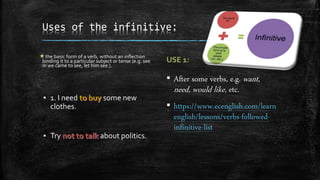
Uses of the infinitive:
the basic form of a verb, without an inflection
binding it to a particular subject or tense (e.g. see
in we came to see, let him see ).
▪ 1. I need some new
clothes.
▪ Try about politics.
▪ After some verbs, e.g. want,
need, would like, etc.
▪ https://www.ecenglish.com/learn
english/lessons/verbs-followed-
infinitive-list
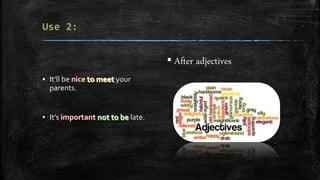
▪ It’ll be your
parents.
▪ It’s late.
▪ After adjectives
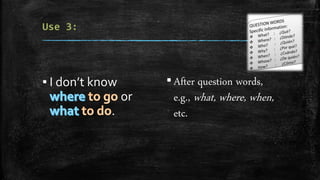
▪ I don’t know
or
.
▪After question words,
e.g., what, where, when,
etc.
▪ A: did you go to the party?
▪ B:To meet new people.
I went to the party to meet
new people.
▪ To say why you do
something.
▪ E.g. I came to this school
English. NOT for learn
English.
BASE FORM
Remember that we use the base form after auxiliary verbs (do/does /didn’t) and after most
modal verbs (can, could, will, would, etc.), e.g.,
Do you live near here?
Can you help me?
I won’t forget.
What would you do?
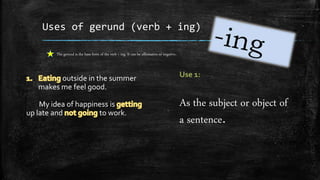
Uses of gerund (verb + ing)
outside in the summer
makes me feel good.
My idea of happiness is
up late and to work.
The gerund is the base form of the verb + ing. It can be affirmative or negative.
As the subject or object of
a sentence.
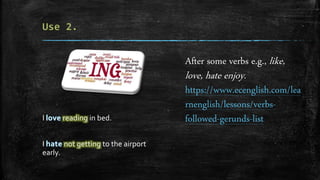
I reading in bed.
I not getting to the airport
early.
After some verbs e.g., like,
love, hate enjoy.
https://www.ecenglish.com/lea
rnenglish/lessons/verbs-
followed-gerunds-list
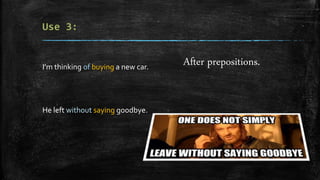
I’m thinking of buying a new car.
He left without saying goodbye.
After prepositions.
Sources:
https://www.ecenglish.com/le
arnenglish/lessons/verbs-
followed-infinitive-list
Oxenden, Clive. American
English File. Oxford

Infinitives and gerunds

  • 1.
  • 2.
    Uses of theinfinitive: the basic form of a verb, without an inflection binding it to a particular subject or tense (e.g. see in we came to see, let him see ). ▪ 1. I need some new clothes. ▪ Try about politics. ▪ After some verbs, e.g. want, need, would like, etc. ▪ https://www.ecenglish.com/learn english/lessons/verbs-followed- infinitive-list
  • 3.
    ▪ It’ll beyour parents. ▪ It’s late. ▪ After adjectives
  • 4.
    ▪ I don’tknow or . ▪After question words, e.g., what, where, when, etc.
  • 5.
    ▪ A: didyou go to the party? ▪ B:To meet new people. I went to the party to meet new people. ▪ To say why you do something. ▪ E.g. I came to this school English. NOT for learn English.
  • 6.
    BASE FORM Remember thatwe use the base form after auxiliary verbs (do/does /didn’t) and after most modal verbs (can, could, will, would, etc.), e.g., Do you live near here? Can you help me? I won’t forget. What would you do?
  • 7.
    Uses of gerund(verb + ing) outside in the summer makes me feel good. My idea of happiness is up late and to work. The gerund is the base form of the verb + ing. It can be affirmative or negative. As the subject or object of a sentence.
  • 8.
    I reading inbed. I not getting to the airport early. After some verbs e.g., like, love, hate enjoy. https://www.ecenglish.com/lea rnenglish/lessons/verbs- followed-gerunds-list
  • 9.
    I’m thinking ofbuying a new car. He left without saying goodbye. After prepositions.
  • 10.