Wh-Cleft Sentences
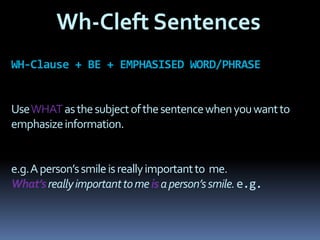
Wh-Cleft Sentences
WH-Clause + BE + EMPHASISED WORD/PHRASE

Use WHAT as the subject of the sentence when you want to
emphasize information.

e.g. A person’s smile is really important to me.
What’s really important to me is a person’s smile.
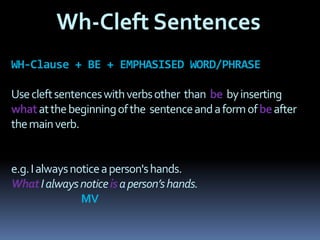
Wh-Cleft Sentences
WH-Clause + BE + EMPHASISED WORD/PHRASE
Use cleft sentences with verbs other than be by inserting
what at the beginning of the sentence and a form of be after
the main verb.

e.g. I always notice a person's hands.
What I always notice is a person’s hands.
MV
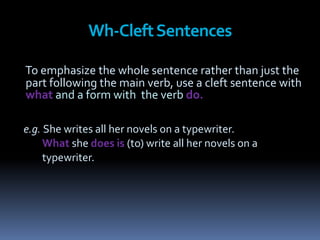
Wh-Cleft Sentences
To emphasize the whole sentence rather than just the
part following the main verb, use a cleft sentence with
what and a form with the verb do.
e.g. She writes all her novels on a typewriter.
What she does is (to) write all her novels on a
typewriter.
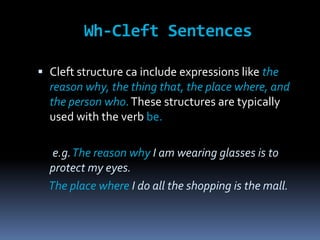
Wh-Cleft Sentences
 Cleft structure can include expressions like the
reason why, the thing that, the place where, and

the person who. These structures are typically
used with the verb be.
e.g. The reason why I am wearing glasses is to
protect my eyes.
The place where I do all the shopping is the mall.

Wh Cleft Sentences

  • 1.
  • 2.
    Wh-Cleft Sentences WH-Clause +BE + EMPHASISED WORD/PHRASE Use WHAT as the subject of the sentence when you want to emphasize information. e.g. A person’s smile is really important to me. What’s really important to me is a person’s smile.
  • 3.
    Wh-Cleft Sentences WH-Clause +BE + EMPHASISED WORD/PHRASE Use cleft sentences with verbs other than be by inserting what at the beginning of the sentence and a form of be after the main verb. e.g. I always notice a person's hands. What I always notice is a person’s hands. MV
  • 4.
    Wh-Cleft Sentences To emphasizethe whole sentence rather than just the part following the main verb, use a cleft sentence with what and a form with the verb do. e.g. She writes all her novels on a typewriter. What she does is (to) write all her novels on a typewriter.
  • 5.
    Wh-Cleft Sentences  Cleftstructure can include expressions like the reason why, the thing that, the place where, and the person who. These structures are typically used with the verb be. e.g. The reason why I am wearing glasses is to protect my eyes. The place where I do all the shopping is the mall.