Introduction to Infection
Prevention Control (IPC) in
Healthcare Settings
By Moses O.
Learning Objectives
By the end of this module, the participants should be able to:
• Define Infection Prevention and Control (IPC) and
healthcare-associated infections (HAIs)
• Explain the benefits of adherence to IPC practices
• Describe structures for management and coordination of IPC
Definition of Terms
• IPC: A set of practices, protocols, and procedures
that are put in place to prevent infections that are
associated with healthcare service provision settings
HAIs are infections that patients / health care
providers develop in the course of receiving
treatment.
Introduction
• Healthcare environment are ideal settings for the transmission of
infections
• Patients / sick animals have infections they can transmit to other
patients / animals and healthcare workers
• Sick patients /animals are more susceptible to infections
• Procedures increase patient risk of infection
• IPC addresses reduction of risks of transmitting infections to the
patient, the care provider and to the environment
Historical Evolution of IPC
5
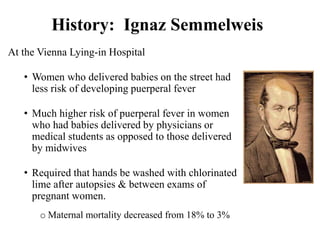
History: Ignaz Semmelweis
At the Vienna Lying-in Hospital
• Women who delivered babies on the street had
less risk of developing puerperal fever
• Much higher risk of puerperal fever in women
who had babies delivered by physicians or
medical students as opposed to those delivered
by midwives
• Required that hands be washed with chlorinated
lime after autopsies & between exams of
pregnant women.
o Maternal mortality decreased from 18% to 3%
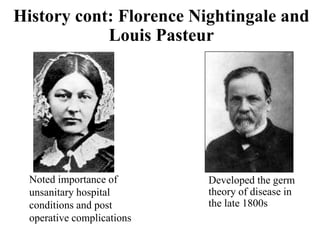
History cont: Florence Nightingale and
Louis Pasteur
Developed the germ
theory of disease in
the late 1800s
Noted importance of
unsanitary hospital
conditions and post
operative complications
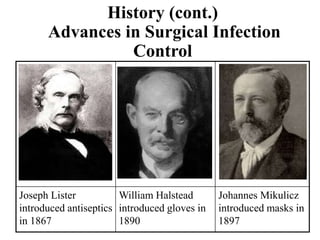
History (cont.)
Advances in Surgical Infection
Control
Joseph Lister
introduced antiseptics
in 1867
William Halstead
introduced gloves in
1890
Johannes Mikulicz
introduced masks in
1897
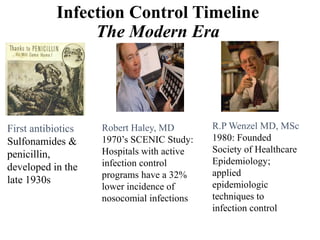
Infection Control Timeline
The Modern Era
First antibiotics
Sulfonamides &
penicillin,
developed in the
late 1930s
Robert Haley, MD
1970’s SCENIC Study:
Hospitals with active
infection control
programs have a 32%
lower incidence of
nosocomial infections
R.P Wenzel MD, MSc
1980: Founded
Society of Healthcare
Epidemiology;
applied
epidemiologic
techniques to
infection control
Infection Control Timeline (cont.)
• 1981 - MRSA was discovered
• 1990’s - Expanded role of IPC to non-acute settings
• 2000’s - Expanded role to ā€œquality promotion
across the healthcare delivery system
So Where Are We Now and What
Happens Next?
Healthcare-Associated Infections
• Burden of HAIs and risk of antimicrobial resistance
(AMR) is increasing in sub-Saharan Africa
o HAI inpatient rate of estimated at 20%
o Some research indicates it may be as high as 40% in
o Extent of HAIs in Kenya is unknown
• Actual extent of AMR in Kenya is also not fully
determined
o Observed trend in a few research sites indicate a rapid
increase of AMR
HAIs (cont.)
High cost of HAIs
• Direct cost to hospitals for the following:
oExtended hospital stay, extra resources, extra treatment, extra
equipment, extra community care and costs if discharged
needing follow-up
• Direct cost to patient/family for:
oPain and scarring, extended stay away from family, working
days lost, family income loss, financial strain, increased
visiting, increased morbidity and mortality
HAIs (cont.)
The benefits of adherence to IPC policies and
guidelines include:
• Quality of health care improves
• Reduces risks of healthcare workers acquiring an
infection
• Lowers cost of health care
What Causes Infections?
• Normal flora: Microorganisms normally found on and in the body
which are not harmful
o Normal flora can also lead to infection under special
circumstances when entering internal organs during surgery or
in an immuno-compromised person
• Pathogens: Microorganisms not normally found on or in the human
body and are associated with disease and include: bacteria, viruses,
fungi, protozoa, helminthes and prions
o Infections are caused when the pathogens enter the body,
reproduce and cause diseases
Modes of Infection Transmission
• Contact: Direct transfer of microorganisms through touch
of bodily fluids
• Vehicle: The material that serves as the mode of transfer of
microorganisms, such as food, water, or air
• Vector: An organism that carries or transmits a pathogen.
These include insects, such as mosquitoes or fleas
IPC Practices
• IPC practices to prevent HAIs are broadly
categorized into:
o Standard precautions
o Additional precautions (also called transmission-
based precautions)
Standard Precautions
• Strategies for standard precautions include:
ļ‚§ Hand hygiene
ļ‚§ Use of personal protective equipment (PPE)
ļ‚§ Prevention of needle stick and injuries from other sharp
instruments
ļ‚§ Respiratory hygiene and cough etiquette
ļ‚§ Environmental cleaning
ļ‚§ Management of linen
ļ‚§ Management of healthcare waste
ļ‚§ Management of patient care equipment
Additional Precautions
Transmission-Based Precautions
Standard precautions plus:
• Contact precautions
• Droplet precautions
• Airborne precaution
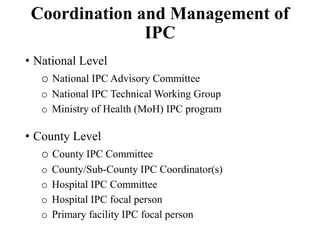
Coordination and Management of
IPC
• National Level
o National IPC Advisory Committee
o National IPC Technical Working Group
o Ministry of Health (MoH) IPC program
• County Level
o County IPC Committee
o County/Sub-County IPC Coordinator(s)
o Hospital IPC Committee
o Hospital IPC focal person
o Primary facility IPC focal person
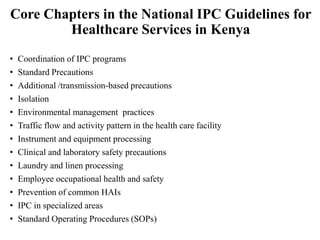
Core Chapters in the National IPC Guidelines for
Healthcare Services in Kenya
• Coordination of IPC programs
• Standard Precautions
• Additional /transmission-based precautions
• Isolation
• Environmental management practices
• Traffic flow and activity pattern in the health care facility
• Instrument and equipment processing
• Clinical and laboratory safety precautions
• Laundry and linen processing
• Employee occupational health and safety
• Prevention of common HAIs
• IPC in specialized areas
• Standard Operating Procedures (SOPs)
22
What We Have Learned
• The importance of IPC
• Definition of IPC and HAIs
• Historic perspective of IPC
• The benefits for adhering to IPC practices
• Introduced the governance structure for IPC

Infection Prevention and Control.ppt

  • 1.
    Introduction to Infection PreventionControl (IPC) in Healthcare Settings By Moses O.
  • 2.
    Learning Objectives By theend of this module, the participants should be able to: • Define Infection Prevention and Control (IPC) and healthcare-associated infections (HAIs) • Explain the benefits of adherence to IPC practices • Describe structures for management and coordination of IPC
  • 3.
    Definition of Terms •IPC: A set of practices, protocols, and procedures that are put in place to prevent infections that are associated with healthcare service provision settings HAIs are infections that patients / health care providers develop in the course of receiving treatment.
  • 4.
    Introduction • Healthcare environmentare ideal settings for the transmission of infections • Patients / sick animals have infections they can transmit to other patients / animals and healthcare workers • Sick patients /animals are more susceptible to infections • Procedures increase patient risk of infection • IPC addresses reduction of risks of transmitting infections to the patient, the care provider and to the environment
  • 5.
  • 6.
    History: Ignaz Semmelweis Atthe Vienna Lying-in Hospital • Women who delivered babies on the street had less risk of developing puerperal fever • Much higher risk of puerperal fever in women who had babies delivered by physicians or medical students as opposed to those delivered by midwives • Required that hands be washed with chlorinated lime after autopsies & between exams of pregnant women. o Maternal mortality decreased from 18% to 3%
  • 7.
    History cont: FlorenceNightingale and Louis Pasteur Developed the germ theory of disease in the late 1800s Noted importance of unsanitary hospital conditions and post operative complications
  • 8.
    History (cont.) Advances inSurgical Infection Control Joseph Lister introduced antiseptics in 1867 William Halstead introduced gloves in 1890 Johannes Mikulicz introduced masks in 1897
  • 9.
    Infection Control Timeline TheModern Era First antibiotics Sulfonamides & penicillin, developed in the late 1930s Robert Haley, MD 1970’s SCENIC Study: Hospitals with active infection control programs have a 32% lower incidence of nosocomial infections R.P Wenzel MD, MSc 1980: Founded Society of Healthcare Epidemiology; applied epidemiologic techniques to infection control
  • 10.
    Infection Control Timeline(cont.) • 1981 - MRSA was discovered • 1990’s - Expanded role of IPC to non-acute settings • 2000’s - Expanded role to ā€œquality promotion across the healthcare delivery system
  • 11.
    So Where AreWe Now and What Happens Next?
  • 12.
    Healthcare-Associated Infections • Burdenof HAIs and risk of antimicrobial resistance (AMR) is increasing in sub-Saharan Africa o HAI inpatient rate of estimated at 20% o Some research indicates it may be as high as 40% in o Extent of HAIs in Kenya is unknown • Actual extent of AMR in Kenya is also not fully determined o Observed trend in a few research sites indicate a rapid increase of AMR
  • 13.
    HAIs (cont.) High costof HAIs • Direct cost to hospitals for the following: oExtended hospital stay, extra resources, extra treatment, extra equipment, extra community care and costs if discharged needing follow-up • Direct cost to patient/family for: oPain and scarring, extended stay away from family, working days lost, family income loss, financial strain, increased visiting, increased morbidity and mortality
  • 14.
    HAIs (cont.) The benefitsof adherence to IPC policies and guidelines include: • Quality of health care improves • Reduces risks of healthcare workers acquiring an infection • Lowers cost of health care
  • 15.
    What Causes Infections? •Normal flora: Microorganisms normally found on and in the body which are not harmful o Normal flora can also lead to infection under special circumstances when entering internal organs during surgery or in an immuno-compromised person • Pathogens: Microorganisms not normally found on or in the human body and are associated with disease and include: bacteria, viruses, fungi, protozoa, helminthes and prions o Infections are caused when the pathogens enter the body, reproduce and cause diseases
  • 16.
    Modes of InfectionTransmission • Contact: Direct transfer of microorganisms through touch of bodily fluids • Vehicle: The material that serves as the mode of transfer of microorganisms, such as food, water, or air • Vector: An organism that carries or transmits a pathogen. These include insects, such as mosquitoes or fleas
  • 17.
    IPC Practices • IPCpractices to prevent HAIs are broadly categorized into: o Standard precautions o Additional precautions (also called transmission- based precautions)
  • 18.
    Standard Precautions • Strategiesfor standard precautions include: ļ‚§ Hand hygiene ļ‚§ Use of personal protective equipment (PPE) ļ‚§ Prevention of needle stick and injuries from other sharp instruments ļ‚§ Respiratory hygiene and cough etiquette ļ‚§ Environmental cleaning ļ‚§ Management of linen ļ‚§ Management of healthcare waste ļ‚§ Management of patient care equipment
  • 19.
    Additional Precautions Transmission-Based Precautions Standardprecautions plus: • Contact precautions • Droplet precautions • Airborne precaution
  • 20.
    Coordination and Managementof IPC • National Level o National IPC Advisory Committee o National IPC Technical Working Group o Ministry of Health (MoH) IPC program • County Level o County IPC Committee o County/Sub-County IPC Coordinator(s) o Hospital IPC Committee o Hospital IPC focal person o Primary facility IPC focal person
  • 21.
    Core Chapters inthe National IPC Guidelines for Healthcare Services in Kenya • Coordination of IPC programs • Standard Precautions • Additional /transmission-based precautions • Isolation • Environmental management practices • Traffic flow and activity pattern in the health care facility • Instrument and equipment processing • Clinical and laboratory safety precautions • Laundry and linen processing • Employee occupational health and safety • Prevention of common HAIs • IPC in specialized areas • Standard Operating Procedures (SOPs)
  • 22.
    22 What We HaveLearned • The importance of IPC • Definition of IPC and HAIs • Historic perspective of IPC • The benefits for adhering to IPC practices • Introduced the governance structure for IPC