China’s cosmetics market, 2011
            February 2012
      Li & Fung Research Centre
In this issue:


     I.    Industry overview                   p. 3

     II.   Competitive landscape               p.18

     III. Latest developments                  p.30

     IV. Snapshots of sub-sector performance   p.45


                                                      2
I.   Industry Overview

     (1) Market Size

     (2) Retail price of cosmetics

     (3) Distribution channels


                                     3
Growth of China’s cosmetics retail value accelerated in
2011

   According to the National Bureau of Statistics of China (NBS), retail sales of
   cosmetics of enterprises above designated size* reached 110.3 billion yuan
   in 2011, up nominally by 18.7% year-on-year (yoy).

   China’s cosmetics market has demonstrated faster growth in 2011 (18.7%
   yoy) than that in 2010 (16.6% yoy).

 Exhibit 1. Retail value of cosmetics by wholesale and retail enterprises above designated size*: 2007-2011

   120                                         110.3   30%
   100                                 88.9            25%
    80                         74.0                    20%
                  59.7
    60    48.8                                         15%
    40                                                 10%   yoy growth (%)        FY10      1Q11       1H11   FY11
    20                                                 5%    Cosmetics              16.6      17.8      20.0   18.7
     0                                                 0%
          2007    2008         2009    2010    2011
                 Sales value          Growth


 Source: National Bureau of Statistics of China (NBS)                                                            4
* Designated size: with annual sales of 5 million yuan or above and with an employment of or over 60.
Cosmetics retail sales in lower-tier cities are fast growing; yet first- and
second-tier cities captured a bigger share of the market


   According to China National Commercial Information Centre (CNCIC),
   cosmetics retail sales rose by 28.2% yoy in third-tier cities in 2010, faster
   than those realized in the first- (15.8%) and second-tier cities (17.0%).

   Although cosmetics sales in lower-tier cities are growing fast, big cities still
   capture a larger share of the market.
    − According to a report* by the Hong Kong Trade and Development Coucil
      (HKTDC), retail sales of cosmetics in Shanghai, Beijing, Jiangsu, Guangzhou,
      Zhejiang and Shandong accounted for more than 55% of the national total.
      Among these cities, Shanghai made up the largest proportion of the total retail
      sales of cosmetics, stood at 12%, followed by Beijing, Jiangsu and Guangdong,
      representing 11%, 9% and 9% respectively.


  *Source: Cosmetics market in China, HKTDC, 2011

                                                                                   5
I.   Industry Overview

     (1) Market Size

     (2) Retail price of cosmetics

     (3) Distribution channels


                                     6
Retail price of cosmetics has been rising in 2011


   Retail price index of cosmetics in China has been rising. The index rose
   above 101.6 starting from August 2011.

   Although the tax levied on imported cosmetics has been reduced from 6.5%
   to 5% since 1 January 2012, market experts observe that retail price of
   many imported cosmetics products remains high.

 Exhibit 2. Retail price index of cosmetics in China, January 2010-December 2011 (Same month of preceding
 year = 100)
 102.0

 101.5

 101.0

 100.5

 100.0

  99.5

  99.0


Source: National Bureau of Statistics of China (NBS)
                                                                                                            7
Escalating cost pressure on cosmetics retailers


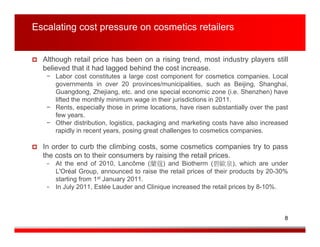
  Although retail price has been on a rising trend, most industry players still
  believed that it had lagged behind the cost increase.
   − Labor cost constitutes a large cost component for cosmetics companies. Local
     governments in over 20 provinces/municipalities, such as Beijing, Shanghai,
     Guangdong, Zhejiang, etc. and one special economic zone (i.e. Shenzhen) have
     lifted the monthly minimum wage in their jurisdictions in 2011.
   − Rents, especially those in prime locations, have risen substantially over the past
     few years.
   − Other distribution, logistics, packaging and marketing costs have also increased
     rapidly in recent years, posing great challenges to cosmetics companies.

  In order to curb the climbing costs, some cosmetics companies try to pass
  the costs on to their consumers by raising the retail prices.
   − At the end of 2010, Lancôme (蘭蔻) and Biotherm (碧歐泉), which are under
     L'Oréal Group, announced to raise the retail prices of their products by 20-30%
     starting from 1st January 2011.
   − In July 2011, Estée Lauder and Clinique increased the retail prices by 8-10%.


                                                                                     8
I.   Industry Overview

     (1) Market Size

     (2) Retail price of cosmetics

     (3) Distribution channels


                                     9
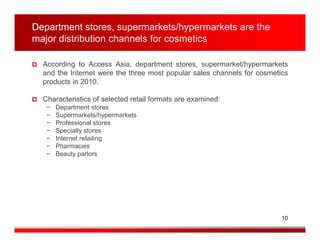
Department stores, supermarkets/hypermarkets are the
major distribution channels for cosmetics

  According to Access Asia, department stores, supermarket/hypermarkets
  and the Internet were the three most popular sales channels for cosmetics
  products in 2010.

  Characteristics of selected retail formats are examined:
   −   Department stores
   −   Supermarkets/hypermarkets
   −   Professional stores
   −   Specialty stores
   −   Internet retailing
   −   Pharmacies
   −   Beauty parlors


                                                                         10
Characteristics of selected distribution channels –
department stores

   Department stores


Pros
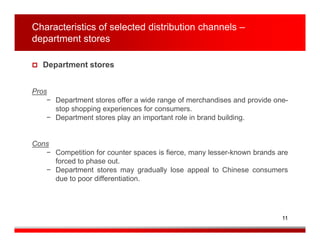
    − Department stores offer a wide range of merchandises and provide one-
      stop shopping experiences for consumers.
    − Department stores play an important role in brand building.


Cons
   − Competition for counter spaces is fierce, many lesser-known brands are
     forced to phase out.
   − Department stores may gradually lose appeal to Chinese consumers
     due to poor differentiation.


                                                                         11
Characteristics of selected distribution channels –
supermarkets/hypermarkets

   Supermarkets/hypermarkets


Pros
    − Supermarkets/hypermarkets are important channels particularly for low-
      to mid-range cosmetics products (e.g. shampoo, facial cleanser). That
      being said, more high-end cosmetics brands, especially foreign-owned
      ones, are sold in supermarkets/hypermarkets.


Cons
   − The entry costs of supermarkets/hypermarkets have been escalating
     over the past years; some weaker local brands are facing tough cost
     challenges.


                                                                          12
Characteristics of selected distribution channels –
professional stores

  Professional stores

   − Professional stores are “one-stop shop” for customers to shop for
     cosmetics and accessories. Examples include Hong Kong-based
     Watsons and Sasa, France-based Sephora, and China-based Gialen
     (嬌蘭佳人) and Cosmart (歌詩瑪).

   − Professional stores offer a wide variety of cosmetics brands in different
     quality and price tiers, catering to different needs of customers.

   − However, quality of products available in professional stores is less
     assured as there may be other substandard parallel imports and even
     counterfeit products being sold in the professional stores.


                                                                            13
Characteristics of selected distribution channels –
specialty stores

  Specialty stores

   − Specialty stores help promote brand image, ensure high quality services
     and standardized prices.

   − Moreover, cosmetics brand owners can achieve autonomy over store
     operation through opening specialty stores.

   − Korean brands such as Skin Food, Etude House and Missha are
     especially interested in distributing their products through specialty
     stores and department stores to avoid high distribution cost in
     hypermarkets.

   − It is expected that specialty stores will become another key retail
     channel for cosmetics as large shopping complexes spring up in these
     years.

   − Nevertheless, some specialty stores are small-scaled, scattered and
     disordered.
                                                                          14
Characteristics of selected distribution channels –
Internet retailing

  Internet retailing

   − There are many types of B2C online retailing portal in China. Below are
     some of the examples.

         Brands operating their own online stores:
           • Lancôme (http://www.lancome.com.cn)
           • Biotherm (http://www.biotherm.com.cn)

         B2C online platform operators that provide a wide range of
         cosmetics brands in different price tiers:
           • Strawberrynet.com (草莓網)
           • Sasa.com (香港莎莎網)

         Group purchase websites that offer cosmetics products at
         discounted price:
           • Gaopeng.com (高朋網)
           • Meituan.com (美團網)

         Online agents that help Chinese customers buy foreign cosmetics
         brands.
                                                                           15
Characteristics of selected distribution channels –
pharmacies

  Pharmacies

   − Selling cosmetics products in pharmacies facilitates repeat purchases.
     Many pharmacies in China are keen to introduce cosmetics products as
     they can generate better profit margins.

   − Many branded cosmeceuticals are distributed via pharmacies. France-
     based    Vichy,   La    Roche-Posay,        China-based     Longliqi
     (隆力奇) and Cortry (可采) are some of the commonly found brands in
     pharmacies.


                                                                         16
Characteristics of selected distribution channels –
beauty parlors

    Beauty parlors

      − According to a survey* conducted by HKTDC, the average spending of
        the respondents at beauty parlors was 2,832 yuan in 2010.
        Respondents from Shanghai spent the most (4,951 yuan) at beauty
        parlors, followed by Beijing (3,528 yuan), Guangzhou (3,078 yuan) and
        Chengdu (2,458 yuan).

      − In fact, many beauty parlors sell their own brands or act as agents to
        distribute other brands in Asia.

      − Examples of beauty parlors in China include Herborist SPA (佰草集漢方
        SPA) and Natural Beauty SPA (自然美SPA生活舘).


                                                                                        17
 *Source: At your service: a rising sector for the Mainland middle class, HKTDC, 2011
II. Competitive landscape

    (1) Foreign cosmetics companies

    (2) Domestics cosmetics companies


                                        18
Foreign cosmetics companies are keen to capture a larger
share of China’s cosmetics market

  Foreign companies are vying for a larger market share in the mass market
  of China’s cosmetics market.

   − For example, it is reported that L'Oréal would expand into 600 second-tier cities
     to reach untapped customer base.

   − US cosmetics firm Mary Kay planned to invest 25 million USD in building a
     distribution centre in China, which is poised to surpass the US to be its largest
     market by 2013, according to media reports.

   − Another US cosmetics company Avon opened a R&D center in China in August
     2011, which is the largest facility of its company outside the US.

   − Estée Lauder unveiled a plan to penetrate more Chinese cities and add more e-
     commerce channels for some of its brands such as Origin and Bobbi Brown in
     the next three years.


                                                                                   19
Foreign cosmetics companies are keen to capture a larger
share of China’s cosmetics market (cont’d)

  Foreign companies are vying for a larger market share in the mass market
  of China’s cosmetics market. (cont’d)

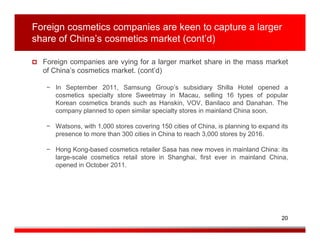
   − In September 2011, Samsung Group’s subsidiary Shilla Hotel opened a
     cosmetics specialty store Sweetmay in Macau, selling 16 types of popular
     Korean cosmetics brands such as Hanskin, VOV, Banilaco and Danahan. The
     company planned to open similar specialty stores in mainland China soon.

   − Watsons, with 1,000 stores covering 150 cities of China, is planning to expand its
     presence to more than 300 cities in China to reach 3,000 stores by 2016.

   − Hong Kong-based cosmetics retailer Sasa has new moves in mainland China: its
     large-scale cosmetics retail store in Shanghai, first ever in mainland China,
     opened in October 2011.


                                                                                    20
Foreign companies are more competitive in the mid- to
high-end and luxury segments

  Currently, foreign brands have gained a firm foothold in the mid- to high-end
  and luxury cosmetics market in China.

  On the other hand, domestic companies are mainly competing in the low-
  end market.

  With solid foundation in high-end cosmetics market operation, foreign
  brands now expand beyond the high-end market, aiming to penetrate the
  mass market in China.
   − For example, L'Oréal introduced several middle-range cosmetics brands such as
     Garnier, L'Oréal Paris, Maybelline New York, etc. to target the mass market.


                                                                               21
Foreign cosmetics enterprises and their major brands in
China

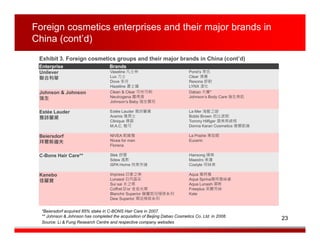
 Exhibit 3 shows the major foreign cosmetics groups and their major brands
 in China.
 Exhibit 3. Foreign cosmetics groups and their major brands in China
 Enterprise       Brands
 L’Oréal          L’Oréal Paris 巴黎歐萊雅                shu uemura 植村秀                Biotherm 碧歐泉
 歐萊雅              Garnier 卡尼爾                        Giorgio Armani 喬治 阿瑪尼         Helena Rubinstein HR 赫蓮娜
                  Maybelline New York 美寶蓮紐約          LA ROCHE-POSAY理膚泉             Kiehl’s Matrix 美奇絲
                  L’Oréal Professional 歐萊雅專業美髮       Mininurse 小護士                 Skinceuticals
                  Kérastase 卡詩                       Yue Sai 羽西
                  Lancôme 蘭蔻                         Vichy 薇姿

 P&G              Head & Shoulders 海飛絲               Vidal Sasson 沙宣               Camay 卡玫爾
 寶潔               Rejoice 飄柔                         Clairol Herbal Essences 伊卡璐   Pantene 潘婷
                  SK-II                              Wella 威娜                      Olay 玉蘭油

 Shiseido         Shiseido 資生堂                       UNO 吾諾                        Shiseido Eudermine 紅色蜜露
 資生堂              Shiseido Men資生堂男士                  PF-Cover 無瑕修顏                 Za 姬芮
                  Clé de peau beauté 珂麗柏蒂            DQ 蒂珂                         Aqua Label 水之印
                  Revital 悅薇                         The Skincare 水活煥妍             Be 彼嘉
                  UV White 優白                        Beneflance 盼麗風姿               Aquair 水之密語
                  Anessa 安熱沙                         Pureness 飄爾麗思                 Perfect 洗顔專科
                  Aupres 歐珀萊                         White Lucent 透白美肌             Kuyura 可悠然
                  Supreme Aupres 思魅歐珀萊               Soi Pure & Mile 泊美舒亞          Super Mild 惠潤
                  Urara 悠萊                           Shanghai Bouquet 上海花漪         Maquillage 心機彩妝
                  Elixir 怡麗絲爾                        Qi 綺怡                         Tessera 欣香
                  Elixir Superieur 怡麗絲爾優悅活顏          Zen 世紀禈香氛                     Hand Cream 美潤護手霜
                  Melanreduce 臻白無瑕                   Bio Performance 百優            Handasui 肌水
                  Asplir 愛泊麗                         Future Solution LX 時光硫璃御藏     Tsubaki 絲蓓綺
                  Whitia 白娣顔                         Body Creator 美體造型             Pure & Mild 泊美
                  Selfit 珊妃                          Dicila 蒂思嵐
                                                                                                              22
 Source: Li & Fung Research Centre and respective company websites
Foreign cosmetics enterprises and their major brands in
China (cont’d)
 Exhibit 3. Foreign cosmetics groups and their major brands in China (cont’d)
 Enterprise                         Brands
 Unilever                            Vaseline 凡士林                            Pond’s 旁氏
 聯合利華                                Lux 力士                                  Clear 清揚
                                     Dove 多芬                                 Rexona 舒耐
                                     Hazeline 夏士蓮                            LYNX 凌仕
 Johnson & Johnson                   Clean & Clear 可伶可俐                      Dabao 大寶*
 強生                                  Neutrogena 露得清                          Johnson’s Body Care 強生美肌
                                     Johnson’s Baby 強生嬰兒

 Estée Lauder                        Estée Lauder 雅詩蘭黛                       La Mer 海藍之謎
 雅詩蘭黛                                Aramis 雅男士                              Bobbi Brown 芭比波朗
                                     Clinique 倩碧                             Tommy Hilfiger 唐美希緋格
                                     M.A.C. 魅可                               Donna Karan Cosmetics 唐娜凱倫

 Beiersdorf                          NIVEA 妮維雅                               La Prairie 莱珀妮
 拜爾斯道夫                               Nivea for men                           Eucerin
                                     Florena

 C-Bons Hair Care**                  Slek 舒雷                                 Hairsong 順爽
                                     Sdew 風影                                 Maestro 美濤
                                     iSPA Home 悅美芳達                          Costyle 珂絲美

 Kanebo                              Impress 印象之美                            Aqua 雅呵雅
 佳麗寶                                 Lunasol 日月晶采                            Aqua Sprina雅呵雅絲睿
                                     Sui sai 水之璨                             Aqua Lunash 潤希
                                     Coffret D’or 金炫光燦                       Freeplus 芙麗芳絲
                                     Blanchir Superior 馥蘭哲兒極致系列              Kate
                                     Dew Superior 潤活極致系列


  *Beiersdorf acquired 85% stake in C-BONS Hair Care in 2007.
  ** Johnson & Johnson has completed the acquisition of Beijing Dabao Cosmetics Co. Ltd. in 2008.
                                                                                                          23
  Source: Li & Fung Research Centre and respective company websites
Foreign cosmetics enterprises and their major brands in
China (cont’d)
 Exhibit 3. Foreign cosmetics groups and their major brands in China (cont’d)
 Enterprise                    Brands
 Kao                           Kao 花王                                Asience 亞羨姿
 花王                            Bioré 碧柔                              Sifoné 詩芬
                               Men’s Bioré 碧柔男士                      Feather 花王飛逸
                               Sofina 蘇菲娜                            Curél 珂潤
                               Est

 Kosé                          Kosé 高絲                               Avenir 艾文莉
 高絲                            Beauté de Kosé美諦高絲                    Recipe-O 蘭哲歐
                               Prédia 貝締雅                            Junkisei 潤肌精
                               Sekkisei 雪肌精                          White St 妍哲
                               Sekkisei Supreme雪肌精 Supreme           Nature & 娜蔻
                               Refine 萊菲                             Moisture Skin Repair
                               Esprique                              Astalution
                               Junkisui 純肌粋                          Grandaine葛倫黛娜
                               Seikisho清肌晶                           Infinity
                               白澄

 Avon Products, Inc.           Avon 雅芳
 美国雅芳产品有限公司

 Amore Pacific Corp            Laneige 蘭芝                            Amore 爱茉莉
 愛茉莉太平洋集團                      Mamode 夢妝                             Sulwhasoo 雪花秀


 Nu Skin Enterprise Inc.       Nu Skin 如新
 如新集團

 LVMH Group                    Guerlain 嬌蘭


 DHC Corp                      DHC
 Source: Li & Fung Research Centre and respective company websites
                                                                                            24
II. Competitive landscape

    (1) Foreign cosmetics companies

    (2) Domestics cosmetics companies


                                        25
Domestic brands are more competitive in the mass market


  Generally, domestic players focus on second- and third-tier cities, offering
  value-for-money products.

  In recent years, a number of local cosmetics brands have caught up with
  their international counterparts. Some local brands that have gained
  increasing attention include: Herborist (佰草集), Chcedo (自然堂), Chinfie (
  清妃), Cheng Ming Ming (鄭明明), Caisy (采詩) and Longliqi, etc.


                                                                            26
Domestic cosmetics enterprises and their major brands in
China
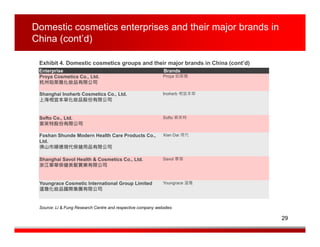
     Exhibit 4 shows some major domestic cosmetics groups and their major
     brands in China.
  Exhibit 4. Domestic cosmetics groups and their major brands in China
  Enterprise                                         Brands
  Shanghai Jahwa Co., Ltd.*                          Maxam 美加淨           Gf 高夫
  上海家化集團                                             Chinfié 清妃          Liushen 六神
                                                     Herborist 佰草集       Cocool 珂珂
                                                     ShanghaiVive雙妹

  Sichuan Jahwa Cortry Cosmetics Co. Ltd** Cortry 可采                     LiveliCutee 伶采
  四川家化可采化妝品股份有限公司

  Jiangsu Longliqi Group Co., Ltd.                   Longliqi 隆力奇        YaFei 雅妃
  江蘇隆力奇集團                                            Yuzhibao 浴之寶        Evergreen 雅妍

  Arche Cosmetics Co., Ltd                           BNS 繽麗              Effi 玉麗
  廣東雅倩化妝品有限公司                                        Ariar 清逸            Airiny 維鮮
                                                     Cathy 佳雪

  Zhuhai Sunrana Cosmetics Co., Ltd.                 Sunrana 姍拉娜
  珠海姍拉娜化妝品有限公司

  Bawang International                               Bawang 霸王           Men’s Bawang 霸王男士
  霸王國際集團                                             Herborn 本草堂         Royal Wind 追風
                                                     Litao 麗濤

 * Ping An Group has acquired 100% of share in Shanghai Jahwa in 2011.
 **Shanghai Jahwa has acquired 51% stake in Cortry in 2008.
 Source: Li & Fung Research Centre and respective company websites                           27
Domestic cosmetics enterprises and their major brands in
China (cont’d)

 Exhibit 4. Domestic cosmetics groups and their major brands in China (cont’d)
 Enterprise                                          Brands
 Shanghai Huayin Commodity Co., Ltd.                 Bee & Flower 蜂花
 上海華銀日用品有限公司
 Guangzhou Houdy Cosmetics Co., Ltd.                 Houdy 好迪          Coian 可靚
 廣州市好迪化妝品有限公司                                        Sincir 信婷         Tongle 童樂


 Decolor Cosmetics Co., Ltd.                         Decolor 迪彩        Crystal晶彩
 廣州市迪彩化妝品有限公司                                        Luxe-Lotus蓮尚      Lotuses 千蓮薈
                                                     Enevous 伊儂華       Nenuph 藍蓮花

 Nanjing Jianong Chemical Co., Ltd.                  TJOY*** 丁家宜       TJOY for men 丁家宜男士
 南京珈儂生化有限公司

 Lafang Group                                        Lafang 拉芳         Bétrue 繽純
 拉芳集團                                                Raclen 雨潔         Sunfeel 聖峰
                                                     Duo Zi 多姿         Mese 美多絲

 Guangzhou Tobaby Cosmetics Co., Ltd.                Tobaby 丹芭露
 廣州露純化妝品有限公司

 Huaya Group Co., Ltd.                               Franic 法蘭琳卡       Meifubao 美膚寶
 環亞化妝品科技有限公司

 Jala (Group) Co., Ltd.                              Chcedo 自然堂        Maysu 美素
 伽藍(集團)股份有限公司

 *** Coty has acquired a majority stake in TJOY in December 2010.                           28
 Source: Li & Fung Research Centre and respective company websites
Domestic cosmetics enterprises and their major brands in
China (cont’d)

 Exhibit 4. Domestic cosmetics groups and their major brands in China (cont’d)
 Enterprise                                                   Brands
 Proya Cosmetics Co., Ltd.                                   Proya 珀萊雅
 杭州珀萊雅化妝品有限公司

 Shanghai Inoherb Cosmetics Co., Ltd.                        Inoherb 相宜本草
 上海相宜本草化妝品股份有限公司


 Softo Co., Ltd.                                             Softo 索芙特
 索芙特股份有限公司

 Foshan Shunde Modern Health Care Products Co.,              Xian Dai 現代
 Ltd.
 佛山市順德現代保健用品有限公司

 Shanghai Savol Health & Cosmetics Co., Ltd.                 Savol 章華
 浙江章華保健美髮實業有限公司


 Youngrace Cosmetic International Group Limited              Youngrace 溫雅
 溫雅化妝品國際集團有限公司


 Source: Li & Fung Research Centre and respective company websites

                                                                                 29
III. Latest developments


                           30
1. Cosmetics brands are keen to explore online
    opportunities
          In response to changes in customers’ purchasing behavior and significant advancements in the
          online retail market, many cosmetics brands have been making use of online platforms to reach
          customers.

          According to iResearch, the transaction value of China’s online retailing market* was up by 75.3%
          yoy to reach 461.0 billion yuan in 2010, accounting for 2.98% of the country’s total retail sales.

          Cosmetics and personal care products ranked 4th among the most popular categories consumer
          purchased online in 2010.

        Exhibit 5. The most popular categories consumer purchased online, 2009-2010
                                   Apparel, footwear and bags
                              Books/music/movies and videos
                         Prepaid cards (e.g., top-up cards, etc)
                                 Cosmetics and personal care
                                      IT/digital/communication
                                                 Home products
                                                Healthcare food
                                                                                                                            2009
                             Maternity and baby care products
                                         Electronic appliances                                                              2010
                                                  Toys and gifts
                                                      Jewellery
                                                        Others

                                                                   0   5   10   15   20   25   30    35   40   45    50    %

        Source: iResearch: “2010-2011年中国网络购物用户行为研究报告简版”
*Accordingto iResearch, scale of online retailing market refers to the total transaction value of consumer-to-consumer (C2C) and business-to-
consumer (B2C) online businesses. Scale of C2C online retailing market is calculated by the total value of purchases, excluding that on the B2C
arm of C2C platforms. Scale of B2C online retailing market has excluded payments of travel expense, air tickets and online bill payment services. 31
1. Cosmetics brands are keen to explore online
opportunities (cont’d)

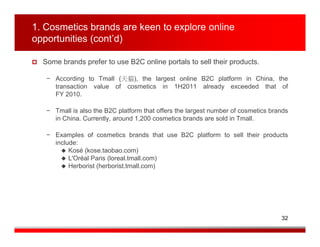
  Some brands prefer to use B2C online portals to sell their products.

   − According to Tmall (天貓), the largest online B2C platform in China, the
     transaction value of cosmetics in 1H2011 already exceeded that of
     FY 2010.

   − Tmall is also the B2C platform that offers the largest number of cosmetics brands
     in China. Currently, around 1,200 cosmetics brands are sold in Tmall.

   − Examples of cosmetics brands that use B2C platform to sell their products
     include:
          Kosé (kose.taobao.com)
          L'Oréal Paris (loreal.tmall.com)
          Herborist (herborist.tmall.com)


                                                                                   32
1. Cosmetics brands are keen to explore online
opportunities (cont’d)

  On the other hand, some brands prefer to start their own e-commerce
  operation to gain autonomy.

   − To reach more new customers, Shiseido started its own e-commerce operation
     in September 2011 by launching an exclusive online product line Pure & Mild Soi
     (http://www.puremild-soi.com/front/contents/top/).

   − Other cosmetics companies such as Lancôme, Estee Lauder and Clinique, etc.
     have also developed their own online stores.

  However, multi-channel retailers should also consider the possible conflicts
  between online and offline stores in terms of variety of products and prices.
  To avoid online channels cannibalizing sales of their offline stores and
  potential conflict of interests with existing distributors and franchisees,
  retailers have to pay extra attention to pricing strategies and to maintain
  online and offline consistency.


                                                                                 33
2. Cosmetics companies receive growing attention in the
capital market

   Recently, cosmetics companies in China have garnered increasing attention
   in the capital market.
     − Local cosmetics brands that have received investments from venture capitalists
       include Guangzhou-based companies Menplus (男性主義), Jimmi (九美子) and
       Ardme (雅茚), and Shanghai-based Cosmart, etc.

   An increasing number of cosmetics companies seek to raise capital through
   IPOs. It is believed that IPOs can generate capital to fund organic growth
   and support expansion. Furthermore, the brand image will be markedly
   improved.
     − Inoherb (相宜本草), Meifubao (美膚寶), Jala* (伽藍集團), Proya (珀萊雅) and
       MGPIN (毛戈平), etc. are cases in point.

   In November 2011, a subsidiary of China’s second biggest insurer Ping An
   Group won a bid for 100% share of Shanghai Jahwa Group, a famous
   domestic company which have a portfolio of cosmetics brands including
   Chinfie, GF (高夫), Shanghai Vive (雙妹), Maxam (美加淨) and Herborist.

                                                                                  34
*Jala Group owns famous local brands such as Maysu (美素), Chcedo(自然堂), etc.
3. Spending on marketing and advertising is huge in China


   To raise brand awareness, cosmetics players have spent huge sums of
   money on marketing and advertising in China.

   Marketing-to-expense ratio for many brands stayed high in 2011. According
   to “China cosmetics market: Amorepacific vs Shiseido” by Samsung
   Securities in July 2011, Shiseido’s marketing-to-expense ratio rose from
   22% in 2010 to 35% in 2011.

   According to a CTR survey*, cosmetics/toiletries (1.4%) contributed the
   most to the growth of 2011’s advertising spending in China (13%). In 2011,
   L'Oréal was the biggest spender on advertising in China.


                                                                           35
*Source: Advertising expenditure in China, 2011, CTR, 2011
4. Social media is becoming an important marketing tool for
cosmetics companies

 Today, social media is a very important marketing tool for cosmetics players
 to connect with their customers.

  − According to Thindov, a market research agency in China, 80% of the top 100
    cosmetics brands in China promoted their brands in Sina Weibo, the most
    popular Chinese microblog as of end-September 2011.


                                                                            36
5. Cosmeceutical market is gaining increasing attention


 Cosmeceuticals are cosmetics products with vitamins, herbs, pharmaceuticals
 or biologically active ingredients purporting to have medical benefits.

 According to the aforementioned report by HKTDC, more than 170 enterprises
 have entered the cosmeceuticals market. It is expected that the cosmeceutical
 market in China would grow by 10-20% yoy to reach 20 billion yuan in 3 to 5
 years.

 Indeed, many players have entered the cosmeceutical market in recent years.

  − Chinese supermarket operator Lianhua (聯華) has formed a partnership with Growell
    Group (a well-known cosmeceutical company in Japan) and Meiribuy (每日通販) (a
    Shanghai-based online platform selling Japanese products) in September 2011. They
    planned to open 8 cosmeceutical stores in the central areas of Shanghai in 2012.

  − China Resources Vanguard is also making inroads into China's health and beauty
    products retail sector. It opened up its first pharmaceutical and beauty retail shop in
    Xi'an in September 2011.

                                                                                        37
5. Cosmeceutical market is gaining increasing attention
(cont’d)

 Currently, the cosmeceutical market in China is dominated by foreign
 brands such as Vichy, La Roche-Posay, Freeplus and Simple. However,
 cosmeceuticals with Chinese herbal medicine are gaining increasing
 attention.

  − For example, domestic brands such as Tongrentang (同仁堂), Herborist,
    Yunnanbaiyao (雲南白藥), Inoherb, etc. are evolving.


                                                                    38
6. Male grooming market is growing fast


 Male grooming market is emerging in the cosmetics industry.
   − According to a report* by Alibaba Research Centre, the market size of male's skincare
     sector reached 4 billion yuan in 2010 (or 8 billion yuan if other male grooming products
     such as fragrance and color cosmetics are included).
   − Male's skincare sector grew by 27% yoy in 2009 and 40% yoy in 2010, five times
     faster than female skincare market.

 Many foreign and domestic brands have launched product lines for men.
   − Foreign brands: Garnier, Olay Men, Biotherm, Lancôme, Clique, Shiseido, Clarins,
     Vichy, Dior, etc.
   − Domestic brands: Dabao (大寳), Ruvanon (洛華儂),Dewa (蒂娃),Your-life Homme (悠
     蘭), Xiawa (夏娃), Chetti Rouge, Chcedo, etc.

 At the moment, most of the male’s grooming products are just extension of
 female product lines. Only a few brands concentrate solely on male’s grooming
 products.

 Facial cleansing product is the most popular product category for men.
 According to the report by HKTDC, there is an increasing demand for mask, UV
 Cream, aftershave moisturiser, deodorants and hair products for male.


 * Source: Statistics of China’s cosmetics market, 2010, Alibaba Group Research Centre    39
7. Children and baby care markets have enormous
potential

  According to Euromonitor, retail sales of China’s children care products are
  anticipated to reach 8.7 billion yuan by 2013, from 5.3 billion yuan in 2010.
  Euromonitor also forecasts that retail sales of China’s baby care will
  increase from 3.5 billion yuan in 2010 to 5.8 billion yuan by 2013.
   − Major players in the sector include Frog Prince (青蛙王子), Coati (小浣熊),
     Yumeijing (鬱美淨), Mentholatum and Johnson & Johnson.

  The number of retail stores selling mom and baby products has grown
  exponentially in recent years.
   − Retailers such as Redbaby (北京紅孩子), Lijiababy (麗家寶貝), Leyou (樂友),
     Aiyingshi (上海愛嬰室), etc. have opened massive retail stores providing skincare
     products for expectant mothers and babies.

  Some cosmetics brands have introduced skincare products specifically for
  expectant mothers and babies.
   − For example, a Chinese time-honored cosmetics brand Kong Fengchun (孔鳳春)
     has launched a new product line Mamale (媽媽樂) for expectant mothers; local
     cosmetics company TJOY (丁家宜) has introduced bbjoy (貝倍驕) for babies.

                                                                              40
8. Green cosmetics products are moving into the
mainstream

    Green products are products that have less impact on the environment or
    are less detrimental to human health. Nowadays, more and more
    consumers are looking for green cosmetics, as these products are applied
    directly to the body, excessive chemical substances present in the product
    may cause skin allergy.

    According to another report* by HKTDC, the demand for green personal
    care products has increased significantly in recent years.

      − 53% of the respondents said that they have bought green personal care products
        in 2011, most of which are products using plant ingredients and products that are
        natural and additive-free.

      − The report* also showed that female consumers concern more about green
        products, but many brands have started to target men’s market in recent years.

      − For example, Inoherb, a domestic brand which focuses on products with plant
        ingredients, has also launched its skin care products for men.


                                                                                      41
* Source: Shopping for green products on the Mainland, HKTDC, 2011
9. Buying cosmetics products abroad is popular; the government
is considering reform of consumption tax on luxury cosmetics

  Currently, the retail prices for high-end and luxury cosmetics sold in China
  are generally higher than those in the overseas markets, due largely to the
  consumption tax (at a rate of 30%) levied on luxury cosmetics in China.

  Also, with increasing income, Renminbi appreciation against the US dollar
  and easing travel restrictions, many Chinese consumers shop for cosmetics
  products abroad.

  The Ministry of Finance announced that from 1 January 2012 onwards,
  tariffs on 730 categories of commodities will be lowered to an average of
  4.4%. Tariffs on imported skin care products will be reduced by 1.5% from
  the current 6.5%. Some industry experts believed that the lowered tariff still
  cannot compensate the recent rise in cost. Market prices of most cosmetic
  products will not fall.

  The spokesperson of the Ministry of Commerce said that China would
  conduct a study on the reform of the consumption tax on mid- and high-end
  products, but details are still under discussion.


                                                                             42
10. Companies in other industries jump on the bandwagon
to offer cosmetics products

  Eyeing the huge growth potential of China’s cosmetics industry, other
  industries are eager to tap the market by offering cosmetics products.
   − VANCL, one of the leading online apparel companies in China, has launched the
     online cosmetics platform (pf.com.cn) in 2011.
   − Fujifilm, a Japanese photographic and imaging company, also officially launched
     a high-end cosmetics product line called ASTALIFT in China in 2011.

  However, entering a different industry may require considerable investment.
  Lacking the expertise in product research and development, and
  consumer’s recognition may pose challenges to these enterprises.


                                                                                 43
11. Rules and regulations of the cosmetics sector in China


     Product safety has long been a major concern in China’s cosmetics market.
        −   In the past years, even famous foreign brands were embroiled in scandal of defective
            cosmetics products. For instance, in November 2011, Johnson & Johnson baby shampoos sold
            in China are reportedly having cancer-causing chemicals.

     As Chinese consumers are now more discerning, product safety is expected to gain
     more attention in the future. More regulations are expected to be launched by the
     government to better regulate the cosmetics industry.

     Exhibit 6 shows some latest rules and regulations related to China’s cosmetics sector.
Exhibit 6. Selected rules and regulations of cosmetics sector in 2011-2012
 Item                                                  Effective    Highlights
                                                       Date
 Guiding Opinions of the Ministry of Commerce          2011-11-     The government sets the growth target of 15%
 on Promoting the Standardized Development of          16           for the beauty and hairdressing Industry in the
 Beauty and Hairdressing Industry during the                        next five years. Enterprises in the beauty and
 12th Five-year Plan Period                                         hairdressing industry are encouraged to expand
 商務部關於“十二五”期間促進美容美髮業規範發                                             their scale of operations and improve the level of
 展的指導意見                                                             services.
 The Measures for the Inspection, Quarantine,          2012-2-1     The Measures aim to regulate the imported and
 Supervision and Administration of Imported and                     exported cosmetics in China and better control
 Exported Cosmetics by the General                                  the hygienic condition of the cosmetic products.
 Administration of Quality Supervision,
 Inspection and Quarantine
 進出口化妝品檢驗檢疫監督管理辦法
                                                                                                                         44
 Source: The Ministry of Commerce, the General Administration of Quality Supervision, Inspection and Quarantine
IV. Snapshots of sub-sector performance


                                          45
Background


  The CNCIC conducts monthly survey to around 200 major department
  stores* in China to study the performance of different cosmetics sub-
  sectors.

  In this newsletter, performance of 5 sub-sectors is examined:
   −   Shampoos and conditioners
   −   Other hair care products
   −   Skincare products
   −   Color cosmetics
   −   Fragrances

  *Note: It is noteworthy that the CNCIC data covers sales in major department stores
  only. Retailers of other formats such as professional and specialty stores are growing
  in popularity. The actual overall market share of cosmetics brands may deviate from
  the CNCIC data.


                                                                                     46
China’s cosmetics market in 2010 was generally less
concentrated than the previous year

  The top 10 players in the 5 major sub-sectors achieved over 65% of the
  market share in major department stores in 2010.

  The top 10 players in the shampoos and conditioners sub-sector had the
  highest market share among other sub-sectors, reaching 94.6% in 2010.
  The top 10 players in the skincare products sector had a share of 79.2% in
  2010.
  Exhibit 7. Market share of top 10 brands of selected sectors, 2009-2010
                                         100     95.2 94.6
        Share of total sales value (%)


                                          90
                                                                                         79.9   79.2
                                          80                    71.8                                                           72.1
                                                                        65.2                                     70.7   67.7          71.0
                                          70
                                          60
                                          50
                                          40
                                          30
                                          20
                                          10
                                           0
                                               Shampoos and    Other hair care        Skincare products     Color cosmetics    Fragrances
                                                conditioners      products
                                                                               2009                       2010
  Source: China National Commercial Information Centre (CNCIC)

  Note: It is noteworthy that the CNCIC data covers sales in major department stores only. The actual overall market share of                47
  cosmetics brands may deviate from the CNCIC data.
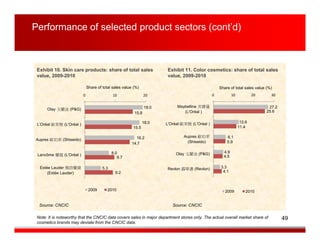
Performance of selected product sectors


Exhibits 8-12 show the performance of the top 5 players in selected sub-sectors, including
Shampoos, conditioners and 2-in-1 conditioning shampoos, other hair care products (colorants, hair
mask & styling agents), skincare products, color cosmetics and fragrances.

Exhibit 8. Shampoos, conditioners and 2-in-1                             Exhibit 9. Other hair care products (colorants, hair
conditioning shampoos: share of total sales value,                       mask & styling agents): share of total sales value,
2009-2010                                                                2009-2010
                                Share of total sales value (%)
                                                                                                           Share of total sales value (%)
                         0           10            20             30                                   0                10              20

Head & Shoulders 海飛                                             25.2           Youngrace 溫雅                                           18.0
      絲 (P&G)                                                     27.5   (Youngrace Cosmetics Group)                         11.1
                                                                                    Decolor 迪彩
    Pantene Pro-V 潘婷                                     20.4                                                                  12.5
                                                                                 (Guangzhou Decolor
          (P&G)                                         19.8                                                                 11.0
                                                                                     Cosmetics)

                                                   17.7                                  章華(Savol)                  6.4
    Rejoice 飄柔 (P&G)                                                                                                       10.6
                                                  16.3

     Slek 舒蕾 (C-Bons                      10.1                                         Maestro 美濤                           11.0
          Group*)                          11.2                                      (C-Bons Group*)                       9.9


                                   5.9                                        L’Oréal 歐萊雅 (L'Oréal )                        10.3
     Lux 力士 (Unilever)                                                                                                    8.6
                                   6.1

                         2009               2010                                             2009                 2010
                                                                               Source: CNCIC
   Source: CNCIC

 Note: It is noteworthy that the CNCIC data covers sales in major department stores only. The actual overall market share of             48
 cosmetics brands may deviate from the CNCIC data.
Performance of selected product sectors (cont’d)


 Exhibit 10. Skin care products: share of total sales                  Exhibit 11. Color cosmetics: share of total sales
 value, 2009-2010                                                      value, 2009-2010

                              Share of total sales value (%)                                        Share of total sales value (%)
                          0                  10                 20                              0           10           20      30


                                                                19.0        Maybelline 美寶蓮                                     27.2
      Olay 玉蘭油 (P&G)
                                                         15.8                  (L'Oréal )                                     25.6

                                                               18.0    L'Oréal 歐萊雅 (L'Oréal )                     12.6
 L’Oréal 歐萊雅 (L'Oréal )
                                                        15.5                                                     11.4

                                                         16.2                   Aupres 歐珀萊              6.1
Aupres 歐珀萊 (Shiseido)
                                                       14.7                       (Shiseido)            5.9

                                             8.0                            Olay 玉蘭油 (P&G)            4.9
 Lancôme 蘭蔻 (L'Oréal )                                                                                4.5
                                                9.7

  Estée Lauder 雅詩蘭黛                    5.3                             Revlon 露華濃 (Revlon)           3.3
      (Estée Lauder)                           9.2                                                    4.1


                               2009       2010                                                         2009          2010


  Source: CNCIC                                                           Source: CNCIC

 Note: It is noteworthy that the CNCIC data covers sales in major department stores only. The actual overall market share of          49
 cosmetics brands may deviate from the CNCIC data.
Performance of selected product sectors (cont’d)


 Exhibit 12. Fragrances: share of total sales value, 2009-2010


                                                             Share of total sales value (%)
                                                       0             10            20                30


                         Chanel 香奈兒 (Chanel SA)                                      19.8
                                                                                              24.3

                   Christian Dior 迪奧 CD                                        16.1
      (Christian Dior (China) Fragrance & Cosmetics)                              18.4

                             BOSS (Hugo Boss AG)                       9.2
                                                                    7.3

                     Burberry 巴寳莉 (Inter Parfums)               6.8
                                                               5.8

                            Lancôme 蘭蔻 (L'Oréal )             5.1
                                                            3.9


                                                2009         2010


  Source: CNCIC

 Note: It is noteworthy that the CNCIC data covers sales in major department stores only. The actual overall market share of   50
 cosmetics brands may deviate from the CNCIC data.
For more information


Li & Fung Research Centre
10/F, LiFung Tower,
888 Cheung Sha Wan Road,
Kowloon, Hong Kong

Tel: 2300 2470      Fax: 2635 1598
Email: lfdc@lf1937.com
http://www.lifunggroup.com/


© Copyright 2012 Li & Fung Research Centre. All rights reserved.
Though Li & Fung Research Centre endeavours to have information presented in this document as accurate and updated as
possible, it accepts no responsibility for any error, omission or misrepresentation. Li & Fung Research Centre and/or its
associates accept no responsibility for any direct, indirect or consequential loss that may arise from the use of information
contained in this document.

Industry series20

  • 1.
    China’s cosmetics market,2011 February 2012 Li & Fung Research Centre
  • 2.
    In this issue: I. Industry overview p. 3 II. Competitive landscape p.18 III. Latest developments p.30 IV. Snapshots of sub-sector performance p.45 2
  • 3.
    I. Industry Overview (1) Market Size (2) Retail price of cosmetics (3) Distribution channels 3
  • 4.
    Growth of China’scosmetics retail value accelerated in 2011 According to the National Bureau of Statistics of China (NBS), retail sales of cosmetics of enterprises above designated size* reached 110.3 billion yuan in 2011, up nominally by 18.7% year-on-year (yoy). China’s cosmetics market has demonstrated faster growth in 2011 (18.7% yoy) than that in 2010 (16.6% yoy). Exhibit 1. Retail value of cosmetics by wholesale and retail enterprises above designated size*: 2007-2011 120 110.3 30% 100 88.9 25% 80 74.0 20% 59.7 60 48.8 15% 40 10% yoy growth (%) FY10 1Q11 1H11 FY11 20 5% Cosmetics 16.6 17.8 20.0 18.7 0 0% 2007 2008 2009 2010 2011 Sales value Growth Source: National Bureau of Statistics of China (NBS) 4 * Designated size: with annual sales of 5 million yuan or above and with an employment of or over 60.
  • 5.
    Cosmetics retail salesin lower-tier cities are fast growing; yet first- and second-tier cities captured a bigger share of the market According to China National Commercial Information Centre (CNCIC), cosmetics retail sales rose by 28.2% yoy in third-tier cities in 2010, faster than those realized in the first- (15.8%) and second-tier cities (17.0%). Although cosmetics sales in lower-tier cities are growing fast, big cities still capture a larger share of the market. − According to a report* by the Hong Kong Trade and Development Coucil (HKTDC), retail sales of cosmetics in Shanghai, Beijing, Jiangsu, Guangzhou, Zhejiang and Shandong accounted for more than 55% of the national total. Among these cities, Shanghai made up the largest proportion of the total retail sales of cosmetics, stood at 12%, followed by Beijing, Jiangsu and Guangdong, representing 11%, 9% and 9% respectively. *Source: Cosmetics market in China, HKTDC, 2011 5
  • 6.
    I. Industry Overview (1) Market Size (2) Retail price of cosmetics (3) Distribution channels 6
  • 7.
    Retail price ofcosmetics has been rising in 2011 Retail price index of cosmetics in China has been rising. The index rose above 101.6 starting from August 2011. Although the tax levied on imported cosmetics has been reduced from 6.5% to 5% since 1 January 2012, market experts observe that retail price of many imported cosmetics products remains high. Exhibit 2. Retail price index of cosmetics in China, January 2010-December 2011 (Same month of preceding year = 100) 102.0 101.5 101.0 100.5 100.0 99.5 99.0 Source: National Bureau of Statistics of China (NBS) 7
  • 8.
    Escalating cost pressureon cosmetics retailers Although retail price has been on a rising trend, most industry players still believed that it had lagged behind the cost increase. − Labor cost constitutes a large cost component for cosmetics companies. Local governments in over 20 provinces/municipalities, such as Beijing, Shanghai, Guangdong, Zhejiang, etc. and one special economic zone (i.e. Shenzhen) have lifted the monthly minimum wage in their jurisdictions in 2011. − Rents, especially those in prime locations, have risen substantially over the past few years. − Other distribution, logistics, packaging and marketing costs have also increased rapidly in recent years, posing great challenges to cosmetics companies. In order to curb the climbing costs, some cosmetics companies try to pass the costs on to their consumers by raising the retail prices. − At the end of 2010, Lancôme (蘭蔻) and Biotherm (碧歐泉), which are under L'Oréal Group, announced to raise the retail prices of their products by 20-30% starting from 1st January 2011. − In July 2011, Estée Lauder and Clinique increased the retail prices by 8-10%. 8
  • 9.
    I. Industry Overview (1) Market Size (2) Retail price of cosmetics (3) Distribution channels 9
  • 10.
    Department stores, supermarkets/hypermarketsare the major distribution channels for cosmetics According to Access Asia, department stores, supermarket/hypermarkets and the Internet were the three most popular sales channels for cosmetics products in 2010. Characteristics of selected retail formats are examined: − Department stores − Supermarkets/hypermarkets − Professional stores − Specialty stores − Internet retailing − Pharmacies − Beauty parlors 10
  • 11.
    Characteristics of selecteddistribution channels – department stores Department stores Pros − Department stores offer a wide range of merchandises and provide one- stop shopping experiences for consumers. − Department stores play an important role in brand building. Cons − Competition for counter spaces is fierce, many lesser-known brands are forced to phase out. − Department stores may gradually lose appeal to Chinese consumers due to poor differentiation. 11
  • 12.
    Characteristics of selecteddistribution channels – supermarkets/hypermarkets Supermarkets/hypermarkets Pros − Supermarkets/hypermarkets are important channels particularly for low- to mid-range cosmetics products (e.g. shampoo, facial cleanser). That being said, more high-end cosmetics brands, especially foreign-owned ones, are sold in supermarkets/hypermarkets. Cons − The entry costs of supermarkets/hypermarkets have been escalating over the past years; some weaker local brands are facing tough cost challenges. 12
  • 13.
    Characteristics of selecteddistribution channels – professional stores Professional stores − Professional stores are “one-stop shop” for customers to shop for cosmetics and accessories. Examples include Hong Kong-based Watsons and Sasa, France-based Sephora, and China-based Gialen (嬌蘭佳人) and Cosmart (歌詩瑪). − Professional stores offer a wide variety of cosmetics brands in different quality and price tiers, catering to different needs of customers. − However, quality of products available in professional stores is less assured as there may be other substandard parallel imports and even counterfeit products being sold in the professional stores. 13
  • 14.
    Characteristics of selecteddistribution channels – specialty stores Specialty stores − Specialty stores help promote brand image, ensure high quality services and standardized prices. − Moreover, cosmetics brand owners can achieve autonomy over store operation through opening specialty stores. − Korean brands such as Skin Food, Etude House and Missha are especially interested in distributing their products through specialty stores and department stores to avoid high distribution cost in hypermarkets. − It is expected that specialty stores will become another key retail channel for cosmetics as large shopping complexes spring up in these years. − Nevertheless, some specialty stores are small-scaled, scattered and disordered. 14
  • 15.
    Characteristics of selecteddistribution channels – Internet retailing Internet retailing − There are many types of B2C online retailing portal in China. Below are some of the examples. Brands operating their own online stores: • Lancôme (http://www.lancome.com.cn) • Biotherm (http://www.biotherm.com.cn) B2C online platform operators that provide a wide range of cosmetics brands in different price tiers: • Strawberrynet.com (草莓網) • Sasa.com (香港莎莎網) Group purchase websites that offer cosmetics products at discounted price: • Gaopeng.com (高朋網) • Meituan.com (美團網) Online agents that help Chinese customers buy foreign cosmetics brands. 15
  • 16.
    Characteristics of selecteddistribution channels – pharmacies Pharmacies − Selling cosmetics products in pharmacies facilitates repeat purchases. Many pharmacies in China are keen to introduce cosmetics products as they can generate better profit margins. − Many branded cosmeceuticals are distributed via pharmacies. France- based Vichy, La Roche-Posay, China-based Longliqi (隆力奇) and Cortry (可采) are some of the commonly found brands in pharmacies. 16
  • 17.
    Characteristics of selecteddistribution channels – beauty parlors Beauty parlors − According to a survey* conducted by HKTDC, the average spending of the respondents at beauty parlors was 2,832 yuan in 2010. Respondents from Shanghai spent the most (4,951 yuan) at beauty parlors, followed by Beijing (3,528 yuan), Guangzhou (3,078 yuan) and Chengdu (2,458 yuan). − In fact, many beauty parlors sell their own brands or act as agents to distribute other brands in Asia. − Examples of beauty parlors in China include Herborist SPA (佰草集漢方 SPA) and Natural Beauty SPA (自然美SPA生活舘). 17 *Source: At your service: a rising sector for the Mainland middle class, HKTDC, 2011
  • 18.
    II. Competitive landscape (1) Foreign cosmetics companies (2) Domestics cosmetics companies 18
  • 19.
    Foreign cosmetics companiesare keen to capture a larger share of China’s cosmetics market Foreign companies are vying for a larger market share in the mass market of China’s cosmetics market. − For example, it is reported that L'Oréal would expand into 600 second-tier cities to reach untapped customer base. − US cosmetics firm Mary Kay planned to invest 25 million USD in building a distribution centre in China, which is poised to surpass the US to be its largest market by 2013, according to media reports. − Another US cosmetics company Avon opened a R&D center in China in August 2011, which is the largest facility of its company outside the US. − Estée Lauder unveiled a plan to penetrate more Chinese cities and add more e- commerce channels for some of its brands such as Origin and Bobbi Brown in the next three years. 19
  • 20.
    Foreign cosmetics companiesare keen to capture a larger share of China’s cosmetics market (cont’d) Foreign companies are vying for a larger market share in the mass market of China’s cosmetics market. (cont’d) − In September 2011, Samsung Group’s subsidiary Shilla Hotel opened a cosmetics specialty store Sweetmay in Macau, selling 16 types of popular Korean cosmetics brands such as Hanskin, VOV, Banilaco and Danahan. The company planned to open similar specialty stores in mainland China soon. − Watsons, with 1,000 stores covering 150 cities of China, is planning to expand its presence to more than 300 cities in China to reach 3,000 stores by 2016. − Hong Kong-based cosmetics retailer Sasa has new moves in mainland China: its large-scale cosmetics retail store in Shanghai, first ever in mainland China, opened in October 2011. 20
  • 21.
    Foreign companies aremore competitive in the mid- to high-end and luxury segments Currently, foreign brands have gained a firm foothold in the mid- to high-end and luxury cosmetics market in China. On the other hand, domestic companies are mainly competing in the low- end market. With solid foundation in high-end cosmetics market operation, foreign brands now expand beyond the high-end market, aiming to penetrate the mass market in China. − For example, L'Oréal introduced several middle-range cosmetics brands such as Garnier, L'Oréal Paris, Maybelline New York, etc. to target the mass market. 21
  • 22.
    Foreign cosmetics enterprisesand their major brands in China Exhibit 3 shows the major foreign cosmetics groups and their major brands in China. Exhibit 3. Foreign cosmetics groups and their major brands in China Enterprise Brands L’Oréal L’Oréal Paris 巴黎歐萊雅 shu uemura 植村秀 Biotherm 碧歐泉 歐萊雅 Garnier 卡尼爾 Giorgio Armani 喬治 阿瑪尼 Helena Rubinstein HR 赫蓮娜 Maybelline New York 美寶蓮紐約 LA ROCHE-POSAY理膚泉 Kiehl’s Matrix 美奇絲 L’Oréal Professional 歐萊雅專業美髮 Mininurse 小護士 Skinceuticals Kérastase 卡詩 Yue Sai 羽西 Lancôme 蘭蔻 Vichy 薇姿 P&G Head & Shoulders 海飛絲 Vidal Sasson 沙宣 Camay 卡玫爾 寶潔 Rejoice 飄柔 Clairol Herbal Essences 伊卡璐 Pantene 潘婷 SK-II Wella 威娜 Olay 玉蘭油 Shiseido Shiseido 資生堂 UNO 吾諾 Shiseido Eudermine 紅色蜜露 資生堂 Shiseido Men資生堂男士 PF-Cover 無瑕修顏 Za 姬芮 Clé de peau beauté 珂麗柏蒂 DQ 蒂珂 Aqua Label 水之印 Revital 悅薇 The Skincare 水活煥妍 Be 彼嘉 UV White 優白 Beneflance 盼麗風姿 Aquair 水之密語 Anessa 安熱沙 Pureness 飄爾麗思 Perfect 洗顔專科 Aupres 歐珀萊 White Lucent 透白美肌 Kuyura 可悠然 Supreme Aupres 思魅歐珀萊 Soi Pure & Mile 泊美舒亞 Super Mild 惠潤 Urara 悠萊 Shanghai Bouquet 上海花漪 Maquillage 心機彩妝 Elixir 怡麗絲爾 Qi 綺怡 Tessera 欣香 Elixir Superieur 怡麗絲爾優悅活顏 Zen 世紀禈香氛 Hand Cream 美潤護手霜 Melanreduce 臻白無瑕 Bio Performance 百優 Handasui 肌水 Asplir 愛泊麗 Future Solution LX 時光硫璃御藏 Tsubaki 絲蓓綺 Whitia 白娣顔 Body Creator 美體造型 Pure & Mild 泊美 Selfit 珊妃 Dicila 蒂思嵐 22 Source: Li & Fung Research Centre and respective company websites
  • 23.
    Foreign cosmetics enterprisesand their major brands in China (cont’d) Exhibit 3. Foreign cosmetics groups and their major brands in China (cont’d) Enterprise Brands Unilever Vaseline 凡士林 Pond’s 旁氏 聯合利華 Lux 力士 Clear 清揚 Dove 多芬 Rexona 舒耐 Hazeline 夏士蓮 LYNX 凌仕 Johnson & Johnson Clean & Clear 可伶可俐 Dabao 大寶* 強生 Neutrogena 露得清 Johnson’s Body Care 強生美肌 Johnson’s Baby 強生嬰兒 Estée Lauder Estée Lauder 雅詩蘭黛 La Mer 海藍之謎 雅詩蘭黛 Aramis 雅男士 Bobbi Brown 芭比波朗 Clinique 倩碧 Tommy Hilfiger 唐美希緋格 M.A.C. 魅可 Donna Karan Cosmetics 唐娜凱倫 Beiersdorf NIVEA 妮維雅 La Prairie 莱珀妮 拜爾斯道夫 Nivea for men Eucerin Florena C-Bons Hair Care** Slek 舒雷 Hairsong 順爽 Sdew 風影 Maestro 美濤 iSPA Home 悅美芳達 Costyle 珂絲美 Kanebo Impress 印象之美 Aqua 雅呵雅 佳麗寶 Lunasol 日月晶采 Aqua Sprina雅呵雅絲睿 Sui sai 水之璨 Aqua Lunash 潤希 Coffret D’or 金炫光燦 Freeplus 芙麗芳絲 Blanchir Superior 馥蘭哲兒極致系列 Kate Dew Superior 潤活極致系列 *Beiersdorf acquired 85% stake in C-BONS Hair Care in 2007. ** Johnson & Johnson has completed the acquisition of Beijing Dabao Cosmetics Co. Ltd. in 2008. 23 Source: Li & Fung Research Centre and respective company websites
  • 24.
    Foreign cosmetics enterprisesand their major brands in China (cont’d) Exhibit 3. Foreign cosmetics groups and their major brands in China (cont’d) Enterprise Brands Kao Kao 花王 Asience 亞羨姿 花王 Bioré 碧柔 Sifoné 詩芬 Men’s Bioré 碧柔男士 Feather 花王飛逸 Sofina 蘇菲娜 Curél 珂潤 Est Kosé Kosé 高絲 Avenir 艾文莉 高絲 Beauté de Kosé美諦高絲 Recipe-O 蘭哲歐 Prédia 貝締雅 Junkisei 潤肌精 Sekkisei 雪肌精 White St 妍哲 Sekkisei Supreme雪肌精 Supreme Nature & 娜蔻 Refine 萊菲 Moisture Skin Repair Esprique Astalution Junkisui 純肌粋 Grandaine葛倫黛娜 Seikisho清肌晶 Infinity 白澄 Avon Products, Inc. Avon 雅芳 美国雅芳产品有限公司 Amore Pacific Corp Laneige 蘭芝 Amore 爱茉莉 愛茉莉太平洋集團 Mamode 夢妝 Sulwhasoo 雪花秀 Nu Skin Enterprise Inc. Nu Skin 如新 如新集團 LVMH Group Guerlain 嬌蘭 DHC Corp DHC Source: Li & Fung Research Centre and respective company websites 24
  • 25.
    II. Competitive landscape (1) Foreign cosmetics companies (2) Domestics cosmetics companies 25
  • 26.
    Domestic brands aremore competitive in the mass market Generally, domestic players focus on second- and third-tier cities, offering value-for-money products. In recent years, a number of local cosmetics brands have caught up with their international counterparts. Some local brands that have gained increasing attention include: Herborist (佰草集), Chcedo (自然堂), Chinfie ( 清妃), Cheng Ming Ming (鄭明明), Caisy (采詩) and Longliqi, etc. 26
  • 27.
    Domestic cosmetics enterprisesand their major brands in China Exhibit 4 shows some major domestic cosmetics groups and their major brands in China. Exhibit 4. Domestic cosmetics groups and their major brands in China Enterprise Brands Shanghai Jahwa Co., Ltd.* Maxam 美加淨 Gf 高夫 上海家化集團 Chinfié 清妃 Liushen 六神 Herborist 佰草集 Cocool 珂珂 ShanghaiVive雙妹 Sichuan Jahwa Cortry Cosmetics Co. Ltd** Cortry 可采 LiveliCutee 伶采 四川家化可采化妝品股份有限公司 Jiangsu Longliqi Group Co., Ltd. Longliqi 隆力奇 YaFei 雅妃 江蘇隆力奇集團 Yuzhibao 浴之寶 Evergreen 雅妍 Arche Cosmetics Co., Ltd BNS 繽麗 Effi 玉麗 廣東雅倩化妝品有限公司 Ariar 清逸 Airiny 維鮮 Cathy 佳雪 Zhuhai Sunrana Cosmetics Co., Ltd. Sunrana 姍拉娜 珠海姍拉娜化妝品有限公司 Bawang International Bawang 霸王 Men’s Bawang 霸王男士 霸王國際集團 Herborn 本草堂 Royal Wind 追風 Litao 麗濤 * Ping An Group has acquired 100% of share in Shanghai Jahwa in 2011. **Shanghai Jahwa has acquired 51% stake in Cortry in 2008. Source: Li & Fung Research Centre and respective company websites 27
  • 28.
    Domestic cosmetics enterprisesand their major brands in China (cont’d) Exhibit 4. Domestic cosmetics groups and their major brands in China (cont’d) Enterprise Brands Shanghai Huayin Commodity Co., Ltd. Bee & Flower 蜂花 上海華銀日用品有限公司 Guangzhou Houdy Cosmetics Co., Ltd. Houdy 好迪 Coian 可靚 廣州市好迪化妝品有限公司 Sincir 信婷 Tongle 童樂 Decolor Cosmetics Co., Ltd. Decolor 迪彩 Crystal晶彩 廣州市迪彩化妝品有限公司 Luxe-Lotus蓮尚 Lotuses 千蓮薈 Enevous 伊儂華 Nenuph 藍蓮花 Nanjing Jianong Chemical Co., Ltd. TJOY*** 丁家宜 TJOY for men 丁家宜男士 南京珈儂生化有限公司 Lafang Group Lafang 拉芳 Bétrue 繽純 拉芳集團 Raclen 雨潔 Sunfeel 聖峰 Duo Zi 多姿 Mese 美多絲 Guangzhou Tobaby Cosmetics Co., Ltd. Tobaby 丹芭露 廣州露純化妝品有限公司 Huaya Group Co., Ltd. Franic 法蘭琳卡 Meifubao 美膚寶 環亞化妝品科技有限公司 Jala (Group) Co., Ltd. Chcedo 自然堂 Maysu 美素 伽藍(集團)股份有限公司 *** Coty has acquired a majority stake in TJOY in December 2010. 28 Source: Li & Fung Research Centre and respective company websites
  • 29.
    Domestic cosmetics enterprisesand their major brands in China (cont’d) Exhibit 4. Domestic cosmetics groups and their major brands in China (cont’d) Enterprise Brands Proya Cosmetics Co., Ltd. Proya 珀萊雅 杭州珀萊雅化妝品有限公司 Shanghai Inoherb Cosmetics Co., Ltd. Inoherb 相宜本草 上海相宜本草化妝品股份有限公司 Softo Co., Ltd. Softo 索芙特 索芙特股份有限公司 Foshan Shunde Modern Health Care Products Co., Xian Dai 現代 Ltd. 佛山市順德現代保健用品有限公司 Shanghai Savol Health & Cosmetics Co., Ltd. Savol 章華 浙江章華保健美髮實業有限公司 Youngrace Cosmetic International Group Limited Youngrace 溫雅 溫雅化妝品國際集團有限公司 Source: Li & Fung Research Centre and respective company websites 29
  • 30.
  • 31.
    1. Cosmetics brandsare keen to explore online opportunities In response to changes in customers’ purchasing behavior and significant advancements in the online retail market, many cosmetics brands have been making use of online platforms to reach customers. According to iResearch, the transaction value of China’s online retailing market* was up by 75.3% yoy to reach 461.0 billion yuan in 2010, accounting for 2.98% of the country’s total retail sales. Cosmetics and personal care products ranked 4th among the most popular categories consumer purchased online in 2010. Exhibit 5. The most popular categories consumer purchased online, 2009-2010 Apparel, footwear and bags Books/music/movies and videos Prepaid cards (e.g., top-up cards, etc) Cosmetics and personal care IT/digital/communication Home products Healthcare food 2009 Maternity and baby care products Electronic appliances 2010 Toys and gifts Jewellery Others 0 5 10 15 20 25 30 35 40 45 50 % Source: iResearch: “2010-2011年中国网络购物用户行为研究报告简版” *Accordingto iResearch, scale of online retailing market refers to the total transaction value of consumer-to-consumer (C2C) and business-to- consumer (B2C) online businesses. Scale of C2C online retailing market is calculated by the total value of purchases, excluding that on the B2C arm of C2C platforms. Scale of B2C online retailing market has excluded payments of travel expense, air tickets and online bill payment services. 31
  • 32.
    1. Cosmetics brandsare keen to explore online opportunities (cont’d) Some brands prefer to use B2C online portals to sell their products. − According to Tmall (天貓), the largest online B2C platform in China, the transaction value of cosmetics in 1H2011 already exceeded that of FY 2010. − Tmall is also the B2C platform that offers the largest number of cosmetics brands in China. Currently, around 1,200 cosmetics brands are sold in Tmall. − Examples of cosmetics brands that use B2C platform to sell their products include: Kosé (kose.taobao.com) L'Oréal Paris (loreal.tmall.com) Herborist (herborist.tmall.com) 32
  • 33.
    1. Cosmetics brandsare keen to explore online opportunities (cont’d) On the other hand, some brands prefer to start their own e-commerce operation to gain autonomy. − To reach more new customers, Shiseido started its own e-commerce operation in September 2011 by launching an exclusive online product line Pure & Mild Soi (http://www.puremild-soi.com/front/contents/top/). − Other cosmetics companies such as Lancôme, Estee Lauder and Clinique, etc. have also developed their own online stores. However, multi-channel retailers should also consider the possible conflicts between online and offline stores in terms of variety of products and prices. To avoid online channels cannibalizing sales of their offline stores and potential conflict of interests with existing distributors and franchisees, retailers have to pay extra attention to pricing strategies and to maintain online and offline consistency. 33
  • 34.
    2. Cosmetics companiesreceive growing attention in the capital market Recently, cosmetics companies in China have garnered increasing attention in the capital market. − Local cosmetics brands that have received investments from venture capitalists include Guangzhou-based companies Menplus (男性主義), Jimmi (九美子) and Ardme (雅茚), and Shanghai-based Cosmart, etc. An increasing number of cosmetics companies seek to raise capital through IPOs. It is believed that IPOs can generate capital to fund organic growth and support expansion. Furthermore, the brand image will be markedly improved. − Inoherb (相宜本草), Meifubao (美膚寶), Jala* (伽藍集團), Proya (珀萊雅) and MGPIN (毛戈平), etc. are cases in point. In November 2011, a subsidiary of China’s second biggest insurer Ping An Group won a bid for 100% share of Shanghai Jahwa Group, a famous domestic company which have a portfolio of cosmetics brands including Chinfie, GF (高夫), Shanghai Vive (雙妹), Maxam (美加淨) and Herborist. 34 *Jala Group owns famous local brands such as Maysu (美素), Chcedo(自然堂), etc.
  • 35.
    3. Spending onmarketing and advertising is huge in China To raise brand awareness, cosmetics players have spent huge sums of money on marketing and advertising in China. Marketing-to-expense ratio for many brands stayed high in 2011. According to “China cosmetics market: Amorepacific vs Shiseido” by Samsung Securities in July 2011, Shiseido’s marketing-to-expense ratio rose from 22% in 2010 to 35% in 2011. According to a CTR survey*, cosmetics/toiletries (1.4%) contributed the most to the growth of 2011’s advertising spending in China (13%). In 2011, L'Oréal was the biggest spender on advertising in China. 35 *Source: Advertising expenditure in China, 2011, CTR, 2011
  • 36.
    4. Social mediais becoming an important marketing tool for cosmetics companies Today, social media is a very important marketing tool for cosmetics players to connect with their customers. − According to Thindov, a market research agency in China, 80% of the top 100 cosmetics brands in China promoted their brands in Sina Weibo, the most popular Chinese microblog as of end-September 2011. 36
  • 37.
    5. Cosmeceutical marketis gaining increasing attention Cosmeceuticals are cosmetics products with vitamins, herbs, pharmaceuticals or biologically active ingredients purporting to have medical benefits. According to the aforementioned report by HKTDC, more than 170 enterprises have entered the cosmeceuticals market. It is expected that the cosmeceutical market in China would grow by 10-20% yoy to reach 20 billion yuan in 3 to 5 years. Indeed, many players have entered the cosmeceutical market in recent years. − Chinese supermarket operator Lianhua (聯華) has formed a partnership with Growell Group (a well-known cosmeceutical company in Japan) and Meiribuy (每日通販) (a Shanghai-based online platform selling Japanese products) in September 2011. They planned to open 8 cosmeceutical stores in the central areas of Shanghai in 2012. − China Resources Vanguard is also making inroads into China's health and beauty products retail sector. It opened up its first pharmaceutical and beauty retail shop in Xi'an in September 2011. 37
  • 38.
    5. Cosmeceutical marketis gaining increasing attention (cont’d) Currently, the cosmeceutical market in China is dominated by foreign brands such as Vichy, La Roche-Posay, Freeplus and Simple. However, cosmeceuticals with Chinese herbal medicine are gaining increasing attention. − For example, domestic brands such as Tongrentang (同仁堂), Herborist, Yunnanbaiyao (雲南白藥), Inoherb, etc. are evolving. 38
  • 39.
    6. Male groomingmarket is growing fast Male grooming market is emerging in the cosmetics industry. − According to a report* by Alibaba Research Centre, the market size of male's skincare sector reached 4 billion yuan in 2010 (or 8 billion yuan if other male grooming products such as fragrance and color cosmetics are included). − Male's skincare sector grew by 27% yoy in 2009 and 40% yoy in 2010, five times faster than female skincare market. Many foreign and domestic brands have launched product lines for men. − Foreign brands: Garnier, Olay Men, Biotherm, Lancôme, Clique, Shiseido, Clarins, Vichy, Dior, etc. − Domestic brands: Dabao (大寳), Ruvanon (洛華儂),Dewa (蒂娃),Your-life Homme (悠 蘭), Xiawa (夏娃), Chetti Rouge, Chcedo, etc. At the moment, most of the male’s grooming products are just extension of female product lines. Only a few brands concentrate solely on male’s grooming products. Facial cleansing product is the most popular product category for men. According to the report by HKTDC, there is an increasing demand for mask, UV Cream, aftershave moisturiser, deodorants and hair products for male. * Source: Statistics of China’s cosmetics market, 2010, Alibaba Group Research Centre 39
  • 40.
    7. Children andbaby care markets have enormous potential According to Euromonitor, retail sales of China’s children care products are anticipated to reach 8.7 billion yuan by 2013, from 5.3 billion yuan in 2010. Euromonitor also forecasts that retail sales of China’s baby care will increase from 3.5 billion yuan in 2010 to 5.8 billion yuan by 2013. − Major players in the sector include Frog Prince (青蛙王子), Coati (小浣熊), Yumeijing (鬱美淨), Mentholatum and Johnson & Johnson. The number of retail stores selling mom and baby products has grown exponentially in recent years. − Retailers such as Redbaby (北京紅孩子), Lijiababy (麗家寶貝), Leyou (樂友), Aiyingshi (上海愛嬰室), etc. have opened massive retail stores providing skincare products for expectant mothers and babies. Some cosmetics brands have introduced skincare products specifically for expectant mothers and babies. − For example, a Chinese time-honored cosmetics brand Kong Fengchun (孔鳳春) has launched a new product line Mamale (媽媽樂) for expectant mothers; local cosmetics company TJOY (丁家宜) has introduced bbjoy (貝倍驕) for babies. 40
  • 41.
    8. Green cosmeticsproducts are moving into the mainstream Green products are products that have less impact on the environment or are less detrimental to human health. Nowadays, more and more consumers are looking for green cosmetics, as these products are applied directly to the body, excessive chemical substances present in the product may cause skin allergy. According to another report* by HKTDC, the demand for green personal care products has increased significantly in recent years. − 53% of the respondents said that they have bought green personal care products in 2011, most of which are products using plant ingredients and products that are natural and additive-free. − The report* also showed that female consumers concern more about green products, but many brands have started to target men’s market in recent years. − For example, Inoherb, a domestic brand which focuses on products with plant ingredients, has also launched its skin care products for men. 41 * Source: Shopping for green products on the Mainland, HKTDC, 2011
  • 42.
    9. Buying cosmeticsproducts abroad is popular; the government is considering reform of consumption tax on luxury cosmetics Currently, the retail prices for high-end and luxury cosmetics sold in China are generally higher than those in the overseas markets, due largely to the consumption tax (at a rate of 30%) levied on luxury cosmetics in China. Also, with increasing income, Renminbi appreciation against the US dollar and easing travel restrictions, many Chinese consumers shop for cosmetics products abroad. The Ministry of Finance announced that from 1 January 2012 onwards, tariffs on 730 categories of commodities will be lowered to an average of 4.4%. Tariffs on imported skin care products will be reduced by 1.5% from the current 6.5%. Some industry experts believed that the lowered tariff still cannot compensate the recent rise in cost. Market prices of most cosmetic products will not fall. The spokesperson of the Ministry of Commerce said that China would conduct a study on the reform of the consumption tax on mid- and high-end products, but details are still under discussion. 42
  • 43.
    10. Companies inother industries jump on the bandwagon to offer cosmetics products Eyeing the huge growth potential of China’s cosmetics industry, other industries are eager to tap the market by offering cosmetics products. − VANCL, one of the leading online apparel companies in China, has launched the online cosmetics platform (pf.com.cn) in 2011. − Fujifilm, a Japanese photographic and imaging company, also officially launched a high-end cosmetics product line called ASTALIFT in China in 2011. However, entering a different industry may require considerable investment. Lacking the expertise in product research and development, and consumer’s recognition may pose challenges to these enterprises. 43
  • 44.
    11. Rules andregulations of the cosmetics sector in China Product safety has long been a major concern in China’s cosmetics market. − In the past years, even famous foreign brands were embroiled in scandal of defective cosmetics products. For instance, in November 2011, Johnson & Johnson baby shampoos sold in China are reportedly having cancer-causing chemicals. As Chinese consumers are now more discerning, product safety is expected to gain more attention in the future. More regulations are expected to be launched by the government to better regulate the cosmetics industry. Exhibit 6 shows some latest rules and regulations related to China’s cosmetics sector. Exhibit 6. Selected rules and regulations of cosmetics sector in 2011-2012 Item Effective Highlights Date Guiding Opinions of the Ministry of Commerce 2011-11- The government sets the growth target of 15% on Promoting the Standardized Development of 16 for the beauty and hairdressing Industry in the Beauty and Hairdressing Industry during the next five years. Enterprises in the beauty and 12th Five-year Plan Period hairdressing industry are encouraged to expand 商務部關於“十二五”期間促進美容美髮業規範發 their scale of operations and improve the level of 展的指導意見 services. The Measures for the Inspection, Quarantine, 2012-2-1 The Measures aim to regulate the imported and Supervision and Administration of Imported and exported cosmetics in China and better control Exported Cosmetics by the General the hygienic condition of the cosmetic products. Administration of Quality Supervision, Inspection and Quarantine 進出口化妝品檢驗檢疫監督管理辦法 44 Source: The Ministry of Commerce, the General Administration of Quality Supervision, Inspection and Quarantine
  • 45.
    IV. Snapshots ofsub-sector performance 45
  • 46.
    Background TheCNCIC conducts monthly survey to around 200 major department stores* in China to study the performance of different cosmetics sub- sectors. In this newsletter, performance of 5 sub-sectors is examined: − Shampoos and conditioners − Other hair care products − Skincare products − Color cosmetics − Fragrances *Note: It is noteworthy that the CNCIC data covers sales in major department stores only. Retailers of other formats such as professional and specialty stores are growing in popularity. The actual overall market share of cosmetics brands may deviate from the CNCIC data. 46
  • 47.
    China’s cosmetics marketin 2010 was generally less concentrated than the previous year The top 10 players in the 5 major sub-sectors achieved over 65% of the market share in major department stores in 2010. The top 10 players in the shampoos and conditioners sub-sector had the highest market share among other sub-sectors, reaching 94.6% in 2010. The top 10 players in the skincare products sector had a share of 79.2% in 2010. Exhibit 7. Market share of top 10 brands of selected sectors, 2009-2010 100 95.2 94.6 Share of total sales value (%) 90 79.9 79.2 80 71.8 72.1 65.2 70.7 67.7 71.0 70 60 50 40 30 20 10 0 Shampoos and Other hair care Skincare products Color cosmetics Fragrances conditioners products 2009 2010 Source: China National Commercial Information Centre (CNCIC) Note: It is noteworthy that the CNCIC data covers sales in major department stores only. The actual overall market share of 47 cosmetics brands may deviate from the CNCIC data.
  • 48.
    Performance of selectedproduct sectors Exhibits 8-12 show the performance of the top 5 players in selected sub-sectors, including Shampoos, conditioners and 2-in-1 conditioning shampoos, other hair care products (colorants, hair mask & styling agents), skincare products, color cosmetics and fragrances. Exhibit 8. Shampoos, conditioners and 2-in-1 Exhibit 9. Other hair care products (colorants, hair conditioning shampoos: share of total sales value, mask & styling agents): share of total sales value, 2009-2010 2009-2010 Share of total sales value (%) Share of total sales value (%) 0 10 20 30 0 10 20 Head & Shoulders 海飛 25.2 Youngrace 溫雅 18.0 絲 (P&G) 27.5 (Youngrace Cosmetics Group) 11.1 Decolor 迪彩 Pantene Pro-V 潘婷 20.4 12.5 (Guangzhou Decolor (P&G) 19.8 11.0 Cosmetics) 17.7 章華(Savol) 6.4 Rejoice 飄柔 (P&G) 10.6 16.3 Slek 舒蕾 (C-Bons 10.1 Maestro 美濤 11.0 Group*) 11.2 (C-Bons Group*) 9.9 5.9 L’Oréal 歐萊雅 (L'Oréal ) 10.3 Lux 力士 (Unilever) 8.6 6.1 2009 2010 2009 2010 Source: CNCIC Source: CNCIC Note: It is noteworthy that the CNCIC data covers sales in major department stores only. The actual overall market share of 48 cosmetics brands may deviate from the CNCIC data.
  • 49.
    Performance of selectedproduct sectors (cont’d) Exhibit 10. Skin care products: share of total sales Exhibit 11. Color cosmetics: share of total sales value, 2009-2010 value, 2009-2010 Share of total sales value (%) Share of total sales value (%) 0 10 20 0 10 20 30 19.0 Maybelline 美寶蓮 27.2 Olay 玉蘭油 (P&G) 15.8 (L'Oréal ) 25.6 18.0 L'Oréal 歐萊雅 (L'Oréal ) 12.6 L’Oréal 歐萊雅 (L'Oréal ) 15.5 11.4 16.2 Aupres 歐珀萊 6.1 Aupres 歐珀萊 (Shiseido) 14.7 (Shiseido) 5.9 8.0 Olay 玉蘭油 (P&G) 4.9 Lancôme 蘭蔻 (L'Oréal ) 4.5 9.7 Estée Lauder 雅詩蘭黛 5.3 Revlon 露華濃 (Revlon) 3.3 (Estée Lauder) 9.2 4.1 2009 2010 2009 2010 Source: CNCIC Source: CNCIC Note: It is noteworthy that the CNCIC data covers sales in major department stores only. The actual overall market share of 49 cosmetics brands may deviate from the CNCIC data.
  • 50.
    Performance of selectedproduct sectors (cont’d) Exhibit 12. Fragrances: share of total sales value, 2009-2010 Share of total sales value (%) 0 10 20 30 Chanel 香奈兒 (Chanel SA) 19.8 24.3 Christian Dior 迪奧 CD 16.1 (Christian Dior (China) Fragrance & Cosmetics) 18.4 BOSS (Hugo Boss AG) 9.2 7.3 Burberry 巴寳莉 (Inter Parfums) 6.8 5.8 Lancôme 蘭蔻 (L'Oréal ) 5.1 3.9 2009 2010 Source: CNCIC Note: It is noteworthy that the CNCIC data covers sales in major department stores only. The actual overall market share of 50 cosmetics brands may deviate from the CNCIC data.
  • 51.
    For more information Li& Fung Research Centre 10/F, LiFung Tower, 888 Cheung Sha Wan Road, Kowloon, Hong Kong Tel: 2300 2470 Fax: 2635 1598 Email: lfdc@lf1937.com http://www.lifunggroup.com/ © Copyright 2012 Li & Fung Research Centre. All rights reserved. Though Li & Fung Research Centre endeavours to have information presented in this document as accurate and updated as possible, it accepts no responsibility for any error, omission or misrepresentation. Li & Fung Research Centre and/or its associates accept no responsibility for any direct, indirect or consequential loss that may arise from the use of information contained in this document.