Industrial Revolution

        U.S. History II
       By Jackie White
Bellwork

ļ‚—Describe what you think is the American Dream is?
Biography/Creative Writing
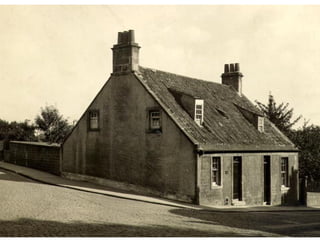
ļ‚—Carefully look at the photograph on the
 next slide.
ļ‚—Write a 1-2 paragraph biography describing
 the person that you think lived here.
ļ‚—Include the following:
 ļ‚”   location
 ļ‚”   occupation
 ļ‚”   cost of living
 ļ‚”   time period
 ļ‚”   number of people who lived together
 ļ‚”   amount of living space
20 Questions
ļ‚—Carefully look at the photograph
 on the next slide.
ļ‚—Your task is to figure out, who
 lived here?
ļ‚—Create one question for me to
 answer to help you solve the
 mystery.
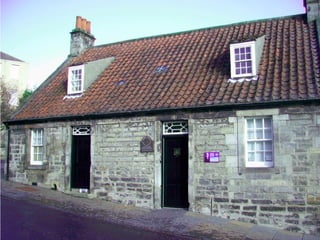
Andrew Carnegie’s birthplace

ļ‚—Location: Dunfermline, Scotland
ļ‚—Occupation: weaver
ļ‚—Rent: $20/year
ļ‚—Time: 1835-1848
ļ‚—Living area: 330 square feet
ļ‚—Family of 4
http://www.carnegieclub.co.uk/

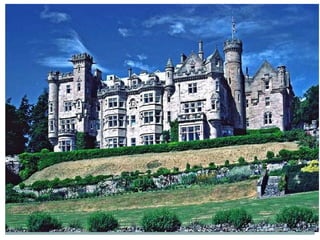
               Skibo Castle
ļ‚—Location: Dornoch, Scotland
ļ‚—Occupation: Steel magnate
ļ‚—Cost: $10,000,000 in 1900
ļ‚—$100,000,000 in 2000
ļ‚—Time: 1897-1919
ļ‚—Living area: 22,000 acres (34 square
 miles) 60,000 square feet
ļ‚—Family of 3
Questions
• Why do you think Andrew Carnegie's family decided to
  move to the U.S.?
• Do you think that Carnegie's birthplace home in
  Dunfermline was characteristic of someone in a low,
  middle, or upper class? And Why.
• Did Andrew Carnegie achieve the American Dream?
• Who could be considered the Andrew Carnegie of
  today?
Was Carnegie a Hero?
ļ‚—Does rising from ā€œragsā€ to ā€œrichesā€ make a person a
 hero?
ļ‚—Do Americans make heroes out of people who make
 it from poverty? (Abe Lincoln, Babe Ruth, Ronald
 Reagan)
ļ‚—Can acquiring great wealth hurt a person’s chance of
 being a hero?
ļ‚—Do Americans sometimes resent people with lots of
 money?
ļ‚—Can a person born rich be a hero? (George
 Washington, John Kennedy)
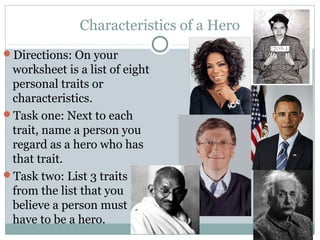
Characteristics of a Hero
ļ‚—Directions: On your
 worksheet is a list of eight
 personal traits or
 characteristics.
ļ‚—Task one: Next to each
 trait, name a person you
 regard as a hero who has
 that trait.
ļ‚—Task two: List 3 traits
 from the list that you
 believe a person must
 have to be a hero.
Anticipation Guide

ļ‚—Before reading the background information predict
 whether or not each of the following statements is
 true or false.
ļ‚—Write T for True & F for false on the line provided.
Background Essay

ļ‚—Read was Andrew Carnegie a Hero? Background
 Essay
ļ‚—Model Think-A-Loud
ļ‚—Complete the two sided or dialectic journal.
ļ‚—On the left side record key people, ideas, events, or
 facts from the reading.
ļ‚—On the right hand side record your thoughts,
 comments, questions, or connections to what you
 read.
Document Analysis

ļ‚—Analyze documents 3-10
ļ‚—Answer the guided questions for each document.
ļ‚—Categorize the documents.
ļ‚—Identify components of a 5 paragraph essay.
ļ‚—Compare 2 essay models.
ļ‚—Complete the DBQ Essay Outline
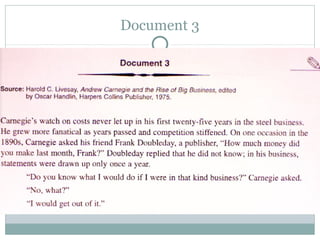
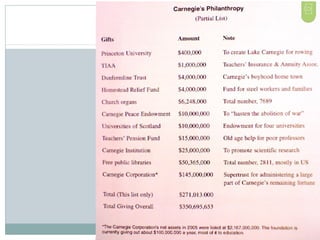
Document 3
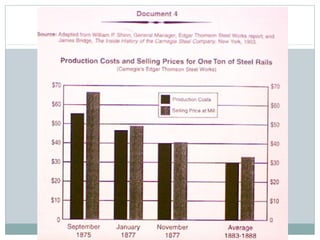
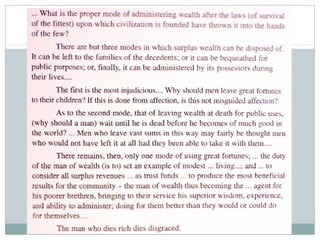
Document 4
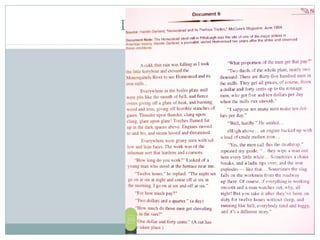
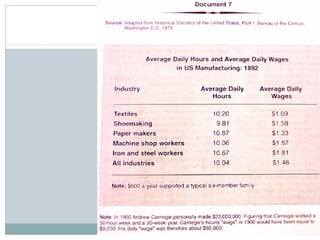
Document 6
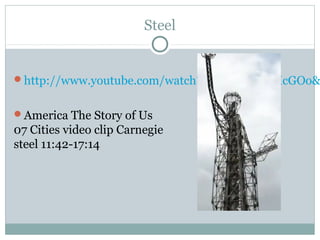
Steel


ļ‚—http://www.youtube.com/watch?v=MMURmbHcGOo&


ļ‚—America The Story of Us
07 Cities video clip Carnegie
steel 11:42-17:14
The Expansion of Industry

ļ‚—MAIN IDEA: At the end of the 19th century, natural
 resources, creative inventions, and growing demand for
 goods fueled an industrial boom.
ļ‚—WHY IT MATTERS NOW: Technological
 developments paved the way for continued growth of
 American industry and eventually a world power.
ļ‚—Terms & Names: Edwin L. Drake, Thomas Alva Edison,
 Christopher Sholes, Alexander Graham Bell, natural
 resource, uses for steel & electricity, impact of industrial
 revolution on society.
Learning Objective

ļ‚—Define and provide examples of natural resources.
ļ‚—Identify several factors that contributed to the
 Industrial Revolution.
ļ‚—Match the inventor to their invention or innovation
 and.
ļ‚—Explain how the Industrial Revolution impacted
 society.
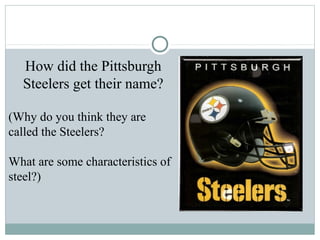
How did the Pittsburgh
  Steelers get their name?

(Why do you think they are
called the Steelers?

What are some characteristics of
steel?)
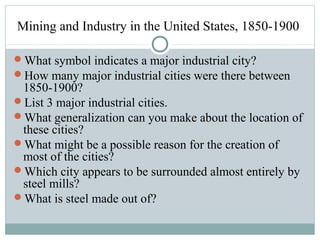
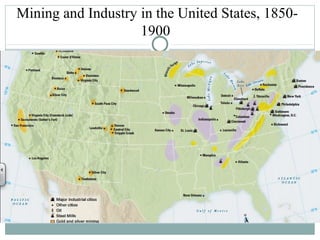
Mining and Industry in the United States, 1850-1900

ļ‚—What symbol indicates a major industrial city?
ļ‚—How many major industrial cities were there between
 1850-1900?
ļ‚—List 3 major industrial cities.
ļ‚—What generalization can you make about the location of
 these cities?
ļ‚—What might be a possible reason for the creation of
 most of the cities?
ļ‚—Which city appears to be surrounded almost entirely by
 steel mills?
ļ‚—What is steel made out of?
Mining and Industry in the United States, 1850-
                    1900
Natural Resources

Definition of word   3 examples of


Use in a semtence    Picture
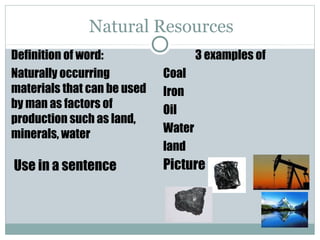
Natural Resources
Definition of word:                  3 examples of
Naturally occurring          Coal
materials that can be used   Iron
by man as factors of         Oil
production such as land,
minerals, water              Water
                             land
Use in a sentence            Picture
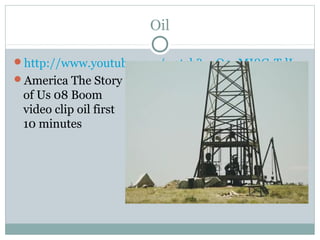
Oil

ļ‚—http://www.youtube.com/watch?v=O9oMI8G-TdI
ļ‚—America The Story
 of Us 08 Boom
 video clip oil first
 10 minutes
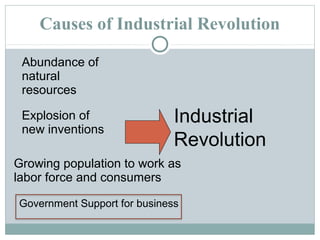
Causes of Industrial Revolution

 Abundance of
 natural
 resources

 Explosion of                 Industrial
 new inventions
                              Revolution
Growing population to work as
labor force and consumers

Government Support for business
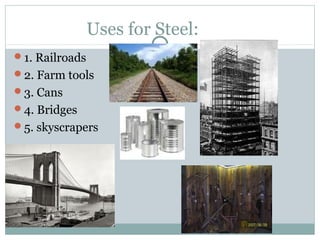
Uses for Steel:
ļ‚—1. Railroads
ļ‚—2. Farm tools
ļ‚—3. Cans
ļ‚—4. Bridges
ļ‚—5. skyscrapers
Uses for Electricity

ļ‚—Think of your typical morning routine.
ļ‚—Write a list of all the things you do before coming to
 school.
ļ‚—Which items on your list required the use of
 electricity?
ļ‚—Record on your notes several uses for electrcity
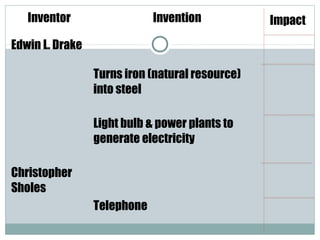
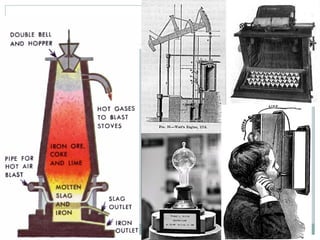
Inventor                  Invention           Impact
Edwin L. Drake

                 Turns iron (natural resource)
                 into steel

                 Light bulb & power plants to
                 generate electricity

Christopher
Sholes
                 Telephone
Impact of American Revolution on
               American Life

ļ‚—How do all these inventions & innovations impact
 society?
ļ‚—More women began to work.
ļ‚—Work that was previously done at home was now
 made in factories .
ļ‚—Industrialization led to long hours and dangerous
 working conditions.
ļ‚—Works was done faster leading to more leisure time.
ļ‚—Industrial Revolution led to an improved standard of
 living and modern life.
Ticket to Leave

ļ‚—Which invention or development in this time period
 had the greatest impact on society and why?
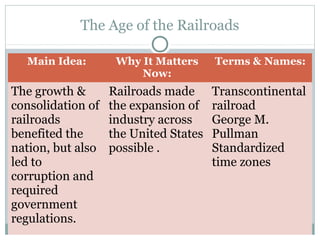
The Age of the Railroads

  Main Idea:        Why It Matters     Terms & Names:
                        Now:
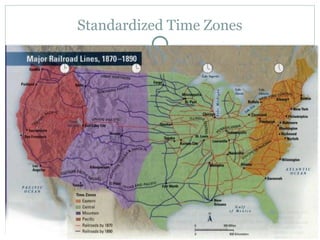
The growth &       Railroads made      Transcontinental
consolidation of   the expansion of    railroad
railroads          industry across     George M.
benefited the      the United States   Pullman
nation, but also   possible .          Standardized
led to                                 time zones
corruption and
required
government
regulations.
Learning Objectives

ļ‚—Identify and be able to explain the positive and
 negative effects of the growth of the railroad on
 America.
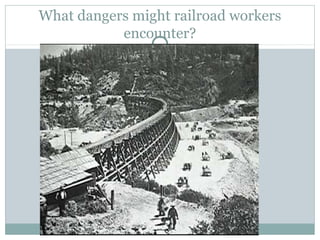
What dangers might railroad workers
           encounter?
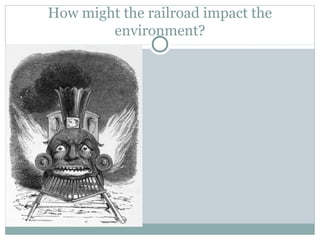
How might the railroad impact the
        environment?
Standardized Time Zones
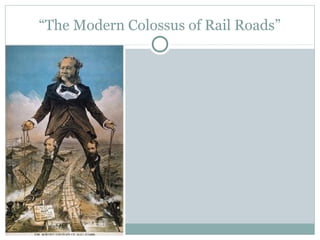
ā€œThe Modern Colossus of Rail Roadsā€
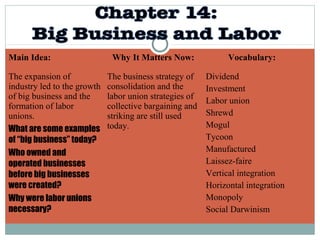
Main Idea:                    Why It Matters Now:              Vocabulary:

The expansion of             The business strategy of    Dividend
industry led to the growth   consolidation and the       Investment
of big business and the      labor union strategies of   Labor union
formation of labor           collective bargaining and
unions.                      striking are still used     Shrewd
What are some examples       today.                      Mogul
of ā€œbig businessā€ today?                                 Tycoon
Who owned and                                            Manufactured
operated businesses                                      Laissez-faire
before big businesses                                    Vertical integration
were created?                                            Horizontal integration
Why were labor unions                                    Monopoly
necessary?                                               Social Darwinism
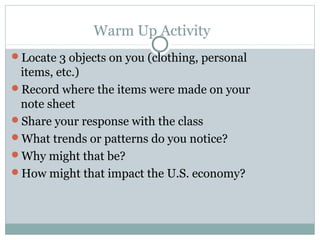
Warm Up Activity
ļ‚—Locate 3 objects on you (clothing, personal
 items, etc.)
ļ‚—Record where the items were made on your
 note sheet
ļ‚—Share your response with the class
ļ‚—What trends or patterns do you notice?
ļ‚—Why might that be?
ļ‚—How might that impact the U.S. economy?
Brainstorm Examples of Government
            Regulations of Businesses

ļ‚—Minimum wage
ļ‚—End to child labor
ļ‚—Workmen’s compensation
ļ‚—Vacation pay
ļ‚—Holiday pay
ļ‚—Health insurance
ļ‚—Safety regulations
ļ‚—Limitations on work day
ļ‚—Overtime pay
ļ‚—Maternity leave
ļ‚—Sick days
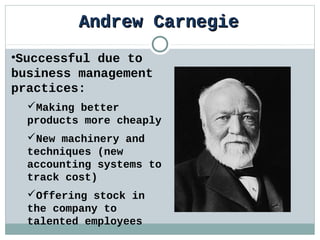
Andrew Carnegie
•Successful due to
business management
practices:
  Making better
  products more cheaply
  New machinery and
  techniques (new
  accounting systems to
  track cost)
  Offering stock in
  the company to
  talented employees
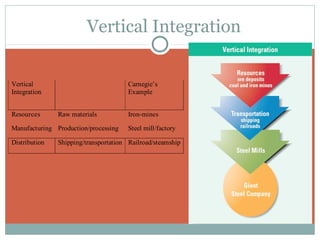
Vertical Integration


Vertical                               Carnegie’s
Integration                            Example


Resources      Raw materials           Iron-mines

Manufacturing Production/processing    Steel mill/factory

Distribution   Shipping/transportation Railroad/steamship
Horizontal Integration


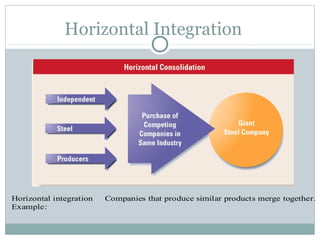
Horizontal integration   Companies that produce similar products merge together.
Example:
Social Darwinism

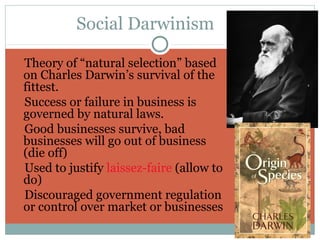
ļ‚—Theory of ā€œnatural selectionā€ based
 on Charles Darwin’s survival of the
 fittest.
ļ‚—Success or failure in business is
 governed by natural laws.
ļ‚—Good businesses survive, bad
 businesses will go out of business
 (die off)
ļ‚—Used to justify laissez-faire (allow to
 do)
ļ‚—Discouraged government regulation
 or control over market or businesses
Examples of Government Regulations
             of Business
ļ‚—Minimum wage              Maternity Leave
ļ‚—End to child labor        sick days
ļ‚—Workmen’s compensation
ļ‚—Vacation pay
ļ‚—Holiday pay
ļ‚—Health insurance
ļ‚—Safety regulations
ļ‚—Limitations on work day
ļ‚—Overtime pay
Government Attempts to Regulate Business

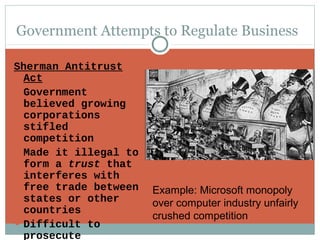
Sherman Antitrust
  Act
ļ‚— Government
  believed growing
  corporations
  stifled
  competition
ļ‚— Made it illegal to
  form a trust that
  interferes with
  free trade between   Example: Microsoft monopoly
  states or other      over computer industry unfairly
  countries
                       crushed competition
ļ‚— Difficult to
  prosecute
Working Conditions
Working Conditions


Length of workday:


# of days work/week:


Safety:


Benefits:
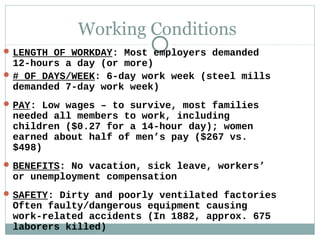
Working Conditions
ļ‚— LENGTH OF WORKDAY: Most employers demanded
  12-hours a day (or more)
ļ‚— # OF DAYS/WEEK: 6-day work week (steel mills
  demanded 7-day work week)
ļ‚— PAY: Low wages – to survive, most families
 needed all members to work, including
 children ($0.27 for a 14-hour day); women
 earned about half of men’s pay ($267 vs.
 $498)
ļ‚— BENEFITS: No vacation, sick leave, workers’
 or unemployment compensation
ļ‚— SAFETY: Dirty and poorly ventilated factories
 Often faulty/dangerous equipment causing
 work-related accidents (In 1882, approx. 675
 laborers killed)
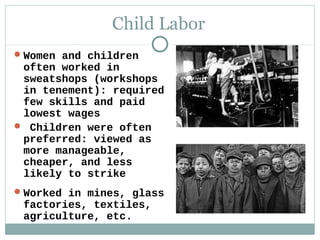
Child Labor
ļ‚— Women and children
 often worked in
 sweatshops (workshops
 in tenement): required
 few skills and paid
 lowest wages
ļ‚— Children were often
 preferred: viewed as
 more manageable,
 cheaper, and less
 likely to strike
ļ‚— Worked in mines, glass
 factories, textiles,
 agriculture, etc.
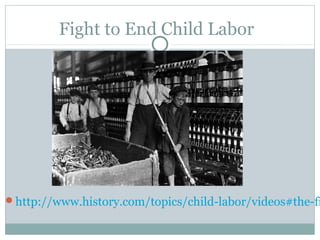
Fight to End Child Labor


ļ‚—http://www.history.com/topics/child-labor/videos#the-fi
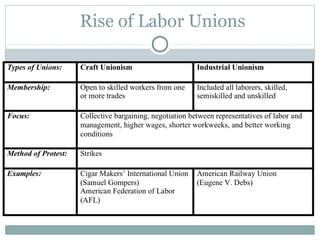
Rise of Labor Unions
Great Strike of 1877
ļ‚—In the economic slump that followed the Panic of
 1873, railroad managers cut wages, increased
 workloads, and laid off workers. Such actions drove
 workers to strike and riot. The general railway strike
 of 1877 was the result of the organization of a
 series of strikes by unionized railroad workers to
 protest wage cuts. These protests involved
 violence, which spread from Pennsylvania and
 West Virginia to the Midwest, Texas, and California,
 and rioters even attacked railroad property,
 derailing trains and burning rail yards. State militia
 companies had to be organized in order to break
 up these picket lines
Haymarket Affair
ļ‚—This was known as the Haymarket Riot for it took
 place near Haymarket Square near downtown
 Chicago. About hundred thousand workers turned
 out including anarchists and radicals who believed
 in using violence. Later, police shot and killed two
 unionists and wounded several others which
 launched a chain of rallies and more violence.
 During a protest against police brutality, a bomb
 exploded as a police company neared, killing seven
 and injuring sixty-seven. Mass arrests were then
 made, and this event later drew attention to labor's
 growing discontent and heightened fear of
 radicalism.
The Homestead Strike
ļ‚—The AFL and the labor movement suffered a series
 of setbacks in the early 1890s when labor violence
 stirred public fears once again. In July 1892, AFL-
 affiliated Amalgamated Association of Iron and
 Steelworkers refused to accept pay cuts and went
 on to strike in Homestead, Pennsylvania in what
 was known as the Homestead Strike. Henry C.
 Frick, president of the Carnegie Steel Company
 closed the plant and later tried to protect the plant
 by hiring three hundred guards. Attacks and
 violence followed and the strikers gave in after five
 months. By this time, public opinion had turned
 against the union after a young anarchist
 attempted to assassinate Frick.
The Pullman Strike
ļ‚— In 1894, workers of at the Pullman Palace Car Company
 walked out in protest over exploitative policies at the company
 town near Chicago. Although the paternalistic George
 Pullman provided everything for the twelve thousand
 residents of the so-called model town named after him, he
 would not negotiate with workers. When hard times began in
 1893, Pullman tried to protect profits by cutting wages.
 Workers sent a committee to Pullman to protest his policies
 but Pullman reacted by firing three of them. Enraged workers
 called a strike, also known as the Pullman Strike, and
 Pullman retaliated by closing his factory. This union was led
 by Eugene V. Debs, voted to aid the strikers by refusing to
 handle any Pullman cars attached to any trains. However,
 soon the strike ended when President Grover Cleveland
 ordered federal troops to crush the protests and Debs
 was sent to prison for defying the court injunction.

Industrial revolution

  • 1.
    Industrial Revolution U.S. History II By Jackie White
  • 2.
    Bellwork ļ‚—Describe what youthink is the American Dream is?
  • 3.
    Biography/Creative Writing ļ‚—Carefully lookat the photograph on the next slide. ļ‚—Write a 1-2 paragraph biography describing the person that you think lived here. ļ‚—Include the following: ļ‚” location ļ‚” occupation ļ‚” cost of living ļ‚” time period ļ‚” number of people who lived together ļ‚” amount of living space
  • 5.
    20 Questions ļ‚—Carefully lookat the photograph on the next slide. ļ‚—Your task is to figure out, who lived here? ļ‚—Create one question for me to answer to help you solve the mystery.
  • 8.
    Andrew Carnegie’s birthplace ļ‚—Location:Dunfermline, Scotland ļ‚—Occupation: weaver ļ‚—Rent: $20/year ļ‚—Time: 1835-1848 ļ‚—Living area: 330 square feet ļ‚—Family of 4
  • 9.
    http://www.carnegieclub.co.uk/ Skibo Castle ļ‚—Location: Dornoch, Scotland ļ‚—Occupation: Steel magnate ļ‚—Cost: $10,000,000 in 1900 ļ‚—$100,000,000 in 2000 ļ‚—Time: 1897-1919 ļ‚—Living area: 22,000 acres (34 square miles) 60,000 square feet ļ‚—Family of 3
  • 10.
    Questions • Why doyou think Andrew Carnegie's family decided to move to the U.S.? • Do you think that Carnegie's birthplace home in Dunfermline was characteristic of someone in a low, middle, or upper class? And Why. • Did Andrew Carnegie achieve the American Dream? • Who could be considered the Andrew Carnegie of today?
  • 11.
    Was Carnegie aHero? ļ‚—Does rising from ā€œragsā€ to ā€œrichesā€ make a person a hero? ļ‚—Do Americans make heroes out of people who make it from poverty? (Abe Lincoln, Babe Ruth, Ronald Reagan) ļ‚—Can acquiring great wealth hurt a person’s chance of being a hero? ļ‚—Do Americans sometimes resent people with lots of money? ļ‚—Can a person born rich be a hero? (George Washington, John Kennedy)
  • 12.
    Characteristics of aHero ļ‚—Directions: On your worksheet is a list of eight personal traits or characteristics. ļ‚—Task one: Next to each trait, name a person you regard as a hero who has that trait. ļ‚—Task two: List 3 traits from the list that you believe a person must have to be a hero.
  • 13.
    Anticipation Guide ļ‚—Before readingthe background information predict whether or not each of the following statements is true or false. ļ‚—Write T for True & F for false on the line provided.
  • 14.
    Background Essay ļ‚—Read wasAndrew Carnegie a Hero? Background Essay ļ‚—Model Think-A-Loud ļ‚—Complete the two sided or dialectic journal. ļ‚—On the left side record key people, ideas, events, or facts from the reading. ļ‚—On the right hand side record your thoughts, comments, questions, or connections to what you read.
  • 15.
    Document Analysis ļ‚—Analyze documents3-10 ļ‚—Answer the guided questions for each document. ļ‚—Categorize the documents. ļ‚—Identify components of a 5 paragraph essay. ļ‚—Compare 2 essay models. ļ‚—Complete the DBQ Essay Outline
  • 16.
  • 17.
  • 19.
  • 23.
    Steel ļ‚—http://www.youtube.com/watch?v=MMURmbHcGOo& ļ‚—America The Storyof Us 07 Cities video clip Carnegie steel 11:42-17:14
  • 24.
    The Expansion ofIndustry ļ‚—MAIN IDEA: At the end of the 19th century, natural resources, creative inventions, and growing demand for goods fueled an industrial boom. ļ‚—WHY IT MATTERS NOW: Technological developments paved the way for continued growth of American industry and eventually a world power. ļ‚—Terms & Names: Edwin L. Drake, Thomas Alva Edison, Christopher Sholes, Alexander Graham Bell, natural resource, uses for steel & electricity, impact of industrial revolution on society.
  • 25.
    Learning Objective ļ‚—Define andprovide examples of natural resources. ļ‚—Identify several factors that contributed to the Industrial Revolution. ļ‚—Match the inventor to their invention or innovation and. ļ‚—Explain how the Industrial Revolution impacted society.
  • 26.
    How did thePittsburgh Steelers get their name? (Why do you think they are called the Steelers? What are some characteristics of steel?)
  • 27.
    Mining and Industryin the United States, 1850-1900 ļ‚—What symbol indicates a major industrial city? ļ‚—How many major industrial cities were there between 1850-1900? ļ‚—List 3 major industrial cities. ļ‚—What generalization can you make about the location of these cities? ļ‚—What might be a possible reason for the creation of most of the cities? ļ‚—Which city appears to be surrounded almost entirely by steel mills? ļ‚—What is steel made out of?
  • 28.
    Mining and Industryin the United States, 1850- 1900
  • 29.
    Natural Resources Definition ofword 3 examples of Use in a semtence Picture
  • 30.
    Natural Resources Definition ofword: 3 examples of Naturally occurring Coal materials that can be used Iron by man as factors of Oil production such as land, minerals, water Water land Use in a sentence Picture
  • 31.
  • 32.
    Causes of IndustrialRevolution Abundance of natural resources Explosion of Industrial new inventions Revolution Growing population to work as labor force and consumers Government Support for business
  • 33.
    Uses for Steel: ļ‚—1.Railroads ļ‚—2. Farm tools ļ‚—3. Cans ļ‚—4. Bridges ļ‚—5. skyscrapers
  • 34.
    Uses for Electricity ļ‚—Thinkof your typical morning routine. ļ‚—Write a list of all the things you do before coming to school. ļ‚—Which items on your list required the use of electricity? ļ‚—Record on your notes several uses for electrcity
  • 35.
    Inventor Invention Impact Edwin L. Drake Turns iron (natural resource) into steel Light bulb & power plants to generate electricity Christopher Sholes Telephone
  • 37.
    Impact of AmericanRevolution on American Life ļ‚—How do all these inventions & innovations impact society? ļ‚—More women began to work. ļ‚—Work that was previously done at home was now made in factories . ļ‚—Industrialization led to long hours and dangerous working conditions. ļ‚—Works was done faster leading to more leisure time. ļ‚—Industrial Revolution led to an improved standard of living and modern life.
  • 38.
    Ticket to Leave ļ‚—Whichinvention or development in this time period had the greatest impact on society and why?
  • 39.
    The Age ofthe Railroads Main Idea: Why It Matters Terms & Names: Now: The growth & Railroads made Transcontinental consolidation of the expansion of railroad railroads industry across George M. benefited the the United States Pullman nation, but also possible . Standardized led to time zones corruption and required government regulations.
  • 40.
    Learning Objectives ļ‚—Identify andbe able to explain the positive and negative effects of the growth of the railroad on America.
  • 41.
    What dangers mightrailroad workers encounter?
  • 42.
    How might therailroad impact the environment?
  • 43.
  • 44.
    ā€œThe Modern Colossusof Rail Roadsā€
  • 45.
    Main Idea: Why It Matters Now: Vocabulary: The expansion of The business strategy of Dividend industry led to the growth consolidation and the Investment of big business and the labor union strategies of Labor union formation of labor collective bargaining and unions. striking are still used Shrewd What are some examples today. Mogul of ā€œbig businessā€ today? Tycoon Who owned and Manufactured operated businesses Laissez-faire before big businesses Vertical integration were created? Horizontal integration Why were labor unions Monopoly necessary? Social Darwinism
  • 46.
    Warm Up Activity ļ‚—Locate3 objects on you (clothing, personal items, etc.) ļ‚—Record where the items were made on your note sheet ļ‚—Share your response with the class ļ‚—What trends or patterns do you notice? ļ‚—Why might that be? ļ‚—How might that impact the U.S. economy?
  • 47.
    Brainstorm Examples ofGovernment Regulations of Businesses ļ‚—Minimum wage ļ‚—End to child labor ļ‚—Workmen’s compensation ļ‚—Vacation pay ļ‚—Holiday pay ļ‚—Health insurance ļ‚—Safety regulations ļ‚—Limitations on work day ļ‚—Overtime pay ļ‚—Maternity leave ļ‚—Sick days
  • 48.
    Andrew Carnegie •Successful dueto business management practices: Making better products more cheaply New machinery and techniques (new accounting systems to track cost) Offering stock in the company to talented employees
  • 49.
    Vertical Integration Vertical Carnegie’s Integration Example Resources Raw materials Iron-mines Manufacturing Production/processing Steel mill/factory Distribution Shipping/transportation Railroad/steamship
  • 50.
    Horizontal Integration Horizontal integration Companies that produce similar products merge together. Example:
  • 51.
    Social Darwinism ļ‚—Theory ofā€œnatural selectionā€ based on Charles Darwin’s survival of the fittest. ļ‚—Success or failure in business is governed by natural laws. ļ‚—Good businesses survive, bad businesses will go out of business (die off) ļ‚—Used to justify laissez-faire (allow to do) ļ‚—Discouraged government regulation or control over market or businesses
  • 52.
    Examples of GovernmentRegulations of Business ļ‚—Minimum wage Maternity Leave ļ‚—End to child labor sick days ļ‚—Workmen’s compensation ļ‚—Vacation pay ļ‚—Holiday pay ļ‚—Health insurance ļ‚—Safety regulations ļ‚—Limitations on work day ļ‚—Overtime pay
  • 53.
    Government Attempts toRegulate Business Sherman Antitrust Act ļ‚— Government believed growing corporations stifled competition ļ‚— Made it illegal to form a trust that interferes with free trade between Example: Microsoft monopoly states or other over computer industry unfairly countries crushed competition ļ‚— Difficult to prosecute
  • 54.
    Working Conditions Working Conditions Lengthof workday: # of days work/week: Safety: Benefits:
  • 55.
    Working Conditions ļ‚— LENGTHOF WORKDAY: Most employers demanded 12-hours a day (or more) ļ‚— # OF DAYS/WEEK: 6-day work week (steel mills demanded 7-day work week) ļ‚— PAY: Low wages – to survive, most families needed all members to work, including children ($0.27 for a 14-hour day); women earned about half of men’s pay ($267 vs. $498) ļ‚— BENEFITS: No vacation, sick leave, workers’ or unemployment compensation ļ‚— SAFETY: Dirty and poorly ventilated factories Often faulty/dangerous equipment causing work-related accidents (In 1882, approx. 675 laborers killed)
  • 56.
    Child Labor ļ‚— Womenand children often worked in sweatshops (workshops in tenement): required few skills and paid lowest wages ļ‚— Children were often preferred: viewed as more manageable, cheaper, and less likely to strike ļ‚— Worked in mines, glass factories, textiles, agriculture, etc.
  • 57.
    Fight to EndChild Labor ļ‚—http://www.history.com/topics/child-labor/videos#the-fi
  • 58.
  • 59.
    Great Strike of1877 ļ‚—In the economic slump that followed the Panic of 1873, railroad managers cut wages, increased workloads, and laid off workers. Such actions drove workers to strike and riot. The general railway strike of 1877 was the result of the organization of a series of strikes by unionized railroad workers to protest wage cuts. These protests involved violence, which spread from Pennsylvania and West Virginia to the Midwest, Texas, and California, and rioters even attacked railroad property, derailing trains and burning rail yards. State militia companies had to be organized in order to break up these picket lines
  • 60.
    Haymarket Affair ļ‚—This wasknown as the Haymarket Riot for it took place near Haymarket Square near downtown Chicago. About hundred thousand workers turned out including anarchists and radicals who believed in using violence. Later, police shot and killed two unionists and wounded several others which launched a chain of rallies and more violence. During a protest against police brutality, a bomb exploded as a police company neared, killing seven and injuring sixty-seven. Mass arrests were then made, and this event later drew attention to labor's growing discontent and heightened fear of radicalism.
  • 61.
    The Homestead Strike ļ‚—TheAFL and the labor movement suffered a series of setbacks in the early 1890s when labor violence stirred public fears once again. In July 1892, AFL- affiliated Amalgamated Association of Iron and Steelworkers refused to accept pay cuts and went on to strike in Homestead, Pennsylvania in what was known as the Homestead Strike. Henry C. Frick, president of the Carnegie Steel Company closed the plant and later tried to protect the plant by hiring three hundred guards. Attacks and violence followed and the strikers gave in after five months. By this time, public opinion had turned against the union after a young anarchist attempted to assassinate Frick.
  • 62.
    The Pullman Strike ļ‚—In 1894, workers of at the Pullman Palace Car Company walked out in protest over exploitative policies at the company town near Chicago. Although the paternalistic George Pullman provided everything for the twelve thousand residents of the so-called model town named after him, he would not negotiate with workers. When hard times began in 1893, Pullman tried to protect profits by cutting wages. Workers sent a committee to Pullman to protest his policies but Pullman reacted by firing three of them. Enraged workers called a strike, also known as the Pullman Strike, and Pullman retaliated by closing his factory. This union was led by Eugene V. Debs, voted to aid the strikers by refusing to handle any Pullman cars attached to any trains. However, soon the strike ended when President Grover Cleveland ordered federal troops to crush the protests and Debs was sent to prison for defying the court injunction.
Editor's Notes

  • #36Ā Smart board Matching activity. Match the inventor to their invention
  • #37Ā Smart board Matching activity. Match the inventor to their invention
  • #54Ā Define ā€œgovernment regulation of businessesā€ – rules established and maintained by a governmental authority, in this case pertaining to business (example of regulations we see today is establishing minimum standards on medicine made by companies, foods (FDA), laws pertaining to schools (Dept. of ED), etc. Difficult to prosecute under the Sherman Act: The Act did not clearly define terms such as trust Companies that utilized the trust strategy reorganized into single corporations The Supreme Court three out 7/8 cases the federal government brought against trusts, and the federal government stopped trying to enforce the Sherman Antitrust Act