Chapter 18Industry & Urban Growth
Section 1A New Industrial Revolution
Why Industry BoomedExpansion of U.S. led to discovers of deposits of coal, iron, lead, & copperAlong with vast forests that could furnish lumberLand grants given by gov’t to railroads & other businessessesTariffs were kept on importsHelped American industry grow by making foreign goods more expensive
Steel & OilTechnology spurred industrial growth as well1850s: Bessemer process was developedMethod of making steel stronger at lower costsSteel quickly replaced iron as basic building materialPittsburgh became nation’s steel making capitalDue to close coal mines & good transportation
1859Titusvill, PANew source of energy found1st oil strikeMethods to refine crude oil were developedMade into lubricants for machines & later into gasolineOil became known as black gold
A Railroad BoomRailroads fueled industrial growthCarried people & goods to the west & raw materials to the eastNew services added (sleeping cars) & more tracks were laid downBig lines soon consolidated & bought up smaller lines Limited competition & kept prices highHigher prices angered small farmers who relied on railroads to get their goods to market
Inventors & InventionsLate 1800sMore patents issued than 10 years before Civil WarU.S. became known as a land of inventionInventions made business & life easier
Edison’s Invention Factory1876Thomas Edison created research lab in Menlo Park, NJHere they created the light bulb, the phonograph, the motion picture camera, & other useful devices1882Edison opened 1st electrical power plant in New York City; other soon followed all over the countrySupplied electricity that lit homes, powered streetcars, & replaced steam engines & electric ones in factories
Communication Revolution1866 telegraph speed increasedCyrus Field laid an underwater telegraph cable from EuropeMade communication faster1876Alexander Graham Bell sent the 1st telephone message to his assistant in another roomPatent for the telephone became the most valuable ever issuedBy 1885 300,000 phones were soldHe later organized over 100 local companies into the giant American Telephone & Telegraphy Company
Devices for Home & Office1868Christopher Sholes invented the type writerMade writing letters much faster1888George Eastman introduced a lightweight cameraReplaced  heavy chemicals & equipmentSold for a low price, ordinary people could purchase itJan MatzeligerAfrican American; invented shoe sewing machineGranville WoodsAfrican American; invented telegraph between moving trains
Transportation RevolutionLate 1800sEuropean engineers developed automobileOnly 8,000 Americans had oneEra of freer & faster transportation followedHenry FordAmerican manufacturer made automobile available to millionsCreated a system to mass produce cars & made them available at a lower price1913 Ford introduced the assembly lineProduction time was cut in halfLower costs to build = lower prices for consumers1917 4.5 million owned carsCars changed the nation’s landscapeRoads spread across country & new cities were developed
The Wright Brothers1903Wilbur & Orville Wright tested a gas powered airplane @ Kitty Hawk, NCStayed in the air for 12 seconds & flew 120 feet1st flights attracted little interestNo use for a flying machineMilitary did not starting using airplane until WWI1920sAirplane started to alter the world by making travel quicker & trade easier
Big Business & organized LaborSection 2
New Ways of Doing BusinessExpansion led by entrepreneursSomeone who sets up new businesses to make a profitTo raise more money, entrepreneurs adopted new ways of organizing business
The CorporationCorporationsBusinesses owned by many investorsRaise money by selling stock or sharesStockholders get some of the profits & pick who runs the companyLimited risk of investors, only lost money they invested
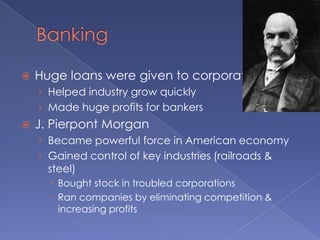
BankingHuge loans were given to corporationsHelped industry grow quicklyMade huge profits for bankersJ. Pierpont MorganBecame powerful force in American economyGained control of key industries (railroads & steel)Bought stock in troubled corporationsRan companies by eliminating competition & increasing profits
Growth of Big BusinessCongress did little to regulate business practicesLed to growth of “Big Business”Entrepreneurs formed monopolies or companies that control most or all business in a particular industry
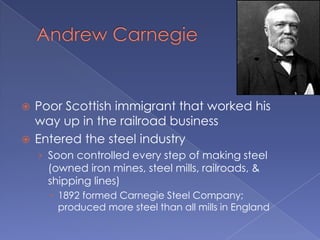
Andrew CarnegiePoor Scottish immigrant that worked his way up in the railroad businessEntered the steel industrySoon controlled every step of making steel (owned iron mines, steel mills, railroads, & shipping lines)1892 formed Carnegie Steel Company; produced more steel than all mills in England
Carnegie believed the rich had a duty to improve societyCalled Gospel of WealthDonated millions to build libraries & charitiesSet up a foundation that funded worthy causes after his death
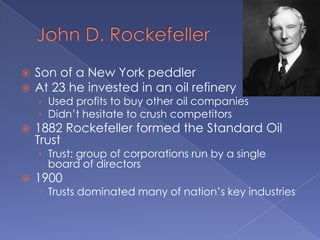
John D. RockefellerSon of a New York peddlerAt 23 he invested in an oil refineryUsed profits to buy other oil companiesDidn’t hesitate to crush competitors1882 Rockefeller formed the Standard Oil TrustTrust: group of corporations run by a single board of directors1900Trusts dominated many of nation’s key industries
Debate Over TrustsBig Business good or bad?CriticsTrusts threatened free enterprise (system in which privately owned businesses compete freely)Business leaders were “robber barons” & used their money to influence politiciansOthersBold “captains of industry”Built up economy & created jobsMade goods & services affordable for American consumers
Social DarwinismSupported trend toward trustsSurvival of the fittest applied to human affairsBusiness leaders used to justify efforts to limit competition & harsh working conditions
Changes in the WorkplaceClose relationships  between owners & workers ended as industries grewMost new workers were immigrants, others were African Americans who left southern farms
Women & ChildrenOutnumbered men in most industriesMany work in sweatshops (workshops with long hours & poor working conditions with low pay)Children had hazardous jobs as wellMost children did not go to school & could not improve their lives
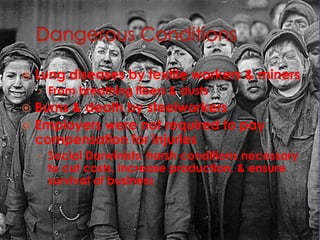
Dangerous ConditionsLung diseases by textile workers & minersFrom breathing fibers & dustsBurns & death by steelworkersEmployers were not required to pay compensation for injuriesSocial Darwinists: harsh conditions necessary to cut costs, increase production, & ensure survival of business
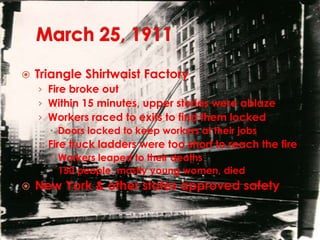
March 25, 1911Triangle Shirtwaist FactoryFire broke outWithin 15 minutes, upper stories were ablazeWorkers raced to exits to find them lockedDoors locked to keep workers at their jobsFire truck ladders were too short to reach the fireWorkers leaped to their deaths150 people, mostly young women, diedNew York & other states approved safety
Workers OrganizeFactory workers made attempts to organize in early days of Industrial RevolutionSecurity guards were hired by companies to attack strikers or union organizersLaws made it illegal to strikeWorkers formed unions in secretSought safer working conditions, higher wages, & shorter hours
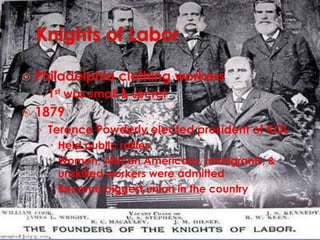
Knights of LaborPhiladelphia clothing workers1st was small & secret1879Terence Powderly elected president of KOLHeld public ralliesWomen, African Americans, immigrants, & unskilled workers were admittedBecame biggest union in the country
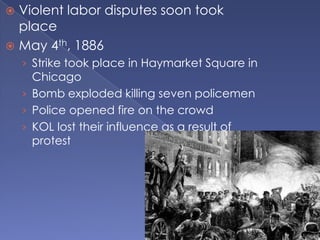
Violent labor disputes soon took placeMay 4th, 1886Strike took place in Haymarket Square in ChicagoBomb exploded killing seven policemenPolice opened fire on the crowdKOL lost their influence as a result of protest
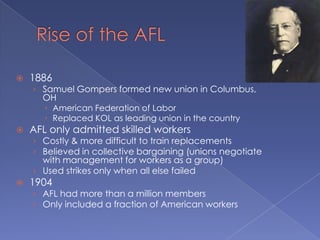
Rise of the AFL1886Samuel Gompers formed new union in Columbus, OHAmerican Federation of LaborReplaced KOL as leading union in the countryAFL only admitted skilled workersCostly & more difficult to train replacementsBelieved in collective bargaining (unions negotiate with management for workers as a group)Used strikes only when all else failed1904AFL had more than a million membersOnly included a fraction of American workers
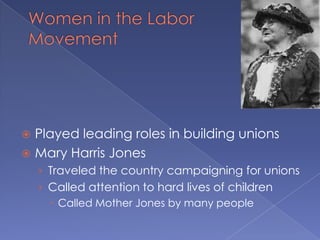
Women in the Labor MovementPlayed leading roles in building unionsMary Harris JonesTraveled the country campaigning for unionsCalled attention to hard lives of childrenCalled Mother Jones by many people
Bitter Strikes1893Severe economic depressionOwners cut production, fired workers, & slashed wagesViolent strikes swept the countryGeorge PullmanCut workers pay by 25% & did not lower rent on company housingWorkers walked off their jobsBy July rail lines were shut down from coast to coastPresident Grover Cleveland sent federal troops to Chicago to end the strikeShots were fired into the crowd, killing 2Public generally sided with owners in violent labor disputesStriking unions were seen as radical or violentBy 1900 only 3% of American workers belonged to a union
Chapter 18 Section 3Cities Grow & Change
Rapid Growth of CitiesUrbanizationRapid growth of city populations18901 in 3 Americans lived in a cityU.S. had cities the sizes of London & ParisReasons for urbanizationCities attracted industry & industry attracted peopleMoved in search of jobs & excitementMany were near waterways, provided easier transport of goods
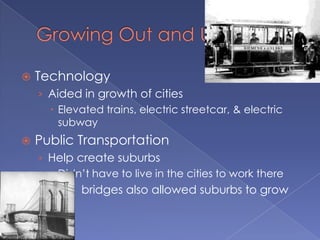
Growing Out and UpTechnologyAided in growth of citiesElevated trains, electric streetcar, & electric subwayPublic TransportationHelp create suburbsDidn’t have to live in the cities to work thereSteel  bridges also allowed suburbs to grow
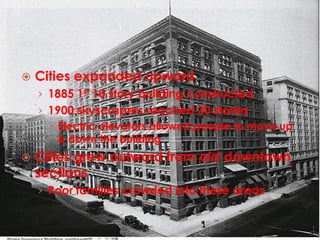
Cities expanded upward1885 1st 10 story building constructed1900 skyscrapers reached 30 storiesElectric elevators allowed people to move up & down the buildingCities grew outward from old downtown sectionsPoor families crowded into these areas
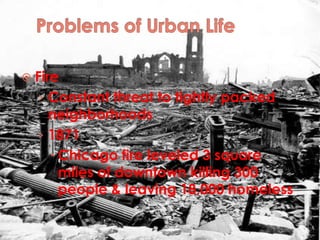
Problems of Urban LifeFireConstant threat to tightly packed neighborhoods1871Chicago fire leveled 3 square miles of downtown killing 300 people & leaving 18,000 homeless
Tenement LifeDowntown slumsPoor living conditionsTenements: buildings divided into many tiny apartmentsNo windows (usually), heat, or indoor plumbing10 people lived in a single room & several families shared a single bathroomStreets were littered w/ garbageDiseases were commonBabies ran the greatest risk of deathIn one Chicago slum, half of all babies died by one
Improving City Life1880sStreetlights, fire stations, police departments, & sanitation stations were set upPublic health officials waged war on diseaseReligious groups served the poorHospitals & clinics were set up for those who could not afford a doctorSalvation Army was founded & gave food, clothing & shelter to the homeless
Settlement HousesJane Addams1889 opened Hull House (settlement house) in ChicagoA center offering help to the urban poorAt settlement housesTaught English to immigrants, sponsored music & sports for young people, & provided nurseries for children of working womenAddams & other house leaders fought to outlaw child labor
The Excitement of City LifeAttractions available in the cityElectric lights, elevated railroads, & tall buildingsDepartment storesDeveloped to meet the needs of shoppersCould buy everything they needed in one store (use to buy shirts in one, shoes in one, pants in one)Goods were separated on different floors
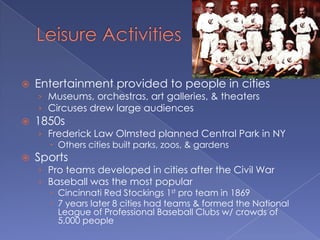
Leisure ActivitiesEntertainment provided to people in citiesMuseums, orchestras, art galleries, & theatersCircuses drew large audiences1850sFrederick Law Olmsted planned Central Park in NYOthers cities built parks, zoos, & gardensSportsPro teams developed in cities after the Civil WarBaseball was the most popularCincinnati Red Stockings 1st pro team in 18697 years later 8 cities had teams & formed the National League of Professional Baseball Clubs w/ crowds of 5,000 people
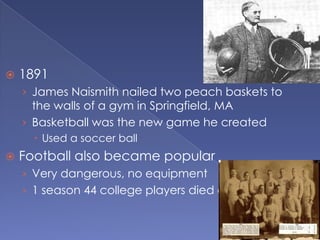
1891James Naismith nailed two peach baskets to the walls of a gym in Springfield, MABasketball was the new game he createdUsed a soccer ballFootball also became popularVery dangerous, no equipment1 season 44 college players died of injuries
Section 4The New Immigrants
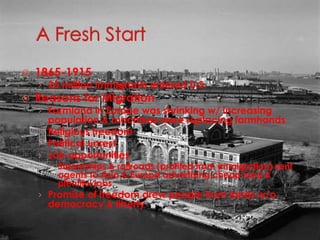
A Fresh Start1865-191525 million immigrants entered U.S.Reasons for MigrationFarmland in Europe was shrinking w/ increasing population & machines were replacing farmhandsReligious freedomPolitical unrestJob opportunitiesSteamships & railroads (profited from immigration) sent agents to Asia & Europe advertising cheap land & plentiful jobsPromise of freedom drew people from lands w/o democracy & liberty
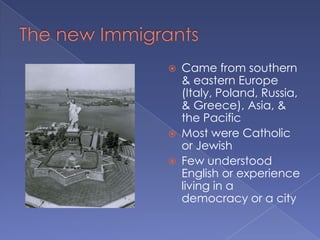
The new ImmigrantsCame from southern & eastern Europe (Italy, Poland, Russia, & Greece), Asia, & the PacificMost were Catholic or JewishFew understood English or experience living in a democracy or a city
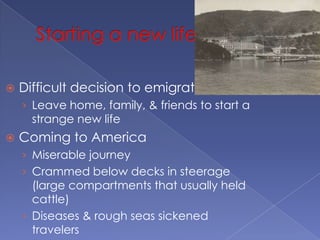
Starting a new lifeDifficult decision to emigrateLeave home, family, & friends to start a strange new lifeComing to AmericaMiserable journeyCrammed below decks in steerage (large compartments that usually held cattle)Diseases & rough seas sickened travelersEuropeans landed at Ellis Island in NY & Asians landed at Angel Island in San FranciscoFaced rigorous physical exam; could be sent home if disabled or seriously ill
Immigrant NeighborhoodsMost settled into cities after being admitted to U.S.Near people from the same countryHelped people feel less isolatedCelebrated familiar holidays & cooked foods from homelandSocial groups were started (Sons of Italy)Storefronts became places of worship
Becoming AmericanImmigrant Aid SocietiesHelped cloth, house, & teach immigrantsAssimilationImmigrants kept traditional modes of worship, family life, & communityWorked hard to also assimilate (process of becoming part of another culture)Children assimilated faster than parents; learned English faster, played baseball & dressed like native-born AmericansPained parents to see children change, but dreamed of the next generations would be better off
Contributions of ImmigrantsLabor of immigrants was essential to new American economyTook whatever job they could find (steel mills, meatpacking plants, mines, garment sweatshops, built subways, skyscrapers, & bridges)Chinese, Irish, & Mexican workers laid hundreds of miles of railroad trackHard work & saving allowed many to advance economicallySometimes opened small businesses to serve their communityCustomers expanded beyond neighborhood over time, spreading traditional customs like food throughout the country (spaghetti, chow mein, & bagles)
Individual Immigrants who contributedAndrew Carnegie, Alexander Graham Bell, Samuel Goldwyn & Louis Mayer (started motion picture industry), Arturo Toscanini (famous orchestra conductor), Leo Baekeland (invented 1st plastic)
A New Wave of Nativism1840sIncreased immigration led to nativismNativists sought to preserve U.S. for native born AmericansImmigrants wouldn’t assimilate because their languages, religions, & customs were too differentTook away jobs from AmericansImmigrants were associated w/ violence, crime, & anarchyWest CoastChinese were drove from mining camps & cities & sometimes killed by angry mobs1882Congress passed Chinese Exclusion Act to exclude Chinese laborers from U.S.1st law limiting immigration based on race; repealed in 19431917Congress passed a law that denied entry to immigrant who could not read their own languagesBarred most of the world’s poor people from U.S.
Education & CultureSection 5
Educating AmericansBefore 1870½ American children attended schoolAll age levels w/ one teacherIndustry GrowthNation needed educated workforceStates improved public schools @ all levels
Education Expands1852Compulsory education law passedRequirement that children attend school up to a certain pointMost states passed minimum of 10th gradeSchools for whites & black were built in the SouthMore reluctant to pass compulsory education laws1918Every state required children to attend schoolHigher education also expandedColleges for men & women openedUniversities offering free or low-cost education opened
The School DayElementary School8:00 a.m. – 4:00 p.m.Learned reading, writing, & arithmeticMoral values & the Christian  religionEducation for AdultsLibraries were builtOffered not only books & magazines, but also speakers on important topics1874Methodist minister opened summer bible school along Lake ChautauquaCamp later opened to the publicChautauqua Society later began & traveling lectures  were sent out
New American WritersAmericans began to read moreBestsellers were dime novelsTold rags-to-riches storiesRealismWriters who try to show life as it isEmphasized the harsh sideStephen Crane, Jack London, Kate Chopin, & Paul Laurence Dunbar
Mark TwainPen name of Samuel ClemensMade stories realistic by capturing the speech patterns of southerners who lived & worked along the Mississippi RiverHuckleberry Finn
A Newspaper BoomLate 1800sNewspapers grew dramatically1900Half the newspapers in the world were printed in the U.S.Causes of newspaper boomSpread of educationMore could read, more newspapers & magazines were boughtUrbanizationNews was shared face to facePeople needed newspapers to stay informed
A New Kind of NewspaperJoseph PulitzerCreated 1st modern mass circulation newspaper1883Bought New York WorldCut the price so more people could afford itAdded crowd pleasing featuresColor comics (the Yellow Kid a sweet slum boy), crime & scandalous headlinesCritics called it yellow journalism

American History Chapter 18 Sections 1-5

  • 1.
  • 2.
    Section 1A NewIndustrial Revolution
  • 3.
    Why Industry BoomedExpansionof U.S. led to discovers of deposits of coal, iron, lead, & copperAlong with vast forests that could furnish lumberLand grants given by gov’t to railroads & other businessessesTariffs were kept on importsHelped American industry grow by making foreign goods more expensive
  • 4.
    Steel & OilTechnologyspurred industrial growth as well1850s: Bessemer process was developedMethod of making steel stronger at lower costsSteel quickly replaced iron as basic building materialPittsburgh became nation’s steel making capitalDue to close coal mines & good transportation
  • 5.
    1859Titusvill, PANew sourceof energy found1st oil strikeMethods to refine crude oil were developedMade into lubricants for machines & later into gasolineOil became known as black gold
  • 6.
    A Railroad BoomRailroadsfueled industrial growthCarried people & goods to the west & raw materials to the eastNew services added (sleeping cars) & more tracks were laid downBig lines soon consolidated & bought up smaller lines Limited competition & kept prices highHigher prices angered small farmers who relied on railroads to get their goods to market
  • 7.
    Inventors & InventionsLate1800sMore patents issued than 10 years before Civil WarU.S. became known as a land of inventionInventions made business & life easier
  • 8.
    Edison’s Invention Factory1876ThomasEdison created research lab in Menlo Park, NJHere they created the light bulb, the phonograph, the motion picture camera, & other useful devices1882Edison opened 1st electrical power plant in New York City; other soon followed all over the countrySupplied electricity that lit homes, powered streetcars, & replaced steam engines & electric ones in factories
  • 9.
    Communication Revolution1866 telegraphspeed increasedCyrus Field laid an underwater telegraph cable from EuropeMade communication faster1876Alexander Graham Bell sent the 1st telephone message to his assistant in another roomPatent for the telephone became the most valuable ever issuedBy 1885 300,000 phones were soldHe later organized over 100 local companies into the giant American Telephone & Telegraphy Company
  • 10.
    Devices for Home& Office1868Christopher Sholes invented the type writerMade writing letters much faster1888George Eastman introduced a lightweight cameraReplaced heavy chemicals & equipmentSold for a low price, ordinary people could purchase itJan MatzeligerAfrican American; invented shoe sewing machineGranville WoodsAfrican American; invented telegraph between moving trains
  • 11.
    Transportation RevolutionLate 1800sEuropeanengineers developed automobileOnly 8,000 Americans had oneEra of freer & faster transportation followedHenry FordAmerican manufacturer made automobile available to millionsCreated a system to mass produce cars & made them available at a lower price1913 Ford introduced the assembly lineProduction time was cut in halfLower costs to build = lower prices for consumers1917 4.5 million owned carsCars changed the nation’s landscapeRoads spread across country & new cities were developed
  • 12.
    The Wright Brothers1903Wilbur& Orville Wright tested a gas powered airplane @ Kitty Hawk, NCStayed in the air for 12 seconds & flew 120 feet1st flights attracted little interestNo use for a flying machineMilitary did not starting using airplane until WWI1920sAirplane started to alter the world by making travel quicker & trade easier
  • 13.
    Big Business &organized LaborSection 2
  • 14.
    New Ways ofDoing BusinessExpansion led by entrepreneursSomeone who sets up new businesses to make a profitTo raise more money, entrepreneurs adopted new ways of organizing business
  • 15.
    The CorporationCorporationsBusinesses ownedby many investorsRaise money by selling stock or sharesStockholders get some of the profits & pick who runs the companyLimited risk of investors, only lost money they invested
  • 16.
    BankingHuge loans weregiven to corporationsHelped industry grow quicklyMade huge profits for bankersJ. Pierpont MorganBecame powerful force in American economyGained control of key industries (railroads & steel)Bought stock in troubled corporationsRan companies by eliminating competition & increasing profits
  • 17.
    Growth of BigBusinessCongress did little to regulate business practicesLed to growth of “Big Business”Entrepreneurs formed monopolies or companies that control most or all business in a particular industry
  • 18.
    Andrew CarnegiePoor Scottishimmigrant that worked his way up in the railroad businessEntered the steel industrySoon controlled every step of making steel (owned iron mines, steel mills, railroads, & shipping lines)1892 formed Carnegie Steel Company; produced more steel than all mills in England
  • 19.
    Carnegie believed therich had a duty to improve societyCalled Gospel of WealthDonated millions to build libraries & charitiesSet up a foundation that funded worthy causes after his death
  • 20.
    John D. RockefellerSonof a New York peddlerAt 23 he invested in an oil refineryUsed profits to buy other oil companiesDidn’t hesitate to crush competitors1882 Rockefeller formed the Standard Oil TrustTrust: group of corporations run by a single board of directors1900Trusts dominated many of nation’s key industries
  • 21.
    Debate Over TrustsBigBusiness good or bad?CriticsTrusts threatened free enterprise (system in which privately owned businesses compete freely)Business leaders were “robber barons” & used their money to influence politiciansOthersBold “captains of industry”Built up economy & created jobsMade goods & services affordable for American consumers
  • 22.
    Social DarwinismSupported trendtoward trustsSurvival of the fittest applied to human affairsBusiness leaders used to justify efforts to limit competition & harsh working conditions
  • 23.
    Changes in theWorkplaceClose relationships between owners & workers ended as industries grewMost new workers were immigrants, others were African Americans who left southern farms
  • 24.
    Women & ChildrenOutnumberedmen in most industriesMany work in sweatshops (workshops with long hours & poor working conditions with low pay)Children had hazardous jobs as wellMost children did not go to school & could not improve their lives
  • 25.
    Dangerous ConditionsLung diseasesby textile workers & minersFrom breathing fibers & dustsBurns & death by steelworkersEmployers were not required to pay compensation for injuriesSocial Darwinists: harsh conditions necessary to cut costs, increase production, & ensure survival of business
  • 26.
    March 25, 1911TriangleShirtwaist FactoryFire broke outWithin 15 minutes, upper stories were ablazeWorkers raced to exits to find them lockedDoors locked to keep workers at their jobsFire truck ladders were too short to reach the fireWorkers leaped to their deaths150 people, mostly young women, diedNew York & other states approved safety
  • 27.
    Workers OrganizeFactory workersmade attempts to organize in early days of Industrial RevolutionSecurity guards were hired by companies to attack strikers or union organizersLaws made it illegal to strikeWorkers formed unions in secretSought safer working conditions, higher wages, & shorter hours
  • 28.
    Knights of LaborPhiladelphiaclothing workers1st was small & secret1879Terence Powderly elected president of KOLHeld public ralliesWomen, African Americans, immigrants, & unskilled workers were admittedBecame biggest union in the country
  • 29.
    Violent labor disputessoon took placeMay 4th, 1886Strike took place in Haymarket Square in ChicagoBomb exploded killing seven policemenPolice opened fire on the crowdKOL lost their influence as a result of protest
  • 30.
    Rise of theAFL1886Samuel Gompers formed new union in Columbus, OHAmerican Federation of LaborReplaced KOL as leading union in the countryAFL only admitted skilled workersCostly & more difficult to train replacementsBelieved in collective bargaining (unions negotiate with management for workers as a group)Used strikes only when all else failed1904AFL had more than a million membersOnly included a fraction of American workers
  • 31.
    Women in theLabor MovementPlayed leading roles in building unionsMary Harris JonesTraveled the country campaigning for unionsCalled attention to hard lives of childrenCalled Mother Jones by many people
  • 32.
    Bitter Strikes1893Severe economicdepressionOwners cut production, fired workers, & slashed wagesViolent strikes swept the countryGeorge PullmanCut workers pay by 25% & did not lower rent on company housingWorkers walked off their jobsBy July rail lines were shut down from coast to coastPresident Grover Cleveland sent federal troops to Chicago to end the strikeShots were fired into the crowd, killing 2Public generally sided with owners in violent labor disputesStriking unions were seen as radical or violentBy 1900 only 3% of American workers belonged to a union
  • 33.
    Chapter 18 Section3Cities Grow & Change
  • 34.
    Rapid Growth ofCitiesUrbanizationRapid growth of city populations18901 in 3 Americans lived in a cityU.S. had cities the sizes of London & ParisReasons for urbanizationCities attracted industry & industry attracted peopleMoved in search of jobs & excitementMany were near waterways, provided easier transport of goods
  • 35.
    Growing Out andUpTechnologyAided in growth of citiesElevated trains, electric streetcar, & electric subwayPublic TransportationHelp create suburbsDidn’t have to live in the cities to work thereSteel bridges also allowed suburbs to grow
  • 36.
    Cities expanded upward18851st 10 story building constructed1900 skyscrapers reached 30 storiesElectric elevators allowed people to move up & down the buildingCities grew outward from old downtown sectionsPoor families crowded into these areas
  • 37.
    Problems of UrbanLifeFireConstant threat to tightly packed neighborhoods1871Chicago fire leveled 3 square miles of downtown killing 300 people & leaving 18,000 homeless
  • 38.
    Tenement LifeDowntown slumsPoorliving conditionsTenements: buildings divided into many tiny apartmentsNo windows (usually), heat, or indoor plumbing10 people lived in a single room & several families shared a single bathroomStreets were littered w/ garbageDiseases were commonBabies ran the greatest risk of deathIn one Chicago slum, half of all babies died by one
  • 39.
    Improving City Life1880sStreetlights,fire stations, police departments, & sanitation stations were set upPublic health officials waged war on diseaseReligious groups served the poorHospitals & clinics were set up for those who could not afford a doctorSalvation Army was founded & gave food, clothing & shelter to the homeless
  • 40.
    Settlement HousesJane Addams1889opened Hull House (settlement house) in ChicagoA center offering help to the urban poorAt settlement housesTaught English to immigrants, sponsored music & sports for young people, & provided nurseries for children of working womenAddams & other house leaders fought to outlaw child labor
  • 41.
    The Excitement ofCity LifeAttractions available in the cityElectric lights, elevated railroads, & tall buildingsDepartment storesDeveloped to meet the needs of shoppersCould buy everything they needed in one store (use to buy shirts in one, shoes in one, pants in one)Goods were separated on different floors
  • 42.
    Leisure ActivitiesEntertainment providedto people in citiesMuseums, orchestras, art galleries, & theatersCircuses drew large audiences1850sFrederick Law Olmsted planned Central Park in NYOthers cities built parks, zoos, & gardensSportsPro teams developed in cities after the Civil WarBaseball was the most popularCincinnati Red Stockings 1st pro team in 18697 years later 8 cities had teams & formed the National League of Professional Baseball Clubs w/ crowds of 5,000 people
  • 43.
    1891James Naismith nailedtwo peach baskets to the walls of a gym in Springfield, MABasketball was the new game he createdUsed a soccer ballFootball also became popularVery dangerous, no equipment1 season 44 college players died of injuries
  • 44.
  • 45.
    A Fresh Start1865-191525million immigrants entered U.S.Reasons for MigrationFarmland in Europe was shrinking w/ increasing population & machines were replacing farmhandsReligious freedomPolitical unrestJob opportunitiesSteamships & railroads (profited from immigration) sent agents to Asia & Europe advertising cheap land & plentiful jobsPromise of freedom drew people from lands w/o democracy & liberty
  • 46.
    The new ImmigrantsCamefrom southern & eastern Europe (Italy, Poland, Russia, & Greece), Asia, & the PacificMost were Catholic or JewishFew understood English or experience living in a democracy or a city
  • 47.
    Starting a newlifeDifficult decision to emigrateLeave home, family, & friends to start a strange new lifeComing to AmericaMiserable journeyCrammed below decks in steerage (large compartments that usually held cattle)Diseases & rough seas sickened travelersEuropeans landed at Ellis Island in NY & Asians landed at Angel Island in San FranciscoFaced rigorous physical exam; could be sent home if disabled or seriously ill
  • 48.
    Immigrant NeighborhoodsMost settledinto cities after being admitted to U.S.Near people from the same countryHelped people feel less isolatedCelebrated familiar holidays & cooked foods from homelandSocial groups were started (Sons of Italy)Storefronts became places of worship
  • 49.
    Becoming AmericanImmigrant AidSocietiesHelped cloth, house, & teach immigrantsAssimilationImmigrants kept traditional modes of worship, family life, & communityWorked hard to also assimilate (process of becoming part of another culture)Children assimilated faster than parents; learned English faster, played baseball & dressed like native-born AmericansPained parents to see children change, but dreamed of the next generations would be better off
  • 50.
    Contributions of ImmigrantsLaborof immigrants was essential to new American economyTook whatever job they could find (steel mills, meatpacking plants, mines, garment sweatshops, built subways, skyscrapers, & bridges)Chinese, Irish, & Mexican workers laid hundreds of miles of railroad trackHard work & saving allowed many to advance economicallySometimes opened small businesses to serve their communityCustomers expanded beyond neighborhood over time, spreading traditional customs like food throughout the country (spaghetti, chow mein, & bagles)
  • 51.
    Individual Immigrants whocontributedAndrew Carnegie, Alexander Graham Bell, Samuel Goldwyn & Louis Mayer (started motion picture industry), Arturo Toscanini (famous orchestra conductor), Leo Baekeland (invented 1st plastic)
  • 52.
    A New Waveof Nativism1840sIncreased immigration led to nativismNativists sought to preserve U.S. for native born AmericansImmigrants wouldn’t assimilate because their languages, religions, & customs were too differentTook away jobs from AmericansImmigrants were associated w/ violence, crime, & anarchyWest CoastChinese were drove from mining camps & cities & sometimes killed by angry mobs1882Congress passed Chinese Exclusion Act to exclude Chinese laborers from U.S.1st law limiting immigration based on race; repealed in 19431917Congress passed a law that denied entry to immigrant who could not read their own languagesBarred most of the world’s poor people from U.S.
  • 53.
  • 54.
    Educating AmericansBefore 1870½American children attended schoolAll age levels w/ one teacherIndustry GrowthNation needed educated workforceStates improved public schools @ all levels
  • 55.
    Education Expands1852Compulsory educationlaw passedRequirement that children attend school up to a certain pointMost states passed minimum of 10th gradeSchools for whites & black were built in the SouthMore reluctant to pass compulsory education laws1918Every state required children to attend schoolHigher education also expandedColleges for men & women openedUniversities offering free or low-cost education opened
  • 56.
    The School DayElementarySchool8:00 a.m. – 4:00 p.m.Learned reading, writing, & arithmeticMoral values & the Christian religionEducation for AdultsLibraries were builtOffered not only books & magazines, but also speakers on important topics1874Methodist minister opened summer bible school along Lake ChautauquaCamp later opened to the publicChautauqua Society later began & traveling lectures were sent out
  • 57.
    New American WritersAmericansbegan to read moreBestsellers were dime novelsTold rags-to-riches storiesRealismWriters who try to show life as it isEmphasized the harsh sideStephen Crane, Jack London, Kate Chopin, & Paul Laurence Dunbar
  • 58.
    Mark TwainPen nameof Samuel ClemensMade stories realistic by capturing the speech patterns of southerners who lived & worked along the Mississippi RiverHuckleberry Finn
  • 59.
    A Newspaper BoomLate1800sNewspapers grew dramatically1900Half the newspapers in the world were printed in the U.S.Causes of newspaper boomSpread of educationMore could read, more newspapers & magazines were boughtUrbanizationNews was shared face to facePeople needed newspapers to stay informed
  • 60.
    A New Kindof NewspaperJoseph PulitzerCreated 1st modern mass circulation newspaper1883Bought New York WorldCut the price so more people could afford itAdded crowd pleasing featuresColor comics (the Yellow Kid a sweet slum boy), crime & scandalous headlinesCritics called it yellow journalism