Instructor
Instructor
Mr. Shyamasundar Tripathy
Management Faculty(HR)
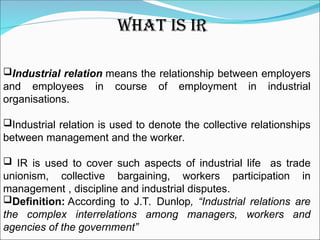
WHAT IS IR
Industrial relation means the relationship between employers
and employees in course of employment in industrial
organisations.
Industrial relation is used to denote the collective relationships
between management and the worker.
 IR is used to cover such aspects of industrial life as trade
unionism, collective bargaining, workers participation in
management , discipline and industrial disputes.
Definition: According to J.T. Dunlop, “Industrial relations are
the complex interrelations among managers, workers and
agencies of the government”
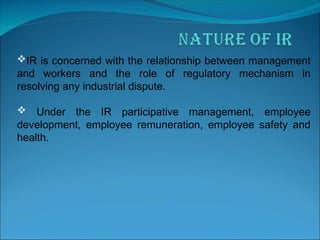
IR is concerned with the relationship between management
and workers and the role of regulatory mechanism in
resolving any industrial dispute.
 Under the IR participative management, employee
development, employee remuneration, employee safety and
health.
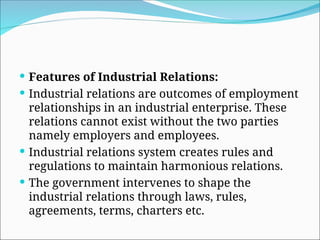
 Features of Industrial Relations:
 Industrial relations are outcomes of employment
relationships in an industrial enterprise. These
relations cannot exist without the two parties
namely employers and employees.
 Industrial relations system creates rules and
regulations to maintain harmonious relations.
 The government intervenes to shape the
industrial relations through laws, rules,
agreements, terms, charters etc.
 Several parties are involved in the Industrial
relations system. The main parties are employers
and their associations, employees and their unions
and the government. These three parties interact
within economic and social environment to shape
the Industrial relations structure.
 Industrial relations are a dynamic and developing
concept, not a static one. They undergo changes
with changing structure and scenario of the
industry as and when change occurs.
 Industrial relations include both individual
relations and collective relationships.
Objectives of Industrial Relations:
•To maintain industrial democracy based on participation of
labour in the management and gains of industry.
•To raise productivity by reducing tendency of high labour
turnover and absenteeism.
•To ensure workers’ participation in management of the
company by giving them a fair say in decision-making and
framing policies.
•To establish a proper channel of communication.
•To increase the morale and discipline of the employees.
•To safeguard the interests of the labour as well as
management by securing the highest level of mutual
understanding and goodwill between all sections in an
industry.
•To avoid all forms of industrial conflicts so as to ensure
industrial peace by providing better living and working
standards for the workers.
Importance of Industrial Relations:
 Uninterrupted Production: The most important
benefit of industrial benefits is that it ensures
continuity of production. This means continuous
employment for all involved right from managers
to workers.
 Reduction in Industrial disputes: Good Industrial
relations reduce Industrial disputes. Strikes,
grievances and lockouts are some of the reflections
of Industrial unrest. Industrial peace helps in
promoting co-operation and increasing production.
 High morale: Good Industrial relations improve
the morale of the employees and motivate the
worker workers to work more and better.
 Reduced wastage: Good Industrial relations are
maintained on the basis of co-operation and
recognition of each other. It helps to reduce
wastage of material, manpower and costs.
 Contributes to economic growth and
development.
 Causes of poor Industrial Relations:
 Economic causes: Often poor wages and poor
working conditions are the main causes for
unhealthy relations between management and
labour. Unauthorised deductions from wages, lack
of fringe benefits, absence of promotion
opportunities, faulty incentive schemes are other
economic causes. Other causes for Industrial
conflicts are inadequate infrastructure, worn-out
plant and machinery, poor layout, unsatisfactory
maintenance etc.
 Organisational causes: Faulty communications
system, unfair practices, non-recognition of trade
unions and labour laws are also some other
causes of poor relations in industry.
 Social causes: Uninteresting nature of work is
the main social cause of poor Industrial
relations. Dissatisfaction with job and personal
life culminates into Industrial conflicts.
 Psychological causes: Lack of job security, non-
recognition of merit and performance, poor
interpersonal relations are the psychological
reasons for unsatisfactory employer-employee
relations.
 Political causes: Multiple unions, inter-union
rivalry weaken the trade unions. Defective trade
unions system prevailing in the country has been
one of the most responsible causes for Industrial
disputes in the country
 Suggestions to improve Industrial Relations:
 Sound personnel policies: Policies and procedures
concerning the compensation, transfer and
promotion, etc. of employees should be fair and
transparent. All policies and rules relating to
Industrial relations should be fair and transparent
to everybody in the enterprise and to the union
leaders.
 Participative management: Employees should
associate workers and unions in the formulation
and implementation of HR policies and practices.
 Responsible unions: A strong trade union is an
asset to the employer. Trade unions should adopt a
responsible rather than political approach to
industrial relations.
 Employee welfare: Employers should recognise
the need for the welfare of workers. They must
ensure reasonable wages, satisfactory working
conditions, and other necessary facilities for
labour. Management should have a genuine
concern for the welfare and betterment of the
working class.
 Grievance procedure: A well-established and properly
administered system committed to the timely and
satisfactory redressal of employee’s grievances can be very
helpful in improving Industrial relations. A suggestion
scheme will help to satisfy the creative urge of the
workers.
 Constructive attitude: Both management and trade
unions should adopt positive attitude towards each other.
Management must recognise unions as the spokesmen of
the workers’ grievances and as custodians of their
interests. The employer should accept workers as equal
partners in a joint endeavour for good Industrial relations.
 Creating a proper communication channel to
avoid grievances and misunderstandings
among employees
 Education and training imparted to the
employees
Employees
Employee
Association
Government
Employer-
Employee
Relations
Employers
Employer
Associations
Courts and
Tribunals
UNITARY APPROACH
 UNITARY APPROACHI is grounded in mutual
cooperation, individual treatment, team work and
shared goals.
 Work place conflict is seen as temporary
aberration, resulting from poor management
Employees who do not mix well with organization
culture Unions cooperate with the management.
 Management’s right to manage is accepted
because there is no ‘we they” feeling Underlying
assumption is that everyone benefits when the
focus is on common interest and promotion of
harmony Based on reactive strategy.
PLURALISM(CONFLICT APPROACH )
 PLURALISM(CONFLICT APPROACH )Pluralism is belief in the
existence of more than one ruling principle, giving rise to a
conflict of interests.
 The pluralist approach to IR accepts conflict between
management and workers as inevitable but containable
through various institutional arrangements ( like collective
bargaining, conciliation and arbitration etc) and is in fact
considered essential for innovation and growth.
 It perceives organizations as coalitions of competing interests ,
where the management’s role is to mediate among the different
interest groups.
 It perceives trade unions as legitimate representative of
employee interests It also perceives stability in IR as the
product of concessions and compromises between management
and unions
MARXIST APPROACH
 MARXIST APPROACH Marxists like pluralists also regard conflict
as inevitable but see it as a product of capitalistic society where as
pluralist believe that the conflict is inevitable in all organizations
 For Marxists IR has wider meaning. For them conflict arises not
because of rift between management and workers but because of
the division in the society between those who own resources and
those who have only labor to offer.
 Marxist approach thus focuses on the type of society in which an
organization functions.
 Industrial conflict is thus equated with political and social unrest
Trade Unions are seen both as labor reaction to exploitation by
capitalists, as- well-as a weapon to bring about a revolutionary
social change.
THE SYSTEM APPROACH
 The system approach was developed by J. P. Dunlop of Harvard
University in 1958.
 According to this approach, individuals are part of an ongoing
but independent social system.
 The behaviour, actions and role of the individuals are shaped by
the cultures of the society.
 The three elements of the system approach are input, process
and output.
 Society provides the cue (signal) to the individuals about how
one should act in a situation.
 The institutions, the value system and other characteristics of
the society influence the process and determine the outcome or
response of the individuals. The basis of this theory is that group
cohesiveness is provided by the common ideology shaped by the
societal factors.
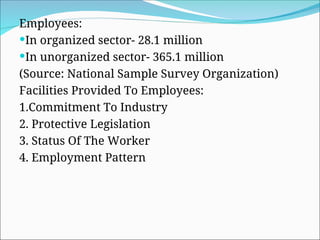
Employees:
In organized sector- 28.1 million
In unorganized sector- 365.1 million
(Source: National Sample Survey Organization)
Facilities Provided To Employees:
1.Commitment To Industry
2. Protective Legislation
3. Status Of The Worker
4. Employment Pattern
Trade Unions:
The union power is exerted primarily at 2 levels-
At the industry level
At the plant level
The personal characteristics of workers, their culture,
educational attainments, qualifications, skills,
attitude towards work, etc. play an important role in
an IR
Employers:
These are the persons working at management level
and taking all the decisions
They have the right to hire and fire any worker
Employers Associations:
Employer associations represent employer
interests before industrial tribunals and provide a
range of IR advisory services including award
interpretation, dispute handling and how to
counter union activity
Government:
The government exerts an important influence on
IR through such measures as providing employment,
intervening in working relationships and regulating
wages, bonus and working conditions through
various laws relating to labour
The government keeps an eye on both the trade
unions and the employer’s organizations to regulate
their behaviors in the interests of the nations
Courts And Tribunals:
Government tribunals charged with preventing
and settling industrial disputes
IR Strategy
 Reactive Strategy
 Proactive Strategy
Factors Affecting Employee
Relations Strategy:
 Internal Factors
 External Factors
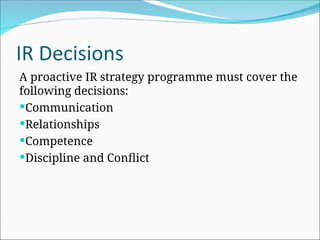
IR Decisions
A proactive IR strategy programme must cover the
following decisions:
Communication
Relationships
Competence
Discipline and Conflict
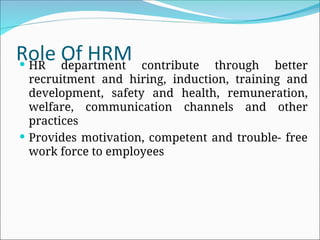
Role Of HRM
 HR department contribute through better
recruitment and hiring, induction, training and
development, safety and health, remuneration,
welfare, communication channels and other
practices
 Provides motivation, competent and trouble- free
work force to employees
industrial-relations for Human Resource Management.ppt

industrial-relations for Human Resource Management.ppt

  • 1.
    Instructor Instructor Mr. Shyamasundar Tripathy Mr.Shyamasundar Tripathy Management Faculty(HR) Management Faculty(HR)
  • 2.
    WHAT IS IR Industrialrelation means the relationship between employers and employees in course of employment in industrial organisations. Industrial relation is used to denote the collective relationships between management and the worker.  IR is used to cover such aspects of industrial life as trade unionism, collective bargaining, workers participation in management , discipline and industrial disputes. Definition: According to J.T. Dunlop, “Industrial relations are the complex interrelations among managers, workers and agencies of the government”
  • 3.
    IR is concernedwith the relationship between management and workers and the role of regulatory mechanism in resolving any industrial dispute.  Under the IR participative management, employee development, employee remuneration, employee safety and health.
  • 4.
     Features ofIndustrial Relations:  Industrial relations are outcomes of employment relationships in an industrial enterprise. These relations cannot exist without the two parties namely employers and employees.  Industrial relations system creates rules and regulations to maintain harmonious relations.  The government intervenes to shape the industrial relations through laws, rules, agreements, terms, charters etc.
  • 5.
     Several partiesare involved in the Industrial relations system. The main parties are employers and their associations, employees and their unions and the government. These three parties interact within economic and social environment to shape the Industrial relations structure.  Industrial relations are a dynamic and developing concept, not a static one. They undergo changes with changing structure and scenario of the industry as and when change occurs.  Industrial relations include both individual relations and collective relationships.

  • 6.
    Objectives of IndustrialRelations: •To maintain industrial democracy based on participation of labour in the management and gains of industry. •To raise productivity by reducing tendency of high labour turnover and absenteeism. •To ensure workers’ participation in management of the company by giving them a fair say in decision-making and framing policies. •To establish a proper channel of communication. •To increase the morale and discipline of the employees. •To safeguard the interests of the labour as well as management by securing the highest level of mutual understanding and goodwill between all sections in an industry. •To avoid all forms of industrial conflicts so as to ensure industrial peace by providing better living and working standards for the workers.
  • 7.
    Importance of IndustrialRelations:  Uninterrupted Production: The most important benefit of industrial benefits is that it ensures continuity of production. This means continuous employment for all involved right from managers to workers.  Reduction in Industrial disputes: Good Industrial relations reduce Industrial disputes. Strikes, grievances and lockouts are some of the reflections of Industrial unrest. Industrial peace helps in promoting co-operation and increasing production.  High morale: Good Industrial relations improve the morale of the employees and motivate the worker workers to work more and better.
  • 8.
     Reduced wastage:Good Industrial relations are maintained on the basis of co-operation and recognition of each other. It helps to reduce wastage of material, manpower and costs.  Contributes to economic growth and development.
  • 9.
     Causes ofpoor Industrial Relations:  Economic causes: Often poor wages and poor working conditions are the main causes for unhealthy relations between management and labour. Unauthorised deductions from wages, lack of fringe benefits, absence of promotion opportunities, faulty incentive schemes are other economic causes. Other causes for Industrial conflicts are inadequate infrastructure, worn-out plant and machinery, poor layout, unsatisfactory maintenance etc.
  • 10.
     Organisational causes:Faulty communications system, unfair practices, non-recognition of trade unions and labour laws are also some other causes of poor relations in industry.  Social causes: Uninteresting nature of work is the main social cause of poor Industrial relations. Dissatisfaction with job and personal life culminates into Industrial conflicts.
  • 11.
     Psychological causes:Lack of job security, non- recognition of merit and performance, poor interpersonal relations are the psychological reasons for unsatisfactory employer-employee relations.  Political causes: Multiple unions, inter-union rivalry weaken the trade unions. Defective trade unions system prevailing in the country has been one of the most responsible causes for Industrial disputes in the country
  • 12.
     Suggestions toimprove Industrial Relations:  Sound personnel policies: Policies and procedures concerning the compensation, transfer and promotion, etc. of employees should be fair and transparent. All policies and rules relating to Industrial relations should be fair and transparent to everybody in the enterprise and to the union leaders.  Participative management: Employees should associate workers and unions in the formulation and implementation of HR policies and practices.
  • 13.
     Responsible unions:A strong trade union is an asset to the employer. Trade unions should adopt a responsible rather than political approach to industrial relations.  Employee welfare: Employers should recognise the need for the welfare of workers. They must ensure reasonable wages, satisfactory working conditions, and other necessary facilities for labour. Management should have a genuine concern for the welfare and betterment of the working class.
  • 14.
     Grievance procedure:A well-established and properly administered system committed to the timely and satisfactory redressal of employee’s grievances can be very helpful in improving Industrial relations. A suggestion scheme will help to satisfy the creative urge of the workers.  Constructive attitude: Both management and trade unions should adopt positive attitude towards each other. Management must recognise unions as the spokesmen of the workers’ grievances and as custodians of their interests. The employer should accept workers as equal partners in a joint endeavour for good Industrial relations.
  • 15.
     Creating aproper communication channel to avoid grievances and misunderstandings among employees  Education and training imparted to the employees
  • 16.
  • 17.
    UNITARY APPROACH  UNITARYAPPROACHI is grounded in mutual cooperation, individual treatment, team work and shared goals.  Work place conflict is seen as temporary aberration, resulting from poor management Employees who do not mix well with organization culture Unions cooperate with the management.  Management’s right to manage is accepted because there is no ‘we they” feeling Underlying assumption is that everyone benefits when the focus is on common interest and promotion of harmony Based on reactive strategy.
  • 18.
    PLURALISM(CONFLICT APPROACH ) PLURALISM(CONFLICT APPROACH )Pluralism is belief in the existence of more than one ruling principle, giving rise to a conflict of interests.  The pluralist approach to IR accepts conflict between management and workers as inevitable but containable through various institutional arrangements ( like collective bargaining, conciliation and arbitration etc) and is in fact considered essential for innovation and growth.  It perceives organizations as coalitions of competing interests , where the management’s role is to mediate among the different interest groups.  It perceives trade unions as legitimate representative of employee interests It also perceives stability in IR as the product of concessions and compromises between management and unions
  • 19.
    MARXIST APPROACH  MARXISTAPPROACH Marxists like pluralists also regard conflict as inevitable but see it as a product of capitalistic society where as pluralist believe that the conflict is inevitable in all organizations  For Marxists IR has wider meaning. For them conflict arises not because of rift between management and workers but because of the division in the society between those who own resources and those who have only labor to offer.  Marxist approach thus focuses on the type of society in which an organization functions.  Industrial conflict is thus equated with political and social unrest Trade Unions are seen both as labor reaction to exploitation by capitalists, as- well-as a weapon to bring about a revolutionary social change.
  • 20.
    THE SYSTEM APPROACH The system approach was developed by J. P. Dunlop of Harvard University in 1958.  According to this approach, individuals are part of an ongoing but independent social system.  The behaviour, actions and role of the individuals are shaped by the cultures of the society.  The three elements of the system approach are input, process and output.  Society provides the cue (signal) to the individuals about how one should act in a situation.  The institutions, the value system and other characteristics of the society influence the process and determine the outcome or response of the individuals. The basis of this theory is that group cohesiveness is provided by the common ideology shaped by the societal factors.
  • 21.
    Employees: In organized sector-28.1 million In unorganized sector- 365.1 million (Source: National Sample Survey Organization) Facilities Provided To Employees: 1.Commitment To Industry 2. Protective Legislation 3. Status Of The Worker 4. Employment Pattern
  • 22.
    Trade Unions: The unionpower is exerted primarily at 2 levels- At the industry level At the plant level The personal characteristics of workers, their culture, educational attainments, qualifications, skills, attitude towards work, etc. play an important role in an IR Employers: These are the persons working at management level and taking all the decisions They have the right to hire and fire any worker
  • 23.
    Employers Associations: Employer associationsrepresent employer interests before industrial tribunals and provide a range of IR advisory services including award interpretation, dispute handling and how to counter union activity
  • 24.
    Government: The government exertsan important influence on IR through such measures as providing employment, intervening in working relationships and regulating wages, bonus and working conditions through various laws relating to labour The government keeps an eye on both the trade unions and the employer’s organizations to regulate their behaviors in the interests of the nations
  • 25.
    Courts And Tribunals: Governmenttribunals charged with preventing and settling industrial disputes
  • 26.
    IR Strategy  ReactiveStrategy  Proactive Strategy
  • 27.
    Factors Affecting Employee RelationsStrategy:  Internal Factors  External Factors
  • 28.
    IR Decisions A proactiveIR strategy programme must cover the following decisions: Communication Relationships Competence Discipline and Conflict
  • 29.
    Role Of HRM HR department contribute through better recruitment and hiring, induction, training and development, safety and health, remuneration, welfare, communication channels and other practices  Provides motivation, competent and trouble- free work force to employees