By:-
Anusri
Fiza
Kunal
Sachin
DEFINITION
• Industrial relation means the relationship between employers and employees in
course of employment in industrial organisations.
• Industrial relation is used to denote the collective relationships between management
and the worker.
• According to J.T. Dunlop “ Industrial relations are the complex interrelations among
managers, workers and agencies of the government”
OBJECTIVES OF IR
• To enhance economic status of worker
• To avoid industrial conflicts and their consequences
• To maintain industrial democracy based on participation of labour in the management
and gains of industry
• To provide an opportunity to the worker to have a say in the management decision
making
• To safeguard the interest of the labours as well as management by securing the
highest level mutual understanding and goodwill between all the section in an industry
NATURE OF IR
• IR arise out of employer employee relations.
• IR is web of rules -formed by the interaction of Govt,Industry & labour.
• IR is dynamic and changing -keep pace with employee expectations, trade unions,
employer associations and other economics and social institutions of society.
• Govt influences and shapes IR – with its laws,rules,agreement through executive and
judicial machinery.
IMPORTANCE OF IR
• Uninterrupted production
• Reduction in Industrial disputes
• High Morale
• Mental Revolution
• Reduced Wastage
• Foster Industrial Peace
• Promote Industrial Democracy
HR FUNCTIONS
• Recruiting the right people for the right job
• Maintaining a safe environment
• Employer- employee relations
• Compensation and benefits
• Labour law compliance
• Training and development.
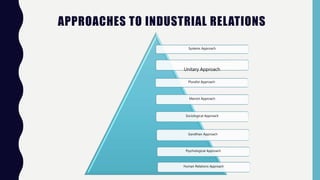
Systems Approach
Unitary Approach
Marxist Approach
Human Relations Approach
Pluralist Approach
Sociological Approach
Psychological Approach
Gandhian Approach
APPROACHES TO INDUSTRIAL RELATIONS
SYSTEMS APPROACH
• Developed by J. P. Dunlop of Harvard University in 1958.
• According to this approach, individuals are part of an ongoing but independent social
system.
• The behaviour, actions and role of the individuals are shaped by the cultures of the
society.
• According to Dunlop, the industrial relations system comprises certain actors, certain
contexts, and an ideology, which binds them together and a body of rules created to
govern the actors at the workplace and work community.
• The actors in the system are the managers, the workers and their representatives, and
the government agencies.
UNITARY APPROACH
• Belief : conflicts are non-permanent
malformations, which are a result of improper
management in the organization.
AIMS:
• To create a productive, effective and
harmonious work environment;
• To develops a trustworthy, open, fair and
transparent work culture;
• To create a cordial work environment;
• To restrict the role of the tribunals and other
government associations like the trade unions
and initiates direct negotiation between the
management and the employees.
PLURALISTIC APPROACH
• Also called the ‘Oxford Approach’
• Proposed by Flanders in the year 1970.
• This approach explained that the management and the trade unions are the different
and robust sub-groups which unanimously form an organization.
• Collective bargaining was considered to be a useful technique for resolving
organizational conflicts.
HIGHLIGHTS OF THIS APPROACH:
The organization should…..
a. Appoint personnel experts and industrial
relations specialists to act as mediators
between the management and trade
unions.
b. Ensure that the trade unions get
recognized
c. Appoint external agent for settlement of
industrial disputes.
MARXIST APPROACH
• Proposed by Lenin in 1978 - emphasized the
social perspective of the organization.
• Also known as the ‘Radical Perspective’.
• This theory perceived that the industrial relations
depend upon the relationship between the
workers (i.e., employees or labour) and the owners
(i.e., employer or capital).
• Based on the proposition that the economic
activities of production, manufacturing, and
distribution are majorly governed by the objective
of profit.
• There exists a class conflict between both the
groups to exercise a higher control or influence
over each other.
SOCIOLOGICAL APPROACH
• The industries comprise of different human beings who need to communicate with the
individuals of other organizations.
• Due to the difference in their attitude, skills, perception, personality, interests, likes
and dislikes, needs, they are usually involved in one or the other conflict.
• Even the social mobility and other aspects including transfer, default, group dynamics,
stress, norms, regulations and status of the workers influence their output and the
industrial relations.
• This approach emphasizes on the impact of various changes in the work
environment (i.e., economic, technical and political) on the interactions and
relationship shared by the employer, employees, institutions and the government
bodies.
GANDHIAN APPROACH
• Proposed by the father of our nation, Mahatma Gandhi or Mohandas Karamchand
Gandhi, who was also a well-known labour leader.
FEATURES
• Gandhi Ji was not against strikes; instead, he gave the following conditions to carry
out a favourable strike:
– The workers or labours can go on a strike only if there is a specific grievance.
– There should be complete non-violence while carrying out strikes.
– The ones who are not involved in the strikes should not be tormented.
• Strikes should be the last option to which the labour should
resort to.
• The objective of this theory is to adopt non-violent ways to bring
in economic parity and material enhancement in a capitalist
society.
• Every organization is a joint venture, and the labour should be
treated as associates or co-partners with the shareholders.
• Gains should be shared with the employees
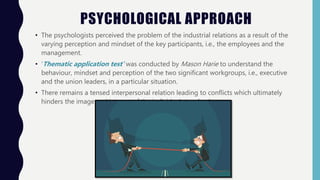
PSYCHOLOGICAL APPROACH
• The psychologists perceived the problem of the industrial relations as a result of the
varying perception and mindset of the key participants, i.e., the employees and the
management.
• ‘Thematic application test’ was conducted by Mason Harie to understand the
behaviour, mindset and perception of the two significant workgroups, i.e., executive
and the union leaders, in a particular situation.
• There remains a tensed interpersonal relation leading to conflicts which ultimately
hinders the image and interest of the individuals involved.
HUMAN RELATIONS APPROACH TO
INDUSTRIAL RELATIONS
• The human relations approach takes organizational development from a psychological
perspective.
• Its focus is in the positive nature, which is believed to exist in all employees and
managers.
• This approach assumes that managers listen to the needs and concerns of the
workforce, and is reasonable and in alignment with the company's larger goals.
• Evalution of industrial relations policies.
• Promotion of rights at work.
• Employment –creation of greater employment and income opportunities for women
and men as a means to reduce poverty and inequality.
• Social protection.
• Social dialougue.
• Wage boards, labour courts ,tribunals &enacted laws.
ROLE OF GOVERNMENT
• Creating & maintaining employee motivation.
• Obtaining commitment from workforce.
• Establishing mutually beneficial channels of
communication.
• Achieving higher levels of efficiency.
• Negotiating terms &conditions of employment.
• Sharing decision making with employees.
ROLE OF EMPLOYERS/MANAGEMENT:-
ROLE OF TRADE UNIONS :
Representation
Negotitation
Voice in decisions affecting workers
Members services : Education and training
Legal assistance
Financial
Welfare benefits
INDUSTRIAL DISPUTE & INDIVIDUAL
DISPUTE
• MEANING :
• Industrial dispute means any dispute of differences between employees and
or between employers & workmen or between workmen & workmen , which is
connected with the employment or non employment of the terms of employment or
the conditions of work of any persons (The industrial disputes act 1947 , section 2k.)
• The industrial disputes are of two types i.e., individual disputes & collective disputes .
The individual disputes may be disputes such as reinstatement , compensation for
wrong termination etc. disputes relating to wages , bonus, profit sharing hours of
etc. are collective disputes.
CAUSES OF INDUSTRIAL DISPUTES :
• The common causes of industrial disputes are as follows :
• Psychological causes :
• Authoritarian leadership (nature of administration.)
• Clash of personalities.
• Difficulty in adjusting in given conditions or with each other (employee & employer.)
• Strict discipline.
• Demand for self respect and recognition by workers .
• Institutional causes :
• Non recognition of trade/ labour union by the management .
• Matters of collective bargaining.
• Unfair conditions & practices.
• Pressure on workers to avoid participation in trade unions .
• Economic causes :
(A) Terms and conditions of employment
• More work hours
• Working in night shifts
• Disputes on promotions, layoff, retrenchment & dismissal etc.
(B) Working conditions
Working conditions such as too hot , too cold , dusty , noisy etc.
Improper plant and workplace layout.
(c.) wages and other benefits ,
Inadequate wages
Poor fringe benefits.
No bonus or other incentives etc.
FORMS OF INDUSTRIAL DISPUTES:
• Strikes:
• It is the most imp form of industrial disputes. A strike is a spontaneous and concerted withdrawal of labour
form production . The industrial dispute act defines strike as suspension or cessation of work by a group of
persons employed in any industry , acting in combination or a concerted refusal or a refusal under a
understanding of any no of persons who are or have been so employed to continue to work or accept
employment.
• Lockouts :
• Lock out is the counter part of strikes . Lockout Is the weapon available to the employer to shut down the
place of work till the workers agree to resume work on the conditions laid down by the employer.
• Gherao :
• It means to surround . It is a physical blockade of managers by encirclement aimed at preventing the
and ingress from and to particular office or place.
• Picketing&boycott:
• Picketing is a method designed to request workers to withdraw cooperation to the employer . In picketing
workers through display signs , banners and play cards drew the attention of the public that there is a
dispute between worker and employer.
• Boycott on the other hand , aims at the disrupting of the normal functioning of the org, the striking
appeal to others for voluntary withdrawal of cooperation with the employer. Instances of boycotting
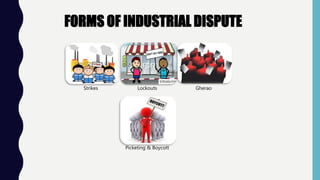
Strikes Lockouts Gherao
Picketing & Boycott
FORMS OF INDUSTRIAL DISPUTE
Industrial relations

Industrial relations

  • 1.
  • 2.
    DEFINITION • Industrial relationmeans the relationship between employers and employees in course of employment in industrial organisations. • Industrial relation is used to denote the collective relationships between management and the worker. • According to J.T. Dunlop “ Industrial relations are the complex interrelations among managers, workers and agencies of the government”
  • 3.
    OBJECTIVES OF IR •To enhance economic status of worker • To avoid industrial conflicts and their consequences • To maintain industrial democracy based on participation of labour in the management and gains of industry • To provide an opportunity to the worker to have a say in the management decision making • To safeguard the interest of the labours as well as management by securing the highest level mutual understanding and goodwill between all the section in an industry
  • 4.
    NATURE OF IR •IR arise out of employer employee relations. • IR is web of rules -formed by the interaction of Govt,Industry & labour. • IR is dynamic and changing -keep pace with employee expectations, trade unions, employer associations and other economics and social institutions of society. • Govt influences and shapes IR – with its laws,rules,agreement through executive and judicial machinery.
  • 5.
    IMPORTANCE OF IR •Uninterrupted production • Reduction in Industrial disputes • High Morale • Mental Revolution • Reduced Wastage • Foster Industrial Peace • Promote Industrial Democracy
  • 6.
    HR FUNCTIONS • Recruitingthe right people for the right job • Maintaining a safe environment • Employer- employee relations • Compensation and benefits • Labour law compliance • Training and development.
  • 8.
    Systems Approach Unitary Approach MarxistApproach Human Relations Approach Pluralist Approach Sociological Approach Psychological Approach Gandhian Approach APPROACHES TO INDUSTRIAL RELATIONS
  • 9.
    SYSTEMS APPROACH • Developedby J. P. Dunlop of Harvard University in 1958. • According to this approach, individuals are part of an ongoing but independent social system. • The behaviour, actions and role of the individuals are shaped by the cultures of the society. • According to Dunlop, the industrial relations system comprises certain actors, certain contexts, and an ideology, which binds them together and a body of rules created to govern the actors at the workplace and work community. • The actors in the system are the managers, the workers and their representatives, and the government agencies.
  • 10.
    UNITARY APPROACH • Belief: conflicts are non-permanent malformations, which are a result of improper management in the organization. AIMS: • To create a productive, effective and harmonious work environment; • To develops a trustworthy, open, fair and transparent work culture; • To create a cordial work environment; • To restrict the role of the tribunals and other government associations like the trade unions and initiates direct negotiation between the management and the employees.
  • 11.
    PLURALISTIC APPROACH • Alsocalled the ‘Oxford Approach’ • Proposed by Flanders in the year 1970. • This approach explained that the management and the trade unions are the different and robust sub-groups which unanimously form an organization. • Collective bargaining was considered to be a useful technique for resolving organizational conflicts. HIGHLIGHTS OF THIS APPROACH: The organization should….. a. Appoint personnel experts and industrial relations specialists to act as mediators between the management and trade unions. b. Ensure that the trade unions get recognized c. Appoint external agent for settlement of industrial disputes.
  • 12.
    MARXIST APPROACH • Proposedby Lenin in 1978 - emphasized the social perspective of the organization. • Also known as the ‘Radical Perspective’. • This theory perceived that the industrial relations depend upon the relationship between the workers (i.e., employees or labour) and the owners (i.e., employer or capital). • Based on the proposition that the economic activities of production, manufacturing, and distribution are majorly governed by the objective of profit. • There exists a class conflict between both the groups to exercise a higher control or influence over each other.
  • 13.
    SOCIOLOGICAL APPROACH • Theindustries comprise of different human beings who need to communicate with the individuals of other organizations. • Due to the difference in their attitude, skills, perception, personality, interests, likes and dislikes, needs, they are usually involved in one or the other conflict. • Even the social mobility and other aspects including transfer, default, group dynamics, stress, norms, regulations and status of the workers influence their output and the industrial relations. • This approach emphasizes on the impact of various changes in the work environment (i.e., economic, technical and political) on the interactions and relationship shared by the employer, employees, institutions and the government bodies.
  • 14.
    GANDHIAN APPROACH • Proposedby the father of our nation, Mahatma Gandhi or Mohandas Karamchand Gandhi, who was also a well-known labour leader. FEATURES • Gandhi Ji was not against strikes; instead, he gave the following conditions to carry out a favourable strike: – The workers or labours can go on a strike only if there is a specific grievance. – There should be complete non-violence while carrying out strikes. – The ones who are not involved in the strikes should not be tormented. • Strikes should be the last option to which the labour should resort to. • The objective of this theory is to adopt non-violent ways to bring in economic parity and material enhancement in a capitalist society. • Every organization is a joint venture, and the labour should be treated as associates or co-partners with the shareholders. • Gains should be shared with the employees
  • 15.
    PSYCHOLOGICAL APPROACH • Thepsychologists perceived the problem of the industrial relations as a result of the varying perception and mindset of the key participants, i.e., the employees and the management. • ‘Thematic application test’ was conducted by Mason Harie to understand the behaviour, mindset and perception of the two significant workgroups, i.e., executive and the union leaders, in a particular situation. • There remains a tensed interpersonal relation leading to conflicts which ultimately hinders the image and interest of the individuals involved.
  • 16.
    HUMAN RELATIONS APPROACHTO INDUSTRIAL RELATIONS • The human relations approach takes organizational development from a psychological perspective. • Its focus is in the positive nature, which is believed to exist in all employees and managers. • This approach assumes that managers listen to the needs and concerns of the workforce, and is reasonable and in alignment with the company's larger goals.
  • 17.
    • Evalution ofindustrial relations policies. • Promotion of rights at work. • Employment –creation of greater employment and income opportunities for women and men as a means to reduce poverty and inequality. • Social protection. • Social dialougue. • Wage boards, labour courts ,tribunals &enacted laws. ROLE OF GOVERNMENT
  • 18.
    • Creating &maintaining employee motivation. • Obtaining commitment from workforce. • Establishing mutually beneficial channels of communication. • Achieving higher levels of efficiency. • Negotiating terms &conditions of employment. • Sharing decision making with employees. ROLE OF EMPLOYERS/MANAGEMENT:-
  • 19.
    ROLE OF TRADEUNIONS : Representation Negotitation Voice in decisions affecting workers Members services : Education and training Legal assistance Financial Welfare benefits
  • 20.
    INDUSTRIAL DISPUTE &INDIVIDUAL DISPUTE • MEANING : • Industrial dispute means any dispute of differences between employees and or between employers & workmen or between workmen & workmen , which is connected with the employment or non employment of the terms of employment or the conditions of work of any persons (The industrial disputes act 1947 , section 2k.) • The industrial disputes are of two types i.e., individual disputes & collective disputes . The individual disputes may be disputes such as reinstatement , compensation for wrong termination etc. disputes relating to wages , bonus, profit sharing hours of etc. are collective disputes.
  • 21.
    CAUSES OF INDUSTRIALDISPUTES : • The common causes of industrial disputes are as follows : • Psychological causes : • Authoritarian leadership (nature of administration.) • Clash of personalities. • Difficulty in adjusting in given conditions or with each other (employee & employer.) • Strict discipline. • Demand for self respect and recognition by workers . • Institutional causes : • Non recognition of trade/ labour union by the management . • Matters of collective bargaining. • Unfair conditions & practices. • Pressure on workers to avoid participation in trade unions .
  • 22.
    • Economic causes: (A) Terms and conditions of employment • More work hours • Working in night shifts • Disputes on promotions, layoff, retrenchment & dismissal etc. (B) Working conditions Working conditions such as too hot , too cold , dusty , noisy etc. Improper plant and workplace layout. (c.) wages and other benefits , Inadequate wages Poor fringe benefits. No bonus or other incentives etc.
  • 23.
    FORMS OF INDUSTRIALDISPUTES: • Strikes: • It is the most imp form of industrial disputes. A strike is a spontaneous and concerted withdrawal of labour form production . The industrial dispute act defines strike as suspension or cessation of work by a group of persons employed in any industry , acting in combination or a concerted refusal or a refusal under a understanding of any no of persons who are or have been so employed to continue to work or accept employment. • Lockouts : • Lock out is the counter part of strikes . Lockout Is the weapon available to the employer to shut down the place of work till the workers agree to resume work on the conditions laid down by the employer. • Gherao : • It means to surround . It is a physical blockade of managers by encirclement aimed at preventing the and ingress from and to particular office or place. • Picketing&boycott: • Picketing is a method designed to request workers to withdraw cooperation to the employer . In picketing workers through display signs , banners and play cards drew the attention of the public that there is a dispute between worker and employer. • Boycott on the other hand , aims at the disrupting of the normal functioning of the org, the striking appeal to others for voluntary withdrawal of cooperation with the employer. Instances of boycotting
  • 24.
    Strikes Lockouts Gherao Picketing& Boycott FORMS OF INDUSTRIAL DISPUTE