INDUSTRIAL LINKAGES WITH
FINANCIAL SECTOR
BY
Dr. C. RAJENDRAN., Ph.D
Dept. of Economics
[Govt. Arts College, Coimbatore]
INTRODUCTION
* Countries with better-developed financial
systems tend to grow faster
* The levels of banking development and stock
market liquidity each exerts a positive influence
on economic growth
* Better-functioning financial systems ease the
external financing constraints that impede firm
and industrial expansion
* Since late 1980s, India began to
implement financial sector reforms
* The objective of the reforms was to
build more efficient, robust and deeper
financial markets
* The financial sector has improved since
the implementation of reforms
* Economists have recognized the importance of the
financial system. In the year since the onset of the
East Asian crisis we have increasingly heard that the
financial system was one of the main causes of the
crisis
* The financial system needs to be reformed in order
to resolve the crisis.
* Many of these discussions treat the financial system
in isolation or link it superficially to the economy.
* Our concern is to discuss the link between the
financial system and the macroeconomy.
* Since 1991, the Indian financial system has undergone
radical transformation.
* Reforms have altered the organizational structure,
ownership pattern and domain of operations of
banks, financial institutions and Non-banking Financial
Companies (NBFCs).
* The main thrust of reforms in the financial sector
was the creation of efficient and stable financial
institutions and markets.
* Reforms in the banking and non-banking
sectors focused on creating a good
environment,
* Strengthening and ensuring the prudential
norms and the supervisory system, changing
the ownership pattern and increasing
competition.
INDIAN FINANCIAL SYSTEM
Meaning and definition of financial system:
* The financial system is possibly the most important
institutional and functional vehicle for economic
transformation.
* Finance is a bridge between the present and the future
mobilization of savings and investment.
* Financial system performs its functions that sets the
pace for the achievement of broader national
objectives.
* According to Christy, the objective of the financial system is to
“supply funds to various sectors and activities of the economy In
ways that promote the fullest possible utilization of resources
without the destabilizing consequence of price level changes or
unnecessary interference with individual desires.”
* According to Robinson, the primary function of the system is
“ to provide a link between savings and investment for the
creation of new wealth and to permit portfolio adjustment in
the composition of the existing wealth.
* A financial system or financial sector functions as an
intermediary and facilitates the flow of funds from the areas
of surplus to the deficit.
Features of Indian financial system
1. Financial system provides an ideal linkage between
depositors and investors, thus encouraging both savings
and investments.
2. Financial system facilitates expansion of financial markets
over space and time.
3. Financial system promotes efficient allocation of financial
resources for socially desirable and economically
productive purposes.
4. Financial system influences both the quality and the
pace of economic development.
COMPONENTS OF FINANCIAL SYSTEM
The financial system consists of four segments or components.
1. Financial institutions
2. Financial markets
3. Financial Instruments
4. Financial services.
1.Financial institutions:
Financial institutions are intermediaries that mobilize savings
& facilitate the allocation of funds in an efficient manner.
Financial institutions can be classified as banking & non-
banking financial institutions.
2. Financial markets:
* Financial markets are a mechanism to deal with the
financial claims.
* The main organized financial markets in India are the
money market & capital market.
* Money market is a market for dealing with financial
assets & securities which have a maturity period of up to
one year.
* Capital market deals with long term securities, that is,
securities having a maturity period of one year or
more.
3. Financial Instruments:
Financial instruments refers to those document
which represents financial claims on assets.
Financial assets refers to a claim to the repayment of
certain sum of money at the end of specified period
together with interest or dividend.
Examples : bills of exchange, promissory notes,
treasury bills, government bonds, deposit receipts,
shares debentures etc.
4. Financial Services:
Financial intermediaries provide financial services such as
Merchant banking
Leasing hire purchases
Credit-rating, and so on.
Financial services rendered by the financial intermediaries
bridge the gap between lack of knowledge on the part of
investors and increasing sophistication of financial
instruments and markets.
These financial services are vital for creation of firms,
industrial expansion, and economic growth.
FUNCTIONS OF FINANCIAL SYSTEM
1. Promotion of liquidity
2. Link between savers and investors
3. Information available
4. Helps in projects selection
5. Achieve risk bearing
6. Minimizes situations of Asymmetric information
7. Reduce cost of transaction and borrowing
8. Financial deepening and broadening
INDUSTRIAL LINKAGES WITH FINANCIAL SECTOR
* Reforms in the financial sector, covering banking, insurance,
financial markets, trade, taxation etc. have been a major catalyst in
strengthening the fundamentals of the Indian economy.
* The reform measures have brought about sweeping changes in this
critical sector of the Indian's economy.
* Improving productivity of capital, through investments in human
capital and raising total factor productivity (TFP).
* The main thrust of the financial sector reforms has been the
creation of efficient and stable financial institutions and development
of the markets, especially the money and government securities
market.
* Earlier, for issuing large loans, banks in India had to obtain prior
approval from the Reserve Bank of India; with the reforms, this
constraint has been removed.
* The limits on the levels of Cash Reserve Ratio (CRR) and
Statutory Liquidity Ratio (SLR) to be maintained by Indian banks
have been relaxed.
* The reforms have resulted in a considerably reduced role for
the state in allocation of credit;
* In the pre-reform period, targets were assigned to the
banking system in India with respect to lending to priority
sectors such as agriculture and small-scale industries.
* These targets have been relaxed as part of the reform
process.
* Ensuring greater transparency in the operations and
accounting practices of the financial sector.
* The private sector including foreign institutional investors (FIIs)
have been allowed entry into the Indian financial sector.
* The Insurance Bill approved by the Indian Parliament in 2000
permitted foreign insurance companies to operate in the
Indian market.
* Industrial Investment norms were liberalised
* Foreign banks have been given permission to access India’s
domestic market
CREDIT POLICY REFORMS AND THEIR IMPACT ON
INDUSTRIAL GROWTH
* Indian firms began to meet their financing needs increasingly
through retained earnings and less through borrowings.
* Improvements in corporate profitability
* Debt-equity ratio of the corporate sector declined
* India’s corporate firms now have improved access to the
domestic and international capital markets.
FINANCIAL SYSTEM AND ECONOMIC DEVELOPMENT – THE LINKAGE
* Financial system may influence saving rates, investment decisions,
technological innovation, and hence long-run growth rates
* The financial system influences growth, and growth transforms the
operation of the financial system.
* The financial system facilitates trade of goods and services.
* An efficient financial system reduces information and transaction costs in
trade and helps the payments mechanism.
* It increases saving mobilization by an improvement of the savers
confidence.
* It plays an important role in mobilizing funds and transforming them into
assets that can better meet the needs of investors
* Financial institutions play an important role in easing the tension
between savers’ preference for liquidity and entrepreneurs’ need
for long-term finance.
* An efficient financial system will allow for a higher level of
investment
* Resources will also be utilized more efficiently due to the ability of
financial intermediaries to identify the most productive investment
opportunities.
* Financial system can enhance efficiency in the corporate sector by
monitoring management and exerting corporate control
* The banking sector and the stock market in each country were
complementary to each other in the process of economic growth
Industrial Sector in India
* The industrial sector is one of the main sectors that contribute more to the
Indian GDP.
* The country ranks fourteenth in the factory output in the world. The
industrial sector is made up of manufacturing, mining and quarrying, and
electricity, water supply, and gas sectors.
* The industrial sector accounts for around 27.6% of the India GDP and it
employs over 17% of the total workforce in the country.
* Industry Growth Rate in India (share in GDP) has been on the rise over the
last few years.
* One of the reasons for the increase in Industry Growth Rate in India is
financial sector development over the period of time and that made the
industrial sector to go for huge amounts of investments.
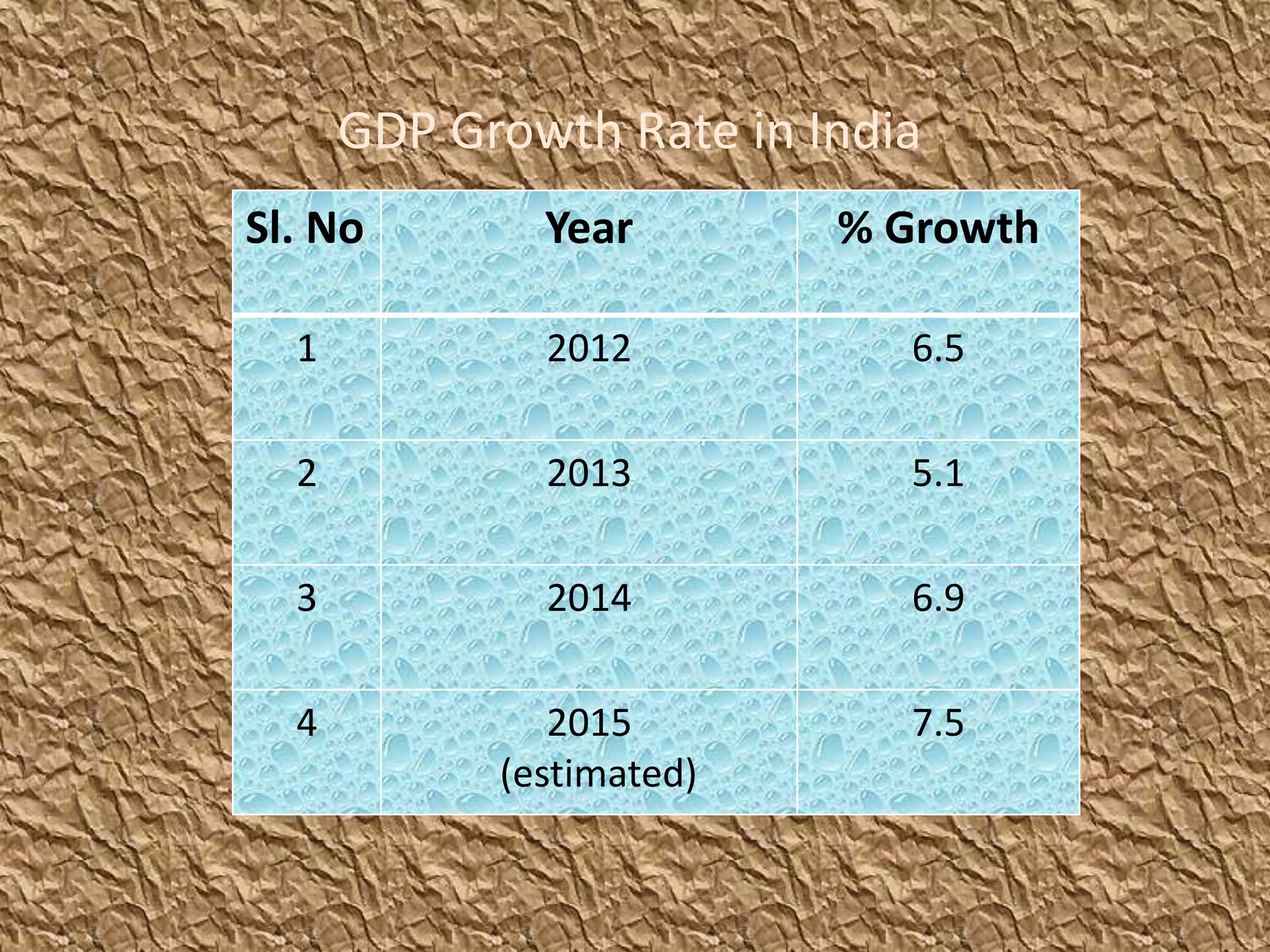
GDP Growth Rate in India
Sl. No Year % Growth
1 2012 6.5
2 2013 5.1
3 2014 6.9
4 2015
(estimated)
7.5
Share of Industrial sector in GDP
Sl. No Year % Share
1 2008-09 28.13
2 2009-10 28.27
3 2010-11 27.92
4 2011-12 28.22
5 2012-13 27.27
6 2013-14 26.13
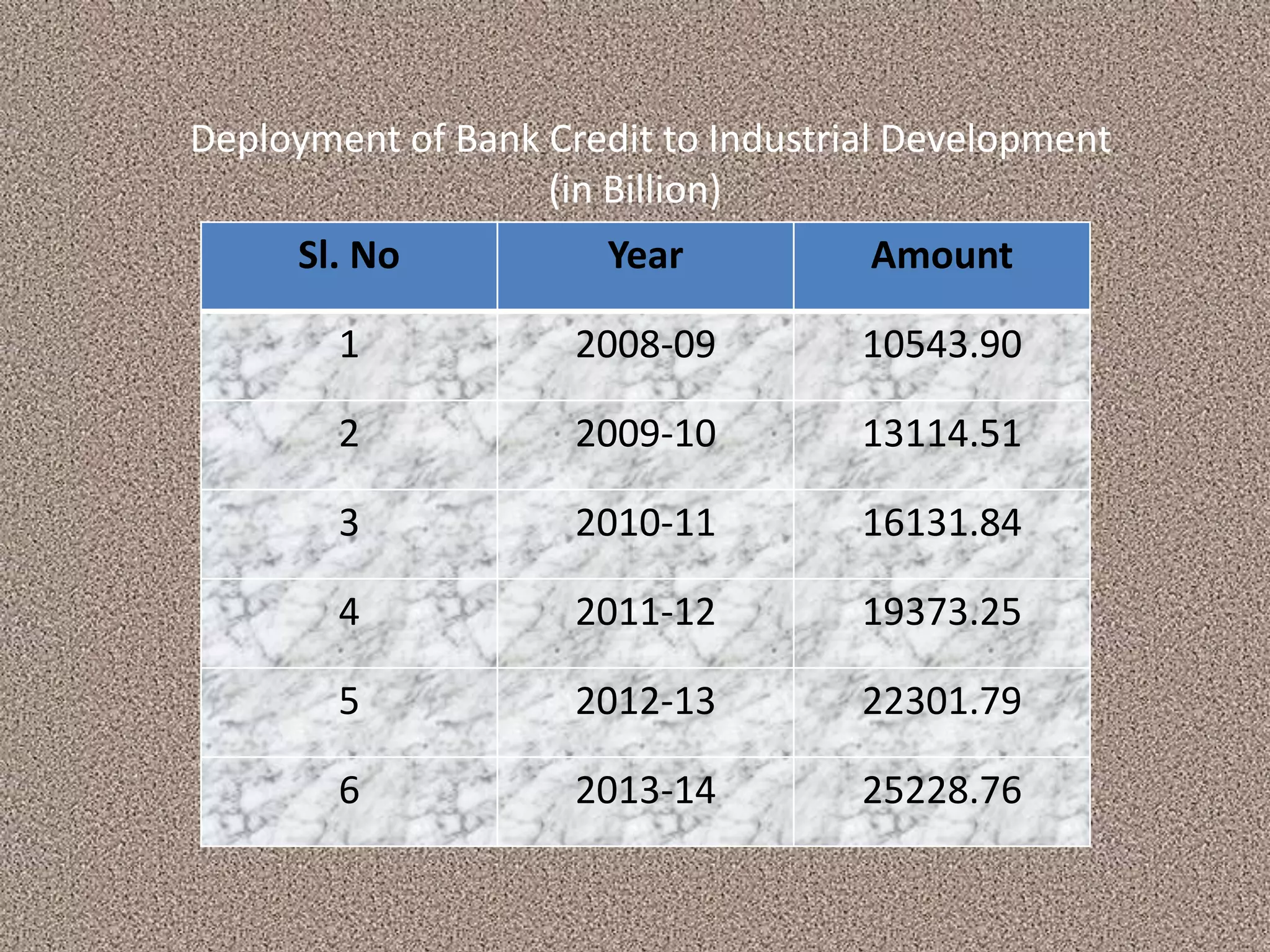
Deployment of Bank Credit to Industrial Development
(in Billion)
Sl. No Year Amount
1 2008-09 10543.90
2 2009-10 13114.51
3 2010-11 16131.84
4 2011-12 19373.25
5 2012-13 22301.79
6 2013-14 25228.76
FDI inflows to Indian Industrial Sector
(US $ Million)
nt of Bank Credit to Industrial Development
(in Billion)
Sl. No Year Amount
1 2008-09 41903
2 2009-10 37746
3 2010-11 36047
4 2011-12 46552
5 2012-13 34298
6 2013-14 36047
For Further Improvement…………….
* As economic reforms gain momentum, India’s growth is likely
to accelerate towards its high long-run potential.
* Measures such as a national Goods and Services Tax (GST),
accompanied by a dismantling of inter-state check posts, can
be transformational and it will significantly improve the
domestic and international competitiveness of Indian
manufacturing firms.
* India’s economic growth is expected to rise to 5.6 percent in
FY15, followed by further acceleration to 6.4 percent and 7.0
percent in FY 2016 and FY 2017.
* India needs to continue making progress on its
domestic reforms agenda and encourage
investments.
* The government's efforts at improving the
performance of the manufacturing sector will lead
to create more jobs.
* Capital flow increases investors’ confidence as
inflation has moderated from double digits, exchange
rate has been stabilized, and financial sector became
strong.
* Sudden financial crises which have struck many parts of the
world in recent years.
* Global financial system have prompted attempts to identify
ways of preventing unexpected shocks.
* International Monetary Fund, focused on this task and
promoted reforms to the architecture of the international
financial system.
* It is considered important to ensure effective supervision of
financial institutions’ operations and monitor the stability of
the financial system as a whole.
* Indian industry has come a long way from the command, control
style of functioning rooted in an inward looking Import substitution
policy to an export orientation, globally competitive, quality driven
style of functioning.
* In short term, with improved investment, scenario coupled with
continual through reforms, the industrial performance is
expected to do better.
* But in long run, the industrial performance depends on how well
the financial reforms are initiated and the investment in Infrastructure.
* The industrial and well developed financial reforms should go hand
in hand to achieve the momentum on the wheel of growth.
Industrial Linkage with Financial sector

Industrial Linkage with Financial sector

  • 1.
    INDUSTRIAL LINKAGES WITH FINANCIALSECTOR BY Dr. C. RAJENDRAN., Ph.D Dept. of Economics [Govt. Arts College, Coimbatore]
  • 2.
    INTRODUCTION * Countries withbetter-developed financial systems tend to grow faster * The levels of banking development and stock market liquidity each exerts a positive influence on economic growth * Better-functioning financial systems ease the external financing constraints that impede firm and industrial expansion
  • 3.
    * Since late1980s, India began to implement financial sector reforms * The objective of the reforms was to build more efficient, robust and deeper financial markets * The financial sector has improved since the implementation of reforms
  • 4.
    * Economists haverecognized the importance of the financial system. In the year since the onset of the East Asian crisis we have increasingly heard that the financial system was one of the main causes of the crisis * The financial system needs to be reformed in order to resolve the crisis. * Many of these discussions treat the financial system in isolation or link it superficially to the economy. * Our concern is to discuss the link between the financial system and the macroeconomy.
  • 5.
    * Since 1991,the Indian financial system has undergone radical transformation. * Reforms have altered the organizational structure, ownership pattern and domain of operations of banks, financial institutions and Non-banking Financial Companies (NBFCs). * The main thrust of reforms in the financial sector was the creation of efficient and stable financial institutions and markets.
  • 6.
    * Reforms inthe banking and non-banking sectors focused on creating a good environment, * Strengthening and ensuring the prudential norms and the supervisory system, changing the ownership pattern and increasing competition.
  • 7.
    INDIAN FINANCIAL SYSTEM Meaningand definition of financial system: * The financial system is possibly the most important institutional and functional vehicle for economic transformation. * Finance is a bridge between the present and the future mobilization of savings and investment. * Financial system performs its functions that sets the pace for the achievement of broader national objectives.
  • 8.
    * According toChristy, the objective of the financial system is to “supply funds to various sectors and activities of the economy In ways that promote the fullest possible utilization of resources without the destabilizing consequence of price level changes or unnecessary interference with individual desires.” * According to Robinson, the primary function of the system is “ to provide a link between savings and investment for the creation of new wealth and to permit portfolio adjustment in the composition of the existing wealth. * A financial system or financial sector functions as an intermediary and facilitates the flow of funds from the areas of surplus to the deficit.
  • 9.
    Features of Indianfinancial system 1. Financial system provides an ideal linkage between depositors and investors, thus encouraging both savings and investments. 2. Financial system facilitates expansion of financial markets over space and time. 3. Financial system promotes efficient allocation of financial resources for socially desirable and economically productive purposes. 4. Financial system influences both the quality and the pace of economic development.
  • 10.
    COMPONENTS OF FINANCIALSYSTEM The financial system consists of four segments or components. 1. Financial institutions 2. Financial markets 3. Financial Instruments 4. Financial services. 1.Financial institutions: Financial institutions are intermediaries that mobilize savings & facilitate the allocation of funds in an efficient manner. Financial institutions can be classified as banking & non- banking financial institutions.
  • 11.
    2. Financial markets: *Financial markets are a mechanism to deal with the financial claims. * The main organized financial markets in India are the money market & capital market. * Money market is a market for dealing with financial assets & securities which have a maturity period of up to one year. * Capital market deals with long term securities, that is, securities having a maturity period of one year or more.
  • 12.
    3. Financial Instruments: Financialinstruments refers to those document which represents financial claims on assets. Financial assets refers to a claim to the repayment of certain sum of money at the end of specified period together with interest or dividend. Examples : bills of exchange, promissory notes, treasury bills, government bonds, deposit receipts, shares debentures etc.
  • 13.
    4. Financial Services: Financialintermediaries provide financial services such as Merchant banking Leasing hire purchases Credit-rating, and so on. Financial services rendered by the financial intermediaries bridge the gap between lack of knowledge on the part of investors and increasing sophistication of financial instruments and markets. These financial services are vital for creation of firms, industrial expansion, and economic growth.
  • 14.
    FUNCTIONS OF FINANCIALSYSTEM 1. Promotion of liquidity 2. Link between savers and investors 3. Information available 4. Helps in projects selection 5. Achieve risk bearing 6. Minimizes situations of Asymmetric information 7. Reduce cost of transaction and borrowing 8. Financial deepening and broadening
  • 15.
    INDUSTRIAL LINKAGES WITHFINANCIAL SECTOR * Reforms in the financial sector, covering banking, insurance, financial markets, trade, taxation etc. have been a major catalyst in strengthening the fundamentals of the Indian economy. * The reform measures have brought about sweeping changes in this critical sector of the Indian's economy. * Improving productivity of capital, through investments in human capital and raising total factor productivity (TFP). * The main thrust of the financial sector reforms has been the creation of efficient and stable financial institutions and development of the markets, especially the money and government securities market.
  • 16.
    * Earlier, forissuing large loans, banks in India had to obtain prior approval from the Reserve Bank of India; with the reforms, this constraint has been removed. * The limits on the levels of Cash Reserve Ratio (CRR) and Statutory Liquidity Ratio (SLR) to be maintained by Indian banks have been relaxed. * The reforms have resulted in a considerably reduced role for the state in allocation of credit; * In the pre-reform period, targets were assigned to the banking system in India with respect to lending to priority sectors such as agriculture and small-scale industries. * These targets have been relaxed as part of the reform process.
  • 17.
    * Ensuring greatertransparency in the operations and accounting practices of the financial sector. * The private sector including foreign institutional investors (FIIs) have been allowed entry into the Indian financial sector. * The Insurance Bill approved by the Indian Parliament in 2000 permitted foreign insurance companies to operate in the Indian market. * Industrial Investment norms were liberalised * Foreign banks have been given permission to access India’s domestic market
  • 18.
    CREDIT POLICY REFORMSAND THEIR IMPACT ON INDUSTRIAL GROWTH * Indian firms began to meet their financing needs increasingly through retained earnings and less through borrowings. * Improvements in corporate profitability * Debt-equity ratio of the corporate sector declined * India’s corporate firms now have improved access to the domestic and international capital markets.
  • 19.
    FINANCIAL SYSTEM ANDECONOMIC DEVELOPMENT – THE LINKAGE * Financial system may influence saving rates, investment decisions, technological innovation, and hence long-run growth rates * The financial system influences growth, and growth transforms the operation of the financial system. * The financial system facilitates trade of goods and services. * An efficient financial system reduces information and transaction costs in trade and helps the payments mechanism. * It increases saving mobilization by an improvement of the savers confidence. * It plays an important role in mobilizing funds and transforming them into assets that can better meet the needs of investors
  • 20.
    * Financial institutionsplay an important role in easing the tension between savers’ preference for liquidity and entrepreneurs’ need for long-term finance. * An efficient financial system will allow for a higher level of investment * Resources will also be utilized more efficiently due to the ability of financial intermediaries to identify the most productive investment opportunities. * Financial system can enhance efficiency in the corporate sector by monitoring management and exerting corporate control * The banking sector and the stock market in each country were complementary to each other in the process of economic growth
  • 21.
    Industrial Sector inIndia * The industrial sector is one of the main sectors that contribute more to the Indian GDP. * The country ranks fourteenth in the factory output in the world. The industrial sector is made up of manufacturing, mining and quarrying, and electricity, water supply, and gas sectors. * The industrial sector accounts for around 27.6% of the India GDP and it employs over 17% of the total workforce in the country. * Industry Growth Rate in India (share in GDP) has been on the rise over the last few years. * One of the reasons for the increase in Industry Growth Rate in India is financial sector development over the period of time and that made the industrial sector to go for huge amounts of investments.
  • 22.
    GDP Growth Ratein India Sl. No Year % Growth 1 2012 6.5 2 2013 5.1 3 2014 6.9 4 2015 (estimated) 7.5
  • 23.
    Share of Industrialsector in GDP Sl. No Year % Share 1 2008-09 28.13 2 2009-10 28.27 3 2010-11 27.92 4 2011-12 28.22 5 2012-13 27.27 6 2013-14 26.13
  • 24.
    Deployment of BankCredit to Industrial Development (in Billion) Sl. No Year Amount 1 2008-09 10543.90 2 2009-10 13114.51 3 2010-11 16131.84 4 2011-12 19373.25 5 2012-13 22301.79 6 2013-14 25228.76
  • 25.
    FDI inflows toIndian Industrial Sector (US $ Million) nt of Bank Credit to Industrial Development (in Billion) Sl. No Year Amount 1 2008-09 41903 2 2009-10 37746 3 2010-11 36047 4 2011-12 46552 5 2012-13 34298 6 2013-14 36047
  • 26.
    For Further Improvement……………. *As economic reforms gain momentum, India’s growth is likely to accelerate towards its high long-run potential. * Measures such as a national Goods and Services Tax (GST), accompanied by a dismantling of inter-state check posts, can be transformational and it will significantly improve the domestic and international competitiveness of Indian manufacturing firms. * India’s economic growth is expected to rise to 5.6 percent in FY15, followed by further acceleration to 6.4 percent and 7.0 percent in FY 2016 and FY 2017.
  • 27.
    * India needsto continue making progress on its domestic reforms agenda and encourage investments. * The government's efforts at improving the performance of the manufacturing sector will lead to create more jobs. * Capital flow increases investors’ confidence as inflation has moderated from double digits, exchange rate has been stabilized, and financial sector became strong.
  • 28.
    * Sudden financialcrises which have struck many parts of the world in recent years. * Global financial system have prompted attempts to identify ways of preventing unexpected shocks. * International Monetary Fund, focused on this task and promoted reforms to the architecture of the international financial system. * It is considered important to ensure effective supervision of financial institutions’ operations and monitor the stability of the financial system as a whole.
  • 29.
    * Indian industryhas come a long way from the command, control style of functioning rooted in an inward looking Import substitution policy to an export orientation, globally competitive, quality driven style of functioning. * In short term, with improved investment, scenario coupled with continual through reforms, the industrial performance is expected to do better. * But in long run, the industrial performance depends on how well the financial reforms are initiated and the investment in Infrastructure. * The industrial and well developed financial reforms should go hand in hand to achieve the momentum on the wheel of growth.