TABLE OF CONTENTS 
 Introduction To Development Bank 
 Meaning of Development Banks 
 Overview of Development Banking in India 
 Definition of Development Banks 
 Functions of development 
 Major objectives of Development Bank 
 Classifications of Development Banks in India 
 Examples of Development Banks in India 
 Conclusion 
 References
1. INTRODUCTION 
Development banks are the institutions which supply capital, 
knowledge and enterprises, the three major ingredients of 
development for business enterprises. 
These institutions provide long term finance to agriculture, 
industries, trade, transport and basic infrastructure, so that in 
the absence of financial resource the economic development of 
the country is not adversely affected.
2. MEANING 
Development banks are specialized financial institutions. 
They provide medium and long-term finance to the 
industrial and agricultural sector. They provide finance to 
both private and public sector. Development banks are 
multipurpose financial institutions. They do term lending, 
investment in securities and other activities. They even 
promote saving and investment habit in the public.
3. OVERVIEW 
The concept of development banking rose only after 
Second World War, after the Great Depression in 1930s. 
As a result the IBRD was set up in 1945 as a worldwide 
institution for development and reconstruction. The 
Narashimam committee had recommended to give up its 
direct financing functions and to perform only the 
promotional and refinancing role. Specialized 
development financial institutions (DFIs) such as the 
IDBI, NABARD, NHB and SIDBI, etc., with majority 
ownership of the Reserve Bank were set up to meet the 
long-term financing requirements of industry and 
agriculture.
4. DEFINITION 
As per Banking subject 
"Development banks are financial institutions established 
to lend (loan) finance (money) on subsidized interest 
rate. Such lending is sanctioned to promote and develop 
important sectors like agriculture, industry, import-export, 
housing and allied activities."
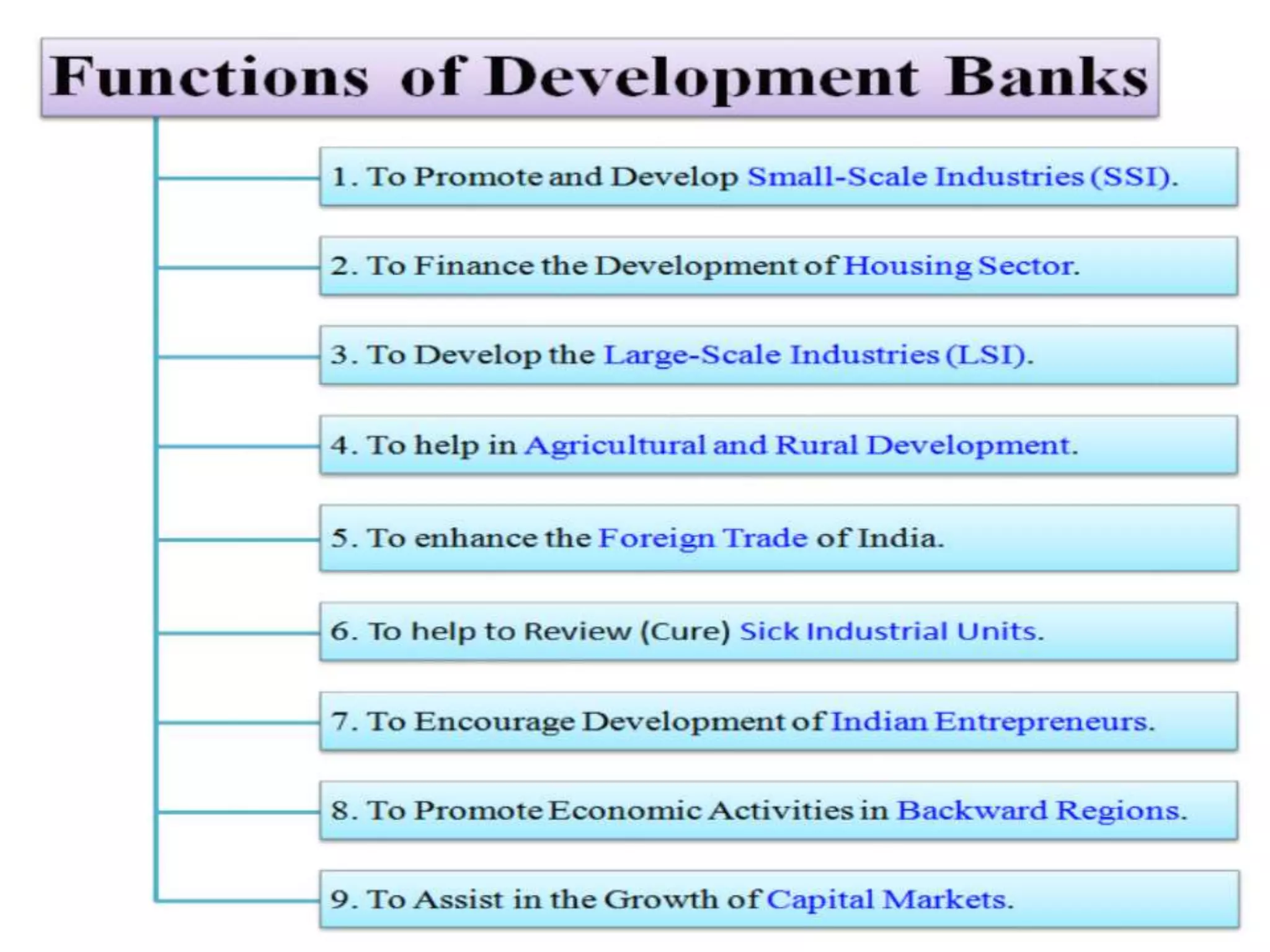
5. IMPORTANT FUNCTION OF 
DEVELOPMENT BANKS 
 Small Scale 
Industries (SSI): 
Development banks play an 
important role in the promotion 
and development of the small-scale 
sector. Government of 
India (GOI) started Small 
industries Development Bank of 
India (SIDBI) to provide medium 
and long-term loans to Small 
Scale Industries (SSI) units.
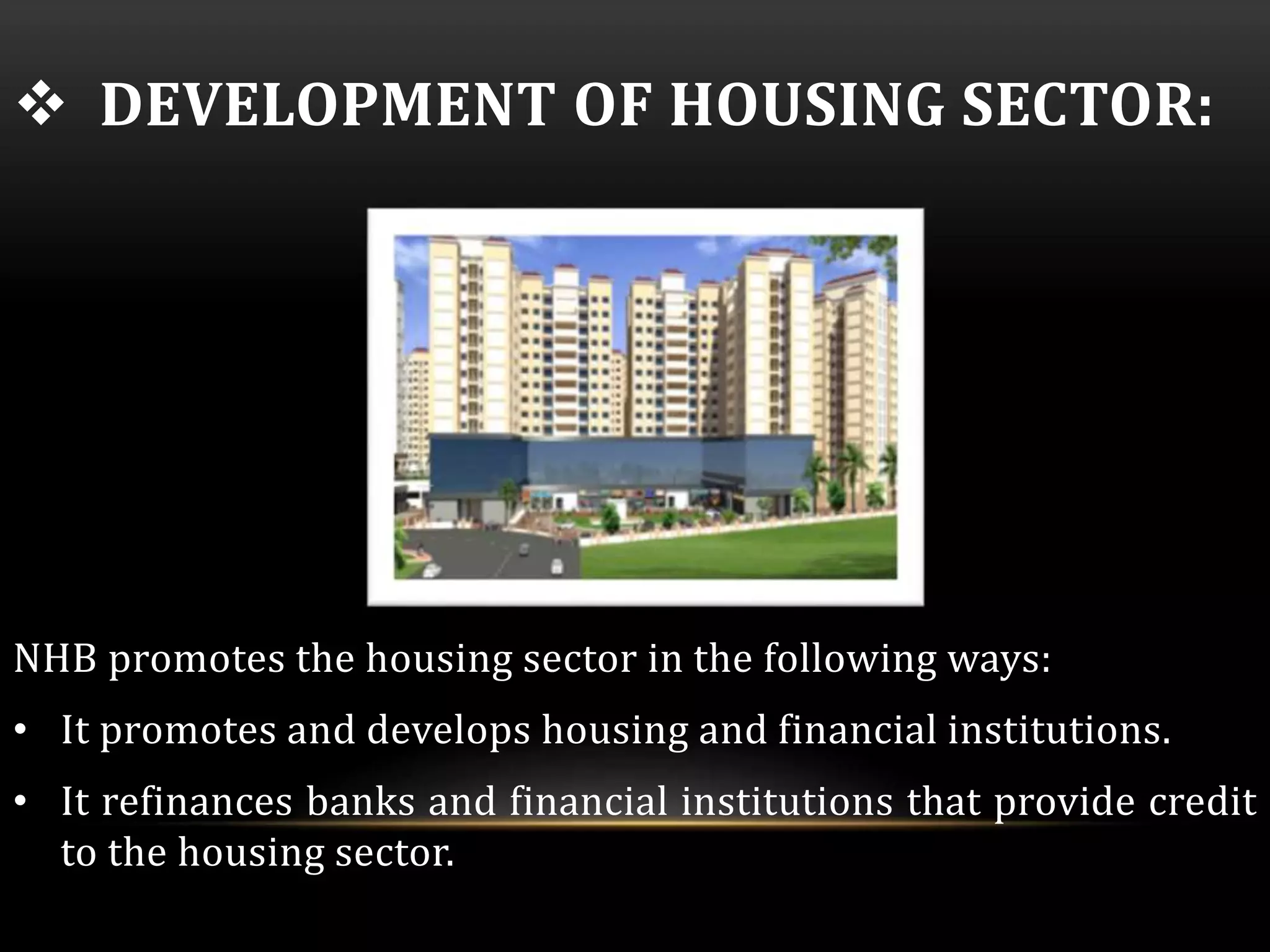
 DEVELOPMENT OF HOUSING SECTOR: 
NHB promotes the housing sector in the following ways: 
• It promotes and develops housing and financial institutions. 
• It refinances banks and financial institutions that provide credit 
to the housing sector.
 Large Scale Industries (LSI) 
Development banks promote and develop large-scale industries 
(LSI). Development financial institutions like IDBI, IFCI, etc., 
provide medium and long-term finance to the corporate sector. 
They provide merchant banking services, such as preparing project 
reports, doing feasibility studies, advising on location of a project, 
and so on.
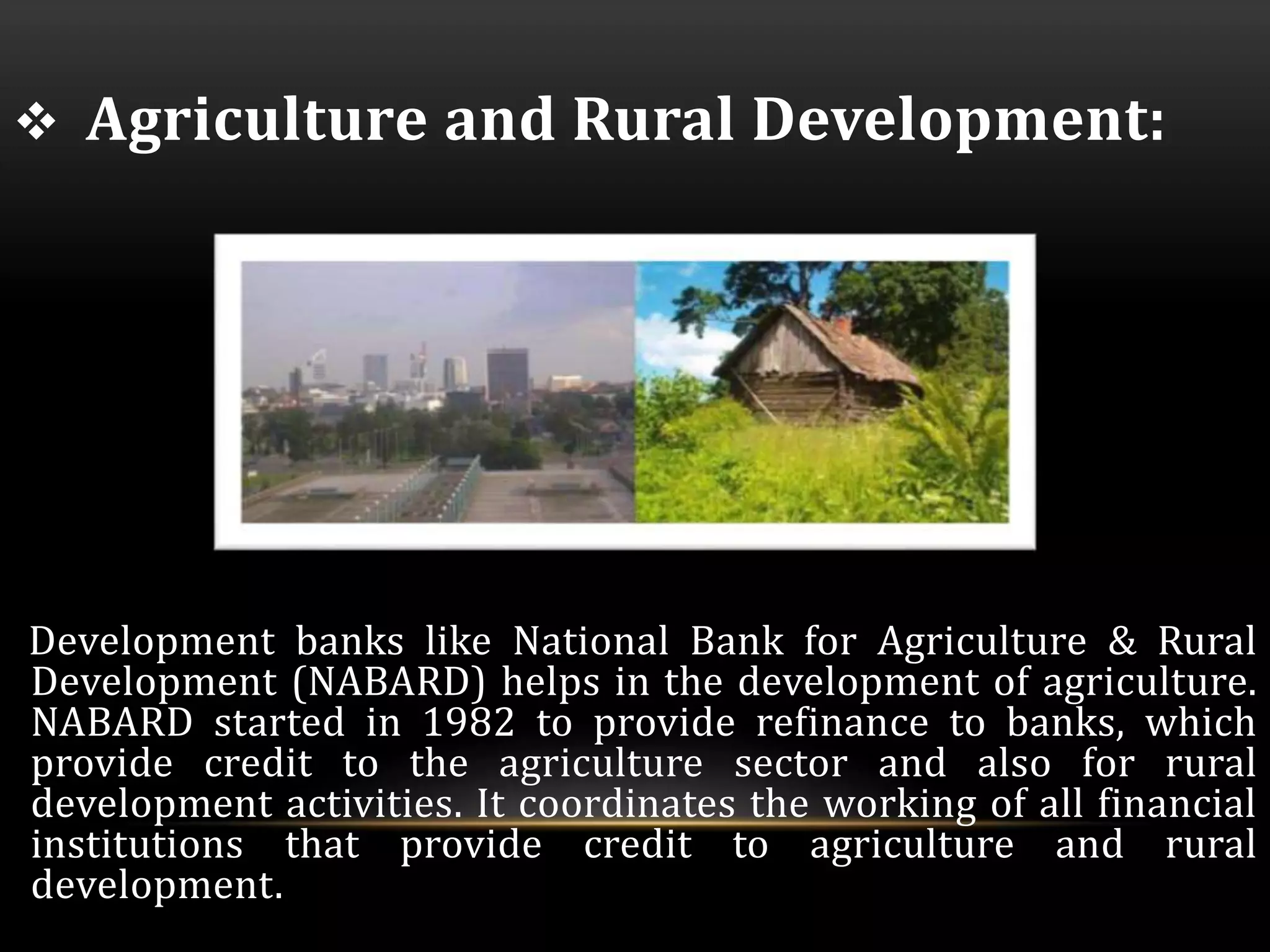
 Agriculture and Rural Development: 
Development banks like National Bank for Agriculture & Rural 
Development (NABARD) helps in the development of agriculture. 
NABARD started in 1982 to provide refinance to banks, which 
provide credit to the agriculture sector and also for rural 
development activities. It coordinates the working of all financial 
institutions that provide credit to agriculture and rural 
development.
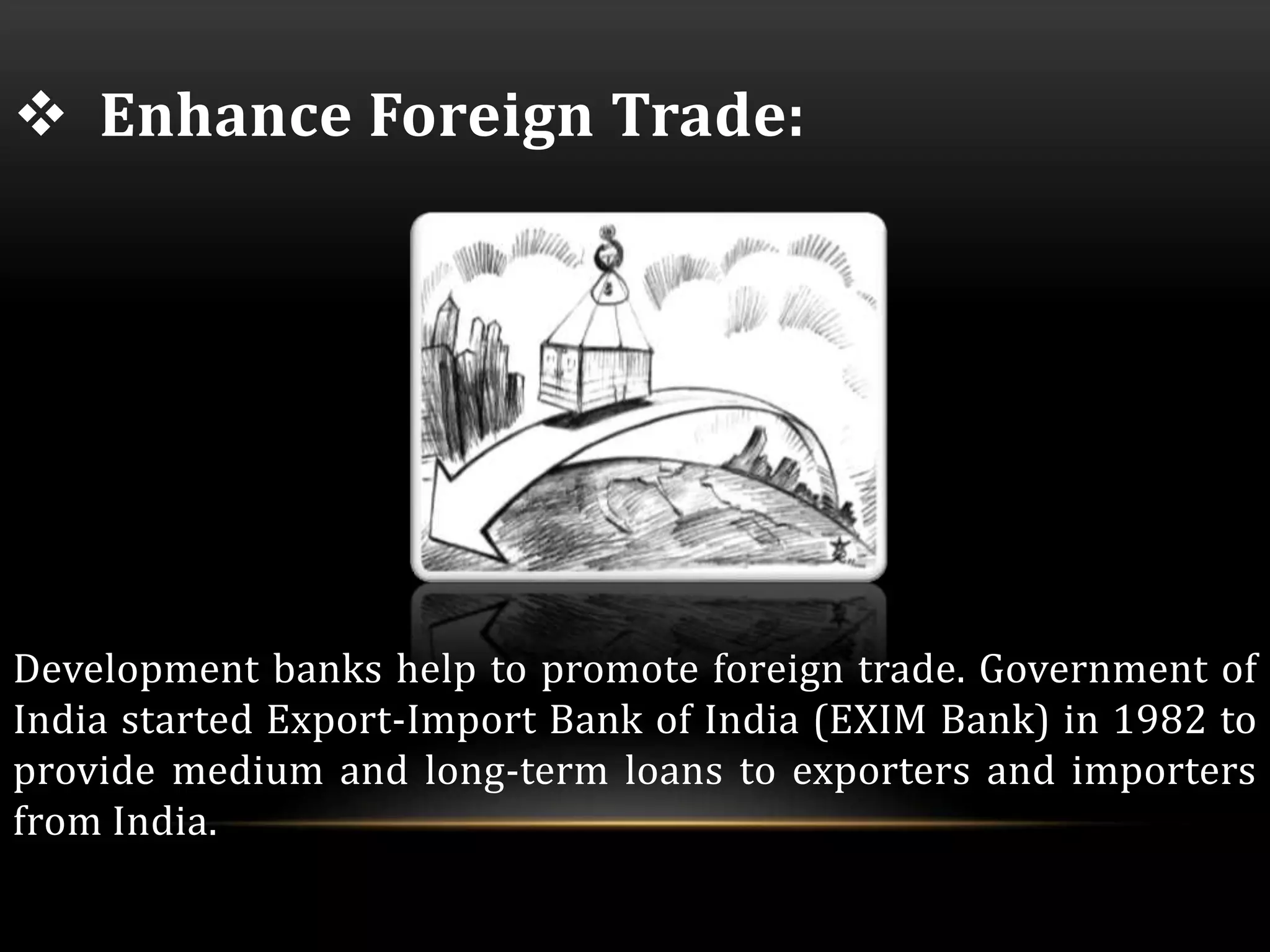
 Enhance Foreign Trade: 
Development banks help to promote foreign trade. Government of 
India started Export-Import Bank of India (EXIM Bank) in 1982 to 
provide medium and long-term loans to exporters and importers 
from India.
 Review of Sick Units: 
IIBI is the main credit and reconstruction institution for revival of 
sick units. It facilitates modernization, restructuring and 
diversification of sick-units by providing credit and other services.
 Entrepreneurship Development: 
Many development banks facilitate 
entrepreneurship development. 
NABARD, State Industrial Development 
Banks and State Finance Corporations 
provide training to entrepreneurs in 
developing leadership and business 
management skills.
 Regional Development: 
Development banks facilitate 
rural and regional development. 
They provide finance for starting 
companies in backward areas. 
They also help the companies in 
project management in such less-developed 
areas.
 Contribution to Capital Markets: 
Development banks contribute the growth of capital markets. 
They invest in equity shares and debentures of various companies 
listed in India.
6. Major objectives of Development Banks 
1. Lay Foundations for Industrialization 
A number of countries got independence from colonial rule. Their 
economies needed to be rehabilitated. Other underdeveloped and 
developing countries too needed to accelerate the pace of 
industrialization. 
2. Meet Capital Needs 
There was a dearth of capital needed to foster industrial growth in 
underdeveloped countries. Owing to the low level of income of the 
people there were no sufficient surpluses for capitalization.
3. Need for Promotional Activities 
Besides capital needs, underdeveloped countries suffered from lack 
of expertise, managerial and technical know-how. Developmental 
banks could take up the job of and joint sectors and provide 
managerial and resources and skills and of channeling them into 
approved fields under private auspices are needed in these 
countries. 
4. Help Small and Medium Sectors 
The large scale was, to some extent, able to meet its needs. There 
was a need to mitigate sufferings of small and medium size 
industries which form a sizeable sector of the industrial economy.
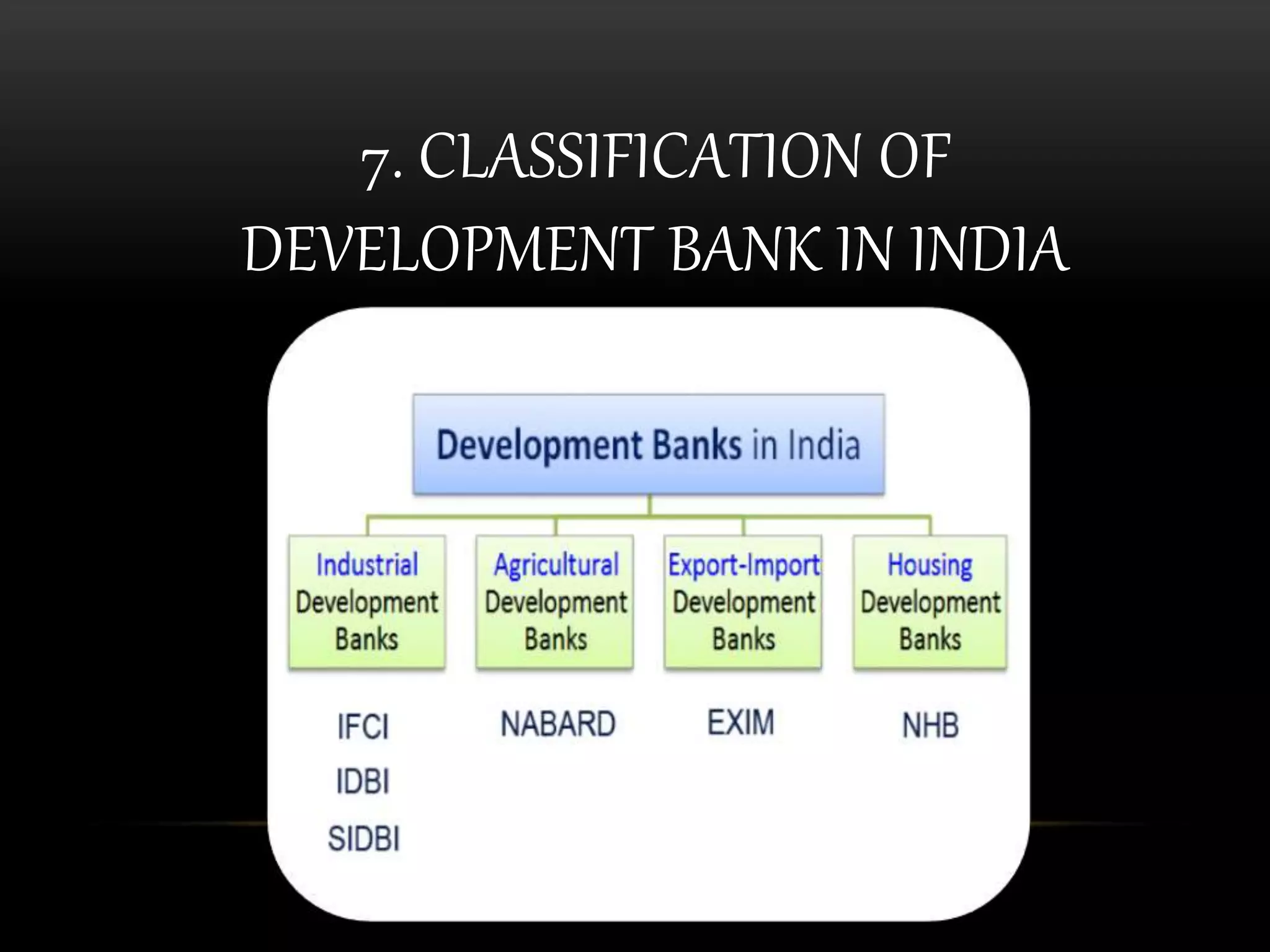
7. CLASSIFICATION OF 
DEVELOPMENT BANK IN INDIA
INDUSTRIAL DEVELOPMENT BANK OF 
INDIA (IDBI) 
The Industrial Development Bank of India (IDBI) was 
established on 1 July 1964 under an Act of Parliament as a 
wholly owned subsidiary of the Reserve Bank of India.
INDUSTRIAL INVESTMENT BANK OF 
INDIA LTD. 
The Industrial Investment Bank 
of India is one of oldest banks in 
India. The Industrial 
Reconstruction Corporation of 
India Ltd., set up in 1971 for 
rehabilitation of sick industrial 
companies, was reconstituted as 
Industrial Reconstruction Bank 
of India in 1985 under the IRBI 
Act, 1984.
ACQUISITION OF UNITED WESTERN 
BANK 
In 2006, IDBI Bank acquired United Western Bank in a rescue 
Annasaheb Chirmule , who worked for the cause of Swadeshi 
movement, founded Satara Swadeshi Commercial Bank in 1907, and 
some three decades later founded United Western Bank.
INDUSTRIAL FINANCE CORPORATION 
OF INDIA 
This was set up in the 1948 to 
provide term lending finance to 
the medium and large scale 
industries by providing them long 
term loans. The cooperative 
organizations, joint and public 
sector units are also eligible for 
getting assistance from IFCI.
INDUSTRIAL CREDIT INVESTMENT 
CORPORATION INDIA 
It was established in 1955 to 
provide finance to the large 
private enterprises and 
industries. It basically issues 
money by underwriting of the 
new securities and subscribing 
to the stocks and debentures of 
the company.
NATIONAL BANK FOR AGRICULTURE AND 
RURAL DEVELOPMENT (NABARD) 
NABARD is a central 
institution for financing 
agricultural and rural sectors. 
It was set up by the central 
Government and RBI in July, 
1982. Its paid up capital was 
Rs.100crores subscribed by 
the Government and RBI 
equally.
SMALL INDUSTRIES DEVELOPMENT 
BANK OF INDIA (SIDBI) 
SIDBI was set up in October 1989 for the purpose of providing 
financial and non-financial assistance to small scale industries in the 
country. It is a wholly owned subsidiary of the IDBI.
DISCOUNT AND FINANCE HOUSE OF 
INDIA (DFHI) 
The Discount and Finance House of India, was set up by the RBI in 
1988.It was a joint stock company owned jointly by the RBI, public 
sector banks and all India financial institution. The authorised 
capital of DFHI was Rs.250 crores. The paid up capital of 
Rs.150crores was contributed by RBI, commercial banks and 
financial institutions.
EXIM BANK 
Exim bank means export 
import bank India. It 
was set up in January, 
1982 as a statutory 
corporation. It is wholly 
owned by the central 
government. Its paid up 
capital was Rs.220.5 
crores.
NATIONAL HOUSING BANK (NHB) 
National Housing Bank was set up in July 1988 as an apex level 
housing finance institution in India. It is wholly owned subsidy of the 
RBI. IT began operations with a capital of Rs. 170 crores.
STOCK HOLDING COOPERATION OF 
INDIA LIMITED (SHCIL) 
SHCIL was promoted by Public financial institutions and 
insurance majors like IDB, UTI, ICICI, LIC, GIC, and its subsidies, 
IFCI, and IIBI. SHCIL was INCORPORATED AS A public limited 
company on 28TH July,1986.
STATE FINANCIAL CORPORATION’S 
(SFCS) 
State Financial Corporation has been set under State Financial Act, 
1951. They play an effective role in the development small and 
medium enterprise and in bringing about regionally balanced 
economic growth. There are about 18 SFCs in the country. 
INDUSTRIAL RECONSTRUCTION BANK OF 
INDIA 
The share capital had been provided by IDBI, IFCI, UTI and LIC. It 
was established to look after the sick and unstable industries and 
take steps to revitalize them by providing the capital reorganization. 
It had been mainly functional in the west Bengal and had been 
suffering from the high rates of default and capital shortages.
development bank

development bank

  • 2.
    TABLE OF CONTENTS  Introduction To Development Bank  Meaning of Development Banks  Overview of Development Banking in India  Definition of Development Banks  Functions of development  Major objectives of Development Bank  Classifications of Development Banks in India  Examples of Development Banks in India  Conclusion  References
  • 3.
    1. INTRODUCTION Developmentbanks are the institutions which supply capital, knowledge and enterprises, the three major ingredients of development for business enterprises. These institutions provide long term finance to agriculture, industries, trade, transport and basic infrastructure, so that in the absence of financial resource the economic development of the country is not adversely affected.
  • 4.
    2. MEANING Developmentbanks are specialized financial institutions. They provide medium and long-term finance to the industrial and agricultural sector. They provide finance to both private and public sector. Development banks are multipurpose financial institutions. They do term lending, investment in securities and other activities. They even promote saving and investment habit in the public.
  • 5.
    3. OVERVIEW Theconcept of development banking rose only after Second World War, after the Great Depression in 1930s. As a result the IBRD was set up in 1945 as a worldwide institution for development and reconstruction. The Narashimam committee had recommended to give up its direct financing functions and to perform only the promotional and refinancing role. Specialized development financial institutions (DFIs) such as the IDBI, NABARD, NHB and SIDBI, etc., with majority ownership of the Reserve Bank were set up to meet the long-term financing requirements of industry and agriculture.
  • 6.
    4. DEFINITION Asper Banking subject "Development banks are financial institutions established to lend (loan) finance (money) on subsidized interest rate. Such lending is sanctioned to promote and develop important sectors like agriculture, industry, import-export, housing and allied activities."
  • 8.
    5. IMPORTANT FUNCTIONOF DEVELOPMENT BANKS  Small Scale Industries (SSI): Development banks play an important role in the promotion and development of the small-scale sector. Government of India (GOI) started Small industries Development Bank of India (SIDBI) to provide medium and long-term loans to Small Scale Industries (SSI) units.
  • 9.
     DEVELOPMENT OFHOUSING SECTOR: NHB promotes the housing sector in the following ways: • It promotes and develops housing and financial institutions. • It refinances banks and financial institutions that provide credit to the housing sector.
  • 10.
     Large ScaleIndustries (LSI) Development banks promote and develop large-scale industries (LSI). Development financial institutions like IDBI, IFCI, etc., provide medium and long-term finance to the corporate sector. They provide merchant banking services, such as preparing project reports, doing feasibility studies, advising on location of a project, and so on.
  • 11.
     Agriculture andRural Development: Development banks like National Bank for Agriculture & Rural Development (NABARD) helps in the development of agriculture. NABARD started in 1982 to provide refinance to banks, which provide credit to the agriculture sector and also for rural development activities. It coordinates the working of all financial institutions that provide credit to agriculture and rural development.
  • 12.
     Enhance ForeignTrade: Development banks help to promote foreign trade. Government of India started Export-Import Bank of India (EXIM Bank) in 1982 to provide medium and long-term loans to exporters and importers from India.
  • 13.
     Review ofSick Units: IIBI is the main credit and reconstruction institution for revival of sick units. It facilitates modernization, restructuring and diversification of sick-units by providing credit and other services.
  • 14.
     Entrepreneurship Development: Many development banks facilitate entrepreneurship development. NABARD, State Industrial Development Banks and State Finance Corporations provide training to entrepreneurs in developing leadership and business management skills.
  • 15.
     Regional Development: Development banks facilitate rural and regional development. They provide finance for starting companies in backward areas. They also help the companies in project management in such less-developed areas.
  • 16.
     Contribution toCapital Markets: Development banks contribute the growth of capital markets. They invest in equity shares and debentures of various companies listed in India.
  • 17.
    6. Major objectivesof Development Banks 1. Lay Foundations for Industrialization A number of countries got independence from colonial rule. Their economies needed to be rehabilitated. Other underdeveloped and developing countries too needed to accelerate the pace of industrialization. 2. Meet Capital Needs There was a dearth of capital needed to foster industrial growth in underdeveloped countries. Owing to the low level of income of the people there were no sufficient surpluses for capitalization.
  • 18.
    3. Need forPromotional Activities Besides capital needs, underdeveloped countries suffered from lack of expertise, managerial and technical know-how. Developmental banks could take up the job of and joint sectors and provide managerial and resources and skills and of channeling them into approved fields under private auspices are needed in these countries. 4. Help Small and Medium Sectors The large scale was, to some extent, able to meet its needs. There was a need to mitigate sufferings of small and medium size industries which form a sizeable sector of the industrial economy.
  • 19.
    7. CLASSIFICATION OF DEVELOPMENT BANK IN INDIA
  • 20.
    INDUSTRIAL DEVELOPMENT BANKOF INDIA (IDBI) The Industrial Development Bank of India (IDBI) was established on 1 July 1964 under an Act of Parliament as a wholly owned subsidiary of the Reserve Bank of India.
  • 21.
    INDUSTRIAL INVESTMENT BANKOF INDIA LTD. The Industrial Investment Bank of India is one of oldest banks in India. The Industrial Reconstruction Corporation of India Ltd., set up in 1971 for rehabilitation of sick industrial companies, was reconstituted as Industrial Reconstruction Bank of India in 1985 under the IRBI Act, 1984.
  • 22.
    ACQUISITION OF UNITEDWESTERN BANK In 2006, IDBI Bank acquired United Western Bank in a rescue Annasaheb Chirmule , who worked for the cause of Swadeshi movement, founded Satara Swadeshi Commercial Bank in 1907, and some three decades later founded United Western Bank.
  • 23.
    INDUSTRIAL FINANCE CORPORATION OF INDIA This was set up in the 1948 to provide term lending finance to the medium and large scale industries by providing them long term loans. The cooperative organizations, joint and public sector units are also eligible for getting assistance from IFCI.
  • 24.
    INDUSTRIAL CREDIT INVESTMENT CORPORATION INDIA It was established in 1955 to provide finance to the large private enterprises and industries. It basically issues money by underwriting of the new securities and subscribing to the stocks and debentures of the company.
  • 25.
    NATIONAL BANK FORAGRICULTURE AND RURAL DEVELOPMENT (NABARD) NABARD is a central institution for financing agricultural and rural sectors. It was set up by the central Government and RBI in July, 1982. Its paid up capital was Rs.100crores subscribed by the Government and RBI equally.
  • 26.
    SMALL INDUSTRIES DEVELOPMENT BANK OF INDIA (SIDBI) SIDBI was set up in October 1989 for the purpose of providing financial and non-financial assistance to small scale industries in the country. It is a wholly owned subsidiary of the IDBI.
  • 27.
    DISCOUNT AND FINANCEHOUSE OF INDIA (DFHI) The Discount and Finance House of India, was set up by the RBI in 1988.It was a joint stock company owned jointly by the RBI, public sector banks and all India financial institution. The authorised capital of DFHI was Rs.250 crores. The paid up capital of Rs.150crores was contributed by RBI, commercial banks and financial institutions.
  • 28.
    EXIM BANK Eximbank means export import bank India. It was set up in January, 1982 as a statutory corporation. It is wholly owned by the central government. Its paid up capital was Rs.220.5 crores.
  • 29.
    NATIONAL HOUSING BANK(NHB) National Housing Bank was set up in July 1988 as an apex level housing finance institution in India. It is wholly owned subsidy of the RBI. IT began operations with a capital of Rs. 170 crores.
  • 30.
    STOCK HOLDING COOPERATIONOF INDIA LIMITED (SHCIL) SHCIL was promoted by Public financial institutions and insurance majors like IDB, UTI, ICICI, LIC, GIC, and its subsidies, IFCI, and IIBI. SHCIL was INCORPORATED AS A public limited company on 28TH July,1986.
  • 31.
    STATE FINANCIAL CORPORATION’S (SFCS) State Financial Corporation has been set under State Financial Act, 1951. They play an effective role in the development small and medium enterprise and in bringing about regionally balanced economic growth. There are about 18 SFCs in the country. INDUSTRIAL RECONSTRUCTION BANK OF INDIA The share capital had been provided by IDBI, IFCI, UTI and LIC. It was established to look after the sick and unstable industries and take steps to revitalize them by providing the capital reorganization. It had been mainly functional in the west Bengal and had been suffering from the high rates of default and capital shortages.