Industrial Disputes
A HUMAN RESOURCE MANAGEMENT
INSPIRED PROJECT BY
JACOB GEORGE
Introduction/Concept
Sec 2 of Industrial Disputes Act, 1947 calls it as
“Any dispute or difference between
 Employers and employers or
 Between employers and workmen or
 Between workmen and workmen
In connection to
1. employment or non-employment
2. the terms of employment
3. the conditions of labor of any person
Forms of Industrial Disputes:
 Strikes
 A spontaneous and concerted withdrawal of labor from production.
“Suspension or cessation of work by a group of persons employed in any industry,
acting in combination or a concerted refusal;
or a refusal under a common understanding(of any number of persons) who are or
have been so employed to continue to work or accept employment”.
-Industrial Disputes Act, 1947.
Examples:
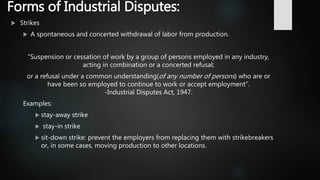
 stay-away strike
 stay-in strike
 sit-down strike: prevent the employers from replacing them with strikebreakers
or, in some cases, moving production to other locations.
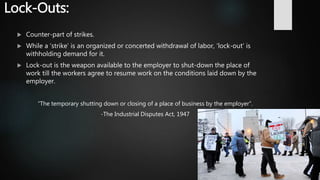
Lock-Outs:
 Counter-part of strikes.
 While a ‘strike’ is an organized or concerted withdrawal of labor, ‘lock-out’ is
withholding demand for it.
 Lock-out is the weapon available to the employer to shut-down the place of
work till the workers agree to resume work on the conditions laid down by the
employer.
“The temporary shutting down or closing of a place of business by the employer”.
-The Industrial Disputes Act, 1947
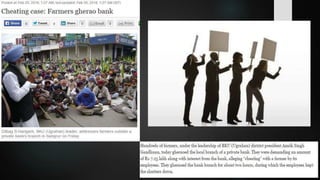
Gherao:
 It is a physical blockade of managers by encirclement aimed at preventing the egress
and ingress from and to a particular office or place.
 The object of Gherao is to compel the “gheraoed” persons to accept the workers’
demands without recourse to the machinery provided by law.
 The National Commission on Labor has refused to accept ‘gherao’ as a form of
industrial protest on the ground that it tends to inflict physical threat on the persons
gheraoed and endangers not only industrial harmony but also creates problems of law
and order.
Picketing and Boycott:
 Picketing is a method designed to request workers to withdraw cooperation to the
employer.
 Workers through display signs, banners and play-cards draw the attention of the public
that there is a dispute between workers and employer.
 Workers discourage their colleagues from entering the place of work and persuade them
to join the strike.
Boycotting, on the other hand, aims at
 Disrupting the normal functioning of the organisation.
 The striking workers voluntarily withdraw co-operation with the employer as an expression
of protest.
 Examples: Boycotting classes and examinations are seen in the Universities also.
Types of Industrial Disputes:
The Industrial Disputes into two main types.
1. Interest Disputes:
 These disputes are also called ‘economic disputes’.
 Such types of disputes arise out of terms and conditions of employment either out of
the claims made by the employees or offers given by the employers.
 Such demands or offers are generally made with a view to arrive at a collective
agreement.
Examples of interest disputes are lay-offs, claims for wages and bonus, job security, fringe
benefits, etc.
2. Grievance or Right Disputes: grievance or right disputes arise out of application or
interpretation of existing agreements or contracts between the employees and the manage-
ment. They relate either to individual worker or a group of workers in the same group. That’s
way in some countries; such disputes are also called ‘individual disputes’. Payment of wages
and other fringe benefits, working time, over-time, seniority, promotion, demotion, dismissal,
discipline, transfer, etc. are the examples of grievance or right disputes.
If these grievances are not settled as per the procedure laid down for this
purpose, these then result in embitterment of the working relationship and a
climate for industrial strife and unrest. Such grievances are often settled
through laid down standard procedures like the provisions of the collective
agreement, employment contract, works rule or law, or customs /usage in this
regard. Besides, Labour Courts or Tribunals also adjudicate over grievance or
interest disputes.
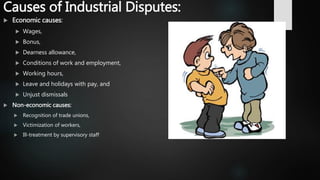
Causes of Industrial Disputes:
 Economic causes:
 Wages,
 Bonus,
 Dearness allowance,
 Conditions of work and employment,
 Working hours,
 Leave and holidays with pay, and
 Unjust dismissals
 Non-economic causes:
 Recognition of trade unions,
 Victimization of workers,
 Ill-treatment by supervisory staff
Effect of Industrial Disputes
 Unrest and unnecessary tensions engulf the hearts and minds of all the people
involved – workers and senior management.
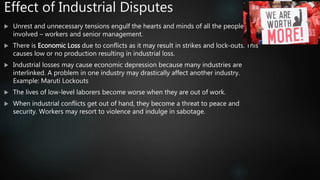
 There is Economic Loss due to conflicts as it may result in strikes and lock-outs. This
causes low or no production resulting in industrial loss.
 Industrial losses may cause economic depression because many industries are
interlinked. A problem in one industry may drastically affect another industry.
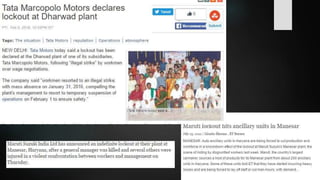
Example: Maruti Lockouts
 The lives of low-level laborers become worse when they are out of work.
 When industrial conflicts get out of hand, they become a threat to peace and
security. Workers may resort to violence and indulge in sabotage.
Industrial Dispute Settlement Machineries in
India
1. Conciliation: is the “practice by which the services of a neutral party is used in a dispute
a). For helping the disputing parties to reduce the extent of their differences and;
b). To arrive at an amicable settlement.”
The Conciliation Officer: The law provides for the appointment of Conciliation Officer by the
Government to conciliate between the parties to the industrial dispute.
The Conciliation Officer is given the powers of a civil court, whereby he is authorized to call the
witness and the parties for enquiry. However, whereas civil court cannot go beyond interpreting
the laws, the conciliation officer can go behind the facts and make judgment which will be
binding upon the parties.
Report about the case must be submitted within 14 days of the commencement of conciliation.
Industrial Dispute Settlement Machineries
Contd.
2. Court of Inquiry: The government can appoint a Court of Inquiry to enquire into any matter
connected with or relevant to industrial dispute.
The court is expected to submit its report within six months.
The court of enquiry may consist of one or more persons to be decided by the appropriate
government.
NOTE!!!
A Board of Conciliation aims at inquiring into and revealing the
causes of an industrial dispute.
A Court of Inquiry’s basic objective is to promote the
settlement of an industrial dispute. Thus, a court of enquiry is
primarily fact-finding machinery.
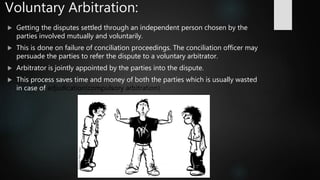
Voluntary Arbitration:
 Getting the disputes settled through an independent person chosen by the
parties involved mutually and voluntarily.
 This is done on failure of conciliation proceedings. The conciliation officer may
persuade the parties to refer the dispute to a voluntary arbitrator.
 Arbitrator is jointly appointed by the parties into the dispute.
 This process saves time and money of both the parties which is usually wasted
in case of adjudication(compulsory arbitration).
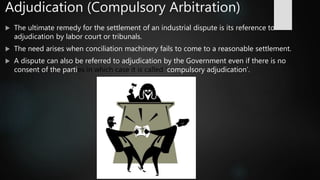
Adjudication (Compulsory Arbitration)
 The ultimate remedy for the settlement of an industrial dispute is its reference to
adjudication by labor court or tribunals.
 The need arises when conciliation machinery fails to come to a reasonable settlement.
 A dispute can also be referred to adjudication by the Government even if there is no
consent of the parties in which case it is called ‘compulsory adjudication’.
Trade Union
Any combination,
whether temporary or permanent,
formed primarily for the purpose of regulating the relationship
between
(a) Workmen and employers, or
(b) Workmen and workmen, or
(c) Employers and employers or
(d) For imposing restrictive conditions on the conduct of any trade or
business.
More about Trade Union Act, 1926
 Trade Union Act, 1926 provides for registration of trade unions.
 Any 7 or more members of a trade union may apply for registration of trade union
under this Act (Section 4) to the Registrar of Trade Unions.
 The Registrar issues a Certificate of Registration in a prescribed form which acts as
evidence that trade union has been duly registered under the Act.
Roles of Trade Unions
 The Act clearly defines the rights and liabilities of registered trade union.
 It indicates the objects on which general funds may be spent.
 The trade unions are given immunity from civil suits in certain cases.
 The members of trade unions can inspect the books of trade unions.
Thank You!

Industrial Disputes

  • 1.
    Industrial Disputes A HUMANRESOURCE MANAGEMENT INSPIRED PROJECT BY JACOB GEORGE
  • 2.
    Introduction/Concept Sec 2 ofIndustrial Disputes Act, 1947 calls it as “Any dispute or difference between  Employers and employers or  Between employers and workmen or  Between workmen and workmen In connection to 1. employment or non-employment 2. the terms of employment 3. the conditions of labor of any person
  • 3.
    Forms of IndustrialDisputes:  Strikes  A spontaneous and concerted withdrawal of labor from production. “Suspension or cessation of work by a group of persons employed in any industry, acting in combination or a concerted refusal; or a refusal under a common understanding(of any number of persons) who are or have been so employed to continue to work or accept employment”. -Industrial Disputes Act, 1947. Examples:  stay-away strike  stay-in strike  sit-down strike: prevent the employers from replacing them with strikebreakers or, in some cases, moving production to other locations.
  • 5.
    Lock-Outs:  Counter-part ofstrikes.  While a ‘strike’ is an organized or concerted withdrawal of labor, ‘lock-out’ is withholding demand for it.  Lock-out is the weapon available to the employer to shut-down the place of work till the workers agree to resume work on the conditions laid down by the employer. “The temporary shutting down or closing of a place of business by the employer”. -The Industrial Disputes Act, 1947
  • 7.
    Gherao:  It isa physical blockade of managers by encirclement aimed at preventing the egress and ingress from and to a particular office or place.  The object of Gherao is to compel the “gheraoed” persons to accept the workers’ demands without recourse to the machinery provided by law.  The National Commission on Labor has refused to accept ‘gherao’ as a form of industrial protest on the ground that it tends to inflict physical threat on the persons gheraoed and endangers not only industrial harmony but also creates problems of law and order.
  • 9.
    Picketing and Boycott: Picketing is a method designed to request workers to withdraw cooperation to the employer.  Workers through display signs, banners and play-cards draw the attention of the public that there is a dispute between workers and employer.  Workers discourage their colleagues from entering the place of work and persuade them to join the strike. Boycotting, on the other hand, aims at  Disrupting the normal functioning of the organisation.  The striking workers voluntarily withdraw co-operation with the employer as an expression of protest.  Examples: Boycotting classes and examinations are seen in the Universities also.
  • 10.
    Types of IndustrialDisputes: The Industrial Disputes into two main types. 1. Interest Disputes:  These disputes are also called ‘economic disputes’.  Such types of disputes arise out of terms and conditions of employment either out of the claims made by the employees or offers given by the employers.  Such demands or offers are generally made with a view to arrive at a collective agreement. Examples of interest disputes are lay-offs, claims for wages and bonus, job security, fringe benefits, etc. 2. Grievance or Right Disputes: grievance or right disputes arise out of application or interpretation of existing agreements or contracts between the employees and the manage- ment. They relate either to individual worker or a group of workers in the same group. That’s way in some countries; such disputes are also called ‘individual disputes’. Payment of wages and other fringe benefits, working time, over-time, seniority, promotion, demotion, dismissal, discipline, transfer, etc. are the examples of grievance or right disputes.
  • 11.
    If these grievancesare not settled as per the procedure laid down for this purpose, these then result in embitterment of the working relationship and a climate for industrial strife and unrest. Such grievances are often settled through laid down standard procedures like the provisions of the collective agreement, employment contract, works rule or law, or customs /usage in this regard. Besides, Labour Courts or Tribunals also adjudicate over grievance or interest disputes.
  • 12.
    Causes of IndustrialDisputes:  Economic causes:  Wages,  Bonus,  Dearness allowance,  Conditions of work and employment,  Working hours,  Leave and holidays with pay, and  Unjust dismissals  Non-economic causes:  Recognition of trade unions,  Victimization of workers,  Ill-treatment by supervisory staff
  • 13.
    Effect of IndustrialDisputes  Unrest and unnecessary tensions engulf the hearts and minds of all the people involved – workers and senior management.  There is Economic Loss due to conflicts as it may result in strikes and lock-outs. This causes low or no production resulting in industrial loss.  Industrial losses may cause economic depression because many industries are interlinked. A problem in one industry may drastically affect another industry. Example: Maruti Lockouts  The lives of low-level laborers become worse when they are out of work.  When industrial conflicts get out of hand, they become a threat to peace and security. Workers may resort to violence and indulge in sabotage.
  • 14.
    Industrial Dispute SettlementMachineries in India 1. Conciliation: is the “practice by which the services of a neutral party is used in a dispute a). For helping the disputing parties to reduce the extent of their differences and; b). To arrive at an amicable settlement.” The Conciliation Officer: The law provides for the appointment of Conciliation Officer by the Government to conciliate between the parties to the industrial dispute. The Conciliation Officer is given the powers of a civil court, whereby he is authorized to call the witness and the parties for enquiry. However, whereas civil court cannot go beyond interpreting the laws, the conciliation officer can go behind the facts and make judgment which will be binding upon the parties. Report about the case must be submitted within 14 days of the commencement of conciliation.
  • 15.
    Industrial Dispute SettlementMachineries Contd. 2. Court of Inquiry: The government can appoint a Court of Inquiry to enquire into any matter connected with or relevant to industrial dispute. The court is expected to submit its report within six months. The court of enquiry may consist of one or more persons to be decided by the appropriate government.
  • 16.
    NOTE!!! A Board ofConciliation aims at inquiring into and revealing the causes of an industrial dispute. A Court of Inquiry’s basic objective is to promote the settlement of an industrial dispute. Thus, a court of enquiry is primarily fact-finding machinery.
  • 17.
    Voluntary Arbitration:  Gettingthe disputes settled through an independent person chosen by the parties involved mutually and voluntarily.  This is done on failure of conciliation proceedings. The conciliation officer may persuade the parties to refer the dispute to a voluntary arbitrator.  Arbitrator is jointly appointed by the parties into the dispute.  This process saves time and money of both the parties which is usually wasted in case of adjudication(compulsory arbitration).
  • 18.
    Adjudication (Compulsory Arbitration) The ultimate remedy for the settlement of an industrial dispute is its reference to adjudication by labor court or tribunals.  The need arises when conciliation machinery fails to come to a reasonable settlement.  A dispute can also be referred to adjudication by the Government even if there is no consent of the parties in which case it is called ‘compulsory adjudication’.
  • 19.
    Trade Union Any combination, whethertemporary or permanent, formed primarily for the purpose of regulating the relationship between (a) Workmen and employers, or (b) Workmen and workmen, or (c) Employers and employers or (d) For imposing restrictive conditions on the conduct of any trade or business.
  • 20.
    More about TradeUnion Act, 1926  Trade Union Act, 1926 provides for registration of trade unions.  Any 7 or more members of a trade union may apply for registration of trade union under this Act (Section 4) to the Registrar of Trade Unions.  The Registrar issues a Certificate of Registration in a prescribed form which acts as evidence that trade union has been duly registered under the Act.
  • 21.
    Roles of TradeUnions  The Act clearly defines the rights and liabilities of registered trade union.  It indicates the objects on which general funds may be spent.  The trade unions are given immunity from civil suits in certain cases.  The members of trade unions can inspect the books of trade unions.
  • 22.

Editor's Notes

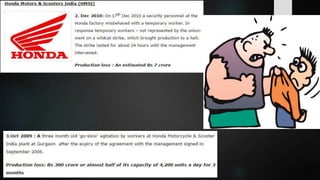
  • #5 December 2010 case: WildCat strike is a strike action undertaken by unionized workers without union leadership's authorization, support, or approval; this is sometimes termed an unofficial industrial action.
  • #13 http://www.yourarticlelibrary.com/essay/industrial-dispute-in-india-definition-causes-and-measures-to-improve-industrial-relations/27991/