Industrial design

Compiled by A Srinivasa Rao
INDUSTRIAL DESIGN
• Protected under the Designs Act, 2000

• Protects     external    shape,    configuration,
  surface     pattern    or    ornamentation     of
  an industrially reproduced article

• New and novel

• Judged solely by the eye

• Non functional
NEW AND NOVEL

• Novel”: Means that it must originate from the
  creator
• “New”: Not identical to a previous design
• Pattern made up of old features but resulting
  combination with strikingly different appearance
  can be novel
• Distinguishable from known designs or
  combination of known designs
• But over the years, the test has become NEW
  AND NOVEL
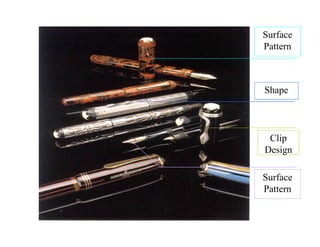
Surface
Pattern


Shape


 Clip
Design

Surface
Pattern
WHY REGISTER YOUR DESIGN?

•   Statutory right – accrues only on registration – territorial

•     Right to prevent others from producing, importing, selling or
    distributing products having an identical appearance or a
    fraudulent or obvious imitation

•    Monopoly Period of 10 years- extendable by 5

•    Gives you a Unique Selling Point (USP)

•    Is an asset & can be licensed
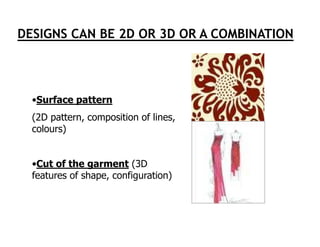
DESIGNS CAN BE 2D OR 3D OR A COMBINATION


  •Surface pattern
  (2D pattern, composition of lines,
  colours)


  •Cut of the garment (3D
  features of shape, configuration)
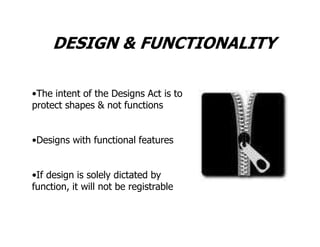
DESIGN & FUNCTIONALITY

•The intent of the Designs Act is to
protect shapes & not functions


•Designs with functional features


•If design is solely dictated by
function, it will not be registrable
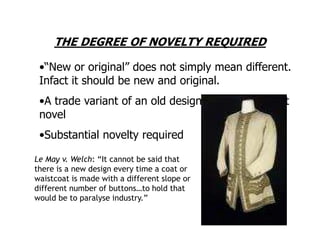
THE DEGREE OF NOVELTY REQUIRED

 •“New or original” does not simply mean different.
 Infact it should be new and original.
 •A trade variant of an old design does not make it
 novel
 •Substantial novelty required

Le May v. Welch: “It cannot be said that
there is a new design every time a coat or
waistcoat is made with a different slope or
different number of buttons…to hold that
would be to paralyse industry.”
LIMITATIONS OF PROTECTION OFFERED
          BY DESIGNS LAW

• A design needs to be registered for any kind of
  rights to be claimed over it – it may not be
  feasible to register every design that is created by
  designers

• A design right cannot be claimed over a design
  that has been published/disclosed to the public

• A design right will only be granted on the
  fulfilment of various criteria like “novelty”, eye
  appeal and non-functionality
ENFORCEMENT

• Identical design or any fraudulent and
  obvious imitation;
• Import for sale
• Publishing or exposing the article which is
  known to be pirated
• Injunction and damages
SECTION 15(2), COPYRIGHT ACT, 1957


• Copyright does not subsist in design registered
  under the Designs Act

• Design capable of being registered, but which has
  not been so registered enjoys copyright protection

• Copyright shall cease as soon as any article to
  which the design has been applied more than
  FIFTY TIMES by an industrial process
THE COPYRIGHT/DESIGN OVERLAP


• Fashion design lies at the cusp between “creativity” and
  “industrial manufacture”
• Great design has the quality of transforming “wearable
  apparel” into “wearable art”
• Thus, the distinction made by law between “purely
  artistic works” and works that have been
  commercialised can be problematic in many cases
• There will be works that are both protectible under
  copyright law as well as under designs law
• Indian law has tried to resolve this by the provision of
  Section 15(2), Copyright Act, 1957
Copyright & Designs Law
• Designs that are not commercialised (i.e., not produced
  more than 50 times), enjoy full copyright protection
  even if not registered as a design

• It may be argued that a design that has been
  commericalised, may be capable of protection under
  Copyright Act on the basis of the underlying artistic
  works (i.e., the sketches, engravings, prototypes, etc.)
  though Section 15 (2) remains a bar
Copyright & Designs Law
• Important to maintain documentation and
  records at every stage of product design and
  development as this may help in claiming
  protection for a design under the Copyright
  Act

• If you think of getting into mass production of
  a unique design, file a design application as
  that would provide you stronger protection &
  complete monopoly
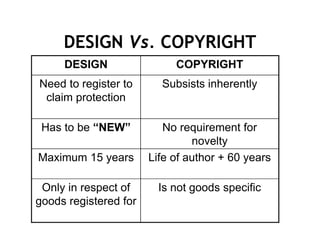
DESIGN Vs. COPYRIGHT
     DESIGN                 COPYRIGHT
Need to register to      Subsists inherently
 claim protection

 Has to be “NEW”          No requirement for
                                novelty
Maximum 15 years       Life of author + 60 years

 Only in respect of      Is not goods specific
goods registered for
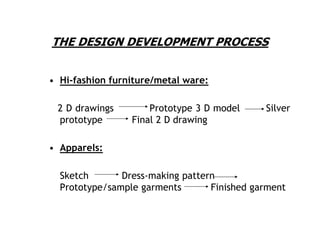
THE DESIGN DEVELOPMENT PROCESS


• Hi-fashion furniture/metal ware:

 2 D drawings        Prototype 3 D model     Silver
 prototype       Final 2 D drawing

• Apparels:

  Sketch       Dress-making pattern
  Prototype/sample garments       Finished garment
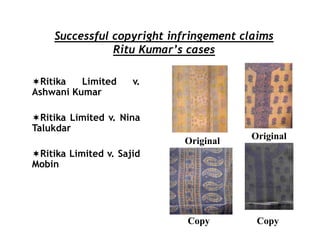
Successful copyright infringement claims
               Ritu Kumar’s cases

  Ritika  Limited     v.
Ashwani Kumar

  Ritika Limited v. Nina
Talukdar
                                       Original
                           Original
 Ritika Limited v. Sajid
Mobin


                            Copy        Copy
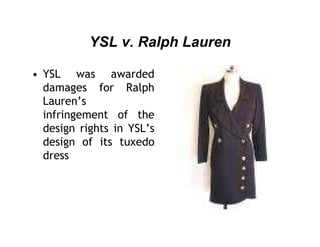
YSL v. Ralph Lauren

• YSL was awarded
  damages for Ralph
  Lauren’s
  infringement of the
  design rights in YSL’s
  design of its tuxedo
  dress
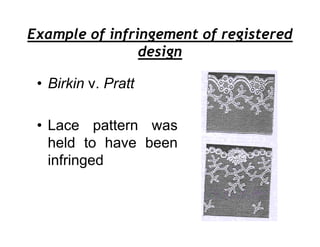
Example of infringement of registered
                design

 • Birkin v. Pratt

 • Lace pattern was
   held to have been
   infringed
INDIAN LANDMARK DECISIONS


• Microfibres Case [2006(32) PTC 157]
  – Upholstery designs
  – Intention
  – Not Artistic work
  – Design registration
  – More than 50 copies
  – No injunction
• Tarun Tahiliani Case [Case No. 183 of
  2007]
  – Haute Couture;
  – Diffusion;
  – Pret-a-porter
  – Accessories
  – Not mass production
  – Distinguished Microfibres
  – Injunction granted
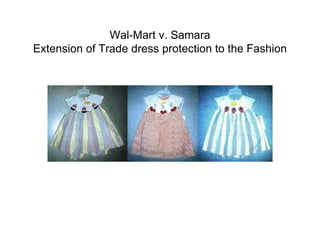
Wal-Mart v. Samara
Extension of Trade dress protection to the Fashion
What to do when licensing a design

• A registered design can be licensed to exploit
  markets or commercialise it on a scale beyond
  the resources of the author

• Essential to specify in the license- the term,
  territory, amount of royalty & type of products
  for which design can be used by licensee
Thank you

Industrial design [compatibility mode]

  • 1.
  • 2.
    INDUSTRIAL DESIGN • Protectedunder the Designs Act, 2000 • Protects external shape, configuration, surface pattern or ornamentation of an industrially reproduced article • New and novel • Judged solely by the eye • Non functional
  • 3.
    NEW AND NOVEL •Novel”: Means that it must originate from the creator • “New”: Not identical to a previous design • Pattern made up of old features but resulting combination with strikingly different appearance can be novel • Distinguishable from known designs or combination of known designs • But over the years, the test has become NEW AND NOVEL
  • 4.
  • 5.
    WHY REGISTER YOURDESIGN? • Statutory right – accrues only on registration – territorial • Right to prevent others from producing, importing, selling or distributing products having an identical appearance or a fraudulent or obvious imitation • Monopoly Period of 10 years- extendable by 5 • Gives you a Unique Selling Point (USP) • Is an asset & can be licensed
  • 6.
    DESIGNS CAN BE2D OR 3D OR A COMBINATION •Surface pattern (2D pattern, composition of lines, colours) •Cut of the garment (3D features of shape, configuration)
  • 7.
    DESIGN & FUNCTIONALITY •Theintent of the Designs Act is to protect shapes & not functions •Designs with functional features •If design is solely dictated by function, it will not be registrable
  • 8.
    THE DEGREE OFNOVELTY REQUIRED •“New or original” does not simply mean different. Infact it should be new and original. •A trade variant of an old design does not make it novel •Substantial novelty required Le May v. Welch: “It cannot be said that there is a new design every time a coat or waistcoat is made with a different slope or different number of buttons…to hold that would be to paralyse industry.”
  • 9.
    LIMITATIONS OF PROTECTIONOFFERED BY DESIGNS LAW • A design needs to be registered for any kind of rights to be claimed over it – it may not be feasible to register every design that is created by designers • A design right cannot be claimed over a design that has been published/disclosed to the public • A design right will only be granted on the fulfilment of various criteria like “novelty”, eye appeal and non-functionality
  • 10.
    ENFORCEMENT • Identical designor any fraudulent and obvious imitation; • Import for sale • Publishing or exposing the article which is known to be pirated • Injunction and damages
  • 11.
    SECTION 15(2), COPYRIGHTACT, 1957 • Copyright does not subsist in design registered under the Designs Act • Design capable of being registered, but which has not been so registered enjoys copyright protection • Copyright shall cease as soon as any article to which the design has been applied more than FIFTY TIMES by an industrial process
  • 12.
    THE COPYRIGHT/DESIGN OVERLAP •Fashion design lies at the cusp between “creativity” and “industrial manufacture” • Great design has the quality of transforming “wearable apparel” into “wearable art” • Thus, the distinction made by law between “purely artistic works” and works that have been commercialised can be problematic in many cases • There will be works that are both protectible under copyright law as well as under designs law • Indian law has tried to resolve this by the provision of Section 15(2), Copyright Act, 1957
  • 13.
    Copyright & DesignsLaw • Designs that are not commercialised (i.e., not produced more than 50 times), enjoy full copyright protection even if not registered as a design • It may be argued that a design that has been commericalised, may be capable of protection under Copyright Act on the basis of the underlying artistic works (i.e., the sketches, engravings, prototypes, etc.) though Section 15 (2) remains a bar
  • 14.
    Copyright & DesignsLaw • Important to maintain documentation and records at every stage of product design and development as this may help in claiming protection for a design under the Copyright Act • If you think of getting into mass production of a unique design, file a design application as that would provide you stronger protection & complete monopoly
  • 15.
    DESIGN Vs. COPYRIGHT DESIGN COPYRIGHT Need to register to Subsists inherently claim protection Has to be “NEW” No requirement for novelty Maximum 15 years Life of author + 60 years Only in respect of Is not goods specific goods registered for
  • 16.
    THE DESIGN DEVELOPMENTPROCESS • Hi-fashion furniture/metal ware: 2 D drawings Prototype 3 D model Silver prototype Final 2 D drawing • Apparels: Sketch Dress-making pattern Prototype/sample garments Finished garment
  • 17.
    Successful copyright infringementclaims Ritu Kumar’s cases Ritika Limited v. Ashwani Kumar Ritika Limited v. Nina Talukdar Original Original Ritika Limited v. Sajid Mobin Copy Copy
  • 18.
    YSL v. RalphLauren • YSL was awarded damages for Ralph Lauren’s infringement of the design rights in YSL’s design of its tuxedo dress
  • 19.
    Example of infringementof registered design • Birkin v. Pratt • Lace pattern was held to have been infringed
  • 20.
    INDIAN LANDMARK DECISIONS •Microfibres Case [2006(32) PTC 157] – Upholstery designs – Intention – Not Artistic work – Design registration – More than 50 copies – No injunction
  • 21.
    • Tarun TahilianiCase [Case No. 183 of 2007] – Haute Couture; – Diffusion; – Pret-a-porter – Accessories – Not mass production – Distinguished Microfibres – Injunction granted
  • 22.
    Wal-Mart v. Samara Extensionof Trade dress protection to the Fashion
  • 23.
    What to dowhen licensing a design • A registered design can be licensed to exploit markets or commercialise it on a scale beyond the resources of the author • Essential to specify in the license- the term, territory, amount of royalty & type of products for which design can be used by licensee
  • 24.