Intellectual
Property
Rights in
Fashion
Industry
“In order to be irreplaceable,
one must always be different.
-Coco Chanel
Why Fashion needs IPR
fashions comes from creativity and Creativity comes from human
intellect
India – 2nd largest producer – textiles and garments
From facts and figures – designers and fashion houses – importance of
protecting their rights
14% - Industrial production
12% - Total exports
4% - Gross Domestic Production
IPR FRAMEWORK
DESIGN ACT
Sec. 2(d)
excludes artistic works
Protects – shapes, patten, ornament –
2D, 3D
Appeal soley to eye
COPYRIGHT ACT
Sec. 13: artistic work
Sec. 15: copyright ceases when:
1) any design – capable of being registered in Designs Act.
2) design reproduced – more than 50 times – by industrial
process
Rajesh Masrani v. Tahiliani Designs
infringement of artistic work:
- Drawings - S. 2(c)(i)
- Prints, patterns – S. 2(c)(iii)
Defendant argued – works comes u/s 15(2) – hence not protectable
Judgement:
- Copyright infringement
- being original work u/s 2(c) will be considered as artistic work .
- Not capable to being registered under Design Act – 2(d)
Only 20 times reproduced - S. 15 will not apply
Ritika Pvt. Limited v. Biba Apparels Pvt. Ltd
Arguments:
Plaintiff – claimed to be first owner of work
Respondents – work falls under S. 15(2),
Copyright Act
Judgement:
No copyright infringement
If design applied to apparel more than 50 times
– loses all protection
TRADEMARK PROTECTION
 Maintains prestige premium for particular brands
Advance Magazine Publishers v Just Lifestyle Private Limited
Plaintiff: use trademark –”VOGUE” – in magazine - similarity
Defendant: trademark – JUST IN VOGUE – retail stores, sales services – different business
Judgement:
- no infringement
- Goods/services – dissimilar – with no common distributor/dealers
- Vogue – ordinary english word
- No deceptive similarity –
“VOGUE” use of conjunction “JUST IN VOGUE”
TRADE DRESS:
Protected through - Sec. 2(zb), Trademarks Act,
1999
Limited to product packaging
concept expanded to encompass design
Key to appeal of clothing design product
Geographical Indication
Valuable asset – local and indigenous communities of
weavers
Economic benefit – 10 years – renewable
Eg. Prior to GI on Banarasi silk & brocade - Handloom
industry was in huge loss – because mechanised unit was
producing cheap alternatives of silk
PATENT
Technical innovation protected
Reliance Industry Limited – patented DEO2 process
technology for Only Vimal textile brand – under USPTO
DEO2 – technology that enables fabric to resist
settlement of micro-organism from perspiration odour
PIRACY in
Fashion and its
Impact
PIRACY
– unauthorised use
- Illegal - reproduction or distribution
- Categorised: a. knock offs
b. counterfeits
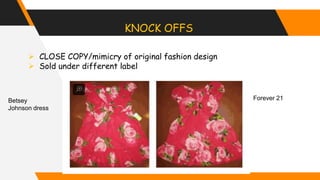
KNOCK OFFS
 CLOSE COPY/mimicry of original fashion design
 Sold under different label
Betsey
Johnson dress
Forever 21
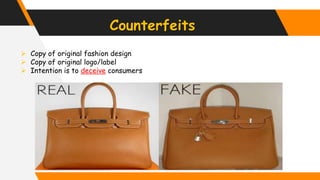
Counterfeits
 Copy of original fashion design
 Copy of original logo/label
 Intention is to deceive consumers
 “victimless crime” – misnomer
Primary victims:
1. Fashion houses/ designers- incurring losses – goodwill
harmed
2. Consumers – deceived – excess pay for inferior goods
e-commerce - boosting luxury counterfeit market - selling
them at lucrative prices – account 25% of fake luxury
goods market in India
Fast fashion
“Weaker version”
Recent trends – apparel+ lifestyle retail – copied and sold at
discounted price
Consumers – finds convenient – obtain recent trends
Growing obsession with fashion + silence of IPR = “Fast Fashion”
Examples – H&M, Forever 21, Zara
Effects on SUSTAINABILITY
 Environment perspective – due to dyeing process, other treatment
process leads to huge wastage
Eg. Polyster involves hazardous emissions, harmful gases
 Forced labour: forced to work under inhumane conditions – women +
children - exploited
UNITED STATES PROTECTION
Senator Chuck Schumer – proposed – INNOVATIVE DESIGN PROTECTION
AND PIRACY PROHIBITION ACT (IDPPPA) – 2012 – to grant copyright
protection
Not passed till date
Backed by criticism:
1. “Piracy paradox”: copying promotes innovation
2. Indirectly increases apparel cost for customers
CONCLUSION
Short term life expectancy
“Fashion Law”
S. 15(2) must provide – more than 50 times
reproduction for designs
Consumer awareness
24
THANKS!
Any questions?
You can find me at @username & user@mail.me

Ipr ppt

  • 1.
  • 2.
    “In order tobe irreplaceable, one must always be different. -Coco Chanel
  • 3.
    Why Fashion needsIPR fashions comes from creativity and Creativity comes from human intellect India – 2nd largest producer – textiles and garments From facts and figures – designers and fashion houses – importance of protecting their rights
  • 4.
    14% - Industrialproduction 12% - Total exports 4% - Gross Domestic Production
  • 5.
  • 6.
    DESIGN ACT Sec. 2(d) excludesartistic works Protects – shapes, patten, ornament – 2D, 3D Appeal soley to eye
  • 7.
    COPYRIGHT ACT Sec. 13:artistic work Sec. 15: copyright ceases when: 1) any design – capable of being registered in Designs Act. 2) design reproduced – more than 50 times – by industrial process
  • 8.
    Rajesh Masrani v.Tahiliani Designs infringement of artistic work: - Drawings - S. 2(c)(i) - Prints, patterns – S. 2(c)(iii) Defendant argued – works comes u/s 15(2) – hence not protectable Judgement: - Copyright infringement - being original work u/s 2(c) will be considered as artistic work . - Not capable to being registered under Design Act – 2(d) Only 20 times reproduced - S. 15 will not apply
  • 9.
    Ritika Pvt. Limitedv. Biba Apparels Pvt. Ltd Arguments: Plaintiff – claimed to be first owner of work Respondents – work falls under S. 15(2), Copyright Act Judgement: No copyright infringement If design applied to apparel more than 50 times – loses all protection
  • 10.
    TRADEMARK PROTECTION  Maintainsprestige premium for particular brands Advance Magazine Publishers v Just Lifestyle Private Limited Plaintiff: use trademark –”VOGUE” – in magazine - similarity Defendant: trademark – JUST IN VOGUE – retail stores, sales services – different business Judgement: - no infringement - Goods/services – dissimilar – with no common distributor/dealers - Vogue – ordinary english word - No deceptive similarity – “VOGUE” use of conjunction “JUST IN VOGUE”
  • 11.
    TRADE DRESS: Protected through- Sec. 2(zb), Trademarks Act, 1999 Limited to product packaging concept expanded to encompass design Key to appeal of clothing design product
  • 12.
    Geographical Indication Valuable asset– local and indigenous communities of weavers Economic benefit – 10 years – renewable Eg. Prior to GI on Banarasi silk & brocade - Handloom industry was in huge loss – because mechanised unit was producing cheap alternatives of silk
  • 13.
    PATENT Technical innovation protected RelianceIndustry Limited – patented DEO2 process technology for Only Vimal textile brand – under USPTO DEO2 – technology that enables fabric to resist settlement of micro-organism from perspiration odour
  • 14.
  • 15.
    PIRACY – unauthorised use -Illegal - reproduction or distribution - Categorised: a. knock offs b. counterfeits
  • 16.
    KNOCK OFFS  CLOSECOPY/mimicry of original fashion design  Sold under different label Betsey Johnson dress Forever 21
  • 17.
    Counterfeits  Copy oforiginal fashion design  Copy of original logo/label  Intention is to deceive consumers
  • 18.
     “victimless crime”– misnomer Primary victims: 1. Fashion houses/ designers- incurring losses – goodwill harmed 2. Consumers – deceived – excess pay for inferior goods e-commerce - boosting luxury counterfeit market - selling them at lucrative prices – account 25% of fake luxury goods market in India
  • 19.
  • 20.
    “Weaker version” Recent trends– apparel+ lifestyle retail – copied and sold at discounted price Consumers – finds convenient – obtain recent trends Growing obsession with fashion + silence of IPR = “Fast Fashion” Examples – H&M, Forever 21, Zara
  • 21.
    Effects on SUSTAINABILITY Environment perspective – due to dyeing process, other treatment process leads to huge wastage Eg. Polyster involves hazardous emissions, harmful gases  Forced labour: forced to work under inhumane conditions – women + children - exploited
  • 22.
    UNITED STATES PROTECTION SenatorChuck Schumer – proposed – INNOVATIVE DESIGN PROTECTION AND PIRACY PROHIBITION ACT (IDPPPA) – 2012 – to grant copyright protection Not passed till date Backed by criticism: 1. “Piracy paradox”: copying promotes innovation 2. Indirectly increases apparel cost for customers
  • 23.
    CONCLUSION Short term lifeexpectancy “Fashion Law” S. 15(2) must provide – more than 50 times reproduction for designs Consumer awareness
  • 24.
    24 THANKS! Any questions? You canfind me at @username & user@mail.me