Active vs Passive 
sentences 
Year 9 Indo Term 3
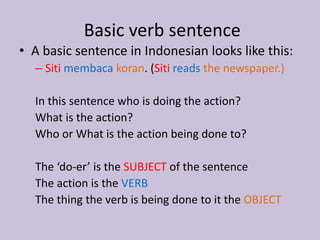
Basic verb sentence 
• A basic sentence in Indonesian looks like this: 
– Siti membaca koran. (Siti reads the newspaper.) 
In this sentence who is doing the action? 
What is the action? 
Who or What is the action being done to? 
The ‘do-er’ is the SUBJECT of the sentence 
The action is the VERB 
The thing the verb is being done to it the OBJECT
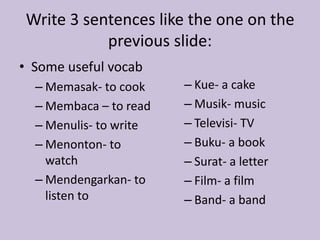
Write 3 sentences like the one on the 
previous slide: 
• Some useful vocab 
– Memasak- to cook 
– Membaca – to read 
– Menulis- to write 
– Menonton- to 
watch 
– Mendengarkan- to 
listen to 
– Kue- a cake 
– Musik- music 
– Televisi- TV 
– Buku- a book 
– Surat- a letter 
– Film- a film 
– Band- a band
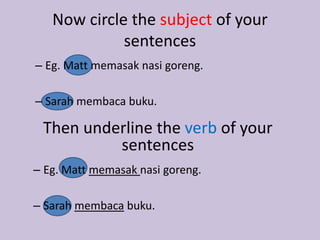
Now circle the subject of your 
sentences 
– Eg. Matt memasak nasi goreng. 
– Sarah membaca buku. 
Then underline the verb of your 
sentences 
– Eg. Matt memasak nasi goreng. 
– Sarah membaca buku.
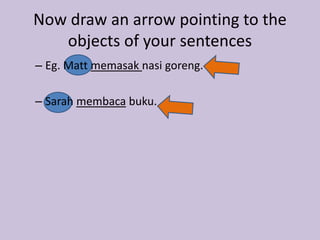
Now draw an arrow pointing to the 
objects of your sentences 
– Eg. Matt memasak nasi goreng. 
– Sarah membaca buku.
Subject focus 
• When the subject of your 
sentence is at the front, this is 
known as a subject focus 
sentence. It can also be called 
an active sentence.
Object focus 
• When the object of your 
sentence is at the front, this is 
known as a object focus 
sentence. It can also be called 
an passive sentence.
Practise writing 3 ENGLISH PASSIVE 
sentences 
• E.g. The fried rice was cooked by 
Matt. 
• E.g. The film was watched by Alison.
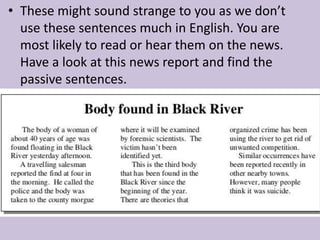
• These might sound strange to you as we don’t 
use these sentences much in English. You are 
most likely to read or hear them on the news. 
Have a look at this news report and find the 
passive sentences.
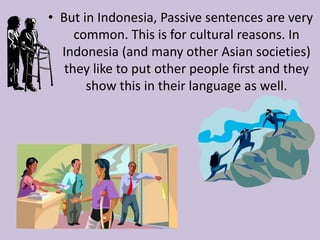
• But in Indonesia, Passive sentences are very 
common. This is for cultural reasons. In 
Indonesia (and many other Asian societies) 
they like to put other people first and they 
show this in their language as well.
Making passive sentences from 
active ones in Indonesian: 
• Remember our first sentence? 
• Siti membaca koran. (Siti reads the newspaper.) 
• Siti=subject membaca=verb and koran=object 
• Is this an ACTIVE or PASSIVE sentence? How 
do you know? 
• To change this sentence (for THIRD PERSON) 
we need to do the following steps:
• 1. Write the object first (and if there is anything 
describing the object keep that as well) 
• E.g. Koran 
• 2. Think of the verb and work out what the base word is, 
e.g. membaca- base word =baca 
• Take the base word and put the letters di on the front 
of it 
• E.g. Koran dibaca 
• 3. Write the subject. 
• E.g. Koran dibaca Siti. 
• *if it makes more sense to you, you can also write the word 
‘oleh’ (by) in front of the subject 
• E.g. Koran dibaca oleh Siti (the newspaper was read BY Siti.
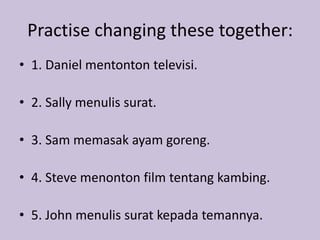
Practise changing these together: 
• 1. Daniel mentonton televisi. 
• 2. Sally menulis surat. 
• 3. Sam memasak ayam goreng. 
• 4. Steve menonton film tentang kambing. 
• 5. John menulis surat kepada temannya.
Now go back to your 
first 3 sentences and 
change them to 
PASSIVE structure.

Indonesian Active vs passive sentences

  • 1.
    Active vs Passive sentences Year 9 Indo Term 3
  • 2.
    Basic verb sentence • A basic sentence in Indonesian looks like this: – Siti membaca koran. (Siti reads the newspaper.) In this sentence who is doing the action? What is the action? Who or What is the action being done to? The ‘do-er’ is the SUBJECT of the sentence The action is the VERB The thing the verb is being done to it the OBJECT
  • 3.
    Write 3 sentenceslike the one on the previous slide: • Some useful vocab – Memasak- to cook – Membaca – to read – Menulis- to write – Menonton- to watch – Mendengarkan- to listen to – Kue- a cake – Musik- music – Televisi- TV – Buku- a book – Surat- a letter – Film- a film – Band- a band
  • 4.
    Now circle thesubject of your sentences – Eg. Matt memasak nasi goreng. – Sarah membaca buku. Then underline the verb of your sentences – Eg. Matt memasak nasi goreng. – Sarah membaca buku.
  • 5.
    Now draw anarrow pointing to the objects of your sentences – Eg. Matt memasak nasi goreng. – Sarah membaca buku.
  • 6.
    Subject focus •When the subject of your sentence is at the front, this is known as a subject focus sentence. It can also be called an active sentence.
  • 7.
    Object focus •When the object of your sentence is at the front, this is known as a object focus sentence. It can also be called an passive sentence.
  • 8.
    Practise writing 3ENGLISH PASSIVE sentences • E.g. The fried rice was cooked by Matt. • E.g. The film was watched by Alison.
  • 9.
    • These mightsound strange to you as we don’t use these sentences much in English. You are most likely to read or hear them on the news. Have a look at this news report and find the passive sentences.
  • 10.
    • But inIndonesia, Passive sentences are very common. This is for cultural reasons. In Indonesia (and many other Asian societies) they like to put other people first and they show this in their language as well.
  • 11.
    Making passive sentencesfrom active ones in Indonesian: • Remember our first sentence? • Siti membaca koran. (Siti reads the newspaper.) • Siti=subject membaca=verb and koran=object • Is this an ACTIVE or PASSIVE sentence? How do you know? • To change this sentence (for THIRD PERSON) we need to do the following steps:
  • 12.
    • 1. Writethe object first (and if there is anything describing the object keep that as well) • E.g. Koran • 2. Think of the verb and work out what the base word is, e.g. membaca- base word =baca • Take the base word and put the letters di on the front of it • E.g. Koran dibaca • 3. Write the subject. • E.g. Koran dibaca Siti. • *if it makes more sense to you, you can also write the word ‘oleh’ (by) in front of the subject • E.g. Koran dibaca oleh Siti (the newspaper was read BY Siti.
  • 13.
    Practise changing thesetogether: • 1. Daniel mentonton televisi. • 2. Sally menulis surat. • 3. Sam memasak ayam goreng. • 4. Steve menonton film tentang kambing. • 5. John menulis surat kepada temannya.
  • 14.
    Now go backto your first 3 sentences and change them to PASSIVE structure.