Download to read offline

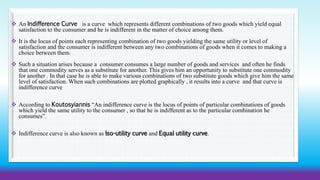
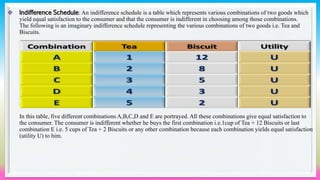
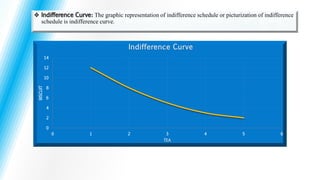
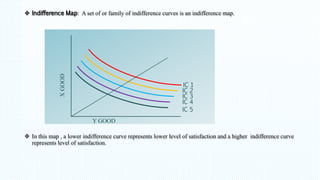
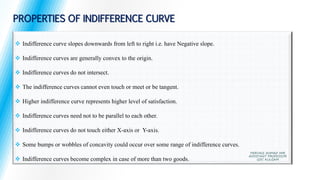

An indifference curve represents combinations of two goods that provide equal satisfaction to a consumer, making them indifferent between choices. It is a locus of points where the consumer is indifferent between combinations that yield the same utility. Indifference curves have negative slopes and are convex, with higher curves representing greater satisfaction. They do not intersect or touch each other, the axes, or have parallel curves. Indifference schedules in tables and indifference maps with multiple curves represent preferences graphically.


