Indifference Curve Analysis
HARSHITH
Introduction
geometrical
•Indifference curve analysis is a new
way to analyse consumer’s
behaviour.
•This approach was propounded by Hicks & Allen.
• It measures utility ordinally.
•It explains consumer behaviour in terms of his
preferences or rankings for different combinations
of two goods, say X and Y.
•An indifference Curve is drawn on the from the
indifferent schedule of the consumer.
Indifference schedule
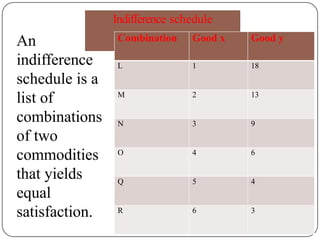
An
indifference
schedule is a
list of
combinations
of two
commodities
that yields
equal
satisfaction.
Combination Good x Good y
L 1 18
M 2 13
N 3 9
O 4 6
Q 5 4
R 6 3
Indifference
Curve
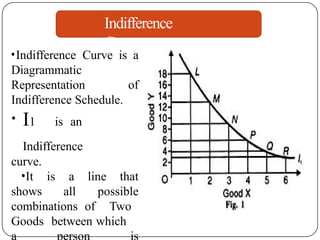
•Indifference Curve is a
Diagrammatic
Representation of
Indifference Schedule.
• I1 is an
Indifference
curve.
•It is a line that
shows all possible
combinations of Two
Goods between which
Assumptions of Indifference
Curve
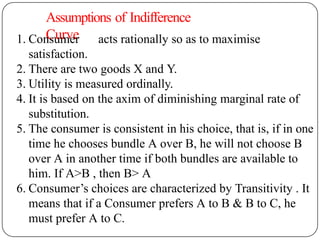
1. Consumer acts rationally so as to maximise
satisfaction.
2. There are two goods X and Y.
3. Utility is measured ordinally.
4. It is based on the axim of diminishing marginal rate of
substitution.
5. The consumer is consistent in his choice, that is, if in one
time he chooses bundle A over B, he will not choose B
over A in another time if both bundles are available to
him. If A>B , then B> A
6. Consumer’s choices are characterized by Transitivity . It
means that if a Consumer prefers A to B & B to C, he
must prefer A to C.
Properties of Indifference
Curve
1. An Indifference Curve has a negative slope. It
denotes that if the quantity of one commodity
(y) decreases, the quantity of the other
(X) increases, if the consumer is to stay on the
same level of satisfaction. If the quantity of
good X is increased in the combination, while
the quantity of good Y remains
unchanged, the new combination will be
preferable to the original one and the two
combinations will not therefore lie on the same
indifference curve provided more of a
commodity gives more satisfaction.
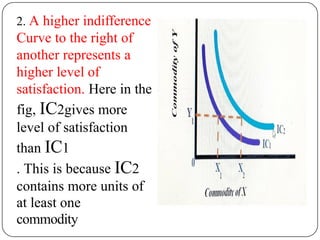
2. A higher indifference
Curve to the right of
another represents a
higher level of
satisfaction. Here in the
fig, IC2gives more
level of satisfaction
than IC1
. This is because IC2
contains more units of
at least one
commodity
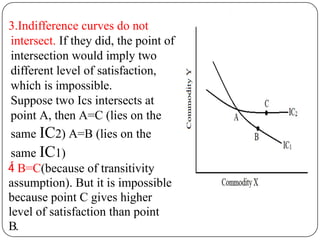
3.Indifference curves do not
intersect. If they did, the point of
intersection would imply two
different level of satisfaction,
which is impossible.
Suppose two Ics intersects at
point A, then A=C (lies on the
same IC2) A=B (lies on the
same IC1)
 B=C(because of transitivity
assumption). But it is impossible
because point C gives higher
level of satisfaction than point
B.
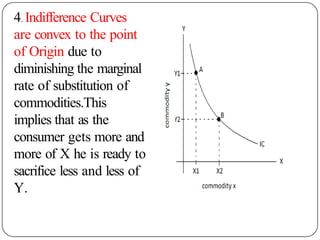
4. Indifference Curves
are convex to the point
of Origin due to
diminishing the marginal
rate of substitution of
commodities.This
implies that as the
consumer gets more and
more of X he is ready to
sacrifice less and less of
Y.
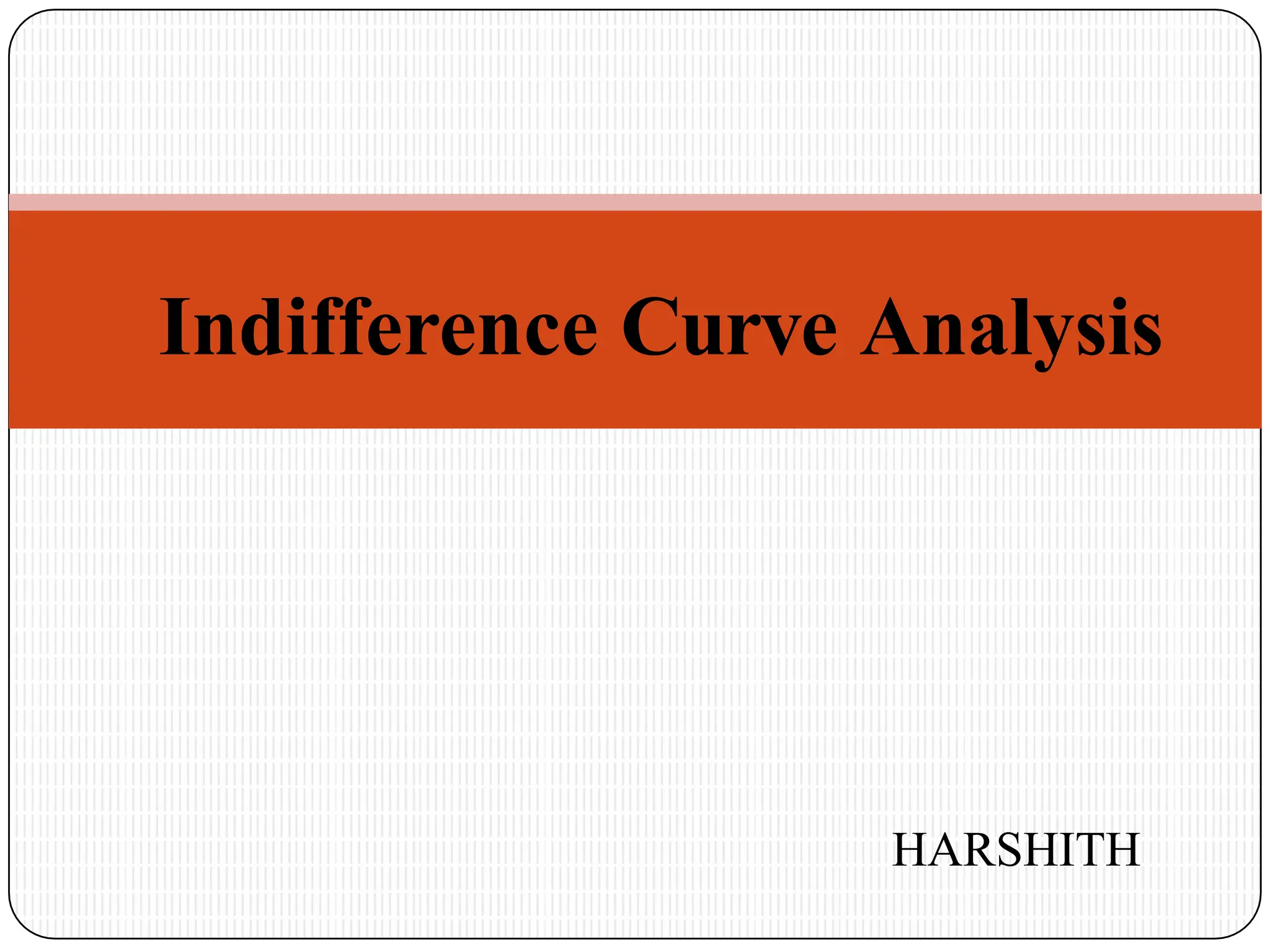
5.
Indifference
curves are not
necessarily
parallel to each
other. This is
because MRS may
differ for
different indifference
curves. If MRS differs
the slope of
indifference curves
also differs.
indifference-curve-analysis and properties.pptx

indifference-curve-analysis and properties.pptx

  • 1.
  • 2.
    Introduction geometrical •Indifference curve analysisis a new way to analyse consumer’s behaviour. •This approach was propounded by Hicks & Allen. • It measures utility ordinally. •It explains consumer behaviour in terms of his preferences or rankings for different combinations of two goods, say X and Y. •An indifference Curve is drawn on the from the indifferent schedule of the consumer.
  • 3.
    Indifference schedule An indifference schedule isa list of combinations of two commodities that yields equal satisfaction. Combination Good x Good y L 1 18 M 2 13 N 3 9 O 4 6 Q 5 4 R 6 3
  • 4.
    Indifference Curve •Indifference Curve isa Diagrammatic Representation of Indifference Schedule. • I1 is an Indifference curve. •It is a line that shows all possible combinations of Two Goods between which
  • 5.
    Assumptions of Indifference Curve 1.Consumer acts rationally so as to maximise satisfaction. 2. There are two goods X and Y. 3. Utility is measured ordinally. 4. It is based on the axim of diminishing marginal rate of substitution. 5. The consumer is consistent in his choice, that is, if in one time he chooses bundle A over B, he will not choose B over A in another time if both bundles are available to him. If A>B , then B> A 6. Consumer’s choices are characterized by Transitivity . It means that if a Consumer prefers A to B & B to C, he must prefer A to C.
  • 6.
    Properties of Indifference Curve 1.An Indifference Curve has a negative slope. It denotes that if the quantity of one commodity (y) decreases, the quantity of the other (X) increases, if the consumer is to stay on the same level of satisfaction. If the quantity of good X is increased in the combination, while the quantity of good Y remains unchanged, the new combination will be preferable to the original one and the two combinations will not therefore lie on the same indifference curve provided more of a commodity gives more satisfaction.
  • 7.
    2. A higherindifference Curve to the right of another represents a higher level of satisfaction. Here in the fig, IC2gives more level of satisfaction than IC1 . This is because IC2 contains more units of at least one commodity
  • 8.
    3.Indifference curves donot intersect. If they did, the point of intersection would imply two different level of satisfaction, which is impossible. Suppose two Ics intersects at point A, then A=C (lies on the same IC2) A=B (lies on the same IC1)  B=C(because of transitivity assumption). But it is impossible because point C gives higher level of satisfaction than point B.
  • 9.
    4. Indifference Curves areconvex to the point of Origin due to diminishing the marginal rate of substitution of commodities.This implies that as the consumer gets more and more of X he is ready to sacrifice less and less of Y.
  • 10.
    5. Indifference curves are not necessarily parallelto each other. This is because MRS may differ for different indifference curves. If MRS differs the slope of indifference curves also differs.