➢A society, or a human society, is a group of people 
involved with each other through persistent relations, 
or a large social grouping sharing the same 
geographical or social territory, typically subject to 
the same political authority and dominant cultural 
expectations. 
➢Human societies are characterized by patterns of 
relationships (social relations) between individuals 
who share a distinctive culture and institutions; a 
given society may be described as the sum total of 
such relationships among its constituent members. 
In the social sciences, a larger society often evinces 
stratification and/ordominance patterns in subgroups.
➢More broadly, a society may be illustrated as an economic, 
social, or industrial infrastructure, made up of a varied 
collection of individuals. Members of a society may be from 
different ethnic groups. 
➢A society can be a particular ethnic group, such as the 
Saxons; a nation state, such as Bhutan; or a broader cultural 
group, such as a Western society. The word society may also 
refer to an organizedvoluntary association of people for 
religious, benevolent, cultural, scientific, political, patriotic, or 
other purposes. 
➢A "society" may even, though more by means of metaphor, 
refer to a social organism such as an ant colony or any 
cooperative aggregate such as, for example, in 
some formulations of artificial intelligence.
Etymology and usage
➢The term "society" came from the Latin word societas, which in turn 
was derived from the noun socius ("comrade, friend, ally"; adjectival 
form socialis) used to describe a bond or interaction between parties 
that are friendly, or at least civil.
➢ Without an article, the term can refer to the entirety of humanity 
(also: "society in general", "society at large", etc.), although those who 
are unfriendly or uncivil to the remainder of society in this sense may 
be deemed to be "antisocial".
➢ Adam Smith wrote that a society "may subsist among different men, 
as among different merchants, from a sense of its utility without any 
mutual love or affection, if only they refrain from doing injury to each 
other.
➢Used in the sense of an association, a society is a body of individuals 
outlined by the bounds of functional interdependence, possibly 
comprising characteristics such as national or cultural identity, 
social solidarity, language, or hierarchical structure.
Conceptions
➢Society, in general, addresses the fact that an individual has rather
limited means as an autonomous unit.
➢The great apes have always been more (Bonobo, Homo, Pan) or less (
Gorilla, Pongo) social animals, so Robinson Crusoe-like situations are
either fictions or unusualcorner cases to the ubiquity of social context
for humans, who fall between presocial and eusocial in the spectrum
of animal ethology.
➢Human societies are most often organized according to their primary
means of subsistence. Social scientists have identified hunter-gatherer
societies, nomadic pastoral societies, horticulturalist or simple farming
societies, and intensive agricultural societies, also calledcivilizations.
➢Some consider industrial and post-industrial societies to be
qualitatively different from traditional agricultural societies.
➔In political science
➢Societies may also be structured politically. In order of
increasing size and complexity, there are bands, tribes,
chiefdoms, and statesocieties.
➢These structures may have varying degrees of
political power, depending on the cultural, geographical,
and historicalenvironments that these societies must
contend with.
➢ A society that is unable to offer an effective response to
other societies it competes with will usually be subsumed
into the culture of the competing society.
➔In sociology
Gerhard Lenski differentiates societies based on
their level of technology, communication, and
economy:
1) hunters and gatherers,
2) simple agricultural,
3) advanced agricultural,
4) industrial, and
5) special (e.g. fishing societies or maritime
societies).
➢This is similar to the system earlier developed by
anthropologists Morton H. Fried, a conflict theorist, and
Elman Service, an integration theorist, who have produced
a system of classification for societies in all human cultures
based on the evolution of social inequality and the role of
the state.
➢This system of classification contains four categories:
✔ Hunter-gatherer bands (categorization of duties and
responsibilities).
✔ Tribal societies in which there are some limited
instances of social rank and prestige
✔ Stratified structures led by chieftains.
✔ Civilizations, with complex social hierarchies and
organized, institutional governments.
TYPES
OF
SOCIETY
➔Pre-industrial
➢In a pre-industrial society, food production, which is
carried out through the use of human and animal
labor, is the main economic activity.
➢These societies can be subdivided according to
their level of technology and their method of
producing food.
➢These subdivisions are hunting and gathering,
pastoral, horticultural, agricultural, and feudal.
Hunting and gathering
➢The main form of food production in such societies is the daily collection
of wild plants and the hunting of wild animals. Hunter-gatherers move
around constantly in search of food. As a result, they do not build
permanent villages or create a wide variety of artifacts, and usually only
form small groups such as bands and tribes.
➢However, some hunting and gathering societies in areas with abundant
resources (such as the Tlingit) lived in larger groups and formed complex
hierarchical social structures such as chiefdoms. The need for mobility
also limits the size of these societies. They generally consist of fewer
than 60 people and rarely exceed 100. Statuses within the tribe are
relatively equal, and decisions are reached through general agreement.
The ties that bind the tribe are more complex than those of the bands
➢.Leadership is personal—charismatic—and used for special purposes
only in tribal society. There are no political offices containing real power,
and a chief is merely a person of influence, a sort of adviser; therefore,
tribal consolidations for collective action are not governmental.
➢The family forms the main social unit, with most societal members being
related by birth or marriage. This type of organization requires the family
to carry out most social functions, including production and education.
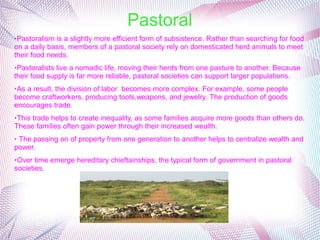
Pastoral
➢Pastoralism is a slightly more efficient form of subsistence. Rather than searching for food
on a daily basis, members of a pastoral society rely on domesticated herd animals to meet
their food needs.
➢Pastoralists live a nomadic life, moving their herds from one pasture to another. Because
their food supply is far more reliable, pastoral societies can support larger populations.
➢As a result, the division of labor becomes more complex. For example, some people
become craftworkers, producing tools,weapons, and jewelry. The production of goods
encourages trade.
➢This trade helps to create inequality, as some families acquire more goods than others do.
These families often gain power through their increased wealth.
➢ The passing on of property from one generation to another helps to centralize wealth and
power.
➢Over time emerge hereditary chieftainships, the typical form of government in pastoral
societies.
Horticultural
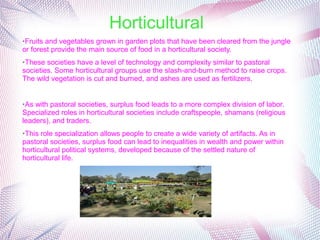
➢Fruits and vegetables grown in garden plots that have been cleared from the jungle
or forest provide the main source of food in a horticultural society.
➢These societies have a level of technology and complexity similar to pastoral
societies. Some horticultural groups use the slash-and-burn method to raise crops.
The wild vegetation is cut and burned, and ashes are used as fertilizers.
➢As with pastoral societies, surplus food leads to a more complex division of labor.
Specialized roles in horticultural societies include craftspeople, shamans (religious
leaders), and traders.
➢This role specialization allows people to create a wide variety of artifacts. As in
pastoral societies, surplus food can lead to inequalities in wealth and power within
horticultural political systems, developed because of the settled nature of
horticultural life.
Agrarian
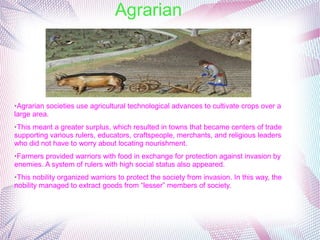
➢Agrarian societies use agricultural technological advances to cultivate crops over a
large area.
➢This meant a greater surplus, which resulted in towns that became centers of trade
supporting various rulers, educators, craftspeople, merchants, and religious leaders
who did not have to worry about locating nourishment.
➢Farmers provided warriors with food in exchange for protection against invasion by
enemies. A system of rulers with high social status also appeared.
➢This nobility organized warriors to protect the society from invasion. In this way, the
nobility managed to extract goods from “lesser” members of society.
Feudal
➢Feudalism was a form of society based on ownership of land. 
Unlike today's farmers, vassals under feudalism were bound 
to cultivating their lord's land. 
➢In exchange for military protection, the lords exploited the 
peasants into providing food, crops, crafts, homage, and other 
services to the landowner. 
➢The estates of the realm system of feudalism was often 
multigenerational; the families of peasants may have 
cultivated their lord's land for generations.
Industrial
➢Between the 15th and 16th centuries, a new economic system emerged that 
began to replace feudalism.
➢Capitalism is marked by open competition in a free market, in which the means of 
production are privately owned. Europe's exploration of the Americas served as 
one impetus for the development of capitalism. The introduction of foreign metals, 
silks, and spices stimulated great commercial activity in European societies.
➢ndustrial societies rely heavily on machines powered by fuels for the production 
of goods. This produced further dramatic increases in efficiency. The increased 
efficiency of production of the industrial revolution produced an even greater 
surplus than before. 
➢Once again, the population boomed. Increased productivity made more goods 
available to everyone. However, inequality became even greater than before. 
➢The breakup of agricultural-based feudal societies caused many people to leave 
the land and seek employment in cities. This created a great surplus of labor and 
gave capitalists plenty of laborers who could be hired for extremely low wages.
➔Post-industrial
➢Post-industrial societies are societies dominated by information, 
services, and high technology more than the production of goods.
➢ Advanced industrial societies are now seeing a shift toward an 
increase in service sectors over manufacturing and production. 
➢The U.S. is the first country to have over half of its work force 
employed in service industries. 
➢Service industries include government, research, education, health, 
sales, law, banking, and so on. It is still too early to identify and 
understand all the ramifications this new kind of society will have for 
social life. 
➢In fact, even the phrase "postindustrial" belies the fact that we don't 
yet quite know what will follow industrial societies or the forms they 
will take.
Prepared by:
Wilma O. Nacional

society