Professor &
Lawyer. Puttu
Guru Prasad,
M.Com. M.B.A., L.L.B., M.Phil. PGDFTM. AP.SET., ICFAI TMF.,
(PhD) at JNTUK.
Senior Faculty for Management Studies,
S&H Department, VVIT, Nambur,
My Blog: puttuguru.blogspot.in 
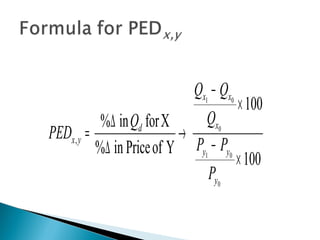
 Cross price elasticity (PEDx,y) measures the
responsiveness of demand for good X following
a change in the price of good Y.
 In effect we are measuring to which degree a
good is a substitute or complement
 PEDx,y describes the important distinction
between substitutes and complements
quantitatively.
100
100
YofPricein%
Xforin%
0
01
0
01
,
×
−
×
−
→
∆
∆
=
y
yy
x
xx
d
yx
P
PP
Q
QQ
Q
PED
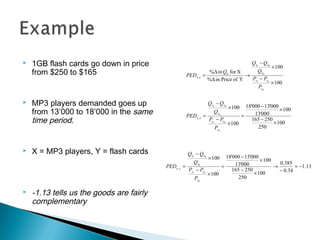
 1GB flash cards go down in price
from $250 to $165
 MP3 players demanded goes up
from 13’000 to 18’000 in the same
time period.
 X = MP3 players, Y = flash cards
 -1.13 tells us the goods are fairly
complementary
100
100
YofPricein%
Xforin%
0
01
0
01
,
×
−
×
−
→
∆
∆
=
y
yy
x
xx
d
yx
P
PP
Q
QQ
Q
PED
100
250
250165
100
000'13
000'13000'18
100
100
0
01
0
01
,
×
−
×
−
=
×
−
×
−
=
y
yy
x
xx
yx
P
PP
Q
QQ
PED
13.1
34.0
385.0
100
250
250165
100
000'13
000'13000'18
100
100
0
01
0
01
, −=
−
→
×
−
×
−
=
×
−
×
−
=
y
yy
x
xx
yx
P
PP
Q
QQ
PED
 Substitutes:
◦ With substitute goods such as brands of
razors, an increase in the price of one good
will lead to an increase in demand for the rival
product
◦ Cross price elasticity will be positive
◦ Weak substitutes – low PEDx,y
◦ Close substitutes – high PEDx,y
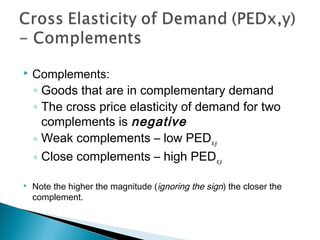
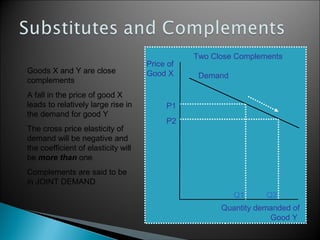
 Complements:
◦ Goods that are in complementary demand
◦ The cross price elasticity of demand for two
complements is negative
◦ Weak complements – low PEDx,y
◦ Close complements – high PEDx,y
 Note the higher the magnitude (ignoring the sign) the closer the
complement.
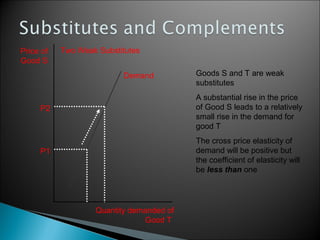
Price of
Good S
Quantity demanded of
Good T
Demand
Two Weak Substitutes
P1
P2
Goods S and T are weak
substitutes
A substantial rise in the price
of Good S leads to a relatively
small rise in the demand for
good T
The cross price elasticity of
demand will be positive but
the coefficient of elasticity will
be less than one
Price of
Good X
Quantity demanded of
Good Y
Demand
Two Close Complements
P2
P1
Goods X and Y are close
complements
A fall in the price of good X
leads to relatively large rise in
the demand for good Y
The cross price elasticity of
demand will be negative and
the coefficient of elasticity will
be more than one
Complements are said to be
in JOINT DEMAND
Q1 Q2
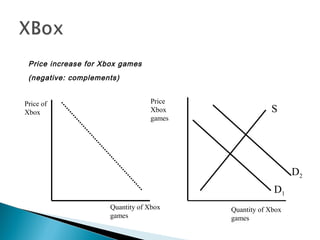
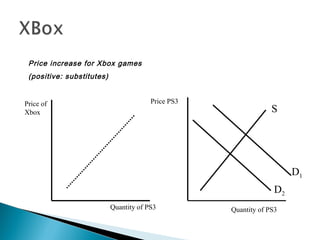
 Given that the price of Xbox 360®
decreases due to a technological advance
(lower productivity costs) what will happen
to the demand for games for Xbox®
and
Playstation 3®
consoles?
 Can you analyse the situation
economically, drawing XED diagrams and
supply/ demand diagrams to illustrate your
conclusions?
Price increase for Xbox games
(negative: complements)
Price of
Xbox
Quantity of Xbox
games
Quantity of Xbox
games
Price
Xbox
games
S
D2
D1
Price increase for Xbox games
(positive: substitutes)
Price of
Xbox
Quantity of PS3 Quantity of PS3
Price PS3
S
D1
D2
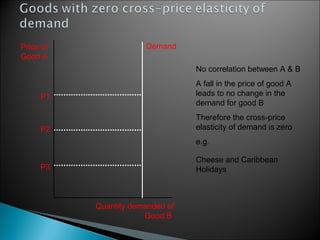
Price of
Good A
Quantity demanded of
Good B
Demand
P1
P2
P3
No correlation between A & B
A fall in the price of good A
leads to no change in the
demand for good B
Therefore the cross-price
elasticity of demand is zero
e.g.
Cheese and Caribbean
Holidays
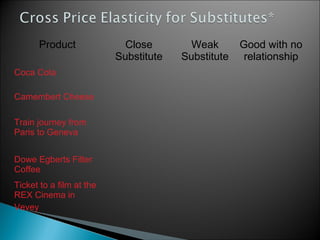
Product Close
Substitute
Weak
Substitute
Good with no
relationship
Coca Cola
Camembert Cheese
Train journey from
Paris to Geneva
Dowe Egberts Filter
Coffee
Ticket to a film at the
REX Cinema in
Vevey
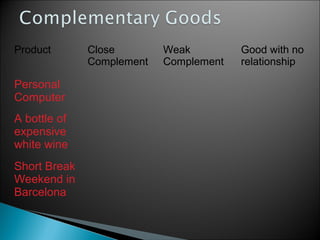
Product Close
Complement
Weak
Complement
Good with no
relationship
Personal
Computer
A bottle of
expensive
white wine
Short Break
Weekend in
Barcelona
 Pricing strategies for substitutes:
 Consider for example the cross-price effect that has occurred with the rapid
expansion of low-cost airlines in the European airline industry.
 Pricing strategies for complementary goods:
 For example, popcorn, soft drinks and cinema tickets have a high negative
value for cross price elasticity– they are strong complements.
 Advertising and marketing:
 In highly competitive markets between brand names carry substantial
value, many businesses spend huge amounts of money every year on
persuasive advertising and marketing.
 Pricing strategies for substitutes: If a competitor cuts the
price of a rival product, firms use estimates of cross-
price elasticity to predict the effect on the quantity
demanded and total revenue of their own product.
 For example, two or more airlines competing with each
other on a given route will have to consider how one
airline might react to its competitor’s price change. Will
many consumers switch? Will they have the capacity to
meet an expected rise in demand? Will the other firm
match a price rise? Will it follow a price fall?
 Consider for example the cross-price effect that
has occurred with the rapid expansion of low-
cost airlines in the European airline industry.
 This has been a major challenge to the existing
and well-established national air carriers, many
of whom have made adjustments to their
business model and pricing strategies to cope
with the increased competition.
 Pricing strategies for complementary goods: For
example, popcorn, soft drinks and cinema
tickets have a high negative value for cross
price elasticity– they are strong complements.
Popcorn has a high mark up i.e. pop corn costs
pennies to make but sells for more than a
pound.
 If firms have a reliable estimate for PEDx,y they
can estimate the effect, say, of a two-for-one
cinema ticket offer on the demand for popcorn.
The additional profit from extra popcorn sales
may more than compensate for the lower cost of
entry into the cinema.
 Advertising and marketing: In highly competitive markets
where brand names carry substantial value, many businesses
spend huge amounts of money every year on persuasive
advertising and marketing. There are many aims behind this,
including attempting to shift out the demand curve for a
product (or product range) and also build consumer loyalty to
a brand.
 When consumers become habitual purchasers of a product,
the cross price elasticity of demand against rival products will
decrease. This reduces the size of the substitution effect
following a price change and makes demand less sensitive to
price. The result is that firms may be able to charge a higher
price, increase their total revenue and turn consumer surplus
into higher profit.
Prof & Lawyer. Puttu GuruProf & Lawyer. Puttu Guru
Prasad,Prasad,
M.Com. M.B.A., L.L.B., M.Phil. PGDFTM. AP.SET., ICFAI TMF., (PhD) atM.Com. M.B.A., L.L.B., M.Phil. PGDFTM. AP.SET., ICFAI TMF., (PhD) at
JNTUK.JNTUK.
Senior Faculty for Management
Studies,
S&H Department, VVIT,
Nambur,
My Blog: puttuguru.blogspot.in 

Cross price elasticity gp

  • 1.
    Professor & Lawyer. Puttu Guru Prasad, M.Com.M.B.A., L.L.B., M.Phil. PGDFTM. AP.SET., ICFAI TMF., (PhD) at JNTUK. Senior Faculty for Management Studies, S&H Department, VVIT, Nambur, My Blog: puttuguru.blogspot.in 
  • 2.
     Cross priceelasticity (PEDx,y) measures the responsiveness of demand for good X following a change in the price of good Y.  In effect we are measuring to which degree a good is a substitute or complement  PEDx,y describes the important distinction between substitutes and complements quantitatively.
  • 3.
  • 4.
     1GB flashcards go down in price from $250 to $165  MP3 players demanded goes up from 13’000 to 18’000 in the same time period.  X = MP3 players, Y = flash cards  -1.13 tells us the goods are fairly complementary 100 100 YofPricein% Xforin% 0 01 0 01 , × − × − → ∆ ∆ = y yy x xx d yx P PP Q QQ Q PED 100 250 250165 100 000'13 000'13000'18 100 100 0 01 0 01 , × − × − = × − × − = y yy x xx yx P PP Q QQ PED 13.1 34.0 385.0 100 250 250165 100 000'13 000'13000'18 100 100 0 01 0 01 , −= − → × − × − = × − × − = y yy x xx yx P PP Q QQ PED
  • 5.
     Substitutes: ◦ Withsubstitute goods such as brands of razors, an increase in the price of one good will lead to an increase in demand for the rival product ◦ Cross price elasticity will be positive ◦ Weak substitutes – low PEDx,y ◦ Close substitutes – high PEDx,y
  • 6.
     Complements: ◦ Goodsthat are in complementary demand ◦ The cross price elasticity of demand for two complements is negative ◦ Weak complements – low PEDx,y ◦ Close complements – high PEDx,y  Note the higher the magnitude (ignoring the sign) the closer the complement.
  • 7.
    Price of Good S Quantitydemanded of Good T Demand Two Weak Substitutes P1 P2 Goods S and T are weak substitutes A substantial rise in the price of Good S leads to a relatively small rise in the demand for good T The cross price elasticity of demand will be positive but the coefficient of elasticity will be less than one
  • 8.
    Price of Good X Quantitydemanded of Good Y Demand Two Close Complements P2 P1 Goods X and Y are close complements A fall in the price of good X leads to relatively large rise in the demand for good Y The cross price elasticity of demand will be negative and the coefficient of elasticity will be more than one Complements are said to be in JOINT DEMAND Q1 Q2
  • 9.
     Given thatthe price of Xbox 360® decreases due to a technological advance (lower productivity costs) what will happen to the demand for games for Xbox® and Playstation 3® consoles?  Can you analyse the situation economically, drawing XED diagrams and supply/ demand diagrams to illustrate your conclusions?
  • 10.
    Price increase forXbox games (negative: complements) Price of Xbox Quantity of Xbox games Quantity of Xbox games Price Xbox games S D2 D1
  • 11.
    Price increase forXbox games (positive: substitutes) Price of Xbox Quantity of PS3 Quantity of PS3 Price PS3 S D1 D2
  • 12.
    Price of Good A Quantitydemanded of Good B Demand P1 P2 P3 No correlation between A & B A fall in the price of good A leads to no change in the demand for good B Therefore the cross-price elasticity of demand is zero e.g. Cheese and Caribbean Holidays
  • 13.
    Product Close Substitute Weak Substitute Good withno relationship Coca Cola Camembert Cheese Train journey from Paris to Geneva Dowe Egberts Filter Coffee Ticket to a film at the REX Cinema in Vevey
  • 14.
    Product Close Complement Weak Complement Good withno relationship Personal Computer A bottle of expensive white wine Short Break Weekend in Barcelona
  • 15.
     Pricing strategiesfor substitutes:  Consider for example the cross-price effect that has occurred with the rapid expansion of low-cost airlines in the European airline industry.  Pricing strategies for complementary goods:  For example, popcorn, soft drinks and cinema tickets have a high negative value for cross price elasticity– they are strong complements.  Advertising and marketing:  In highly competitive markets between brand names carry substantial value, many businesses spend huge amounts of money every year on persuasive advertising and marketing.
  • 16.
     Pricing strategiesfor substitutes: If a competitor cuts the price of a rival product, firms use estimates of cross- price elasticity to predict the effect on the quantity demanded and total revenue of their own product.  For example, two or more airlines competing with each other on a given route will have to consider how one airline might react to its competitor’s price change. Will many consumers switch? Will they have the capacity to meet an expected rise in demand? Will the other firm match a price rise? Will it follow a price fall?
  • 17.
     Consider forexample the cross-price effect that has occurred with the rapid expansion of low- cost airlines in the European airline industry.  This has been a major challenge to the existing and well-established national air carriers, many of whom have made adjustments to their business model and pricing strategies to cope with the increased competition.
  • 18.
     Pricing strategiesfor complementary goods: For example, popcorn, soft drinks and cinema tickets have a high negative value for cross price elasticity– they are strong complements. Popcorn has a high mark up i.e. pop corn costs pennies to make but sells for more than a pound.  If firms have a reliable estimate for PEDx,y they can estimate the effect, say, of a two-for-one cinema ticket offer on the demand for popcorn. The additional profit from extra popcorn sales may more than compensate for the lower cost of entry into the cinema.
  • 19.
     Advertising andmarketing: In highly competitive markets where brand names carry substantial value, many businesses spend huge amounts of money every year on persuasive advertising and marketing. There are many aims behind this, including attempting to shift out the demand curve for a product (or product range) and also build consumer loyalty to a brand.  When consumers become habitual purchasers of a product, the cross price elasticity of demand against rival products will decrease. This reduces the size of the substitution effect following a price change and makes demand less sensitive to price. The result is that firms may be able to charge a higher price, increase their total revenue and turn consumer surplus into higher profit.

  • 20.
    Prof & Lawyer. PuttuGuruProf & Lawyer. Puttu Guru Prasad,Prasad, M.Com. M.B.A., L.L.B., M.Phil. PGDFTM. AP.SET., ICFAI TMF., (PhD) atM.Com. M.B.A., L.L.B., M.Phil. PGDFTM. AP.SET., ICFAI TMF., (PhD) at JNTUK.JNTUK. Senior Faculty for Management Studies, S&H Department, VVIT, Nambur, My Blog: puttuguru.blogspot.in