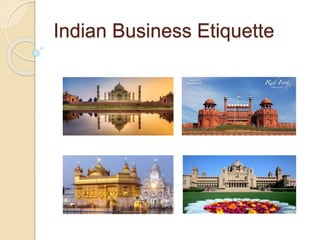
Indian Business Etiquette
India -Facts & statistics
India, officially the Republic of India
• 7th largest country in the world by land area
• 2nd most populous, with a population of over 1.2 billion people.
The Capital: New Delhi
Main Cities: Mumbai (Bombay), Kolkata (Calcutta), Chennai , Bangalore , Hyderabad
Population: 1.3 billion
Size: 3,287,263 sq km (1,269,346 sq miles)
Official Languages: Hindi, English
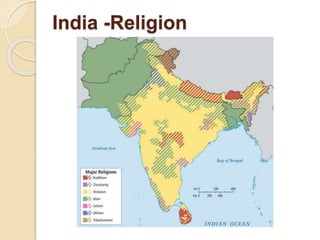
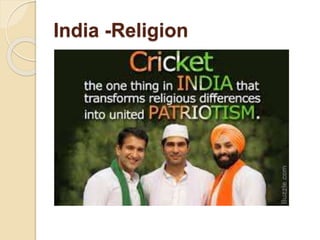
Religion: Hindu 74.33%
Muslim 14.20 %
Christian : 5.84%
Sikh :1.86%
Buddhist 1.86%
Others 2.30 %
India -Economy
 The Indian economy is one of the fastest growing in the world .
 The Indian economy is expected to grow at 7.2 per cent in FY 2017-18, as per the
forecast by International Monetary Fund (IMF).
 Indian labour force is estimated at 509.3 million
 60% are employed in agriculture or related industries
 India has established Special Economic Zones to encourage and support business
 India's long-term growth is considered moderately positive due to a young population
and corresponding low dependency ratio, healthy savings and investment rates
 GDP growth 5.7% (2017 Q2)
GDP $2.454
trillion
(nominal;
2017)
[3]
$9.489
trillion
(PPP;
2017)
[3]
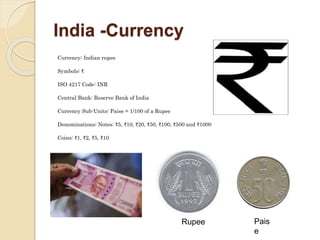
Currency: Indian rupee
Symbols: ₹
ISO 4217 Code: INR
Central Bank: Reserve Bank of India
Currency Sub-Units: Paise = 1/100 of a Rupee
Denominations: Notes: ₹5, ₹10, ₹20, ₹50, ₹100, ₹500 and ₹1000
Coins: ₹1, ₹2, ₹5, ₹10
India -Currency
Rupee Pais
e
India -Religion
India -Religion
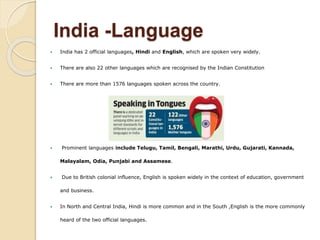
India -Language
 India has 2 official languages, Hindi and English, which are spoken very widely.
 There are also 22 other languages which are recognised by the Indian Constitution
 There are more than 1576 languages spoken across the country.
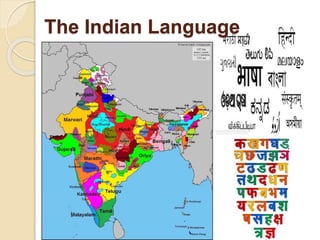
 Prominent languages include Telugu, Tamil, Bengali, Marathi, Urdu, Gujarati, Kannada,
Malayalam, Odia, Punjabi and Assamese.
 Due to British colonial influence, English is spoken widely in the context of education, government
and business.
 In North and Central India, Hindi is more common and in the South ,English is the more commonly
heard of the two official languages.
The Indian Language
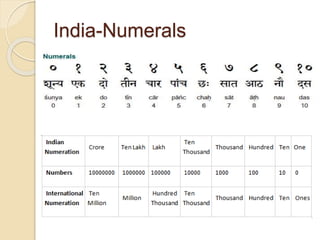
India-Numerals
Business Meetings
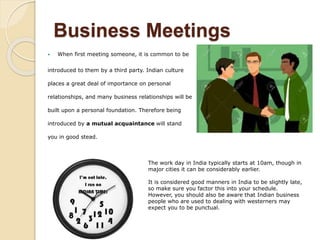
 When first meeting someone, it is common to be
introduced to them by a third party. Indian culture
places a great deal of importance on personal
relationships, and many business relationships will be
built upon a personal foundation. Therefore being
introduced by a mutual acquaintance will stand
you in good stead.
The work day in India typically starts at 10am, though in
major cities it can be considerably earlier.
It is considered good manners in India to be slightly late,
so make sure you factor this into your schedule.
However, you should also be aware that Indian business
people who are used to dealing with westerners may
expect you to be punctual.
Business Meetings
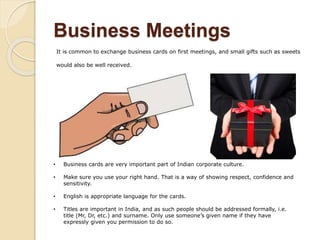
It is common to exchange business cards on first meetings, and small gifts such as sweets
would also be well received.
• Business cards are very important part of Indian corporate culture.
• Make sure you use your right hand. That is a way of showing respect, confidence and
sensitivity.
• English is appropriate language for the cards.
• Titles are important in India, and as such people should be addressed formally, i.e.
title (Mr, Dr, etc.) and surname. Only use someone’s given name if they have
expressly given you permission to do so.
Business Meetings - Greeting
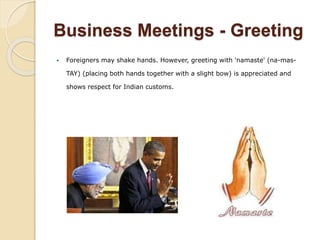
 Foreigners may shake hands. However, greeting with 'namaste' (na-mas-
TAY) (placing both hands together with a slight bow) is appreciated and
shows respect for Indian customs.
Business Meetings -
Handshakes
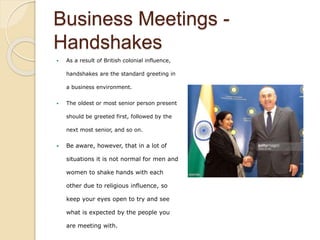
 As a result of British colonial influence,
handshakes are the standard greeting in
a business environment.
 The oldest or most senior person present
should be greeted first, followed by the
next most senior, and so on.
 Be aware, however, that in a lot of
situations it is not normal for men and
women to shake hands with each
other due to religious influence, so
keep your eyes open to try and see
what is expected by the people you
are meeting with.
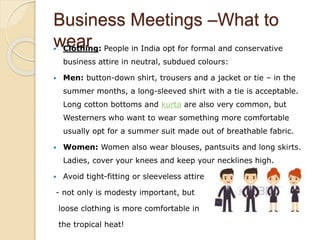
Business Meetings –What to
wear Clothing: People in India opt for formal and conservative
business attire in neutral, subdued colours:
 Men: button-down shirt, trousers and a jacket or tie – in the
summer months, a long-sleeved shirt with a tie is acceptable.
Long cotton bottoms and kurta are also very common, but
Westerners who want to wear something more comfortable
usually opt for a summer suit made out of breathable fabric.
 Women: Women also wear blouses, pantsuits and long skirts.
Ladies, cover your knees and keep your necklines high.
 Avoid tight-fitting or sleeveless attire
- not only is modesty important, but
loose clothing is more comfortable in
the tropical heat!
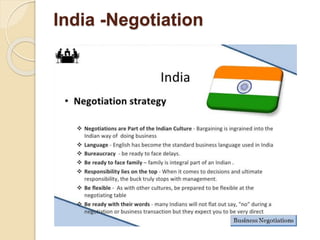
India -Negotiation
India -Business Dinners
 Sharing of food is good Indian manners, and it is common in
restaurants to order a number of dishes and share them all
between the
members of your party.
 However, never share cutlery
or drink from someone else’s
glass or take food from some
one’s personal plate, as this is considered very offensive.
 Social etiquette varies greatly across different areas.
 Be conscious of your hosts Dietary restrictions and if possible eat
the same as them or at least try to not eat foods that may find
offensive .
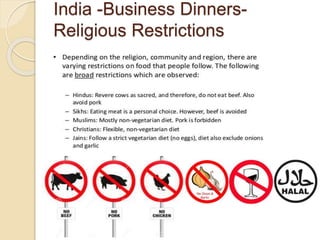
India -Business Dinners-
Religious Restrictions
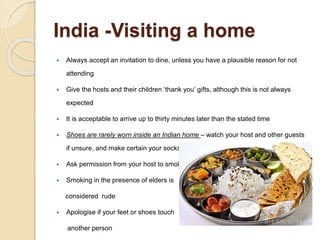
India -Visiting a home
 Always accept an invitation to dine, unless you have a plausible reason for not
attending
 Give the hosts and their children ‘thank you’ gifts, although this is not always
expected
 It is acceptable to arrive up to thirty minutes later than the stated time
 Shoes are rarely worn inside an Indian home – watch your host and other guests
if unsure, and make certain your socks are clean!
 Ask permission from your host to smoke.
 Smoking in the presence of elders is
considered rude
 Apologise if your feet or shoes touch
another person
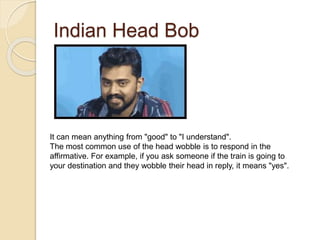
Indian Head Bob
It can mean anything from "good" to "I understand".
The most common use of the head wobble is to respond in the
affirmative. For example, if you ask someone if the train is going to
your destination and they wobble their head in reply, it means "yes".
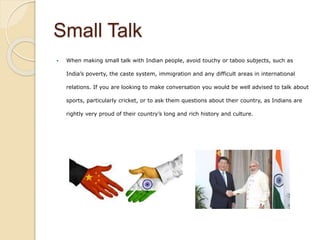
Small Talk
 When making small talk with Indian people, avoid touchy or taboo subjects, such as
India’s poverty, the caste system, immigration and any difficult areas in international
relations. If you are looking to make conversation you would be well advised to talk about
sports, particularly cricket, or to ask them questions about their country, as Indians are
rightly very proud of their country’s long and rich history and culture.
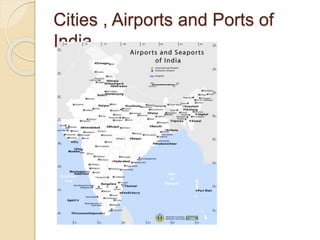
Cities , Airports and Ports of
India
Thanks
THE
END

Indian business etiquette

  • 1.
  • 2.
    India -Facts &statistics India, officially the Republic of India • 7th largest country in the world by land area • 2nd most populous, with a population of over 1.2 billion people. The Capital: New Delhi Main Cities: Mumbai (Bombay), Kolkata (Calcutta), Chennai , Bangalore , Hyderabad Population: 1.3 billion Size: 3,287,263 sq km (1,269,346 sq miles) Official Languages: Hindi, English Religion: Hindu 74.33% Muslim 14.20 % Christian : 5.84% Sikh :1.86% Buddhist 1.86% Others 2.30 %
  • 3.
    India -Economy  TheIndian economy is one of the fastest growing in the world .  The Indian economy is expected to grow at 7.2 per cent in FY 2017-18, as per the forecast by International Monetary Fund (IMF).  Indian labour force is estimated at 509.3 million  60% are employed in agriculture or related industries  India has established Special Economic Zones to encourage and support business  India's long-term growth is considered moderately positive due to a young population and corresponding low dependency ratio, healthy savings and investment rates  GDP growth 5.7% (2017 Q2) GDP $2.454 trillion (nominal; 2017) [3] $9.489 trillion (PPP; 2017) [3]
  • 4.
    Currency: Indian rupee Symbols:₹ ISO 4217 Code: INR Central Bank: Reserve Bank of India Currency Sub-Units: Paise = 1/100 of a Rupee Denominations: Notes: ₹5, ₹10, ₹20, ₹50, ₹100, ₹500 and ₹1000 Coins: ₹1, ₹2, ₹5, ₹10 India -Currency Rupee Pais e
  • 5.
  • 6.
  • 7.
    India -Language  Indiahas 2 official languages, Hindi and English, which are spoken very widely.  There are also 22 other languages which are recognised by the Indian Constitution  There are more than 1576 languages spoken across the country.  Prominent languages include Telugu, Tamil, Bengali, Marathi, Urdu, Gujarati, Kannada, Malayalam, Odia, Punjabi and Assamese.  Due to British colonial influence, English is spoken widely in the context of education, government and business.  In North and Central India, Hindi is more common and in the South ,English is the more commonly heard of the two official languages.
  • 8.
  • 9.
  • 10.
    Business Meetings  Whenfirst meeting someone, it is common to be introduced to them by a third party. Indian culture places a great deal of importance on personal relationships, and many business relationships will be built upon a personal foundation. Therefore being introduced by a mutual acquaintance will stand you in good stead. The work day in India typically starts at 10am, though in major cities it can be considerably earlier. It is considered good manners in India to be slightly late, so make sure you factor this into your schedule. However, you should also be aware that Indian business people who are used to dealing with westerners may expect you to be punctual.
  • 11.
    Business Meetings It iscommon to exchange business cards on first meetings, and small gifts such as sweets would also be well received. • Business cards are very important part of Indian corporate culture. • Make sure you use your right hand. That is a way of showing respect, confidence and sensitivity. • English is appropriate language for the cards. • Titles are important in India, and as such people should be addressed formally, i.e. title (Mr, Dr, etc.) and surname. Only use someone’s given name if they have expressly given you permission to do so.
  • 12.
    Business Meetings -Greeting  Foreigners may shake hands. However, greeting with 'namaste' (na-mas- TAY) (placing both hands together with a slight bow) is appreciated and shows respect for Indian customs.
  • 13.
    Business Meetings - Handshakes As a result of British colonial influence, handshakes are the standard greeting in a business environment.  The oldest or most senior person present should be greeted first, followed by the next most senior, and so on.  Be aware, however, that in a lot of situations it is not normal for men and women to shake hands with each other due to religious influence, so keep your eyes open to try and see what is expected by the people you are meeting with.
  • 14.
    Business Meetings –Whatto wear Clothing: People in India opt for formal and conservative business attire in neutral, subdued colours:  Men: button-down shirt, trousers and a jacket or tie – in the summer months, a long-sleeved shirt with a tie is acceptable. Long cotton bottoms and kurta are also very common, but Westerners who want to wear something more comfortable usually opt for a summer suit made out of breathable fabric.  Women: Women also wear blouses, pantsuits and long skirts. Ladies, cover your knees and keep your necklines high.  Avoid tight-fitting or sleeveless attire - not only is modesty important, but loose clothing is more comfortable in the tropical heat!
  • 15.
  • 16.
    India -Business Dinners Sharing of food is good Indian manners, and it is common in restaurants to order a number of dishes and share them all between the members of your party.  However, never share cutlery or drink from someone else’s glass or take food from some one’s personal plate, as this is considered very offensive.  Social etiquette varies greatly across different areas.  Be conscious of your hosts Dietary restrictions and if possible eat the same as them or at least try to not eat foods that may find offensive .
  • 17.
  • 18.
    India -Visiting ahome  Always accept an invitation to dine, unless you have a plausible reason for not attending  Give the hosts and their children ‘thank you’ gifts, although this is not always expected  It is acceptable to arrive up to thirty minutes later than the stated time  Shoes are rarely worn inside an Indian home – watch your host and other guests if unsure, and make certain your socks are clean!  Ask permission from your host to smoke.  Smoking in the presence of elders is considered rude  Apologise if your feet or shoes touch another person
  • 19.
    Indian Head Bob Itcan mean anything from "good" to "I understand". The most common use of the head wobble is to respond in the affirmative. For example, if you ask someone if the train is going to your destination and they wobble their head in reply, it means "yes".
  • 20.
    Small Talk  Whenmaking small talk with Indian people, avoid touchy or taboo subjects, such as India’s poverty, the caste system, immigration and any difficult areas in international relations. If you are looking to make conversation you would be well advised to talk about sports, particularly cricket, or to ask them questions about their country, as Indians are rightly very proud of their country’s long and rich history and culture.
  • 21.
    Cities , Airportsand Ports of India
  • 22.

Editor's Notes

  • #4 Tip: Add your own speaker notes here.
  • #5 Tip: Add your own speaker notes here.
  • #12 Tip: Add your own speaker notes here.