Indian Banking Industry
06 Aug, 2015
Particulars Page
1. Industry Overview 4-5
2.Indian Banking- Advances 7-8
3.Indian Banking - Deposits 9-10
4. Indian Banking- Investments 11
5. Indian Banking –NPA’s 12-13
6.Indian Banking-Operating Expenditure 14
7. Indian Banking-Net Profit Margin 15
8.Major Players in Indian Banking 16
9. Major Players – State Bank Of India 17
10. Major Players- ICICI Bank 18
11. Major Players- HSBC Bank 19
12.Sectorial Deployment of Credit 20
13. Financial Performance- SBI 21
14. Financial Performance –ICICI Bank 22
15.SWOT Analysis 23
16. Indian Banking- Government Initiatives 24-25
Table Of Contents
Table Of Contents
Particulars Page
17. Indian Banking – Future Outlook 26
18. Disclaimer 27
Indian Banking Industry- Overview
• Indian Banking Sector has grown at a healthy and steady pace.
• Indian Banking set to become fifth largest in the world by 2020 and third largest by the year 2025.
• Bank credits are expected to grow at 17% CAGR in medium term leading to increased credit penetration.
• The country's largest lender State Bank of India (SBI) is at the 38th position based on the size of assets, while India's largest private
sector lender ICICI Bank is at 99th position
• According to the World Bank, India has around 3.5 ATMs and less than seven bank branches per 100,000 people as compared with
OECD (Organisation for Economic Co-operation and Development), where there are nearly 30 branches and 90 ATMs per 100,000
people.
• In India, the universal banking model is followed. The general principle in this regard is that para-banking activities, such as credit
cards, primary dealer, leasing, hire purchase, factoring etc., can be conducted either inside the bank departmentally or outside the
bank through subsidiary/ joint venture /associate.
• Investment banking and insurance services are provided by the universal/foreign banks as an in-house departmental activity or
through subsidiary.
• The banking stability indicator suggests that overall risks to the banking sector remained unchanged during the first half of 2014-15.
• The Growth of Indian Banks have moderated after the FY14-15. Profitability declined on higher provisioning of accounts.
• The size of Interbank Market in relation to total banking sector is on a steady decline. However, Contagion analysis with the top five
most connected banks reveal that banking system could lose its potential Tier-1 Capital under the current liquidity condition.
Indian Banking Industry- Overview
Indian Banking Performance
Indian Banking Industry- Overview
Indian banking Industry reaches third by 2025
 The Business of Scheduled Commercial
Banks grew at a CAGR of 17% to INR 152,684
billion in 2013-14, from INR 70,641 billion
in 2008-09
 Public sector banks (PSBs) remained the
major growth driver, with a 77% share in
SCBs' total business as of 2013-14
 Working capital loans grew at a CAGR
of 22.6% from 2008-09 to 2013-14, while
term loans recorded a 13% CAGR
Snapshot
Indian Banking Industry - Overview
Banks in the year 2008-09
Banks in the year 2013-14
 The banking system in India is the most extensive. The total asset value of the entire banking sector in India is nearly US$
270 billion.
 State Banks control over 80% of the market leaving very little for other rivals.
 Presence of 46 commercial banks along with other foreign banks, rural and co-operative lenders.
 At the end of February, 13.7 crore accounts had been opened under Pradhanmantri Jan Dhan Yojna (PMJDY) and 12.2 crore
RuPay debit cards were issued. These new accounts have mobilised deposits of INR 12,694 crore (US$ 2.01 billion).
 India’s banking sector would improve to 12-13 per cent in FY16 from less than 10% in the second half of CY14
 According to researches carried out by the Reserve Bank of India (RBI), on an all India basis, 59 per cent of the adult
population in the country has bank accounts and 41 per cent don’t.
 In rural areas, the coverage of banks is 39 per cent, against 60 per cent in urban areas. There is only one bank for a
population of13000..
Indian Banking Industry - Overview
ADVANCES
• Advances of (SCBs) grew at a CAGR of
17.5% between 2008-09 and 2013-14.
(Image 1)
• . Advances of public sector
banks increased at a CAGR of 17.7%
between 2008-09 and 2013-14 to
INR 51,011 billion.(Image 2)
Indian Banking Industry – Banking Advances
Advances of SCB’sAdvances of Scheduled Commercial Banks
Advances of Public Sector Banks
Advances(Contd.)
• Advances by private sector banks grew
the most among all bank groups, at a
CAGR of 18.5% (Image 1)
• Total advances by foreign banks grew at
a CAGR of 12% to INR2,912 billion in
2013-14, from INR 1,654 billion in 2008-
09. During this period, working capital
loans registered a CAGR of 14%, while
term loans recorded a
CAGR of only 9%.(Image 2)
Indian Banking Industry – Banking Advances
Advances Of Private Sector Banks
Advances of Foreign Sector Banks
Deposits
• Scheduled commercial banks' deposits
grew at a CAGR of 16% between 2008-
09 and 2013-14.(Image 1)
• Public sector bank deposits grew at a
CAGR of 16% between 2008-09 and
2013-14 to INR 65,890 billion(Image 2)
Indian Banking Industry – Banking Deposits (1/2)
Deposits of Scheduled Commercial Banks
Deposits of Public Sector Banks
Deposits(Contd.)
• Private sector bank deposits grew at a
CAGR of 17% to INR 15,917 billion in
2013-14 from INR 7,364 billion in 2008-
09.
• Foreign banks generally cater to high net
worth individuals and NRIs. HSBC Bank,
Standard Chartered Bank, Citibank and
ABN AMRO Bank, are involved in retail
banking.
Indian Banking Industry – Banking Deposits (2/2)
Deposits of Private Sector Banks
Deposits of Foreign Banks
Investments
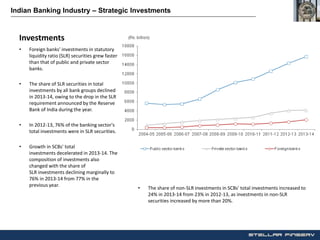
• Foreign banks' investments in statutory
liquidity ratio (SLR) securities grew faster
than that of public and private sector
banks.
• The share of SLR securities in total
investments by all bank groups declined
in 2013-14, owing to the drop in the SLR
requirement announced by the Reserve
Bank of India during the year.
• In 2012-13, 76% of the banking sector's
total investments were in SLR securities.
• Growth in SCBs' total
investments decelerated in 2013-14. The
composition of investments also
changed with the share of
SLR investments declining marginally to
76% in 2013-14 from 77% in the
previous year.
• The share of non-SLR investments in SCBs' total investments increased to
24% in 2013-14 from 23% in 2012-13, as investments in non-SLR
securities increased by more than 20%.
Indian Banking Industry – Strategic Investments
Non Performing Assets
In 2013-14, overall gross NPAs for the
industry increased by 30 bps y-o-y to 3.9%
due to the weak macroeconomic scenario,
sharp rise in interest rates and volatility in
the currency and commodity markets.
Below is performance of SCBs.
Indian Banking Industry – Non Performing Assets
NPAs (Contd.)
• The gross NPA ratio declined by about
172 bps y-o-y to 2.54%. In 2011-
12, 2012-13 and 2013-14, the gross NPA
ratio rose again marginally to 2.6%, 2.9%
and 4%, respectively.
• The share of foreign banks in gross advances of all SCBs
declined to 4% in 2013-14 from 6% in 2008-09. The share
of gross NPAs of foreign banks in the industry's gross
NPAs also declined to 4% from 5%.
Indian Banking Industry – Non Performing Assets
Indian Banking Industry – Operating Expenditure
Operating Expenditure
• In 2013-14, scheduled commercial
banks' (SCBs') employee costs increased
by 15% y-o-y against 12% growth in
2012-13.
• Employee costs as a percentage of operating
expenses for SCBs declined to 55% in 2013-14 from 56%
in 2012-13.
Indian Banking- NPM
Net Profitability Margin
• The SCBs' net profitability margin
declined to 1.76 per cent in 2013-14,
down from 1.91 per cent in 2012-
13. (Image 1)
• The NPM of foreign banks declined by 34
bps y-o-y to 3.49 per cent in 2013-
14. Spreads declined by 72 bps y-o-
y to 3.99 per cent in 2013-14. (Image 2)
Major Players in Indian Banking
SBI and Associates Nationalised Banks Foreign Banks
State Bank of India Allahabad Bank HSBC
State Bank of Bikaner and Jaipur Andhra Bank Citi Bank
State Bank of Hyderabad Bank of India Deustche Bank
State Bank of Travancore Central bank of India RBS
State Bank of Hyderabad IDBI Bank Credit Suisse AG
State Bank of Mysore Canara Bank
State Bank of Patiala HDFC Bank
Axis Bank
Punjab National Bank
Indian Banking Sector at a Glance
(Amount in ` Billion)
Sr. No Items
Amount Outstanding (As at
End-March)
Percentage Variation
2013 2014 2012-13 2013-14
1 Balance Sheet Operations
1.1
Total Liabilities/assets 95,900 1,09,635 15.2 14.3
1.2
Deposits 74,297 85,331 15.1 14.9
1.3
Borrowings 10,104 11,008 19.7 9.0
1.4
Loans and advances 58,798 67,352 15.9 14.5
1.5
Investments 26,131 28,829 17.0 10.3
1.6
Off-balance sheet exposure (as percentage of on-balance sheet liabilities) 138.3 122.0 - -
1.7
Total consolidated international claims 3,312 3,777 17.9 14.0
2 Profitability
2.1
Net profit 912 809 11.5 -11.3
2.2
Return on Asset (RoA) (Per cent) 1.04 0.81 - -
2.3
Return on Equity (RoE) (Per cent) 13.84 10.68 - -
2.4
Net Interest Margin (NIM) (Per cent) 2.6 2.5 - -
3
Capital Adequacy
3.1
Capital to risk weighted assets ratio (CRAR) @ 13.88 13.02 - -
3.2
Tier I capital (as percentage of total capital) @ 74.1 77.5 - -
3.3
CRAR (tier I) (Per cent) @ 10.29 10.09 - -
Asset Quality
Gross NPAs 1,941 2,642 35.8 36.1
Net NPAs 987 1,427 51.4 44.6
Gross NPA ratio (Gross NPAs as percentage of gross advances) 3.2 3.8 - -
Net NPA ratio (Net NPAs as percentage of net advances) 1.7 2.1 - -
Provision Coverage Ratio (Per cent)** 47.6 44.3 - -
Slippage ratio (Per cent) 2.8 3.8 - -
Sectoral Deployment of Bank Credit #
Gross bank credit
49642 56572 13.6 14.0
Agriculture
5899 6694 7.9 13.5
Industry
22302 25229 15.1 13.1
Services
11519 13370 12.6 16.1
Personal loans
8976 10367 14.7 15.5
Technological Development
Total number of credit cards (in million) 20 19 10.8 -1.7
Total number of debit cards (in million) 331 394 19.1 19.0
Number of ATMs 1,14,014 1,60,055 19.2 40.4
Customer Services*
Total number of complaints received during the year 70,541 76,573 -3.2 8.6
Total number of complaints addressed 69,704 78,745 -4.4 13.0
Percentage of complaints addressed 92.7 95.9 - -
Financial Inclusion
Credit-deposit ratio (Per cent) 79.1 78.9 - -
Number of new bank branches opened 7,757 10,738 - -
Number of banking outlets in villages (Total) 2,68,454 3,83,804 47.7 43.0
Major Players- State Bank Of India
Major Players- ICICI Bank
Major Players- HSBC Bank
Sectorial Deployment of Credit
Banking in Australia
• Australia’s major banks are the most profitable in the developed world.
• The Australian Banks reported a combined statutory profit of $28.8 billion which marks an increase of 10.5%.
• Australia's major banks have delivered a 5.6 per cent rise in combined underlying cash earnings of $29 billion after tax for
the full year.
• Further fall in bad debts combined with growth in core earnings and a rebound in credit demand helped underpin the
record result.
• The Australian Prudential Regulatory Authority (APRA) issues separate licenses to carry on credit card issuing and/or
acquiring business to Specialist Credit Card Institutions (SCCIs). SCCIs are a special class of authorised deposit-taking
institutions (ADIs) that are authorised to perform a limited range of banking activities.
• Regulation of Australian Financial system is carried out by :
i) Australian Prudential Regulation Authority (APRA)
ii) Australian Securities and Investment Commission (ASIC)
iii) The Reserve Bank of Australia (RBA)
• Wealth Management and Insurance Income were the major drivers which fuelled Australia’s Banking Industry.
• Despite the capital markets continue to grow, the focus is on creating an efficient, diversified revenue stream.
• Fees and Commissions continue to be the largest contributor of funds.
• Innovation and Collaboration of are key determining factors of growth in Industry. The components of Financial
Technology can be listed as:
i) Personal Finance
ii) Big Data and Analytics
iii) Payments
iv) Front Office
v) Capital Markets Technology
Banking Industry In Singapore
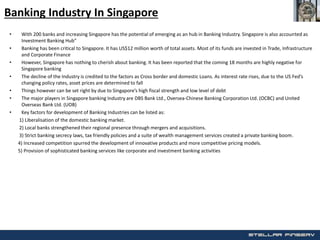
• With 200 banks and increasing Singapore has the potential of emerging as an hub in Banking Industry. Singapore is also accounted as
Investment Banking Hub”
• Banking has been critical to Singapore. It has US$12 million worth of total assets. Most of its funds are invested in Trade, Infrastructure
and Corporate Finance
• However, Singapore has nothing to cherish about banking. It has been reported that the coming 18 months are highly negative for
Singapore banking
• The decline of the Industry is credited to the factors as Cross border and domestic Loans. As interest rate rises, due to the US Fed’s
changing policy rates, asset prices are determined to fall
• Things however can be set right by due to Singapore’s high fiscal strength and low level of debt
• The major players in Singapore banking Industry are DBS Bank Ltd., Oversea-Chinese Banking Corporation Ltd. (OCBC) and United
Overseas Bank Ltd. (UOB)
• Key factors for development of Banking Industries can be listed as:
1) Liberalisation of the domestic banking market.
2) Local banks strengthened their regional presence through mergers and acquisitions.
3) Strict banking secrecy laws, tax friendly policies and a suite of wealth management services created a private banking boom.
4) Increased competition spurred the development of innovative products and more competitive pricing models.
5) Provision of sophisticated banking services like corporate and investment banking activities
Banking Industry in UK
UK banks are regaining their position post crisis with focus on high profitability
Key highlights can be listed as :
1) Clear signs of recovery and improvements
2) UK and EU-wide regulatory demands, capital market reforms and uncertainty of London's future as a global financial centre adds further
pressure
3) The role of digital and the impact of an improved cultural governance has not been fully realised
4) All five organisations are profitable again but developing very differently
The wider financial system has benefited from firms and people locating near one another in clusters. Partly as a result, the United Kingdom
may be able to provide banking services more efficiently than other countries.
UK has the biggest banking sector. On residency basis(TOTAL ASSETS IRRESPECTIVE OF NATIONALITY) it is the biggest sector. Relative to GDP,
it stood at around 450% in 2013 compared to 100% in 1975.
Foreign banks are a particularly large part of the UK banking system. This is a distinguishing feature of UK Banking.
Banking Industry in UK
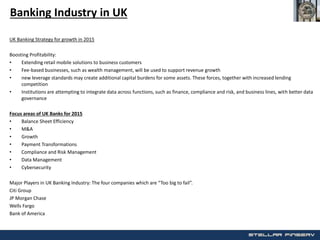
UK Banking Strategy for growth in 2015
Boosting Profitability:
• Extending retail mobile solutions to business customers
• Fee-based businesses, such as wealth management, will be used to support revenue growth
• new leverage standards may create additional capital burdens for some assets. These forces, together with increased lending
competition
• Institutions are attempting to integrate data across functions, such as finance, compliance and risk, and business lines, with better data
governance
Focus areas of UK Banks for 2015
• Balance Sheet Efficiency
• M&A
• Growth
• Payment Transformations
• Compliance and Risk Management
• Data Management
• Cybersecurity
Major Players in UK Banking Industry: The four companies which are “Too big to fail”.
Citi Group
JP Morgan Chase
Wells Fargo
Bank of America
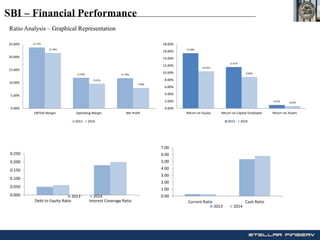
Ratio Analysis – Graphical Representation
SBI – Financial Performance
23.75%
11.92% 11.79%
21.59%
9.61%
7.99%
0.00%
5.00%
10.00%
15.00%
20.00%
25.00%
EBITDA Margin Operating Margin Net Profit
2013 2014
15.49%
11.61%
0.97%
10.41%
8.82%
0.65%
0.00%
2.00%
4.00%
6.00%
8.00%
10.00%
12.00%
14.00%
16.00%
18.00%
Return on Equity Return on Capital Employed Return on Assets
2013 2014
0.000
0.050
0.100
0.150
0.200
0.250
Debt to Equity Ratio Interest Coverage Ratio
2013 2014 0.00
1.00
2.00
3.00
4.00
5.00
6.00
7.00
Current Ratio Cash Ratio
2013 2014
Ratio Analysis – Graphical Representation
ICICI – Financial Performance
13.10%
10.04%
1.62%
14.02%
10.82%
1.73%
0.00%
2.00%
4.00%
6.00%
8.00%
10.00%
12.00%
14.00%
16.00%
Return on Equity Return on Capital Employed Return on Assets
2013 2014
22.06%
18.61%
17.19%
23.42%
18.88%
17.97%
0.00%
5.00%
10.00%
15.00%
20.00%
25.00%
EBITDA Margin Operating Margin Net Profit
2013 2014
0.000
0.020
0.040
0.060
0.080
Debt to Equity Ratio Interest Coverage Ratio
2013 2014
0.50
0.52
0.54
0.56
0.58
0.60
Current Ratio Cash Ratio
2013 2014
1.India is set to be a global outperformer in coming
years, in Macroeconomic terms.
2.India’s high consumer savings rate and efficacy of
regulation undertaken by RBI have provided
stability.
3.Though loan is growing rapidly, there are few
signs of excesses that have taken place over China.
4.Lack of linkages between Indian Banks and global
financial system have made global markets
comparatively immune to volatility
1. Commercial banking sector dominated by SBI,
reducing efficiency levels and product quality
practised globally.
2.Banking System is held back by low per capita GDP.
3.Logistics in running can be difficult to paper based
payment systems.
1.India still under-banked. Per capita deposit is low.
People hold savings outside formal banking system.
2.India’s banks are progressively being opened to
competition from foreign banks.
3.Reserve Bank is looking to enact major reforms in
system.
4.Market open for mutual funds, insurance
companies and other related Financial products.
5.Governments’s sale of public banks to private
banks can help improve the efficiency and
management of the firms.
1.Particular products as Mortgages are hampered by
inefficiencies in housing market.
2.Effect of Pension reforms and Insurance reforms
are not yet known.
3.State directed lending requirements and fee waiver,
subsidies reduce profitability and resilience of the
sector.
Indian Commercial Banking– SWOT Q4
2015Analysis
Weakness
Opportunity Threats
Strength
Indian Banking – Government Initiatives
 New bank licences to boost competition
RBI issued guidelines which allow companies from any sector to set up bank through a
wholly-owned Non-Operative Financial Holding Company (NOFHC) structure, thus paving
the way for corporate houses to enter the banking sector.
 RBI’s Liquidity Measures
In order to arrest further decline in the Indian rupee against the US dollar, the Reserve
Bank of India (RBI) issued a series of liquidity measures. These measures are expected to
restore some stability to the foreign exchange market.
 Vote on Account- Interim Budget
Weaker public sector banks with low capital adequacy would be impacted the most due
to lower capital infusion by the government.
The interim Budget has proposed to provide Rs 112 billion as capital support to all public
sector banks (PSBs) in 2014-15, which is lower than the average of Rs 147 billion provided in
the past 4 years till 2013-14.
 Union Budget 2014-15
Union budget 2014-15 has been very positive for the banks. Some of the key positives
were lesser regulatory restrictions of CRR, SLR and priority sector lending on raising of
infrastructure bonds
Indian Banking – Government Initiatives
 Union Budget 2015-16
Union budget 2015-16 has been positive for the banks. Some of the key positives were
allocation of funds, proposal to create a holding and investment company and an Autonomous Bank
Board Bureau, allowing NBFCs recourse to SARFAESI Act, establishment of the Bankruptcy Code and
setting up of MUDRA bank.
 RBI Guideline on Infra Bonds
Easing of norms for banks funding infrastructure projects is a step of the government and the
Reserve Bank of India (RBI) to resolve structural issues related to infrastructure financing and
providing a boost to affordable housing.
 Public Sector Bank Reform
Indradhanush, the seven-rayed plan to revamp public sector banks in India tries to address the
critical problems impacting their performance. Success, however, will depend on relentless
implementation, and staying the course no matter the obstacles.
Government and RBI reforms in Banking
Reforms
• Banks are allowed to raise capital from market to meet capital
adequacy norms and can dilute government’s stake by 52%.
• Pradhan Mantri Jan Dhan Yojna aims to provide one account every
household giving impetus to provide universal banking facilities.
• Two new banks have been granted approval to setup in coming next
18 months. (Approval made on April,2014).
Action by Govt to deal with NPA’s.
• Issued new guidelines to act when there is detection of asset going
NPA.
• For Asset Reconstruction Companies , the minimum investment in
security receipts increased to 15% from 5%.
• Bring flexibility in project loans for Infrastructure and core industries.
Indian Banking – Future Outlook
• Bad debts problematic for India's private sector banks
According to numbers reported by the banks, state banks hold $44 billion of nearly $50 billion
gross loans classified as bad. But Reuters calculations based on publicly available data show the
problem is growing at a faster pace at private banks.
• According to a report of Standards and Poors, Indian government steps to support the
capitalization of public sector banks won't fully resolve their looming capital shortfall.
• Though Conditions of PSBs in time, may not seem favourable, but Government and RBI are
formulating new policies to strengthen the Indian Banking Industry. It is only a matter of time
that Indian Banking will emerge as shiny Industry.
Improved Risk Management Practises
Indian banks are focusing on adopting integrated approach
to risk management
Banks have already embraced the international banking
supervision accord of Basel II
Digital Banking/Technological innovations
Great scope for development. Mobile has penetrated to the
most rural areas.
Government focusing on Digital banking to deliver world
class products to all.
Licensing requirements
High barriers to entry stay for new Indian Bank
licences.
The new entrants have to address financial
inclusion, comply with priority-sector lending
targets, and position 25% of their branches in
rural areas. Such restrictions could limit
profitability for new banks
Capital and regulatory requirements
Stringent check on Capital at entry level, mergers
and acquisitions, licensing and raising funds
increase trouble for new entrants
Investment in technology and bank branches
Focus On Financial Inclusion
Spreading Branch networks and spreading reach top non
bankers in country.
Growth Drivers Industry Barriers
Indian Banking Industry – Growth v/s Barriers
Consolidation
Banks are increasingly looking at consolidation to derive
greater benefits such as enhanced synergy; cost take-outs
from economies of scale; organisational efficiency;
diversification of risks
Policy Support
Simplification of KYC Norms, No –frills account, new policy
schemes as MUDRA Bank, Integarting banking and Adhar are
few policy moves to list
Economic Drivers
Strong GDP Growth will boost the sector due to credibility of
monetary policy.
Growth Drivers Industry Barriers
Indian Banking Industry – Growth v/s Barriers
Housing and Personal Finance
Rise in Housuing loan, increasing urbanisation and constant
increase in CAGR of housing.
Overall Political environment
and uncertanties related to it.
Shortage of Quality people
Getting the right set of people
is crucial for Management.
Indian Banking- Future Prospects
• Despite the new govt. policy showing improving growth scenario, the macroeconomic fundamentals depict the picture of modest
growth for FY15.
• Banks need to raise capital of 1.8-2 trillion over the next two years, of which 45-50% are to be issued in form of Tier-1, 35-40%
through Tier-2 and balance through common equity. In absence of Tier-1 requirements, Indian banks will generate the entire revenue
through common equity.
• Overall credit growth may rise 14-15% in FY15, private banks may outpace PSB’s in Credit Growth. Overall gross NPA’s could remain at
4-4.2% by FY15 compared to 3.9% in FY14.
• Worst is over for Indian banking, liquidity is going to remain steady, inflation is expected to move downwards and RBI is in full control
of volatility.
• Indian Banks may take up new participants, Two banks IDFC and Bandhan group is bound to boost financial inclusion and is expected
to intensify competition.
• Postponing of Basel – III Capital norm by one year, RBI has given relief to some banks which are under pressure of stressed margins
and low profitability on account of NPA’s.
• With a new and stable govt. in place, higher spending on Infrastructure and development will speed up growth. Moderate recovery is
likely to be seen in FY15 AND GDP is expected to grow by 5.3-5.5%.
• RBI’s new policy will encourage banks to identify bad loans and take corrective actions.
Growing Demand
• Increase in working population and disposable incomes are going to increase demand.
• Rural banking is potentially going to improve.
Innovation In services
• Mobile and Internet banking to improve Efficiency.
• Vast un-banked sector has scope for innovation.
DISCLAIMER
This publication has been prepared solely for information purpose and does not
constitute a solicitation to any person to buy or sell a security. While the information
contained therein has been obtained from sources believed to be reliable, Everyone is
advised to satisfy themselves before making any Investments. Stellar Finserv, does not
bear any responsibility for the authentication of the information contained in the
reports and consequently, is not liable for any decisions taken based on the same.
GENERAL INFORMATION
For enquiries and customized reports on Companies and Industries contact:
Contact No: 9820302186
Email: info@stellarfinserv.com
We will get in touch with you within 12 hours
Stellar Finserv is a fast growing Financial Services and Strategic Consulting Company with a
major focus on providing Quality services to meet the client needs.

Indian Banking Industry_Akshay

  • 1.
  • 2.
    Particulars Page 1. IndustryOverview 4-5 2.Indian Banking- Advances 7-8 3.Indian Banking - Deposits 9-10 4. Indian Banking- Investments 11 5. Indian Banking –NPA’s 12-13 6.Indian Banking-Operating Expenditure 14 7. Indian Banking-Net Profit Margin 15 8.Major Players in Indian Banking 16 9. Major Players – State Bank Of India 17 10. Major Players- ICICI Bank 18 11. Major Players- HSBC Bank 19 12.Sectorial Deployment of Credit 20 13. Financial Performance- SBI 21 14. Financial Performance –ICICI Bank 22 15.SWOT Analysis 23 16. Indian Banking- Government Initiatives 24-25 Table Of Contents
  • 3.
    Table Of Contents ParticularsPage 17. Indian Banking – Future Outlook 26 18. Disclaimer 27
  • 4.
    Indian Banking Industry-Overview • Indian Banking Sector has grown at a healthy and steady pace. • Indian Banking set to become fifth largest in the world by 2020 and third largest by the year 2025. • Bank credits are expected to grow at 17% CAGR in medium term leading to increased credit penetration. • The country's largest lender State Bank of India (SBI) is at the 38th position based on the size of assets, while India's largest private sector lender ICICI Bank is at 99th position • According to the World Bank, India has around 3.5 ATMs and less than seven bank branches per 100,000 people as compared with OECD (Organisation for Economic Co-operation and Development), where there are nearly 30 branches and 90 ATMs per 100,000 people. • In India, the universal banking model is followed. The general principle in this regard is that para-banking activities, such as credit cards, primary dealer, leasing, hire purchase, factoring etc., can be conducted either inside the bank departmentally or outside the bank through subsidiary/ joint venture /associate. • Investment banking and insurance services are provided by the universal/foreign banks as an in-house departmental activity or through subsidiary. • The banking stability indicator suggests that overall risks to the banking sector remained unchanged during the first half of 2014-15. • The Growth of Indian Banks have moderated after the FY14-15. Profitability declined on higher provisioning of accounts. • The size of Interbank Market in relation to total banking sector is on a steady decline. However, Contagion analysis with the top five most connected banks reveal that banking system could lose its potential Tier-1 Capital under the current liquidity condition.
  • 5.
    Indian Banking Industry-Overview Indian Banking Performance
  • 6.
    Indian Banking Industry-Overview Indian banking Industry reaches third by 2025
  • 7.
     The Businessof Scheduled Commercial Banks grew at a CAGR of 17% to INR 152,684 billion in 2013-14, from INR 70,641 billion in 2008-09  Public sector banks (PSBs) remained the major growth driver, with a 77% share in SCBs' total business as of 2013-14  Working capital loans grew at a CAGR of 22.6% from 2008-09 to 2013-14, while term loans recorded a 13% CAGR Snapshot Indian Banking Industry - Overview Banks in the year 2008-09 Banks in the year 2013-14
  • 8.
     The bankingsystem in India is the most extensive. The total asset value of the entire banking sector in India is nearly US$ 270 billion.  State Banks control over 80% of the market leaving very little for other rivals.  Presence of 46 commercial banks along with other foreign banks, rural and co-operative lenders.  At the end of February, 13.7 crore accounts had been opened under Pradhanmantri Jan Dhan Yojna (PMJDY) and 12.2 crore RuPay debit cards were issued. These new accounts have mobilised deposits of INR 12,694 crore (US$ 2.01 billion).  India’s banking sector would improve to 12-13 per cent in FY16 from less than 10% in the second half of CY14  According to researches carried out by the Reserve Bank of India (RBI), on an all India basis, 59 per cent of the adult population in the country has bank accounts and 41 per cent don’t.  In rural areas, the coverage of banks is 39 per cent, against 60 per cent in urban areas. There is only one bank for a population of13000.. Indian Banking Industry - Overview
  • 9.
  • 10.
    ADVANCES • Advances of(SCBs) grew at a CAGR of 17.5% between 2008-09 and 2013-14. (Image 1) • . Advances of public sector banks increased at a CAGR of 17.7% between 2008-09 and 2013-14 to INR 51,011 billion.(Image 2) Indian Banking Industry – Banking Advances Advances of SCB’sAdvances of Scheduled Commercial Banks Advances of Public Sector Banks
  • 11.
    Advances(Contd.) • Advances byprivate sector banks grew the most among all bank groups, at a CAGR of 18.5% (Image 1) • Total advances by foreign banks grew at a CAGR of 12% to INR2,912 billion in 2013-14, from INR 1,654 billion in 2008- 09. During this period, working capital loans registered a CAGR of 14%, while term loans recorded a CAGR of only 9%.(Image 2) Indian Banking Industry – Banking Advances Advances Of Private Sector Banks Advances of Foreign Sector Banks
  • 12.
    Deposits • Scheduled commercialbanks' deposits grew at a CAGR of 16% between 2008- 09 and 2013-14.(Image 1) • Public sector bank deposits grew at a CAGR of 16% between 2008-09 and 2013-14 to INR 65,890 billion(Image 2) Indian Banking Industry – Banking Deposits (1/2) Deposits of Scheduled Commercial Banks Deposits of Public Sector Banks
  • 13.
    Deposits(Contd.) • Private sectorbank deposits grew at a CAGR of 17% to INR 15,917 billion in 2013-14 from INR 7,364 billion in 2008- 09. • Foreign banks generally cater to high net worth individuals and NRIs. HSBC Bank, Standard Chartered Bank, Citibank and ABN AMRO Bank, are involved in retail banking. Indian Banking Industry – Banking Deposits (2/2) Deposits of Private Sector Banks Deposits of Foreign Banks
  • 14.
    Investments • Foreign banks'investments in statutory liquidity ratio (SLR) securities grew faster than that of public and private sector banks. • The share of SLR securities in total investments by all bank groups declined in 2013-14, owing to the drop in the SLR requirement announced by the Reserve Bank of India during the year. • In 2012-13, 76% of the banking sector's total investments were in SLR securities. • Growth in SCBs' total investments decelerated in 2013-14. The composition of investments also changed with the share of SLR investments declining marginally to 76% in 2013-14 from 77% in the previous year. • The share of non-SLR investments in SCBs' total investments increased to 24% in 2013-14 from 23% in 2012-13, as investments in non-SLR securities increased by more than 20%. Indian Banking Industry – Strategic Investments
  • 15.
    Non Performing Assets In2013-14, overall gross NPAs for the industry increased by 30 bps y-o-y to 3.9% due to the weak macroeconomic scenario, sharp rise in interest rates and volatility in the currency and commodity markets. Below is performance of SCBs. Indian Banking Industry – Non Performing Assets
  • 16.
    NPAs (Contd.) • Thegross NPA ratio declined by about 172 bps y-o-y to 2.54%. In 2011- 12, 2012-13 and 2013-14, the gross NPA ratio rose again marginally to 2.6%, 2.9% and 4%, respectively. • The share of foreign banks in gross advances of all SCBs declined to 4% in 2013-14 from 6% in 2008-09. The share of gross NPAs of foreign banks in the industry's gross NPAs also declined to 4% from 5%. Indian Banking Industry – Non Performing Assets
  • 17.
    Indian Banking Industry– Operating Expenditure Operating Expenditure • In 2013-14, scheduled commercial banks' (SCBs') employee costs increased by 15% y-o-y against 12% growth in 2012-13. • Employee costs as a percentage of operating expenses for SCBs declined to 55% in 2013-14 from 56% in 2012-13.
  • 18.
    Indian Banking- NPM NetProfitability Margin • The SCBs' net profitability margin declined to 1.76 per cent in 2013-14, down from 1.91 per cent in 2012- 13. (Image 1) • The NPM of foreign banks declined by 34 bps y-o-y to 3.49 per cent in 2013- 14. Spreads declined by 72 bps y-o- y to 3.99 per cent in 2013-14. (Image 2)
  • 19.
    Major Players inIndian Banking SBI and Associates Nationalised Banks Foreign Banks State Bank of India Allahabad Bank HSBC State Bank of Bikaner and Jaipur Andhra Bank Citi Bank State Bank of Hyderabad Bank of India Deustche Bank State Bank of Travancore Central bank of India RBS State Bank of Hyderabad IDBI Bank Credit Suisse AG State Bank of Mysore Canara Bank State Bank of Patiala HDFC Bank Axis Bank Punjab National Bank
  • 20.
    Indian Banking Sectorat a Glance (Amount in ` Billion) Sr. No Items Amount Outstanding (As at End-March) Percentage Variation 2013 2014 2012-13 2013-14 1 Balance Sheet Operations 1.1 Total Liabilities/assets 95,900 1,09,635 15.2 14.3 1.2 Deposits 74,297 85,331 15.1 14.9 1.3 Borrowings 10,104 11,008 19.7 9.0 1.4 Loans and advances 58,798 67,352 15.9 14.5 1.5 Investments 26,131 28,829 17.0 10.3 1.6 Off-balance sheet exposure (as percentage of on-balance sheet liabilities) 138.3 122.0 - - 1.7 Total consolidated international claims 3,312 3,777 17.9 14.0 2 Profitability 2.1 Net profit 912 809 11.5 -11.3 2.2 Return on Asset (RoA) (Per cent) 1.04 0.81 - - 2.3 Return on Equity (RoE) (Per cent) 13.84 10.68 - - 2.4 Net Interest Margin (NIM) (Per cent) 2.6 2.5 - - 3 Capital Adequacy 3.1 Capital to risk weighted assets ratio (CRAR) @ 13.88 13.02 - - 3.2 Tier I capital (as percentage of total capital) @ 74.1 77.5 - - 3.3 CRAR (tier I) (Per cent) @ 10.29 10.09 - -
  • 21.
    Asset Quality Gross NPAs1,941 2,642 35.8 36.1 Net NPAs 987 1,427 51.4 44.6 Gross NPA ratio (Gross NPAs as percentage of gross advances) 3.2 3.8 - - Net NPA ratio (Net NPAs as percentage of net advances) 1.7 2.1 - - Provision Coverage Ratio (Per cent)** 47.6 44.3 - - Slippage ratio (Per cent) 2.8 3.8 - - Sectoral Deployment of Bank Credit # Gross bank credit 49642 56572 13.6 14.0 Agriculture 5899 6694 7.9 13.5 Industry 22302 25229 15.1 13.1 Services 11519 13370 12.6 16.1 Personal loans 8976 10367 14.7 15.5 Technological Development Total number of credit cards (in million) 20 19 10.8 -1.7 Total number of debit cards (in million) 331 394 19.1 19.0 Number of ATMs 1,14,014 1,60,055 19.2 40.4 Customer Services* Total number of complaints received during the year 70,541 76,573 -3.2 8.6 Total number of complaints addressed 69,704 78,745 -4.4 13.0 Percentage of complaints addressed 92.7 95.9 - - Financial Inclusion Credit-deposit ratio (Per cent) 79.1 78.9 - - Number of new bank branches opened 7,757 10,738 - - Number of banking outlets in villages (Total) 2,68,454 3,83,804 47.7 43.0
  • 22.
    Major Players- StateBank Of India
  • 23.
  • 24.
  • 25.
  • 26.
    Banking in Australia •Australia’s major banks are the most profitable in the developed world. • The Australian Banks reported a combined statutory profit of $28.8 billion which marks an increase of 10.5%. • Australia's major banks have delivered a 5.6 per cent rise in combined underlying cash earnings of $29 billion after tax for the full year. • Further fall in bad debts combined with growth in core earnings and a rebound in credit demand helped underpin the record result. • The Australian Prudential Regulatory Authority (APRA) issues separate licenses to carry on credit card issuing and/or acquiring business to Specialist Credit Card Institutions (SCCIs). SCCIs are a special class of authorised deposit-taking institutions (ADIs) that are authorised to perform a limited range of banking activities. • Regulation of Australian Financial system is carried out by : i) Australian Prudential Regulation Authority (APRA) ii) Australian Securities and Investment Commission (ASIC) iii) The Reserve Bank of Australia (RBA) • Wealth Management and Insurance Income were the major drivers which fuelled Australia’s Banking Industry. • Despite the capital markets continue to grow, the focus is on creating an efficient, diversified revenue stream. • Fees and Commissions continue to be the largest contributor of funds. • Innovation and Collaboration of are key determining factors of growth in Industry. The components of Financial Technology can be listed as: i) Personal Finance ii) Big Data and Analytics iii) Payments iv) Front Office v) Capital Markets Technology
  • 27.
    Banking Industry InSingapore • With 200 banks and increasing Singapore has the potential of emerging as an hub in Banking Industry. Singapore is also accounted as Investment Banking Hub” • Banking has been critical to Singapore. It has US$12 million worth of total assets. Most of its funds are invested in Trade, Infrastructure and Corporate Finance • However, Singapore has nothing to cherish about banking. It has been reported that the coming 18 months are highly negative for Singapore banking • The decline of the Industry is credited to the factors as Cross border and domestic Loans. As interest rate rises, due to the US Fed’s changing policy rates, asset prices are determined to fall • Things however can be set right by due to Singapore’s high fiscal strength and low level of debt • The major players in Singapore banking Industry are DBS Bank Ltd., Oversea-Chinese Banking Corporation Ltd. (OCBC) and United Overseas Bank Ltd. (UOB) • Key factors for development of Banking Industries can be listed as: 1) Liberalisation of the domestic banking market. 2) Local banks strengthened their regional presence through mergers and acquisitions. 3) Strict banking secrecy laws, tax friendly policies and a suite of wealth management services created a private banking boom. 4) Increased competition spurred the development of innovative products and more competitive pricing models. 5) Provision of sophisticated banking services like corporate and investment banking activities
  • 28.
    Banking Industry inUK UK banks are regaining their position post crisis with focus on high profitability Key highlights can be listed as : 1) Clear signs of recovery and improvements 2) UK and EU-wide regulatory demands, capital market reforms and uncertainty of London's future as a global financial centre adds further pressure 3) The role of digital and the impact of an improved cultural governance has not been fully realised 4) All five organisations are profitable again but developing very differently The wider financial system has benefited from firms and people locating near one another in clusters. Partly as a result, the United Kingdom may be able to provide banking services more efficiently than other countries. UK has the biggest banking sector. On residency basis(TOTAL ASSETS IRRESPECTIVE OF NATIONALITY) it is the biggest sector. Relative to GDP, it stood at around 450% in 2013 compared to 100% in 1975. Foreign banks are a particularly large part of the UK banking system. This is a distinguishing feature of UK Banking.
  • 29.
    Banking Industry inUK UK Banking Strategy for growth in 2015 Boosting Profitability: • Extending retail mobile solutions to business customers • Fee-based businesses, such as wealth management, will be used to support revenue growth • new leverage standards may create additional capital burdens for some assets. These forces, together with increased lending competition • Institutions are attempting to integrate data across functions, such as finance, compliance and risk, and business lines, with better data governance Focus areas of UK Banks for 2015 • Balance Sheet Efficiency • M&A • Growth • Payment Transformations • Compliance and Risk Management • Data Management • Cybersecurity Major Players in UK Banking Industry: The four companies which are “Too big to fail”. Citi Group JP Morgan Chase Wells Fargo Bank of America
  • 30.
    Ratio Analysis –Graphical Representation SBI – Financial Performance 23.75% 11.92% 11.79% 21.59% 9.61% 7.99% 0.00% 5.00% 10.00% 15.00% 20.00% 25.00% EBITDA Margin Operating Margin Net Profit 2013 2014 15.49% 11.61% 0.97% 10.41% 8.82% 0.65% 0.00% 2.00% 4.00% 6.00% 8.00% 10.00% 12.00% 14.00% 16.00% 18.00% Return on Equity Return on Capital Employed Return on Assets 2013 2014 0.000 0.050 0.100 0.150 0.200 0.250 Debt to Equity Ratio Interest Coverage Ratio 2013 2014 0.00 1.00 2.00 3.00 4.00 5.00 6.00 7.00 Current Ratio Cash Ratio 2013 2014
  • 31.
    Ratio Analysis –Graphical Representation ICICI – Financial Performance 13.10% 10.04% 1.62% 14.02% 10.82% 1.73% 0.00% 2.00% 4.00% 6.00% 8.00% 10.00% 12.00% 14.00% 16.00% Return on Equity Return on Capital Employed Return on Assets 2013 2014 22.06% 18.61% 17.19% 23.42% 18.88% 17.97% 0.00% 5.00% 10.00% 15.00% 20.00% 25.00% EBITDA Margin Operating Margin Net Profit 2013 2014 0.000 0.020 0.040 0.060 0.080 Debt to Equity Ratio Interest Coverage Ratio 2013 2014 0.50 0.52 0.54 0.56 0.58 0.60 Current Ratio Cash Ratio 2013 2014
  • 32.
    1.India is setto be a global outperformer in coming years, in Macroeconomic terms. 2.India’s high consumer savings rate and efficacy of regulation undertaken by RBI have provided stability. 3.Though loan is growing rapidly, there are few signs of excesses that have taken place over China. 4.Lack of linkages between Indian Banks and global financial system have made global markets comparatively immune to volatility 1. Commercial banking sector dominated by SBI, reducing efficiency levels and product quality practised globally. 2.Banking System is held back by low per capita GDP. 3.Logistics in running can be difficult to paper based payment systems. 1.India still under-banked. Per capita deposit is low. People hold savings outside formal banking system. 2.India’s banks are progressively being opened to competition from foreign banks. 3.Reserve Bank is looking to enact major reforms in system. 4.Market open for mutual funds, insurance companies and other related Financial products. 5.Governments’s sale of public banks to private banks can help improve the efficiency and management of the firms. 1.Particular products as Mortgages are hampered by inefficiencies in housing market. 2.Effect of Pension reforms and Insurance reforms are not yet known. 3.State directed lending requirements and fee waiver, subsidies reduce profitability and resilience of the sector. Indian Commercial Banking– SWOT Q4 2015Analysis Weakness Opportunity Threats Strength
  • 33.
    Indian Banking –Government Initiatives  New bank licences to boost competition RBI issued guidelines which allow companies from any sector to set up bank through a wholly-owned Non-Operative Financial Holding Company (NOFHC) structure, thus paving the way for corporate houses to enter the banking sector.  RBI’s Liquidity Measures In order to arrest further decline in the Indian rupee against the US dollar, the Reserve Bank of India (RBI) issued a series of liquidity measures. These measures are expected to restore some stability to the foreign exchange market.  Vote on Account- Interim Budget Weaker public sector banks with low capital adequacy would be impacted the most due to lower capital infusion by the government. The interim Budget has proposed to provide Rs 112 billion as capital support to all public sector banks (PSBs) in 2014-15, which is lower than the average of Rs 147 billion provided in the past 4 years till 2013-14.  Union Budget 2014-15 Union budget 2014-15 has been very positive for the banks. Some of the key positives were lesser regulatory restrictions of CRR, SLR and priority sector lending on raising of infrastructure bonds
  • 34.
    Indian Banking –Government Initiatives  Union Budget 2015-16 Union budget 2015-16 has been positive for the banks. Some of the key positives were allocation of funds, proposal to create a holding and investment company and an Autonomous Bank Board Bureau, allowing NBFCs recourse to SARFAESI Act, establishment of the Bankruptcy Code and setting up of MUDRA bank.  RBI Guideline on Infra Bonds Easing of norms for banks funding infrastructure projects is a step of the government and the Reserve Bank of India (RBI) to resolve structural issues related to infrastructure financing and providing a boost to affordable housing.  Public Sector Bank Reform Indradhanush, the seven-rayed plan to revamp public sector banks in India tries to address the critical problems impacting their performance. Success, however, will depend on relentless implementation, and staying the course no matter the obstacles.
  • 35.
    Government and RBIreforms in Banking Reforms • Banks are allowed to raise capital from market to meet capital adequacy norms and can dilute government’s stake by 52%. • Pradhan Mantri Jan Dhan Yojna aims to provide one account every household giving impetus to provide universal banking facilities. • Two new banks have been granted approval to setup in coming next 18 months. (Approval made on April,2014). Action by Govt to deal with NPA’s. • Issued new guidelines to act when there is detection of asset going NPA. • For Asset Reconstruction Companies , the minimum investment in security receipts increased to 15% from 5%. • Bring flexibility in project loans for Infrastructure and core industries.
  • 36.
    Indian Banking –Future Outlook • Bad debts problematic for India's private sector banks According to numbers reported by the banks, state banks hold $44 billion of nearly $50 billion gross loans classified as bad. But Reuters calculations based on publicly available data show the problem is growing at a faster pace at private banks. • According to a report of Standards and Poors, Indian government steps to support the capitalization of public sector banks won't fully resolve their looming capital shortfall. • Though Conditions of PSBs in time, may not seem favourable, but Government and RBI are formulating new policies to strengthen the Indian Banking Industry. It is only a matter of time that Indian Banking will emerge as shiny Industry.
  • 37.
    Improved Risk ManagementPractises Indian banks are focusing on adopting integrated approach to risk management Banks have already embraced the international banking supervision accord of Basel II Digital Banking/Technological innovations Great scope for development. Mobile has penetrated to the most rural areas. Government focusing on Digital banking to deliver world class products to all. Licensing requirements High barriers to entry stay for new Indian Bank licences. The new entrants have to address financial inclusion, comply with priority-sector lending targets, and position 25% of their branches in rural areas. Such restrictions could limit profitability for new banks Capital and regulatory requirements Stringent check on Capital at entry level, mergers and acquisitions, licensing and raising funds increase trouble for new entrants Investment in technology and bank branches Focus On Financial Inclusion Spreading Branch networks and spreading reach top non bankers in country. Growth Drivers Industry Barriers Indian Banking Industry – Growth v/s Barriers Consolidation Banks are increasingly looking at consolidation to derive greater benefits such as enhanced synergy; cost take-outs from economies of scale; organisational efficiency; diversification of risks
  • 38.
    Policy Support Simplification ofKYC Norms, No –frills account, new policy schemes as MUDRA Bank, Integarting banking and Adhar are few policy moves to list Economic Drivers Strong GDP Growth will boost the sector due to credibility of monetary policy. Growth Drivers Industry Barriers Indian Banking Industry – Growth v/s Barriers Housing and Personal Finance Rise in Housuing loan, increasing urbanisation and constant increase in CAGR of housing. Overall Political environment and uncertanties related to it. Shortage of Quality people Getting the right set of people is crucial for Management.
  • 39.
    Indian Banking- FutureProspects • Despite the new govt. policy showing improving growth scenario, the macroeconomic fundamentals depict the picture of modest growth for FY15. • Banks need to raise capital of 1.8-2 trillion over the next two years, of which 45-50% are to be issued in form of Tier-1, 35-40% through Tier-2 and balance through common equity. In absence of Tier-1 requirements, Indian banks will generate the entire revenue through common equity. • Overall credit growth may rise 14-15% in FY15, private banks may outpace PSB’s in Credit Growth. Overall gross NPA’s could remain at 4-4.2% by FY15 compared to 3.9% in FY14. • Worst is over for Indian banking, liquidity is going to remain steady, inflation is expected to move downwards and RBI is in full control of volatility. • Indian Banks may take up new participants, Two banks IDFC and Bandhan group is bound to boost financial inclusion and is expected to intensify competition. • Postponing of Basel – III Capital norm by one year, RBI has given relief to some banks which are under pressure of stressed margins and low profitability on account of NPA’s. • With a new and stable govt. in place, higher spending on Infrastructure and development will speed up growth. Moderate recovery is likely to be seen in FY15 AND GDP is expected to grow by 5.3-5.5%. • RBI’s new policy will encourage banks to identify bad loans and take corrective actions. Growing Demand • Increase in working population and disposable incomes are going to increase demand. • Rural banking is potentially going to improve. Innovation In services • Mobile and Internet banking to improve Efficiency. • Vast un-banked sector has scope for innovation.
  • 40.
    DISCLAIMER This publication hasbeen prepared solely for information purpose and does not constitute a solicitation to any person to buy or sell a security. While the information contained therein has been obtained from sources believed to be reliable, Everyone is advised to satisfy themselves before making any Investments. Stellar Finserv, does not bear any responsibility for the authentication of the information contained in the reports and consequently, is not liable for any decisions taken based on the same.
  • 41.
    GENERAL INFORMATION For enquiriesand customized reports on Companies and Industries contact: Contact No: 9820302186 Email: info@stellarfinserv.com We will get in touch with you within 12 hours Stellar Finserv is a fast growing Financial Services and Strategic Consulting Company with a major focus on providing Quality services to meet the client needs.

Editor's Notes

  • #11 Annual Report 2013-14 http://markets.ft.com/research/Markets/Tearsheets/Forecasts?s=HEROMOTOCO:NSI Business Responsibility 2013-14 Money Control
  • #12 Annual Report 2013-14 http://markets.ft.com/research/Markets/Tearsheets/Forecasts?s=HEROMOTOCO:NSI Business Responsibility 2013-14 Money Control
  • #13 Annual Report 2013-14 http://markets.ft.com/research/Markets/Tearsheets/Forecasts?s=HEROMOTOCO:NSI Business Responsibility 2013-14 Money Control
  • #14 Annual Report 2013-14 http://markets.ft.com/research/Markets/Tearsheets/Forecasts?s=HEROMOTOCO:NSI Business Responsibility 2013-14 Money Control
  • #15 Annual Report 2013-14 http://markets.ft.com/research/Markets/Tearsheets/Forecasts?s=HEROMOTOCO:NSI Business Responsibility 2013-14 Money Control
  • #16 Annual Report 2013-14 http://markets.ft.com/research/Markets/Tearsheets/Forecasts?s=HEROMOTOCO:NSI Business Responsibility 2013-14 Money Control
  • #17 Annual Report 2013-14 http://markets.ft.com/research/Markets/Tearsheets/Forecasts?s=HEROMOTOCO:NSI Business Responsibility 2013-14 Money Control
  • #18 Annual Report 2013-14 http://markets.ft.com/research/Markets/Tearsheets/Forecasts?s=HEROMOTOCO:NSI Business Responsibility 2013-14 Money Control
  • #19 Annual Report 2013-14 http://markets.ft.com/research/Markets/Tearsheets/Forecasts?s=HEROMOTOCO:NSI Business Responsibility 2013-14 Money Control
  • #23 Annual Report 2013-14 http://markets.ft.com/research/Markets/Tearsheets/Forecasts?s=HEROMOTOCO:NSI Business Responsibility 2013-14 Money Control
  • #24 Annual Report 2013-14 http://markets.ft.com/research/Markets/Tearsheets/Forecasts?s=HEROMOTOCO:NSI Business Responsibility 2013-14 Money Control
  • #25 Annual Report 2013-14 http://markets.ft.com/research/Markets/Tearsheets/Forecasts?s=HEROMOTOCO:NSI Business Responsibility 2013-14 Money Control
  • #26 Annual Report 2013-14 http://markets.ft.com/research/Markets/Tearsheets/Forecasts?s=HEROMOTOCO:NSI Business Responsibility 2013-14 Money Control