
Indian Banking Sector 2015
Indian Banking Sector
An Industry Profiling
This is a study of the Indian banking sector in partial fulfillment of the fieldwork
curriculum of first semester at Tata Institute of Social Sciences, Mumbai
2015
Ankit Amlan
Tata Institute of Social Sciences
8/31/2015
Tata Institute of Social Sciences | Mumbai
2Banking Sector in India: An Industry Profiling
2
Introduction
According to the Reserve Bank of India (RBI), the banking sector in India is sound,
adequately capitalised and well-regulated. Indian financial and economic conditions are
much better than in many other countries of the world. Credit, market and liquidity risk
studies show that Indian banks are generally resilient and have withstood the global
downturn well (IBEF 2015).
Over the past couple of years, the Indian banking sector has displayed a high level of
resilience in the face of high domestic inflation, rupee depreciation and fiscal uncertainty in
the US and Europe. In order to stimulate the economy and support growth of the banking
sector, the Reserve Bank of India (RBI) adopted several policy measures (Indian Banking
KPMG 2013).
With a sense of optimism slowly creeping in, the banking industry expects that 2015 will
bring better growth prospects. This optimism is because of the fact that the Government is
working hard to speed up the industrial growth in the country and the RBI is initiating a
number of measures that would go a long way in helping the banks to rebuild themselves.
The recent announcements of RBI, it is felt, are a clear pointer to the future of the
restructured domestic banking industry.
An Overview
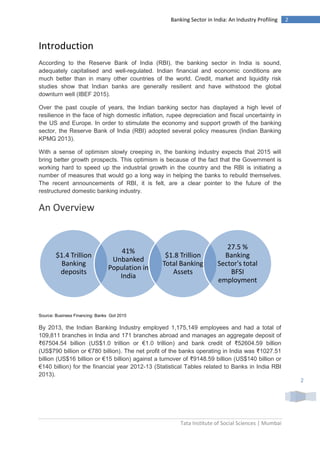
Source: Business Financing: Banks GoI 2015
By 2013, the Indian Banking Industry employed 1,175,149 employees and had a total of
109,811 branches in India and 171 branches abroad and manages an aggregate deposit of
₹67504.54 billion (US$1.0 trillion or €1.0 trillion) and bank credit of ₹52604.59 billion
(US$790 billion or €780 billion). The net profit of the banks operating in India was ₹1027.51
billion (US$16 billion or €15 billion) against a turnover of ₹9148.59 billion (US$140 billion or
€140 billion) for the financial year 2012-13 (Statistical Tables related to Banks in India RBI
2013).
$1.4 Trillion
Banking
deposits
41%
Unbanked
Population in
India
$1.8 Trillion
Total Banking
Assets
27.5 %
Banking
Sector's total
BFSI
employment
Tata Institute of Social Sciences | Mumbai
3Banking Sector in India: An Industry Profiling
3
2008 2009 2010 2011 2012 2013
Number of
Commercial
Banks
169 166 163 163 169 151
Number of
branches
78,787 82,897 88,203 94,019 102,377 109,811
Population
per Bank (in
thousands) 15 15 14 13 13 12
Aggregate
deposits
₹31969 ₹38341 ₹44928 ₹52078 ₹59091 ₹67504.4
Per Capita
deposit
₹28610(U
S$430)
₹33919(US$
510)
₹39107(U
S$590)
₹45505 (U
S$690)
₹50183 (US
$760)
₹56380 (
US$850
Cash
deposit
Ratio
75% 74% 74% 76% 79% 79%
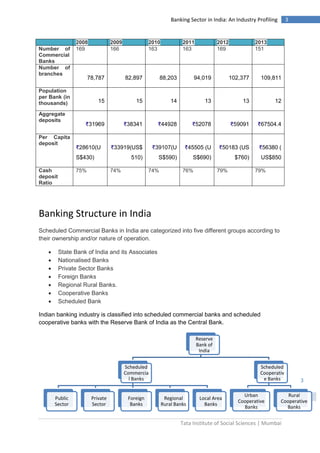
Banking Structure in India
Scheduled Commercial Banks in India are categorized into five different groups according to
their ownership and/or nature of operation.
 State Bank of India and its Associates
 Nationalised Banks
 Private Sector Banks
 Foreign Banks
 Regional Rural Banks.
 Cooperative Banks
 Scheduled Bank
Indian banking industry is classified into scheduled commercial banks and scheduled
cooperative banks with the Reserve Bank of India as the Central Bank.
Reserve
Bank of
India
Scheduled
Commercia
l Banks
Public
Sector
Private
Sector
Foreign
Banks
Regional
Rural Banks
Local Area
Banks
Scheduled
Cooperativ
e Banks
Urban
Cooperative
Banks
Rural
Cooperative
Banks
Tata Institute of Social Sciences | Mumbai
4Banking Sector in India: An Industry Profiling
4
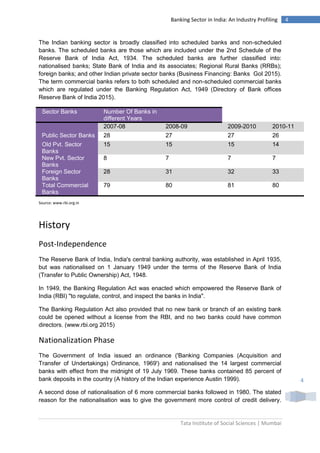
The Indian banking sector is broadly classified into scheduled banks and non-scheduled
banks. The scheduled banks are those which are included under the 2nd Schedule of the
Reserve Bank of India Act, 1934. The scheduled banks are further classified into:
nationalised banks; State Bank of India and its associates; Regional Rural Banks (RRBs);
foreign banks; and other Indian private sector banks (Business Financing: Banks GoI 2015).
The term commercial banks refers to both scheduled and non-scheduled commercial banks
which are regulated under the Banking Regulation Act, 1949 (Directory of Bank offices
Reserve Bank of India 2015).
Sector Banks Number Of Banks in
different Years
2007-08 2008-09 2009-2010 2010-11
Public Sector Banks 28 27 27 26
Old Pvt. Sector
Banks
15 15 15 14
New Pvt. Sector
Banks
8 7 7 7
Foreign Sector
Banks
28 31 32 33
Total Commercial
Banks
79 80 81 80
Source: www.rbi.org.in
History
Post-Independence
The Reserve Bank of India, India's central banking authority, was established in April 1935,
but was nationalised on 1 January 1949 under the terms of the Reserve Bank of India
(Transfer to Public Ownership) Act, 1948.
In 1949, the Banking Regulation Act was enacted which empowered the Reserve Bank of
India (RBI) "to regulate, control, and inspect the banks in India".
The Banking Regulation Act also provided that no new bank or branch of an existing bank
could be opened without a license from the RBI, and no two banks could have common
directors. (www.rbi.org 2015)
Nationalization Phase
The Government of India issued an ordinance ('Banking Companies (Acquisition and
Transfer of Undertakings) Ordinance, 1969') and nationalised the 14 largest commercial
banks with effect from the midnight of 19 July 1969. These banks contained 85 percent of
bank deposits in the country (A history of the Indian experience Austin 1999).
A second dose of nationalisation of 6 more commercial banks followed in 1980. The stated
reason for the nationalisation was to give the government more control of credit delivery.
Tata Institute of Social Sciences | Mumbai
5Banking Sector in India: An Industry Profiling
5
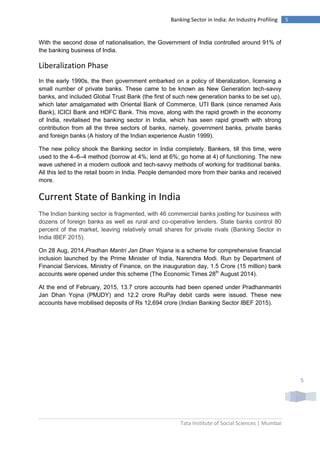
With the second dose of nationalisation, the Government of India controlled around 91% of
the banking business of India.
Liberalization Phase
In the early 1990s, the then government embarked on a policy of liberalization, licensing a
small number of private banks. These came to be known as New Generation tech-savvy
banks, and included Global Trust Bank (the first of such new generation banks to be set up),
which later amalgamated with Oriental Bank of Commerce, UTI Bank (since renamed Axis
Bank), ICICI Bank and HDFC Bank. This move, along with the rapid growth in the economy
of India, revitalised the banking sector in India, which has seen rapid growth with strong
contribution from all the three sectors of banks, namely, government banks, private banks
and foreign banks (A history of the Indian experience Austin 1999).
The new policy shook the Banking sector in India completely. Bankers, till this time, were
used to the 4–6–4 method (borrow at 4%; lend at 6%; go home at 4) of functioning. The new
wave ushered in a modern outlook and tech-savvy methods of working for traditional banks.
All this led to the retail boom in India. People demanded more from their banks and received
more.
Current State of Banking in India
The Indian banking sector is fragmented, with 46 commercial banks jostling for business with
dozens of foreign banks as well as rural and co-operative lenders. State banks control 80
percent of the market, leaving relatively small shares for private rivals (Banking Sector in
India IBEF 2015).
On 28 Aug, 2014,Pradhan Mantri Jan Dhan Yojana is a scheme for comprehensive financial
inclusion launched by the Prime Minister of India, Narendra Modi. Run by Department of
Financial Services, Ministry of Finance, on the inauguration day, 1.5 Crore (15 million) bank
accounts were opened under this scheme (The Economic Times 28th
August 2014).
At the end of February, 2015, 13.7 crore accounts had been opened under Pradhanmantri
Jan Dhan Yojna (PMJDY) and 12.2 crore RuPay debit cards were issued. These new
accounts have mobilised deposits of Rs 12,694 crore (Indian Banking Sector IBEF 2015).
Tata Institute of Social Sciences | Mumbai
6Banking Sector in India: An Industry Profiling
6
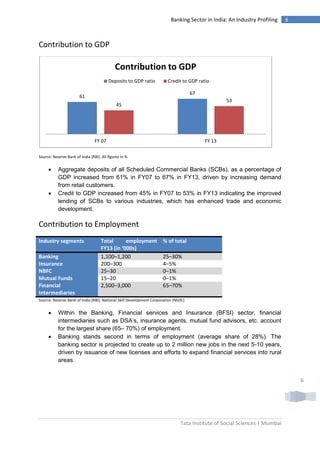
Contribution to GDP
Source: Reserve Bank of India (RBI). All figures in %
 Aggregate deposits of all Scheduled Commercial Banks (SCBs), as a percentage of
GDP increased from 61% in FY07 to 67% in FY13, driven by increasing demand
from retail customers.
 Credit to GDP increased from 45% in FY07 to 53% in FY13 indicating the improved
lending of SCBs to various industries, which has enhanced trade and economic
development.
Contribution to Employment
Industry segments Total employment
FY13 (in ‘000s)
% of total
Banking 1,100–1,200 25–30%
Insurance 200–300 4–5%
NBFC 25–30 0–1%
Mutual Funds 15–20 0–1%
Financial
Intermediaries
2,500–3,000 65–70%
Source: Reserve Bank of India (RBI), National Skill Development Corporation (NSDC)
 Within the Banking, Financial services and Insurance (BFSI) sector, financial
intermediaries such as DSA’s, insurance agents, mutual fund advisors, etc. account
for the largest share (65– 70%) of employment.
 Banking stands second in terms of employment (average share of 28%). The
banking sector is projected to create up to 2 million new jobs in the next 5-10 years,
driven by issuance of new licenses and efforts to expand financial services into rural
areas.
61
67
45
53
FY 07 FY 13
Contribution to GDP
Deposits to GDP ratio Credit to GDP ratio
Tata Institute of Social Sciences | Mumbai
7Banking Sector in India: An Industry Profiling
7
Sector Banks
Number Of
Employees in
different Years
2007-08 2008-09 2009-2010 2010-11
Public Sector 715408 731524 739646 757535
Old sector banks 48700 51341 55052 55075
New sector banks 110123 124998 127468 163604
Foreign banks 31301 29582 28012 27968
Total Commercial
Banks
905532 937445 950178 1004182
Source: www.rbi.org.in
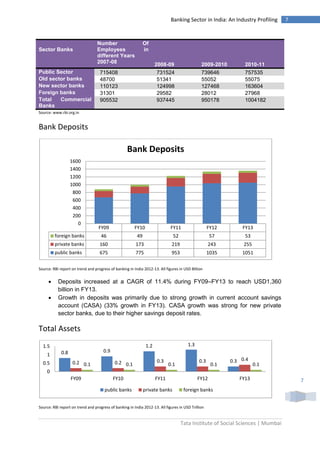
Bank Deposits
Source: RBI report on trend and progress of banking in India 2012-13. All figures in USD Billion
 Deposits increased at a CAGR of 11.4% during FY09–FY13 to reach USD1,360
billion in FY13.
 Growth in deposits was primarily due to strong growth in current account savings
account (CASA) (33% growth in FY13). CASA growth was strong for new private
sector banks, due to their higher savings deposit rates.
Total Assets
Source: RBI report on trend and progress of banking in India 2012-13. All figures in USD Trillion
FY09 FY10 FY11 FY12 FY13
foreign banks 46 49 52 57 53
private banks 160 173 219 243 255
public banks 675 775 953 1035 1051
0
200
400
600
800
1000
1200
1400
1600
Bank Deposits
0.8 0.9
1.2 1.3
0.30.2 0.2 0.3 0.3 0.4
0.1 0.1 0.1 0.1 0.1
0
0.5
1
1.5
FY09 FY10 FY11 FY12 FY13
public banks private banks foreign banks
Tata Institute of Social Sciences | Mumbai
8Banking Sector in India: An Industry Profiling
8
 Total banking sector assets increased at a CAGR of 11.3% to USD1.8 trillion in FY13.
 Public sector banks accounted for majority (73%) of the total assets in FY13
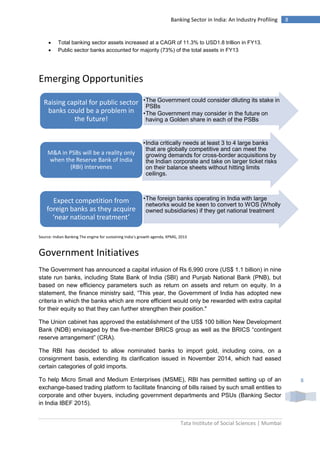
Emerging Opportunities
Source: Indian Banking The engine for sustaining India’s growth agenda, KPMG, 2013
Government Initiatives
The Government has announced a capital infusion of Rs 6,990 crore (US$ 1.1 billion) in nine
state run banks, including State Bank of India (SBI) and Punjab National Bank (PNB), but
based on new efficiency parameters such as return on assets and return on equity. In a
statement, the finance ministry said, “This year, the Government of India has adopted new
criteria in which the banks which are more efficient would only be rewarded with extra capital
for their equity so that they can further strengthen their position."
The Union cabinet has approved the establishment of the US$ 100 billion New Development
Bank (NDB) envisaged by the five-member BRICS group as well as the BRICS “contingent
reserve arrangement” (CRA).
The RBI has decided to allow nominated banks to import gold, including coins, on a
consignment basis, extending its clarification issued in November 2014, which had eased
certain categories of gold imports.
To help Micro Small and Medium Enterprises (MSME), RBI has permitted setting up of an
exchange-based trading platform to facilitate financing of bills raised by such small entities to
corporate and other buyers, including government departments and PSUs (Banking Sector
in India IBEF 2015).
•The Government could consider diluting its stake in
PSBs
•The Government may consider in the future on
having a Golden share in each of the PSBs
Raising capital for public sector
banks could be a problem in
the future!
•India critically needs at least 3 to 4 large banks
that are globally competitive and can meet the
growing demands for cross-border acquisitions by
the Indian corporate and take on larger ticket risks
on their balance sheets without hitting limits
ceilings.
M&A in PSBs will be a reality only
when the Reserve Bank of India
(RBI) intervenes
•The foreign banks operating in India with large
networks would be keen to convert to WOS (Wholly
owned subsidiaries) if they get national treatment
Expect competition from
foreign banks as they acquire
‘near national treatment’
Tata Institute of Social Sciences | Mumbai
9Banking Sector in India: An Industry Profiling
9
On 28 Aug, 2014,Pradhan Mantri Jan Dhan Yojana is a scheme for comprehensive financial
inclusion launched by the Prime Minister of India, Narendra Modi. Run by Department of
Financial Services, Ministry of Finance, on the inauguration day, 1.5 Crore (15 million) bank
accounts were opened under this scheme (The Economic Times 28th
August 2014).
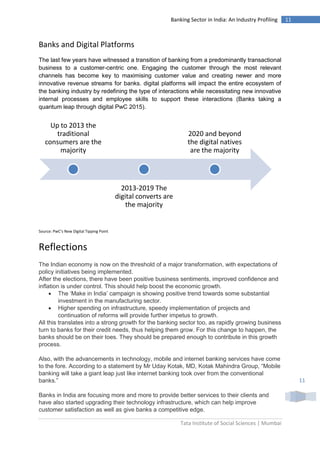
Aspirations of Modern India
The ‘rising middle class’ – will account for close to one third of the
population in the next 20 years
Source: NCAER
Middle class consumers are prominent drivers of growth and consumption in India due to
their increasing disposable income. A report by National Council for Applied Economic
Research’s (NCAER) Centre for Macro Consumer Research indicates that by 2015-16, India
will be a country of 53.3 million middle class households, translating into 267 million people
(India’s middle class population to touch 267 million in 5 yrs, Economic Times, February 6,
2011).
4.3
2.5
3.5
2.4
4.4
1.82 2
3
2011 2015-16 2025-26
Rise in Middle class
Indian Middle Class (in millions) Individuals (in millions) Percentage of total population
Tata Institute of Social Sciences | Mumbai
10Banking Sector in India: An Industry Profiling
10
Investment in banking products may not be the default choice for
the middle class
While a rise in consumption is a given, all savings and investments going to banks is not.
Banks would have to strive hard to attract deposits in the future as the rising segment opens
up to other avenues for savings and investments such as mutual funds, insurance, real-
estate and commodities.
Most banks will need to start putting together strategic plans and identify teams to focus on
deposit raising, and move from the model of servicing walkin customers, to aggressively
pursuing new customers through innovative bundling, promise of better returns, higher levels
of customer service and attractive rewards programmes (Indian Banking The engine for
sustaining India’s growth agenda, KPMG, 2013).
What will the emerging middle class seek? Will banks be able to
provide?
Source: Banking The engine for sustaining India’s growth agenda, KPMG, 2013
The new middle class is likely to be fickle in its banking relationship – given the very low
costs of, and multiple available options for, switching. The key to building and profiting from
a long-term relationship with this segment will be the ability to build trust over a series of
transactions.
A key aspect to this challenge will be the bank’s ability to build and retain a team that is
trained, not only in the nuances of the products and services they sell, but also in the
development of soft skills and trust building skills. The emerging middle class is likely to
value the relationship higher; if their point of contact is someone they trust (Indian Banking
The engine for sustaining India’s growth agenda, KPMG, 2013).
Tata Institute of Social Sciences | Mumbai
11Banking Sector in India: An Industry Profiling
11
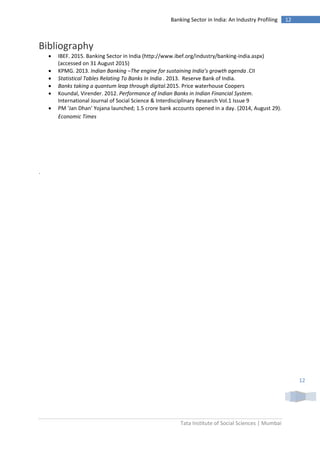
Banks and Digital Platforms
The last few years have witnessed a transition of banking from a predominantly transactional
business to a customer-centric one. Engaging the customer through the most relevant
channels has become key to maximising customer value and creating newer and more
innovative revenue streams for banks. digital platforms will impact the entire ecosystem of
the banking industry by redefining the type of interactions while necessitating new innovative
internal processes and employee skills to support these interactions (Banks taking a
quantum leap through digital PwC 2015).
Source: PwC’s New Digital Tipping Point
Reflections
The Indian economy is now on the threshold of a major transformation, with expectations of
policy initiatives being implemented.
After the elections, there have been positive business sentiments, improved confidence and
inflation is under control. This should help boost the economic growth.
 The ‘Make in India’ campaign is showing positive trend towards some substantial
investment in the manufacturing sector.
 Higher spending on infrastructure, speedy implementation of projects and
continuation of reforms will provide further impetus to growth.
All this translates into a strong growth for the banking sector too, as rapidly growing business
turn to banks for their credit needs, thus helping them grow. For this change to happen, the
banks should be on their toes. They should be prepared enough to contribute in this growth
process.
Also, with the advancements in technology, mobile and internet banking services have come
to the fore. According to a statement by Mr Uday Kotak, MD, Kotak Mahindra Group, “Mobile
banking will take a giant leap just like internet banking took over from the conventional
banks.”
Banks in India are focusing more and more to provide better services to their clients and
have also started upgrading their technology infrastructure, which can help improve
customer satisfaction as well as give banks a competitive edge.
Up to 2013 the
traditional
consumers are the
majority
2013-2019 The
digital converts are
the majority
2020 and beyond
the digital natives
are the majority
Tata Institute of Social Sciences | Mumbai
12Banking Sector in India: An Industry Profiling
12
Bibliography
 IBEF. 2015. Banking Sector in India (http://www.ibef.org/industry/banking-india.aspx)
(accessed on 31 August 2015)
 KPMG. 2013. Indian Banking –The engine for sustaining India’s growth agenda .CII
 Statistical Tables Relating To Banks In India . 2013. Reserve Bank of India.
 Banks taking a quantum leap through digital.2015. Price waterhouse Coopers
 Koundal, Virender. 2012. Performance of Indian Banks in Indian Financial System.
International Journal of Social Science & Interdisciplinary Research Vol.1 Issue 9
 PM 'Jan Dhan' Yojana launched; 1.5 crore bank accounts opened in a day. (2014, August 29).
Economic Times
.

sector profile

  • 1.
    Indian Banking Sector2015 Indian Banking Sector An Industry Profiling This is a study of the Indian banking sector in partial fulfillment of the fieldwork curriculum of first semester at Tata Institute of Social Sciences, Mumbai 2015 Ankit Amlan Tata Institute of Social Sciences 8/31/2015
  • 2.
    Tata Institute ofSocial Sciences | Mumbai 2Banking Sector in India: An Industry Profiling 2 Introduction According to the Reserve Bank of India (RBI), the banking sector in India is sound, adequately capitalised and well-regulated. Indian financial and economic conditions are much better than in many other countries of the world. Credit, market and liquidity risk studies show that Indian banks are generally resilient and have withstood the global downturn well (IBEF 2015). Over the past couple of years, the Indian banking sector has displayed a high level of resilience in the face of high domestic inflation, rupee depreciation and fiscal uncertainty in the US and Europe. In order to stimulate the economy and support growth of the banking sector, the Reserve Bank of India (RBI) adopted several policy measures (Indian Banking KPMG 2013). With a sense of optimism slowly creeping in, the banking industry expects that 2015 will bring better growth prospects. This optimism is because of the fact that the Government is working hard to speed up the industrial growth in the country and the RBI is initiating a number of measures that would go a long way in helping the banks to rebuild themselves. The recent announcements of RBI, it is felt, are a clear pointer to the future of the restructured domestic banking industry. An Overview Source: Business Financing: Banks GoI 2015 By 2013, the Indian Banking Industry employed 1,175,149 employees and had a total of 109,811 branches in India and 171 branches abroad and manages an aggregate deposit of ₹67504.54 billion (US$1.0 trillion or €1.0 trillion) and bank credit of ₹52604.59 billion (US$790 billion or €780 billion). The net profit of the banks operating in India was ₹1027.51 billion (US$16 billion or €15 billion) against a turnover of ₹9148.59 billion (US$140 billion or €140 billion) for the financial year 2012-13 (Statistical Tables related to Banks in India RBI 2013). $1.4 Trillion Banking deposits 41% Unbanked Population in India $1.8 Trillion Total Banking Assets 27.5 % Banking Sector's total BFSI employment
  • 3.
    Tata Institute ofSocial Sciences | Mumbai 3Banking Sector in India: An Industry Profiling 3 2008 2009 2010 2011 2012 2013 Number of Commercial Banks 169 166 163 163 169 151 Number of branches 78,787 82,897 88,203 94,019 102,377 109,811 Population per Bank (in thousands) 15 15 14 13 13 12 Aggregate deposits ₹31969 ₹38341 ₹44928 ₹52078 ₹59091 ₹67504.4 Per Capita deposit ₹28610(U S$430) ₹33919(US$ 510) ₹39107(U S$590) ₹45505 (U S$690) ₹50183 (US $760) ₹56380 ( US$850 Cash deposit Ratio 75% 74% 74% 76% 79% 79% Banking Structure in India Scheduled Commercial Banks in India are categorized into five different groups according to their ownership and/or nature of operation.  State Bank of India and its Associates  Nationalised Banks  Private Sector Banks  Foreign Banks  Regional Rural Banks.  Cooperative Banks  Scheduled Bank Indian banking industry is classified into scheduled commercial banks and scheduled cooperative banks with the Reserve Bank of India as the Central Bank. Reserve Bank of India Scheduled Commercia l Banks Public Sector Private Sector Foreign Banks Regional Rural Banks Local Area Banks Scheduled Cooperativ e Banks Urban Cooperative Banks Rural Cooperative Banks
  • 4.
    Tata Institute ofSocial Sciences | Mumbai 4Banking Sector in India: An Industry Profiling 4 The Indian banking sector is broadly classified into scheduled banks and non-scheduled banks. The scheduled banks are those which are included under the 2nd Schedule of the Reserve Bank of India Act, 1934. The scheduled banks are further classified into: nationalised banks; State Bank of India and its associates; Regional Rural Banks (RRBs); foreign banks; and other Indian private sector banks (Business Financing: Banks GoI 2015). The term commercial banks refers to both scheduled and non-scheduled commercial banks which are regulated under the Banking Regulation Act, 1949 (Directory of Bank offices Reserve Bank of India 2015). Sector Banks Number Of Banks in different Years 2007-08 2008-09 2009-2010 2010-11 Public Sector Banks 28 27 27 26 Old Pvt. Sector Banks 15 15 15 14 New Pvt. Sector Banks 8 7 7 7 Foreign Sector Banks 28 31 32 33 Total Commercial Banks 79 80 81 80 Source: www.rbi.org.in History Post-Independence The Reserve Bank of India, India's central banking authority, was established in April 1935, but was nationalised on 1 January 1949 under the terms of the Reserve Bank of India (Transfer to Public Ownership) Act, 1948. In 1949, the Banking Regulation Act was enacted which empowered the Reserve Bank of India (RBI) "to regulate, control, and inspect the banks in India". The Banking Regulation Act also provided that no new bank or branch of an existing bank could be opened without a license from the RBI, and no two banks could have common directors. (www.rbi.org 2015) Nationalization Phase The Government of India issued an ordinance ('Banking Companies (Acquisition and Transfer of Undertakings) Ordinance, 1969') and nationalised the 14 largest commercial banks with effect from the midnight of 19 July 1969. These banks contained 85 percent of bank deposits in the country (A history of the Indian experience Austin 1999). A second dose of nationalisation of 6 more commercial banks followed in 1980. The stated reason for the nationalisation was to give the government more control of credit delivery.
  • 5.
    Tata Institute ofSocial Sciences | Mumbai 5Banking Sector in India: An Industry Profiling 5 With the second dose of nationalisation, the Government of India controlled around 91% of the banking business of India. Liberalization Phase In the early 1990s, the then government embarked on a policy of liberalization, licensing a small number of private banks. These came to be known as New Generation tech-savvy banks, and included Global Trust Bank (the first of such new generation banks to be set up), which later amalgamated with Oriental Bank of Commerce, UTI Bank (since renamed Axis Bank), ICICI Bank and HDFC Bank. This move, along with the rapid growth in the economy of India, revitalised the banking sector in India, which has seen rapid growth with strong contribution from all the three sectors of banks, namely, government banks, private banks and foreign banks (A history of the Indian experience Austin 1999). The new policy shook the Banking sector in India completely. Bankers, till this time, were used to the 4–6–4 method (borrow at 4%; lend at 6%; go home at 4) of functioning. The new wave ushered in a modern outlook and tech-savvy methods of working for traditional banks. All this led to the retail boom in India. People demanded more from their banks and received more. Current State of Banking in India The Indian banking sector is fragmented, with 46 commercial banks jostling for business with dozens of foreign banks as well as rural and co-operative lenders. State banks control 80 percent of the market, leaving relatively small shares for private rivals (Banking Sector in India IBEF 2015). On 28 Aug, 2014,Pradhan Mantri Jan Dhan Yojana is a scheme for comprehensive financial inclusion launched by the Prime Minister of India, Narendra Modi. Run by Department of Financial Services, Ministry of Finance, on the inauguration day, 1.5 Crore (15 million) bank accounts were opened under this scheme (The Economic Times 28th August 2014). At the end of February, 2015, 13.7 crore accounts had been opened under Pradhanmantri Jan Dhan Yojna (PMJDY) and 12.2 crore RuPay debit cards were issued. These new accounts have mobilised deposits of Rs 12,694 crore (Indian Banking Sector IBEF 2015).
  • 6.
    Tata Institute ofSocial Sciences | Mumbai 6Banking Sector in India: An Industry Profiling 6 Contribution to GDP Source: Reserve Bank of India (RBI). All figures in %  Aggregate deposits of all Scheduled Commercial Banks (SCBs), as a percentage of GDP increased from 61% in FY07 to 67% in FY13, driven by increasing demand from retail customers.  Credit to GDP increased from 45% in FY07 to 53% in FY13 indicating the improved lending of SCBs to various industries, which has enhanced trade and economic development. Contribution to Employment Industry segments Total employment FY13 (in ‘000s) % of total Banking 1,100–1,200 25–30% Insurance 200–300 4–5% NBFC 25–30 0–1% Mutual Funds 15–20 0–1% Financial Intermediaries 2,500–3,000 65–70% Source: Reserve Bank of India (RBI), National Skill Development Corporation (NSDC)  Within the Banking, Financial services and Insurance (BFSI) sector, financial intermediaries such as DSA’s, insurance agents, mutual fund advisors, etc. account for the largest share (65– 70%) of employment.  Banking stands second in terms of employment (average share of 28%). The banking sector is projected to create up to 2 million new jobs in the next 5-10 years, driven by issuance of new licenses and efforts to expand financial services into rural areas. 61 67 45 53 FY 07 FY 13 Contribution to GDP Deposits to GDP ratio Credit to GDP ratio
  • 7.
    Tata Institute ofSocial Sciences | Mumbai 7Banking Sector in India: An Industry Profiling 7 Sector Banks Number Of Employees in different Years 2007-08 2008-09 2009-2010 2010-11 Public Sector 715408 731524 739646 757535 Old sector banks 48700 51341 55052 55075 New sector banks 110123 124998 127468 163604 Foreign banks 31301 29582 28012 27968 Total Commercial Banks 905532 937445 950178 1004182 Source: www.rbi.org.in Bank Deposits Source: RBI report on trend and progress of banking in India 2012-13. All figures in USD Billion  Deposits increased at a CAGR of 11.4% during FY09–FY13 to reach USD1,360 billion in FY13.  Growth in deposits was primarily due to strong growth in current account savings account (CASA) (33% growth in FY13). CASA growth was strong for new private sector banks, due to their higher savings deposit rates. Total Assets Source: RBI report on trend and progress of banking in India 2012-13. All figures in USD Trillion FY09 FY10 FY11 FY12 FY13 foreign banks 46 49 52 57 53 private banks 160 173 219 243 255 public banks 675 775 953 1035 1051 0 200 400 600 800 1000 1200 1400 1600 Bank Deposits 0.8 0.9 1.2 1.3 0.30.2 0.2 0.3 0.3 0.4 0.1 0.1 0.1 0.1 0.1 0 0.5 1 1.5 FY09 FY10 FY11 FY12 FY13 public banks private banks foreign banks
  • 8.
    Tata Institute ofSocial Sciences | Mumbai 8Banking Sector in India: An Industry Profiling 8  Total banking sector assets increased at a CAGR of 11.3% to USD1.8 trillion in FY13.  Public sector banks accounted for majority (73%) of the total assets in FY13 Emerging Opportunities Source: Indian Banking The engine for sustaining India’s growth agenda, KPMG, 2013 Government Initiatives The Government has announced a capital infusion of Rs 6,990 crore (US$ 1.1 billion) in nine state run banks, including State Bank of India (SBI) and Punjab National Bank (PNB), but based on new efficiency parameters such as return on assets and return on equity. In a statement, the finance ministry said, “This year, the Government of India has adopted new criteria in which the banks which are more efficient would only be rewarded with extra capital for their equity so that they can further strengthen their position." The Union cabinet has approved the establishment of the US$ 100 billion New Development Bank (NDB) envisaged by the five-member BRICS group as well as the BRICS “contingent reserve arrangement” (CRA). The RBI has decided to allow nominated banks to import gold, including coins, on a consignment basis, extending its clarification issued in November 2014, which had eased certain categories of gold imports. To help Micro Small and Medium Enterprises (MSME), RBI has permitted setting up of an exchange-based trading platform to facilitate financing of bills raised by such small entities to corporate and other buyers, including government departments and PSUs (Banking Sector in India IBEF 2015). •The Government could consider diluting its stake in PSBs •The Government may consider in the future on having a Golden share in each of the PSBs Raising capital for public sector banks could be a problem in the future! •India critically needs at least 3 to 4 large banks that are globally competitive and can meet the growing demands for cross-border acquisitions by the Indian corporate and take on larger ticket risks on their balance sheets without hitting limits ceilings. M&A in PSBs will be a reality only when the Reserve Bank of India (RBI) intervenes •The foreign banks operating in India with large networks would be keen to convert to WOS (Wholly owned subsidiaries) if they get national treatment Expect competition from foreign banks as they acquire ‘near national treatment’
  • 9.
    Tata Institute ofSocial Sciences | Mumbai 9Banking Sector in India: An Industry Profiling 9 On 28 Aug, 2014,Pradhan Mantri Jan Dhan Yojana is a scheme for comprehensive financial inclusion launched by the Prime Minister of India, Narendra Modi. Run by Department of Financial Services, Ministry of Finance, on the inauguration day, 1.5 Crore (15 million) bank accounts were opened under this scheme (The Economic Times 28th August 2014). Aspirations of Modern India The ‘rising middle class’ – will account for close to one third of the population in the next 20 years Source: NCAER Middle class consumers are prominent drivers of growth and consumption in India due to their increasing disposable income. A report by National Council for Applied Economic Research’s (NCAER) Centre for Macro Consumer Research indicates that by 2015-16, India will be a country of 53.3 million middle class households, translating into 267 million people (India’s middle class population to touch 267 million in 5 yrs, Economic Times, February 6, 2011). 4.3 2.5 3.5 2.4 4.4 1.82 2 3 2011 2015-16 2025-26 Rise in Middle class Indian Middle Class (in millions) Individuals (in millions) Percentage of total population
  • 10.
    Tata Institute ofSocial Sciences | Mumbai 10Banking Sector in India: An Industry Profiling 10 Investment in banking products may not be the default choice for the middle class While a rise in consumption is a given, all savings and investments going to banks is not. Banks would have to strive hard to attract deposits in the future as the rising segment opens up to other avenues for savings and investments such as mutual funds, insurance, real- estate and commodities. Most banks will need to start putting together strategic plans and identify teams to focus on deposit raising, and move from the model of servicing walkin customers, to aggressively pursuing new customers through innovative bundling, promise of better returns, higher levels of customer service and attractive rewards programmes (Indian Banking The engine for sustaining India’s growth agenda, KPMG, 2013). What will the emerging middle class seek? Will banks be able to provide? Source: Banking The engine for sustaining India’s growth agenda, KPMG, 2013 The new middle class is likely to be fickle in its banking relationship – given the very low costs of, and multiple available options for, switching. The key to building and profiting from a long-term relationship with this segment will be the ability to build trust over a series of transactions. A key aspect to this challenge will be the bank’s ability to build and retain a team that is trained, not only in the nuances of the products and services they sell, but also in the development of soft skills and trust building skills. The emerging middle class is likely to value the relationship higher; if their point of contact is someone they trust (Indian Banking The engine for sustaining India’s growth agenda, KPMG, 2013).
  • 11.
    Tata Institute ofSocial Sciences | Mumbai 11Banking Sector in India: An Industry Profiling 11 Banks and Digital Platforms The last few years have witnessed a transition of banking from a predominantly transactional business to a customer-centric one. Engaging the customer through the most relevant channels has become key to maximising customer value and creating newer and more innovative revenue streams for banks. digital platforms will impact the entire ecosystem of the banking industry by redefining the type of interactions while necessitating new innovative internal processes and employee skills to support these interactions (Banks taking a quantum leap through digital PwC 2015). Source: PwC’s New Digital Tipping Point Reflections The Indian economy is now on the threshold of a major transformation, with expectations of policy initiatives being implemented. After the elections, there have been positive business sentiments, improved confidence and inflation is under control. This should help boost the economic growth.  The ‘Make in India’ campaign is showing positive trend towards some substantial investment in the manufacturing sector.  Higher spending on infrastructure, speedy implementation of projects and continuation of reforms will provide further impetus to growth. All this translates into a strong growth for the banking sector too, as rapidly growing business turn to banks for their credit needs, thus helping them grow. For this change to happen, the banks should be on their toes. They should be prepared enough to contribute in this growth process. Also, with the advancements in technology, mobile and internet banking services have come to the fore. According to a statement by Mr Uday Kotak, MD, Kotak Mahindra Group, “Mobile banking will take a giant leap just like internet banking took over from the conventional banks.” Banks in India are focusing more and more to provide better services to their clients and have also started upgrading their technology infrastructure, which can help improve customer satisfaction as well as give banks a competitive edge. Up to 2013 the traditional consumers are the majority 2013-2019 The digital converts are the majority 2020 and beyond the digital natives are the majority
  • 12.
    Tata Institute ofSocial Sciences | Mumbai 12Banking Sector in India: An Industry Profiling 12 Bibliography  IBEF. 2015. Banking Sector in India (http://www.ibef.org/industry/banking-india.aspx) (accessed on 31 August 2015)  KPMG. 2013. Indian Banking –The engine for sustaining India’s growth agenda .CII  Statistical Tables Relating To Banks In India . 2013. Reserve Bank of India.  Banks taking a quantum leap through digital.2015. Price waterhouse Coopers  Koundal, Virender. 2012. Performance of Indian Banks in Indian Financial System. International Journal of Social Science & Interdisciplinary Research Vol.1 Issue 9  PM 'Jan Dhan' Yojana launched; 1.5 crore bank accounts opened in a day. (2014, August 29). Economic Times .