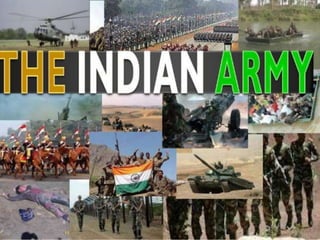
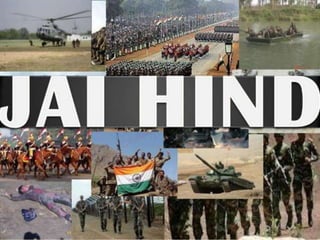
INDIAN ARMY
THE LIFLINE OF INDIA
MOTIVATION
INSPIRATION
VALOUR
SACRIFICE
INDEX
 INTRODUCTION
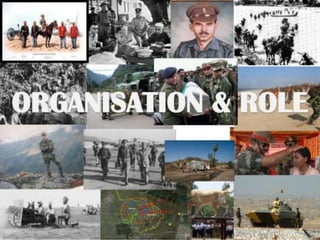
 ORGANISATION AND ROLE
 HISTORY
 INDIAN ARMY IN NATION BUILDING
 DETAILS OF SACRIFICED SOLDIERS
 LIST OF INCIDENTS AND WARS
 JOINING THE INDIAN ARMY
 REGIMENTS OF INDIAN ARMY
 FEATURES OF INDIAN ARMY
 OATH OF INDIAN ARMY
 MOTIVATIONAL VIDEO
INTRODUCTION
 Indian Army is the land based branch, organization or largest component of
the Indian Armed Forces.
 Indian army is the Largest Standing Volunteer Army including 1, 129, 900
active personnel and 960,000 reserve personnel.
 Indian army was originated from the armies of East Indian Company,
which eventually became the British Indian Army which also finally
became the national army after Independence.
 The mission of the Indian Army is to ensure National Security and National
Unity, defending the nation from external aggression and internal threats,
and maintaining peace and security within its Borders.
 Indian Army Conducted rescue operations during natural calamities and
other disturbances they are Like Operation Surya Hope, Operation Vijay,
Operation Meghdoot and Operation Cactus etc.
 The COAS (CHIEF OF ARMY STAFF) is the professional head,
commander and usually the highest ranking military officer in Indian Army.
The Current COAS of Indian Army is General Bipin Rawat.
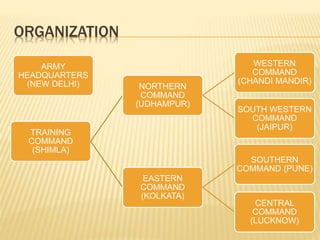
ORGANIZATION
TRAINING
COMMAND
(SHIMLA)
NORTHERN
COMMAND
(UDHAMPUR)
WESTERN
COMMAND
(CHANDI MANDIR)
SOUTH WESTERN
COMMAND
(JAIPUR)
EASTERN
COMMAND
(KOLKATA)
SOUTHERN
COMMAND (PUNE)
CENTRAL
COMMAND
(LUCKNOW)
ARMY
HEADQUARTERS
(NEW DELHI)
RANKS OF INDIAN ARMY
 THERE ARE TWO TYPES OF THE RANKS OF THE
INDIAN ARMY:-
 1) NON COMMISSIONED OFFICERS (NCO)
 2) JUNIOR COMMISSIONED OFFICERS (JCO)
1) NON COMMISSIONED OFFICERS
 SEPOY.
 LANCE NAIK (INFANTRY).
 LANCE DAFFADAR (CAVALRY AND ARMOURED
REGIMENTS).
 HAVILDAR (INFANTRY).
 NAIB SUBEDAR (INFANTRY).
 NAIB RISALDAR (CAVALRY AND ARMOURED
REGIMENTS).
 SUBEDAR MAJOR (INFANTRY).
 RISALDAR MAJOR (CAVALRY AND ARMOURED
REGIMENTS).
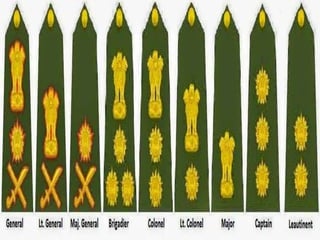
2) JUNIOR COMMISSIONED OFFICERS
 LIEUTNANT.
 CAPTAIN.
 MAJOR.
 LIEUTNANT COLONEL.
 COLONEL.
 BRIGADIER.
 MAJOR GENEREAL.
 LIEUTNANT GENERAL.
 GENERAL.
 FIELD MARSHAL.
COMBAT ARMS OF INDIAN ARMY
 COMBAT ARMS OF INDIAN ARMY IS ARE AS FOLLOWS:-
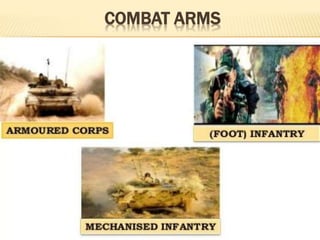
 1) ARMOURED CORPS.
 2) (FOOT) INFANTRY.
 3) MECHANISED INFANTRY.
COMBAT ARMS
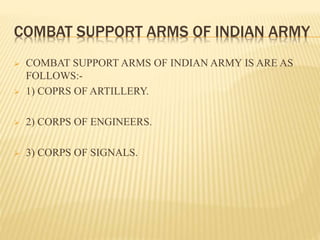
COMBAT SUPPORT ARMS OF INDIAN ARMY
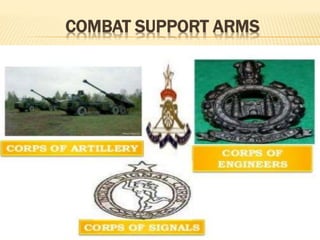
 COMBAT SUPPORT ARMS OF INDIAN ARMY IS ARE AS
FOLLOWS:-
 1) COPRS OF ARTILLERY.
 2) CORPS OF ENGINEERS.
 3) CORPS OF SIGNALS.
COMBAT SUPPORT ARMS
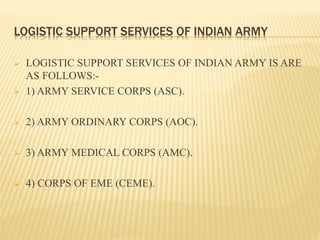
LOGISTIC SUPPORT SERVICES OF INDIAN ARMY
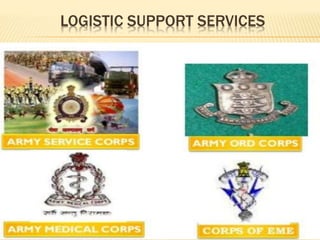
 LOGISTIC SUPPORT SERVICES OF INDIAN ARMY IS ARE
AS FOLLOWS:-
 1) ARMY SERVICE CORPS (ASC).
 2) ARMY ORDINARY CORPS (AOC).
 3) ARMY MEDICAL CORPS (AMC).
 4) CORPS OF EME (CEME).
LOGISTIC SUPPORT SERVICES
MEDALS AND AWARDS OF INDIAN ARMY
 Indian Honours, and Awards of Indian Army can be divided into
two categories:-
 1) Gallantry Awards:-
 a) Those for gallantry in the face of the enemy.
 b) Those for gallantry other than in the face of the enemy.
 2) Non Gallantry Awards:-
ROLE OF INDIAN ARMY
 To Safeguard the territorial integrity of the nation against external
aggression.
 Due to country’s long borders encompassing different geographical and
climatic conditions such as desert terrain on the west, snow covered
mountains in the north and thick rain fed mountainous jungles in the east,
the Army has to constantly prepare itself for diverse challenges.
 In addition, the Army is often required to assist the Civil Administration
during internal security disturbances and in maintenance of law and order,
in organizing relief operations during natural calamities like floods,
earthquakes and cyclones and in the maintenance of essential services.
 Demands of the army have increased manifold due to continuous
deployment of its forces in intense counter insurgency operations in Jammu
& Kashmir and the North East parts of the Country. To achieve these
objectives, the Army has to be constantly modernized, suitably structured,
equipped and trained.
OVERVIEW
 Evolved from British Indian Army.
 Immediately after Independence-fought first Indo Pak War and Liberation Of
Hyderabad in 1947-48.
 Liberated Goa in 1961.
 Fought Sino-Indian War of 1962.
 Fought three subsequent wars with Pakistan in 1962, 1965 and 1971.
 Other major operations undertaken by the Indian Army include Operation Vijay
(Kargil War of 1999), Operation Parakram (Mobililsation post parliament
attack).
 Indian army also has been an active participant in United Nations Peacekeeping
missions.
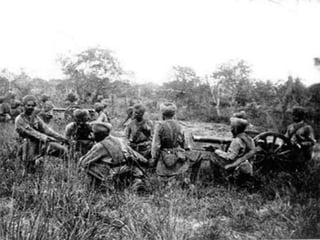
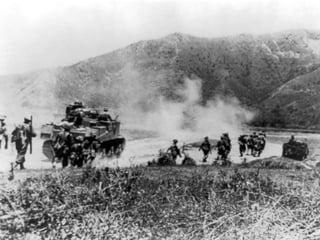
FIRST INDO-PAK WAR (1947-48)
 Invasion of Kashmir by Pakistan Army.
 Indian army fought immediately after independence and
after Maharaja Hari Singh acceded with India.
 After this, Indian Army (Indian Artillery Troops) airlifted
to Srinagar on 15th October 1947.
 Intense war waged across the state and former comrades
found themselves fighting each other.
 This First India Pakistan war of 1947 was ended with
United Nations sponsored Ceasefire in 1948.
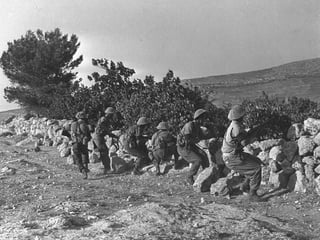
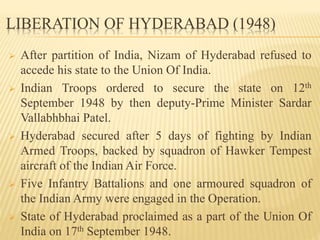
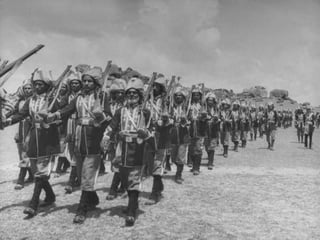
LIBERATION OF HYDERABAD (1948)
 After partition of India, Nizam of Hyderabad refused to
accede his state to the Union Of India.
 Indian Troops ordered to secure the state on 12th
September 1948 by then deputy-Prime Minister Sardar
Vallabhbhai Patel.
 Hyderabad secured after 5 days of fighting by Indian
Armed Troops, backed by squadron of Hawker Tempest
aircraft of the Indian Air Force.
 Five Infantry Battalions and one armoured squadron of
the Indian Army were engaged in the Operation.
 State of Hyderabad proclaimed as a part of the Union Of
India on 17th September 1948.
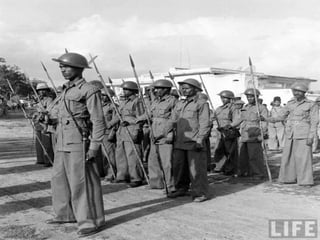
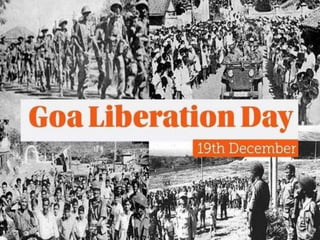
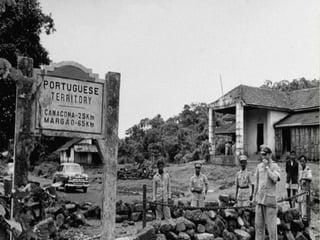
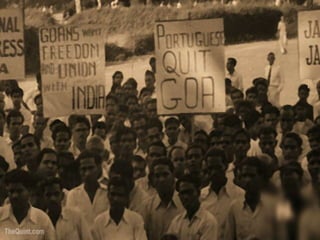
LIBERATION OF GOA (1961)
 Portugal refused to relinquish control of its Indian Colonies of
Goa, Daman and Diu after Independence.
 Repeated attempts by India to negotiate with Portugal for return of
its territory spurned by Portuguese Prime Minister and dictator,
Antonio De Oliveira Salazar.
 Indian army launched on 12 December 1961 to evict the
Portuguese.
 Portuguese General Manuel Antonio Vassalo e Silva surrendered
to the Indian Army, after twenty six hours and Goa, Daman and
Diu joined the Indian Union.
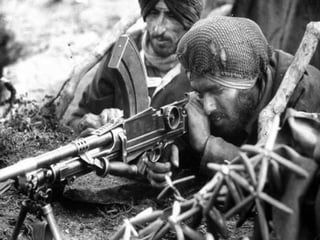
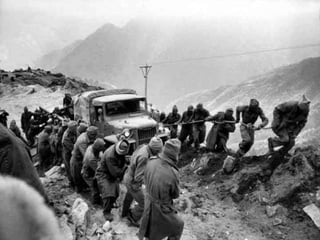
SINO-INDIAN WAR OF 1962
 War started with small-scale clashes between the Indian and
Chinese patrols all long disputed McMahon Line.
 China launched major attack in Arunachal Pradesh on 12th October
1962.
 This war was caused by dispute over Aksai, Chin and Arunachal
Pradesh both claimed China & India.
 Although Indian Army fought valiantly it suffered some reverses
because of lack of adequate weapons, ammunition and equipment.
 War ended with China making a unilateral withdrawal of its troops
in November 1962.
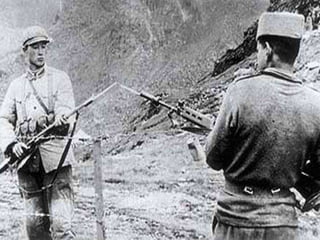
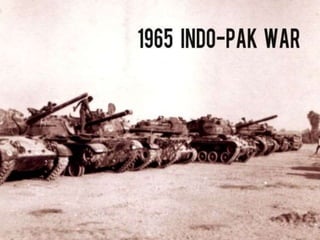
INDO-PAK WAR OF 1965
 War of 1965 between India and Pakistan over Kashmir is the
second war.
 This war was Initiated by Pakistani President Ayub Khan by
Launching Operation Gibraltar in August 1965 by large scale
infiltration into India.
 In retaliation, the India’s Army launched a major offensive
throughout its border with Pakistan, with Lahore as its Prime
Budget.
 Major battles with Pakistan fought in Kashmir, Punjab and
Rajasthan.
 War ended with Cease Fire Agreement at Tashkent.
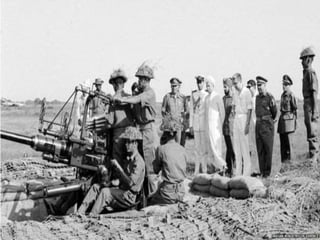
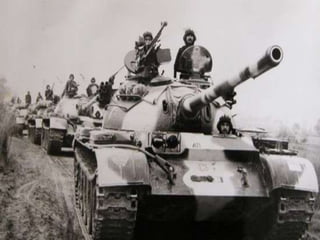
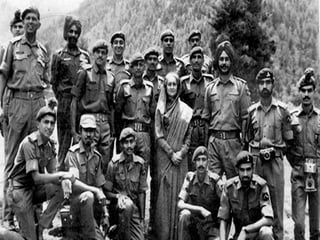
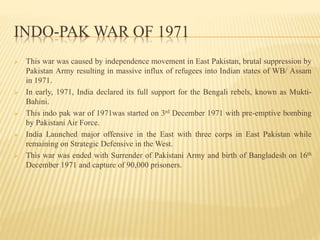
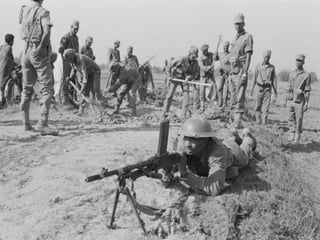
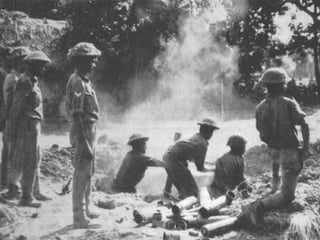
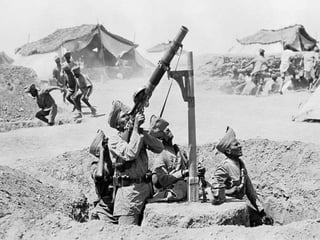
INDO-PAK WAR OF 1971
 This war was caused by independence movement in East Pakistan, brutal suppression by
Pakistan Army resulting in massive influx of refugees into Indian states of WB/ Assam
in 1971.
 In early, 1971, India declared its full support for the Bengali rebels, known as Mukti-
Bahini.
 This indo pak war of 1971was started on 3rd December 1971 with pre-emptive bombing
by Pakistani Air Force.
 India Launched major offensive in the East with three corps in East Pakistan while
remaining on Strategic Defensive in the West.
 This war was ended with Surrender of Pakistani Army and birth of Bangladesh on 16th
December 1971 and capture of 90,000 prisoners.
INDO-PAK WAR OF KARGIL (OPERATION
VIJAY)
 Operation Vijay is one of the most important mission which was actively
handles by the Indian Army.
 This war was started in mid 1999 when Shri. Attalbihari Vajpayee was the
Prime Minister Of India. At that time they declared India as the Nuclear
Country after completing successful Nuclear Test in Pokhran in Rajasthan. The
conflict i.e. Operation Vijay was started by Pakistani Paramilitary forces and
Kashmiri insurgents who captured deserted. But strategic, Himalayan Heights in
the Kargil district of India.
 Kargil is one of the most sensitive area than Jammu and Kashmir. Kargil is
situated in the Districts of Leh & Laddakh.
 Indian army launched attacks to re-capture thee posts fighting some major
battles in Kargil, Batalik and Dras.
 This war i.e. Operation Vijay was completed and successful on 26th July 1999
after Indian Army re-captured all heights and Pakistan Army was forced to
withdraw.
 In this Operation We loosed 4000 Army Soldiers and Officers.
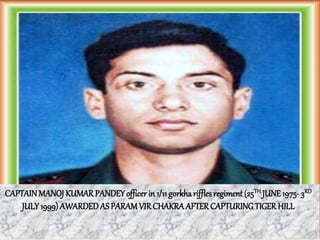
CAPTAINMANOJ KUMARPANDEYofficer in 1/11 gorkharifflesregiment (25TH JUNE1975- 3RD
JULY 1999) AWARDEDAS PARAMVIRCHAKRAAFTERCAPTURINGTIGERHILL
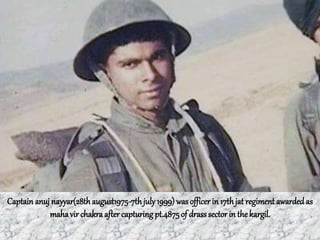
Captain anuj nayyar(28thaugust1975-7thjuly1999) was officer in 17thjat regiment awarded as
mahavir chakra after capturing pt.4875of drass sectorin the kargil.
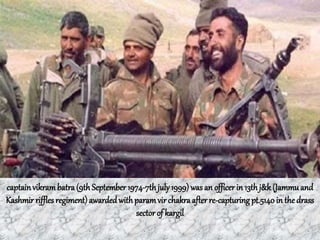
captainvikrambatra(9th September 1974-7thjuly1999) wasan officerin 13th j&k (Jammuand
Kashmir rifflesregiment)awardedwithparam vir chakra afterre-capturingpt.5140 in the drass
sector of kargil
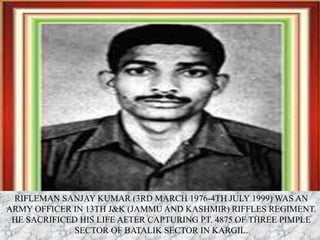
RIFLEMAN SANJAY KUMAR (3RD MARCH 1976-4TH JULY 1999) WAS AN
ARMY OFFICER IN 13TH J&K (JAMMU AND KASHMIR) RIFFLES REGIMENT.
HE SACRIFICED HIS LIFE AFTER CAPTURING PT. 4875 OF THREE PIMPLE
SECTOR OF BATALIK SECTOR IN KARGIL.
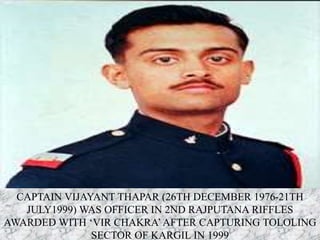
CAPTAIN VIJAYANT THAPAR (26TH DECEMBER 1976-21TH
JULY1999) WAS OFFICER IN 2ND RAJPUTANA RIFFLES
AWARDED WITH ‘VIR CHAKRA’AFTER CAPTURING TOLOLING
SECTOR OF KARGIL IN 1999
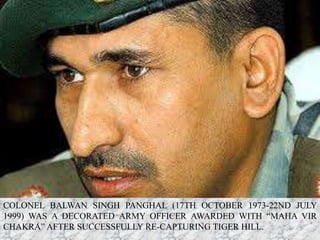
COLONEL BALWAN SINGH PANGHAL (17TH OCTOBER 1973-22ND JULY
1999) WAS A DECORATED ARMY OFFICER AWARDED WITH “MAHA VIR
CHAKRA” AFTER SUCCESSFULLY RE-CAPTURING TIGER HILL.
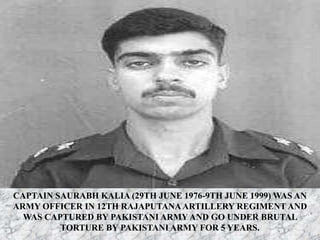
CAPTAIN SAURABH KALIA (29TH JUNE 1976-9TH JUNE 1999) WAS AN
ARMY OFFICER IN 12TH RAJAPUTANAARTILLERY REGIMENT AND
WAS CAPTURED BY PAKISTANI ARMY AND GO UNDER BRUTAL
TORTURE BY PAKISTANI ARMY FOR 5 YEARS.
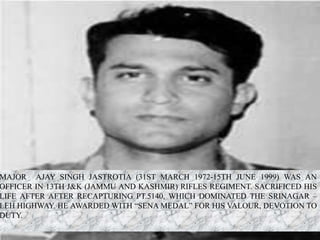
MAJOR AJAY SINGH JASTROTIA (31ST MARCH 1972-15TH JUNE 1999) WAS AN
OFFICER IN 13TH J&K (JAMMU AND KASHMIR) RIFLES REGIMENT. SACRIFICED HIS
LIFE AFTER AFTER RECAPTURING PT.5140, WHICH DOMINATED THE SRINAGAR –
LEH HIGHWAY. HE AWARDED WITH “SENA MEDAL” FOR HIS VALOUR, DEVOTION TO
DUTY.
LIST OF OPERATIONS AND WARS
HANDLES BY INDIAN ARMY
 Operation Polo. (1948)
 Operation Vijay. (1961)
 Operation Steeplechase. (1984)
 Operation Blue Star. (1984)
 Operation Woodrose.(1984)
 Operation Meghdoot. (1984)
 Operation Rajiv.(1987)
 Operation Bluebird.(1987)
 Operation Pawan.(1987)
 Operation Virat.(1988)
 Operation Trishul.(1988)
 Operation Checkmate.(1988)
 Operation Cactus.(1988)
 Operation Vijay.(1999)
 Operation Parakram.(2001)
 Operation Sarp Vinash.(2003)
 Operation Black Tornado.(2008)
 Operation Cyclone.(2008)
 Operation Surya Hope.(2013)
 Operation All Out.(2015)
 Operation Maitri.(2015)
 Indian Counter Insurgency operation in
Myanmar (2015).(2015)
 Uri Base Camp Attack.(2016)
 India Pakistan Military Confrontation
(Surgical Strike).(2018)
 Operation Calm Down.(2016)
 Operation Sahayog.(2018)
 Operation Goodwill.(1998)
 Balakot Pakistan Air Strike (26th Feb 2019)
 Operation Trident.(1971)
 Operation Safed Sagar (1999).
INTERNAL SECURITY
 Apart from guarding the borders with China and Pakistan, Indian
Army is also deployed for internal security in a major way.
 Indian Army’s Northern Command is deployed for fighting
Pakistan abetted proxy war in J&K, fighting Muslim
fundamentalist insurgent groups operating form save havens in
Pakistan.
 Indian Army’s Eastern Command is also deployed for internal
security in the North Eastern states of Assam, Nagaland and
Manipur.
DISASTER RELIEF
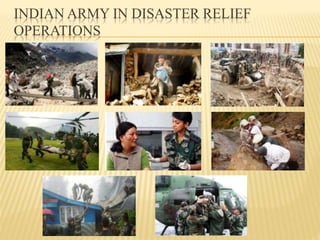
 The following attributes make the Army a potent instrument for disaster relief:-
 1) It is suitably poised for rapid response and for mobillising self-contained,
composite task forces to any part of the country. Even overseas, in conjunction
with the Indian Navy and Indian Air Force.
 2) It is structured, organized and managed to provide support for a full range of
public relief services.
 3) The versatille capabilities of the Army to respond to any form of disaster
situation can be exemplified by the assistance provides during the Following
disasters:-
 1) Tsunami Disaster (2004).
 2) Kashmir Earthquake (2005).
 3) Leh Cloud Burst (2010).
 4) Sikkim Earthquake (2011)
INDIAN ARMY IN DISASTER RELIEF
OPERATIONS
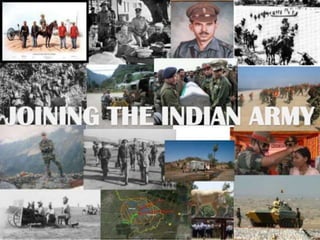
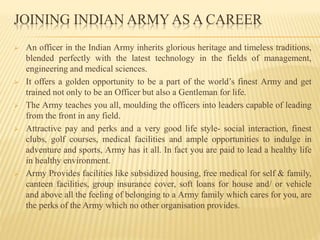
JOINING INDIAN ARMY AS A CAREER
 An officer in the Indian Army inherits glorious heritage and timeless traditions,
blended perfectly with the latest technology in the fields of management,
engineering and medical sciences.
 It offers a golden opportunity to be a part of the world’s finest Army and get
trained not only to be an Officer but also a Gentleman for life.
 The Army teaches you all, moulding the officers into leaders capable of leading
from the front in any field.
 Attractive pay and perks and a very good life style- social interaction, finest
clubs, golf courses, medical facilities and ample opportunities to indulge in
adventure and sports, Army has it all. In fact you are paid to lead a healthy life
in healthy environment.
 Army Provides facilities like subsidized housing, free medical for self & family,
canteen facilities, group insurance cover, soft loans for house and/ or vehicle
and above all the feeling of belonging to a Army family which cares for you, are
the perks of the Army which no other organisation provides.
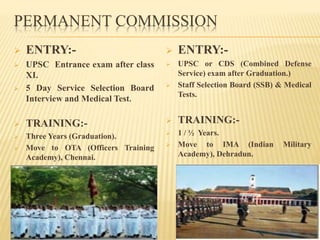
PERMANENT COMMISSION
 ENTRY:-
 UPSC Entrance exam after class
XI.
 5 Day Service Selection Board
Interview and Medical Test.
 TRAINING:-
 Three Years (Graduation).
 Move to OTA (Officers Training
Academy), Chennai.
 ENTRY:-
 UPSC or CDS (Combined Defense
Service) exam after Graduation.)
 Staff Selection Board (SSB) & Medical
Tests.
 TRAINING:-
 1 / ½ Years.
 Move to IMA (Indian Military
Academy), Dehradun.
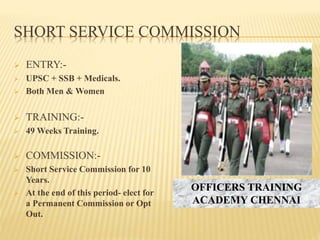
SHORT SERVICE COMMISSION
 ENTRY:-
 UPSC + SSB + Medicals.
 Both Men & Women
 TRAINING:-
 49 Weeks Training.
 COMMISSION:-
 Short Service Commission for 10
Years.
 At the end of this period- elect for
a Permanent Commission or Opt
Out.
OFFICERS TRAINING
ACADEMY CHENNAI
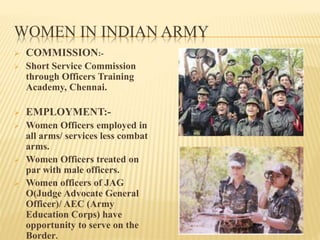
WOMEN IN INDIAN ARMY
 COMMISSION:-
 Short Service Commission
through Officers Training
Academy, Chennai.
 EMPLOYMENT:-
 Women Officers employed in
all arms/ services less combat
arms.
 Women Officers treated on
par with male officers.
 Women officers of JAG
O(Judge Advocate General
Officer)/ AEC (Army
Education Corps) have
opportunity to serve on the
Border.
REGIMENTS OF INDIAN ARMY
 The Brigade of The Guards (1948).
 Mechanized Infantry Regiment (1979).
 Madras Regiment (1758).
 Rajputana Riffles (1775).
 Rajput Regiment (1778).
 Dogra Regiment (1877).
 Sikh Regiment (1846).
 Parachute Regiment (1945).
 Jat Regiment (1795).
 Punjab Regiment (1761).
 The Grenadiers (1758).
 Sikh Light Infantry (1768).
 Maratha Light Infantry (1648).
 The Garhwal Riffles (1887).
 Kumaon Regiment (1813).
 Assam Regiment (1941).
 Bihar Regiment (1941).
 Mahar Regiment (1941).
 Jammu & Kashmir Riffles (1821).
 Jammu & Kashmir Light Infantry (1947).
 Naga Regiment (1970).
 1 Gorkha Riffles (1815).
 3 Gorkha Riffles (1815).
 4 Gorkha Riffles (1857).
 5 Gorkha Riffles (1858).
 8 Gorkha Riffles (1824).
 9 Gorkha Riffles (1827).
 11 Gorkha Riffles (1918-1922)
 Ladakh Scouts (1963).
 Arunachal Scouts (2010).
 Sikkim Scouts (2013).
 Paramilitary Regiment (Para Special Forces).
 Special Frontier Force (1758).
 Former Bengal Regiments.
 Former Punjab Regiments.
 Former Madras
FEATURES OF INDIAN ARMY
 Our Indian Army is highly equipped with a number
of latest weapons.
 Indian Army is having a number of powerful tanks
and aircrafts.
 Indian Soldiers are considered as the very best hill
climbers in among other countries.
 India has the biggest standing Volunteer Army in the
world.
COURT MARTIAL
 A court-martial or court martial (plural courts-martial or courts martial, as
"martial" is a postpositive adjective is a military court or a trial conducted in
such a court. A court-martial is empowered to determine the guilt of members
of the armed forces subject to military law, and, if the defendant is found
guilty, to decide upon punishment. In addition, courts-martial may be used to
try prisoners of war for war crimes. The Geneva Convention requires
that POWs who are on trial for war crimes be subject to the same procedures
as would be the holding military’s own forces. Finally, courts-martial can be
convened for other purposes, such as dealing with violations of martial law,
and can involve civilian defendants.
 Most navies have a standard court-martial which convenes whenever a ship is
lost; this does not presume that the captain is suspected of wrongdoing, but
merely that the circumstances surrounding the loss of the ship be made part of
the official record. Most military forces maintain a judicial system that tries
defendants for breaches of military discipline. Some countries
like France and Germany have no courts martial in times of peace and use
civilian courts instead.
 There are four kinds of courts-martial in India. These are the
General Court Martial (GCM), District Court Martial (DCM),
Summary General Court Martial (SGCM) and Summary Court
Martial (SCM). According to the Army Act, army courts can try
personnel for all kinds of offenses, except for murder and rape of a
civilian, which are primarily tried by a civilian court of law.
Higher government authorities do not deal with the military
doctrines. The President of India can use his judicial power,
(Article 72), to give either pardon, reprieve, respite or remission of
punishment or sentence given by a court martial.
OATH OF INDIAN ARMY
 I, Parth Milind Bhagare do solemnly swear that I will
bear true faith and allegiance to the constitution of India
as by the law established and that I will, as in duty bound,
honesty and faithfully serve in the regular army of the
union of India and go wherever ordered, by land, sea or
air and that I will observe and obey all commands of the
President of the Union of India and the commands of any
officer set over me even to the peril of my life.
LOGOS OF INDIAN ARMY
QUESTIONS ON THIS PPT
 Explain the Organization Of Indian Army.
 What are the Ranks Of Junior Commissioned Officers in
Indian Army?
 Give any 10 Names of the Regiments Of Indian Army.
 Give any Five names of the officers who sacrifice his life in
Kargil War Of 1999 (Operation Vijay).
 What are the Features of Indian Army?
 What is Qualification required for permanent commission in
Indian Army?
 What is A Court Martial? Explain In Brief.
PARTH M. BHAGARE COMPANY SENIOR
UNDER OFFICER , NCC INDIAN ARMY
WING.
MASTERMIND OF THIS
PRESENTATION:
Indian army

Indian army

  • 1.
    INDIAN ARMY THE LIFLINEOF INDIA MOTIVATION INSPIRATION VALOUR SACRIFICE
  • 3.
    INDEX  INTRODUCTION  ORGANISATIONAND ROLE  HISTORY  INDIAN ARMY IN NATION BUILDING  DETAILS OF SACRIFICED SOLDIERS  LIST OF INCIDENTS AND WARS  JOINING THE INDIAN ARMY  REGIMENTS OF INDIAN ARMY  FEATURES OF INDIAN ARMY  OATH OF INDIAN ARMY  MOTIVATIONAL VIDEO
  • 4.
    INTRODUCTION  Indian Armyis the land based branch, organization or largest component of the Indian Armed Forces.  Indian army is the Largest Standing Volunteer Army including 1, 129, 900 active personnel and 960,000 reserve personnel.  Indian army was originated from the armies of East Indian Company, which eventually became the British Indian Army which also finally became the national army after Independence.  The mission of the Indian Army is to ensure National Security and National Unity, defending the nation from external aggression and internal threats, and maintaining peace and security within its Borders.  Indian Army Conducted rescue operations during natural calamities and other disturbances they are Like Operation Surya Hope, Operation Vijay, Operation Meghdoot and Operation Cactus etc.  The COAS (CHIEF OF ARMY STAFF) is the professional head, commander and usually the highest ranking military officer in Indian Army. The Current COAS of Indian Army is General Bipin Rawat.
  • 6.
  • 7.
    RANKS OF INDIANARMY  THERE ARE TWO TYPES OF THE RANKS OF THE INDIAN ARMY:-  1) NON COMMISSIONED OFFICERS (NCO)  2) JUNIOR COMMISSIONED OFFICERS (JCO)
  • 8.
    1) NON COMMISSIONEDOFFICERS  SEPOY.  LANCE NAIK (INFANTRY).  LANCE DAFFADAR (CAVALRY AND ARMOURED REGIMENTS).  HAVILDAR (INFANTRY).  NAIB SUBEDAR (INFANTRY).  NAIB RISALDAR (CAVALRY AND ARMOURED REGIMENTS).  SUBEDAR MAJOR (INFANTRY).  RISALDAR MAJOR (CAVALRY AND ARMOURED REGIMENTS).
  • 9.
    2) JUNIOR COMMISSIONEDOFFICERS  LIEUTNANT.  CAPTAIN.  MAJOR.  LIEUTNANT COLONEL.  COLONEL.  BRIGADIER.  MAJOR GENEREAL.  LIEUTNANT GENERAL.  GENERAL.  FIELD MARSHAL.
  • 11.
    COMBAT ARMS OFINDIAN ARMY  COMBAT ARMS OF INDIAN ARMY IS ARE AS FOLLOWS:-  1) ARMOURED CORPS.  2) (FOOT) INFANTRY.  3) MECHANISED INFANTRY.
  • 12.
  • 13.
    COMBAT SUPPORT ARMSOF INDIAN ARMY  COMBAT SUPPORT ARMS OF INDIAN ARMY IS ARE AS FOLLOWS:-  1) COPRS OF ARTILLERY.  2) CORPS OF ENGINEERS.  3) CORPS OF SIGNALS.
  • 14.
  • 15.
    LOGISTIC SUPPORT SERVICESOF INDIAN ARMY  LOGISTIC SUPPORT SERVICES OF INDIAN ARMY IS ARE AS FOLLOWS:-  1) ARMY SERVICE CORPS (ASC).  2) ARMY ORDINARY CORPS (AOC).  3) ARMY MEDICAL CORPS (AMC).  4) CORPS OF EME (CEME).
  • 16.
  • 17.
    MEDALS AND AWARDSOF INDIAN ARMY  Indian Honours, and Awards of Indian Army can be divided into two categories:-  1) Gallantry Awards:-  a) Those for gallantry in the face of the enemy.  b) Those for gallantry other than in the face of the enemy.  2) Non Gallantry Awards:-
  • 18.
    ROLE OF INDIANARMY  To Safeguard the territorial integrity of the nation against external aggression.  Due to country’s long borders encompassing different geographical and climatic conditions such as desert terrain on the west, snow covered mountains in the north and thick rain fed mountainous jungles in the east, the Army has to constantly prepare itself for diverse challenges.  In addition, the Army is often required to assist the Civil Administration during internal security disturbances and in maintenance of law and order, in organizing relief operations during natural calamities like floods, earthquakes and cyclones and in the maintenance of essential services.  Demands of the army have increased manifold due to continuous deployment of its forces in intense counter insurgency operations in Jammu & Kashmir and the North East parts of the Country. To achieve these objectives, the Army has to be constantly modernized, suitably structured, equipped and trained.
  • 20.
    OVERVIEW  Evolved fromBritish Indian Army.  Immediately after Independence-fought first Indo Pak War and Liberation Of Hyderabad in 1947-48.  Liberated Goa in 1961.  Fought Sino-Indian War of 1962.  Fought three subsequent wars with Pakistan in 1962, 1965 and 1971.  Other major operations undertaken by the Indian Army include Operation Vijay (Kargil War of 1999), Operation Parakram (Mobililsation post parliament attack).  Indian army also has been an active participant in United Nations Peacekeeping missions.
  • 21.
    FIRST INDO-PAK WAR(1947-48)  Invasion of Kashmir by Pakistan Army.  Indian army fought immediately after independence and after Maharaja Hari Singh acceded with India.  After this, Indian Army (Indian Artillery Troops) airlifted to Srinagar on 15th October 1947.  Intense war waged across the state and former comrades found themselves fighting each other.  This First India Pakistan war of 1947 was ended with United Nations sponsored Ceasefire in 1948.
  • 26.
    LIBERATION OF HYDERABAD(1948)  After partition of India, Nizam of Hyderabad refused to accede his state to the Union Of India.  Indian Troops ordered to secure the state on 12th September 1948 by then deputy-Prime Minister Sardar Vallabhbhai Patel.  Hyderabad secured after 5 days of fighting by Indian Armed Troops, backed by squadron of Hawker Tempest aircraft of the Indian Air Force.  Five Infantry Battalions and one armoured squadron of the Indian Army were engaged in the Operation.  State of Hyderabad proclaimed as a part of the Union Of India on 17th September 1948.
  • 31.
    LIBERATION OF GOA(1961)  Portugal refused to relinquish control of its Indian Colonies of Goa, Daman and Diu after Independence.  Repeated attempts by India to negotiate with Portugal for return of its territory spurned by Portuguese Prime Minister and dictator, Antonio De Oliveira Salazar.  Indian army launched on 12 December 1961 to evict the Portuguese.  Portuguese General Manuel Antonio Vassalo e Silva surrendered to the Indian Army, after twenty six hours and Goa, Daman and Diu joined the Indian Union.
  • 36.
    SINO-INDIAN WAR OF1962  War started with small-scale clashes between the Indian and Chinese patrols all long disputed McMahon Line.  China launched major attack in Arunachal Pradesh on 12th October 1962.  This war was caused by dispute over Aksai, Chin and Arunachal Pradesh both claimed China & India.  Although Indian Army fought valiantly it suffered some reverses because of lack of adequate weapons, ammunition and equipment.  War ended with China making a unilateral withdrawal of its troops in November 1962.
  • 42.
    INDO-PAK WAR OF1965  War of 1965 between India and Pakistan over Kashmir is the second war.  This war was Initiated by Pakistani President Ayub Khan by Launching Operation Gibraltar in August 1965 by large scale infiltration into India.  In retaliation, the India’s Army launched a major offensive throughout its border with Pakistan, with Lahore as its Prime Budget.  Major battles with Pakistan fought in Kashmir, Punjab and Rajasthan.  War ended with Cease Fire Agreement at Tashkent.
  • 48.
    INDO-PAK WAR OF1971  This war was caused by independence movement in East Pakistan, brutal suppression by Pakistan Army resulting in massive influx of refugees into Indian states of WB/ Assam in 1971.  In early, 1971, India declared its full support for the Bengali rebels, known as Mukti- Bahini.  This indo pak war of 1971was started on 3rd December 1971 with pre-emptive bombing by Pakistani Air Force.  India Launched major offensive in the East with three corps in East Pakistan while remaining on Strategic Defensive in the West.  This war was ended with Surrender of Pakistani Army and birth of Bangladesh on 16th December 1971 and capture of 90,000 prisoners.
  • 53.
    INDO-PAK WAR OFKARGIL (OPERATION VIJAY)  Operation Vijay is one of the most important mission which was actively handles by the Indian Army.  This war was started in mid 1999 when Shri. Attalbihari Vajpayee was the Prime Minister Of India. At that time they declared India as the Nuclear Country after completing successful Nuclear Test in Pokhran in Rajasthan. The conflict i.e. Operation Vijay was started by Pakistani Paramilitary forces and Kashmiri insurgents who captured deserted. But strategic, Himalayan Heights in the Kargil district of India.  Kargil is one of the most sensitive area than Jammu and Kashmir. Kargil is situated in the Districts of Leh & Laddakh.  Indian army launched attacks to re-capture thee posts fighting some major battles in Kargil, Batalik and Dras.  This war i.e. Operation Vijay was completed and successful on 26th July 1999 after Indian Army re-captured all heights and Pakistan Army was forced to withdraw.  In this Operation We loosed 4000 Army Soldiers and Officers.
  • 55.
    CAPTAINMANOJ KUMARPANDEYofficer in1/11 gorkharifflesregiment (25TH JUNE1975- 3RD JULY 1999) AWARDEDAS PARAMVIRCHAKRAAFTERCAPTURINGTIGERHILL
  • 56.
    Captain anuj nayyar(28thaugust1975-7thjuly1999)was officer in 17thjat regiment awarded as mahavir chakra after capturing pt.4875of drass sectorin the kargil.
  • 57.
    captainvikrambatra(9th September 1974-7thjuly1999)wasan officerin 13th j&k (Jammuand Kashmir rifflesregiment)awardedwithparam vir chakra afterre-capturingpt.5140 in the drass sector of kargil
  • 58.
    RIFLEMAN SANJAY KUMAR(3RD MARCH 1976-4TH JULY 1999) WAS AN ARMY OFFICER IN 13TH J&K (JAMMU AND KASHMIR) RIFFLES REGIMENT. HE SACRIFICED HIS LIFE AFTER CAPTURING PT. 4875 OF THREE PIMPLE SECTOR OF BATALIK SECTOR IN KARGIL.
  • 59.
    CAPTAIN VIJAYANT THAPAR(26TH DECEMBER 1976-21TH JULY1999) WAS OFFICER IN 2ND RAJPUTANA RIFFLES AWARDED WITH ‘VIR CHAKRA’AFTER CAPTURING TOLOLING SECTOR OF KARGIL IN 1999
  • 60.
    COLONEL BALWAN SINGHPANGHAL (17TH OCTOBER 1973-22ND JULY 1999) WAS A DECORATED ARMY OFFICER AWARDED WITH “MAHA VIR CHAKRA” AFTER SUCCESSFULLY RE-CAPTURING TIGER HILL.
  • 61.
    CAPTAIN SAURABH KALIA(29TH JUNE 1976-9TH JUNE 1999) WAS AN ARMY OFFICER IN 12TH RAJAPUTANAARTILLERY REGIMENT AND WAS CAPTURED BY PAKISTANI ARMY AND GO UNDER BRUTAL TORTURE BY PAKISTANI ARMY FOR 5 YEARS.
  • 62.
    MAJOR AJAY SINGHJASTROTIA (31ST MARCH 1972-15TH JUNE 1999) WAS AN OFFICER IN 13TH J&K (JAMMU AND KASHMIR) RIFLES REGIMENT. SACRIFICED HIS LIFE AFTER AFTER RECAPTURING PT.5140, WHICH DOMINATED THE SRINAGAR – LEH HIGHWAY. HE AWARDED WITH “SENA MEDAL” FOR HIS VALOUR, DEVOTION TO DUTY.
  • 63.
    LIST OF OPERATIONSAND WARS HANDLES BY INDIAN ARMY  Operation Polo. (1948)  Operation Vijay. (1961)  Operation Steeplechase. (1984)  Operation Blue Star. (1984)  Operation Woodrose.(1984)  Operation Meghdoot. (1984)  Operation Rajiv.(1987)  Operation Bluebird.(1987)  Operation Pawan.(1987)  Operation Virat.(1988)  Operation Trishul.(1988)  Operation Checkmate.(1988)  Operation Cactus.(1988)  Operation Vijay.(1999)  Operation Parakram.(2001)  Operation Sarp Vinash.(2003)  Operation Black Tornado.(2008)  Operation Cyclone.(2008)  Operation Surya Hope.(2013)  Operation All Out.(2015)  Operation Maitri.(2015)  Indian Counter Insurgency operation in Myanmar (2015).(2015)  Uri Base Camp Attack.(2016)  India Pakistan Military Confrontation (Surgical Strike).(2018)  Operation Calm Down.(2016)  Operation Sahayog.(2018)  Operation Goodwill.(1998)  Balakot Pakistan Air Strike (26th Feb 2019)  Operation Trident.(1971)  Operation Safed Sagar (1999).
  • 65.
    INTERNAL SECURITY  Apartfrom guarding the borders with China and Pakistan, Indian Army is also deployed for internal security in a major way.  Indian Army’s Northern Command is deployed for fighting Pakistan abetted proxy war in J&K, fighting Muslim fundamentalist insurgent groups operating form save havens in Pakistan.  Indian Army’s Eastern Command is also deployed for internal security in the North Eastern states of Assam, Nagaland and Manipur.
  • 66.
    DISASTER RELIEF  Thefollowing attributes make the Army a potent instrument for disaster relief:-  1) It is suitably poised for rapid response and for mobillising self-contained, composite task forces to any part of the country. Even overseas, in conjunction with the Indian Navy and Indian Air Force.  2) It is structured, organized and managed to provide support for a full range of public relief services.  3) The versatille capabilities of the Army to respond to any form of disaster situation can be exemplified by the assistance provides during the Following disasters:-  1) Tsunami Disaster (2004).  2) Kashmir Earthquake (2005).  3) Leh Cloud Burst (2010).  4) Sikkim Earthquake (2011)
  • 67.
    INDIAN ARMY INDISASTER RELIEF OPERATIONS
  • 69.
    JOINING INDIAN ARMYAS A CAREER  An officer in the Indian Army inherits glorious heritage and timeless traditions, blended perfectly with the latest technology in the fields of management, engineering and medical sciences.  It offers a golden opportunity to be a part of the world’s finest Army and get trained not only to be an Officer but also a Gentleman for life.  The Army teaches you all, moulding the officers into leaders capable of leading from the front in any field.  Attractive pay and perks and a very good life style- social interaction, finest clubs, golf courses, medical facilities and ample opportunities to indulge in adventure and sports, Army has it all. In fact you are paid to lead a healthy life in healthy environment.  Army Provides facilities like subsidized housing, free medical for self & family, canteen facilities, group insurance cover, soft loans for house and/ or vehicle and above all the feeling of belonging to a Army family which cares for you, are the perks of the Army which no other organisation provides.
  • 70.
    PERMANENT COMMISSION  ENTRY:- UPSC Entrance exam after class XI.  5 Day Service Selection Board Interview and Medical Test.  TRAINING:-  Three Years (Graduation).  Move to OTA (Officers Training Academy), Chennai.  ENTRY:-  UPSC or CDS (Combined Defense Service) exam after Graduation.)  Staff Selection Board (SSB) & Medical Tests.  TRAINING:-  1 / ½ Years.  Move to IMA (Indian Military Academy), Dehradun.
  • 71.
    SHORT SERVICE COMMISSION ENTRY:-  UPSC + SSB + Medicals.  Both Men & Women  TRAINING:-  49 Weeks Training.  COMMISSION:-  Short Service Commission for 10 Years.  At the end of this period- elect for a Permanent Commission or Opt Out. OFFICERS TRAINING ACADEMY CHENNAI
  • 72.
    WOMEN IN INDIANARMY  COMMISSION:-  Short Service Commission through Officers Training Academy, Chennai.  EMPLOYMENT:-  Women Officers employed in all arms/ services less combat arms.  Women Officers treated on par with male officers.  Women officers of JAG O(Judge Advocate General Officer)/ AEC (Army Education Corps) have opportunity to serve on the Border.
  • 73.
    REGIMENTS OF INDIANARMY  The Brigade of The Guards (1948).  Mechanized Infantry Regiment (1979).  Madras Regiment (1758).  Rajputana Riffles (1775).  Rajput Regiment (1778).  Dogra Regiment (1877).  Sikh Regiment (1846).  Parachute Regiment (1945).  Jat Regiment (1795).  Punjab Regiment (1761).  The Grenadiers (1758).  Sikh Light Infantry (1768).  Maratha Light Infantry (1648).  The Garhwal Riffles (1887).  Kumaon Regiment (1813).  Assam Regiment (1941).  Bihar Regiment (1941).  Mahar Regiment (1941).  Jammu & Kashmir Riffles (1821).  Jammu & Kashmir Light Infantry (1947).  Naga Regiment (1970).  1 Gorkha Riffles (1815).  3 Gorkha Riffles (1815).  4 Gorkha Riffles (1857).  5 Gorkha Riffles (1858).  8 Gorkha Riffles (1824).  9 Gorkha Riffles (1827).  11 Gorkha Riffles (1918-1922)  Ladakh Scouts (1963).  Arunachal Scouts (2010).  Sikkim Scouts (2013).  Paramilitary Regiment (Para Special Forces).  Special Frontier Force (1758).  Former Bengal Regiments.  Former Punjab Regiments.  Former Madras
  • 74.
    FEATURES OF INDIANARMY  Our Indian Army is highly equipped with a number of latest weapons.  Indian Army is having a number of powerful tanks and aircrafts.  Indian Soldiers are considered as the very best hill climbers in among other countries.  India has the biggest standing Volunteer Army in the world.
  • 75.
    COURT MARTIAL  Acourt-martial or court martial (plural courts-martial or courts martial, as "martial" is a postpositive adjective is a military court or a trial conducted in such a court. A court-martial is empowered to determine the guilt of members of the armed forces subject to military law, and, if the defendant is found guilty, to decide upon punishment. In addition, courts-martial may be used to try prisoners of war for war crimes. The Geneva Convention requires that POWs who are on trial for war crimes be subject to the same procedures as would be the holding military’s own forces. Finally, courts-martial can be convened for other purposes, such as dealing with violations of martial law, and can involve civilian defendants.  Most navies have a standard court-martial which convenes whenever a ship is lost; this does not presume that the captain is suspected of wrongdoing, but merely that the circumstances surrounding the loss of the ship be made part of the official record. Most military forces maintain a judicial system that tries defendants for breaches of military discipline. Some countries like France and Germany have no courts martial in times of peace and use civilian courts instead.
  • 76.
     There arefour kinds of courts-martial in India. These are the General Court Martial (GCM), District Court Martial (DCM), Summary General Court Martial (SGCM) and Summary Court Martial (SCM). According to the Army Act, army courts can try personnel for all kinds of offenses, except for murder and rape of a civilian, which are primarily tried by a civilian court of law. Higher government authorities do not deal with the military doctrines. The President of India can use his judicial power, (Article 72), to give either pardon, reprieve, respite or remission of punishment or sentence given by a court martial.
  • 77.
    OATH OF INDIANARMY  I, Parth Milind Bhagare do solemnly swear that I will bear true faith and allegiance to the constitution of India as by the law established and that I will, as in duty bound, honesty and faithfully serve in the regular army of the union of India and go wherever ordered, by land, sea or air and that I will observe and obey all commands of the President of the Union of India and the commands of any officer set over me even to the peril of my life.
  • 78.
  • 79.
    QUESTIONS ON THISPPT  Explain the Organization Of Indian Army.  What are the Ranks Of Junior Commissioned Officers in Indian Army?  Give any 10 Names of the Regiments Of Indian Army.  Give any Five names of the officers who sacrifice his life in Kargil War Of 1999 (Operation Vijay).  What are the Features of Indian Army?  What is Qualification required for permanent commission in Indian Army?  What is A Court Martial? Explain In Brief.
  • 80.
    PARTH M. BHAGARECOMPANY SENIOR UNDER OFFICER , NCC INDIAN ARMY WING. MASTERMIND OF THIS PRESENTATION: