INDIAN ARMED FORCES
INDIAN ARMY
INDIAN NAVY
INDIAN AIRFORCE
PRESENTED BY-
SAURABH KUMAR MEENA
AJAY KATARIA
VIKASH KUMAR
INDIAN ARMY
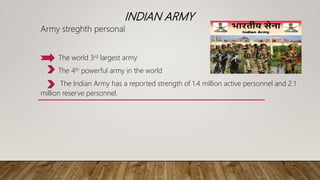
Army streghth personal
The world 3rd largest army
The 4th powerful army in the world
The Indian Army has a reported strength of 1.4 million active personnel and 2.1
million reserve personnel.
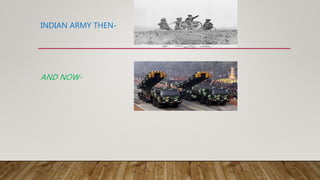
INDIAN ARMY THEN-
AND NOW-
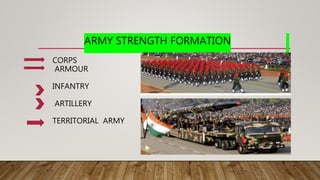
ARMY STRENGTH FORMATION
CORPS
ARMOUR
INFANTRY
ARTILLERY
TERRITORIAL ARMY
THE INDIAN NAVY
Established by Britain while India was a colony,
the Indian Navy (Bharatiya Nau Sena) is the
naval branch of the Armed Forces of India. In
terms of personnel, it is the world's fifth largest
navy. It presently operates over 180 vessels,
including one aircraft carrier. Earlier it was
known as Royal Indian Marine but after 1934 it
was known as indian navy.
INTRODUCTION-:
Chief of Naval Staff-:
As of 2017 , the Indian Navy has a strength of 67,109 personnel and
a large operational fleet consisting of one aircraft carrier, one
amphibious transport dock, eight landing ship tanks , 11 destroyers,
14 frigates , one nuclear-powered attach submarine , one ballistic
missile submarine , 13 coventionally – powered attach.
Strength-:
Admiral sunil lanba assumed command of the Indian Navy ,as the 23rd chief of
the naval staff on 31st may 2017 , Admiral lanba ,is a Navigation and Direction
specialist who has served as the navigation and operations officer onboard
numerous ships in both the Eastern and western fleet . His nearly four decades
experience include tenures at sea, ashore at various headquarter, operational and
training establishment as well as tri-services institution
The Western Naval Command
(Headquarters at Mumbai)
The Eastern Naval Command
(Head quarters at Visakhapatnam).
The Southern Naval Command
(Headquarters at Kochi).
 Indian Navy is operated with three head quarter.
These Head quarters are:-
NAVY COMMAND IN INDIA-:
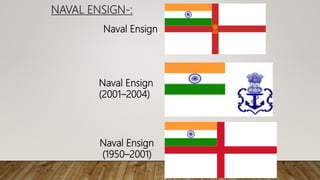
NAVAL ENSIGN-:
Naval Ensign
(1950–2001)
Naval Ensign
(2001–2004)
Naval Ensign
Role of Indian Navy:-
The president of India serves as supreme commander of the
Indian Navy. The Chief of Naval staff, usually a four-star officer
in the rank of admiral , commands the navy. The Indian navy is
the fifth largest in the world . It played an important role in
india`s victory in the 1971 Indo- pakistani war.
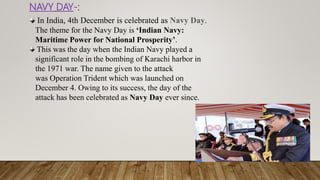
NAVY DAY-:
In India, 4th December is celebrated as Navy Day.
The theme for the Navy Day is ‘Indian Navy:
Maritime Power for National Prosperity’.
This was the day when the Indian Navy played a
significant role in the bombing of Karachi harbor in
the 1971 war. The name given to the attack
was Operation Trident which was launched on
December 4. Owing to its success, the day of the
attack has been celebrated as Navy Day ever since.
Major Conflicts-:
The Navy has been involved in 2 wars
with
Pakistan. While the Indo-Pakistani War of
1965 largely involved patrolling of the
coast,
India's navy played a significant role in
the
bombing of Karachi harbour in the 1971
war.
Weapon systems of the Indian Navy
Submarine-launched ballistic missile-:
 Agni-III SLBM
 K-15 SLBM
SLBM -: A submarine-launched ballistic missile is
a ballistic missile capable of being launched from some
submarines.
Ship Launched Ballistic Missile-:
 Prithvi III - Naval Version (350 km range with a
payload of 1000 kg)
Cruise/Anti-Ship Missile-:
 K15 Hypersonic Cruise Missile (Test fired many times)
 Brahmos Supersonic Cruise Missile
Kh-35 (SS-N-25 SwitchBlade)
P-20 (SS-N-2D Styx)
Sea Eagle missile
 Harpoon (missile) (these missiles were recently
ordered from the USA)
 Gabriel missile
 Exocet missile (these missiles were recently ordered
from the France for scorpene submarine)
UNDER DEVELOPED
 Nirbhay long range subsonic cruise missile
 Brahmos Hypersonic Cruise Missile
INDIAN AIRFORCE
INDIAN AIR FORCE
HISTORY:
 The history of the Indian Air Force
began with its establishment in 1932
and continues up to the present day.
 Formation and early pilots Westland
Wapiti , one of the first aircraftmen of
the Indian Air Force.
 The Indian Air Force (IAF; IAST:
Bhāratīya Vayu Senā) is the airarm of
the Indian armed forces.
 It is the world's fourth largest air
force in terms of both personnel and
aircraft.
 Its primary responsibility is to
secure Indian airspace and to conduct
aerial warfare during a conflict.
 Then IAF, the Indian Air Force went through an intense phase
of modernization and consolidation. With newly acquired HF-
24 , MiG-21and Sukhoi Su-7BM aircraft.
 After many wars, Now the IAF becomes the MOST
STRONGEST AND FOURTH IN NATION WIDE
AIRFORCE.
 Now IAF has aircrafts for various function as
FIGHTERS,TRANSPORT,HELICOPTERS,TRAINER,AER
OBATIC TEAMS.
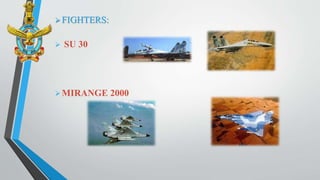
FIGHTERS:
 SU 30
MIRANGE 2000
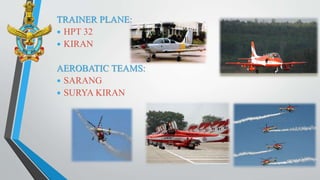
TRAINER PLANE:
 HPT 32
 KIRAN
AEROBATIC TEAMS:
 SARANG
 SURYA KIRAN
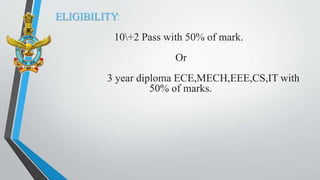
ELIGIBILITY:
10+2 Pass with 50% of mark.
Or
3 year diploma ECE,MECH,EEE,CS,IT with
50% of marks.
“
”THANKYOU
JAI HIND

Presentation on indian Armed Force

  • 1.
    INDIAN ARMED FORCES INDIANARMY INDIAN NAVY INDIAN AIRFORCE PRESENTED BY- SAURABH KUMAR MEENA AJAY KATARIA VIKASH KUMAR
  • 2.
    INDIAN ARMY Army streghthpersonal The world 3rd largest army The 4th powerful army in the world The Indian Army has a reported strength of 1.4 million active personnel and 2.1 million reserve personnel.
  • 3.
  • 5.
  • 6.
  • 7.
    Established by Britainwhile India was a colony, the Indian Navy (Bharatiya Nau Sena) is the naval branch of the Armed Forces of India. In terms of personnel, it is the world's fifth largest navy. It presently operates over 180 vessels, including one aircraft carrier. Earlier it was known as Royal Indian Marine but after 1934 it was known as indian navy. INTRODUCTION-:
  • 8.
    Chief of NavalStaff-: As of 2017 , the Indian Navy has a strength of 67,109 personnel and a large operational fleet consisting of one aircraft carrier, one amphibious transport dock, eight landing ship tanks , 11 destroyers, 14 frigates , one nuclear-powered attach submarine , one ballistic missile submarine , 13 coventionally – powered attach. Strength-: Admiral sunil lanba assumed command of the Indian Navy ,as the 23rd chief of the naval staff on 31st may 2017 , Admiral lanba ,is a Navigation and Direction specialist who has served as the navigation and operations officer onboard numerous ships in both the Eastern and western fleet . His nearly four decades experience include tenures at sea, ashore at various headquarter, operational and training establishment as well as tri-services institution
  • 9.
    The Western NavalCommand (Headquarters at Mumbai) The Eastern Naval Command (Head quarters at Visakhapatnam). The Southern Naval Command (Headquarters at Kochi).  Indian Navy is operated with three head quarter. These Head quarters are:- NAVY COMMAND IN INDIA-:
  • 10.
    NAVAL ENSIGN-: Naval Ensign (1950–2001) NavalEnsign (2001–2004) Naval Ensign
  • 11.
    Role of IndianNavy:- The president of India serves as supreme commander of the Indian Navy. The Chief of Naval staff, usually a four-star officer in the rank of admiral , commands the navy. The Indian navy is the fifth largest in the world . It played an important role in india`s victory in the 1971 Indo- pakistani war.
  • 12.
    NAVY DAY-: In India,4th December is celebrated as Navy Day. The theme for the Navy Day is ‘Indian Navy: Maritime Power for National Prosperity’. This was the day when the Indian Navy played a significant role in the bombing of Karachi harbor in the 1971 war. The name given to the attack was Operation Trident which was launched on December 4. Owing to its success, the day of the attack has been celebrated as Navy Day ever since.
  • 13.
    Major Conflicts-: The Navyhas been involved in 2 wars with Pakistan. While the Indo-Pakistani War of 1965 largely involved patrolling of the coast, India's navy played a significant role in the bombing of Karachi harbour in the 1971 war.
  • 14.
    Weapon systems ofthe Indian Navy Submarine-launched ballistic missile-:  Agni-III SLBM  K-15 SLBM SLBM -: A submarine-launched ballistic missile is a ballistic missile capable of being launched from some submarines. Ship Launched Ballistic Missile-:  Prithvi III - Naval Version (350 km range with a payload of 1000 kg)
  • 15.
    Cruise/Anti-Ship Missile-:  K15Hypersonic Cruise Missile (Test fired many times)  Brahmos Supersonic Cruise Missile Kh-35 (SS-N-25 SwitchBlade) P-20 (SS-N-2D Styx) Sea Eagle missile  Harpoon (missile) (these missiles were recently ordered from the USA)  Gabriel missile  Exocet missile (these missiles were recently ordered from the France for scorpene submarine) UNDER DEVELOPED  Nirbhay long range subsonic cruise missile  Brahmos Hypersonic Cruise Missile
  • 16.
  • 17.
    INDIAN AIR FORCE HISTORY: The history of the Indian Air Force began with its establishment in 1932 and continues up to the present day.  Formation and early pilots Westland Wapiti , one of the first aircraftmen of the Indian Air Force.
  • 18.
     The IndianAir Force (IAF; IAST: Bhāratīya Vayu Senā) is the airarm of the Indian armed forces.  It is the world's fourth largest air force in terms of both personnel and aircraft.  Its primary responsibility is to secure Indian airspace and to conduct aerial warfare during a conflict.
  • 19.
     Then IAF,the Indian Air Force went through an intense phase of modernization and consolidation. With newly acquired HF- 24 , MiG-21and Sukhoi Su-7BM aircraft.  After many wars, Now the IAF becomes the MOST STRONGEST AND FOURTH IN NATION WIDE AIRFORCE.  Now IAF has aircrafts for various function as FIGHTERS,TRANSPORT,HELICOPTERS,TRAINER,AER OBATIC TEAMS.
  • 20.
  • 21.
    TRAINER PLANE:  HPT32  KIRAN AEROBATIC TEAMS:  SARANG  SURYA KIRAN
  • 22.
    ELIGIBILITY: 10+2 Pass with50% of mark. Or 3 year diploma ECE,MECH,EEE,CS,IT with 50% of marks.
  • 25.